

Atlantis 2023: Vertical Farm Towers That Turn a City's Waste Into Its Own Food Supply
Jakub Sokólski proposes a network of timber farming towers where organic waste, water and energy circulate in a closed loop inside the dense city.


Cities eat what they do not grow. Food arrives from agricultural zones far beyond the urban edge, waste leaves in the opposite direction, and the distance between the two keeps stretching as cities expand and farmland shrinks. Atlantis 2023 starts from that imbalance and asks a blunt architectural question: what happens if the city stops outsourcing its metabolism and starts building it into its skyline?
Designed by Jakub Sokólski, the proposal imagines a distributed network of multifunctional farming towers working within a closed-loop food system modelled on natural biosphere cycles. Each tower stacks automated cultivation, research laboratories, logistics, public space, education and renewable energy into one vertical organism. Sokólski frames the problem through rapidly urbanising contexts such as China, where megacities depend on massive food imports, and responds with a hybrid infrastructure in which organic waste becomes feedstock and agriculture becomes part of the urban fabric instead of a rural afterthought.
A Farm That Begins at the Monorail Stop
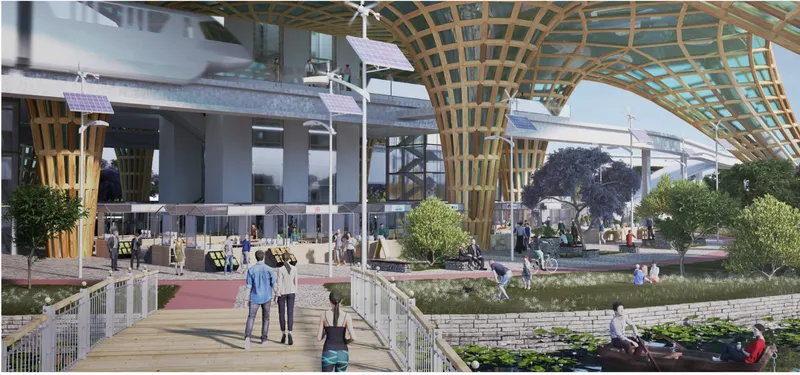
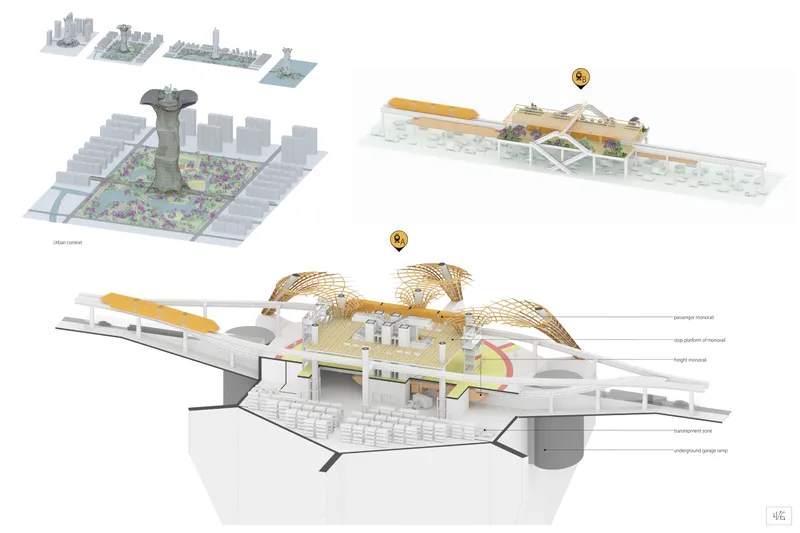
The most persuasive move in the scheme happens at street level, not at the top of the towers. Timber lattice canopy columns rise above a market plaza, a monorail glides overhead, and visitors cross a wooden footbridge between stalls. The farm reads first as a public room, a place to buy, linger and pass through, before it registers as a production facility. That inversion matters: food infrastructure that people walk through every day earns a civic legitimacy that sealed warehouse farms never achieve.
The axonometric explains why the plaza works. The monorail platform sits under the lattice roof, while an underground transshipment zone handles distribution below grade. Sokólski treats each tower as a node in a citywide network, so produce moves out by rail and logistics stay buried, freeing the ground plane for people. Transport and agriculture are designed as one system, which is exactly what a closed-loop city needs if shortened supply chains are to mean anything in practice.
A Tapering Timber Tower Tested in Four Variants
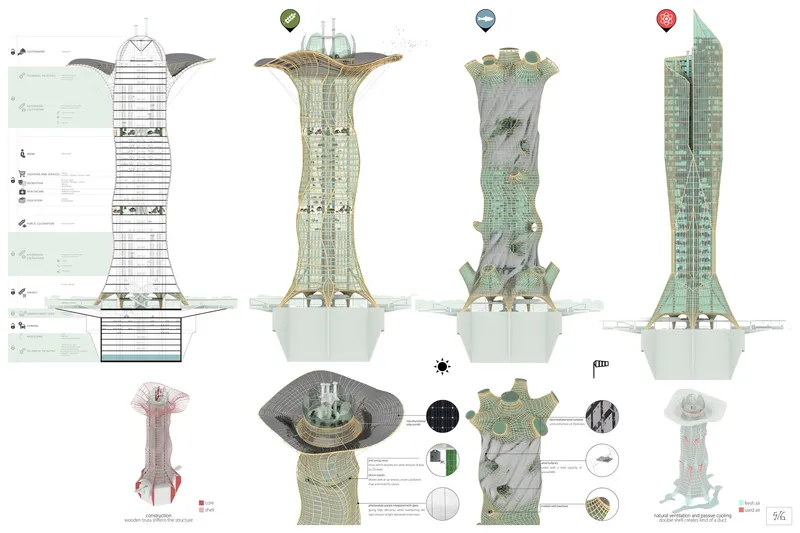
The section and elevation sheet shows a tall, tapering tower drawn in four variants, accompanied by diagrams of the timber structure, ventilation strategy and facade layers. The organic silhouette, which Sokólski compares to flowering plants rising above the city, is more than a symbolic gesture here. A tapering profile changes how light and air reach the cultivation floors, and the ventilation diagrams suggest the form is doing environmental work alongside its role as a landmark.
Presenting variants rather than a single fixed object is a smart choice for a networked proposal. If the towers are meant to repeat across districts, they need a family resemblance that can adapt to different sites and capacities. The layered facade and exposed timber frame give that family a consistent material language, one that sets these farms apart from the glass-and-steel vertical farm imagery the typology usually defaults to.
Picnic Tables Among the Tomato Racks
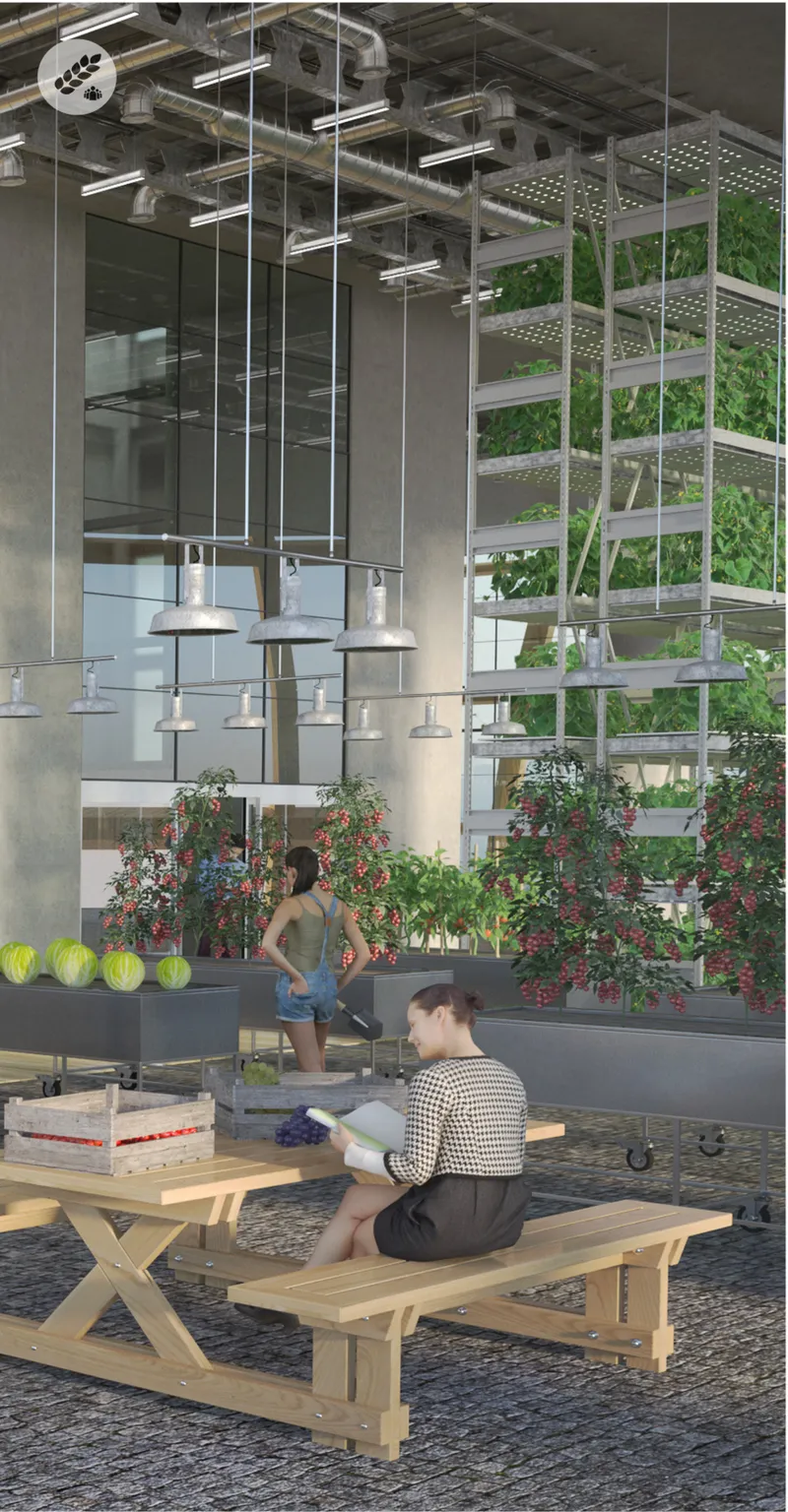
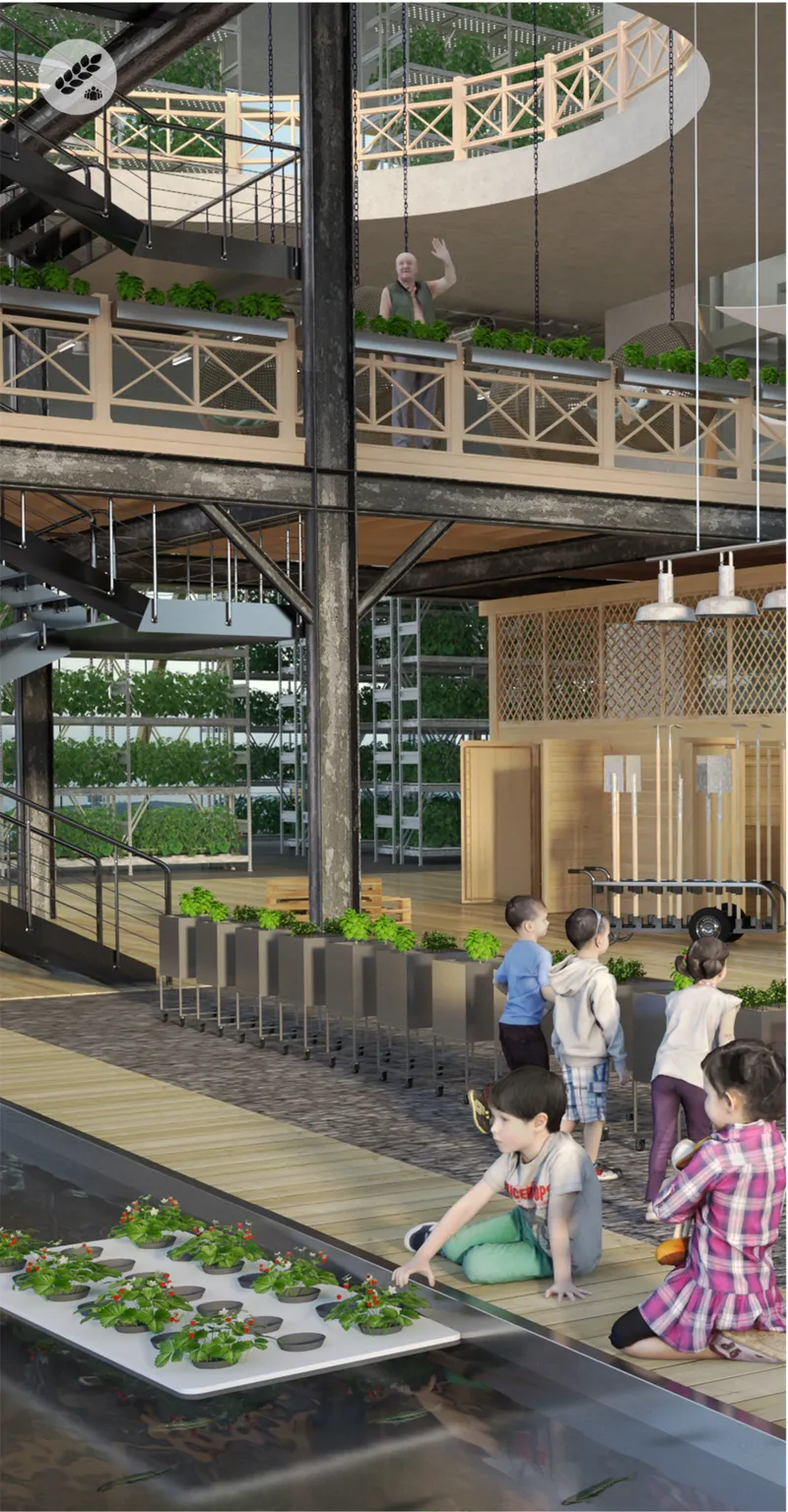
Inside, the boundary between growing space and public space is deliberately porous. A wooden picnic table sits directly in front of vertical racks of tomato plants, and a woman reads beneath hanging pendant lamps as though she were in a library. Elsewhere, children kneel beside a floating planter in a water channel, under timber-railed balconies and stacked growing racks. These are the interiors where the brief's educational and recreational layers become tangible.
The water channel is a quietly significant detail. It makes visible the circulation of water and nutrients that a closed-loop system depends on, turning an invisible resource cycle into something children can reach out and touch. Architecture that explains its own metabolism to the people inside it does more for food literacy than any signage could.
Robots and People Sharing the Production Floor
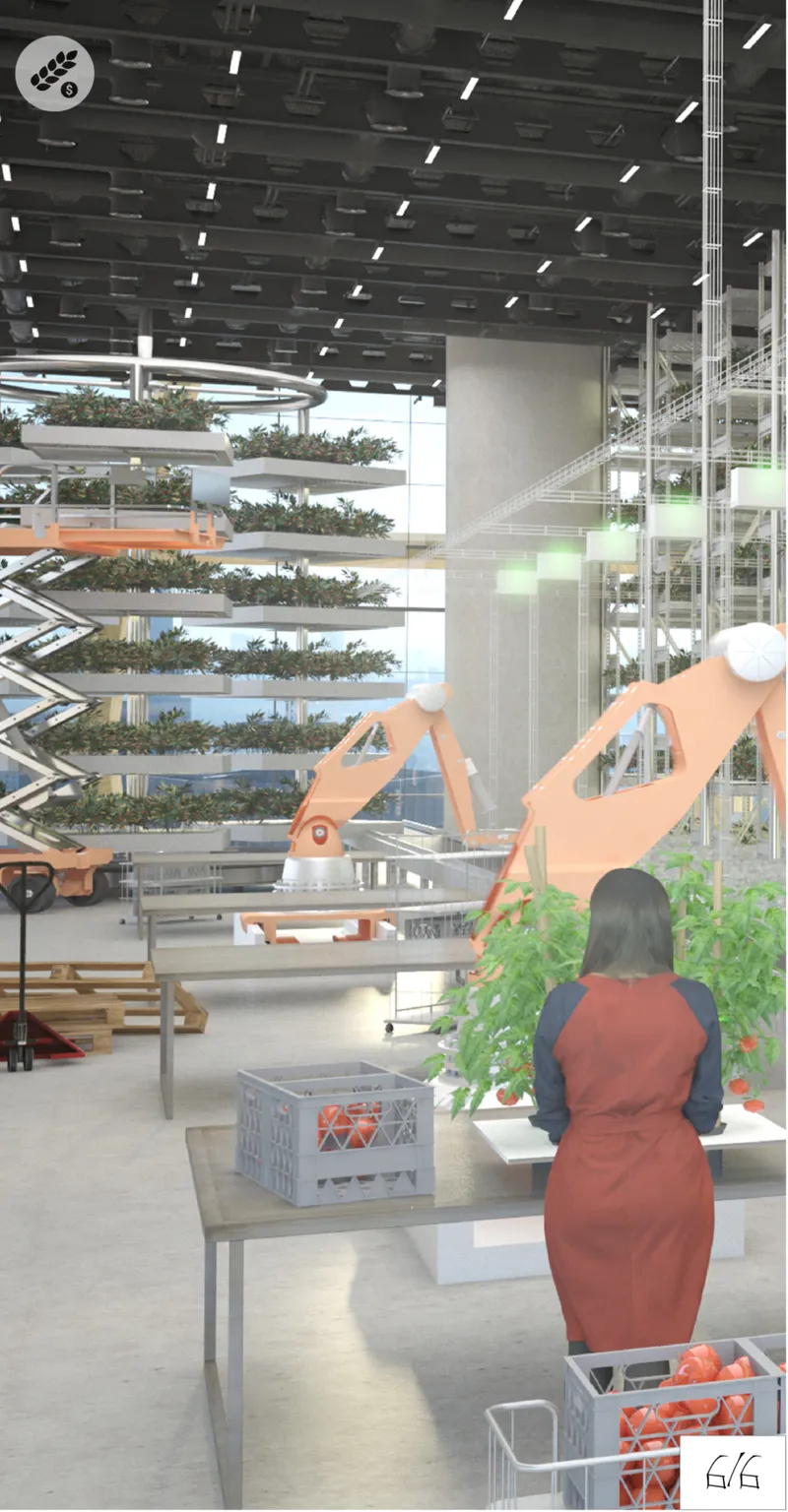
The final interior brings the automated cultivation zones into view: orange robotic arms work among tall planting racks while a woman sorts tomatoes at a work table nearby. Sokólski does not hide automation behind closed doors, nor does he let it eliminate the human presence. The image proposes a production floor where machines handle repetitive cultivation tasks and people remain involved in handling, quality and research, matching the laboratories and agricultural facilities written into the tower's programme.
Why This Project Matters
Vertical farming proposals often stop at crop yield per square metre. Atlantis 2023 is more ambitious in a useful way: it treats the farm as urban infrastructure, linking food production to transit, waste recovery, energy generation and public life. Placing a monorail stop and an underground transshipment zone at the base of a timber farming tower is the kind of systemic thinking the circular city conversation needs and rarely gets in drawings.
The project's real strength is that it makes a closed-loop metabolism legible at human scale. Market plazas, reading tables among tomato vines and water channels for children give the system a social face, while the tapering timber variants give it a recognisable identity across the city. Questions remain about how much food each node could realistically supply, but as a model for turning consumption centres back into productive ecosystems, Sokólski's proposal sets a clear and inhabitable direction.
View the Full Project
About the Designers
Designer: Jakub Sokólski
Enter a Design Competition on uni.xyz
uni.xyz runs architecture and design competitions year-round that reward proposals with spatial conviction and real site intelligence.
Project credits: Atlantis 2023 by Jakub Sokólski.


Popular Articles
Popular articles from the community

Tsunami Convergenics: Turning Catastrophic Ocean Forces into Underwater Housing Infrastructure
A speculative underwater settlement off the coast of Onagawa, Japan, treats tsunamis and typhoons as energy sources rather than threats.
Temporary Home for Dogs: A Reversed Zoo Rethinks Animal Shelter Architecture
In Bucharest, a sinuous corridor and freed landscape flip the logic of containment, designing a shelter that works to make itself unnecessary.

Singing Woman: An Opera House That Performs Before the Curtain Rises
Ovidiu Cristian Pavel's conceptual opera house translates Estonia's choral identity into a sculpted waterfront landmark facing the Baltic Sea.
Faces of the Soviet Avant-Garde: Turning Moscow's Street Names into an Open-Air Museum
A network of sculptural installations across a Moscow residential district transforms forgotten architect names into spatial encounters with cultural memor

Similar Reads
You might also enjoy these articles

Healing Façade: A Modular Chapel System That Restores Ethiopia's Sacred Forests
Winner of the Eco-Chapel competition, this circular timber façade collects water from air to rebuild soil and reforest degraded Ethiopian landscapes.
Kaffeebühnen: Where Coffee Shop Architecture Becomes a Civic Stage in Vienna
A linear sequence of timber boxes, transparent shells, and open yards turns the Viennese café tradition into a public performance space.
Eco Chapel: A Modular Forest Pavilion That Grows Like the Landscape It Protects
Hexagonal timber modules weave through existing trees, turning a chapel into a living system for prayer, education, and reforestation.


Urban Forest: A Vertical Ecosystem for 5,000 Workers in Singapore's Changi Business Park
Radially stacked pods and layered green decks turn a 7-acre plot into 47 acres of ecological workspace projected for 2040.

Comments (0)
Please login or sign up to add comments
No comments yet. Be the first to comment!