

Vertical University in an Urban Scenario: Stacking Campus Life in Mumbai's BKC District
A vertical campus model that consolidates academic, residential, and social programs into a single tower complex on one of Mumbai's densest urban sites.


What happens to the quad, the courtyard, the shaded path between lecture hall and library, when a university must grow upward instead of outward? In cities like Mumbai, where developable land is vanishing under the pressure of migration, infrastructure, and economic concentration, the horizontal campus is becoming an anachronism. Vertical University in an Urban Scenario proposes a different model: one that stacks academic programs, student housing, administrative offices, and social spaces into a single integrated complex, replacing the traditional spread of buildings across open ground with a tower typology built for metropolitan density.
Designed by Rajeev Atha and published on uni.xyz, the project situates its campus within the Bandra-Kurla Complex (BKC), one of Mumbai's most prominent commercial and institutional districts. The site benefits from a high Floor Space Index that enables vertical development, strong public transport connectivity including proximity to airports and arterial roads, and adjacency to commercial, hospitality, and residential infrastructure. Rather than treating these urban pressures as obstacles, the design treats them as the very conditions that justify a new campus typology.
Twin Towers Rising from a Green Podium
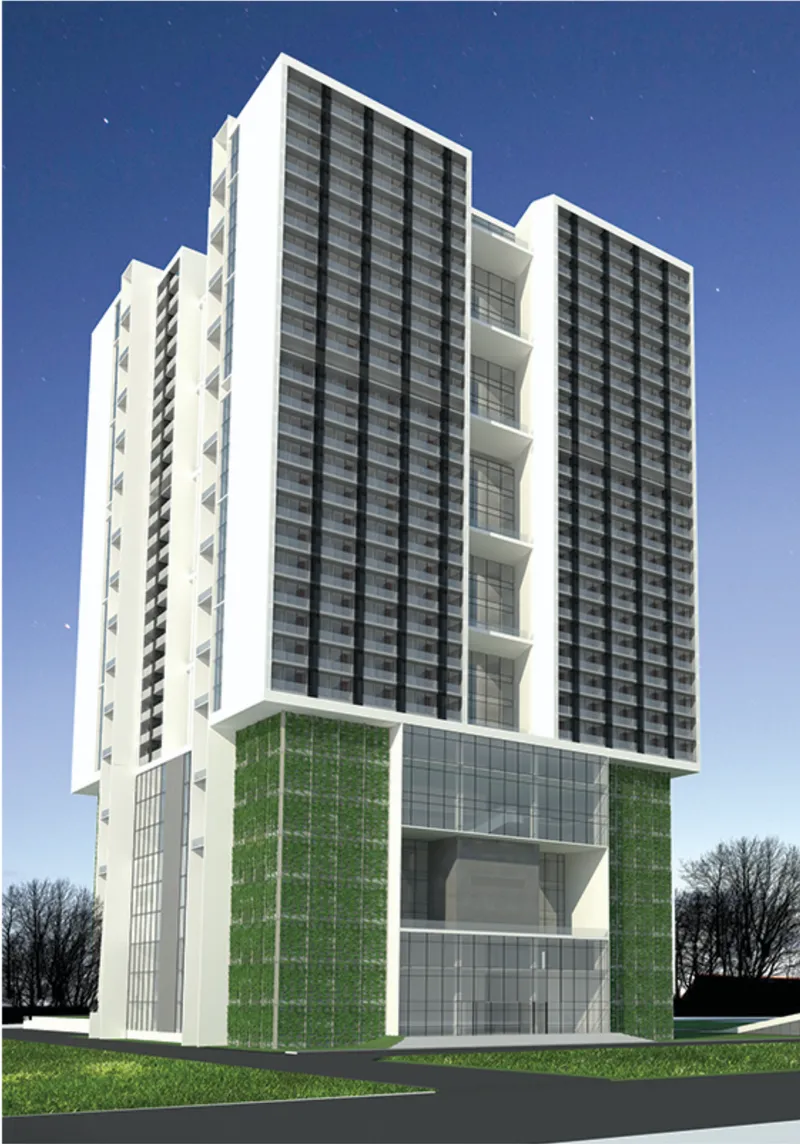
The front elevation reveals the project's fundamental organizational move: a twin-tower complex rising from a shared podium base, with planted walls flanking the lower volumes. The podium acts as the campus ground plane, consolidating the shared amenities, entry sequences, and social infrastructure that in a conventional university would occupy separate buildings scattered across a site. By anchoring both towers to this common base, the design preserves the sense of institutional cohesion that campuses rely on for identity and community.
The vertical green panels that line the podium are not ornamental. They signal the project's commitment to reintroducing landscape into a building type that might otherwise read as pure commercial tower. The contrast between the white structural frame and the dense planted surfaces gives the complex a legibility at the urban scale: this is not another office block in BKC, but something programmatically distinct.
Green Walls as Vertical Ground
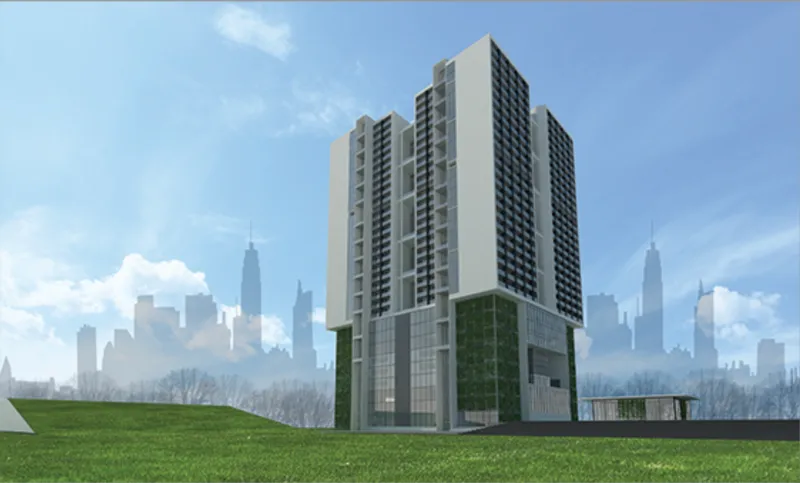
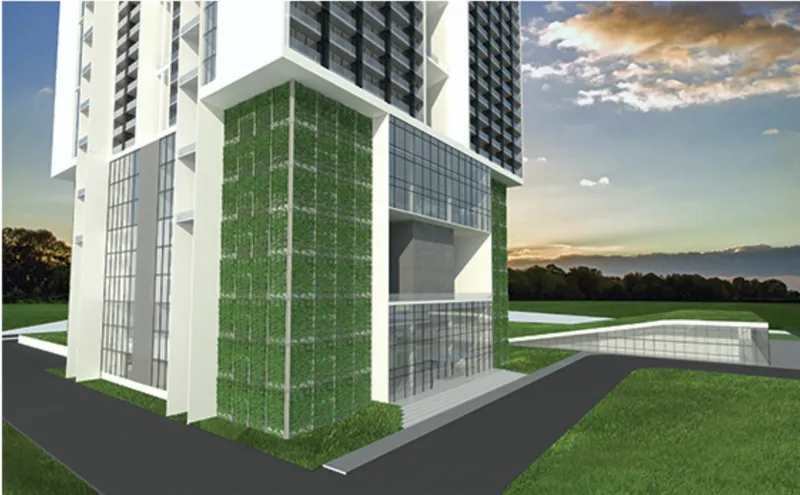
Two views of the tower base make the landscape strategy concrete. Vertical green wall panels wrap the lower levels, sitting beside glazed volumes that open onto the surrounding district. Seen against the Mumbai skyline at sunset, the planted surfaces create an intermediate zone between the density of the city and the interior life of the campus. The design draws from global precedents like the Wabash Building at Roosevelt University in Chicago and the Mode Gakuen Cocoon Tower in Tokyo, both of which demonstrate that academic, administrative, and student spaces can coexist within high-rise structures without sacrificing campus character.
The project reinterprets traditional campus open spaces as what Atha calls "virtual grounds": stacked terraces, atriums, and intermediate social platforms that maintain visual and physical connectivity across floors. These green walls at the base are the most visible expression of that idea, collapsing the horizontal lawn into a vertical surface that still provides the sensory qualities of landscape: shade, texture, seasonal change.
A Residential Facade Built on Rhythm and Air
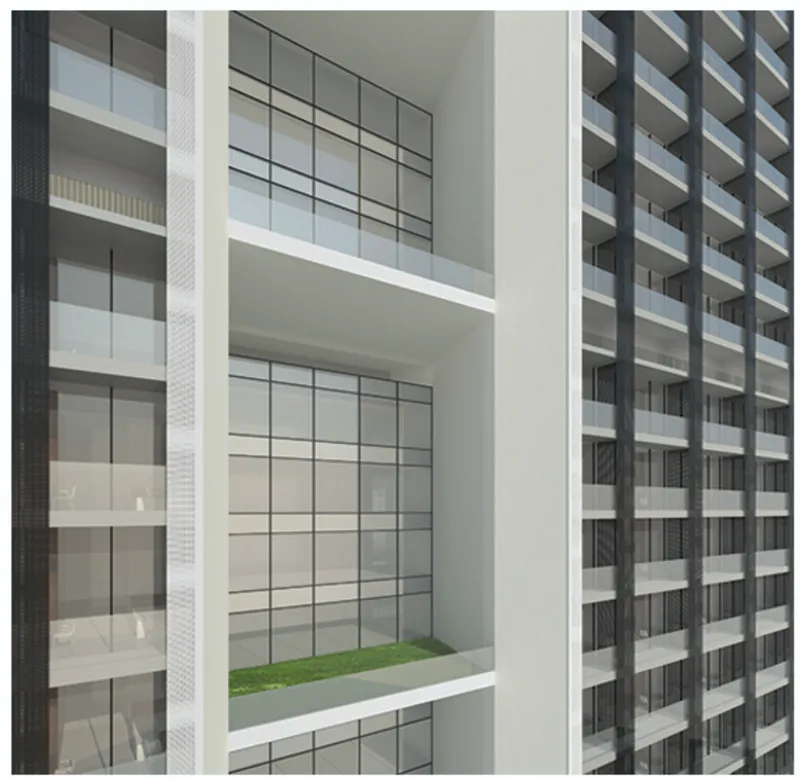
The close-up of the residential tower facade reveals a carefully articulated system of gridded glazing, white balconies, and planted terraces inserted at regular intervals. The rhythm is deliberate: the grid provides a rational structural module for student housing, while the planted terraces break the repetition and introduce shared outdoor space at the scale of a floor or a cluster of units. These are the "out-of-class" spaces that Atha identifies as essential to campus life, translated from the courtyard and quadrangle into a stacked format that works within the tower's footprint.
The balconies are not deep, but their repetition across the facade creates a layered depth that softens the mass of the tower. Combined with the planted terraces, they ensure that residents have access to daylight, ventilation, and a visual connection to the city, conditions that distinguish this from a standard residential high-rise and give it the character of a campus building.
Interior Light Through a Gridded Lens
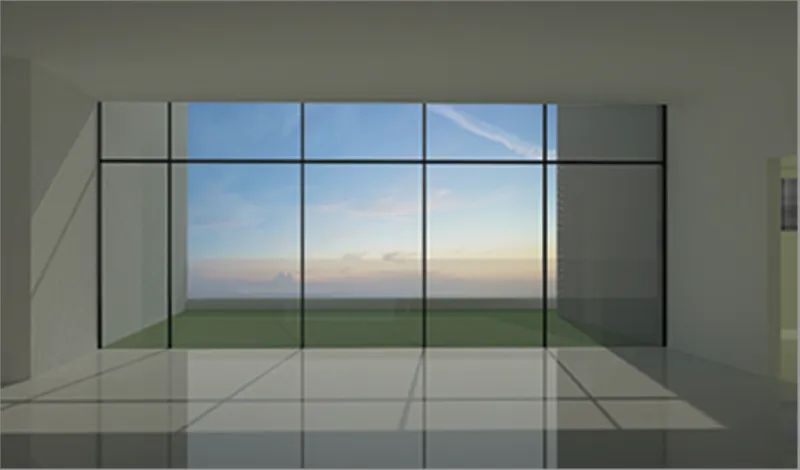
The interior perspective captures a moment that encapsulates the project's aspiration: floor-to-ceiling gridded glass walls frame an open landscape at dusk, dissolving the boundary between the vertical campus and the city beyond. The grid of the glazing becomes a visual filter, organizing the panoramic view into a pattern that echoes the structural logic of the building itself. For a student studying or socializing in this space, the city is not a distant backdrop but an immediate presence, reinforcing the project's core argument that an urban university should be embedded in, not isolated from, metropolitan life.
The quality of light here matters. Rather than the sealed, artificially lit interiors common to commercial towers, this space is suffused with natural light modulated through the glazing grid. It suggests that the vertical campus can achieve the environmental qualities of a low-rise courtyard building through careful section design and facade engineering, not through nostalgia for the horizontal, but through a confident embrace of height.
Why This Project Matters
The debate around vertical campuses tends to focus on efficiency: how many square meters of program can be stacked per square meter of land. Atha's project pushes past that framing to ask a harder question, which is whether the social and spatial qualities that define campus life can survive the transition from ground to sky. The stacked terraces, green walls, and glazed social platforms are all attempts to prove that they can, and the BKC site gives the experiment real stakes, placing the proposal in one of the most land-pressured districts in one of the world's densest cities.
What makes the project instructive is its refusal to treat verticality as a compromise. The twin-tower form, the planted podium, and the rhythm of the residential facade all suggest that a vertical university is not a shrunken version of a horizontal one but a genuinely different typology with its own spatial logic and its own relationship to the city. For Mumbai, and for any metropolis where land scarcity is reshaping institutional planning, that distinction is worth taking seriously.
View the Full Project
About the Designers
Designer: Rajeev Atha
Enter a Design Competition on uni.xyz
uni.xyz runs architecture and design competitions year-round that reward proposals with spatial conviction and real site intelligence.
Project credits: Vertical University in an Urban Scenario by Rajeev Atha.


Popular Articles
Popular articles from the community

Tsunami Convergenics: Turning Catastrophic Ocean Forces into Underwater Housing Infrastructure
A speculative underwater settlement off the coast of Onagawa, Japan, treats tsunamis and typhoons as energy sources rather than threats.

Singing Woman: An Opera House That Performs Before the Curtain Rises
Ovidiu Cristian Pavel's conceptual opera house translates Estonia's choral identity into a sculpted waterfront landmark facing the Baltic Sea.

Cloaked Colonization: A Mobile Underwater Habitat That Moves Like a Fish
Micah Abaya's shortlisted EHC Pacific entry reimagines ocean settlement as a dispersed network of self-sustaining architectural organisms.

Manzana Morphosis: Stretching Barcelona's Grid into a Living Landscape for 2050
A radical reworking of the Eixample manzana turns density into a tool for generous public space, vertical ecology, and environmental performance.

Similar Reads
You might also enjoy these articles
Yenisei Monitoring Center: A Sun-and-Moon Sphere Anchors a Research Campus on Siberia's Great River
In Krasnoyarsk, shifting square blocks, a glazed central sphere and descending window rhythms turn river science into a public spectacle on the Yenisei.
Andretta Artist's Village: A Node-Based Masterplan That Lets the Hills Write the Plan
A cultural landscape strategy for Palampur's artist colony threads studios, residences and stages along a porous spine shaped by the Dhauladhar terrain.
Street Children Rehabilitation Center: A Brick Campus That Eases Children From Street to Safety
A low-rise courtyard campus where learning streets, uthans and shaded verandahs stage a gradual passage from street into protective, family-scale life.

The NEON Culture: A Field of Pavilions Built for the 24-Hour City
Smaran Alva spreads galleries, stages, clubs and markets across a varied site, treating light, sound and ramped movement as the real building materials.

Comments (0)
Please login or sign up to add comments
No comments yet. Be the first to comment!