
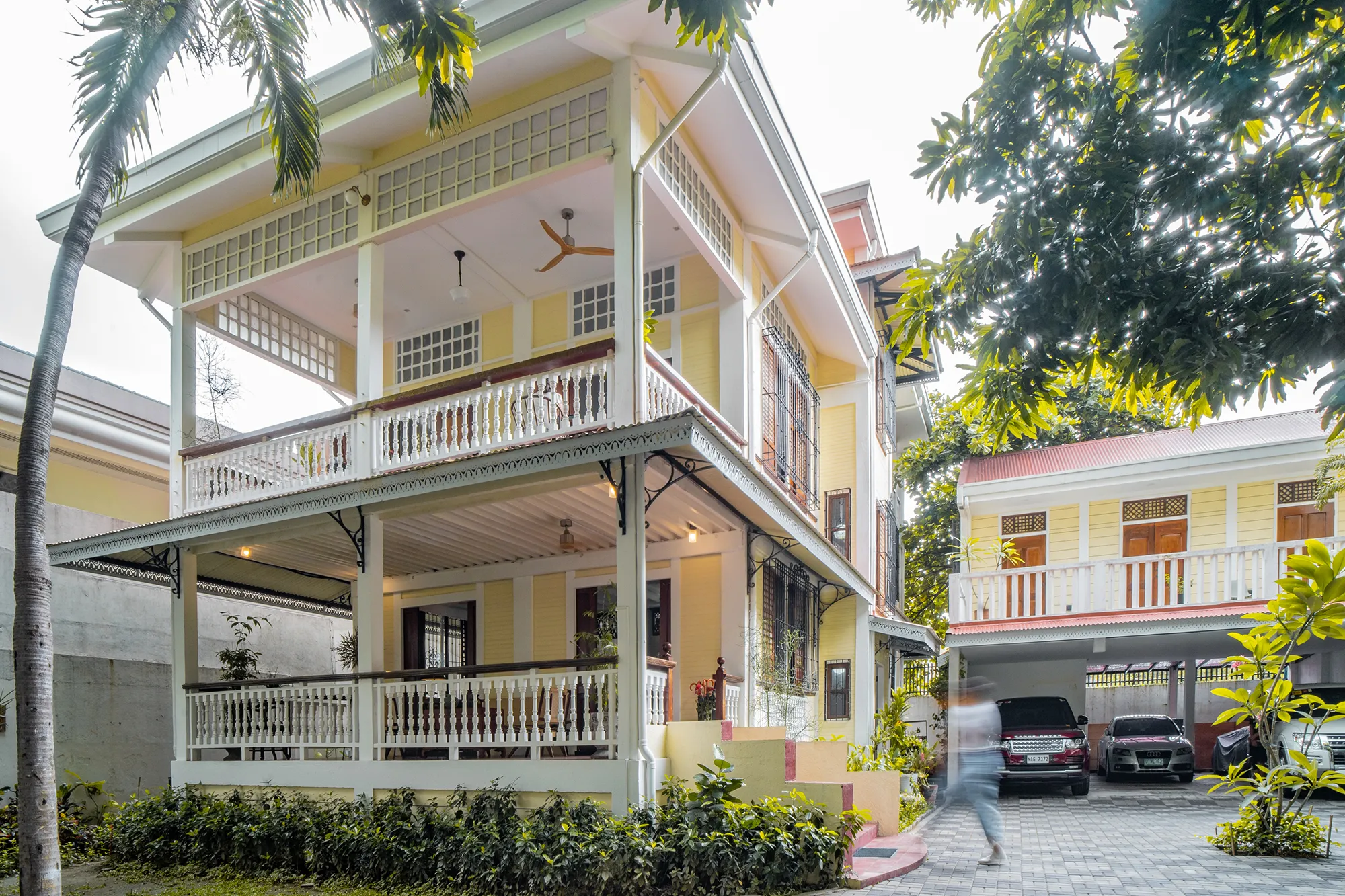
Villa Floro: A Tropical House Reborn
Villa Floro is a groundbreaking feat in hybrid conservation in the Philippines, fusing together the old and the new as employed in domestic architecture.

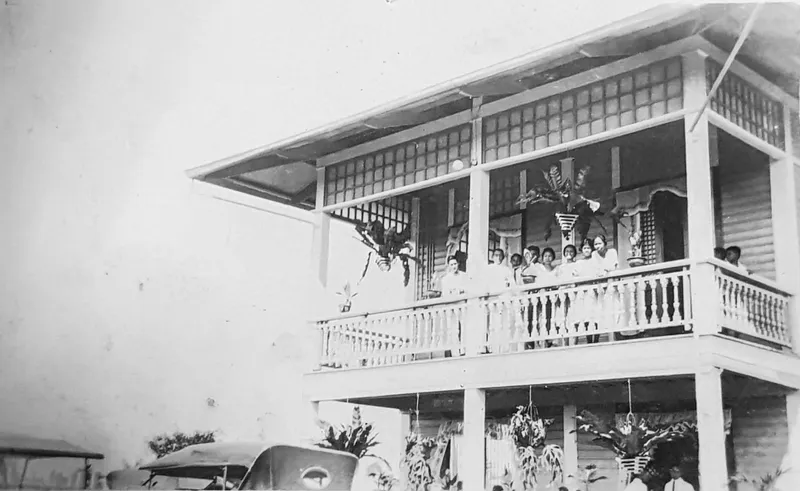 The original house in 1927.
The house was built in 1924 for Floro Santos, Circulation Manager of The Philippines Free Press during the early 20th century. It was the first house built along Foch Street (now P. Guevarra Street) in the Little Baguio district of the Municipality of San Juan, then under the Province of Rizal in the Philippine Islands. The house served as the nucleus of a family complex with his wife, Maria Feliciano and their eight children.
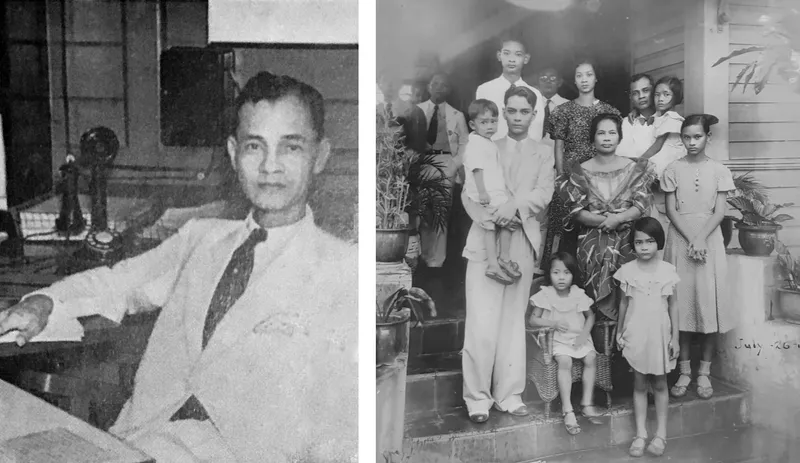 Photographs of Floro Santos and his family.
Stylistically, the house combined the aesthetics of Franco-American colonial buildings with its large, two-level balcony, but fused with bahay-na-bato (traditional Filipino wood-and-stone house) elements: capiz shell sliding windows, ventanillas (literally: 'little windows'), metal openwork fascia, and lyre-shaped fretwork.
The house served many functions through the decades from hosting social and civic events to providing a safe refuge during the war. Miraculously, the house survived the Second World War but not the rapid developments of our time—the lot was subdivided, and demolition was impending.
The lot where the house stood was passed on as inheritance to the three descendants of one of Floro Santos's daughter. The house stood right in the middle of the lot, and the there was no way the house could stay in its original location once the lot is subdivided. Fortunately, one of the three sisters was interested in keeping the house, so it was decided that it would be transferred to a new property within the same neighborhood.
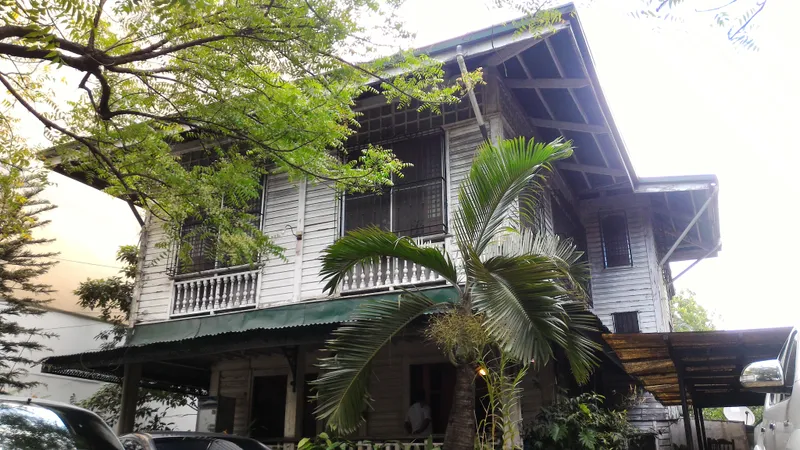 The house as of 2018. Note the addition of walls affront, completely covering the porch which was an original feature of the house.
In 2018, despite the dilapidated state and obsolete spatial program of the house, the owner initiated the relocation and conservation of the structure to a new site just 400 meters away, because the property on which it stood was to be subdivided among co-heirs. Maintaining its morphology and material integrity, the house was meticulously documented and rebuilt piece-by-piece on a modern reinforced concrete body and steel skeleton.
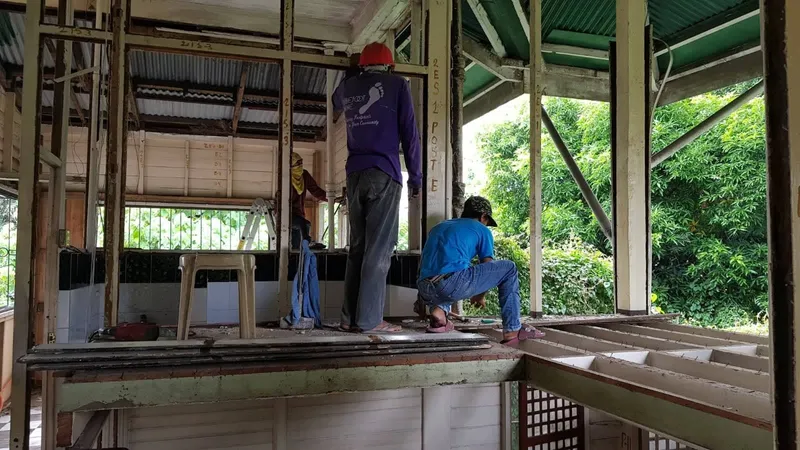
With new functional and technological requirements, the house was reprogramed and expanded with an additional wing at the rear, housing a modern kitchen, an audio-visual room, gallery space, gym, home office and a six-car garage. The intervention seamlessly integrated the historic structure with the new spaces in a manner sympathetic to the original, resulting in an architecture that ensures the continuation of associated values and genius loci.
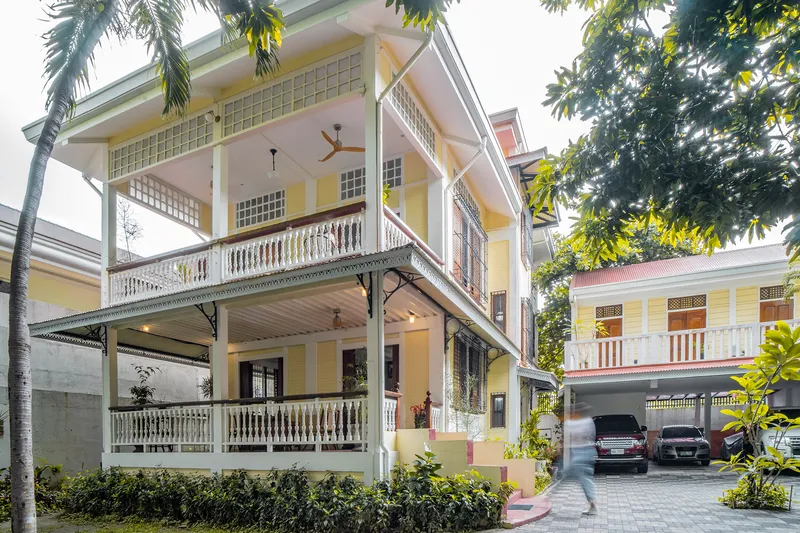 The house, relocated to its new site.
Villa Floro, a groundbreaking feat in hybrid conservation in the Philippines, is a testament to the feasibility of moving old houses, infusing them with contemporary use and technology while honoring the past. The house, distinct in its new location, has reinvigorated a sense of community in its neighborhood, generating new memories.



Popular Articles
Popular articles from the community


Riyadh For All: Intergenerational Urban Design for Active Aging in Rabat
Riyadh For All reimagines urban design in Rabat with intergenerational co-living, adaptive courtyards, and Moroccan cultural exchange today.

Hill & Cross Opera: Sculptural Opera House Architecture Shaped by Tallinn’s Landscape and Identity
Hill & Cross Opera reimagines opera house architecture in Tallinn through its sculptural hill, civic plaza, glass wave and a luminous cross.

Conexión: Biophilic Design Reimagines High-Rise Living in Hong Kong
Conexión reimagines high-rise living in Hong Kong through biophilic design, green facades, shared spaces, daylight, water and nature within.

Co-life: Sustainable Architecture for Age-Friendly Community Living
Co-life reimagines sustainable architecture for seniors through courtyards, rammed earth, shared gardens, and spaces designed for belonging.


Similar Reads
You might also enjoy these articles

Day and Night Park: A Time-Based Urban Newsstand in Beijing
A temporary urban newsstand in Beijing blending travel, light, and reading through poetic colors, compact form, and community-focused design.

Modernist Patio Renovation in El Masnou, Barcelona by Oliver Segura Arquitectura + Cebrià Arquitectura
Modernist patio renovation blending tradition and innovation with a movable pool, leveled floors, and Catalan materials in El Masnou.

Alto Residencial Coop: Cooperative Housing Development in Santiago de Compostela by Carbajo Barrios Arquitectos
A linear cooperative housing complex blending white volumes and perforated metal façades, enhancing community living, natural light, privacy, and urban integration.
Vil Genis School by BPA ARCHITECTURE – Massy, France
Vil Genis School in Massy, France, features sustainable design, south-facing classrooms, community integration, accessible spaces, and modern educational architecture.




Comments (0)
Please login or sign up to add comments
No comments yet. Be the first to comment!