
Lacroix Chessex Shelters a Fragmented Timber Villa Beneath One Bold Gable in Veyrier
A 150-square-meter all-wood house near Geneva uses a single sweeping roof to unify offset volumes along a diagonal site.


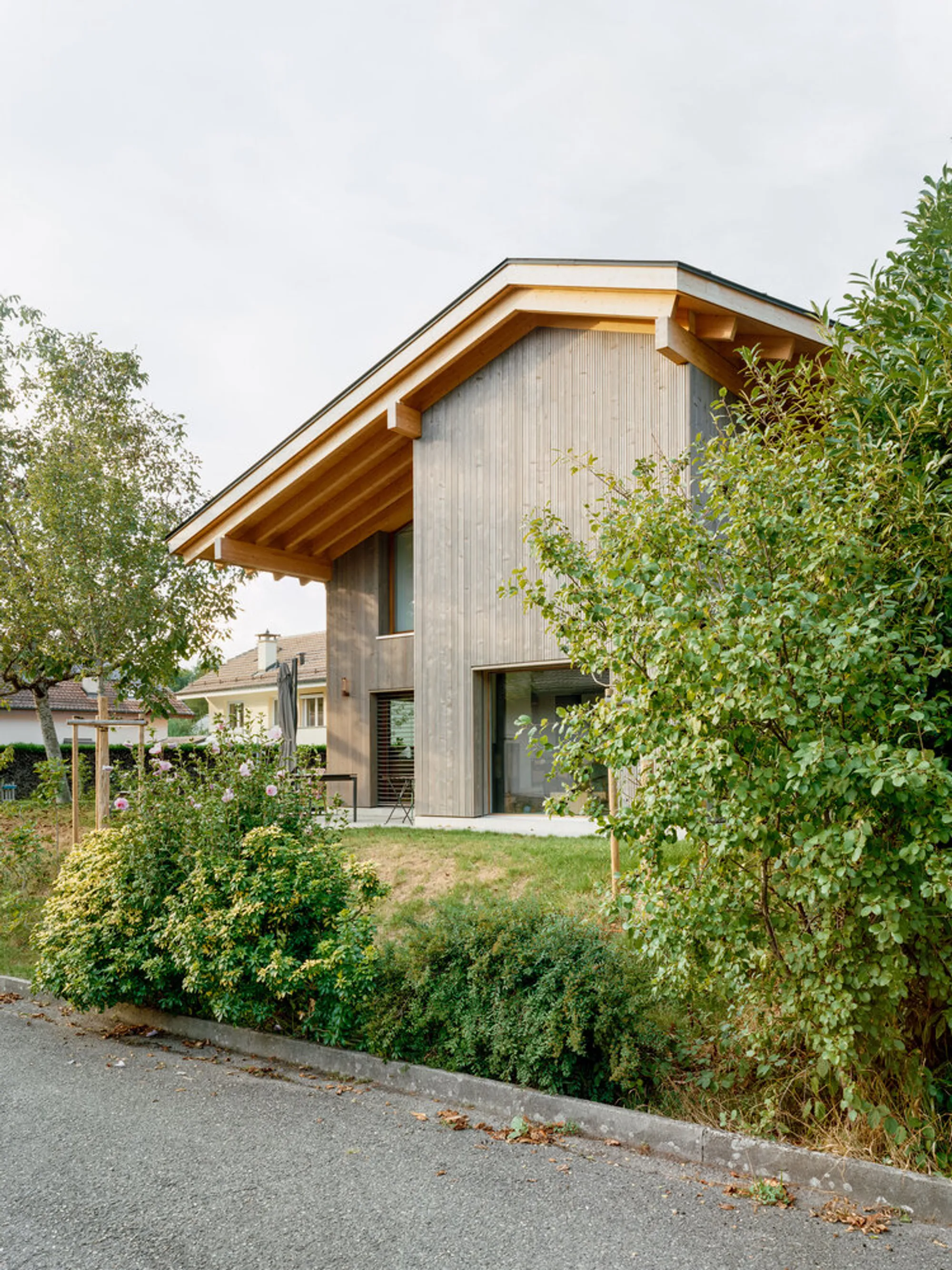
At first glance, the Villa in Veyrier looks like a single confident gesture: a steep gable roof clad in timber, sitting quietly on a sloped street in the Geneva suburbs. But the simplicity of that silhouette is a deliberate illusion. Beneath the roof, Lacroix Chessex has arranged a set of offset volumes on a square grid, rotating and fragmenting the plan to follow the diagonal axis of the site. The result is a house that reads as monolithic from the street but unfolds into surprising spatial variety once you step inside.
Built adjacent to an existing family home from the late 1990s, the 2024 villa is entirely wood: wooden structure, wooden facades, wooden interiors. That commitment to a single material family is not decorative nostalgia. Paired with thermal and photovoltaic solar panels on the expansive roof and an air-to-water heat pump, the house earns a THPE (Très Haute Performance Energétique) label. The project is interesting not because it checks sustainability boxes but because it proves that a rigorous material strategy can generate both high performance and genuine architectural character.
One Roof, Many Volumes
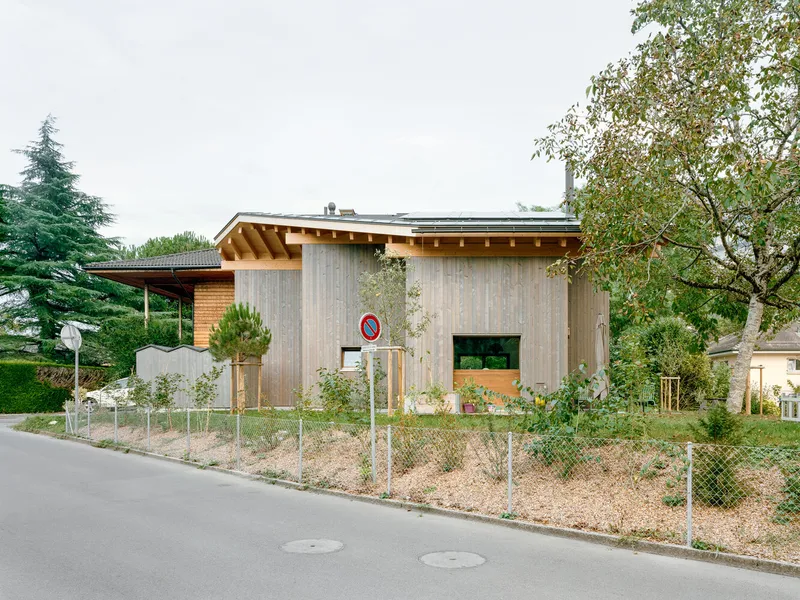
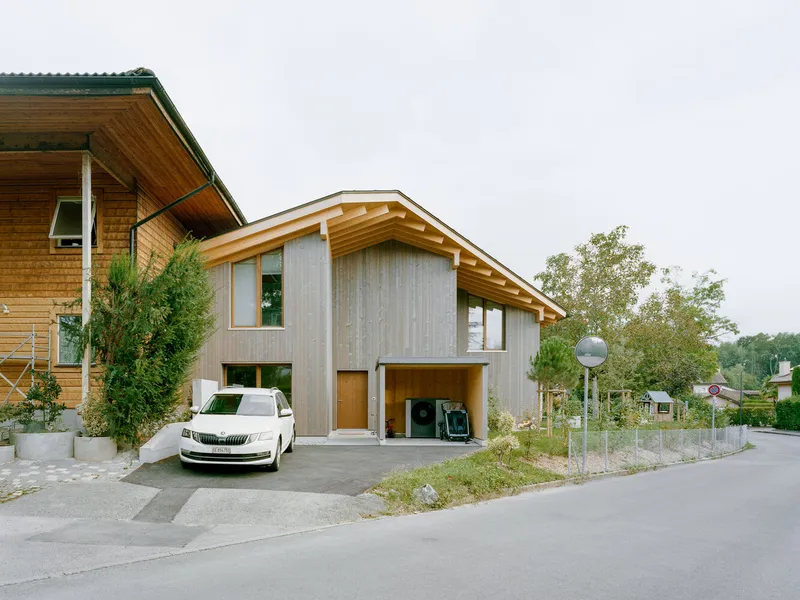
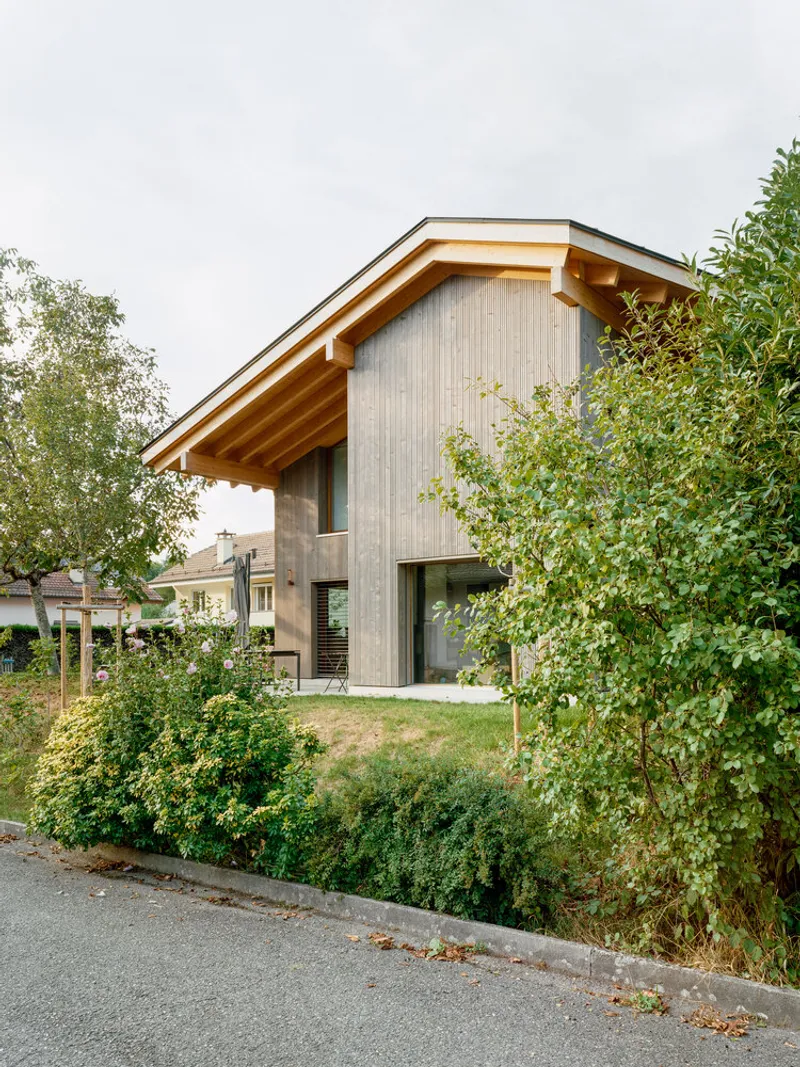
The villa's defining move is its roof. A single unitary gable stretches over the entire footprint, its deep eaves casting heavy shadow lines along the vertical timber cladding below. From the street the house could almost be a barn or a rural workshop, an impression reinforced by the exposed rafter tails that extend beyond the facade. The scale of the roof gives the house a presence that belies its modest 150 square meters.
What keeps this from becoming a generic pitched-roof box is the plan underneath. The volumes are not extruded from a simple rectangle. They shift and overlap, following the site's diagonal, so the gable shelters what is really a collection of interlocking rooms rather than a single container. You see hints of this fragmentation in the way the roofline meets neighboring structures and fences at unexpected angles.
Timber as Total System
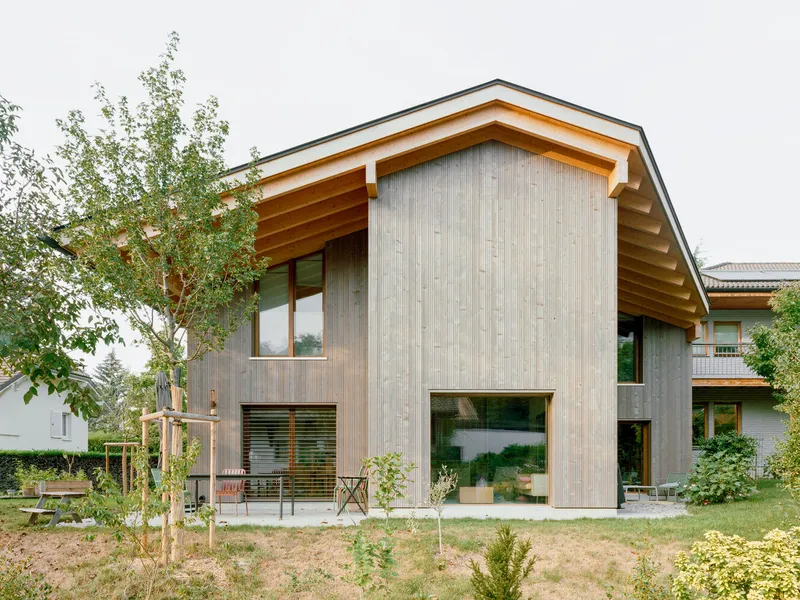
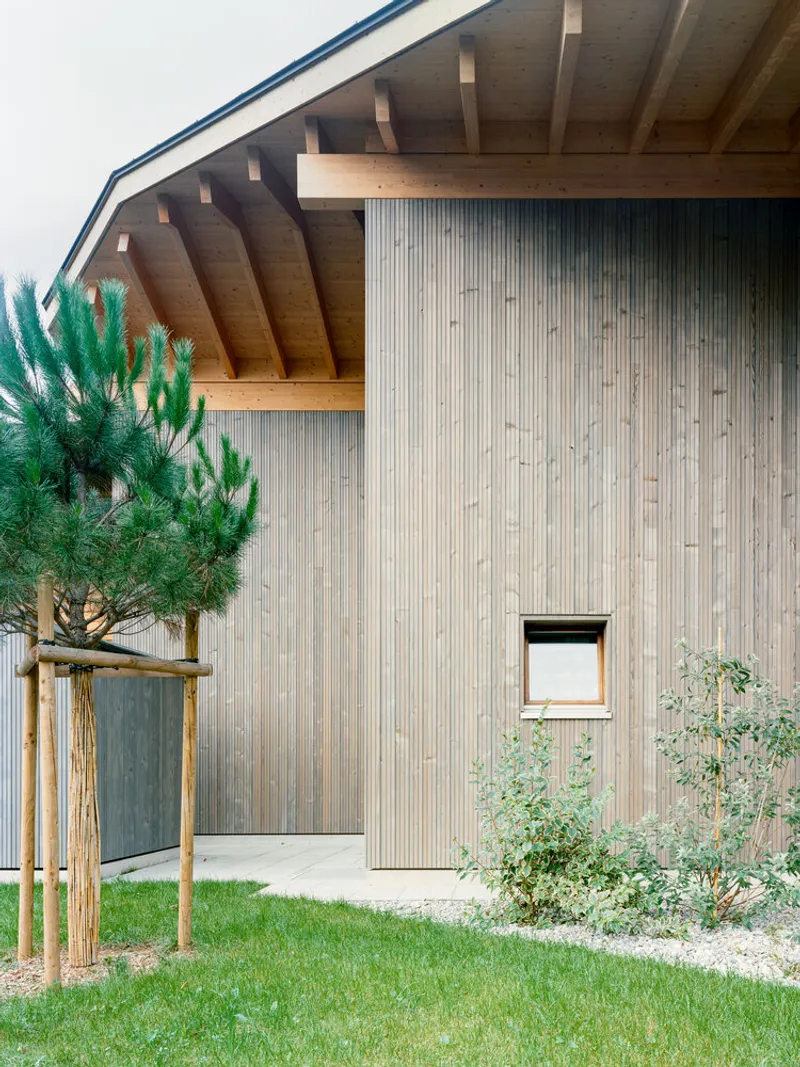
Vertical wood cladding wraps the exterior with an almost textile rhythm, the narrow boards casting fine shadow lines that shift through the day. The overhanging eaves expose the rafter structure, so you read the building's skeleton before you enter. A small, carefully placed window punctuates one facade like a peephole, resisting the urge to glaze everything.
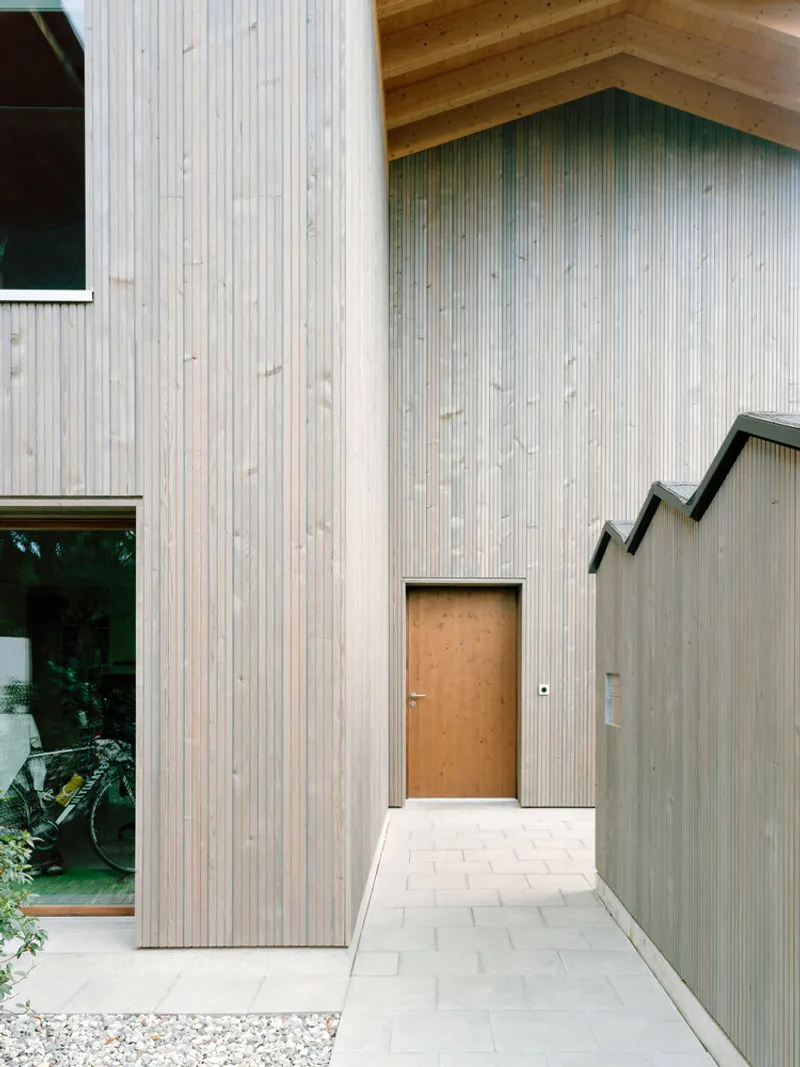
The entry sequence reinforces the material logic. Pale stone pavers lead to a timber door set flush within the cladding, as if the wall simply opens. There is no portico, no grand threshold. The door is wood; the wall is wood; the structure behind is wood. The simplicity is disarming, but it communicates an unusual level of discipline. Every joint and every surface belongs to the same material ecosystem.
Ground Floor: Open Plan, Warm Edges
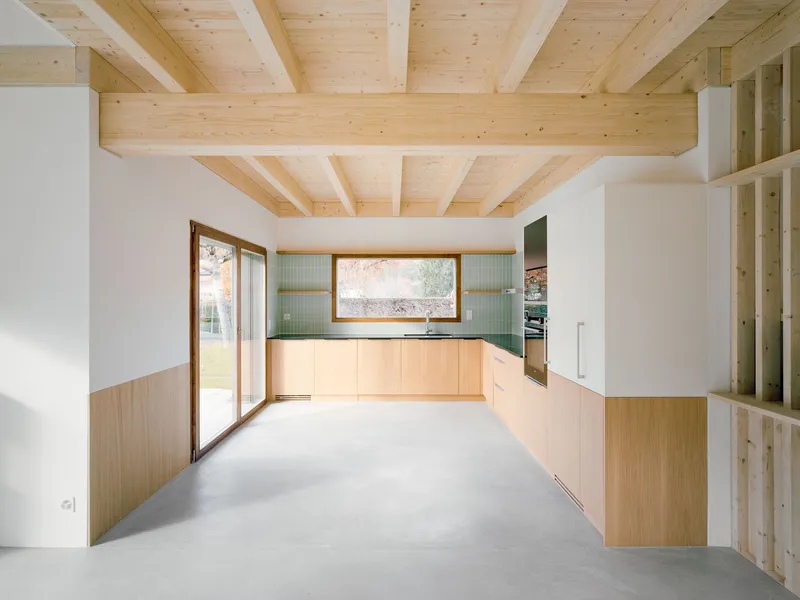
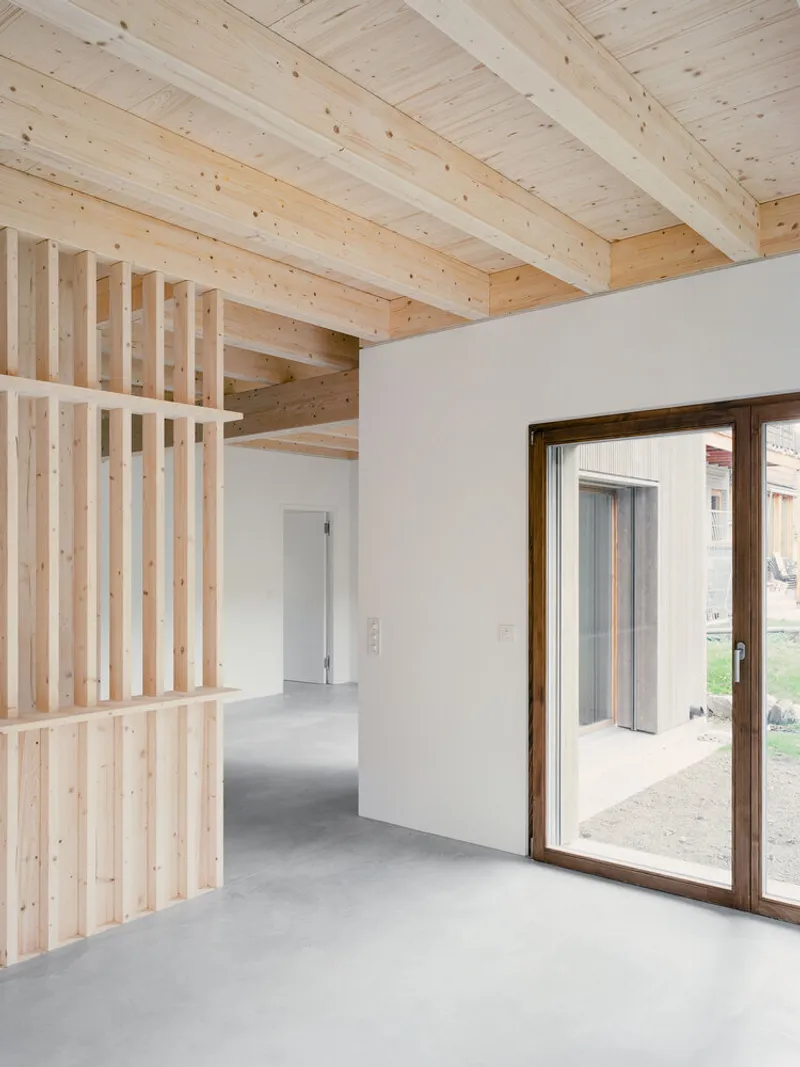
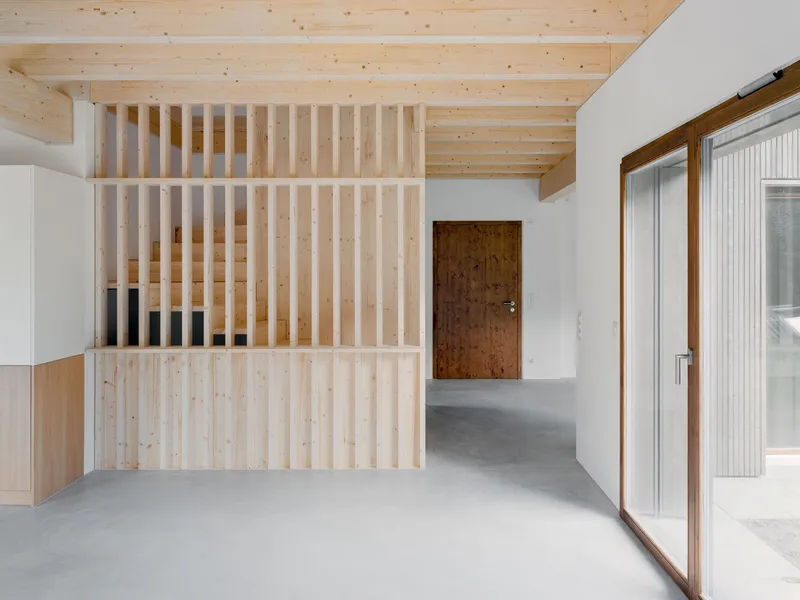
Inside, the ground floor holds the social program: living room, dining room, open kitchen, a bathroom, and a bedroom that doubles as an office. The kitchen is the scene-stealer. Light wood cabinetry meets a green tile backsplash, and the exposed beam ceiling runs overhead with the regularity of a ruled page. A polished concrete floor grounds the warmth of all that timber, providing thermal mass and a visual counterweight.
Lacroix Chessex uses vertical timber slat screens to modulate the open plan without closing it down. One screen divides the entry hall from the living areas; another frames a glass door that opens to the garden. These partitions filter light, offer glimpses, and give the occupants control over privacy without resorting to conventional walls. The screens also echo the vertical rhythm of the exterior cladding, collapsing the boundary between inside and outside.
The Structural Ceiling as Interior Landscape
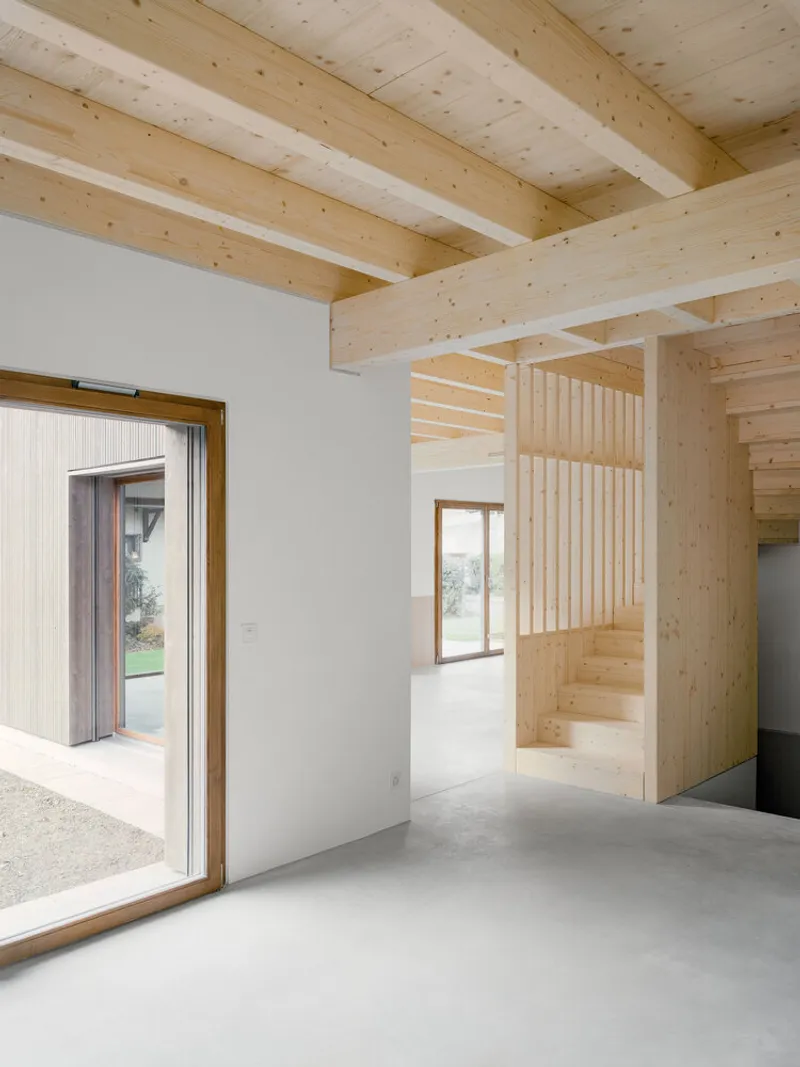
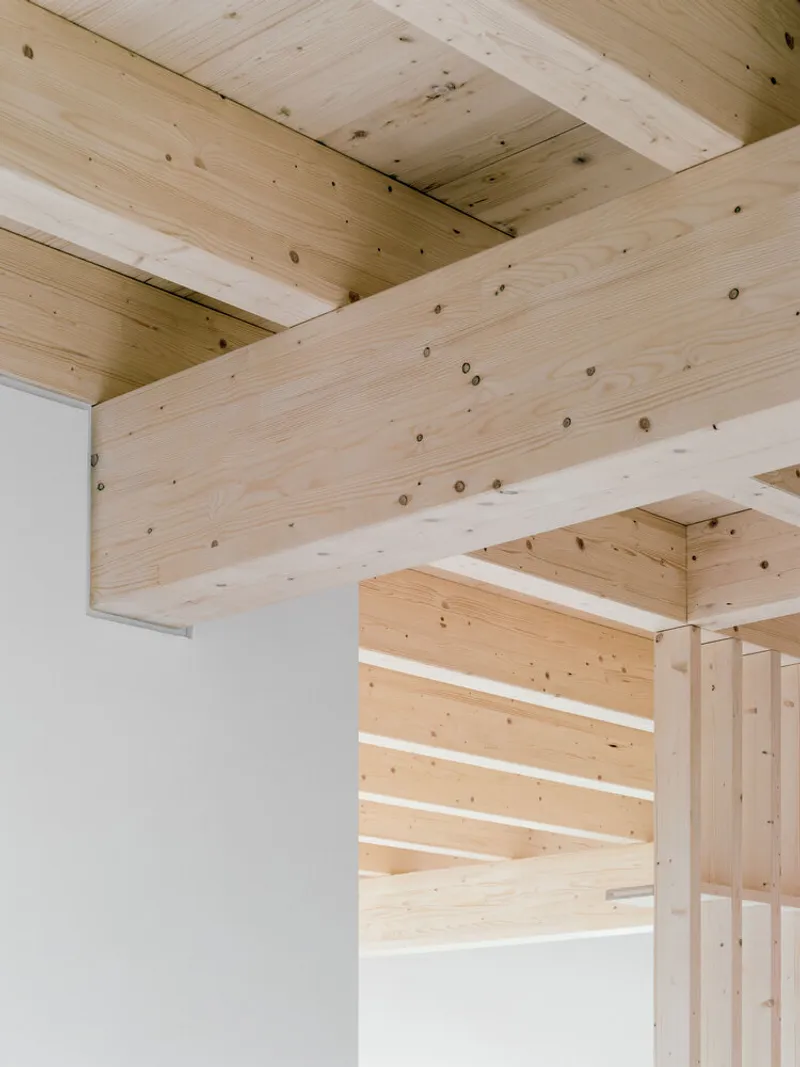
Throughout the house, the exposed beam ceiling is less a detail than a spatial protagonist. Timber joists, beams, and rafters are left visible, creating a dense rhythm overhead that compresses or expands depending on where you stand. At the staircase, the beam grid meets the slatted screen divider, and the two systems lock together like overlapping grids.
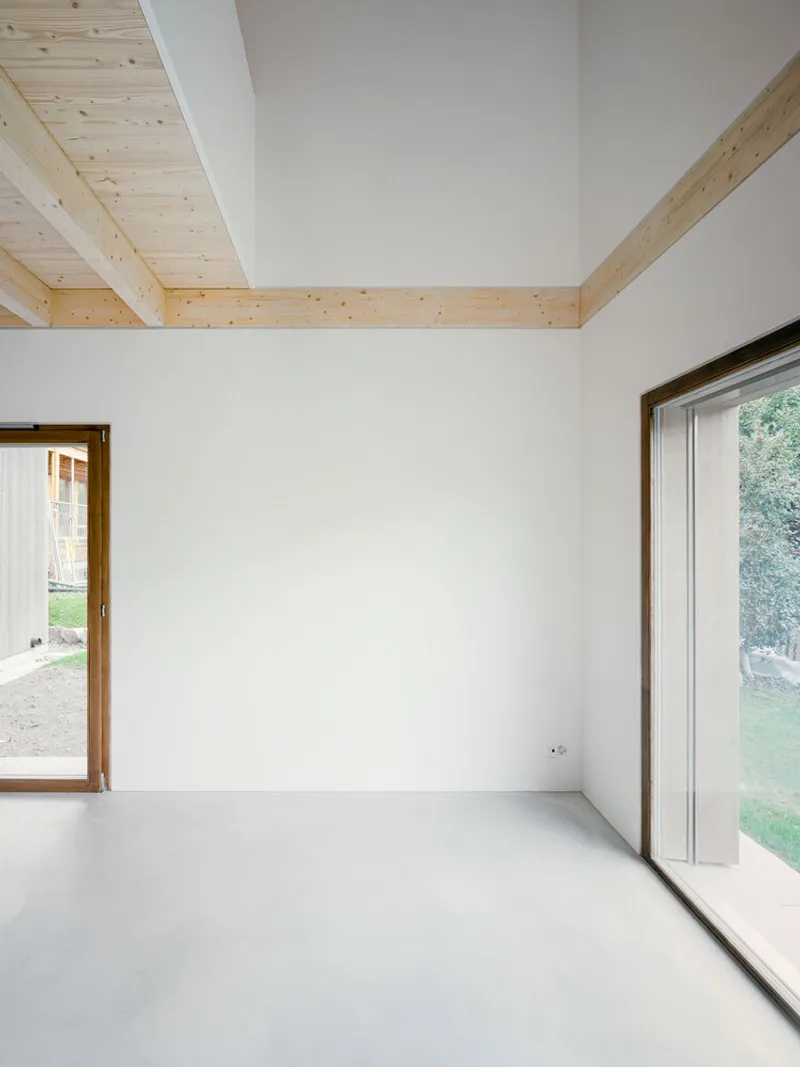
Where beams intersect with white plaster walls, the material contrast is sharp: rough-sawn timber against smooth mineral surfaces. These moments of tension keep the interiors from feeling like a log cabin. The white walls reflect light upward into the beam structure, making the ceiling glow rather than loom. It is a careful calibration between exposed structure and finished surface that gives the house its warmth without coziness tipping into claustrophobia.
Upper Floor and Skylights
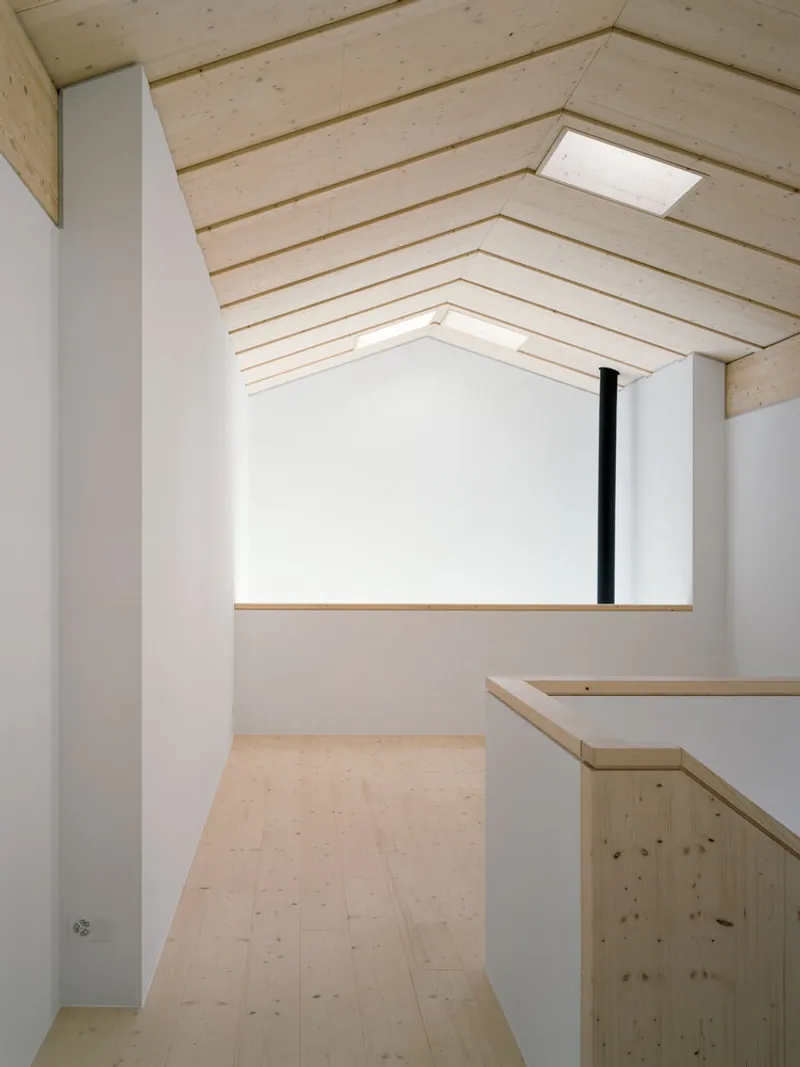
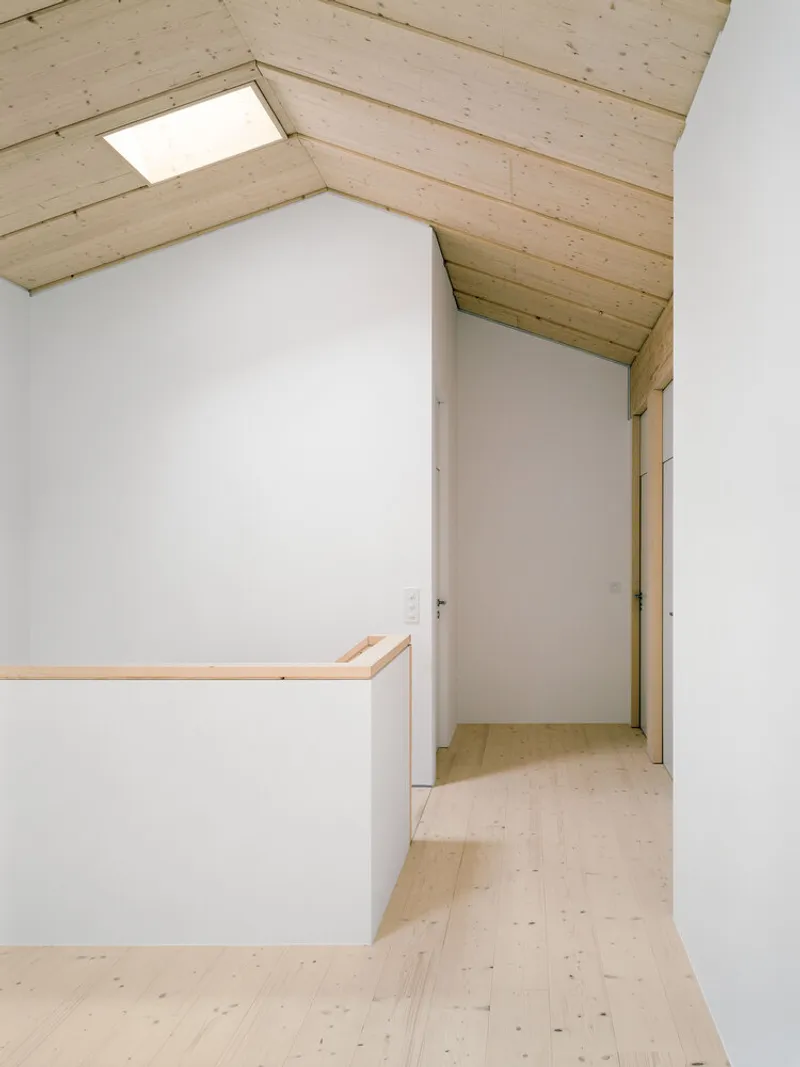
The upper floor holds three bedrooms and a mezzanine, tucked under the sloping roof. Skylights cut through the gable, washing the landing and corridor with daylight from above. The hallway on this level is a lesson in proportion: low ceiling, plywood floor, a single skylight that turns a passage into a destination. You linger in it rather than rushing through.
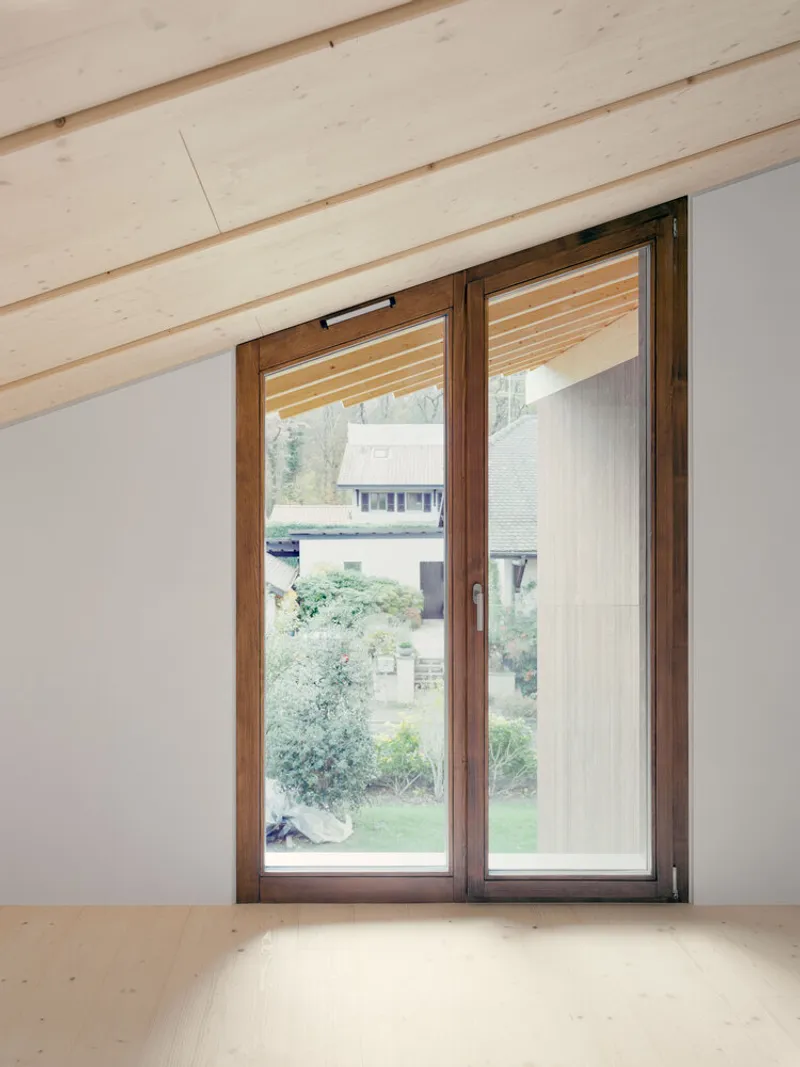
A timber-framed window overlooking the garden demonstrates the architects' control of framing. The vertical ceiling beams run perpendicular to the view, creating a layered depth that makes the window feel more like a painting than an opening. The upper floor is private without being dark, compact without feeling tight. The roof's generous volume pays off here, providing headroom and light where a conventional pitched ceiling might pinch.
Between Buildings: The Courtyard Edge
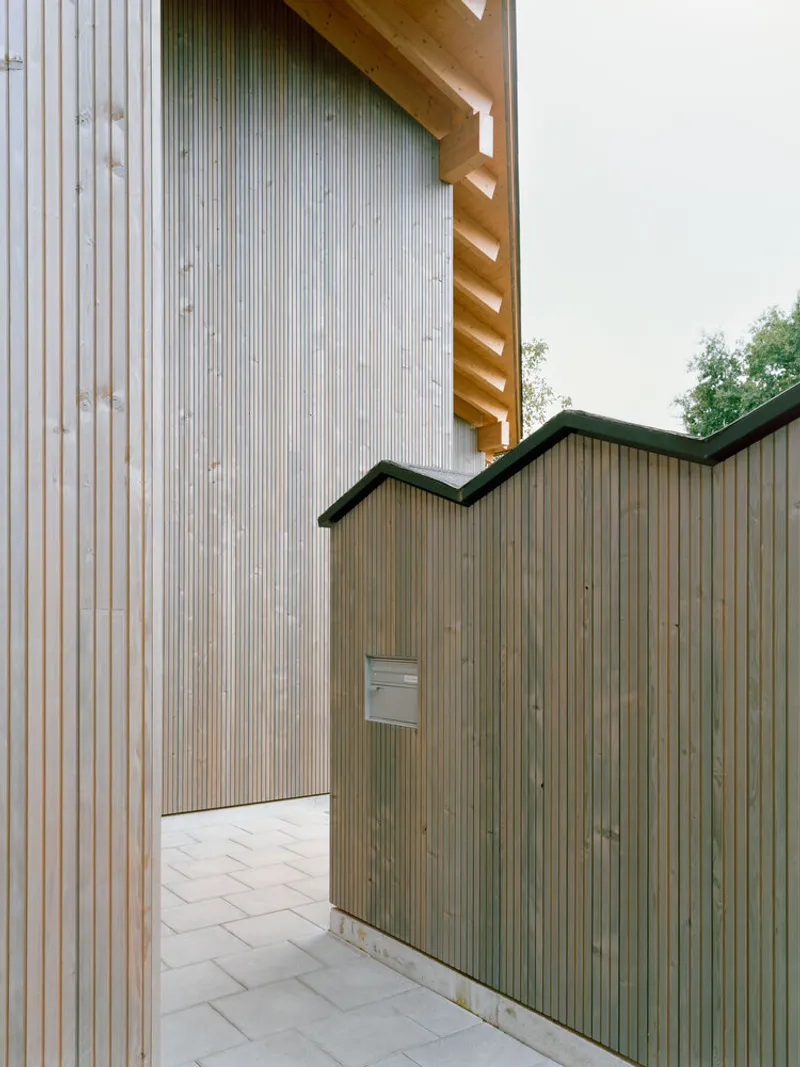
A narrow courtyard passage runs between the new villa and its neighbor, bounded by corrugated metal cladding on one side and a stained timber fence on the other. Herringbone paving underfoot gives this utilitarian space an unexpected dignity. The passage acknowledges that the house does not exist in isolation; it negotiates with the existing family home and the suburban fabric around it.
This in-between space is where the project's pragmatism shows most clearly. Rather than pretending the adjacent house does not exist, Lacroix Chessex treats the gap as a designed threshold. The material shift from timber to corrugated metal marks the boundary between old and new without hostility, a diplomatic joint in a domestic compound.
Plans and Drawings
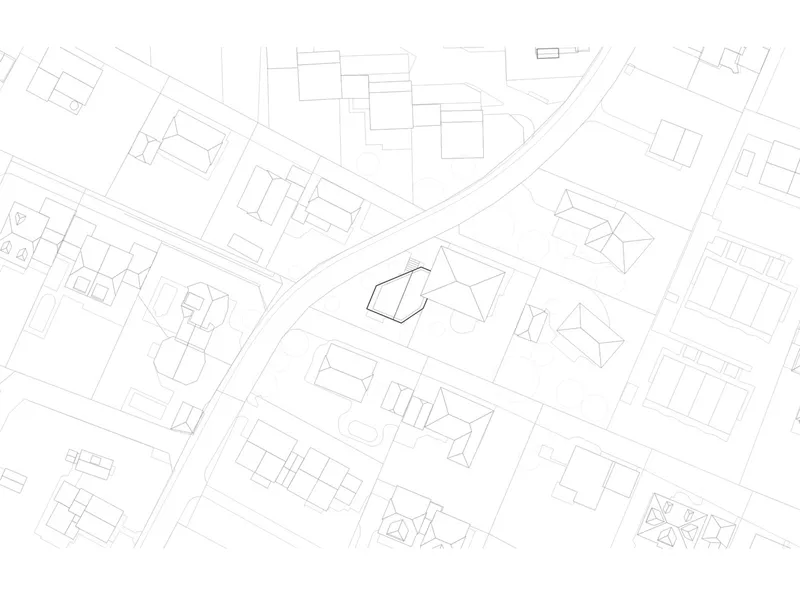
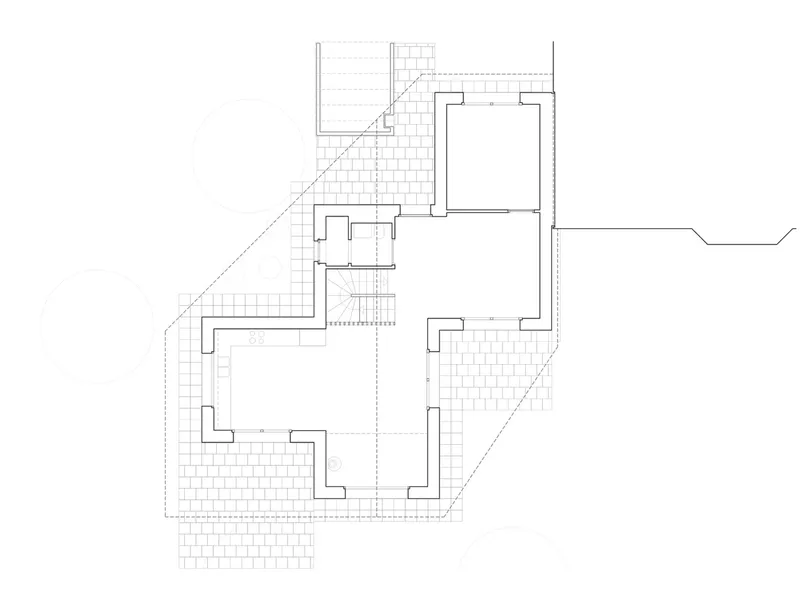
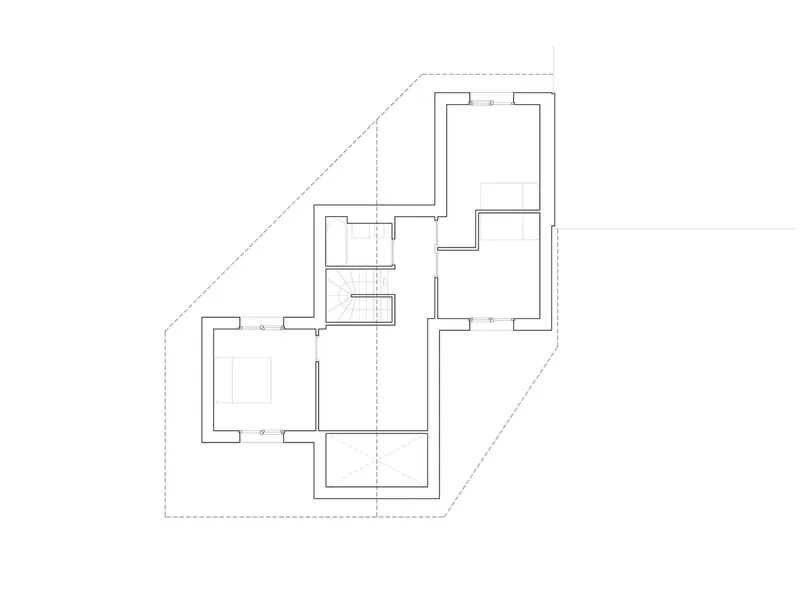
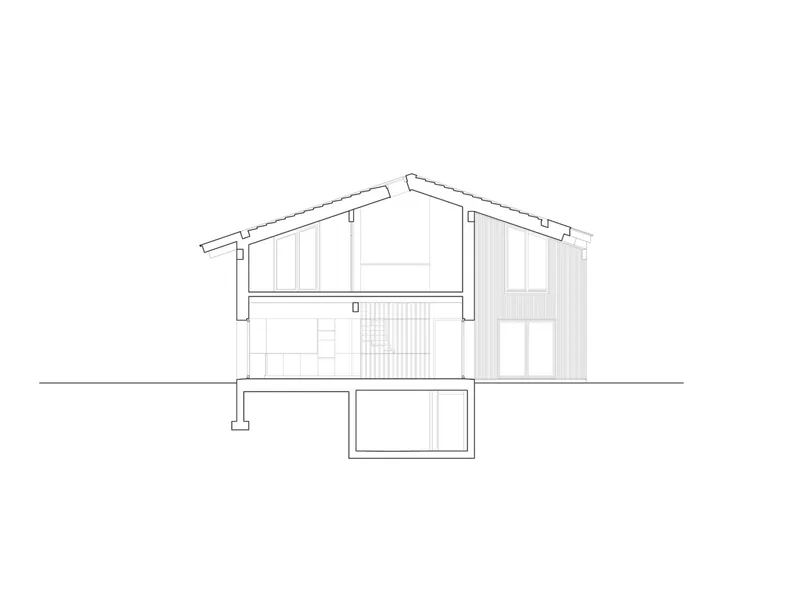
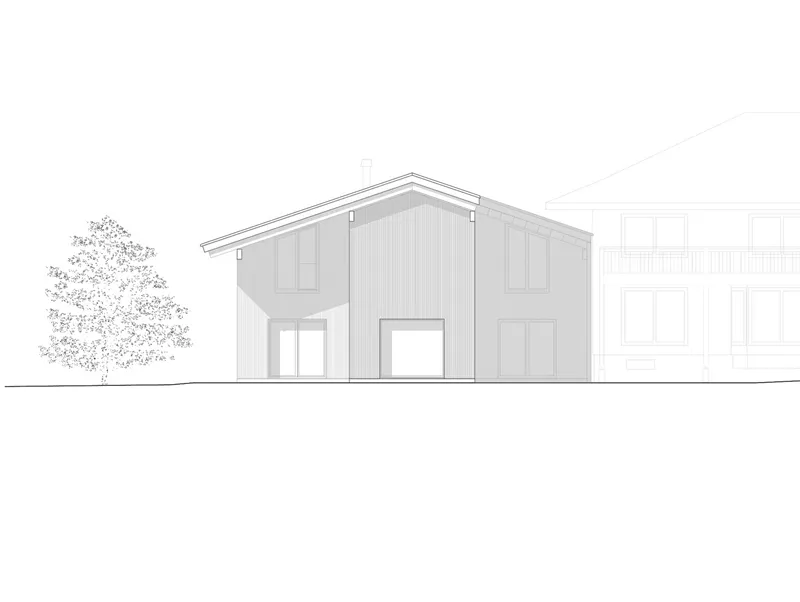
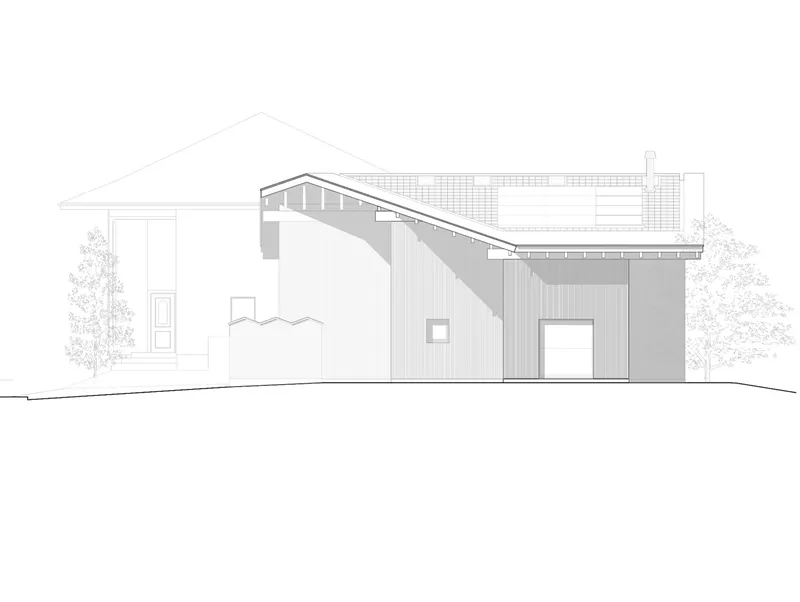
The site plan reveals how the villa slots into a curving suburban street grid, its diagonal orientation distinct from the rectangular lots around it. The floor plans show the square grid that organizes the rooms, with an L-shaped ground floor opening toward exterior terraces and a more compact, irregular upper level gathered around a central staircase. The grid is visible but not rigid; rooms shift off-axis where the site demands it.
The section is the drawing that explains the project most clearly. You see the steep gable spanning two stories of timber framing, the exposed structure that defines every interior, and the vertical cladding enclosing everything. The elevations confirm that the house presents different faces to the street and to its neighbor: one long and assertive, the other stepped and deferential. These drawings make the design logic legible in a way the photographs, however beautiful the light, cannot.
Why This Project Matters
The Villa in Veyrier matters because it refuses the false choice between sustainability and spatial ambition. An all-wood house with solar panels and a heat pump could easily be a well-meaning box. Lacroix Chessex instead delivers a building whose environmental performance emerges from its architectural strategy: the large roof that generates energy also unifies fragmented volumes, the exposed structure that reduces material waste also creates the defining interior character. Performance and form are not layered on top of each other; they are the same thing.
For a suburban site next to an existing family house, the project also demonstrates a mature approach to context. It does not mimic its neighbor or ignore it. It introduces a new material and geometric language while respecting the scale and grain of the street. In a moment when residential architecture often oscillates between nostalgic pastiche and willful provocation, this villa charts a third path: disciplined, specific, and genuinely useful as a model for how to build well in established neighborhoods.
Villa in Veyrier by Lacroix Chessex. Veyrier, Switzerland. Approximately 150 m². Completed 2024. Photography by Olivier di Giambattista.
About the Studio
Share Your Own Work on uni.xyz
If projects like this are the kind of work you want to make, uni.xyz is a place to publish your own, find collaborators, and enter design competitions.




Popular Articles
Popular articles from the community


Co-Life: Senior Housing Design That Reconnects Older Adults With the City
Co-Life reimagines senior housing design through healing gardens, shared streets, workshops, and a sustainable community across generations.

Co-life: Sustainable Architecture for Age-Friendly Community Living
Co-life reimagines sustainable architecture for seniors through courtyards, rammed earth, shared gardens, and spaces designed for belonging.

The Ocean Hive: Sustainable Architecture for a Self-Sufficient Civilization at Sea
The Ocean Hive imagines sustainable architecture at sea, where modular habitats, algae, wave power and ocean waste sustain a growing colony.

Riyadh For All: Intergenerational Urban Design for Active Aging in Rabat
Riyadh For All reimagines urban design in Rabat with intergenerational co-living, adaptive courtyards, and Moroccan cultural exchange today.


Similar Reads
You might also enjoy these articles

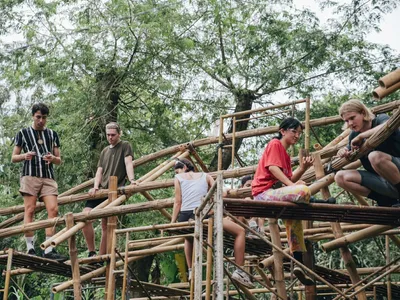
Bamboo Housing Challenge 2026: Design Affordable, Sustainable Homes Using Bamboo
An international design competition by Bamboo U and IBUKU inviting architects and designers to reimagine affordable housing using bamboo — with the winning design built full-scale in Bali.

Computational Design & Education: Beegraphy Design Awards Introduces 7th Category (Featuring Jiyun's Innovative Approach)
Dive into Beegraphy’s 7th Design Awards category, where computational design meets education to create immersive, interactive learning tools, inspired by Jiyun’s work.

From Parametric Lighting to Urban Furniture: Join the 2nd Workshop in Beegraphy’s Computational Design Series
Dive into Cutting-Edge Design Techniques and Practical Applications with Industry Experts

Last Call: Unleash Your Architectural Genius in SHAK's Kindergarten Design Competition
Urgent call for architects to join SHAK's kindergarten design competition before the looming deadline


Explore Villa Competitions
Discover active competitions in this discipline



Challenge to reimagine the Iron Throne


Photograph architecture without architects


Illustrate the lost glory of Angkor Wat - Render Challenge


Design challenge to reuse E-waste
Comments (0)
Please login or sign up to add comments
No comments yet. Be the first to comment!