
Collaboratorio Builds a Straw and Clay Passive House on the Rocky Coast West of Helsinki
Villa Koppar in Kopparnäs, Inkoo proves that prefabricated straw panels, rammed earth floors, and geothermal heating can deliver a warm family home on a ti

Most passive houses look like passive houses: tight, white, technically competent, and aesthetically forgettable. Villa Koppar, completed in 2023 by Helsinki-area practice Collaboratorio, does something rarer. It meets passive house standards while feeling handmade, grounded, even ancient. The 180-square-meter residence sits on rugged exposed bedrock in Kopparnäs, Inkoo, roughly 45 kilometers west of the Finnish capital, and it is built almost entirely from straw, clay, and wood. That material palette is not decorative. It is structural, thermal, and deeply intentional.
Designed for a young family on a limited budget, the project comprises two gabled volumes: a main house and a detached garage with a small dependance. The construction relies on prefabricated straw panels by Ecococon, load-bearing twin stud frames of sustainably sourced timber, rammed earth floors mixed with clay sourced from Kouvola, Finland, and clay-plastered interior walls. Geothermal heating closes the energy loop. What makes Villa Koppar genuinely interesting is not the checklist of green credentials but the proof that industrialized, biogenic construction can produce rooms that feel warm, specific, and unhurried.
Two Gables in the Pines
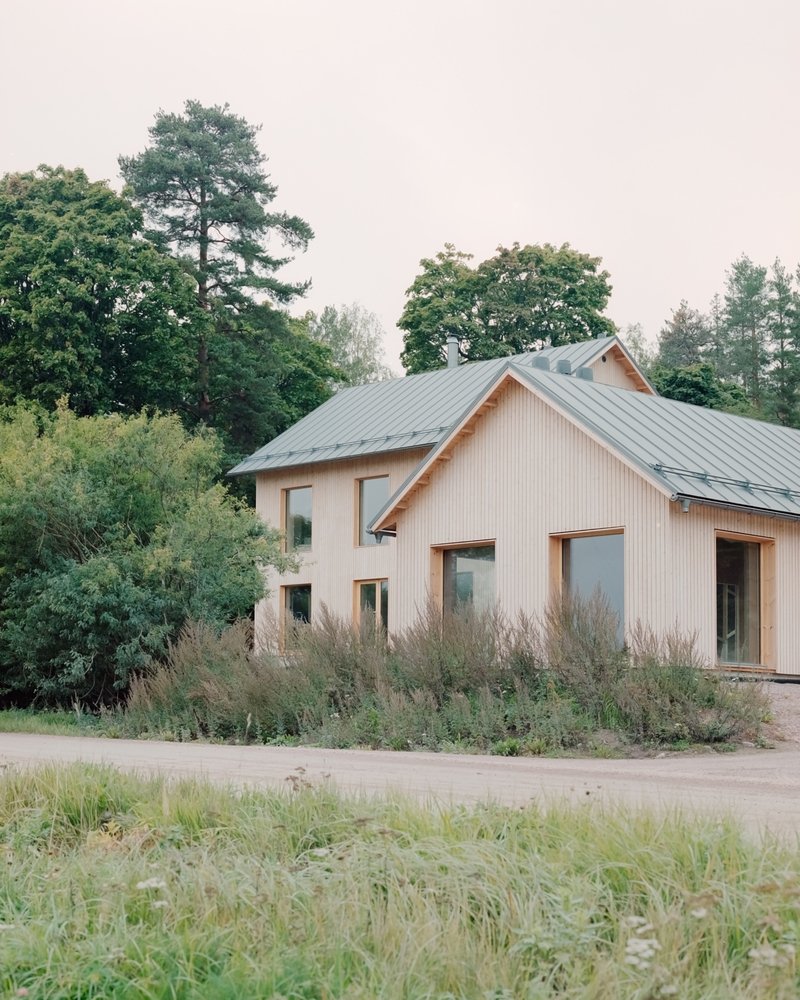
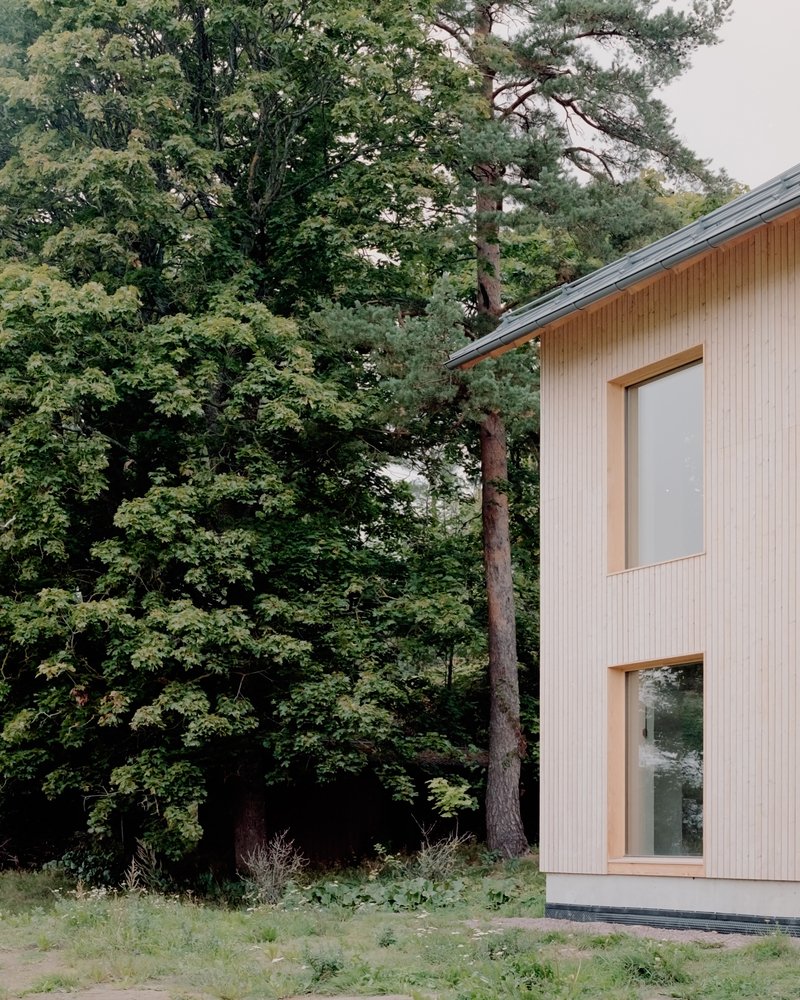
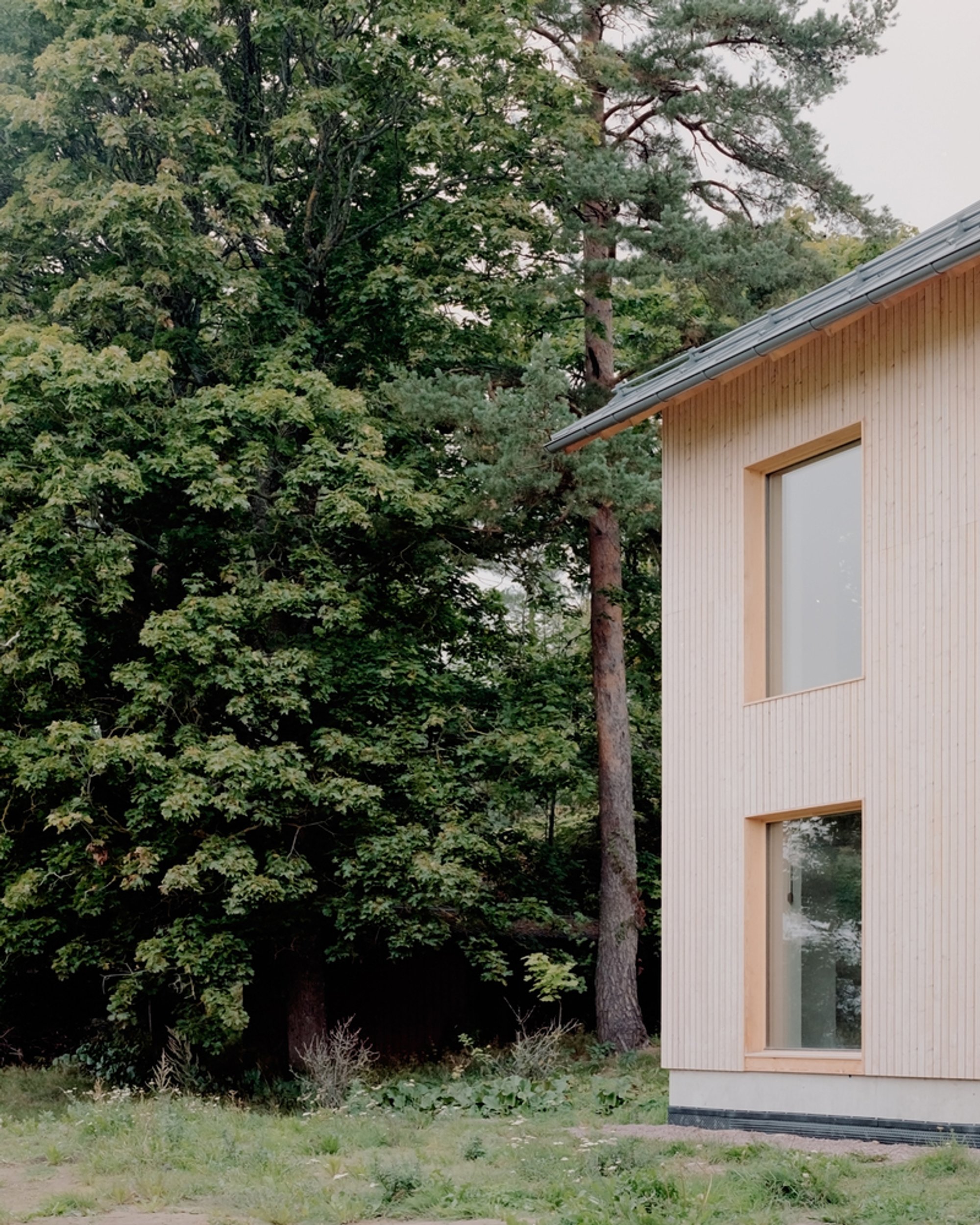
The exterior reads as two simple pitched volumes clad in Organowood-treated spruce boards set vertically. The treatment eliminates the need for periodic repainting, a practical concession to the Finnish climate that also gives the facades a uniform silver-grey tone as they weather. Stacked window openings are set deep, roughly half a meter into the wall thickness created by the 40-centimeter Ecococon straw panels. Those recesses are not just a byproduct of insulation depth; they frame views like small telescopes and throw dramatic light across the clay-plastered reveals inside.
Siting the house on bedrock among mature pines and deciduous trees required a light footprint. The two volumes sit modestly among the canopy rather than clearing it, and the metal roofline keeps a low profile against the treetops. The result is a house that looks like it could have been here for decades, quietly absorbing the granite and lichen palette of coastal southern Finland.
The Terrace as a Threshold
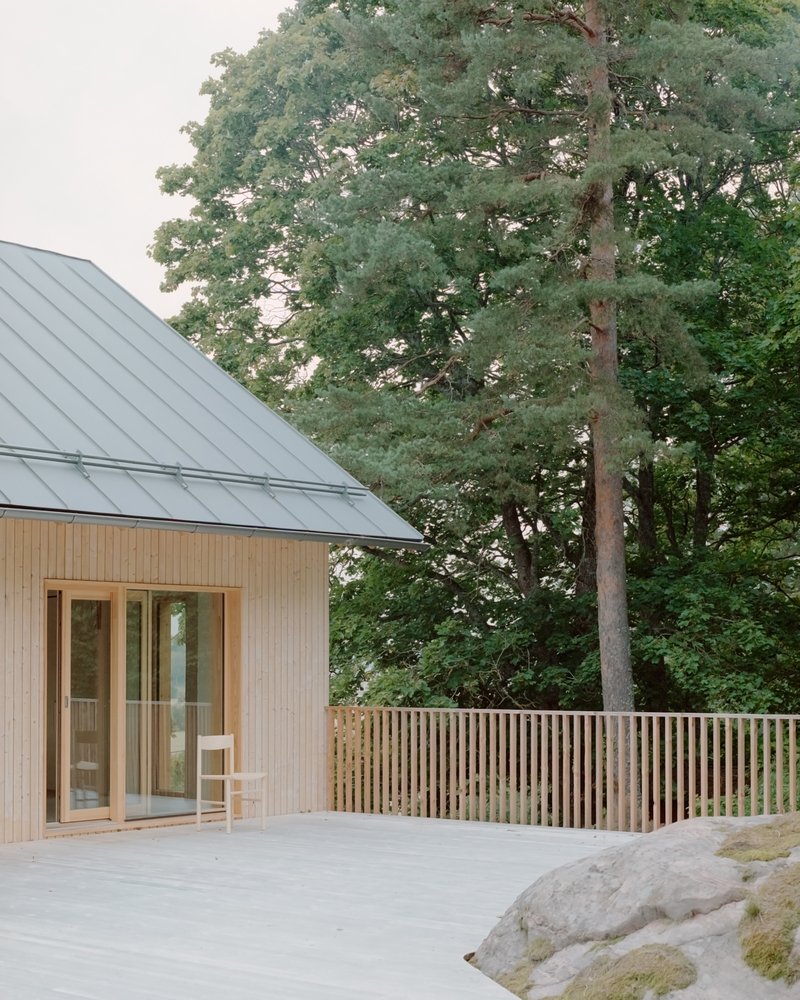
A 70-square-meter terrace extends from the upper floor, where the main living spaces are located. Collaboratorio positioned the living areas above grade to capture long views over the rocky terrain and surrounding forest. The terrace acts as a generous threshold between the interior and the landscape, blurring the boundary in a way that the deep-set windows alone cannot. Vertical timber slat railings maintain a visual rhythm with the facade cladding while allowing air and light to pass freely.
An existing pine tree rises through the deck, preserved in place. It is a small gesture, but it signals the project's broader attitude toward the site: the architecture defers to what was already there. The ground-floor bedrooms, in turn, open directly onto the garden, giving every member of the family their own calibrated relationship with the outdoors.
Clay, Straw, and the Warmth of Raw Materials
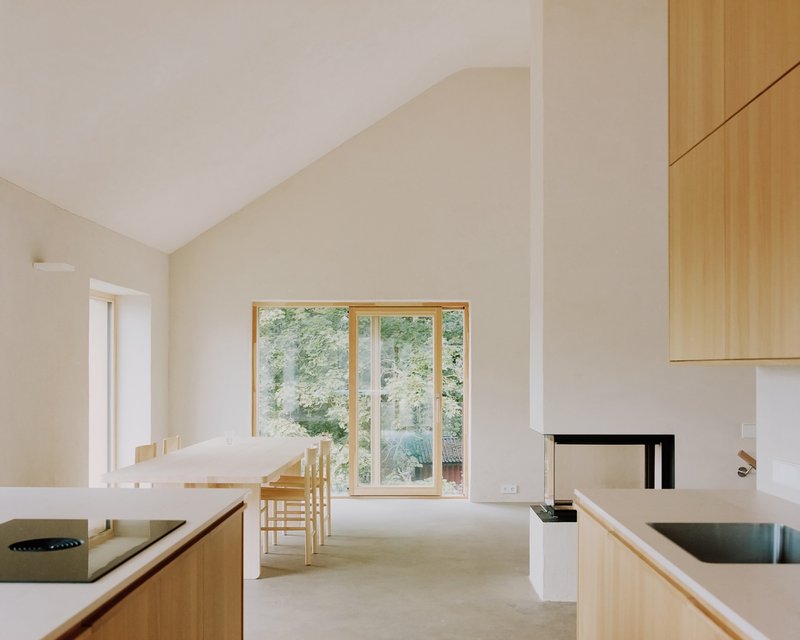
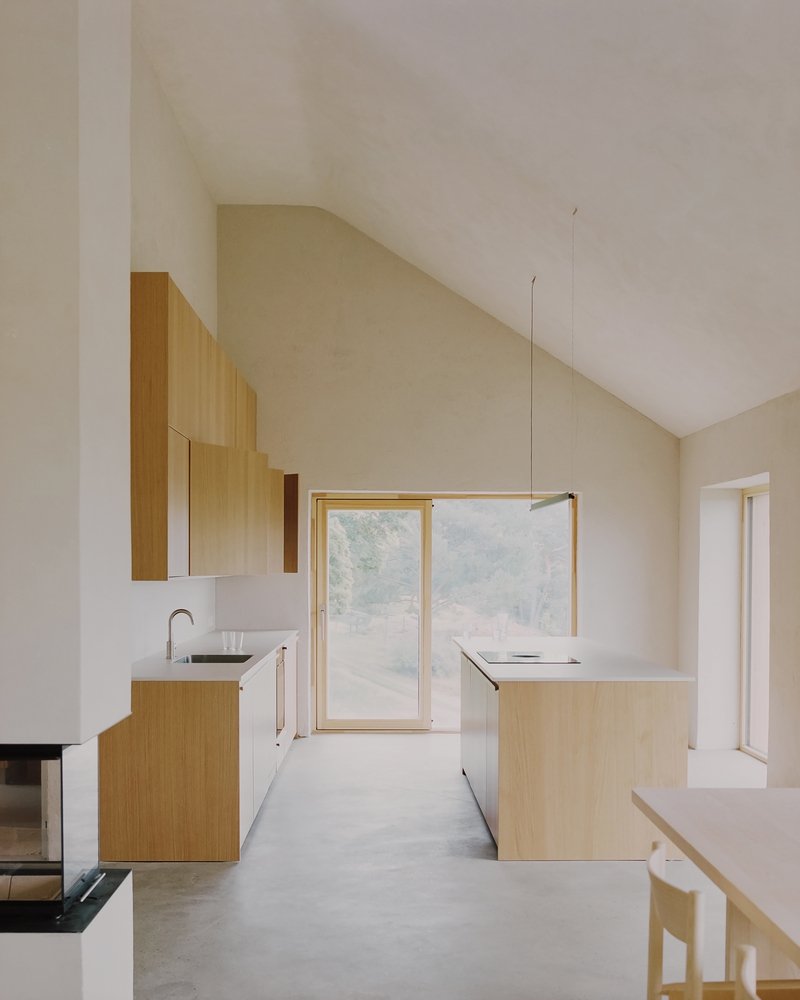
Step inside and the material logic becomes tactile. The vaulted ceiling follows the pitch of the roof, clad in light timber that amplifies the sense of volume in what is, by square meters, a compact house. Walls are finished in clay plaster, hand-applied by craftspeople from Rouhis, producing a softly textured surface that absorbs sound and regulates humidity. The rammed earth floor, a mix branded as Luonnonbetoni, incorporates Finnish clay and acts as thermal mass, storing and slowly releasing the geothermal heat that warms the house.
The kitchen anchors the upper-floor plan with a one-meter-wide, three-meter-long island that doubles as the family's everyday gathering point. Birch cabinetry lines the wall behind it, paired with a pendant light that hangs from the ridge. Glazed doors at the end of the room open directly to the terrace and the garden beyond, pulling daylight deep into the plan. Interior doorways are full height, reaching to the ceiling line, which eliminates the horizontal break of conventional head frames and makes the rooms feel taller and more continuous than their dimensions suggest.
Living with Fire and Light
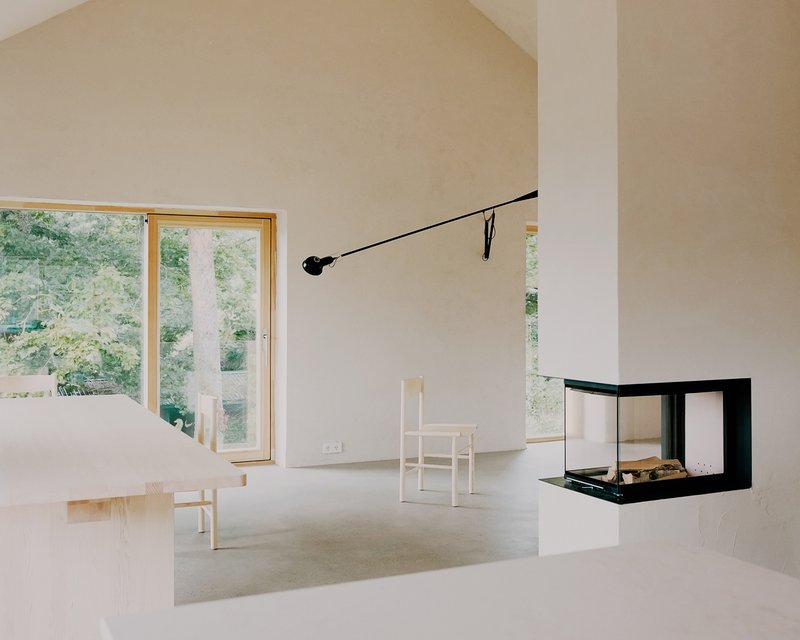
The living room centers on a three-sided fireplace insert set into a clean, plaster-finished volume. An articulated swing-arm wall lamp, one of several carefully chosen fixtures from brands like FLOS and Luceplan, reinforces the room's character: precise, functional, and deliberately restrained. Timber chairs sit nearby, their material and grain echoing the spruce cladding outside and the oak stair treads that connect the two floors.
Collaboratorio's minimalism here is not the minimalism of omission. Every surface is doing thermal, acoustic, or structural work. The clay plaster breathes, the straw insulates, the rammed earth stores heat, and the wood ties the palette together visually. The architects describe their approach as drawing on vernacular solutions tested over centuries, then adapting them to Finnish climate conditions and contemporary prefabrication technology. It is a credible claim. The rooms feel inhabited by their materials rather than decorated with them.
Why This Project Matters
Villa Koppar matters because it closes a gap that most sustainable housing still leaves wide open: the gap between environmental performance and spatial quality. Plenty of passive houses hit their energy numbers. Far fewer produce rooms you actually want to sit in, lit by deep window reveals, warmed by rammed earth underfoot, and surrounded by walls that smell faintly of clay. Collaboratorio demonstrates that biogenic construction is not a compromise or a back-to-the-land concession. It is a live, industrially scalable building method that can outperform conventional systems on comfort, carbon, and cost.
For a young family working within a limited budget, this house offers something even more valuable than low operating costs. It offers specificity. The clay comes from Kouvola. The spruce weathers to match the granite it sits on. The straw panels were manufactured in a factory and assembled on site in a fraction of conventional construction time. Villa Koppar is not a prototype or a manifesto pavilion. It is a family home, quietly proving that the future of residential construction in northern Europe might look less like engineered panels and triple glazing and more like straw, clay, and timber, the same materials that kept people warm here a thousand years ago.
Villa Koppar by Collaboratorio, Kopparnäs, Inkoo, Finland. 180 m². Completed 2023. Photography by Simone Bossi.
About the Studio
Share Your Own Work on uni.xyz
If projects like this are the kind of work you want to make, uni.xyz is a place to publish your own, find collaborators, and enter design competitions.




Popular Articles
Popular articles from the community

Residence BB 214: Quiet Precision in Ludhiana
Minimalist Architecture & Design Studio composes a residence of white volumes, filtered light, and deliberate restraint in Punjab's urban fabric.
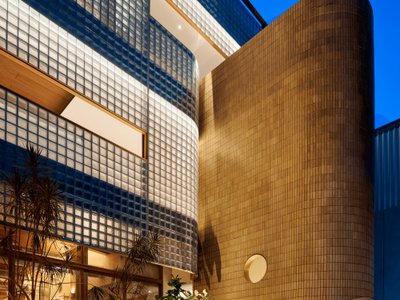
Gunawarman 35: Jakarta's Corner of Quiet Complexity
WOFF's mixed-use building in Jakarta pairs translucent glass block walls with a buff brick cylinder to hold coffee, wellness, and work under one roof.

Filtering Space: A Gradual Spatial Experience
From urban intensity to spatial calm.
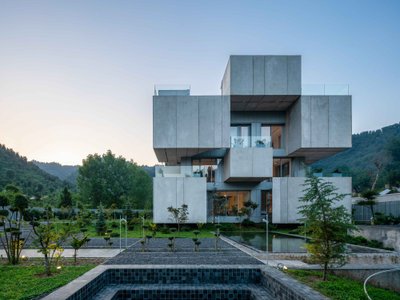
Bood Design Bureau Splits a Gilan Residence in Two to Let the Forest In
Double Side House negotiates privacy and openness through interlocking concrete volumes and planted courtyards in northern Iran's humid Caspian lowlands.

Similar Reads
You might also enjoy these articles
Filtering Space: A Gradual Spatial Experience
From urban intensity to spatial calm.


The Ken Roberts Memorial Delineation Competition (Krob)
As the most senior architectural drawing competition currently in operation anywhere in the world, it draws hundreds of entries each year, awarding the very best submissions in a series of medium-based categories.


Waterfront Redevelopment and Urban Revitalization in Mumbai: Forging a New Dawn for Darukhana
A transformative waterfront redevelopment project reimagining Darukhana’s shipbreaking heritage into an inclusive urban future.

OUT-OF-MAP: A Call for Postcards on Feminist Narratives of Public Space
Rhizoma Design and Research Lab invites artists, designers, architects, researchers, and students to reflect on how feminist perspectives can reshape public space. Selected works will be exhibited in Barcelona, October 2026. Submissions open until 15 April 2026.

Explore Architecture Competitions
Discover active competitions in this discipline




The International Standard for Design Portfolios


The Global Benchmark for Architecture Dissertation Awards


The Global Benchmark for Graduation Excellence


Challenge to reimagine the Iron Throne
Comments (0)
Please login or sign up to add comments
No comments yet. Be the first to comment!