
STAM Arkitekter Lifts a Trio of Timber Gables Above the Rocky Shore of Sweden's Orust Island
Villa Ulvås perches on concrete piers over granite outcrops, letting the west coast landscape flow unbroken beneath it.


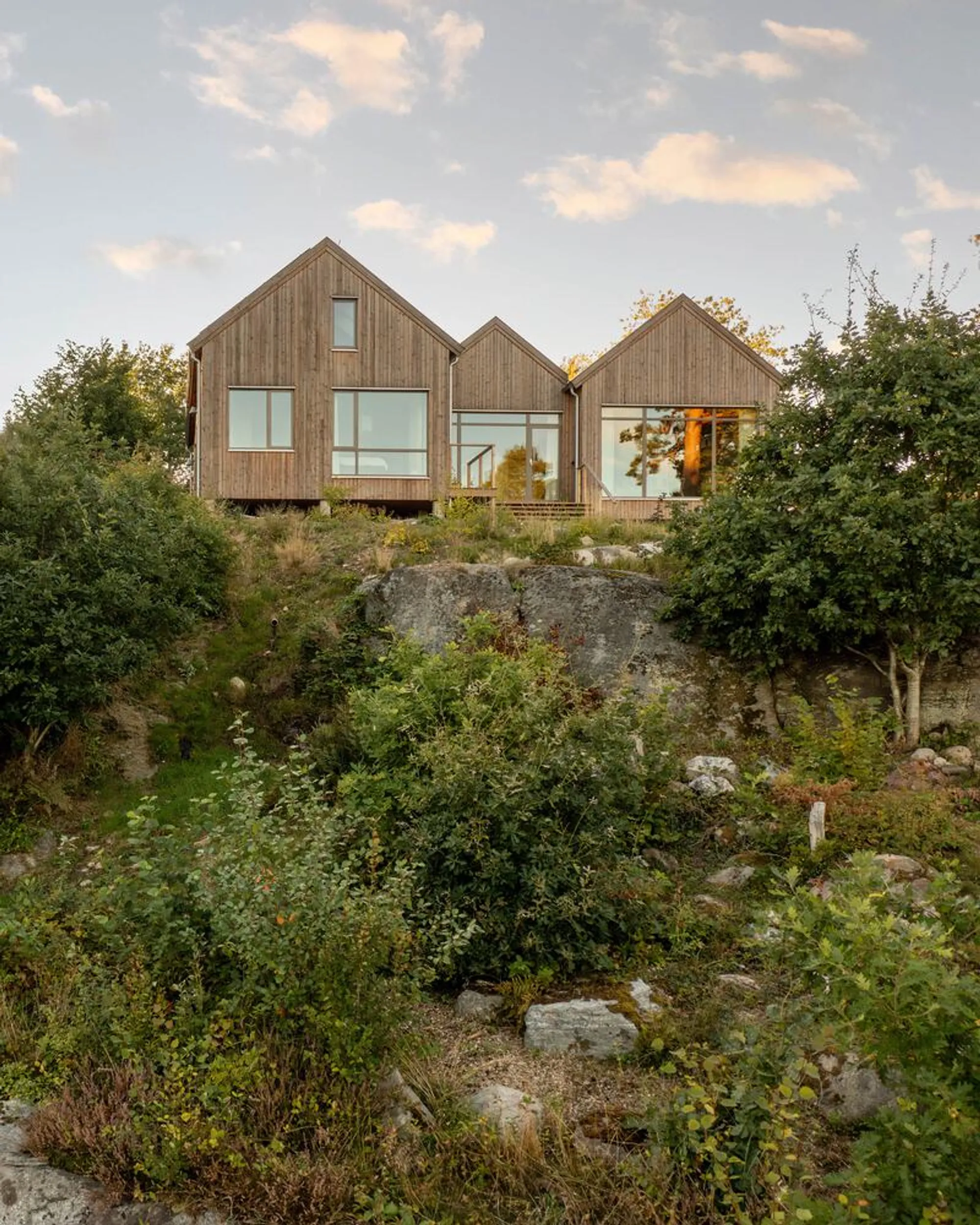
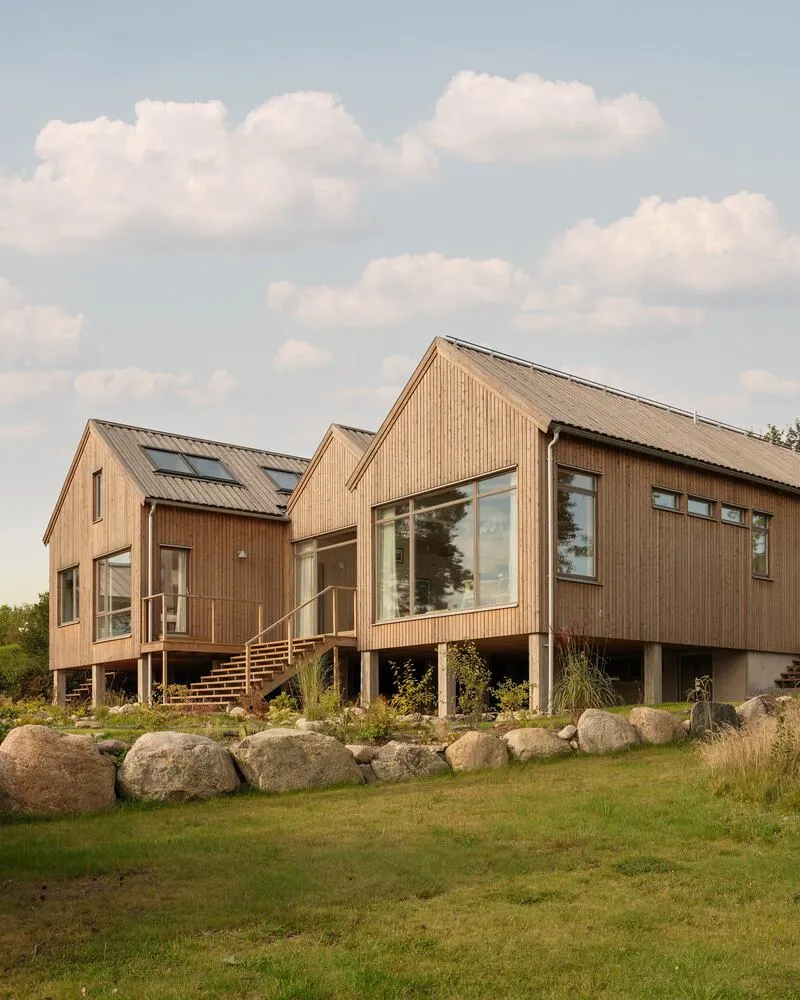
On the island of Orust, where Sweden's west coast fractures into a labyrinth of fjords and pine-covered rock, STAM Arkitekter has planted a house that refuses to flatten its site. Villa Ulvås is composed of three gabled volumes, each clad in linseed oil-treated pine, offset from one another and lifted clear of the granite on slender concrete piers. The strategy is disarmingly simple: rather than carving a platform into the slope, let the ground keep its contour and raise the architecture above it. What results is a house that reads less as an object on a hillside and more as a canopy drifting between the trees.
The genuinely interesting move here is not the material palette, though it is handled with care, nor the gable silhouette, which is familiar enough in Nordic residential work. It is the decision to treat the building as a cluster rather than a bar. Three parallel volumes generate sheltered pockets of outdoor space: decks, courtyards, a stone-edged garden path. The house wraps around its own microclimate, creating calm zones on an island where wind is a constant companion. That interplay between exposure and protection is the organizing idea, and everything from structural logic to interior sequence follows from it.
Touching the Ground Lightly
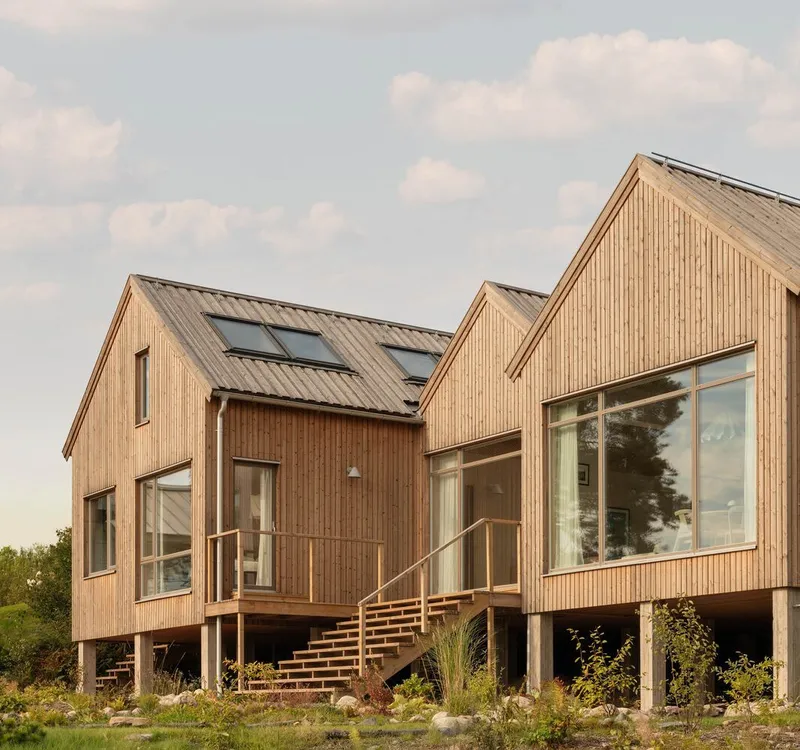
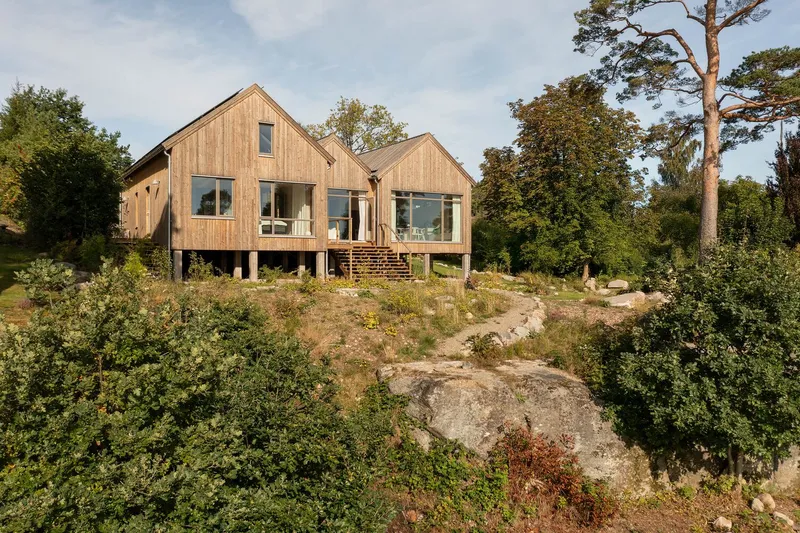
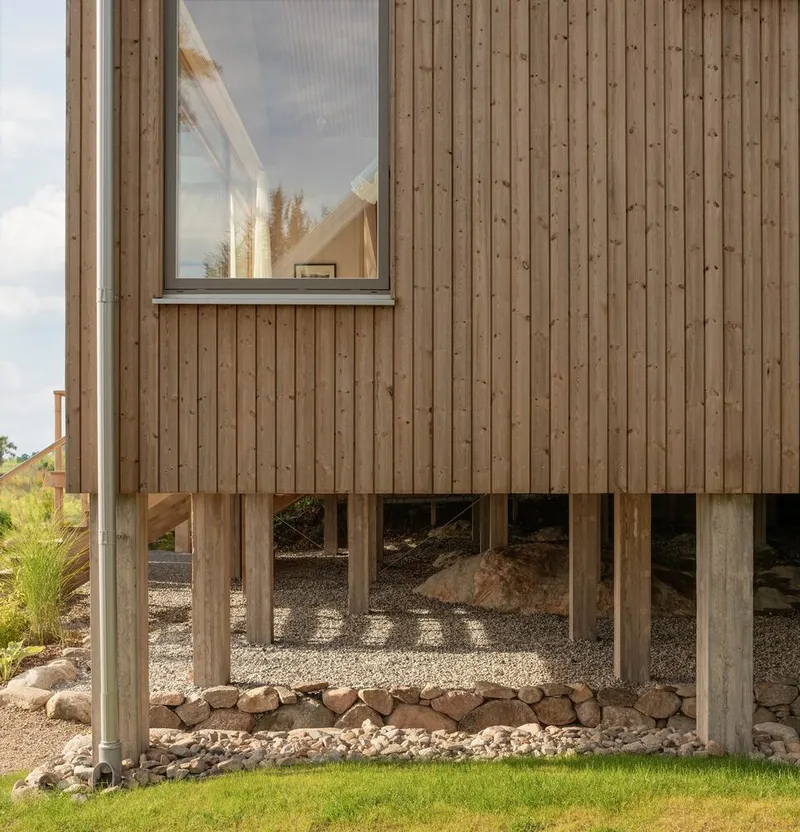
The concrete piers that support Villa Ulvås are among its most consequential design decisions. Orust's terrain is a geology lesson in granite: boulders break the surface everywhere, and the thin topsoil supports only wild grasses and low scrub between the pines. Excavating a conventional foundation would have meant dynamiting rock, removing vegetation, and regrading the slope. Instead, the cylindrical piers land on point loads, allowing water, roots, and air to continue moving beneath the floor plate.
Lifting the house also changes how it is perceived from a distance. The undercroft creates a visible gap of daylight between structure and ground, so the building never appears to weigh down its setting. From the waterside, the three volumes seem to hover above the rocky outcrop, their timber cladding catching the same amber tones as the surrounding pine bark. The exposed wooden posts visible in certain sections suggest a secondary structural language, a timber subframe working with the concrete to carry the loads without over-engineering the joints.
Three Gables, One Rhythm
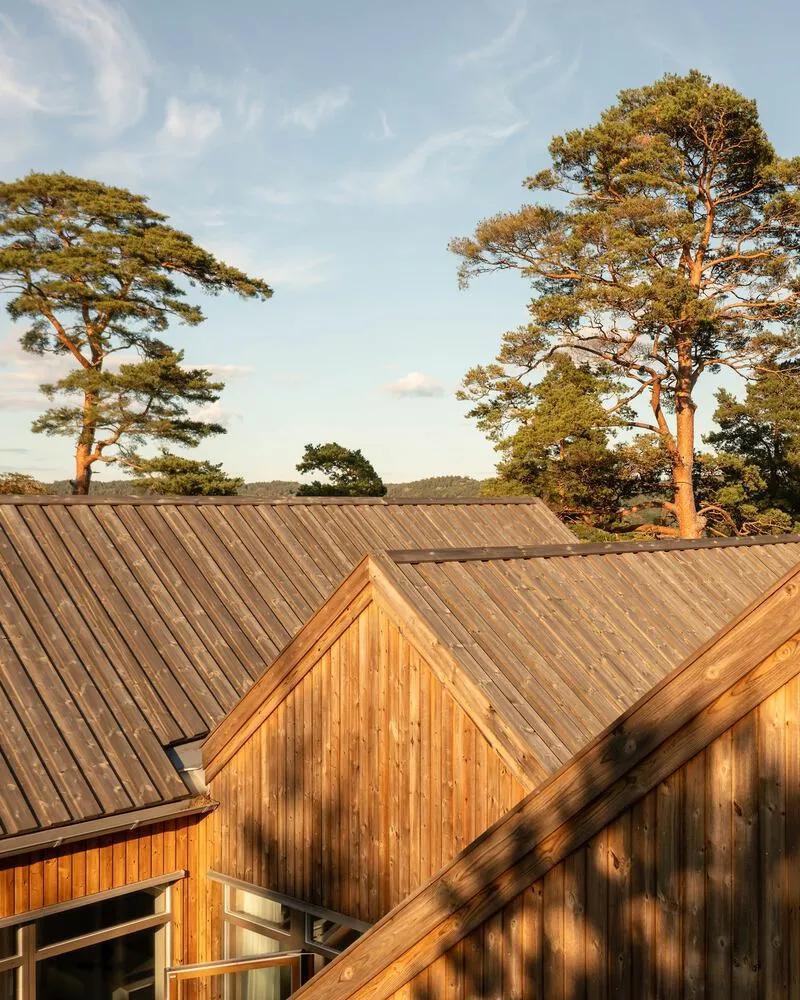
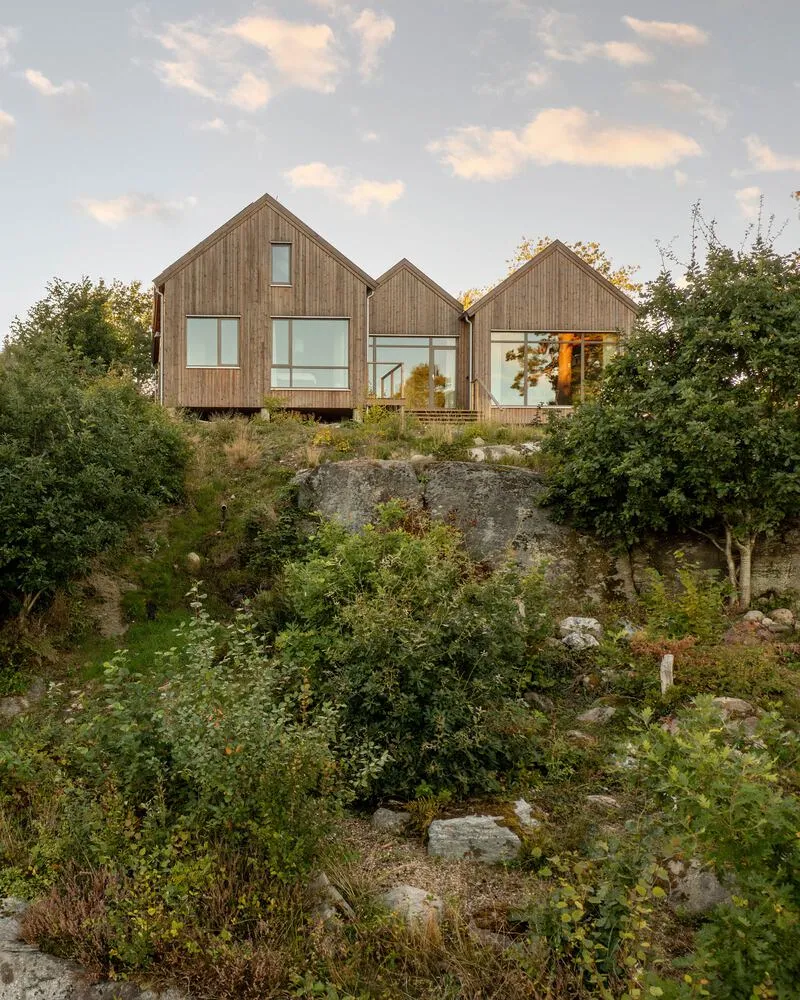
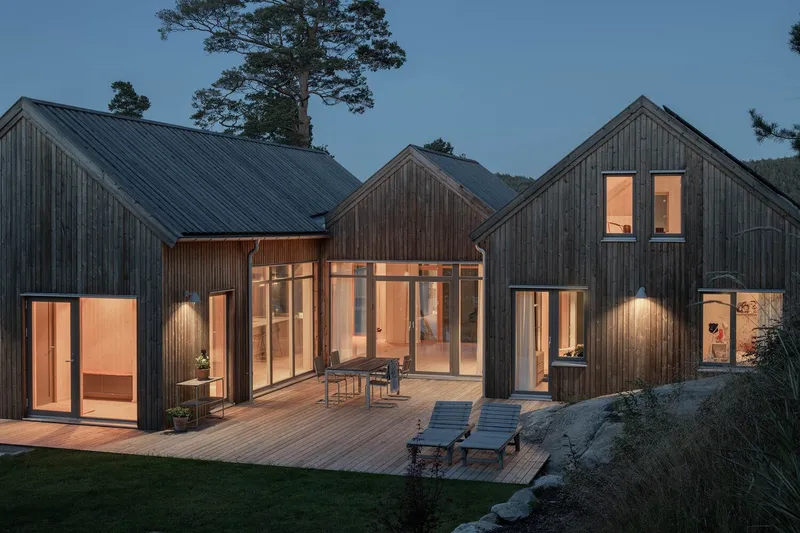
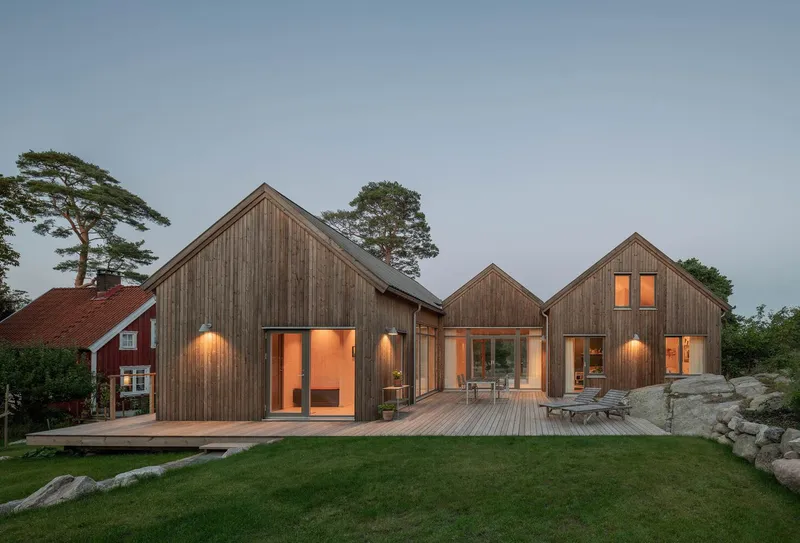
The compositional logic of three offset gabled volumes gives Villa Ulvås a rhythm that a single elongated bar could never achieve. Each volume has its own ridge line, its own pitch, and its own orientation, yet the trio reads as a unified family of forms. The gaps between them are as deliberate as the solids: they admit light, frame views of the canopy, and allow wind to pass through rather than slam against a single facade.
At dusk, the cluster effect intensifies. Interior lighting turns the glazed openings into lanterns, and the overlapping roof profiles create a silhouette that echoes the irregular skyline of the pines behind. There is a domestic scale to each individual gable that prevents the total composition from feeling monumental. You could read each volume as a room made visible from the outside, and in many ways that is exactly what they are.
The Deck as Connective Tissue
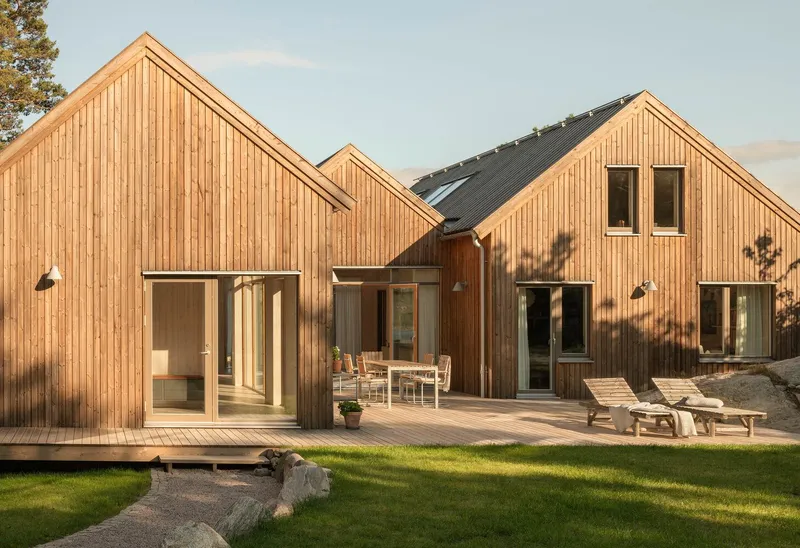
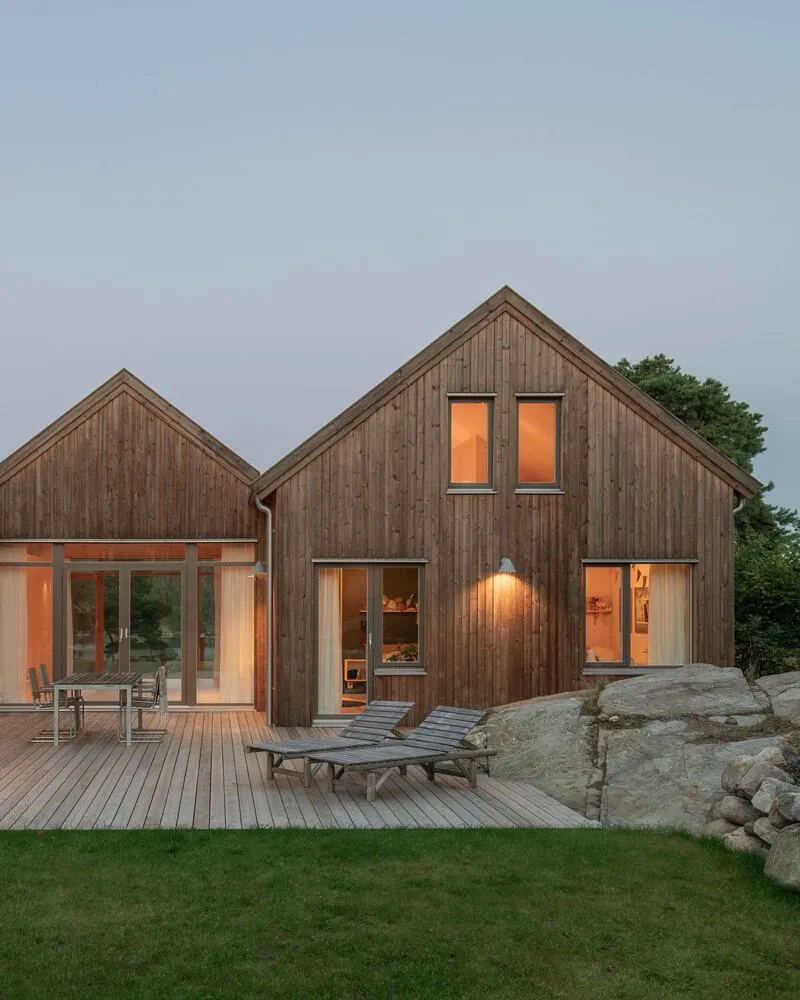
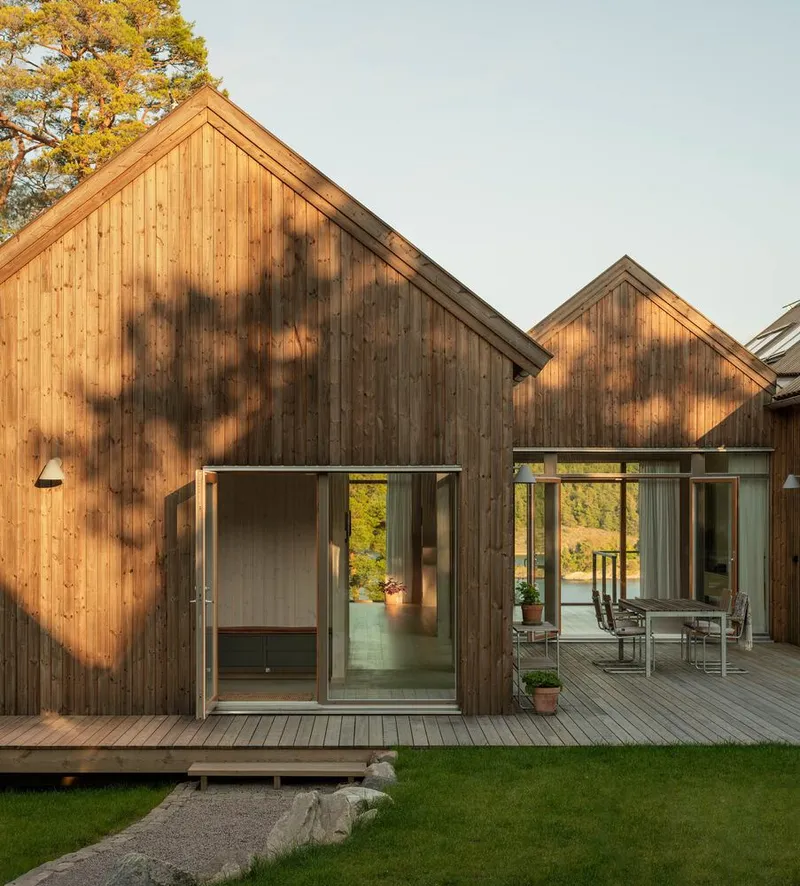
Scandinavian residential architecture lives and dies by its outdoor rooms, and Villa Ulvås treats its timber decks as full participants in the spatial plan. A southwest-facing terrace stretches between the volumes, collecting evening light and framing views down toward the water. Lounge chairs face inward as much as outward, a detail that reveals how the architects conceived the space: the illuminated interiors at twilight become a backdrop as compelling as the landscape itself.
Where the deck meets the granite, the transition is handled without fuss. Boulders push up against the platform edge, and the timber boards simply stop. There is no retaining wall, no planter box pretending the rock is not there. The honesty of that junction reinforces the broader argument of the project: this is a house that accommodates its site rather than the other way around.
Timber Skin and the Promise of Patina
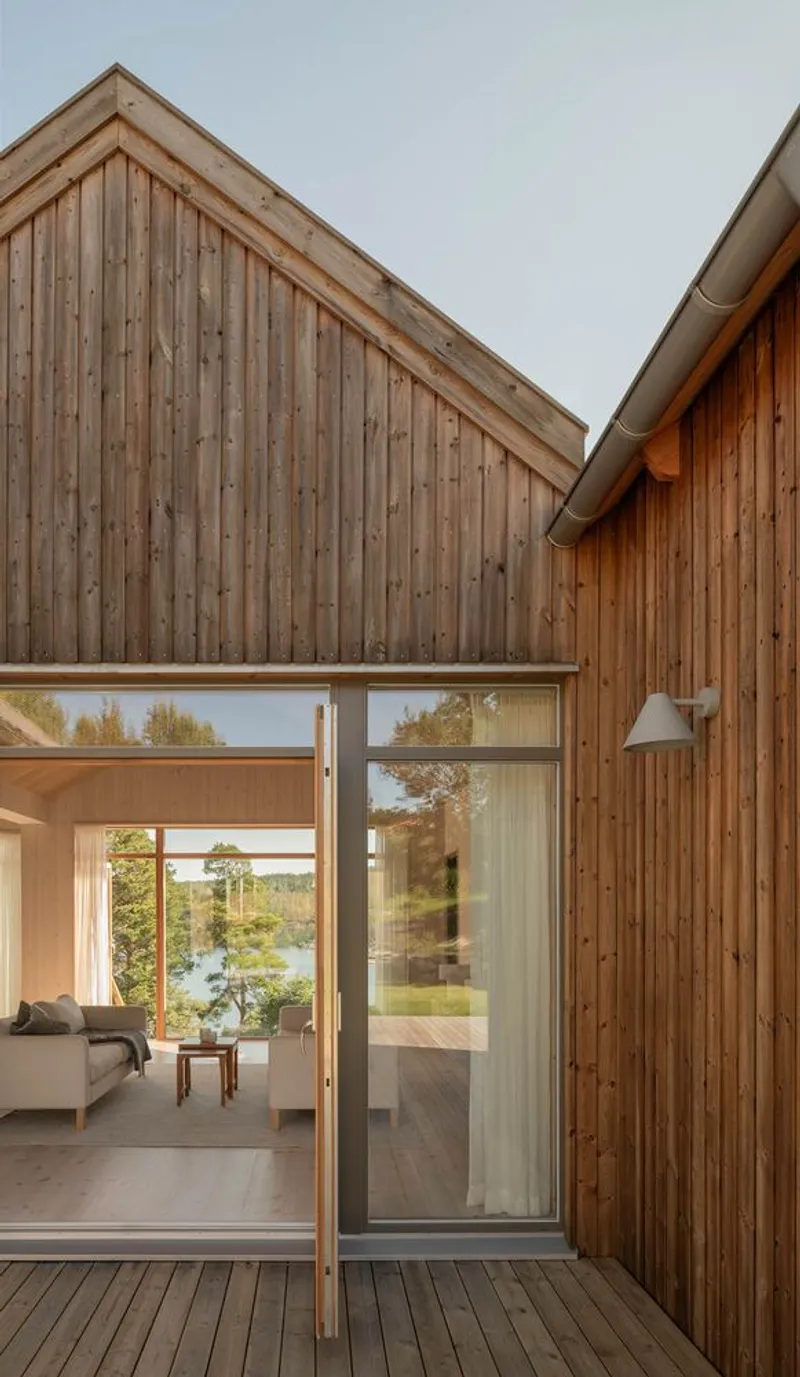
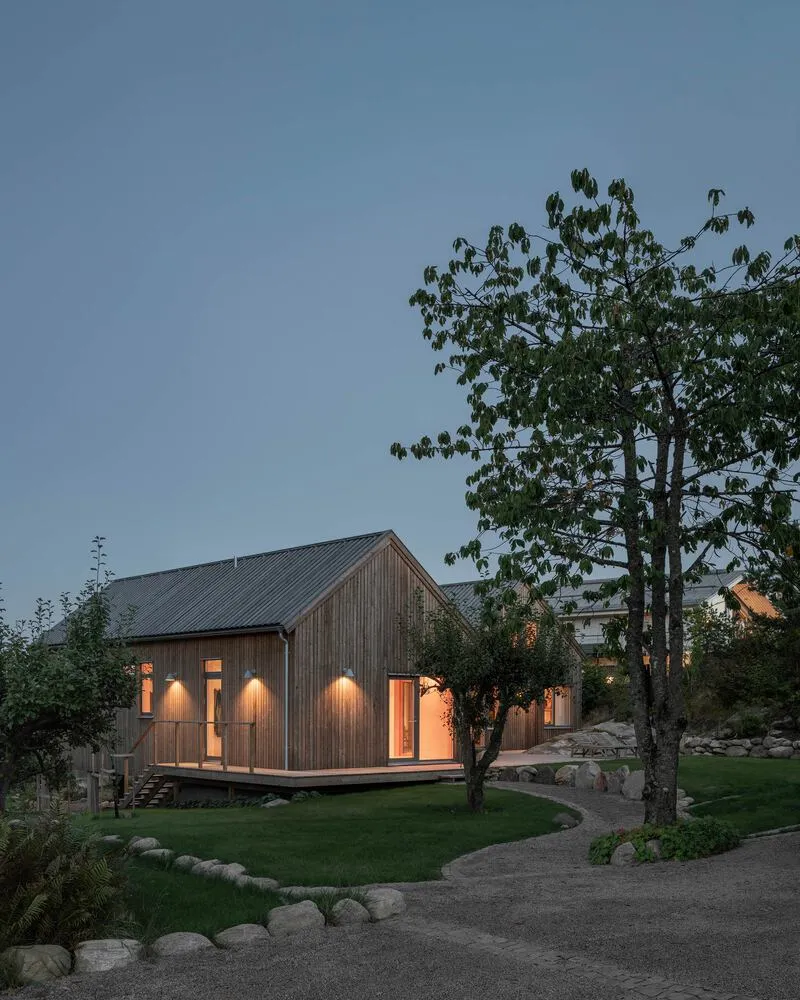
The exterior cladding is vertically oriented pine treated with linseed oil, a traditional Scandinavian finish that sidesteps the synthetic preservatives common in coastal construction. Over time, the boards will silver to a driftwood grey, bringing the house closer in tone to the lichen-covered rock and weathered tree trunks that surround it. The choice acknowledges that a building on an exposed coast is going to change appearance whether you want it to or not; better to design for that change than fight it.
Corner details are clean but not precious. The gable ends meet the wall planes with tight joints, and the vertical grain of the cladding emphasizes the height of the pitched roofs. Wall-mounted exterior sconces cast warm pools of light against the timber at night, pulling the texture of the wood grain into sharp relief. These are small gestures, but they reveal a project where craft decisions were made at the scale of the joint, not just the massing model.
Glass, Views, and Controlled Exposure
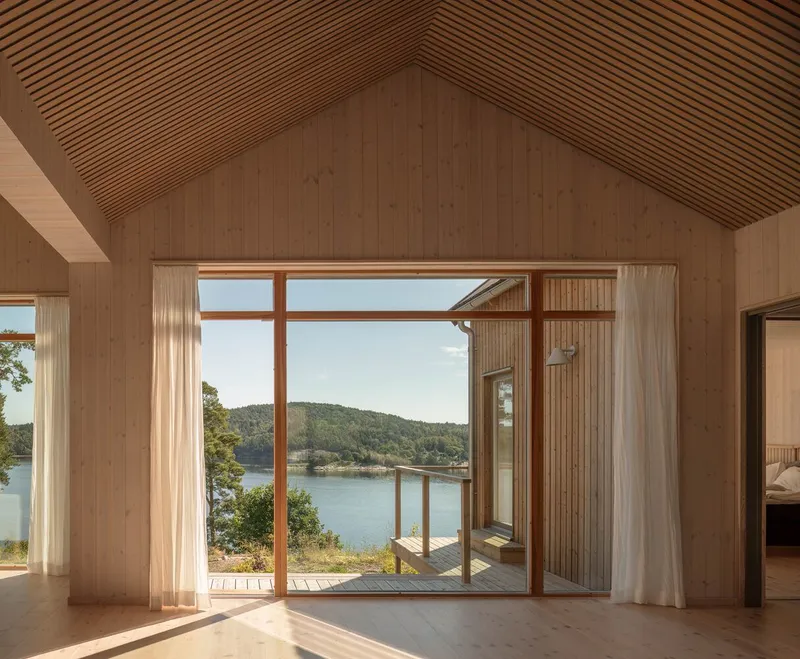
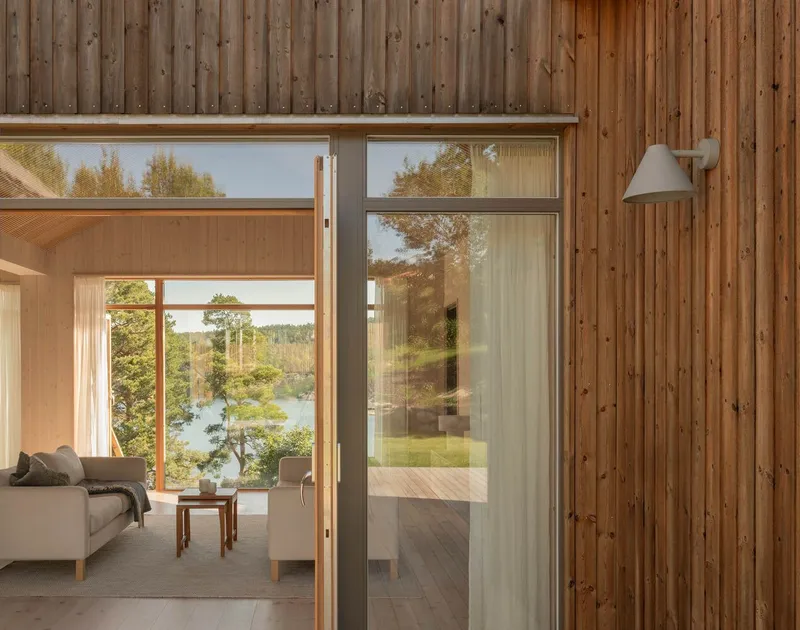
Full-height glazed doors appear on nearly every facade, but their placement is anything but uniform. Some open directly onto the deck; others frame a narrow slot of waterfront through the pines. Inside, a slatted wood ceiling runs overhead, its rhythm picking up the vertical lines of the exterior cladding and pulling the eye toward the landscape beyond. The effect is cinematic: you are always aware of the outdoors, but the view is always edited.
The interplay between solid timber wall and transparent opening controls both heat gain and privacy. On the garden side, larger windows admit afternoon sun; on the exposed flanks, glazing is more restrained. The house does not advertise itself to every angle equally. From certain vantage points it presents almost entirely as timber, a warm, opaque mass. From others, it dissolves into glass and light. That duality keeps the architecture unpredictable as you move around it.
Landscape as Architecture
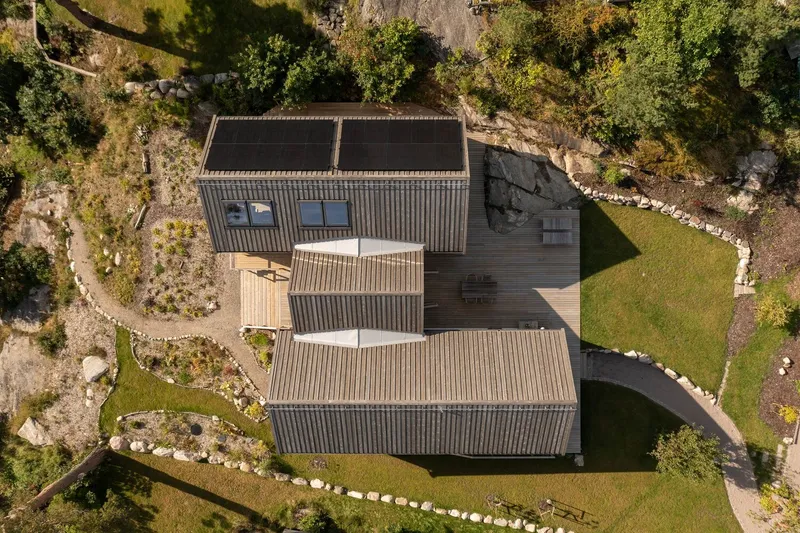
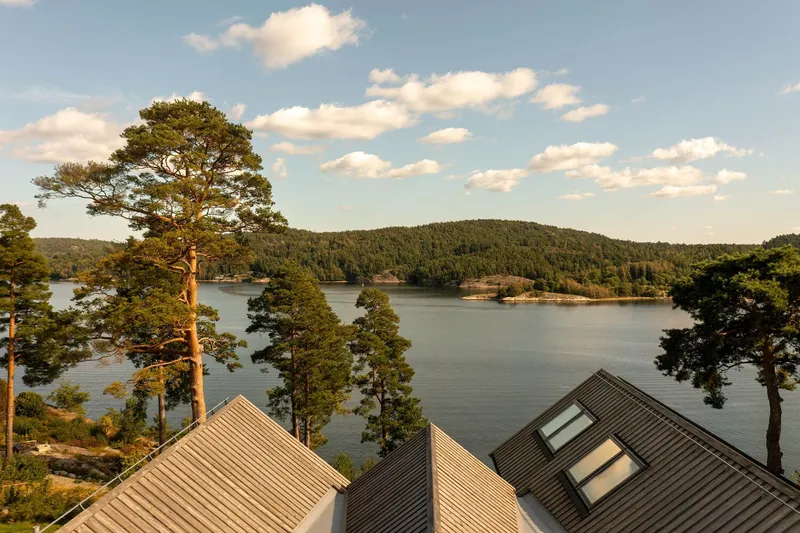
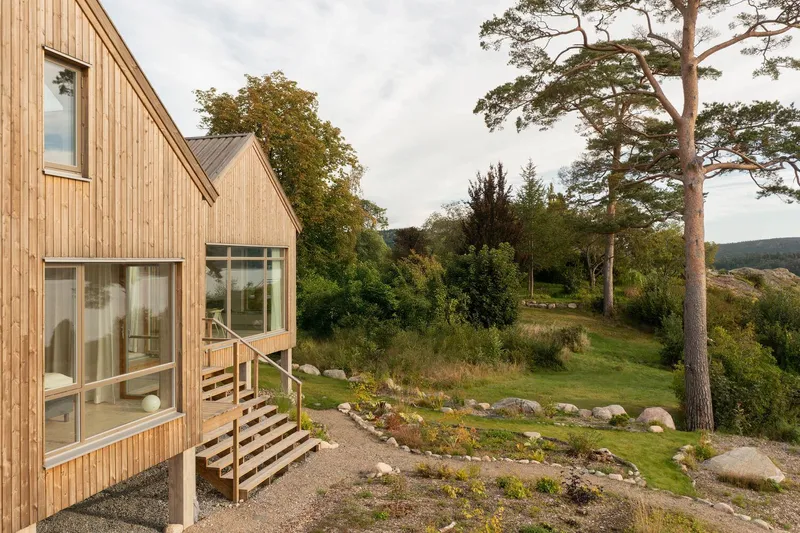
An aerial reading of the site reveals how carefully the ground plane has been composed. A stone-lined garden path threads between the volumes, with a modest lawn filling the sheltered court. Beyond that green pocket, the terrain returns to its natural state: scattered boulders, wild grasses, and the ubiquitous Scots pines that define the Orust shoreline. The transition from cultivated to wild is gradual and convincing.
From above, the metal-clad roofs with their punched skylights register as a fourth landscape layer, sitting between canopy and rock. The skylights are not decorative; they deliver zenith light into the interior, reducing dependence on the lateral glazing during winter's short days. The overall composition, house, garden, forest, and water, reads as a single system rather than a building imposed on a backdrop.
Plans and Drawings
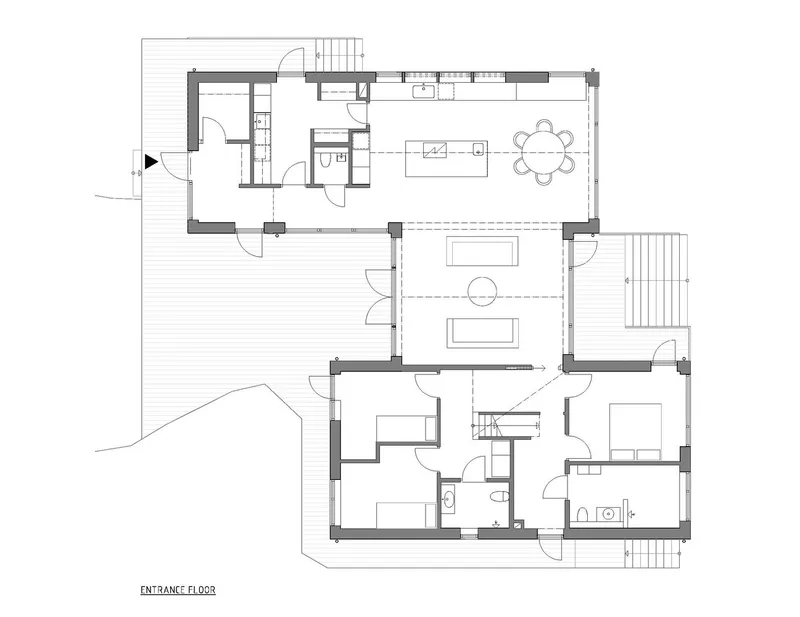
The entrance-level plan confirms the three-volume strategy in plan. Living and dining areas occupy the central and largest gable, with bedrooms and bathrooms distributed across the flanking volumes. The offset geometry creates a pinch point at each junction, an implied threshold that lets you feel the transition from communal to private space without a door. Corridors are kept tight, reinforcing the sense of expansion when you arrive in the main rooms.
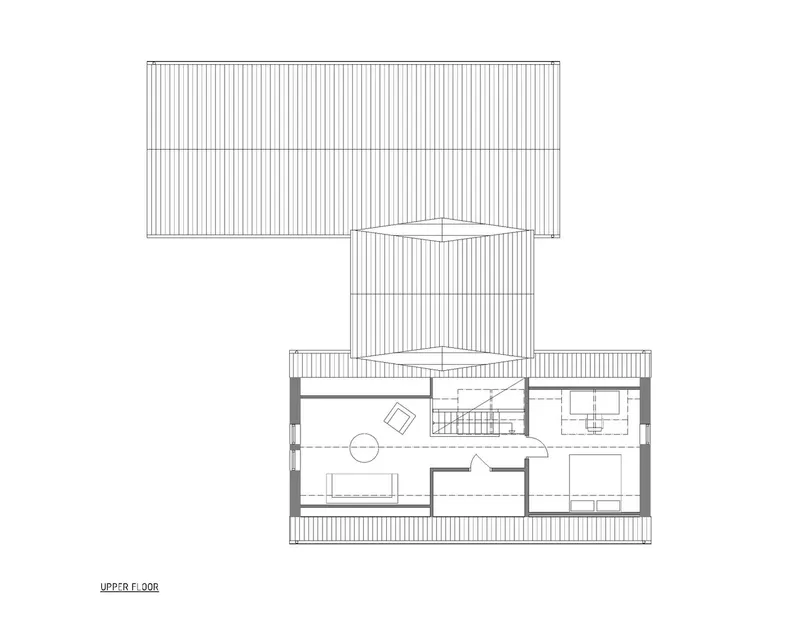
The upper floor is compact, tucked beneath the pitched roof with a central stairwell acting as the hinge between sleeping quarters. The drawn roof outline shows the steep pitch clearly, a proportion that sheds snow, resists wind uplift, and creates generous ceiling heights inside without adding a full second story. It is a plan that earns its complexity: every offset serves a functional or experiential purpose.
Why This Project Matters
Villa Ulvås is not reinventing the Scandinavian timber house. It is refining a well-understood typology by taking its site conditions seriously at every scale, from the decision to use point-load piers down to the orientation of each glazed opening. The result is a house that performs well against coastal wind and rain while remaining generous and open in its interior experience. That balance is harder to achieve than it looks, and STAM Arkitekter has pulled it off without resorting to formal gymnastics or material spectacle.
For architects working on exposed coastal sites anywhere in northern Europe, the project offers a clear lesson: fragmenting volume can be more effective than fortifying it. Three modest gables sheltering a shared court outperform a single monolithic form in terms of wind management, scale, and spatial variety. Villa Ulvås succeeds because it treats the harsh climate not as a problem to solve but as a design parameter to embrace, and the house is richer for it.
Villa Ulvås by STAM Arkitekter. Located on the island of Orust, Sweden. Photography by James Silverman.
About the Studio
Share Your Own Work on uni.xyz
If projects like this are the kind of work you want to make, uni.xyz is a place to publish your own, find collaborators, and enter design competitions.



Popular Articles
Popular articles from the community


Hill & Cross Opera: Sculptural Opera House Architecture Shaped by Tallinn’s Landscape and Identity
Hill & Cross Opera reimagines opera house architecture in Tallinn through its sculptural hill, civic plaza, glass wave and a luminous cross.

Co-Life: Senior Housing Design That Reconnects Older Adults With the City
Co-Life reimagines senior housing design through healing gardens, shared streets, workshops, and a sustainable community across generations.

The Earth Pod: 3D Printed Homes for Resilient Refugee Communities
The Earth Pod reimagines refugee housing through 3D printed homes made from clay, combining resilience, self-sufficiency, and rapid shelter.

Riyadh For All: Intergenerational Urban Design for Active Aging in Rabat
Riyadh For All reimagines urban design in Rabat with intergenerational co-living, adaptive courtyards, and Moroccan cultural exchange today.


Similar Reads
You might also enjoy these articles


Hodi-Mandai Geram
Project Function: Preservation and revitalization of the Intangible heritage and socio-spatial identity of the Hodi by Housing, Cultural Memory Center, Sacred Grove, landscape, local tourism economy


Olio Towers: A Mid-Rise for Performers That Fuses Housing, Rehearsal, and Stage
Located blocks from Houston's Theater District, this modular tower stacks living units around a central performance atrium.

Oasis: Modular Green Housing Carved into Dhaka's Urban Fabric
A shortlisted Plugin Housing entry reclaims unauthorized settlements in Dhaka with stepped concrete volumes, green roofs, and ventilation-driven design.

Black Hole: A Floating Megastructure for the Post-Physical Era
Emiliano Mazzarotto envisions a spherical, self-scaling arena where e-sports, digital hotels, and holographic stadiums replace traditional public space.
Explore Architecture Competitions
Discover active competitions in this discipline



Challenge to reimagine the Iron Throne


Photograph architecture without architects


Illustrate the lost glory of Angkor Wat - Render Challenge


Design challenge to reuse E-waste
Comments (0)
Please login or sign up to add comments
No comments yet. Be the first to comment!