
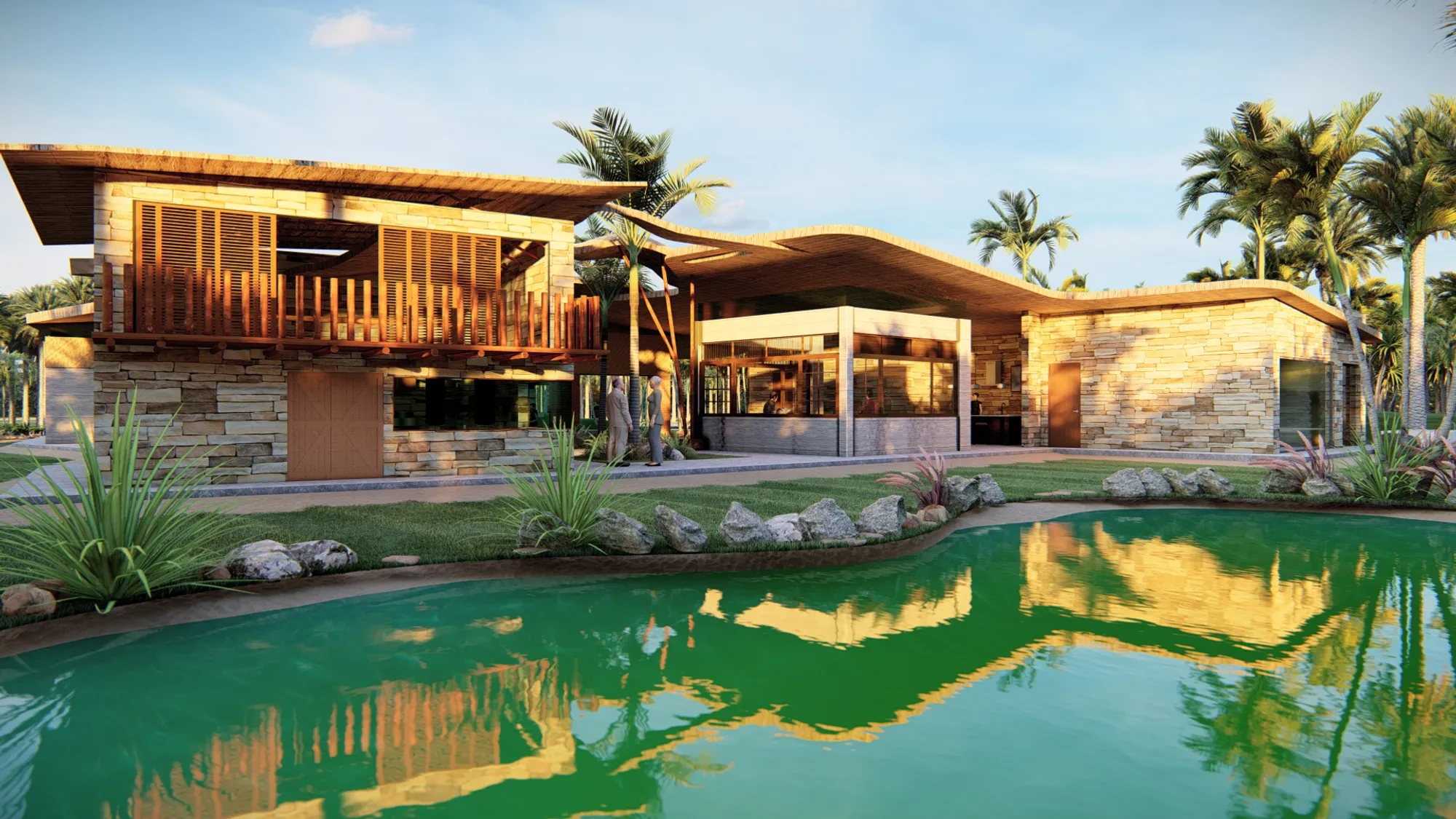
Villa Vernacular
Ceilo Y Tierra Casa

The user is a family of 5, which includes an individual of age 49, both of his parents, his wife, and a son. The provider of the house is a software engineer who tends to work 5 days a week. Besides working as an engineer, the individual is also a very passionate wildlife photography enthusiast. Every weekend, he travels to different landscapes, which could be mountains, deserts, coastal areas, or forests, and explores them extensively. He comes across new, and sometimes rare, species of flora and fauna. His dedication and passion have led him to read innumerable books on traveling, photography, flora, and fauna. Some of the books are, "Birds of India, Threatened Birds of Uttarakhand, Birds of Himachal Pradesh, Threatened Birds of India, Birds of Indian Subcontinent, Man-Eaters of Kumaon, the Snow Leopard". His commitment has helped him master a perfect balance between his job and the side hustle. Being a wildlife photographer, his camera and its equipment are top tier and take up a lot of storage space.
The wife is a homemaker and looks after the family needs. She also backs the husband up when needed, be it his official work or hobby.
The son is studying architecture and a gaming fanatic.
The elderly, i.e., the parents are living their lives in content and are happy to be with their son and his family.
This family and their individual concerns, interests, and needs were kept in mind while crafting the brief. Each and every space should cater to them competently.
Design Principle:
The principal consideration made was to choose a site that sits right in the middle of grassland, surrounded by open fields, rivers, and farmlands on all the sides for as far as the eyes could see. This allows us with an ultimate 360° view scope.
Now, if we go with the conventional approach and put a building mass in the middle of nowhere, it'll not be suitable with the surroundings. So, instead of building the mass up vertically, it was spread into the horizontal span. This gave us enough opportunity to blend the built structure to its natural backdrop and retain its beauty.
If we look at it at the urban level, the building block doesn't interfere with the surroundings in an obvious way and the site planning was done credibly to preserve the indoor-outdoor relationship. Green spaces have also been incorporated inside the building block. Every room has a view to the outside and even though every independent space has been designed to have its own openness, the entire structure as a whole appears to under a single roof.
Taking advantage of the lush green areas in the surroundings and a bunch of various species of flora and fauna, a viewing space is observed on the backside of the site. The photographer can actually sit and enjoy the views and click pictures in seclusion from the environment. A lotus pond dug in the ground (adding up soil for the creation of mounds on-site for landscaping) attracts various bird species and can be clicked from inside too.
The family can actually feel blended with nature with no barriers across the house and yes! nature comes in as it should in its natural perspective.
The materials are chosen with deep care and keeping in mind the local climate and easy availability. Some of the materials used are listed below:
- Rough stone for shower areas.
- Raked sand on the periphery of the built mass.
- Wooden deckings.
- Bamboo sections supporting the roof structure and interior elevations
- Thatch roof on the whole project
- Grey Marble on the flooring (local stone)
- Lime Plaster on the walls
- Any special stone locally available around the site
Taking the site form and surroundings into consideration, the blocking has been done to support the needs of the family as well as not disturbing the natural environment. The built mass started from a big dense block that caters to the requirement and leaves abundant green spaces. The only drawback was the priority of nature to the built block. Hence, the idea for clusters came into mind. But as the clusters were kept on-site, the idea of a homogeneous house was disturbed. Various iterations were done after which the cluster formation with a single thatched roof (which acted as an envelope) was finalized.
This idea and design cater to numerous advantages which are listed below:
- No priority to built mass over open areas.
- Nature coming inside the house as if the house is an after-effect of the conditions of the site.
- A single roof binding all the elements together but make it breathable.
- lush green areas in the inside of the house.
- No feeling of closeness in the house
The design brief was formulated taking every small detail of what an individual needs if he enjoys his profession as well his hobbies. The project is nothing but an outcome of how spaces unite and segregate to create what is known as a HOME as well as an ESCAPE FROM THE NORMAL.



Popular Articles
Popular articles from the community


Riyadh For All: Intergenerational Urban Design for Active Aging in Rabat
Riyadh For All reimagines urban design in Rabat with intergenerational co-living, adaptive courtyards, and Moroccan cultural exchange today.

The Musturak Paradise: Senior Living Architecture for a Connected Future in Temara, Morocco
The Musturak Paradise reimagines senior living architecture in Temara via private homes, social spaces, culture, community, and shared care.

Co-Life: Senior Housing Design That Reconnects Older Adults With the City
Co-Life reimagines senior housing design through healing gardens, shared streets, workshops, and a sustainable community across generations.

Conexión: Biophilic Design Reimagines High-Rise Living in Hong Kong
Conexión reimagines high-rise living in Hong Kong through biophilic design, green facades, shared spaces, daylight, water and nature within.

Similar Reads
You might also enjoy these articles
The Rhythm of Seasons
A Farmers' Market Connecting Nature and the City

More Than a Building-Designing a Living System
More Than a Building-Designing a Living System
Base Beyond
DESERT COMPOUND ARID: TOURISM OF ABSENCE AND ABUNDANCE



Comments (0)
Please login or sign up to add comments
No comments yet. Be the first to comment!