
Wallflower Architecture Designs a Courtyard Sanctuary in Singapore to Make Time Stand Still
A 14,000 square foot house at the end of a Bukit Timah cul-de-sac turns inward around frangipani trees, travertine, and water.


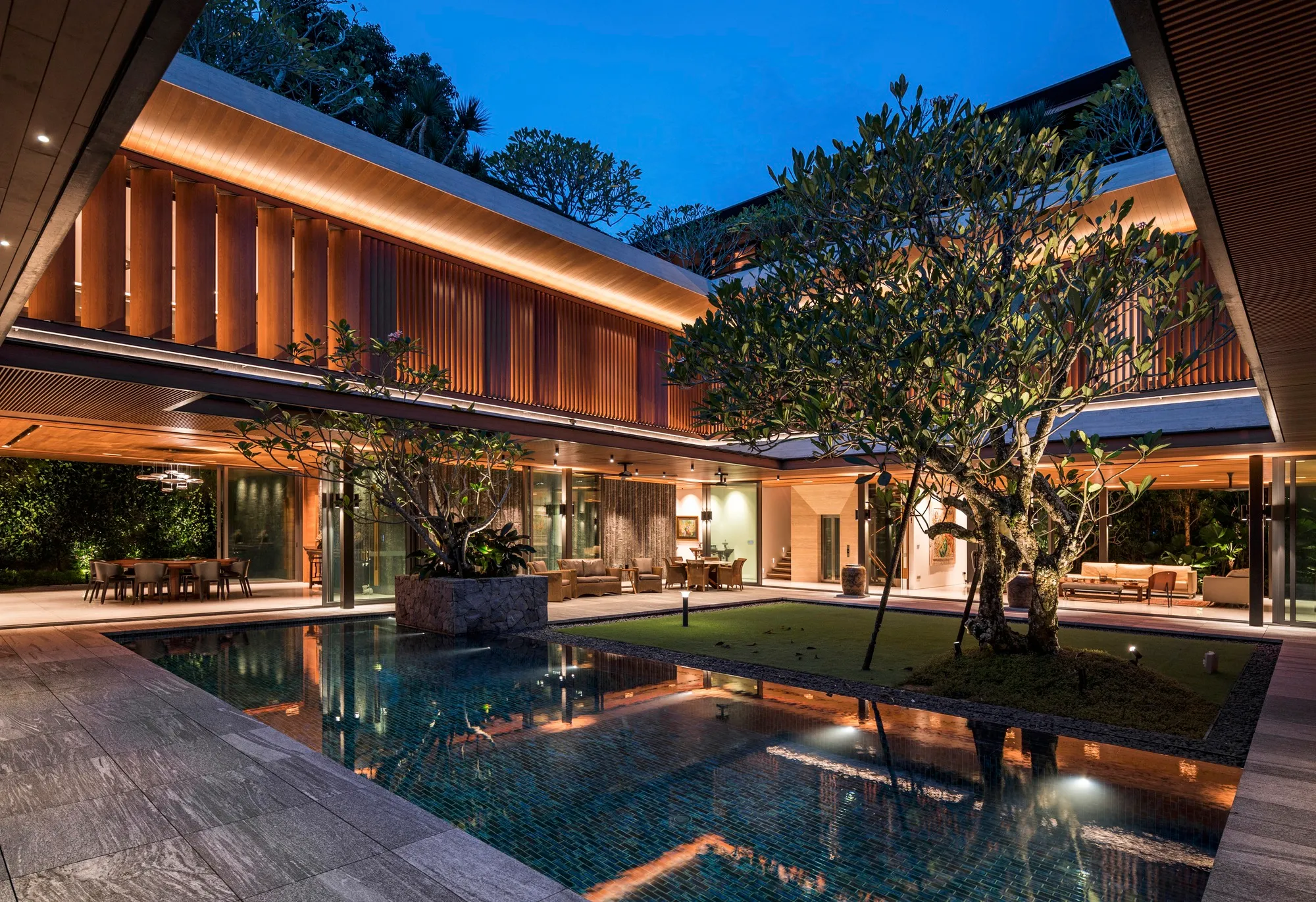
Retirement houses are often sentimental projects, but they rarely produce architecture this disciplined. Forgetting Time House, completed in 2022 by Wallflower Architecture + Design at the end of a quiet cul-de-sac in Bukit Timah, Singapore, is a 14,000 square foot residence built around a single provocation: what would a house look like if its primary function were to slow down time? The answer, it turns out, is an inward-facing courtyard house wrapped in vertical timber screens, organized around a central reflecting pool, frangipani trees, and a material palette so restrained it borders on monastic.
What makes this house genuinely interesting is not its size or its tropical modernist vocabulary, both of which are common enough in Singapore's Good Class Bungalow districts. It is the rigor with which the courtyard typology is deployed as a passive environmental strategy and as a psychological device. Every room turns its back on the street and faces inward. Breezes are choreographed through retractable glazing on opposing walls. Daylight is filtered, never direct. The effect is a house that feels simultaneously open and deeply private, a retreat within the density of one of the world's most expensive residential markets.
A Street Presence That Deflects Attention

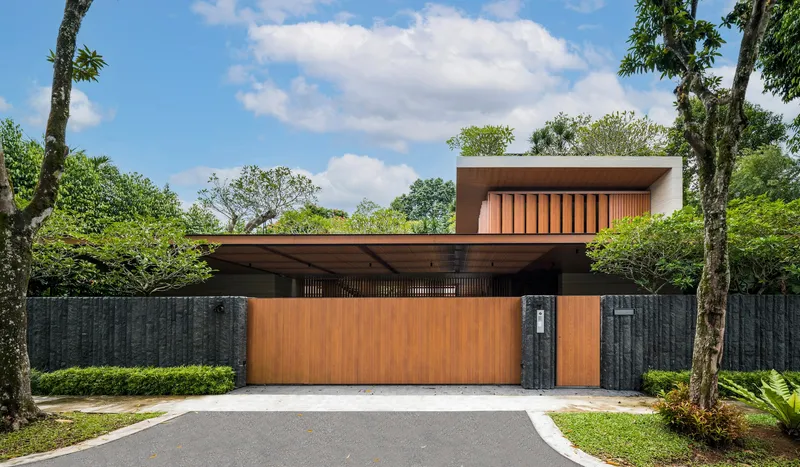

From the street, Forgetting Time House reveals almost nothing. The 31-meter wide frontage presents a long, low horizontal plane of timber cladding above a rough-textured concrete boundary wall, punctuated by cycads and boulders that read more as landscape installation than residential garden. The entry gate is set within this wall without ceremony. There is no front door in any conventional sense, just a timber portal that signals a threshold.
The deliberate opacity here is the point. In a neighborhood where houses often compete for visibility, this facade operates as a defensive screen. The second-storey block is set far back, anchoring the rear edge of the property so that the street elevation reads as a single-storey pavilion stretching beneath a cantilevered roof. You would never guess the scale of what lies behind.
Arriving Through the Porte-Cochère
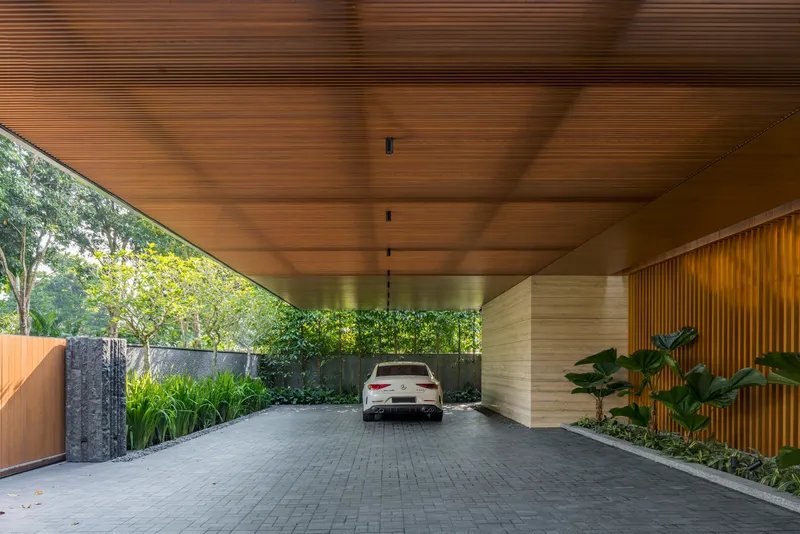
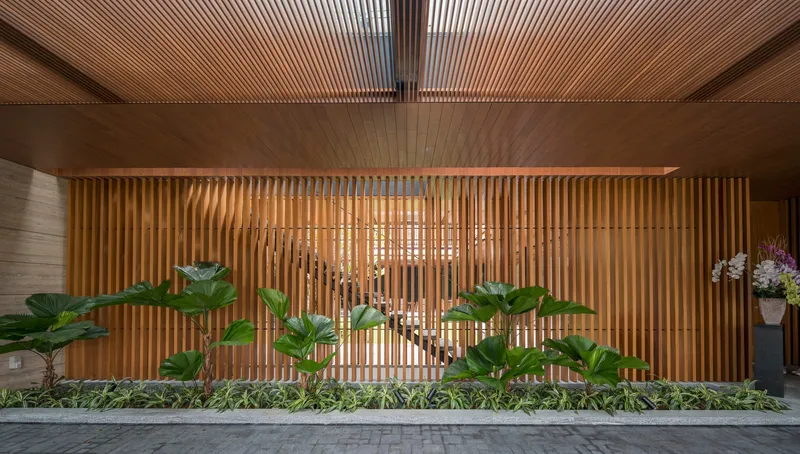

The arrival sequence is generous and deliberate. An uninterrupted porte-cochère, its soffit clad in slatted timber, extends across the full carport width. Stone-clad columns support the overhang, and the material transition from rough exterior wall to warm timber ceiling happens gradually. By the time you step out of a car, the street is already behind you. At blue hour, the illuminated timber screens glow from within, turning the entire entry facade into a lantern that hints at the courtyard life concealed inside.
The Courtyard as Organizing Principle
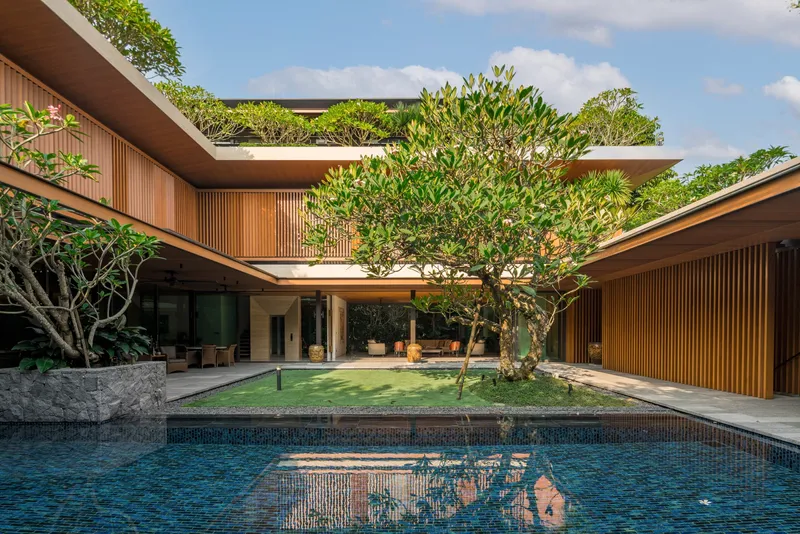
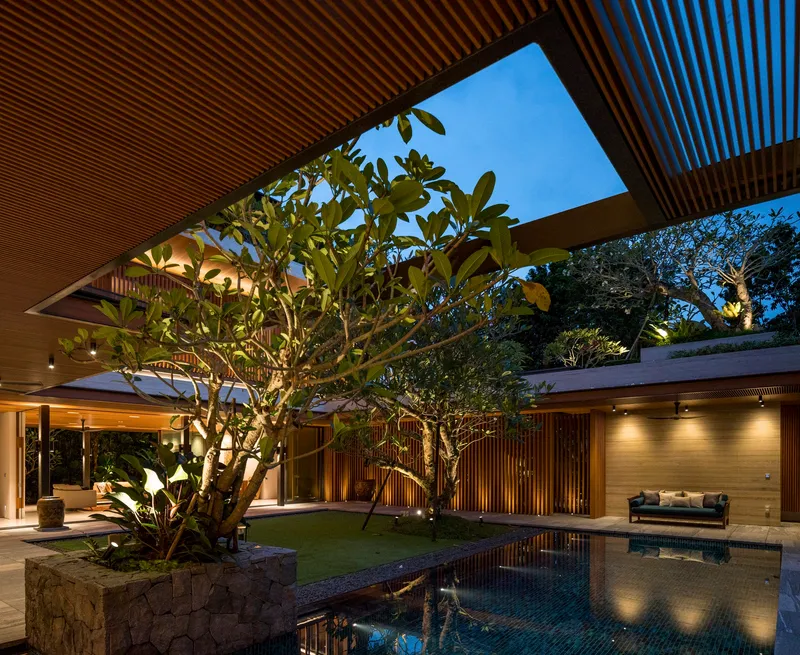
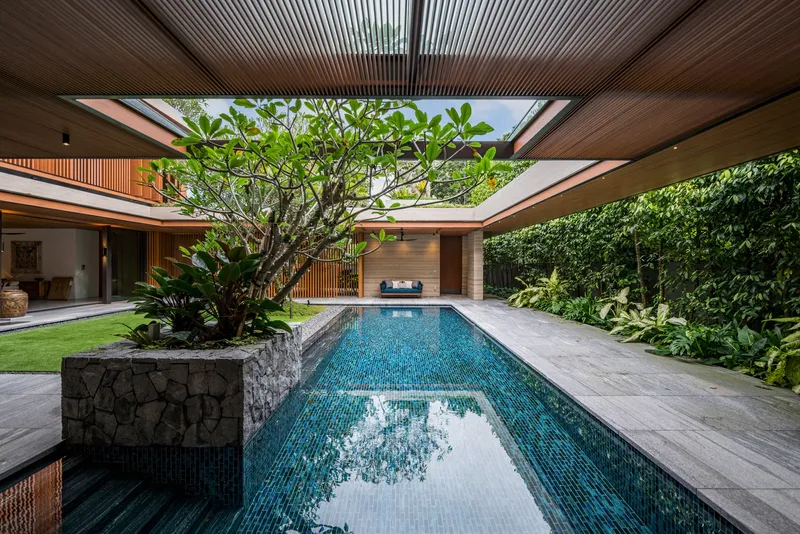
The central courtyard is the engine of the house. A reflecting pool stretches between planted beds where frangipani trees rise through openings in the slatted timber ceiling, their canopies reaching toward the sky. The courtyard is not merely decorative. It is the primary source of daylight, ventilation, and spatial orientation for every room in the house. Walk anywhere inside, and within a few steps you are visually reconnected to this green core.
Wallflower has arranged frangipani trees across each floor of the house, a biophilic strategy that threads nature vertically through the section. The trees are not incidental planting; they are structural to the composition, anchoring views from the stairwell, the living room, and the rooftop terrace. The pool beneath them doubles as a mirror, pulling sky and canopy into the ground plane and dissolving the boundary between interior and exterior.
Living Spaces That Breathe

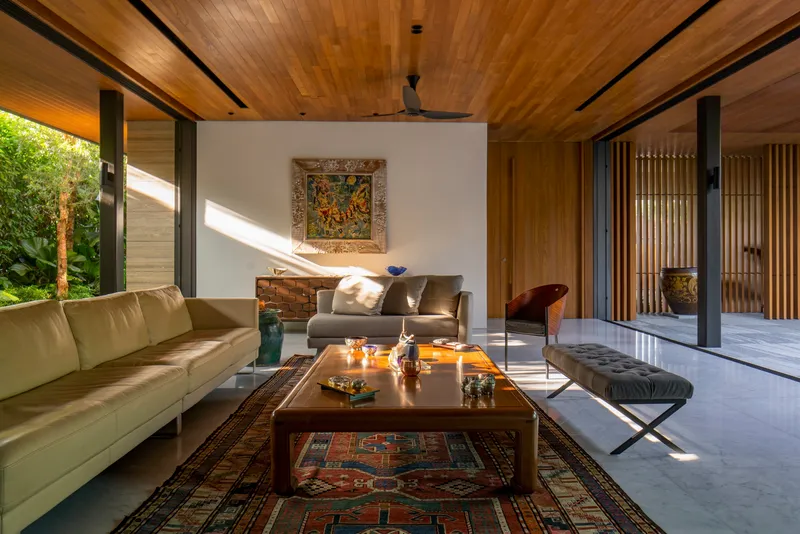
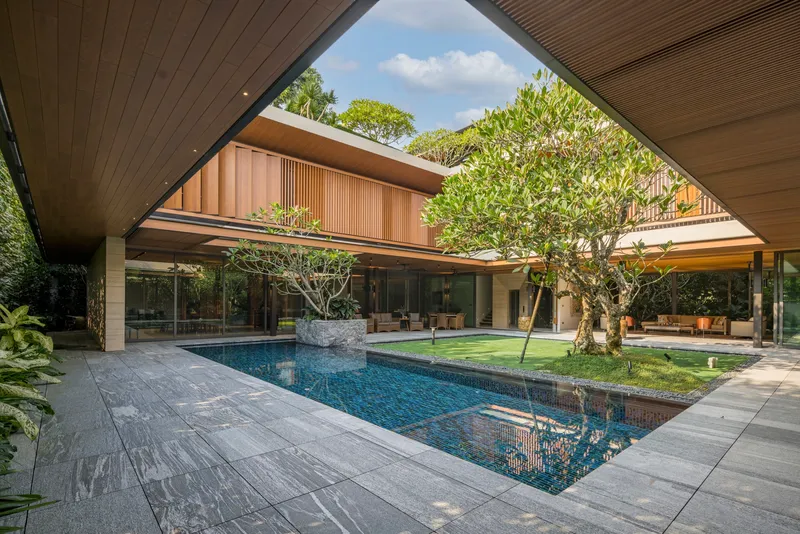
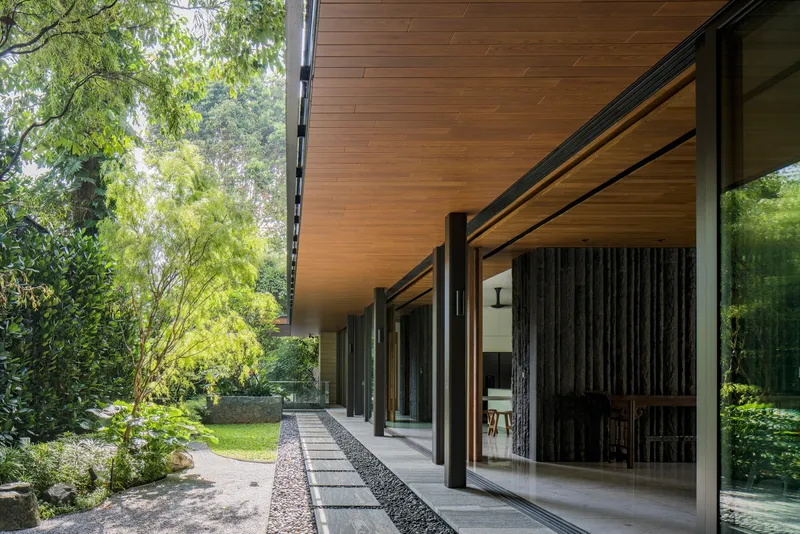
The ground floor living room is held up by slender black steel columns and roofed in timber, a deliberately open frame that dissolves on two sides through full-height glazing. Retractable doors on both the courtyard and garden sides allow tropical breezes to pass clean through the room, turning it into a covered veranda when fully open. This is passive climate design deployed with real commitment: not a token operable window, but an entire wall plane that disappears.
The covered walkways that wrap the courtyard are equally considered. Timber soffits shelter concrete floors, and stepping stones through gravel gardens create a decompression zone between the glazed interior and the planted exterior. You move through these thresholds constantly throughout the day, and each one recalibrates your sense of being inside or outside. The ambiguity is intentional and effective.
Timber Screens and Filtered Light
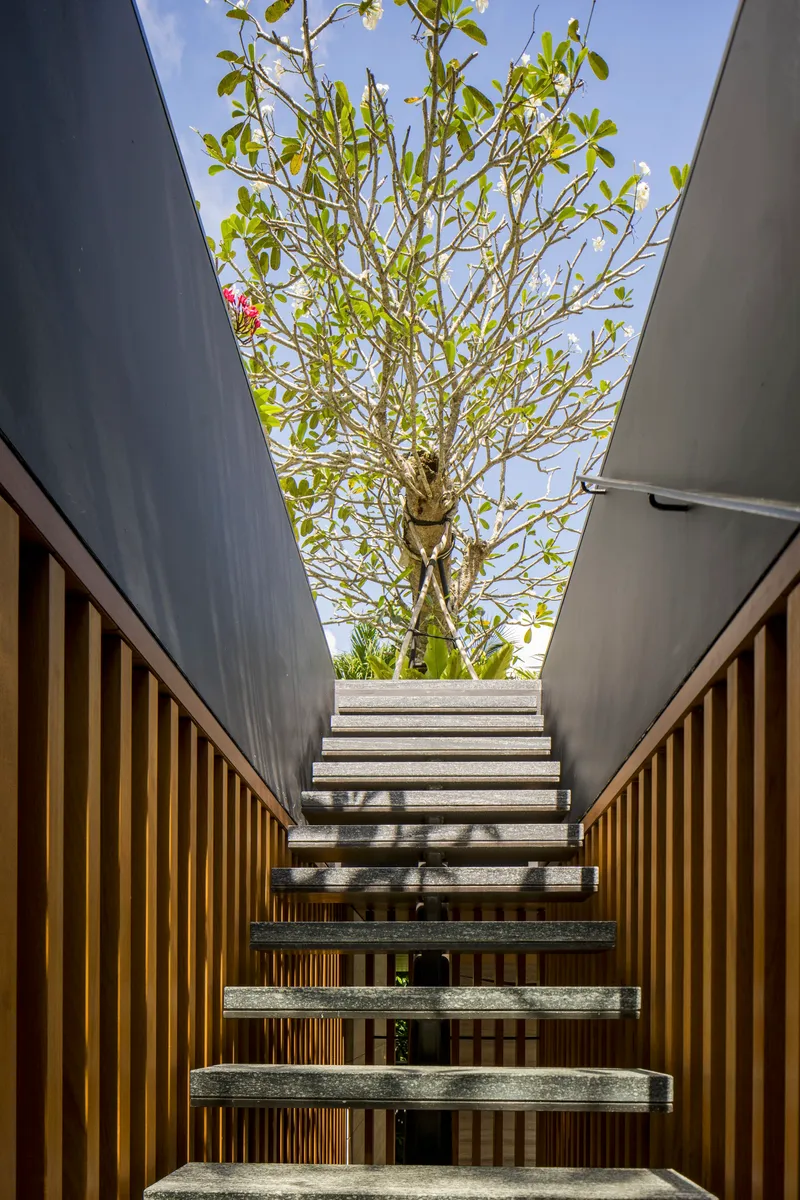
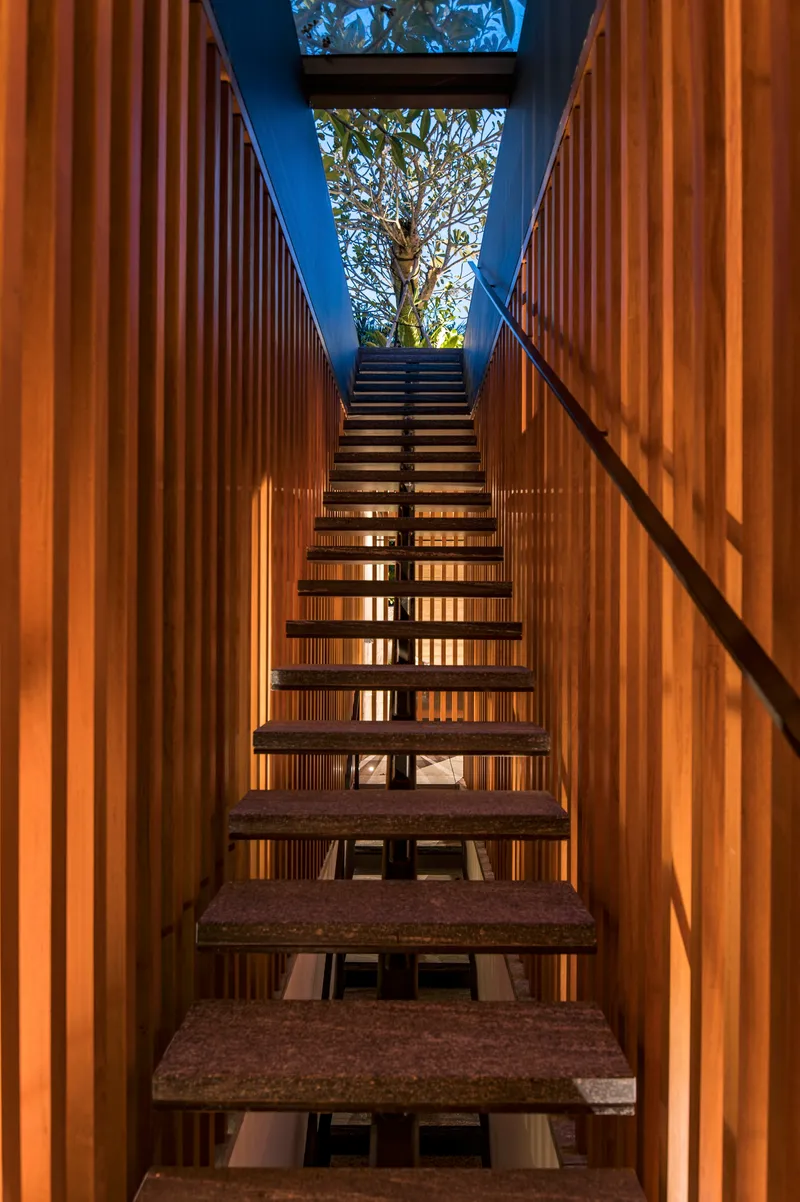
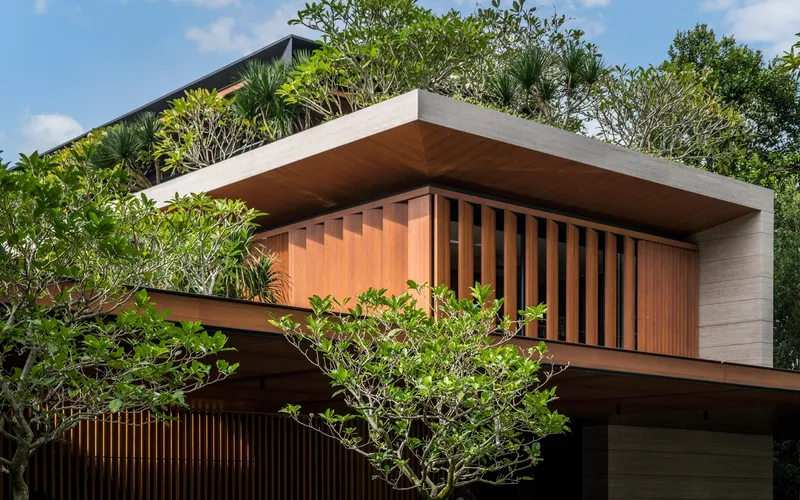
Vertical timber louvers are the dominant motif, and they work hard. On the upper level, they shield bedrooms from direct sun and provide privacy from neighboring properties while maintaining airflow and diffused daylight. At the staircase, they transform the stairwell into a lantern, with open risers and timber slats filtering light as it descends through the section. Wallflower has detailed this stairwell as a future art gallery, with track lights integrated into grooves along the underside of the staircase stringer, ready to illuminate paintings that will be added over time.
The outdoor staircase is equally compelling: concrete treads rise between timber screens toward a frangipani tree silhouetted against the sky. It is one of those moments where the architecture frames nature so precisely that the tree becomes the focal point and the building recedes. The weathered bark of the frangipani against the clean lines of the timber and concrete is a studied contrast that earns its visual power.
Water, Garden, and the In-Between
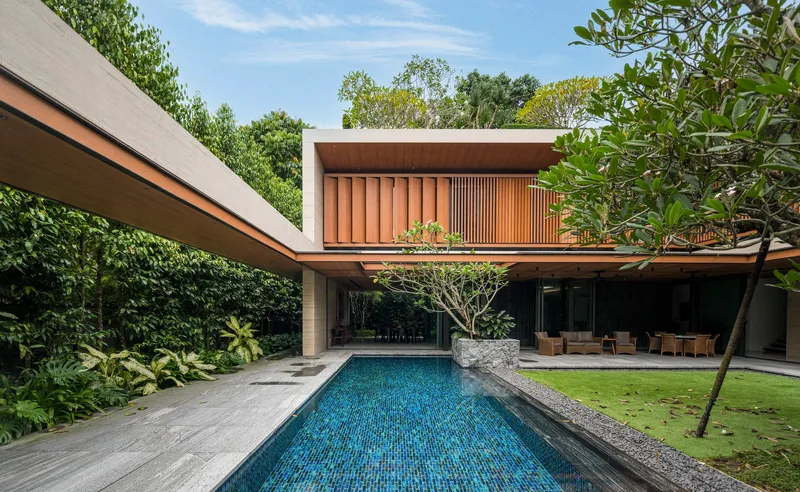
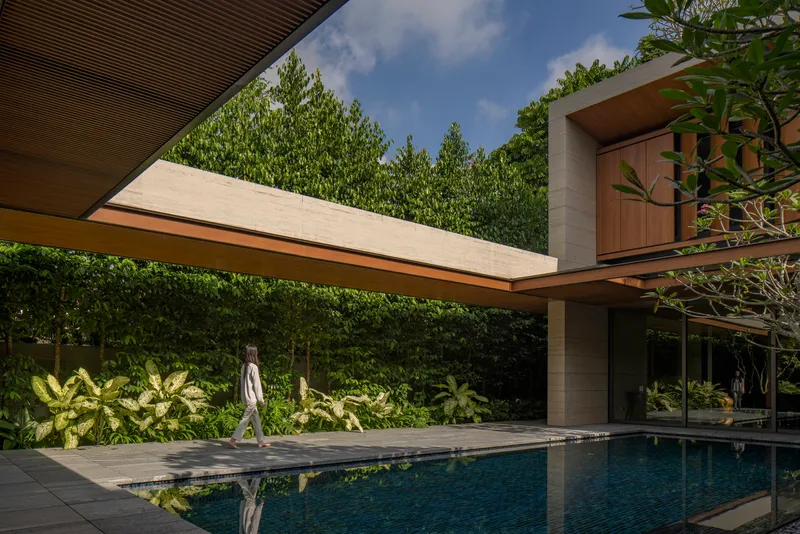

The swimming pool extends from the courtyard reflecting pool toward the rear of the property, its blue mosaic tiles a deliberate contrast to the warm timber and stone elsewhere. Dense tropical plantings bank against cantilevered concrete volumes, and a figure walking past in one image gives scale to the overhang: these are deep, generous sheltering planes, not decorative gestures. The garden is layered with bamboo, broad-leafed palms, and groundcover, creating visual density that screens the house from its surroundings while providing the kind of lush, immersive greenery that Singapore's climate rewards.
Material Precision in the Details

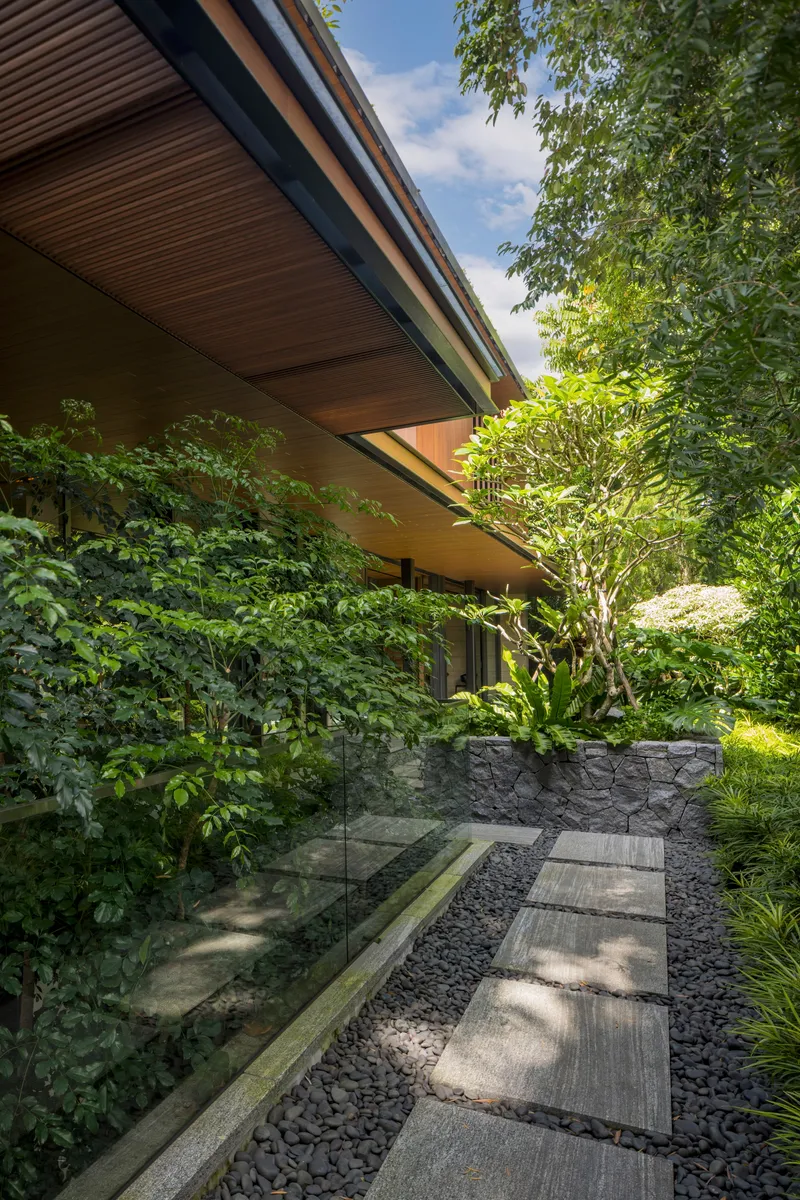
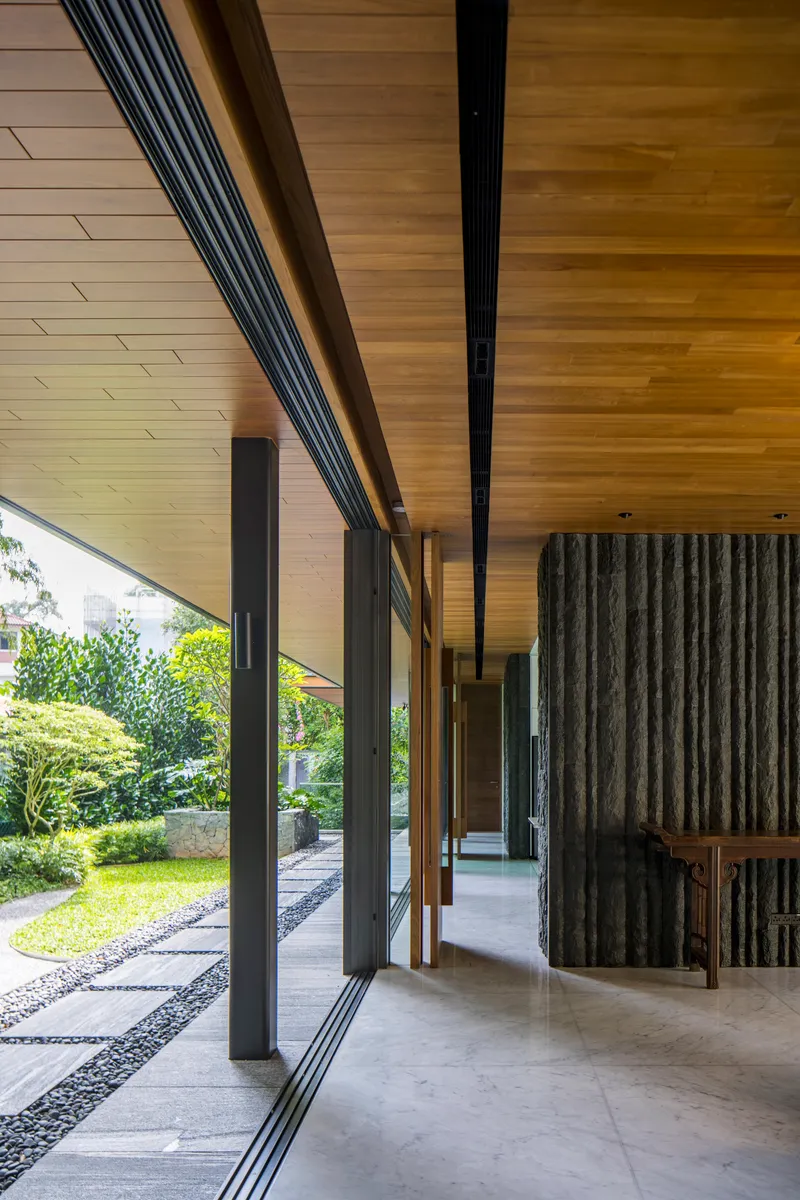
The material palette is narrow and deliberate: travertine, architectural timber, concrete, and glass. Within that restraint, the details are surprisingly rich. The powder room is a small jewel box, its vanity clad in heavily veined stone, fitted with a Gessi Goccia tap shaped like a water droplet over a lily-pod wash basin. It is the kind of room where restraint and indulgence coexist without contradiction.
Elsewhere, stepping stones through gravel gardens beneath timber soffits catch raking afternoon light, and wood cladding installed along the underside of concrete structure softens what would otherwise be a brutalist vocabulary. The material choices balance warmth and tactility throughout, a principle that Wallflower has applied with uncommon consistency across the full 14,000 square feet.
The Rooftop as Final Retreat
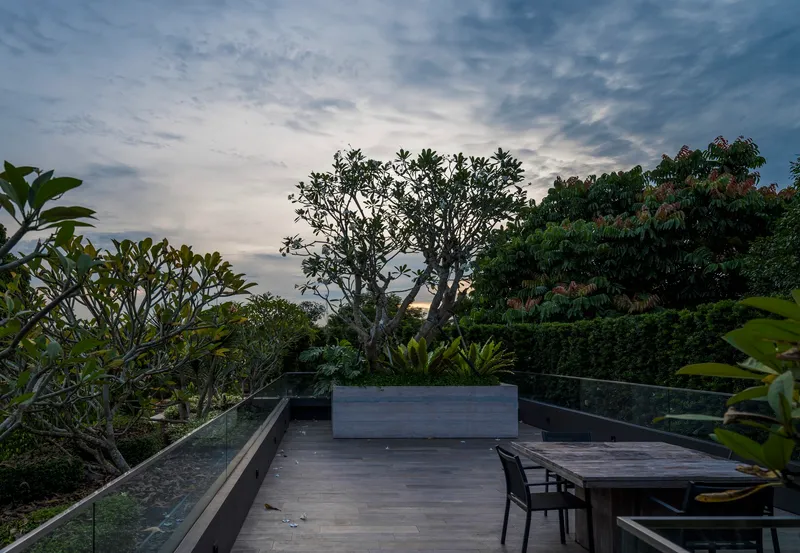
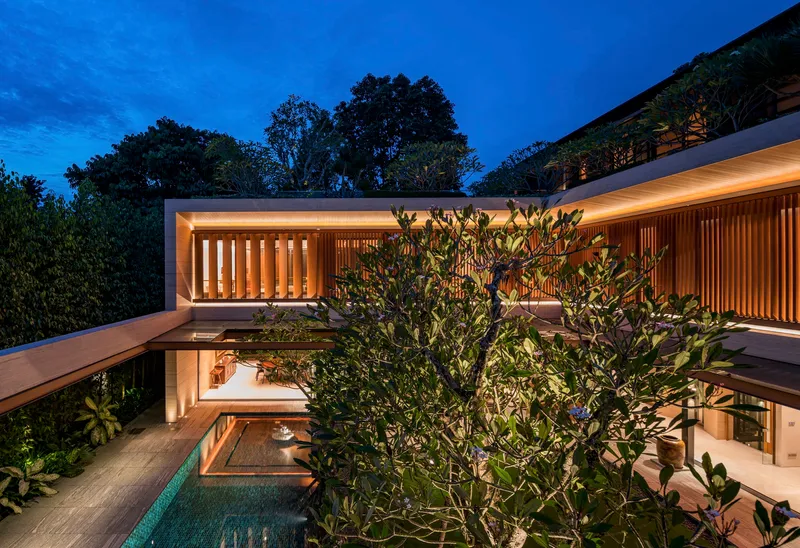
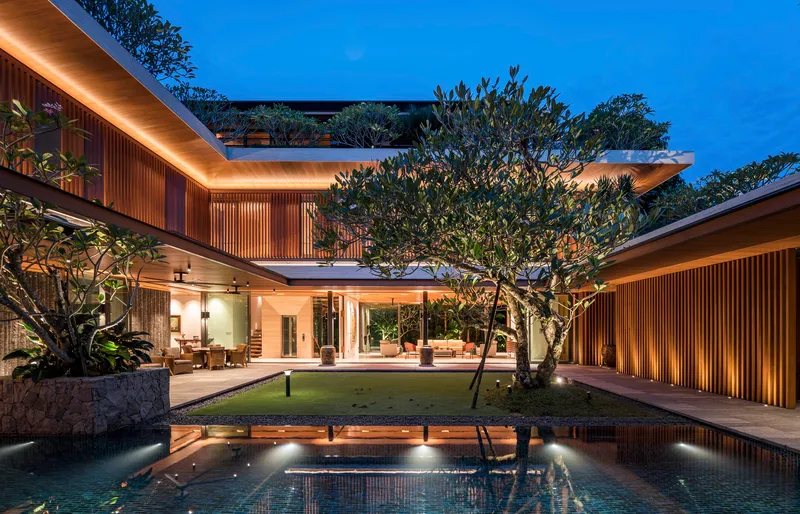
The sequence culminates at the rooftop terrace, where a timber deck holds a dining table and planter boxes framed by frangipani trees at dusk. A private study at the top level is shielded by this terrace, creating a room within a garden within a house. The vertical timber louvers reappear here, now serving as balustrades and privacy screens for the upper level terraces. At twilight, the two-storey timber-louvered facades glow with warm light, and the courtyard pool below reflects the entire composition, doubling the apparent height of the house.
From this vantage point, you can read the full organizational logic: the inward-facing courtyard, the layered thresholds, the frangipani trees threading through every level. It is a house that rewards vertical movement with increasingly private spaces, ending in a canopy-level retreat where the city of Singapore effectively disappears.
Why This Project Matters
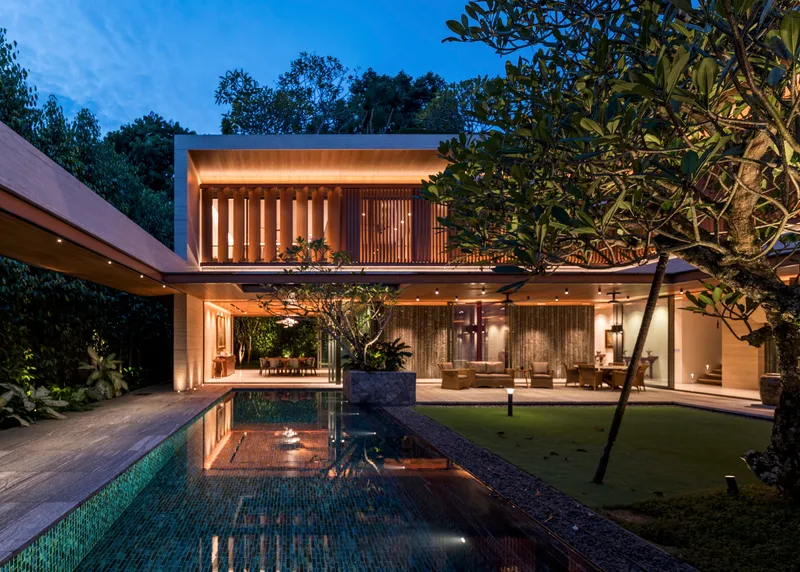
Forgetting Time House is a persuasive argument for the courtyard typology as the most effective spatial strategy for dense tropical cities. It addresses privacy, climate, daylight, and psychological wellbeing through a single organizational move, and it does so without resorting to mechanical systems or hermetic enclosures. The house breathes, literally and figuratively. In a city where air conditioning is the default response to heat, a home that opens its walls to the breeze and structures its plan around trees and water is quietly radical.
More broadly, the project demonstrates that the concept of a retirement sanctuary does not require withdrawal from architecture. Wallflower has produced a house that is simultaneously meditative and spatially sophisticated, restrained in its palette but generous in its spatial ambition. The name, Forgetting Time, is sentimental. The architecture is not. It earns its calm through precision, proportion, and an unwavering commitment to bringing the garden inside.
Forgetting Time House by Wallflower Architecture + Design. Bukit Timah, Singapore. 14,000 sq ft. Completed 2022.
About the Studio
Share Your Own Work on uni.xyz
If projects like this are the kind of work you want to make, uni.xyz is a place to publish your own, find collaborators, and enter design competitions.




Popular Articles
Popular articles from the community

EW PARK: Sustainable Architecture Reimagines the Future of Urban Parking
EW PARK reimagines city parking as a modular wooden tower combining automation, solar energy, electric mobility, and adaptable urban design.

The Earth Pod: 3D Printed Homes for Resilient Refugee Communities
The Earth Pod reimagines refugee housing through 3D printed homes made from clay, combining resilience, self-sufficiency, and rapid shelter.

AL-JANNAH: Sustainable Architecture and Permaculture for Afghan Widows
AL-JANNAH uses sustainable architecture and permaculture to create resilient oasis of housing, learning, work and renewal for Afghan widows.

Hill & Cross Opera: Sculptural Opera House Architecture Shaped by Tallinn’s Landscape and Identity
Hill & Cross Opera reimagines opera house architecture in Tallinn through its sculptural hill, civic plaza, glass wave and a luminous cross.


Similar Reads
You might also enjoy these articles

Bao Huynh Watercolor Atelier: A Serene Art Retreat in Hội An
Bao Huynh Watercolor Atelier in Hội An blends multifunctional art spaces, sustainable design, local materials, and family-friendly living in a serene environment.

Atelier Macri Concept Store Interior Design by CASE-REAL
Atelier Macri store features a "ko" counter, walnut wood details, cork displays, blending retail, gallery, and seamless customer experiences.

Manuel Vargas Izquierdo Stadium and High-Performance Sports Center: Architectural Excellence in Jalpa de Méndez
The Manuel Vargas Izquierdo Stadium blends sustainable design, inclusive sports facilities, and cultural-inspired architecture, revitalizing Jalpa de Méndez’s public spaces.

KAKR Buluh Awar Hall: Revitalizing Community and Ecology Through Bamboo Architecture
Community built bamboo hall revitalizes Buluh Awar village, empowering youth, restoring ecology, celebrating vernacular craftsmanship through sustainable architecture and culture.




Comments (0)
Please login or sign up to add comments
No comments yet. Be the first to comment!