
2BOOKS Design Turns 33 Square Meters in Taiwan into a Light-Filled Live-Work Apartment
The Wang Residence in Guangfuli, Taiwan proves that a narrow, split-level apartment can feel generous when every square meter earns its keep.


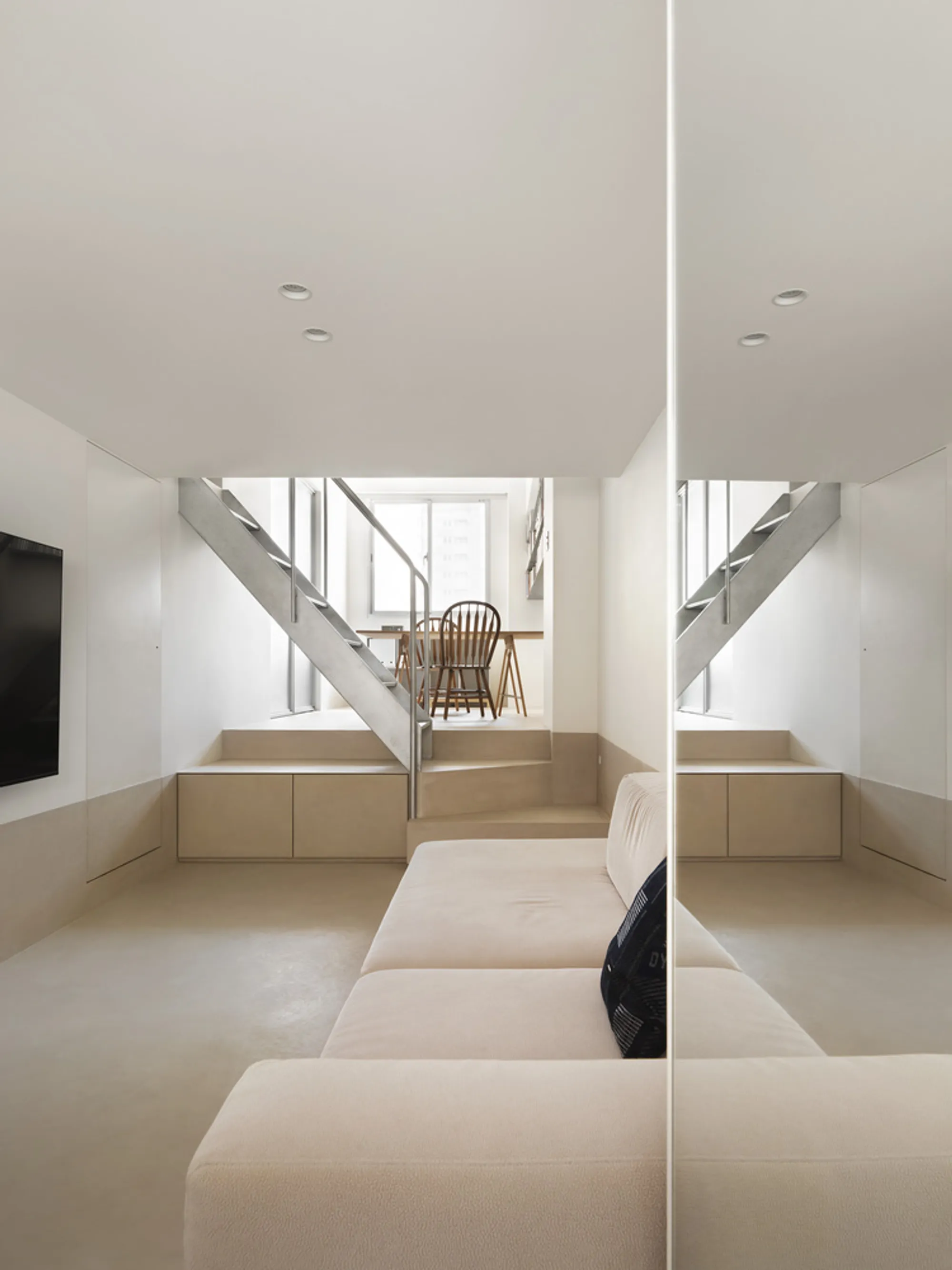
Buying an apartment sight unseen is a gamble. When the clients behind the Wang Residence finally walked into their 33-square-meter unit in Guangfuli, Taiwan, they found a narrow, dark space with a low mezzanine that made the already modest footprint feel oppressive. What 2BOOKS Design accomplished here, completed in 2024, is a miniature masterclass in section: by gutting most of the existing mezzanine and rethinking vertical relationships, the studio turned a claustrophobic corridor into a double-height room that breathes.
The central problem was straightforward but unforgiving: both residents work from home, so the apartment had to function simultaneously as office, kitchen, living room, and bedroom, all within 33 square meters and a narrow floor plate with two different elevation changes. 2BOOKS Design's answer was not to subdivide further but to strip back, using a steel staircase, sliding partitions, and white walls to create a sequence of rooms that feel distinct without ever feeling closed off. Light does the rest, playing across blank surfaces throughout the day.
A Staircase That Organizes Everything
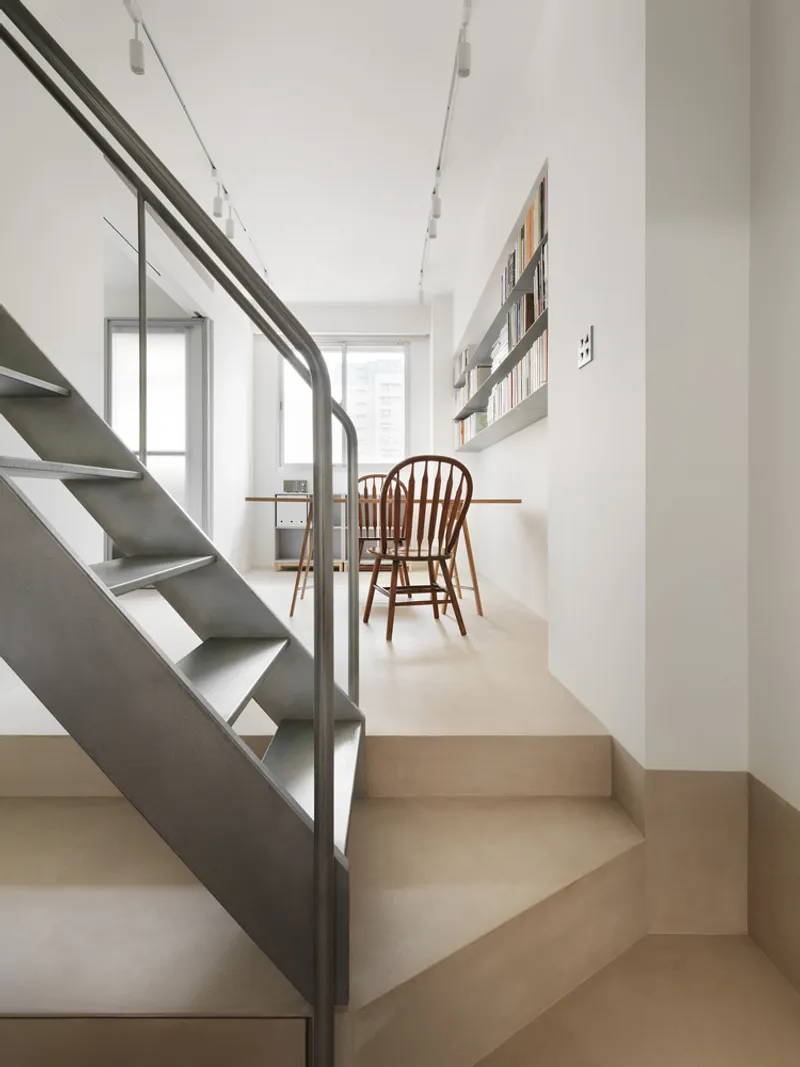
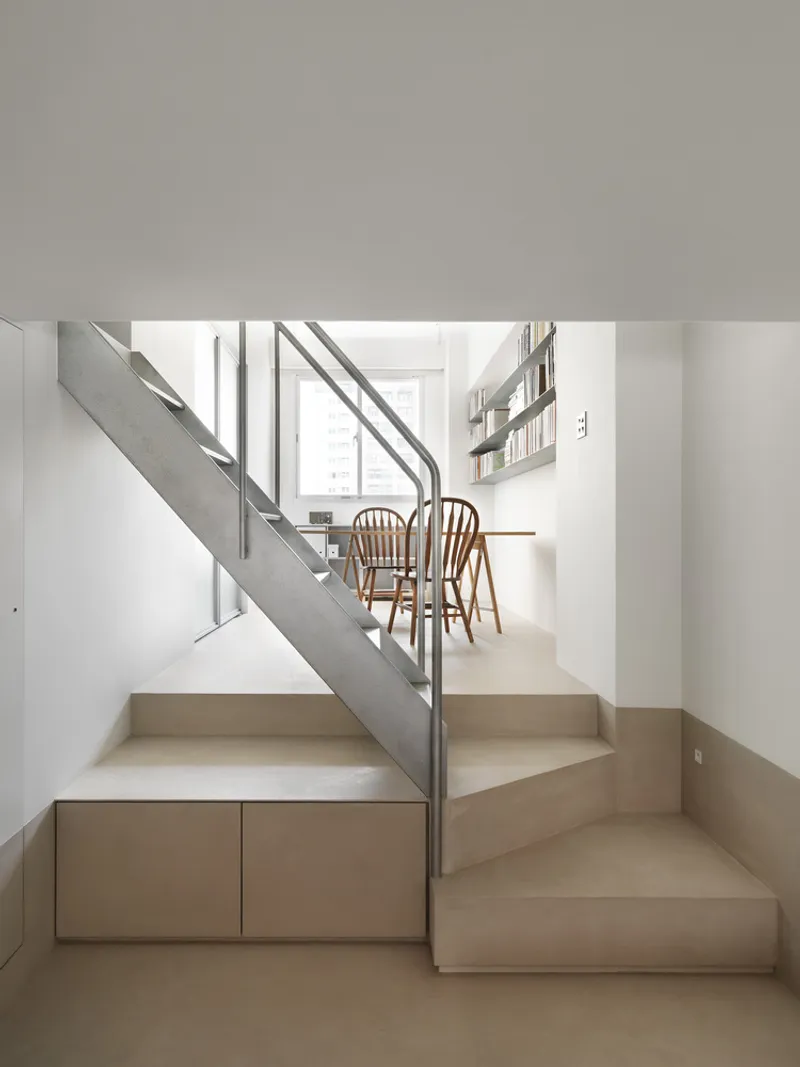
In an apartment this small, the staircase cannot afford to be merely circulation. Here the open-tread steel stair acts as a spatial divider between the workspace below and the dining area above, its transparency preventing the kind of visual blockage a wall would impose. Storage drawers are tucked into the timber treads on one side, while the opposite run of steel risers frames a built-in desk flanked by bentwood chairs and shelving. It is a piece of furniture as much as it is architecture.
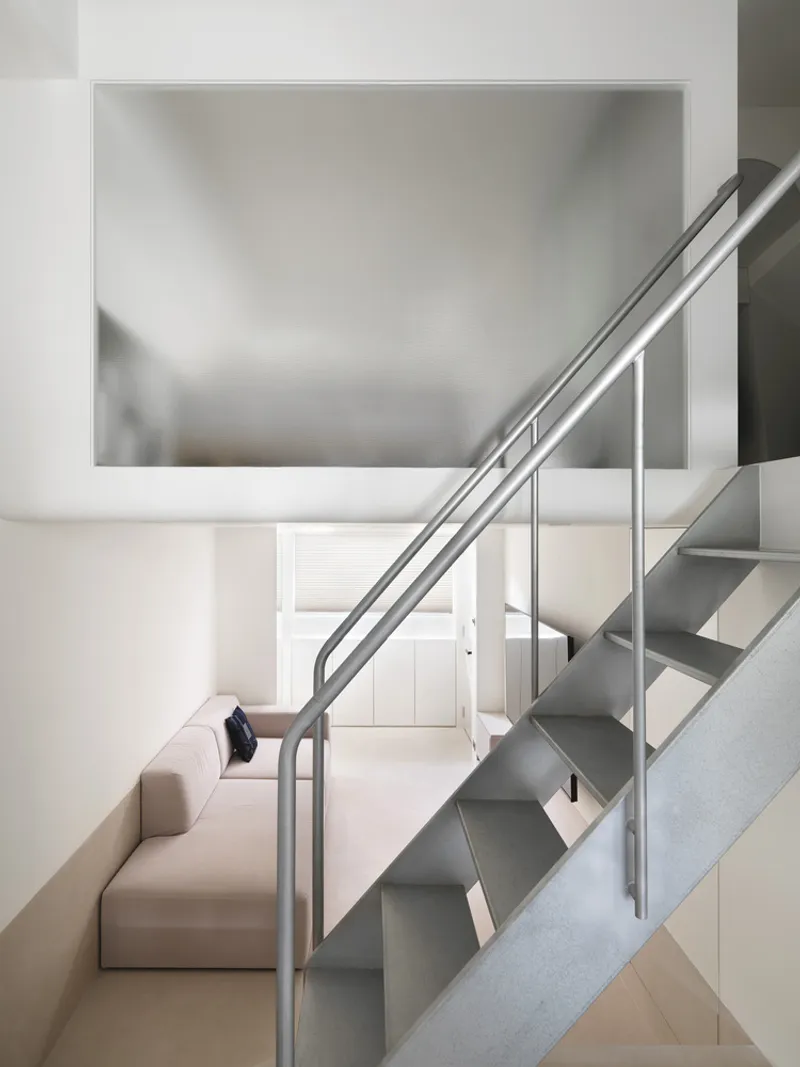
Looking upward through the stair reveals a rectangular skylight that pulls daylight deep into the center of the plan, exactly where a narrow apartment tends to go dark. The recessed entry door below sits in relative shadow, which makes the light overhead feel more dramatic. 2BOOKS Design clearly understood that controlling where brightness falls matters more than simply adding windows.
The Double-Height Trick
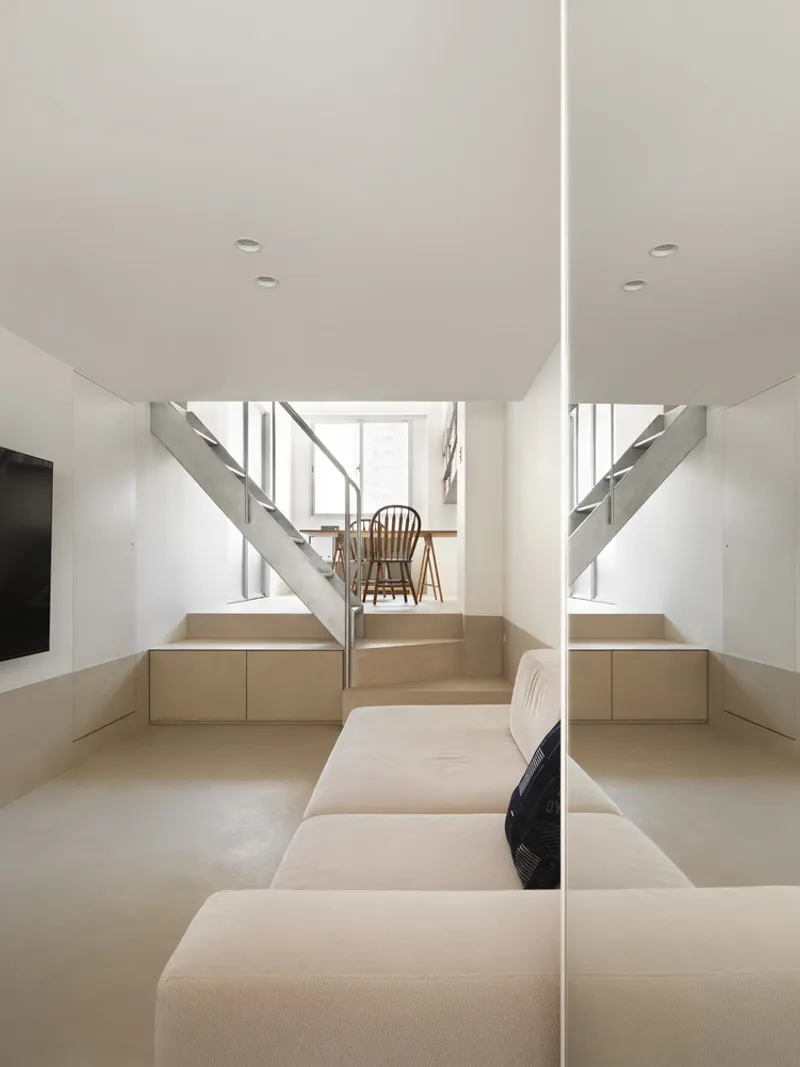
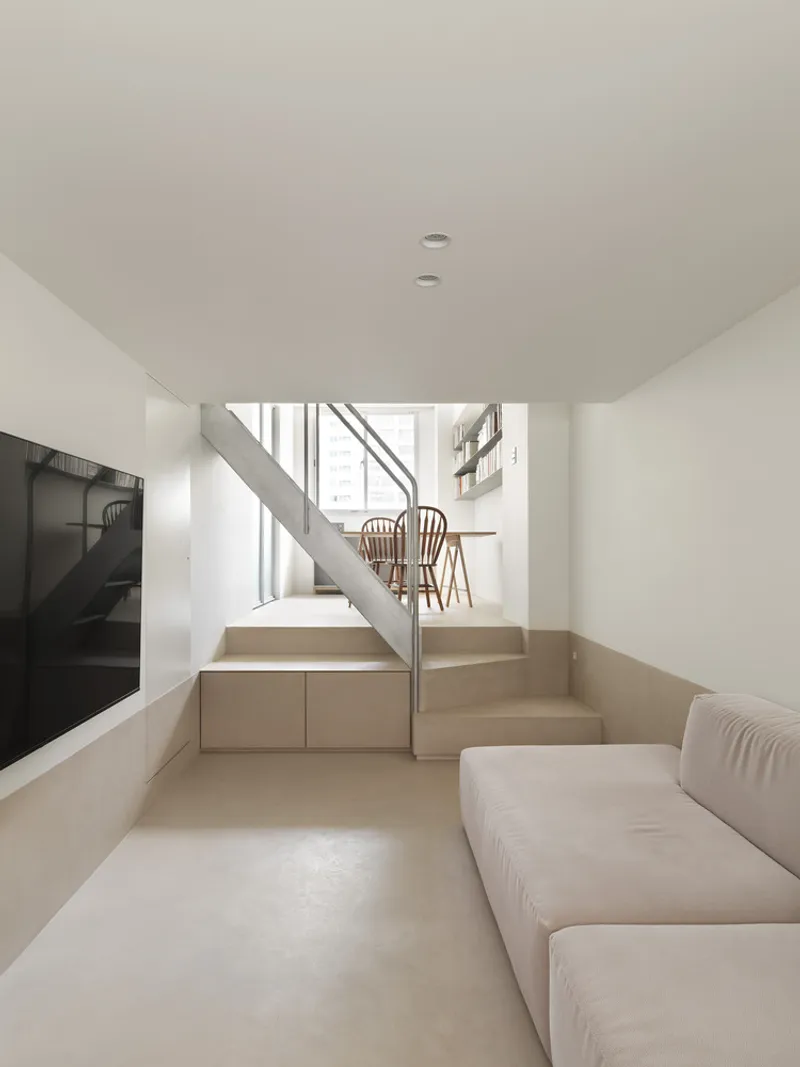
Removing most of the original mezzanine was the project's decisive move. What remains is a retained platform along the wall opposite the main windows, just enough to house a bedroom and private bath above while releasing a full double-height volume below. Mirrored steel stair stringers amplify the vertical dimension, bouncing light and reflections across plywood built-in seating and storage platforms at the lower level. The sunken living room with its integrated timber steps and steel handrail feels generous precisely because the ceiling above it is real, not artificially compressed.
The workspace occupies the zone with the best natural light and the highest ceiling in the house. That is a deliberate hierarchy: the room where the residents spend their working hours gets the architectural premium. The sitting area, anchored by a Togo couch, sits a step lower, creating a subtle shift in posture and mood without any partition.
Sliding Partitions and the Privacy Gradient
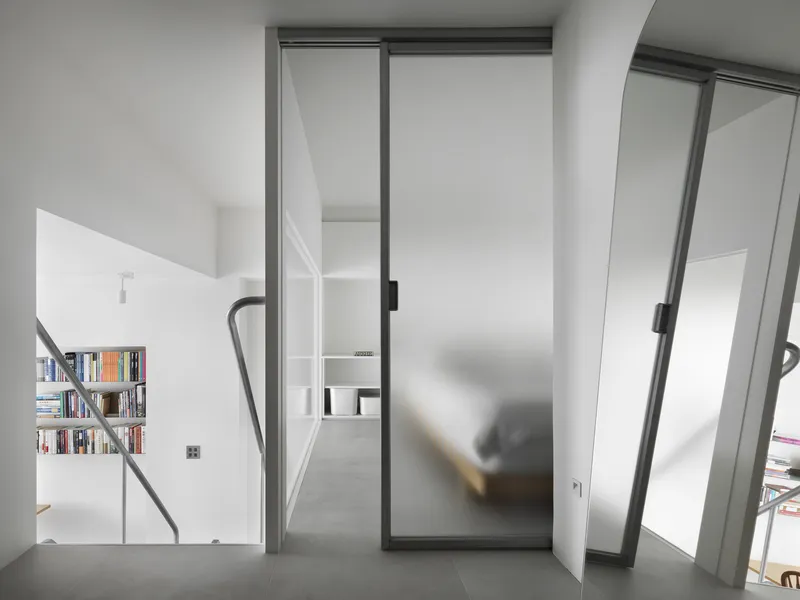
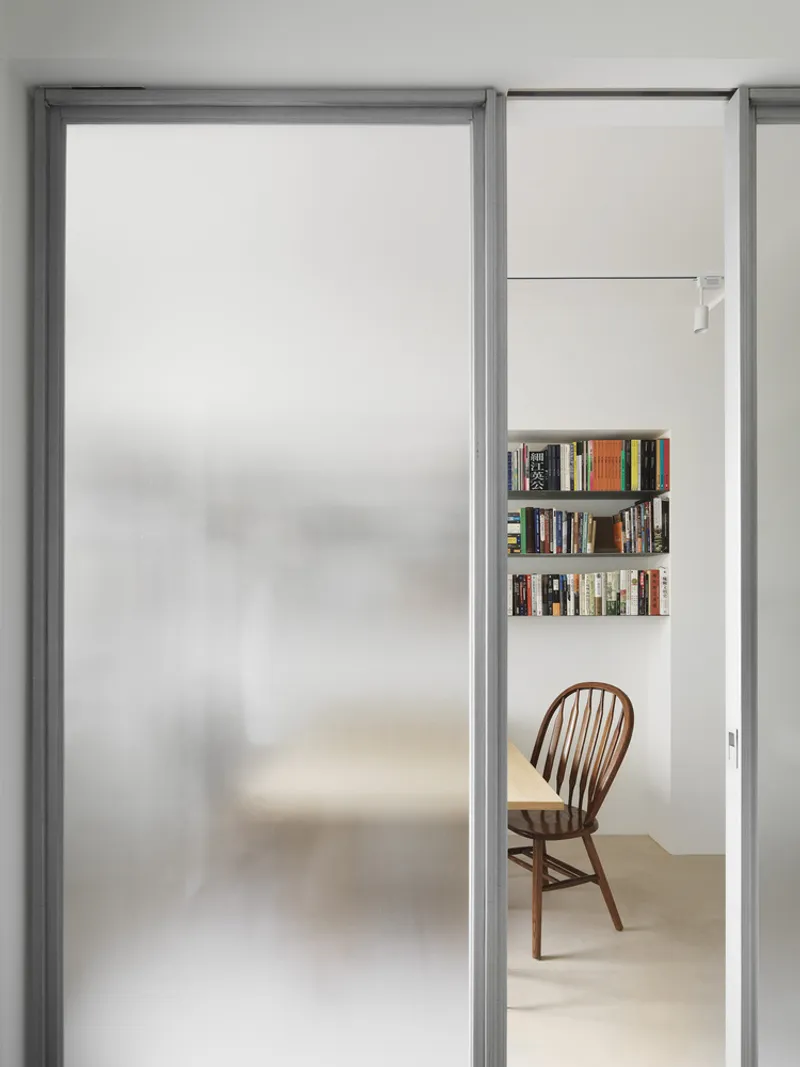
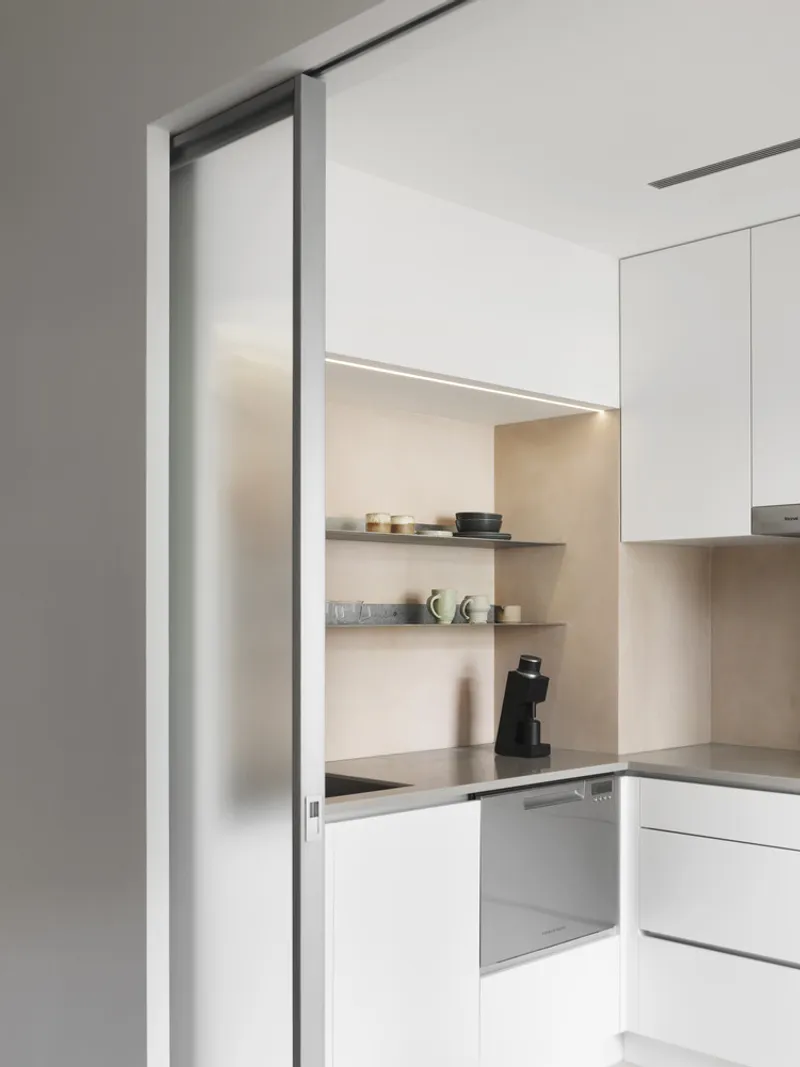
Pocket doors and frosted glass sliding panels do the heavy lifting where privacy is concerned. A dark metal-framed frosted door can seal off the workspace from the living area, while a similar panel in the kitchen alcove conceals open shelving and grey countertops when the residents want a clean visual line. The blurred silhouette of a figure passing through one of these doors is almost the project's signature image: you sense the presence of another room without seeing it.
Shades on the large main windows handle the relationship with the dense neighborhood outside, filtering daylight without eliminating it. Windows on sides without neighbors or passersby are left bare. The logic is surgical: privacy only where needed, transparency everywhere else.
A Kitchen Measured in Centimeters
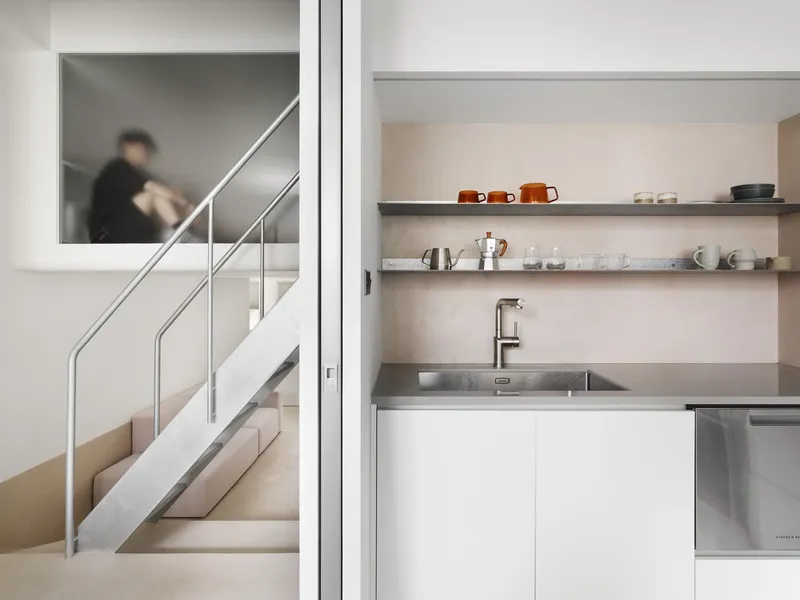
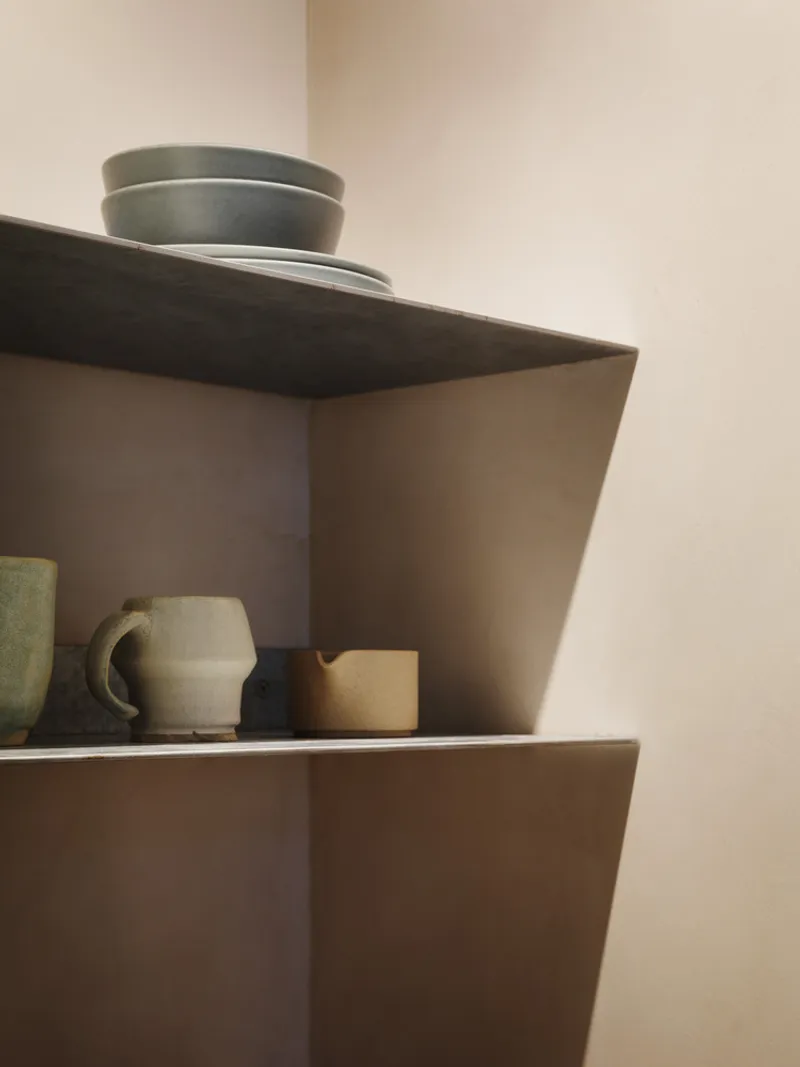
The white kitchen niche with its stainless steel counter and open shelving is a study in restraint. Ceramic cups and glassware are displayed rather than hidden, a choice that only works when the inventory is deliberately edited down. Cantilevered timber shelves in a nearby corner hold a few ceramic bowls in afternoon light, treating everyday objects as a still life.
Open shelving in a 33-square-meter apartment is a commitment to discipline: everything on display must earn its place. 2BOOKS Design seems to have understood that the visual clutter of cabinet doors can make a small kitchen feel smaller than the objects themselves.
The Elevated Bedroom
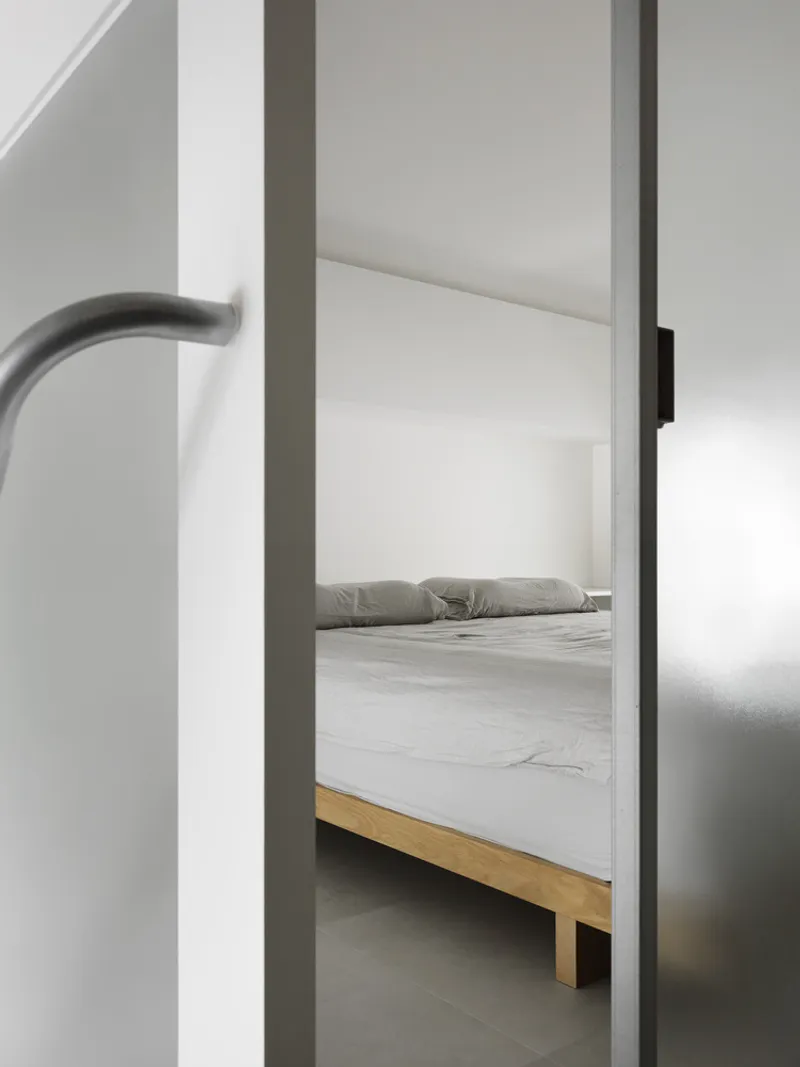
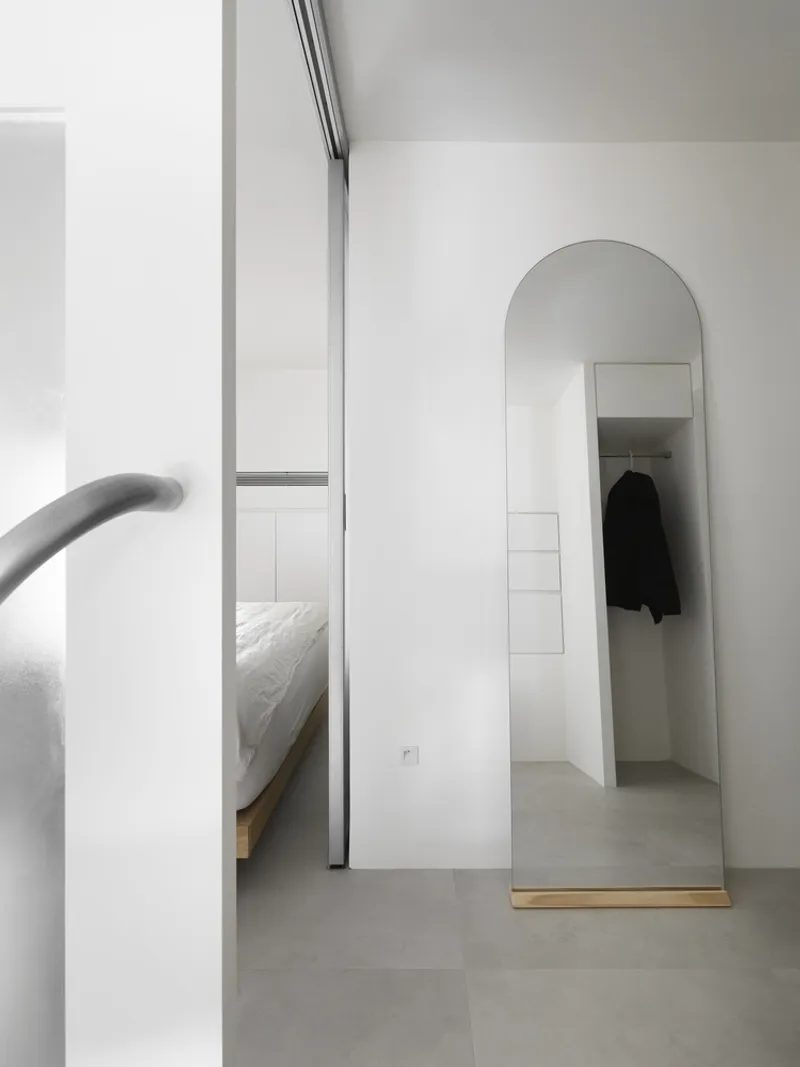
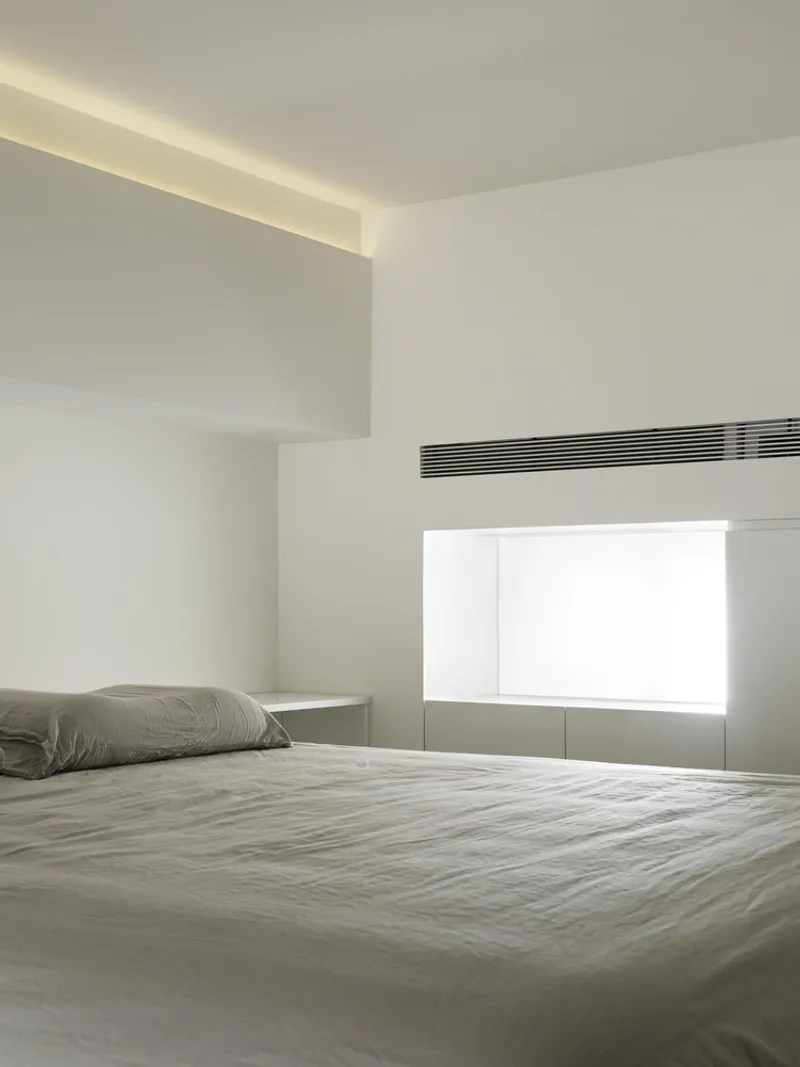
The retained mezzanine slice holds a floor bed visible through an open sliding partition, a deliberate decision that keeps the bedroom connected to the double-height volume while allowing it to be closed off at night. An arched mirror leaning against the white wall reflects the space beyond, a simple trick that doubles the perceived depth of the room. Recessed ceiling cove lighting and a horizontal air conditioning vent above the window keep the surfaces clean and uninterrupted.
A floor bed is an honest choice for a space this tight: it eliminates the visual bulk of a bed frame and keeps the sightline low, so even when you are standing on the mezzanine, the ceiling feels adequate rather than pressing down. The closet space with its exposed hanging rod is similarly no-nonsense, treating storage as part of the room's composition rather than something to hide.
Dining as Social Center
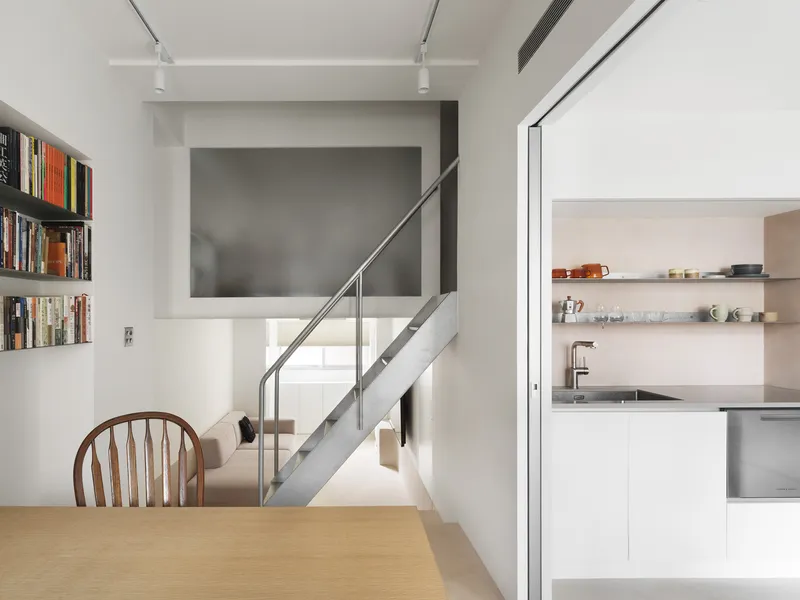
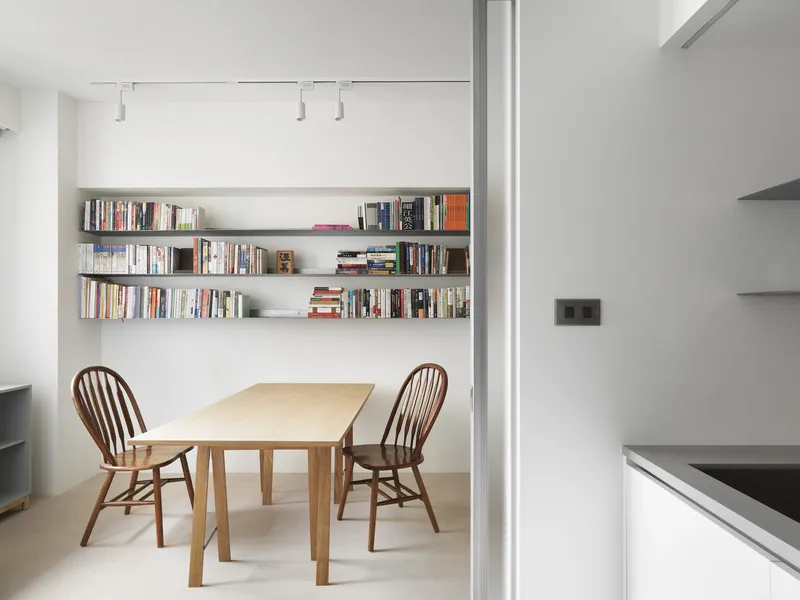
The dining area sits at the hinge point of the plan, looking past the steel staircase toward the kitchen on one side and out toward the windows on the other. A Hay Loop Stand Table with Petit Standard chairs and a set of Windsor chairs beneath wall-mounted bookshelves give the zone a warm, slightly eclectic character that offsets the apartment's otherwise rigorous minimalism. Track lighting overhead provides even illumination without the visual noise of pendant fixtures.
Placing the dining table at the intersection of circulation paths is a deliberate social strategy. In a live-work apartment for two, the table becomes the shared commons: the place where work pauses, meals happen, and the day's rhythms overlap.
White Walls as Active Material
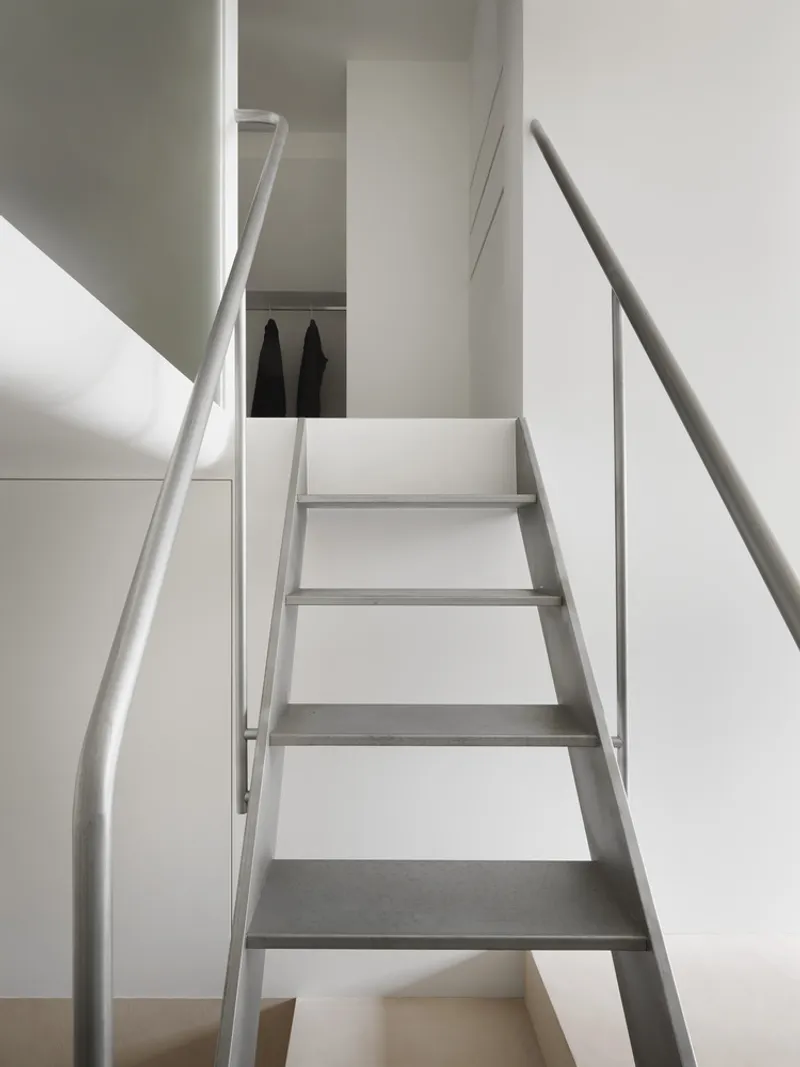
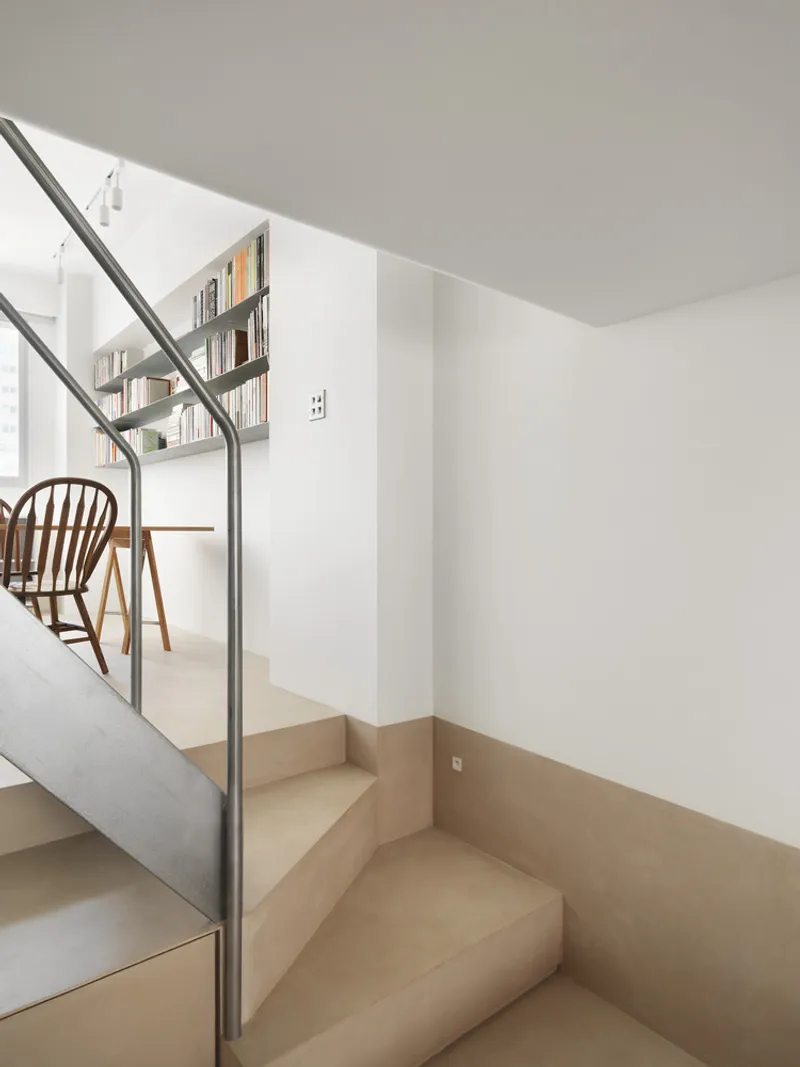
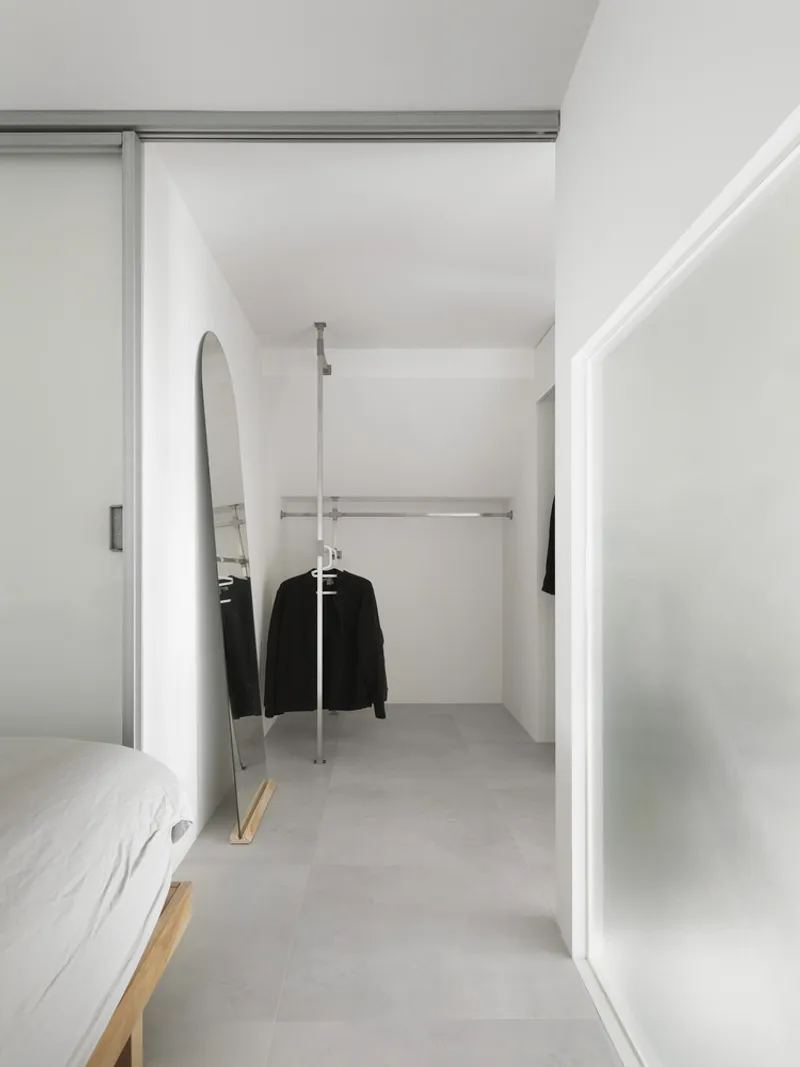
White-toned walls are often dismissed as a default, but here they function as an active material. The shifting play of shadows across curved and planar surfaces changes the character of the apartment throughout the day. A white steel staircase ascending between curved walls under natural daylight reads almost as sculpture, its open risers casting rhythmic shadow lines on the floor below.
2BOOKS Design selected a rough-leafed holly plant, native to Southeast Asia, as the apartment's single botanical element. Its vibrant, organic lines provide exactly the kind of visual relief that a monochromatic interior needs without requiring the maintenance burden of a full indoor garden. One plant, chosen well, does more than a dozen chosen carelessly.
Why This Project Matters
The Wang Residence is not solving a new problem. Architects have been wrestling with micro-apartments for decades, and the toolkit of mezzanines, sliding doors, and built-in furniture is well established. What 2BOOKS Design demonstrates is the value of discipline in deploying those tools. Every decision, from removing the mezzanine to leaving certain windows bare, follows a clear logic rooted in how two people actually live and work in one room. There is no gimmick here, just relentless prioritization.
At 33 square meters, the margin for error is essentially zero. A misplaced partition or an overscaled piece of furniture would collapse the spatial illusion. The fact that the apartment photographs as a generous, light-filled home rather than a clever miniature is the highest compliment the design can receive. For anyone working on compact housing in dense Asian cities, the Wang Residence offers a useful, replicable lesson: work the section, control the light, and let the architecture do the talking.
Wang Residence by 2BOOKS Design, Guangfuli, Taiwan. 33 square meters. Completed 2024. Photography by Moooten Studio / Qimin Wu.
About the Studio
Share Your Own Work on uni.xyz
If projects like this are the kind of work you want to make, uni.xyz is a place to publish your own, find collaborators, and enter design competitions.




Popular Articles
Popular articles from the community


Hill & Cross Opera: Sculptural Opera House Architecture Shaped by Tallinn’s Landscape and Identity
Hill & Cross Opera reimagines opera house architecture in Tallinn through its sculptural hill, civic plaza, glass wave and a luminous cross.

Riyadh For All: Intergenerational Urban Design for Active Aging in Rabat
Riyadh For All reimagines urban design in Rabat with intergenerational co-living, adaptive courtyards, and Moroccan cultural exchange today.

AL-JANNAH: Sustainable Architecture and Permaculture for Afghan Widows
AL-JANNAH uses sustainable architecture and permaculture to create resilient oasis of housing, learning, work and renewal for Afghan widows.

Co-Life: Senior Housing Design That Reconnects Older Adults With the City
Co-Life reimagines senior housing design through healing gardens, shared streets, workshops, and a sustainable community across generations.


Similar Reads
You might also enjoy these articles


Hodi-Mandai Geram
Project Function: Preservation and revitalization of the Intangible heritage and socio-spatial identity of the Hodi by Housing, Cultural Memory Center, Sacred Grove, landscape, local tourism economy


Olio Towers: A Mid-Rise for Performers That Fuses Housing, Rehearsal, and Stage
Located blocks from Houston's Theater District, this modular tower stacks living units around a central performance atrium.

Oasis: Modular Green Housing Carved into Dhaka's Urban Fabric
A shortlisted Plugin Housing entry reclaims unauthorized settlements in Dhaka with stepped concrete volumes, green roofs, and ventilation-driven design.

Black Hole: A Floating Megastructure for the Post-Physical Era
Emiliano Mazzarotto envisions a spherical, self-scaling arena where e-sports, digital hotels, and holographic stadiums replace traditional public space.

Explore Small Space Competitions
Discover active competitions in this discipline



Challenge to reimagine the Iron Throne


Photograph architecture without architects


Illustrate the lost glory of Angkor Wat - Render Challenge


Design challenge to reuse E-waste
Comments (0)
Please login or sign up to add comments
No comments yet. Be the first to comment!