

Western Sydney International Airport: A New Benchmark for Future-Ready Airport Architecture
A future-ready airport blending light, landscape, and culture, offering intuitive passenger flow, sustainable design, and a uniquely Western Sydney identity.


The new Western Sydney International (Nancy-Bird Walton) Airport (WSI) marks a transformative moment in Australia’s aviation history. Designed by Zaha Hadid Architects, COX Architecture, and Woods Bagot, the terminal represents the first major airport construction in the country in more than 50 years. Located in Badgerys Creek, this next-generation airport is envisioned not only as a global gateway but also as a catalyst for economic, cultural, and social growth across Western Sydney.

WSI redefines contemporary airport architecture with an approach grounded in place-based design, advanced sustainability, and an intuitive passenger-first experience. From the early masterplan developed by COX and ZHA to the design and delivery led by Woods Bagot and Multiplex, the terminal demonstrates how innovation and human-centric spatial planning can shape the future of travel.
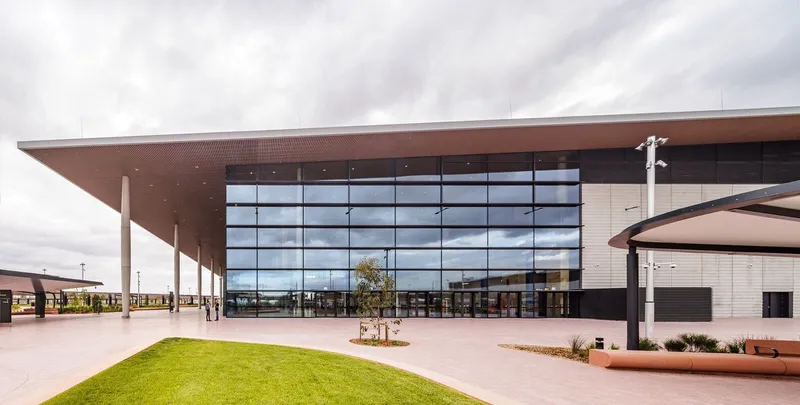

A Landmark Airport Rooted in Landscape and Light
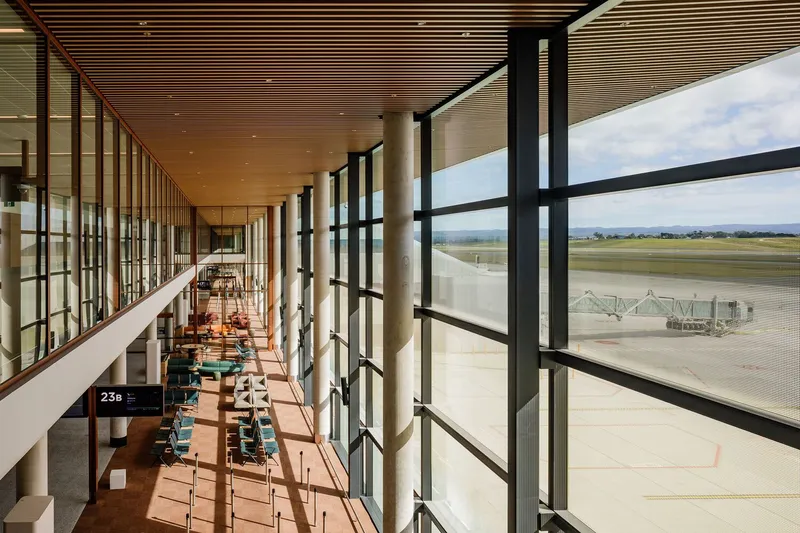
The terminal’s architectural language draws from the expansive horizons of the Cumberland Plain, evoking the natural beauty of Western Sydney. Its horizontal profile and soft, sweeping edges respond sensitively to the landscape, creating an infrastructure icon that feels both grounded and dynamic.
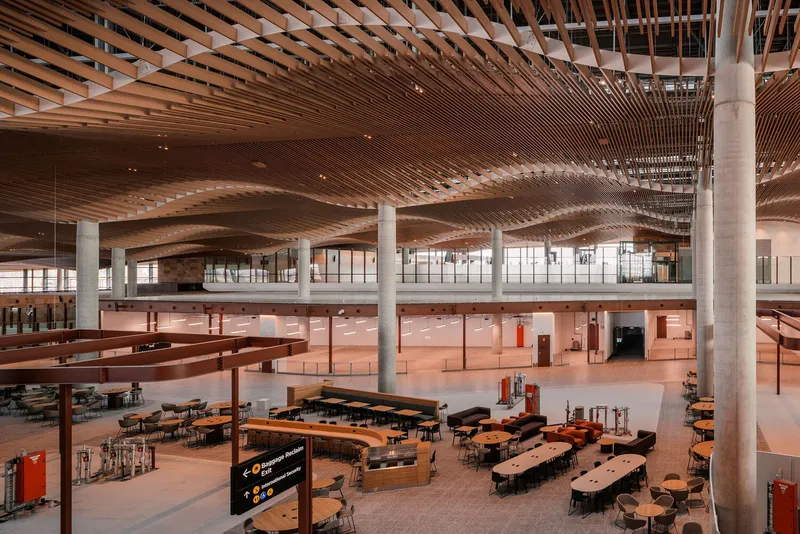
A sculptural ceiling system—one of the most distinctive features—filters natural light in a way that echoes sunlight glancing through eucalyptus bark. This celebration of “Great Australian Light” transforms the terminal into a calm, intuitive, and beautifully ambient environment.
Design lead David Holm of COX explains that the goal was to craft an airport that “belongs to its place in both spirit and identity.” Light becomes the primary tool for orientation, comfort, and emotional connection, shaping every moment of the passenger journey.
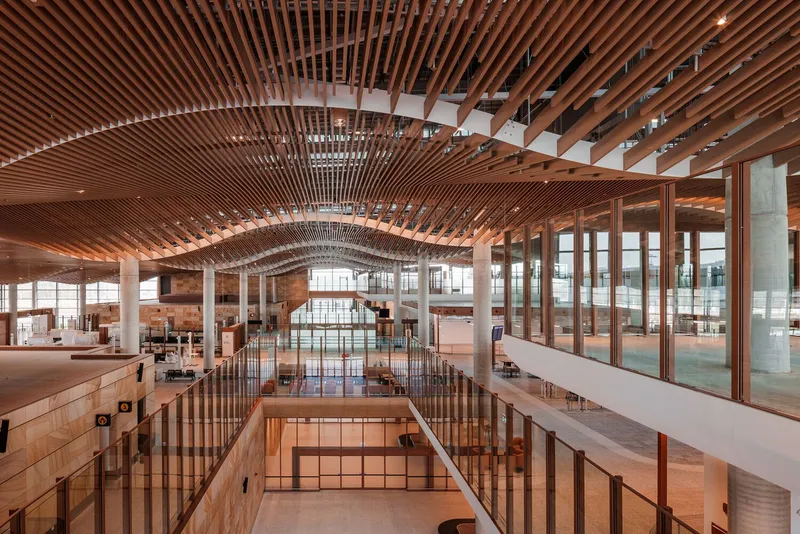
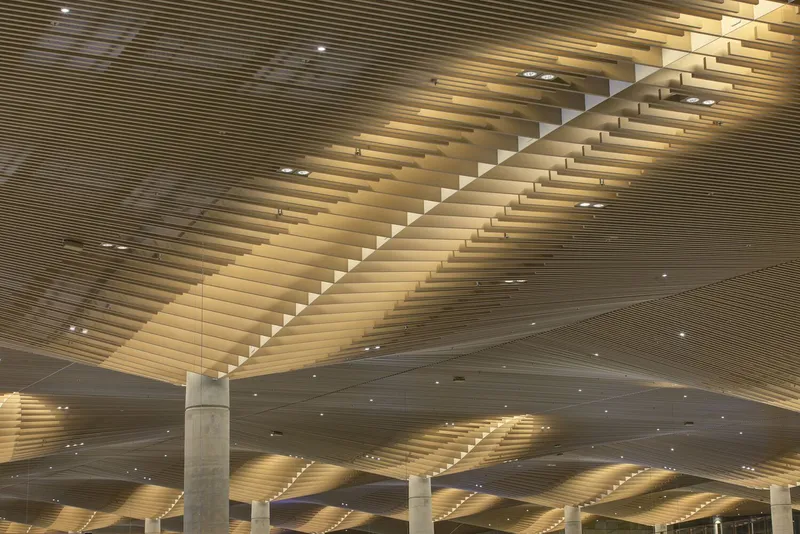
A Passenger Experience Shaped by Western Sydney’s Cultural Identity
Western Sydney is one of Australia’s most culturally diverse regions, and the terminal reflects this through spatial storytelling and design inclusivity. Developed in consultation with Dharug Custodians and guided by First Nations consultant Murrawin, the architecture integrates local cultural narratives into the heart of the building.
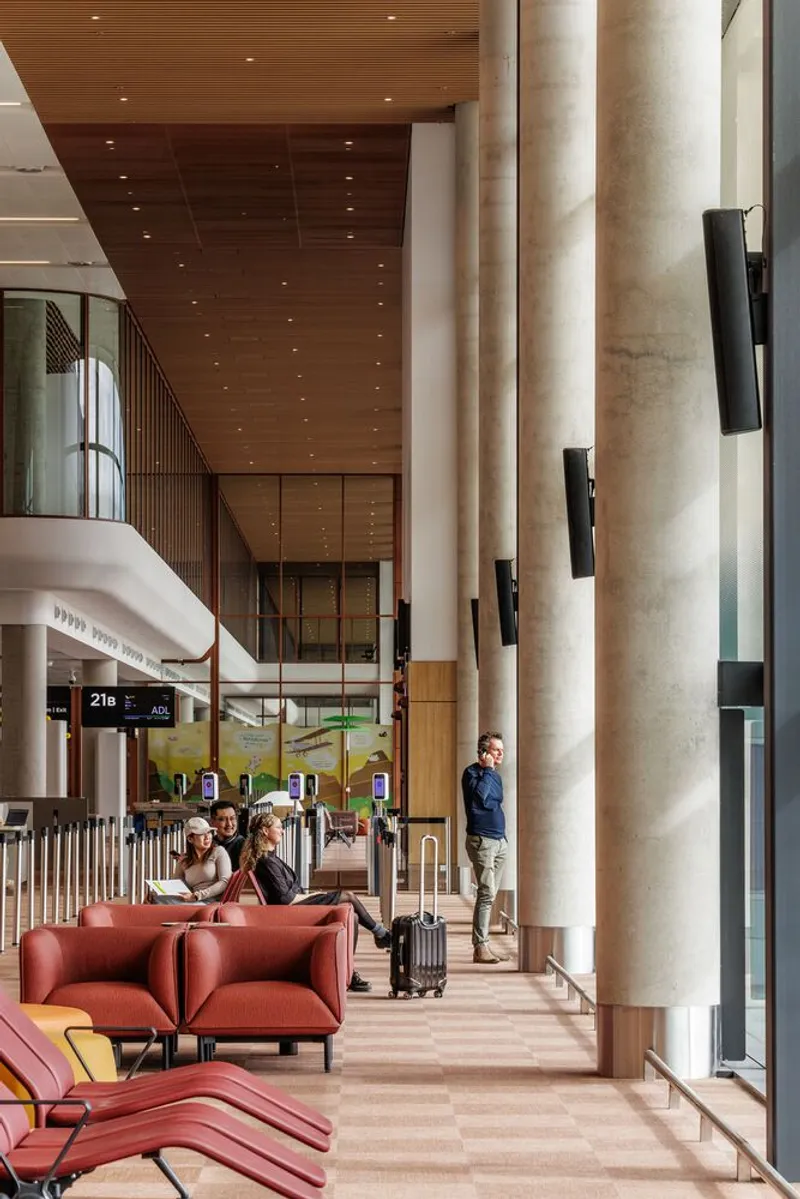
Warm materials, open sightlines, and seamless indoor-outdoor transitions create a welcoming, egalitarian terminal experience. For Zaha Hadid Architects, the project provided a rare opportunity to shape the next generation of global airport design—combining international ambition with local authenticity.
Woods Bagot further refined the architectural vision, ensuring that the landsides, terminal interiors, and forecourts convey a uniquely Western Sydney identity. The result is a terminal that feels like both a gateway and a destination, encouraging passengers to connect with place as they transition through the space.

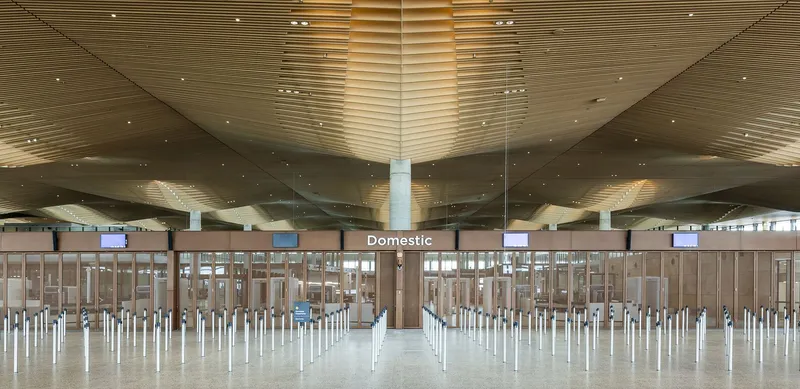
Intuitive Circulation and Human-Scaled Architecture
WSI elevates passenger experience through simplicity and legibility. The terminal’s spatial organization offers clear visual cues, intuitive circulation paths, and optimized passenger flow with minimal stress points.
Every design move—material selection, lighting strategy, glazing, wayfinding, ceiling geometry—supports comfort, clarity, and ease of movement. The architecture acts as a guide, reducing the cognitive load typically associated with international air travel.

A Future-Proof and Sustainable Airport Terminal
Designed to achieve a 5-Star Green Star Rating, Western Sydney International Airport integrates regenerative design principles that build long-term environmental resilience. Key features include:
- Natural ventilation strategies
- High-performance energy systems
- On-site water recycling
- Low-carbon construction approaches
- Passive daylighting and shading
- Long-span modular systems for flexible expansion
The terminal’s modular architectural structure ensures scalability without operational disruption, anticipating the future of aviation technology and long-term passenger growth.
Woods Bagot and Multiplex collaborated to develop innovative solutions that balance sustainability, operational efficiency, and commercial requirements—ensuring the building evolves with changing aviation demands.
A Transformational Infrastructure Project for Australia
As one of Australia’s most significant infrastructure investments, the Western Sydney International Airport ushers in a new era of aviation design. It showcases how world-class architecture, cultural expression, and environmental stewardship can come together in a landmark project built for future generations.

All photographs are works of Trevor Mein, Brett Boardman, Multiplex




Popular Articles
Popular articles from the community


Co-Life: Senior Housing Design That Reconnects Older Adults With the City
Co-Life reimagines senior housing design through healing gardens, shared streets, workshops, and a sustainable community across generations.

Riyadh For All: Intergenerational Urban Design for Active Aging in Rabat
Riyadh For All reimagines urban design in Rabat with intergenerational co-living, adaptive courtyards, and Moroccan cultural exchange today.

Conexión: Biophilic Design Reimagines High-Rise Living in Hong Kong
Conexión reimagines high-rise living in Hong Kong through biophilic design, green facades, shared spaces, daylight, water and nature within.
EW PARK: Sustainable Architecture Reimagines the Future of Urban Parking
EW PARK reimagines city parking as a modular wooden tower combining automation, solar energy, electric mobility, and adaptable urban design.

Similar Reads
You might also enjoy these articles


Hodi-Mandai Geram
Project Function: Preservation and revitalization of the Intangible heritage and socio-spatial identity of the Hodi by Housing, Cultural Memory Center, Sacred Grove, landscape, local tourism economy


Olio Towers: A Mid-Rise for Performers That Fuses Housing, Rehearsal, and Stage
Located blocks from Houston's Theater District, this modular tower stacks living units around a central performance atrium.

Oasis: Modular Green Housing Carved into Dhaka's Urban Fabric
A shortlisted Plugin Housing entry reclaims unauthorized settlements in Dhaka with stepped concrete volumes, green roofs, and ventilation-driven design.

Black Hole: A Floating Megastructure for the Post-Physical Era
Emiliano Mazzarotto envisions a spherical, self-scaling arena where e-sports, digital hotels, and holographic stadiums replace traditional public space.


Explore Airport Design Competitions
Discover active competitions in this discipline



Challenge to reimagine the Iron Throne


Photograph architecture without architects


Illustrate the lost glory of Angkor Wat - Render Challenge


Design challenge to reuse E-waste
Comments (0)
Please login or sign up to add comments
No comments yet. Be the first to comment!