

FEI Patisserie: A Timber Pavilion on the River
NEME Studio added a timber and steel pavilion to a Chinese concrete building, creating a riverfront cafe with awning windows and a draped fabric ceiling.


On a riverfront in southern China, a wooden pavilion has been added to the ground floor of an existing concrete building. FEI Patisserie, designed by NEME Studio Architects, is a cafe and bakery housed inside a timber and steel addition that wraps around the original structure like a verandah. The pavilion is the entire architecture: a post-and-beam frame, awning windows that tilt open like louvres, polished concrete floors, and a fabric ceiling that drapes between the timber rafters.
The brief was to convert a ground-floor commercial space inside a generic concrete building into a destination patisserie. NEME Studio chose not to renovate the interior. Instead, they built a new pavilion outside the existing building, on the river side, and let the original walls remain as the back of the cafe. The new structure is light, transparent, and entirely additive. It can be removed without damaging the original. It is also more interesting than anything that could have been done inside.
The Pavilion: Wood, Steel, and Awning Windows

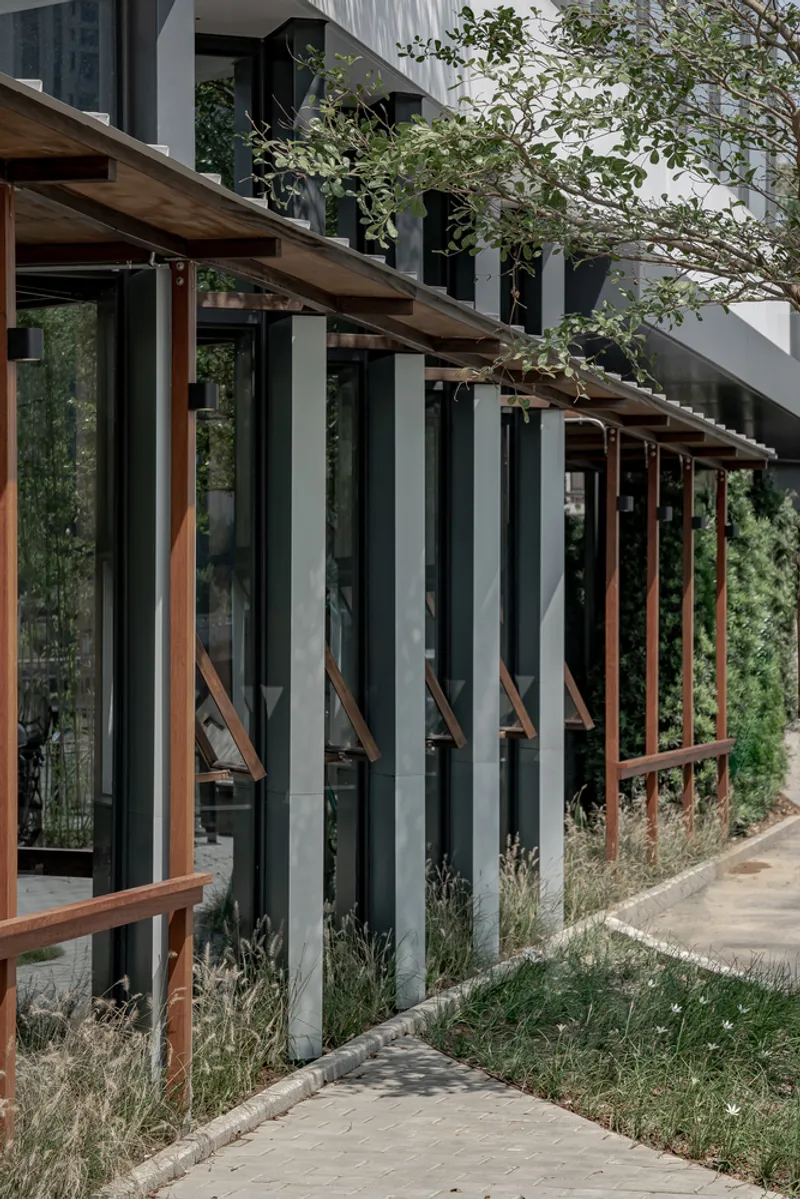
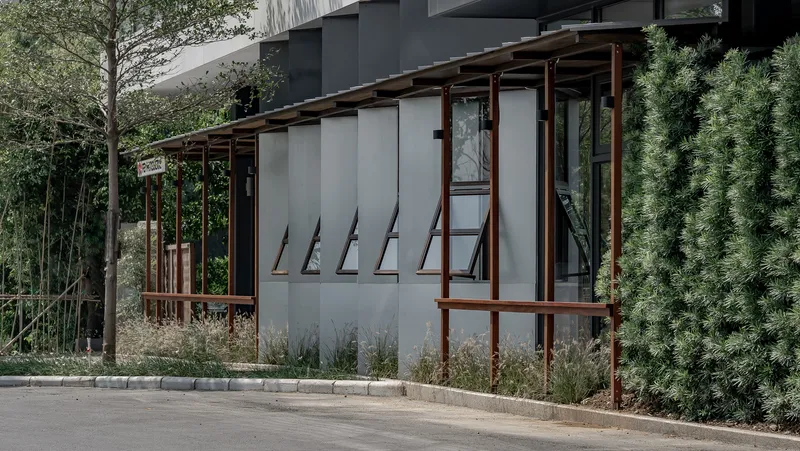
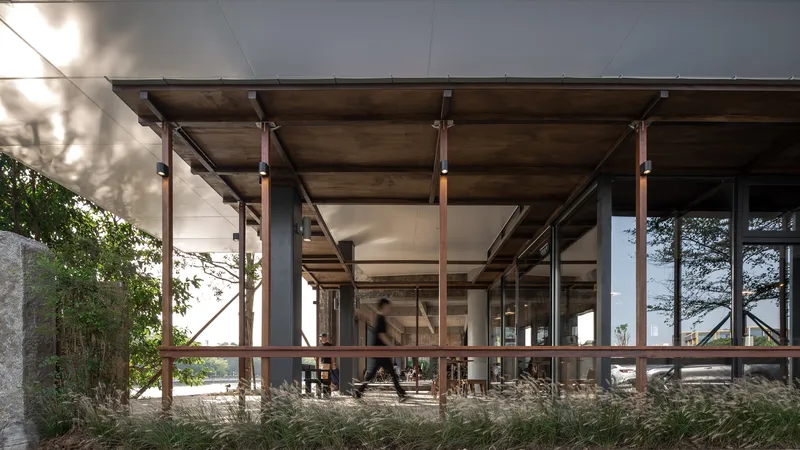
The pavilion is built from slim steel columns and timber beams, glazed with floor-to-ceiling glass walls. Awning windows along the lower portion can be propped open to bring in river breezes. The timber rafters cantilever out beyond the glass to create a deep overhang, sheltering the walkway around the pavilion. The framework reads as honest construction: every joint, every beam, every window mechanism is exposed and legible.
Construction: New on Old

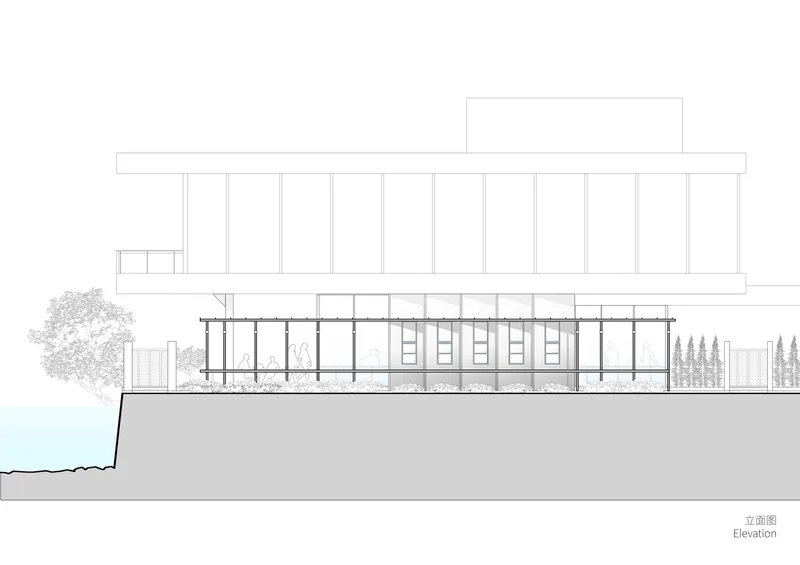
The construction diptych shows the strategy clearly. The existing building is a white concrete commercial block with a flat facade and standard windows. The new pavilion is a steel and timber frame attached to its base, wrapping around the ground floor on the river side. The elevation drawing shows the relationship: the original building stands above, and the new pavilion sits below, attached but distinct. The two architectures are intentionally different. The contrast is the design move.
The Riverside Walkway


The walkway around the pavilion is the public face. Timber posts and beams support the deep overhang. Dark glass doors open to the cafe interior. Plants grow along the base. From outside, the pavilion looks like a Japanese teahouse extended to a commercial scale. The deep eaves, the awning windows, and the timber rhythm all reference traditional East Asian garden architecture, but the materials and the structural logic are contemporary.
The Cafe Interior: Tatami and Fabric


Inside, the cafe is divided into low tatami platforms with kotatsu-style timber tables. The walls are dark timber. The ceiling is draped with white fabric panels that dip and curve between the rafters, softening the structure and providing acoustic absorption. Pendant lights hang from the rafters above each table. The atmosphere is calm, warm, and slightly theatrical. The fabric ceiling is the project's signature interior gesture: a soft layer that contrasts with the hard timber and steel frame.

Counter, Bar, and Window Seats

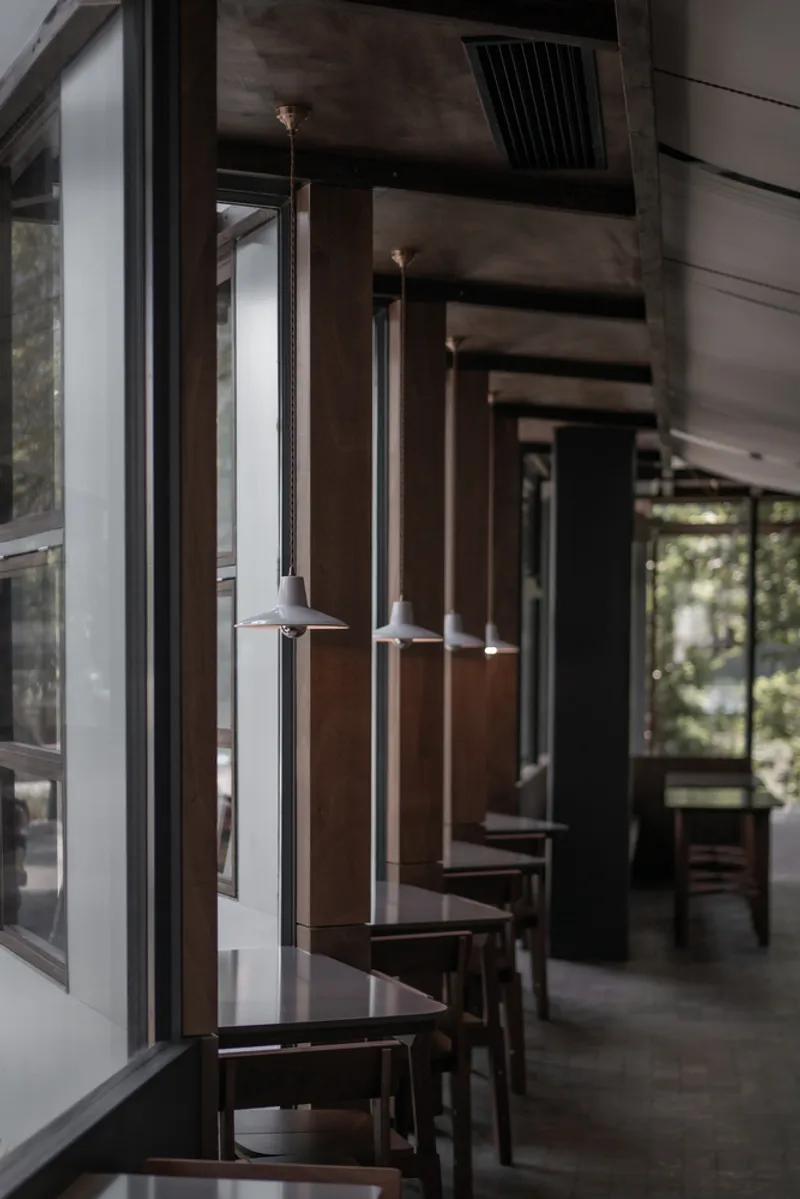

The bar and counter run along one edge with timber stools, glassware on display, and pendant lights overhead. The window counters face the street and the river, with single tables and tilted awning windows that bring in air and views. A woman sits reading at one of these counters, a small pendant lamp casting warm light over her book. These details show what the architect designed for: solo coffee, slow afternoons, and moments of quiet inside a busy commercial district.

Views: River and Greenery


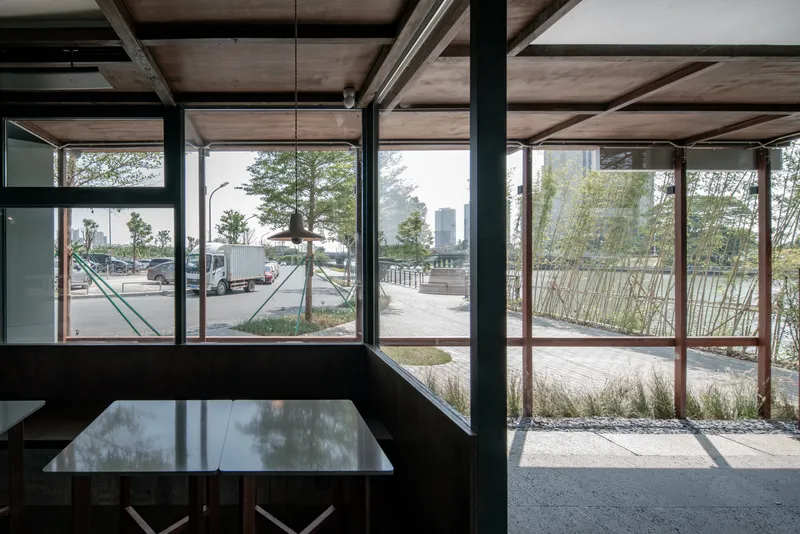
The pavilion's strongest views are toward the river. From inside, the glass walls frame the trees, the water, and the distant city skyline. The timber columns mark the foreground. The polished concrete floor reflects the light. The kitchen counter at one end is visible through the structure. The architecture frames the landscape, and the landscape becomes the dominant element of the interior. This is the reason the pavilion was built outside the existing walls: the original building had no view, and the new pavilion gives it one.

Window and Frame Details
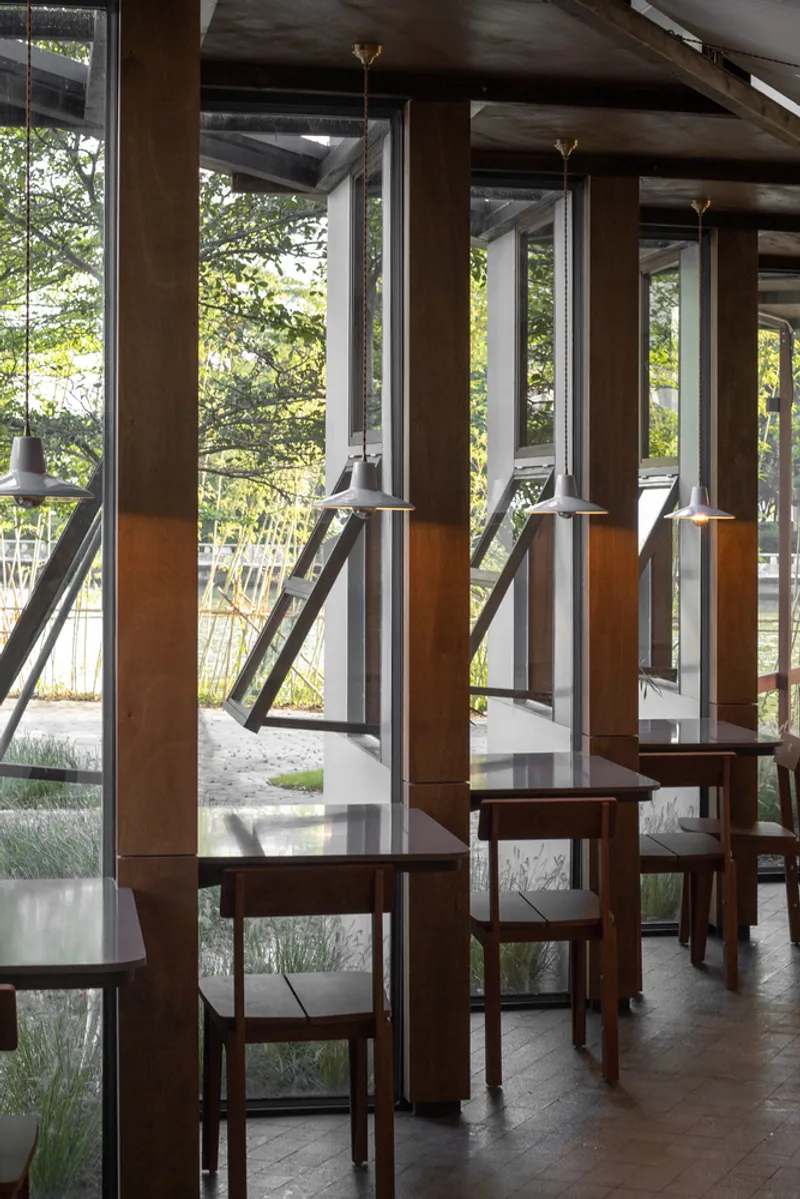

The awning windows are the project's most expressive detail. They tilt outward on horizontal hinges, propped at different angles by metal stays. From inside, they frame views in horizontal slices. From outside, the row of tilted windows reads as a kinetic facade element that changes through the day. The FEI PATISSERIE sign is mounted on the dark facade behind a timber screen, visible from the street but not dominant.
Why This Project Matters
Adaptive reuse of generic commercial buildings is one of the most common briefs in contemporary urban architecture, especially in Chinese cities where concrete blocks from the 1990s and 2000s line every commercial street. Most renovations gut the interior and start from scratch. NEME Studio did the opposite: they left the interior alone and built a new pavilion outside it. The new architecture has its own logic, materials, and atmosphere. The old building becomes the back wall.
If you are working on adaptive reuse, cafe design, or any project where the existing building is unremarkable but the site is good, FEI Patisserie is worth studying for how an additive timber pavilion can transform a generic commercial space into a destination.
About the Studio
Share Your Own Work on uni.xyz
If you are working on cafe architecture, timber pavilions, or adaptive reuse, uni.xyz is a place to publish your work and connect with a global design community.
Project credits: FEI Patisserie by NEME Studio Architects. China.




Popular Articles
Popular articles from the community


Riyadh For All: Intergenerational Urban Design for Active Aging in Rabat
Riyadh For All reimagines urban design in Rabat with intergenerational co-living, adaptive courtyards, and Moroccan cultural exchange today.

The Ocean Hive: Sustainable Architecture for a Self-Sufficient Civilization at Sea
The Ocean Hive imagines sustainable architecture at sea, where modular habitats, algae, wave power and ocean waste sustain a growing colony.

The Earth Pod: 3D Printed Homes for Resilient Refugee Communities
The Earth Pod reimagines refugee housing through 3D printed homes made from clay, combining resilience, self-sufficiency, and rapid shelter.
AL-JANNAH: Sustainable Architecture and Permaculture for Afghan Widows
AL-JANNAH uses sustainable architecture and permaculture to create resilient oasis of housing, learning, work and renewal for Afghan widows.
Similar Reads
You might also enjoy these articles


Hodi-Mandai Geram
Project Function: Preservation and revitalization of the Intangible heritage and socio-spatial identity of the Hodi by Housing, Cultural Memory Center, Sacred Grove, landscape, local tourism economy


Olio Towers: A Mid-Rise for Performers That Fuses Housing, Rehearsal, and Stage
Located blocks from Houston's Theater District, this modular tower stacks living units around a central performance atrium.

Oasis: Modular Green Housing Carved into Dhaka's Urban Fabric
A shortlisted Plugin Housing entry reclaims unauthorized settlements in Dhaka with stepped concrete volumes, green roofs, and ventilation-driven design.

Black Hole: A Floating Megastructure for the Post-Physical Era
Emiliano Mazzarotto envisions a spherical, self-scaling arena where e-sports, digital hotels, and holographic stadiums replace traditional public space.


Explore Pavilion Competitions
Discover active competitions in this discipline


Challenge to design luxury tourism on rails


Challenge to reimagine the Iron Throne


Photograph architecture without architects


VR headsets Storefront design competition
Comments (0)
Please login or sign up to add comments
No comments yet. Be the first to comment!