
Workshop and Diseño y Construcción Carve a Layered Retreat from a Century-Old Mérida House
On a sliver of land just 4.5 meters wide in Mérida's historic center, French-era beams and Mayan stucco share walls with concrete and glass.


Casa Lorena occupies one quarter of what was once a grand early twentieth-century residence in the historic center of Mérida, Mexico. The original mansion was subdivided repeatedly over the decades, leaving behind a narrow, deep plot only 4.5 meters wide, squeezed between party walls and stripped of most of its former grandeur. Workshop, Diseño y Construcción, led by architects Francisco Bernés Aranda and Fabián Gutiérrez Cetina, took this sliver of inheritance and turned it into a 125-square-meter house that reads as a dialogue between two centuries of building culture.
What makes the project worth studying is its refusal to choose between preservation and invention. One wing is restored: load-bearing masonry walls stripped back to raw stone, Decauville steel beams (imported from France during the henequén boom) left exposed and celebrated, Marseille clay tiles salvaged and reinstalled on the roof. The other wing is entirely new: concrete, cement block, chukum-finished surfaces tinted blue, tempered glass doors anchored to old wooden frames. Between them, a central courtyard with a narrow pool acts as the thermal engine and spatial hinge of the entire house. The result is not a compromise but a kind of architectural bilingualism, where each language makes the other more legible.
Street and Threshold

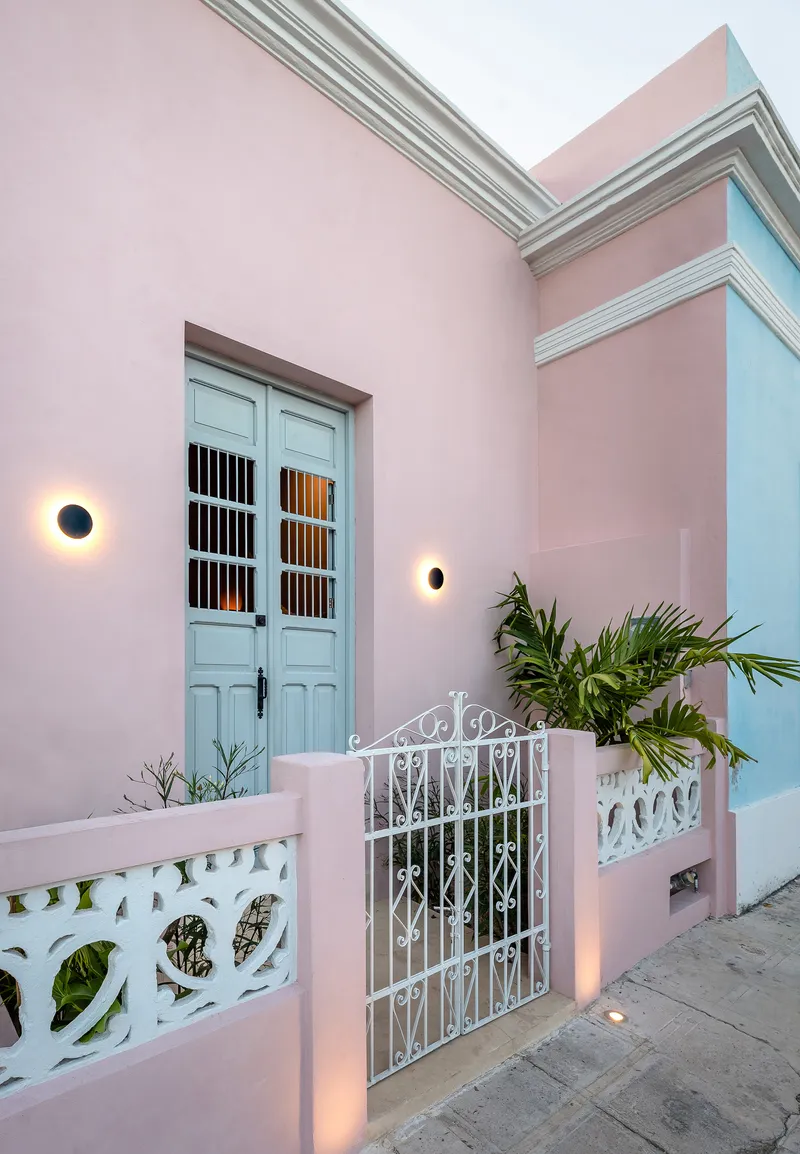
From the street, Casa Lorena is almost nothing: a pink stucco wall, a pale blue door, a pair of wall sconces. The facade sits slightly inset from the sidewalk, an anomaly in Mérida's downtown grid where colonial houses typically press their faces right against the property line. The ornamental ironwork on the entry gate is one of the few signals of the building's age. Everything else is withheld. You pass through without any sense of the depth or complexity of what lies behind.
That restraint is deliberate. In a city where historic center renovations often announce themselves loudly, Workshop and Diseño y Construcción opted for near-anonymity on the exterior, concentrating all architectural energy on the interior sequence. The threshold is quiet so that the courtyard, when it arrives, can be loud.
The Restored Wing: Stone, Timber, and Memory


The front volume houses the living room and dining area beneath ceilings that soar past five meters. Here, all wall finishing has been removed to leave the original stonework exposed, revealing the irregular courses that nineteenth-century masons laid by hand. Decauville beams, the narrow-gauge steel rails that once carried henequén fiber across Yucatán's haciendas before being repurposed as structural lintels, span the width of the rooms. Wooden rafters rest on top of them, supporting the salvaged Marseille tiles overhead.
The decision to reveal rather than erase these materials is more than aesthetic. It is a legible argument about Mérida's building history, where French imports and local masonry coexisted as the standard construction system for decades. By keeping the beams visible and restoring them in place, the architects let visitors read the structural logic of the original house even as they inhabit a thoroughly contemporary space.
Living Spaces and Material Texture


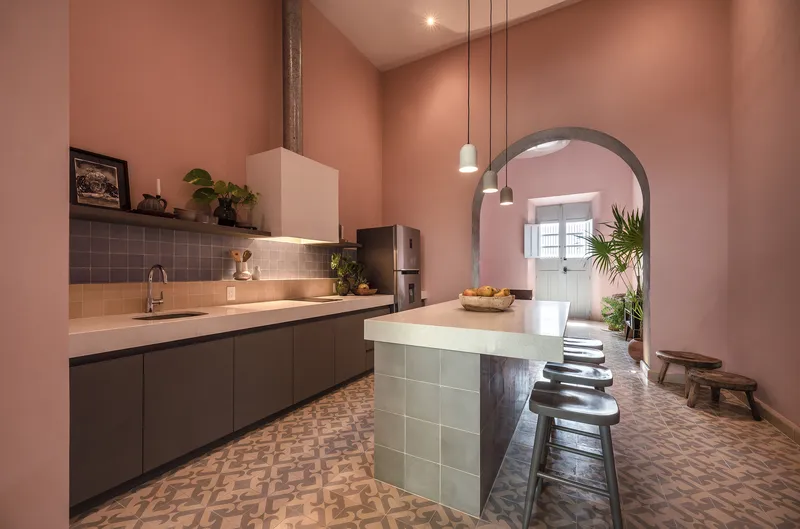
Patterned pasta tiles in blue tones cover the floors of the living room and kitchen, pulling the eye along the linear axis of the house. Pink plaster walls in the kitchen volume create a warm counterpoint to the cooler stone surfaces of the dining room. Leather lounge chairs, ceiling fans, and palm fronds filtering through from the courtyard establish an atmosphere that feels lived-in rather than curated.
The kitchen itself bridges old and new: a white quartz island sits beneath pendant lights suspended from an exposed industrial pipe, while an arched passage behind it leads toward the planted courtyard. Arched doorways are original; the tempered glass doors that fill some of them are not. The join between old wooden frames and new glazing is left visible, another instance of the architects' insistence on showing their hand rather than hiding the seam.
The Kitchen as Connector


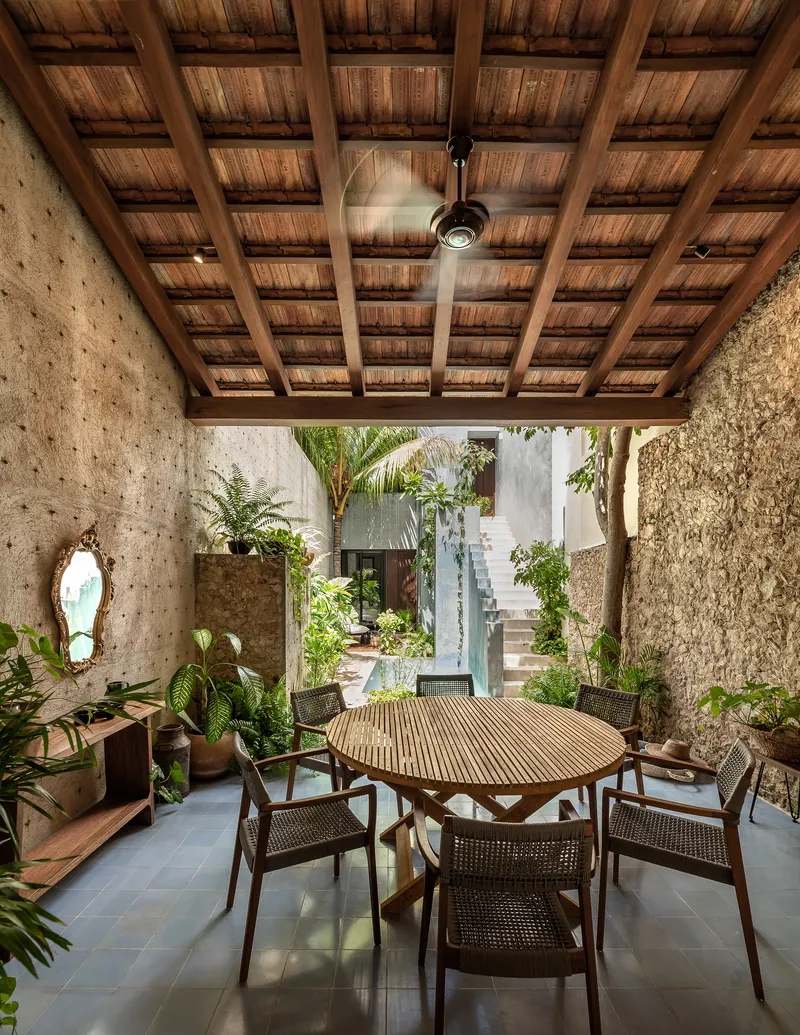
Positioned between the restored wing and the courtyard, the kitchen-dining zone functions as a spatial decompression chamber. Its arched opening to the garden lets light and air flood across the cooking surface, while the covered dining terrace on the opposite side, with its timber beam ceiling and concrete walls, provides shade during Mérida's relentless afternoons. The progression from enclosed stone room to covered terrace to open sky happens within just a few meters of linear circulation, compressing what would be a generous sequence in a larger house into something almost cinematic.
The Courtyard and Pool as Spatial Engine


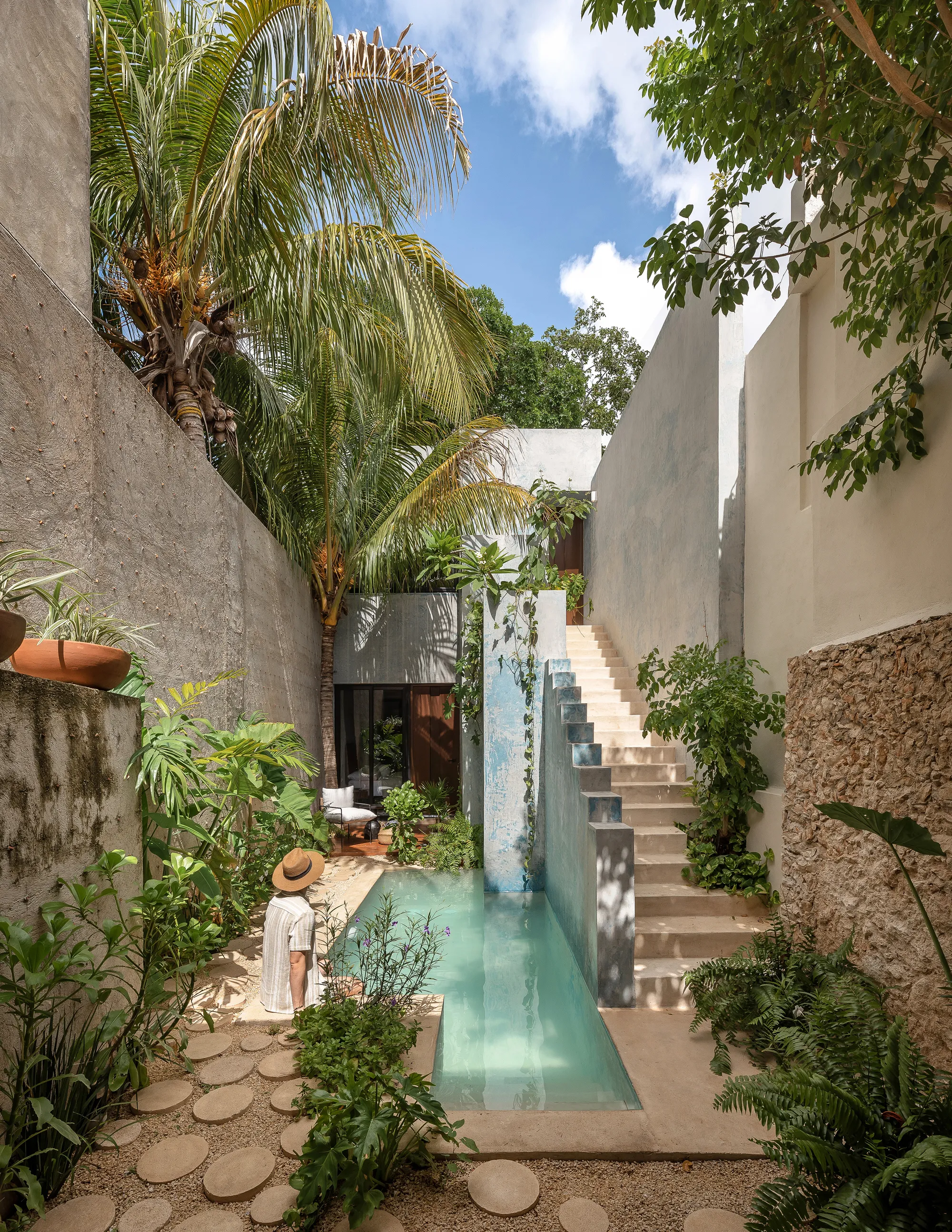
The central courtyard is the heart of Casa Lorena, and the narrow lap pool running through it is its pulse. The pool does more than cool: it acts as the main partition between the semi-private social block at the front (living, dining, kitchen) and the private sleeping quarters at the rear. You cannot pass from one to the other without walking alongside water, a sensory transition that rewires your awareness of interior climate as you move through the house.
Overhead views reveal how tightly the planting, water, and built mass interlock. Palm trees rise past the roofline, casting dappled shadows on the chukum-finished walls. The courtyard is simultaneously a light well, a ventilation chimney, and a garden, fulfilling three functions in a footprint that could barely park a car. This is the payoff for the narrow plot: when you can only expand vertically, every square meter of open air becomes precious, and the architects treat it accordingly.
Staircase, Plunge, and Vertical Circulation

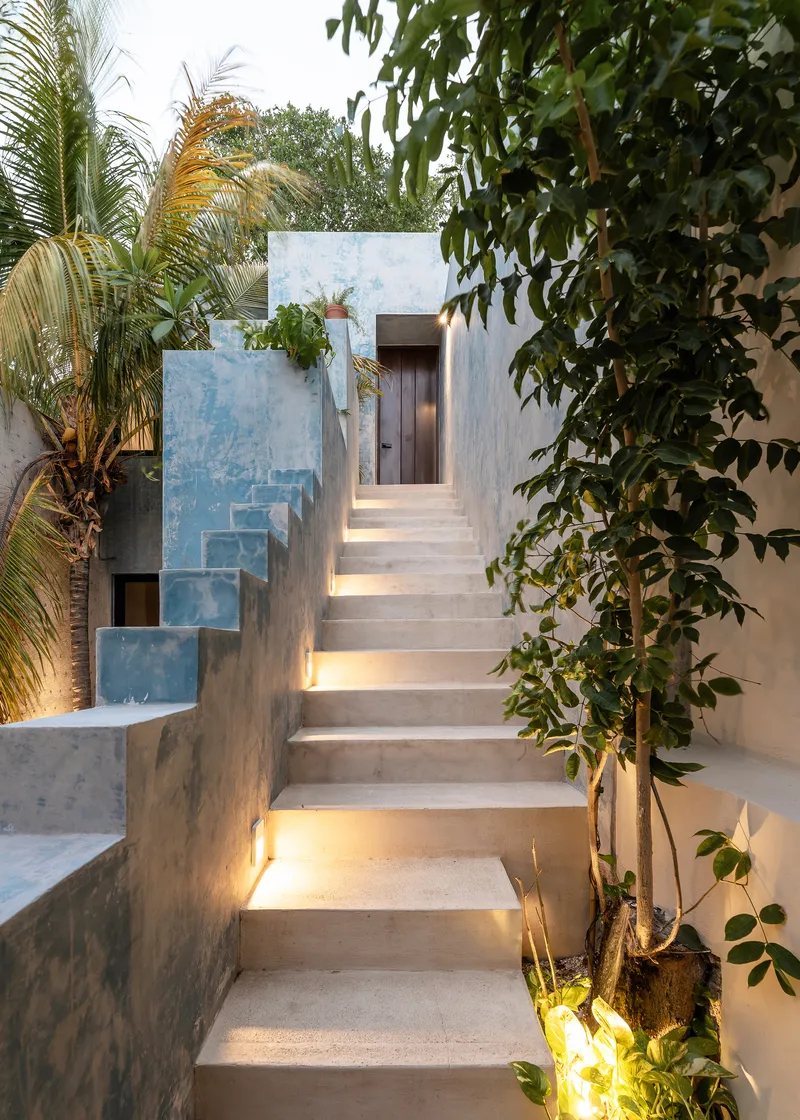

A concrete staircase climbs alongside the pool, its integrated step lighting turning it into a lantern at dusk. The stairs connect the ground-floor social spaces to the upper bedroom, threading past tropical foliage that softens what could have been a harsh concrete canyon. Blue-tinted chukum plaster on the stair walls deepens the color as shadows lengthen, creating a gradient effect that changes throughout the day.
At the base of the staircase, a shallow water feature and climbing vines blur the boundary between architecture and landscape. The weathered surface of the blue plaster, already showing the patina of Mérida's humid climate, suggests that the architects anticipated aging as part of the design rather than an adversary to it.
Bedrooms, Bathrooms, and the Ventilation Cube

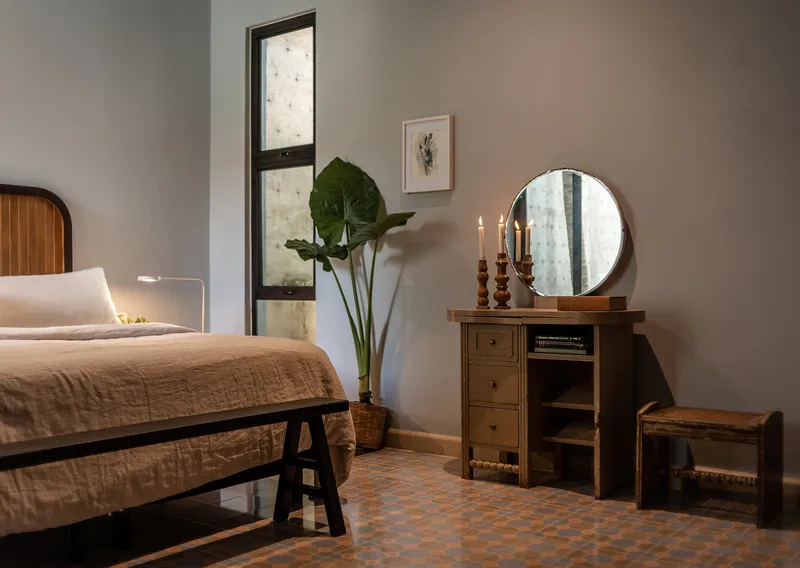

The two bedrooms are stacked at the rear of the plot, accessed through the wooden deck that borders the courtyard. Patterned terracotta floor tiles give the ground-floor bedroom a warmth distinct from the blue-toned social spaces. A tall vertical window in the upper bedroom frames a strip of sky and brings in a column of light that changes character by the hour. The bathrooms are treated with equal care: a terrazzo vanity, a brown tile partition, and a glazed door opening to the planted courtyard turn what is typically the most utilitarian room in a house into one of its most atmospheric.
The ground-floor bedroom connects to its bathroom through a "ventilation cube," an intermediary volume at a different height that draws air through the section and creates a surprising sense of spaciousness in a room that is, by any metric, compact. This small move encapsulates the project's strategy: when horizontal space is constrained, manipulate the section.
Interstitial Gardens and the Rear Courtyard

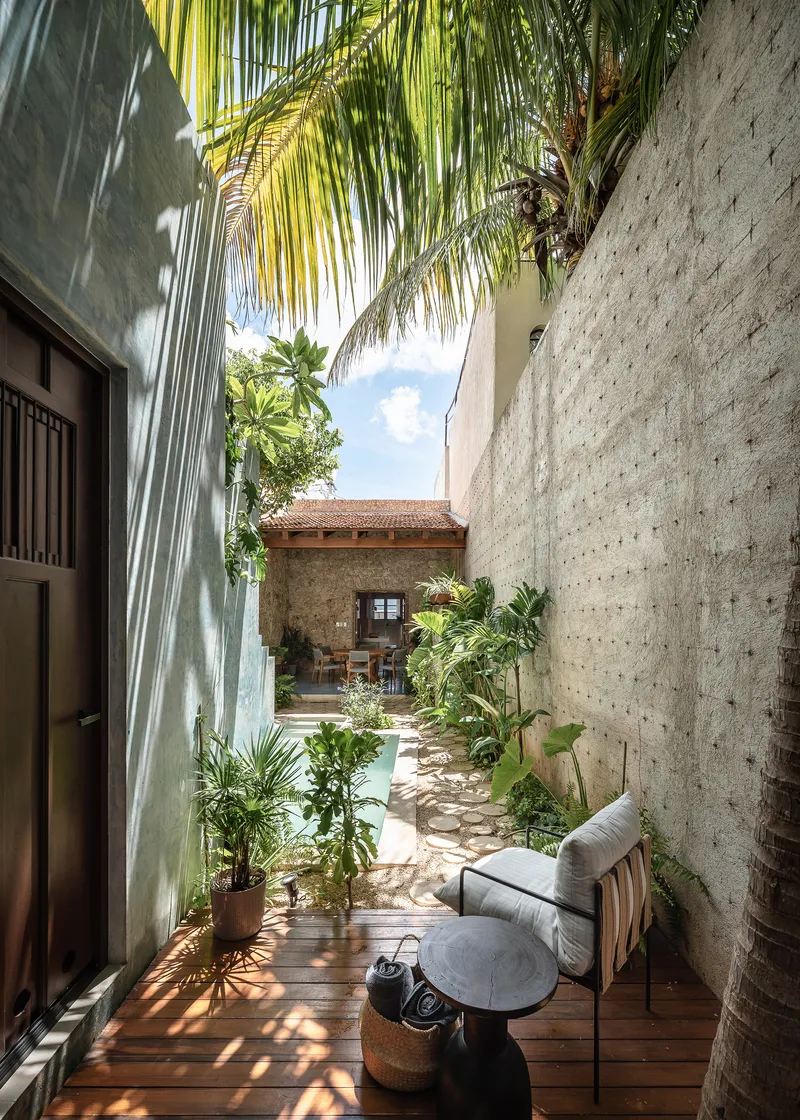

Linear circulation on a 4.5-meter-wide plot could easily feel like a corridor. The architects break that monotony with interstitial gardens, planted beds tucked between rooms, stone pavers that shift underfoot, and a timber deck seating area surrounded by potted palms. These pockets of green fragment the journey through the house, introducing visual breaks and small moments of stillness that make the 125 square meters feel substantially larger than they are.
The rear courtyard, with its board-formed concrete walls and climbing vines, belongs firmly to the new wing. Its material language is modern, but its spatial logic, the deep, shaded outdoor room sheltered from the street, is as old as Yucatecan domestic architecture itself.
Plans and Drawings
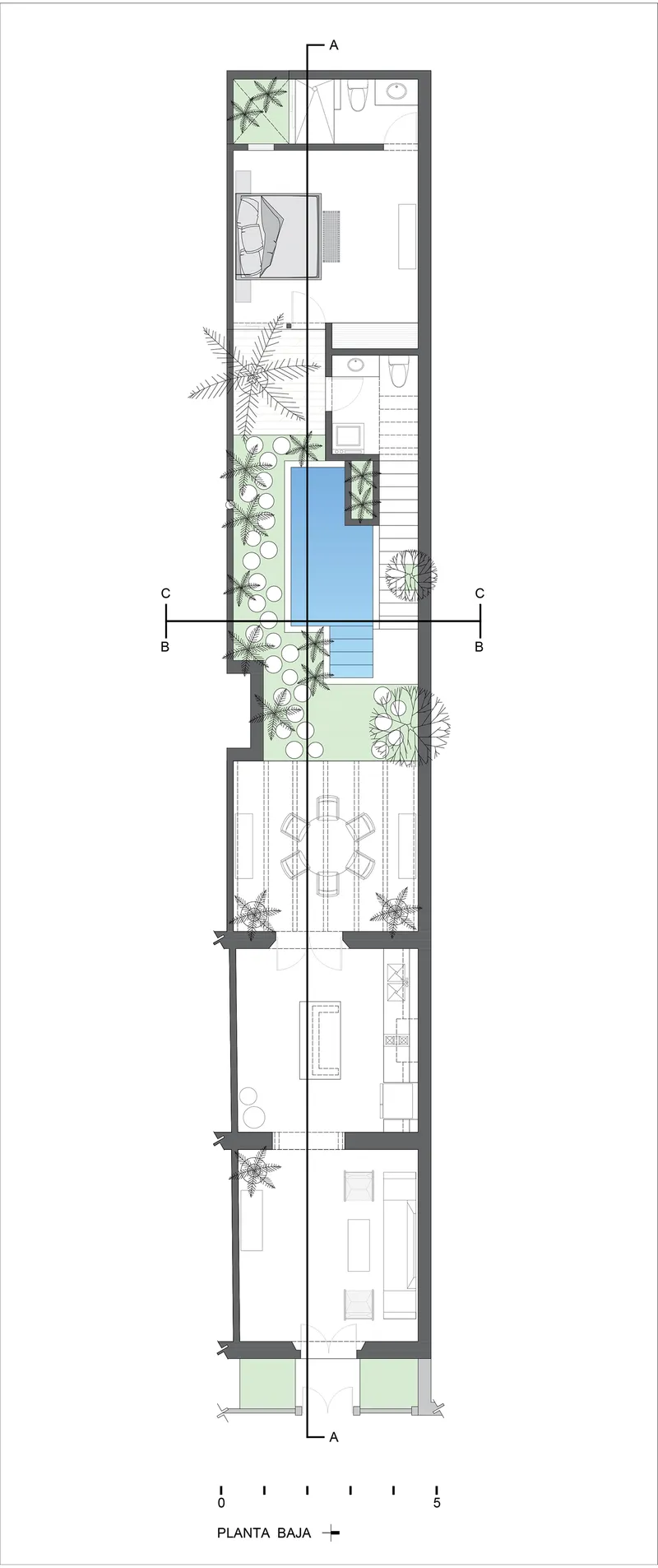
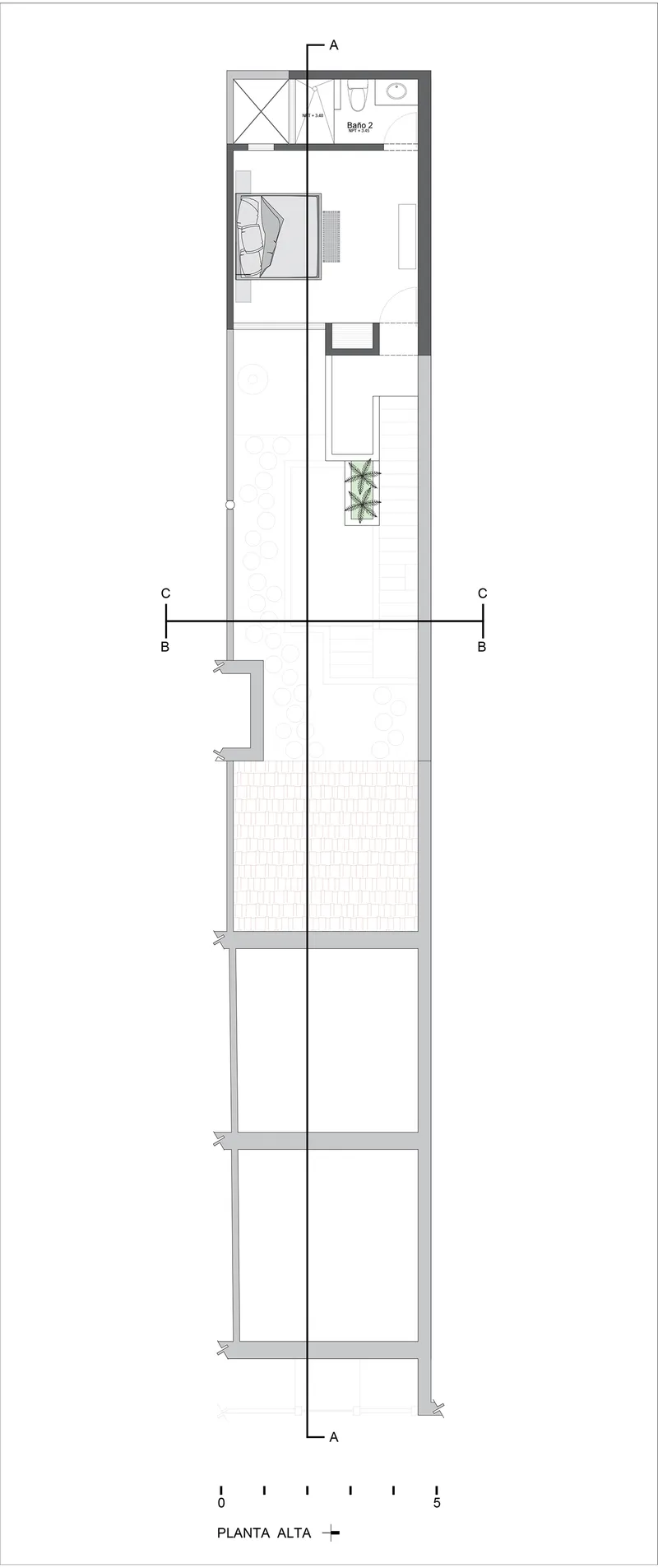

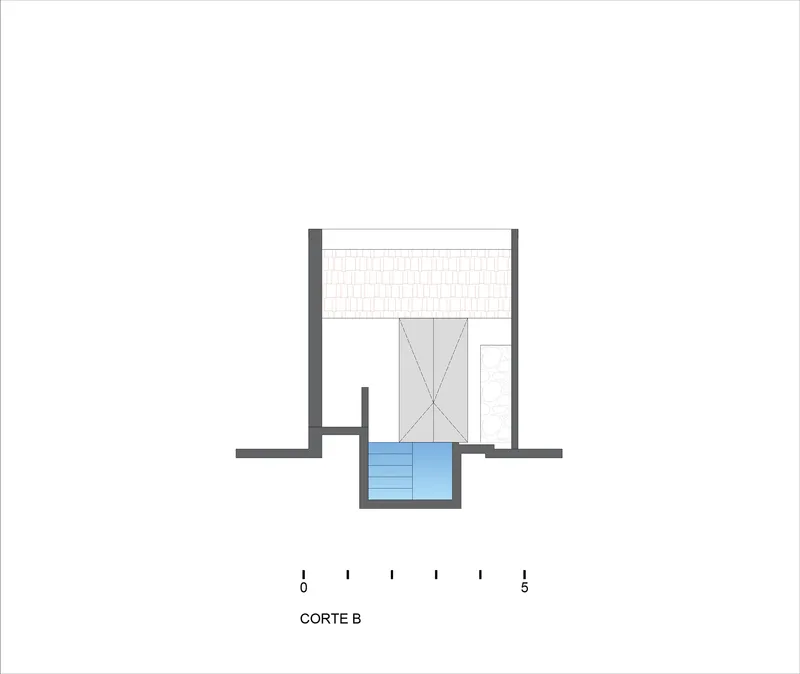

The ground and upper floor plans confirm just how extreme the proportions are: a slender rectangle extending deep into the block, with the pool positioned almost exactly at the midpoint. Rooms stack along one edge, circulation along the other, and the courtyard acts as the fulcrum. The sections are equally revealing. One shows the double-height living room with its timber roof structure tilting over the pivot door and sunken pool below grade. Another exposes the staircase climbing alongside buried storage volumes, clarifying how the architects carved usable space out of a plot that offers no forgiveness in width.
Read together, the drawings make visible what the photographs only hint at: the project's reliance on sectional ingenuity. Rooms at different heights, cubes stacked and offset, a pool that drops below the courtyard floor. Almost none of this registers from a plan view alone. The section is where Casa Lorena does its real work.
Why This Project Matters
Historic center renovation in Latin American cities often defaults to one of two modes: nostalgic reconstruction that freezes a building in amber, or wholesale demolition that replaces the old with something indistinguishable from any global developer product. Casa Lorena refuses both. By restoring one wing and building another from scratch, Workshop and Diseño y Construcción create a house where the conversation between past and present is not implied but built into the structure itself. You can see, touch, and inhabit the difference.
The project also stands as a sharp lesson in working with constraint. On a plot 4.5 meters wide, every decision carries disproportionate weight: the pool is not decoration but partition, the courtyard is not luxury but necessity, the ventilation cube is not whimsy but the only way to make a ground-floor bedroom breathable. When resources are scarce, architecture has to think harder, and the thinking here is rigorous, specific, and deeply embedded in the material culture of Mérida.
Casa Lorena, designed by Workshop and Diseño y Construcción, lead architects Francisco Bernés Aranda and Fabián Gutiérrez Cetina, located in Mérida, Mexico. 125 m², completed in 2022. Photography by Manolo R. Solís.
About the Studio
Share Your Own Work on uni.xyz
If projects like this are the kind of work you want to make, uni.xyz is a place to publish your own, find collaborators, and enter design competitions.




Popular Articles
Popular articles from the community

EW PARK: Sustainable Architecture Reimagines the Future of Urban Parking
EW PARK reimagines city parking as a modular wooden tower combining automation, solar energy, electric mobility, and adaptable urban design.

Hill & Cross Opera: Sculptural Opera House Architecture Shaped by Tallinn’s Landscape and Identity
Hill & Cross Opera reimagines opera house architecture in Tallinn through its sculptural hill, civic plaza, glass wave and a luminous cross.

AL-JANNAH: Sustainable Architecture and Permaculture for Afghan Widows
AL-JANNAH uses sustainable architecture and permaculture to create resilient oasis of housing, learning, work and renewal for Afghan widows.

Co-life: Sustainable Architecture for Age-Friendly Community Living
Co-life reimagines sustainable architecture for seniors through courtyards, rammed earth, shared gardens, and spaces designed for belonging.


Similar Reads
You might also enjoy these articles

Bao Huynh Watercolor Atelier: A Serene Art Retreat in Hội An
Bao Huynh Watercolor Atelier in Hội An blends multifunctional art spaces, sustainable design, local materials, and family-friendly living in a serene environment.

Atelier Macri Concept Store Interior Design by CASE-REAL
Atelier Macri store features a "ko" counter, walnut wood details, cork displays, blending retail, gallery, and seamless customer experiences.

Manuel Vargas Izquierdo Stadium and High-Performance Sports Center: Architectural Excellence in Jalpa de Méndez
The Manuel Vargas Izquierdo Stadium blends sustainable design, inclusive sports facilities, and cultural-inspired architecture, revitalizing Jalpa de Méndez’s public spaces.
KAKR Buluh Awar Hall: Revitalizing Community and Ecology Through Bamboo Architecture
Community built bamboo hall revitalizes Buluh Awar village, empowering youth, restoring ecology, celebrating vernacular craftsmanship through sustainable architecture and culture.


Comments (0)
Please login or sign up to add comments
No comments yet. Be the first to comment!