
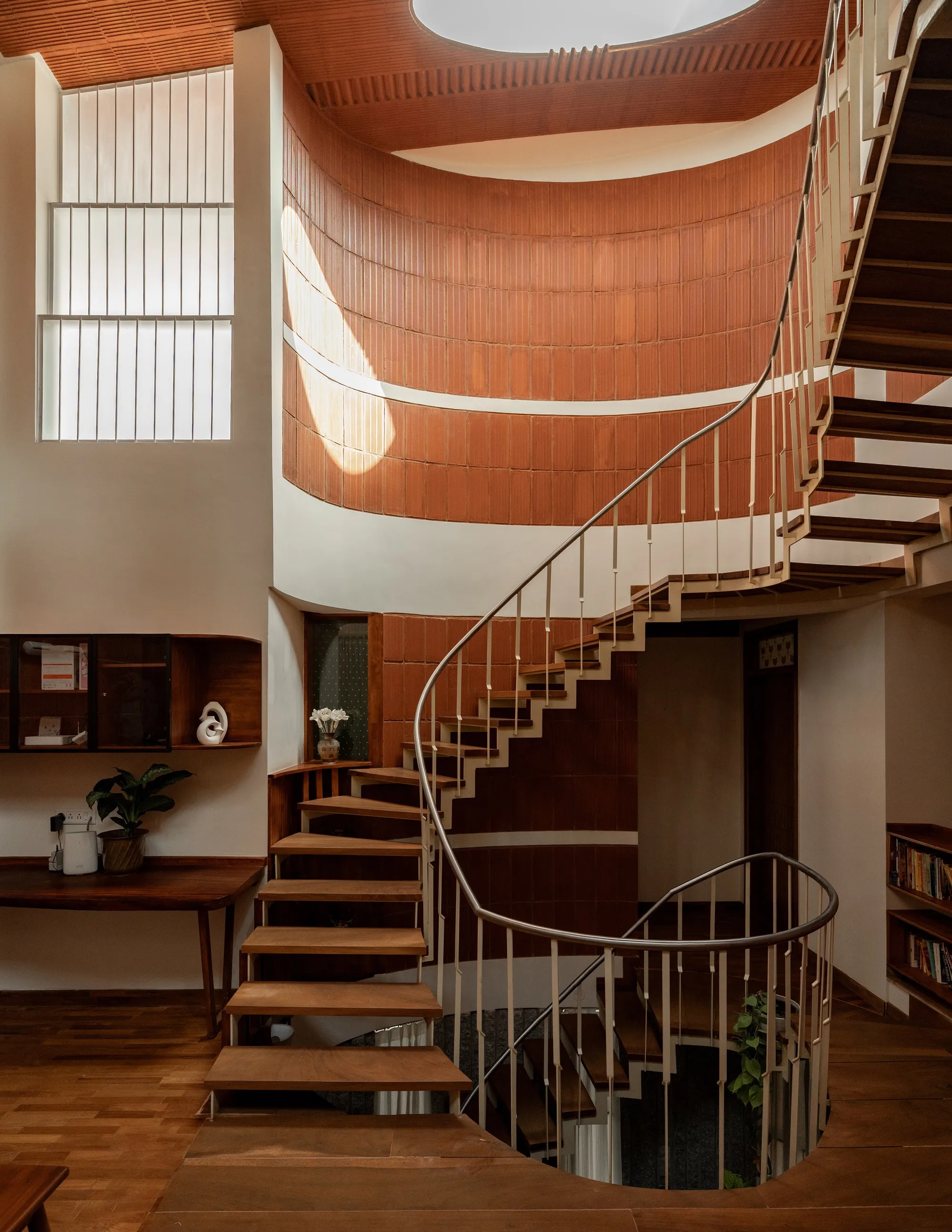
Wright Inspires Channels Tamil Nadu's Traditional Homes into a Bengaluru Residence Built Around a Spiral Stair
Srila House in Bengaluru wraps timber, terracotta, and perforated brick around a helical void that pulls light through every level.


Most contemporary houses in Bengaluru are concrete boxes dressed in cladding. Wright Inspires, led by architect Prathima Seethur, decided to build something else entirely: a 3,280-square-foot residence that breathes like the traditional homes of Tamil Nadu, organized around shade, ritual, and the slow passage of daylight. Srila House does not attempt to replicate a heritage typology. It borrows the principles, warmth and porosity and an ease between interior and garden, and translates them into a tightly planned urban plot.
The most striking move is a helical timber staircase that punches vertically through all three levels, creating a circular void that functions less as circulation and more as a light well. Around this spine, the house fans out into living spaces lined with slatted timber ceilings, terracotta accent walls, and perforated brick screens. The palette is narrow (Wienerberger brick, Baliapatnam tiles, natural stone, Asian Paints finishes) but handled with enough variation to keep every room distinct. It is a house that takes its material choices seriously and then lets daylight do the rest.
A Street Facade That Filters Rather Than Blocks
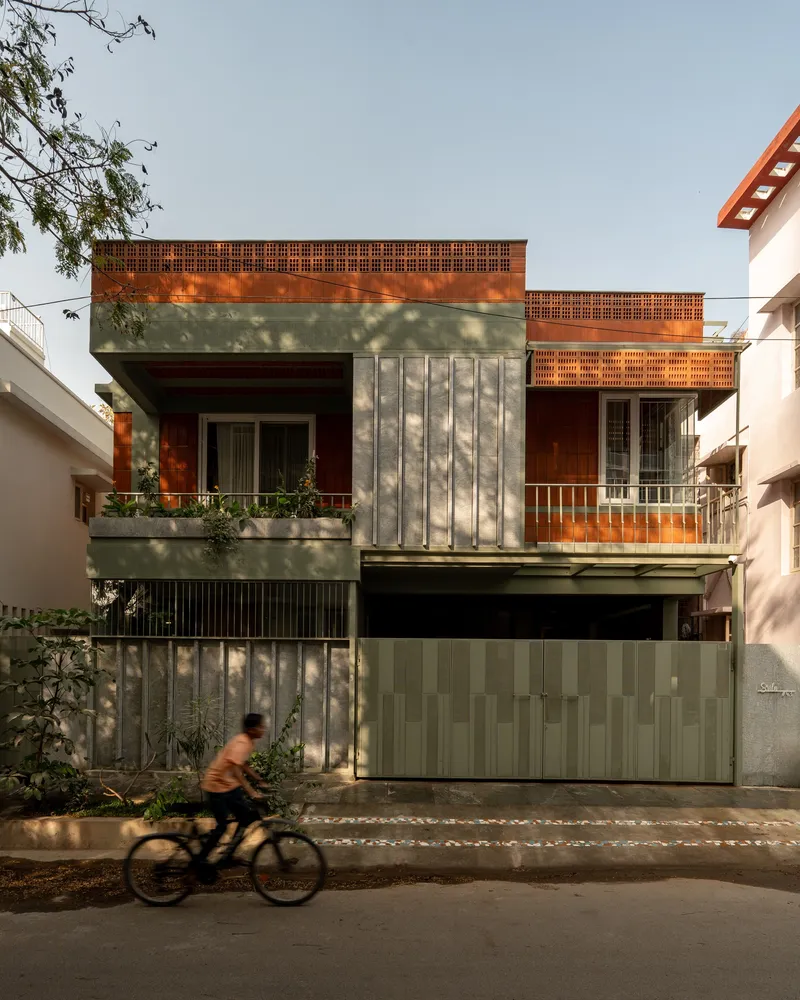
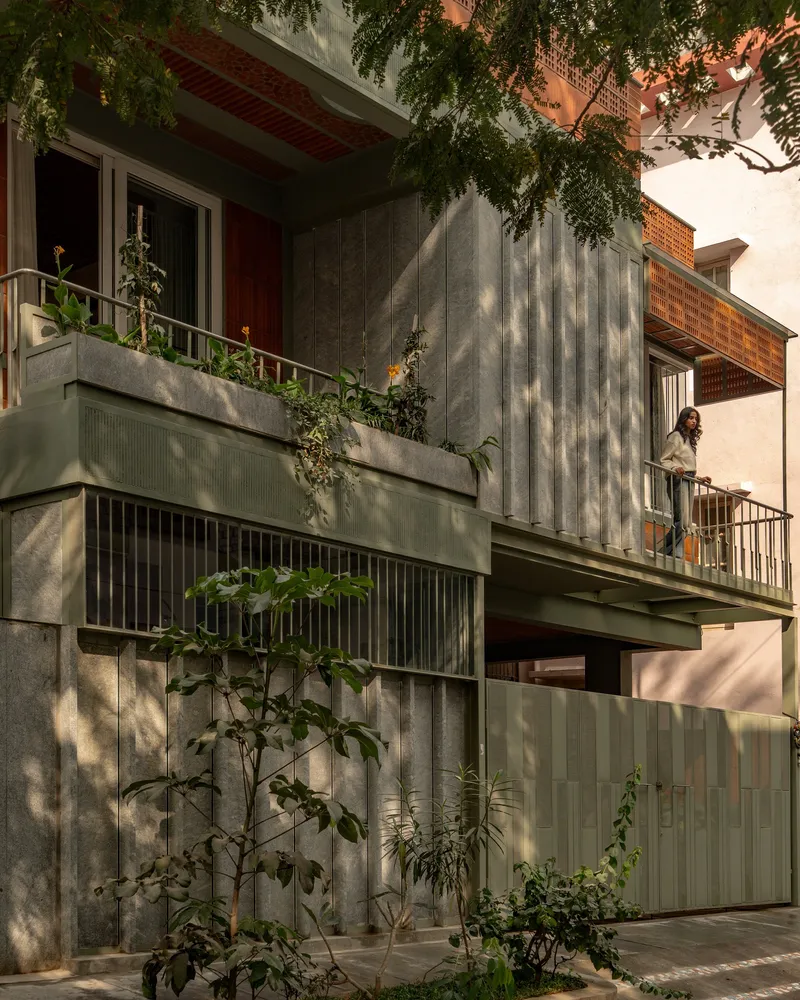
From the street, Srila House presents a layered composition of vertical concrete panels and perforated brick screens. It is not trying to be opaque or fortress-like. The facade reads as a series of overlapping filters: concrete fins shield planted balconies, while the brick screens allow cross-ventilation and dappled light to reach interior rooms. At dusk, tree shadows play across the cladding, softening the geometry further.
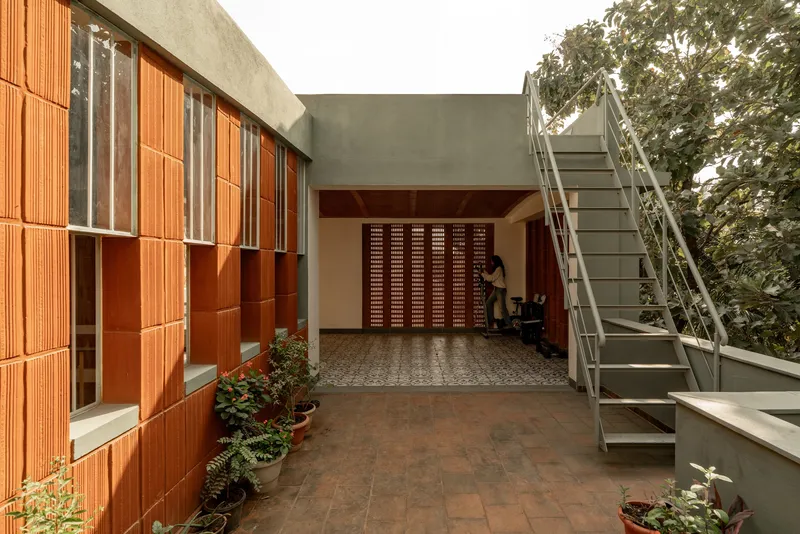
The covered entry terrace at ground level, framed in red terracotta tile and topped with a perforated screen door, signals the house's commitment to threshold spaces. You are never abruptly inside or outside. The steel stair to the upper level reinforces that the building's vertical life begins before you even cross the front door.
The Spiral Stair as Spatial Engine
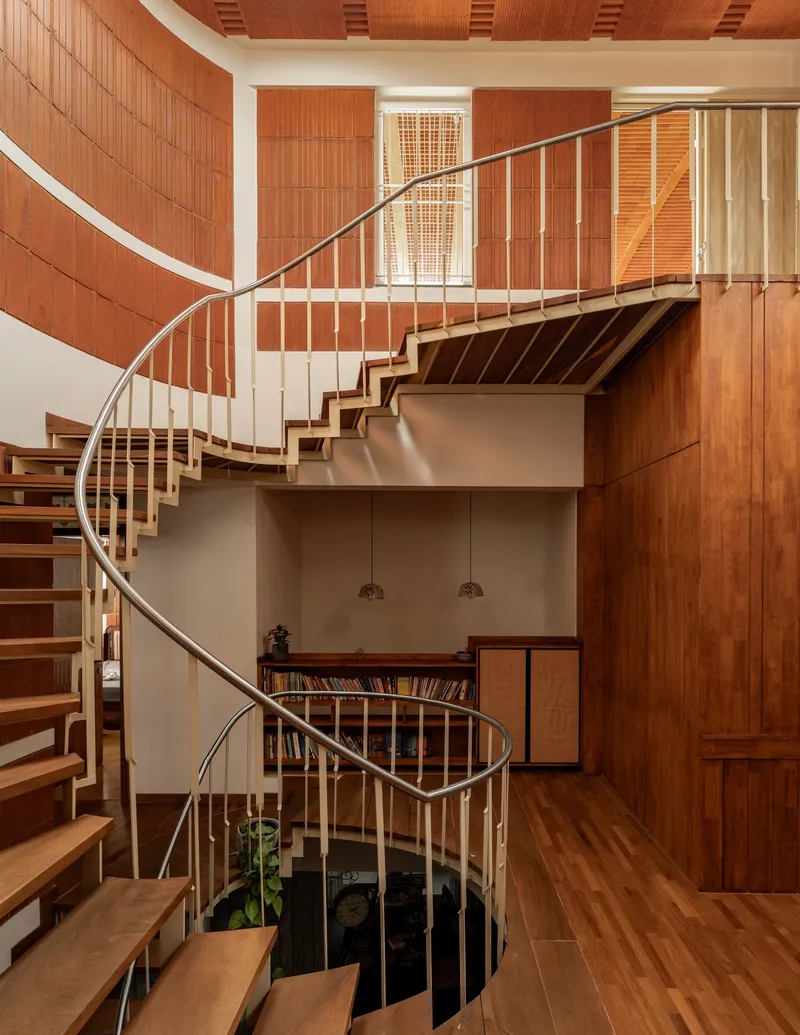
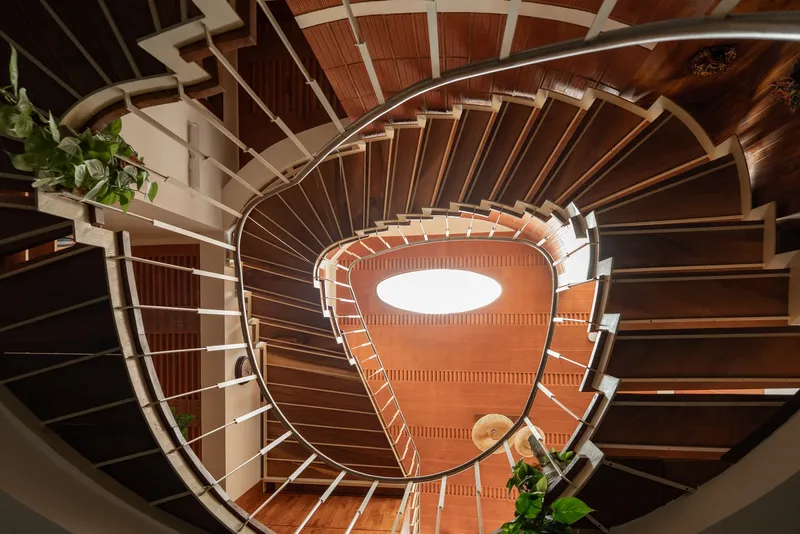
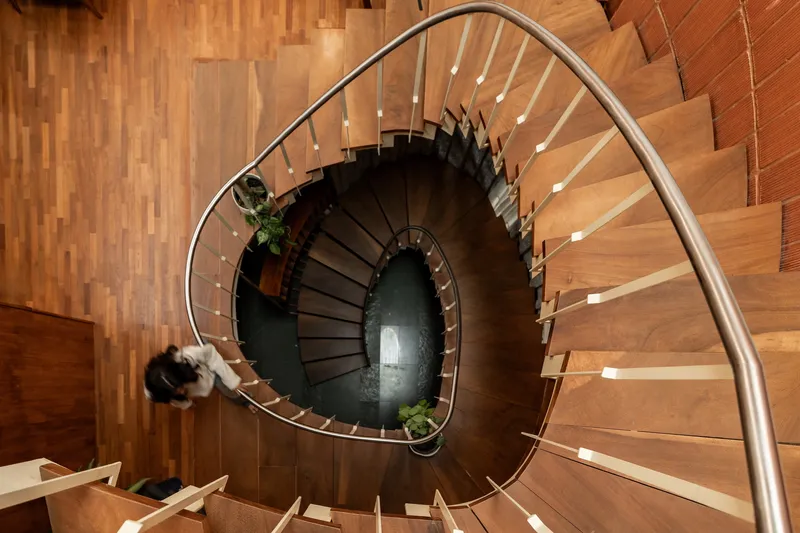
Every house needs a staircase. Very few houses build an entire spatial strategy around one. Srila's helical stair is constructed of open timber treads radiating around a central void, supported by a steel rod balustrade that keeps sightlines clear. Seen from above, the stair resembles a nautilus shell. Seen from below, it is a column of air and trailing greenery.
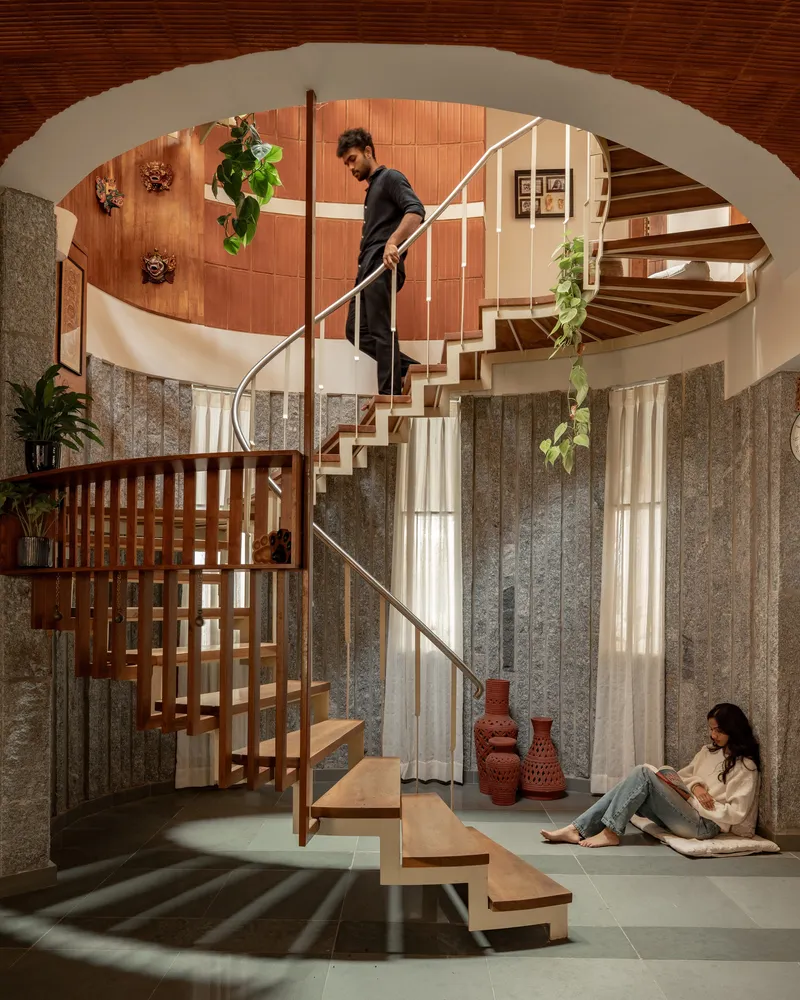
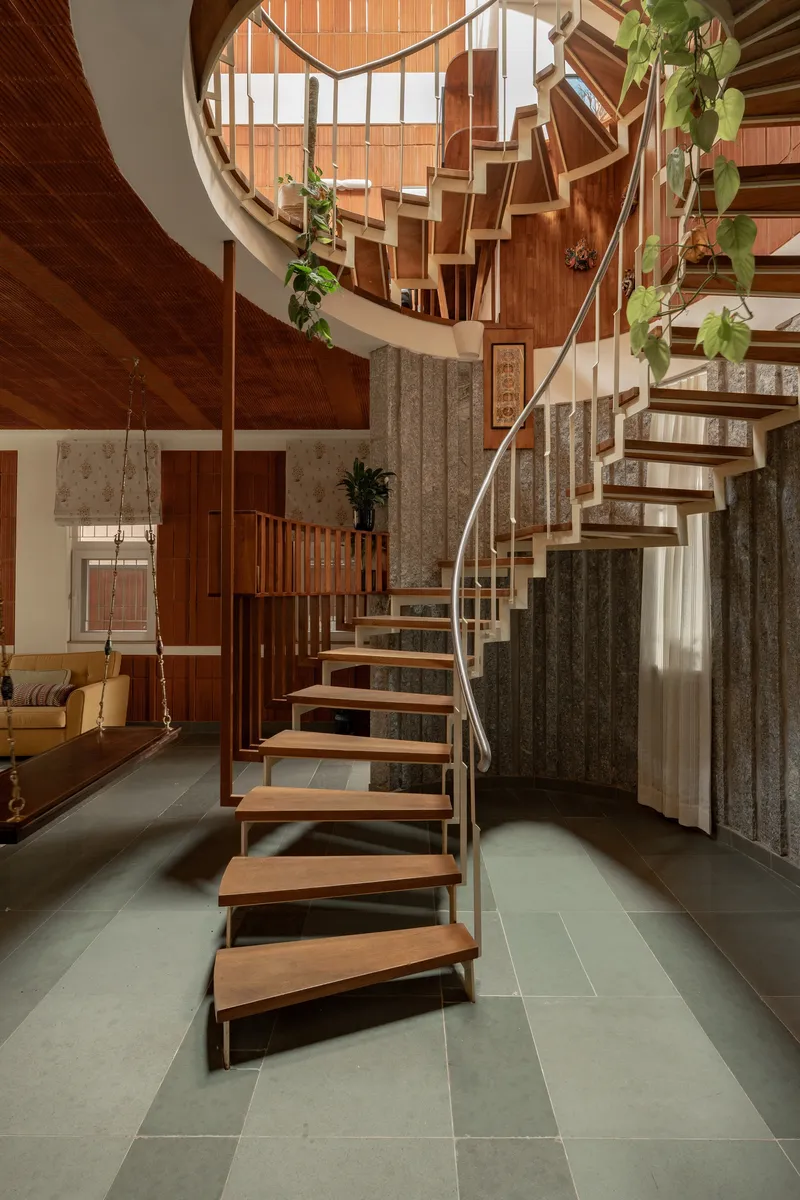
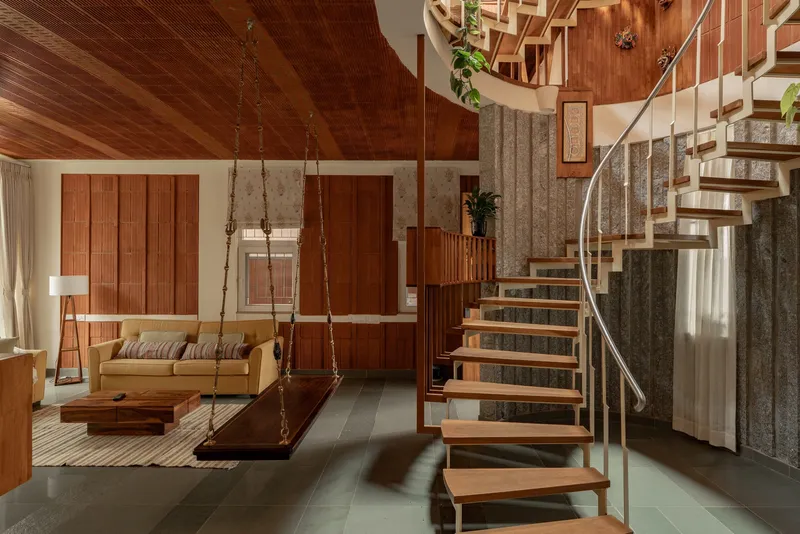
The stair connects not just floors but moods. At the ground level, it sits beside a living area furnished with a suspended wood swing bench and a timber-clad vaulted ceiling, lending the room a relaxed, almost courtyard-like quality. Higher up, it passes through walls paneled in terracotta tile, drawing the material language of the facade deep into the house. The arched opening that frames the stair at the living level is one of the few curved gestures in the architecture, and it earns its drama precisely because the rest of the plan is rectilinear.
Living Spaces Woven with Timber and Light
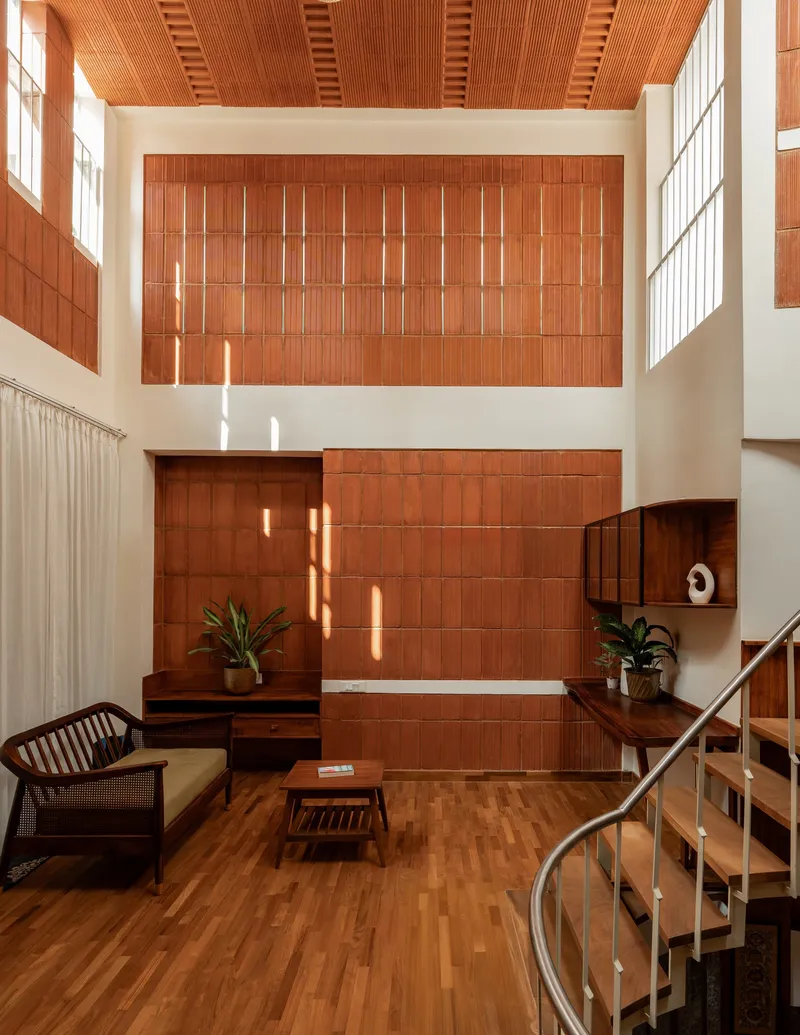
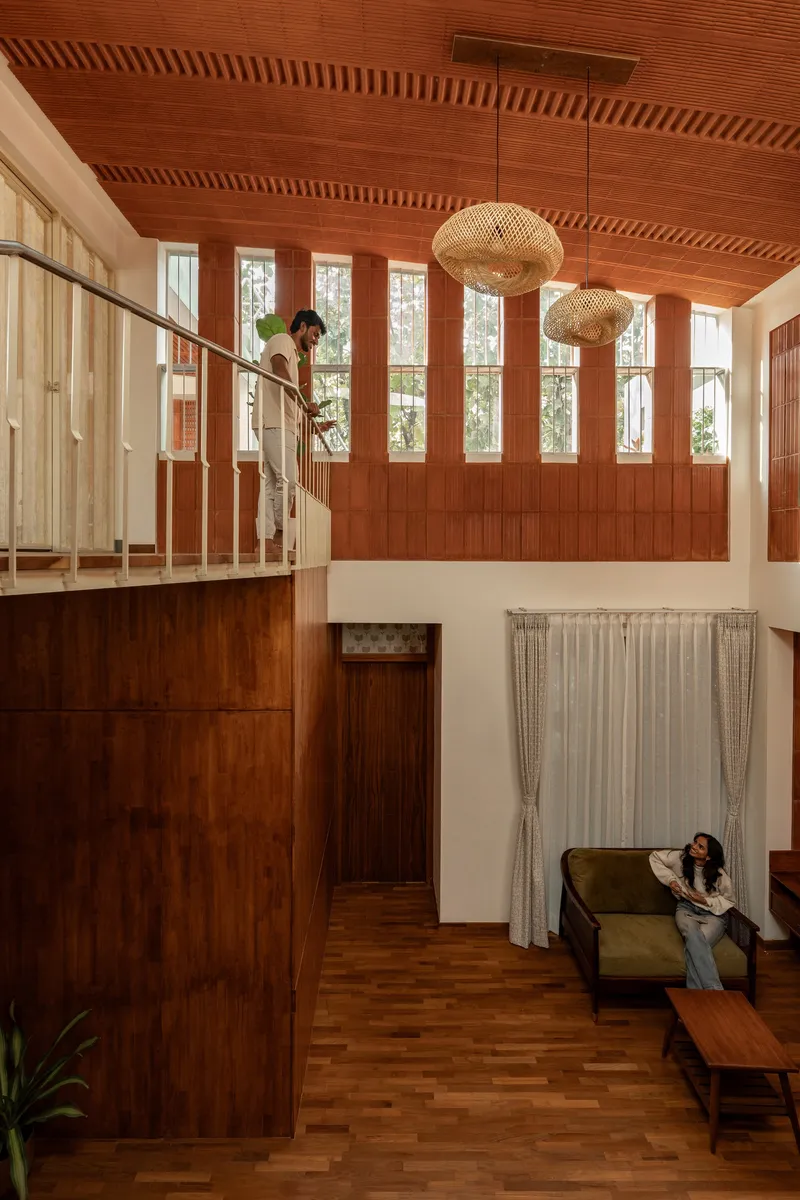
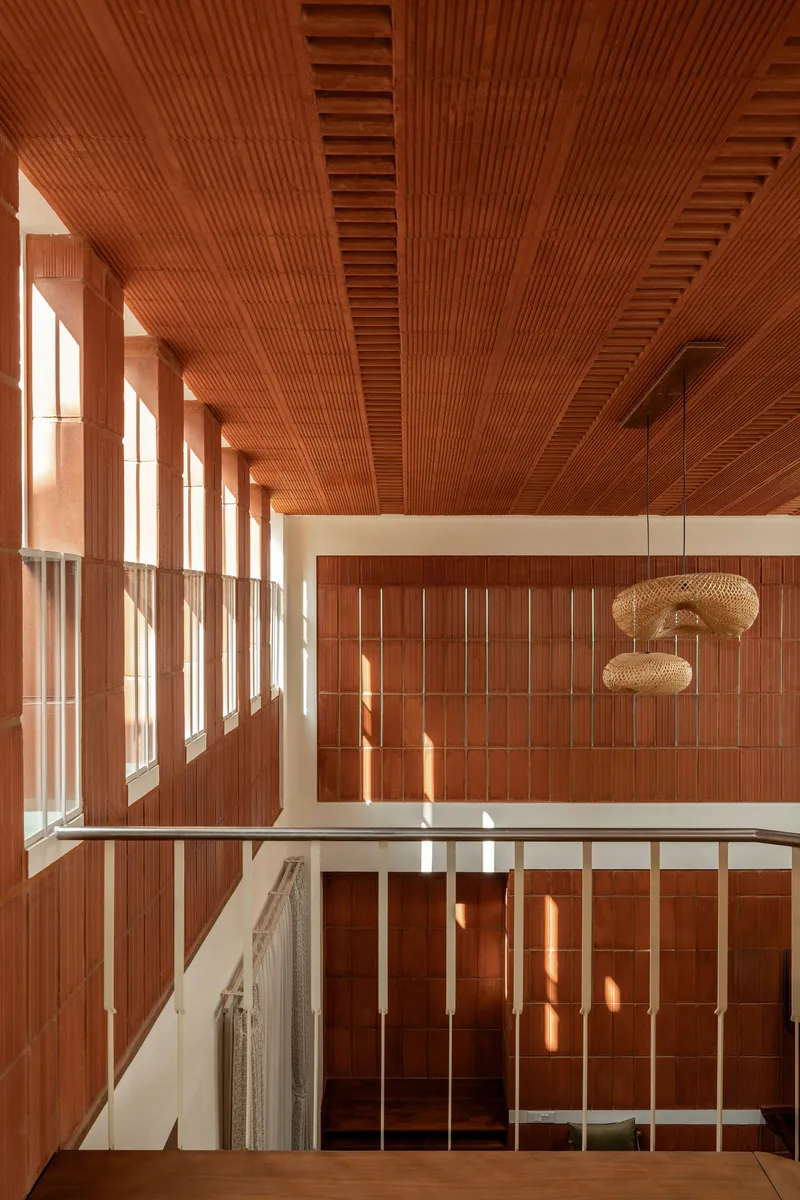
The double-height living room is the heart of the house, anchored by a terracotta tile accent wall and crowned with a slatted timber ceiling that runs continuously into clerestory windows above. These high openings pull warm afternoon sun across the timber slats, turning them into a constantly shifting pattern of light and shadow. A mezzanine bridge crosses the upper portion of the volume, giving the space a sectional complexity that belies its modest footprint.
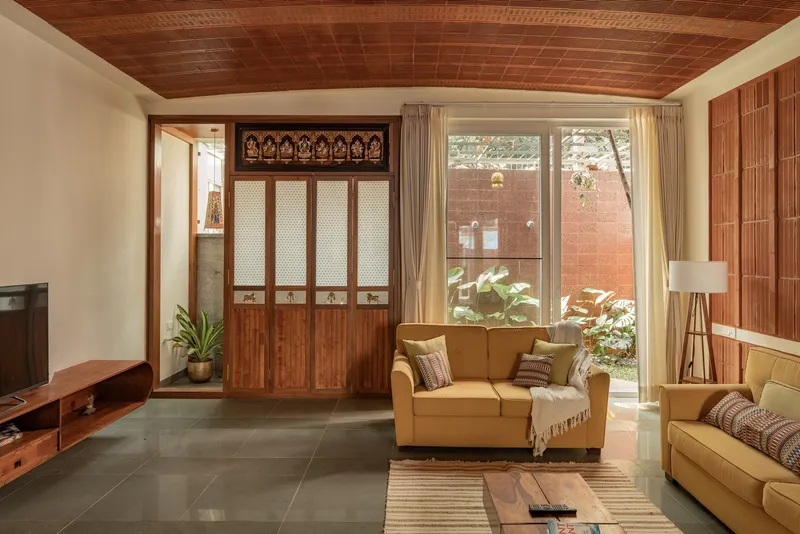
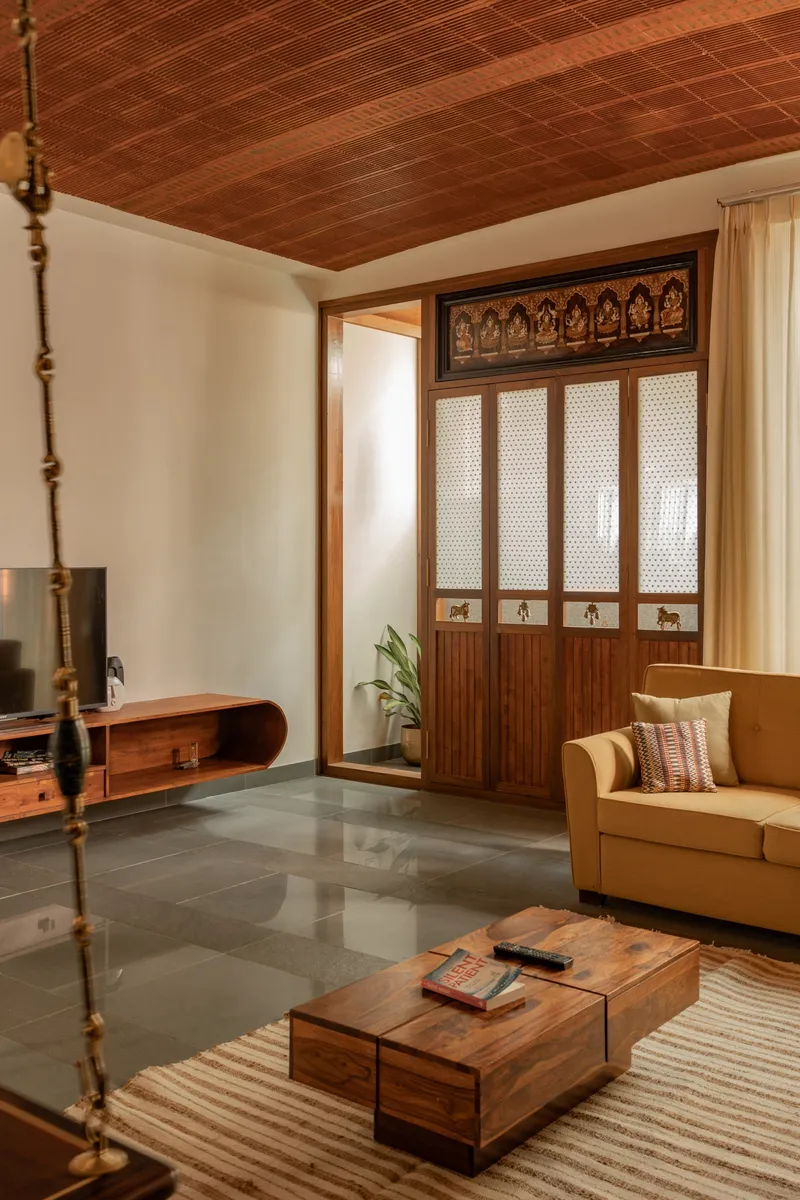
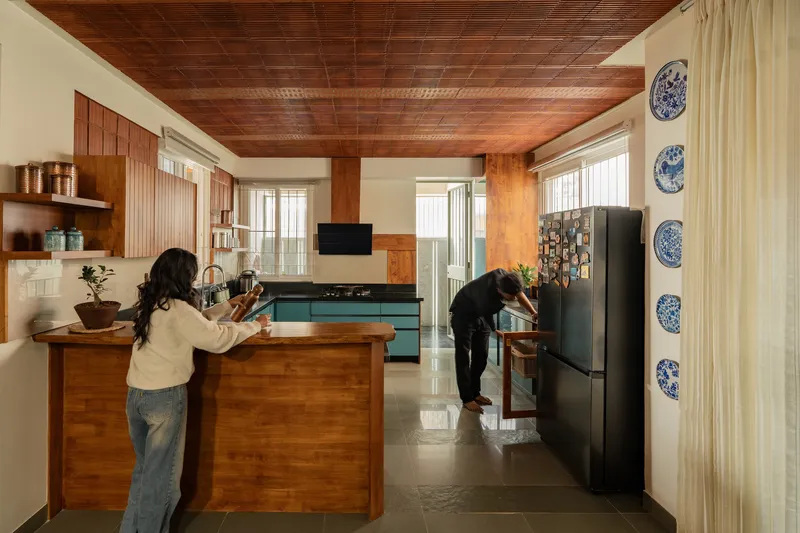
Elsewhere on the ground floor, timber screen doors open to courtyard views, and a kitchen with a timber island sits beneath the same slatted ceiling system. The consistency of the overhead plane ties these rooms together while the floor materials shift: polished stone in the living areas, patterned tiles in the kitchen, checkered terracotta at the entry. It is an old trick borrowed from traditional South Indian homes, where the floor told you what each room was for.
Thresholds, Terraces, and the Space Between
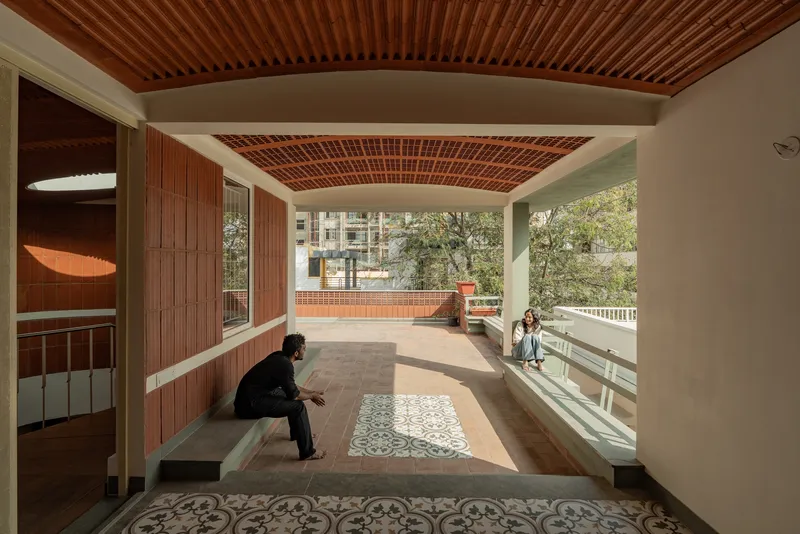
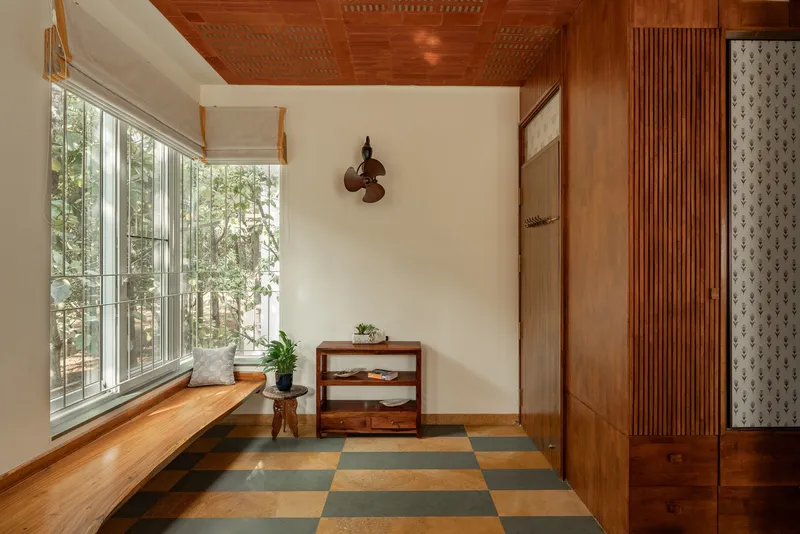
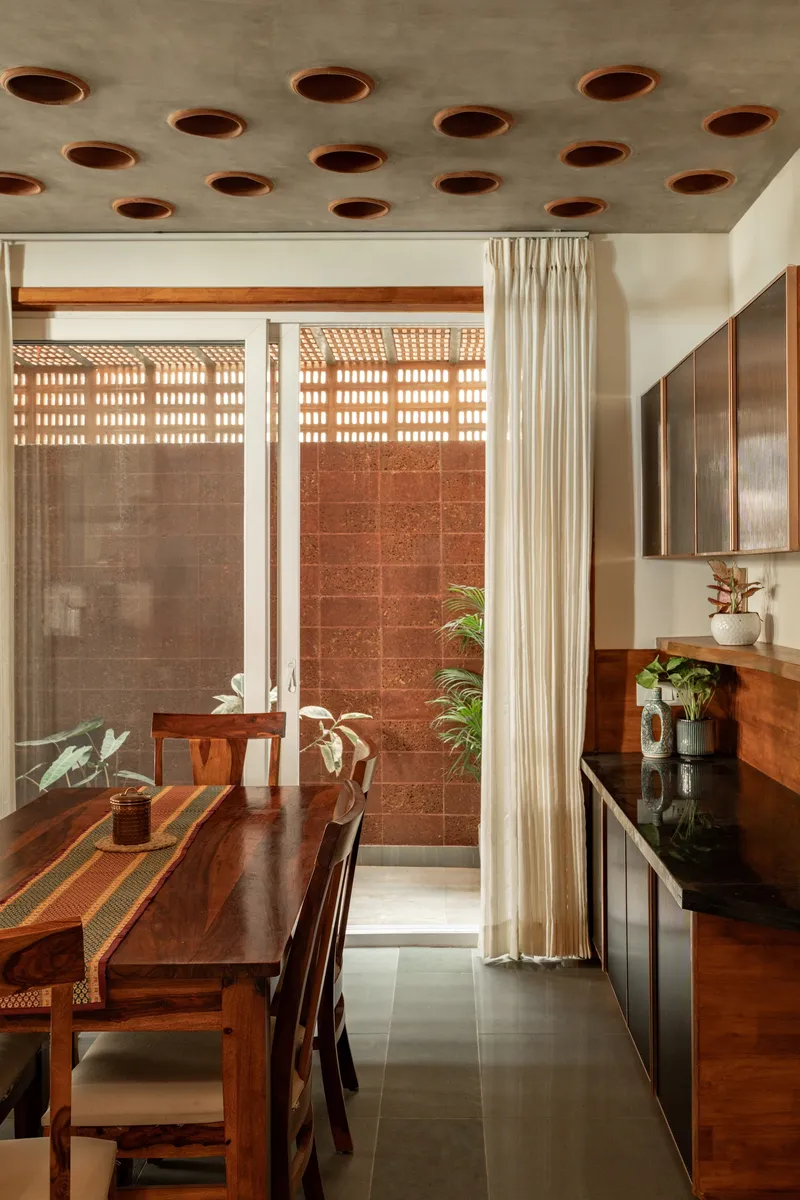
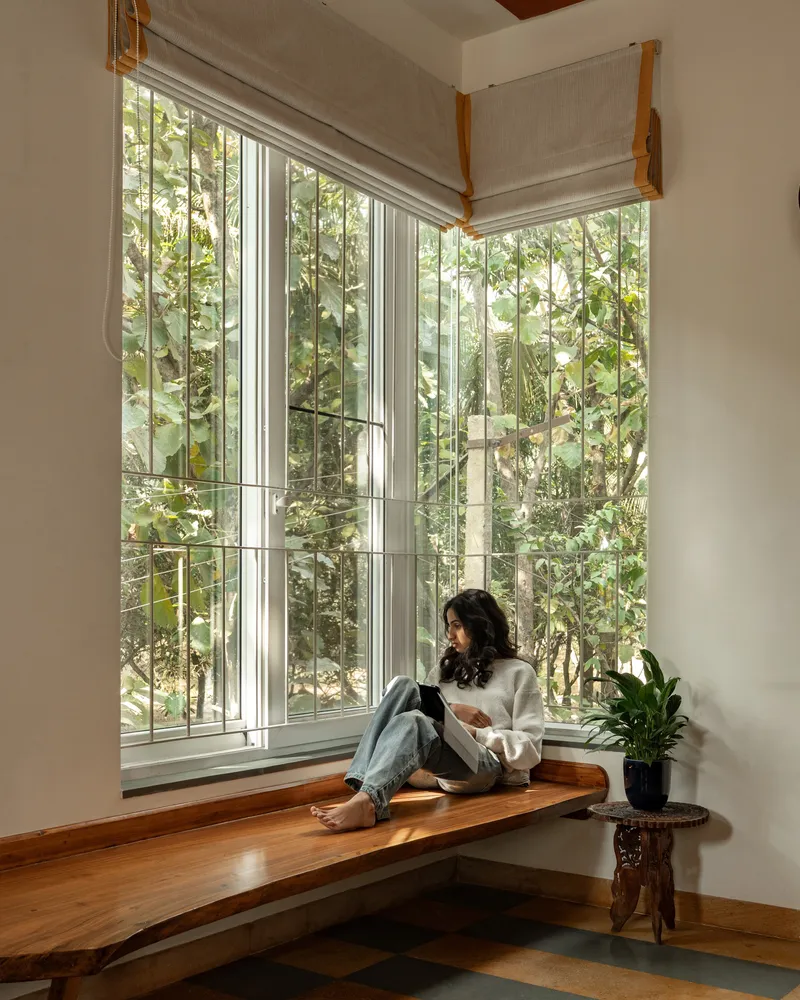
Wright Inspires invests heavily in intermediate zones: covered terraces with perforated brick ceilings and patterned floor tiles, entrance nooks with built-in timber benches and garden views, dining areas that open directly to a courtyard through what is essentially a missing wall. These spaces are where the Tamil Nadu reference lands most convincingly. In the traditional agraharam house, verandas and thinnai (sitting platforms) mediated between public and private life. Srila compresses that idea into smaller gestures, but the intent is the same: slow the transition, reward the pause.
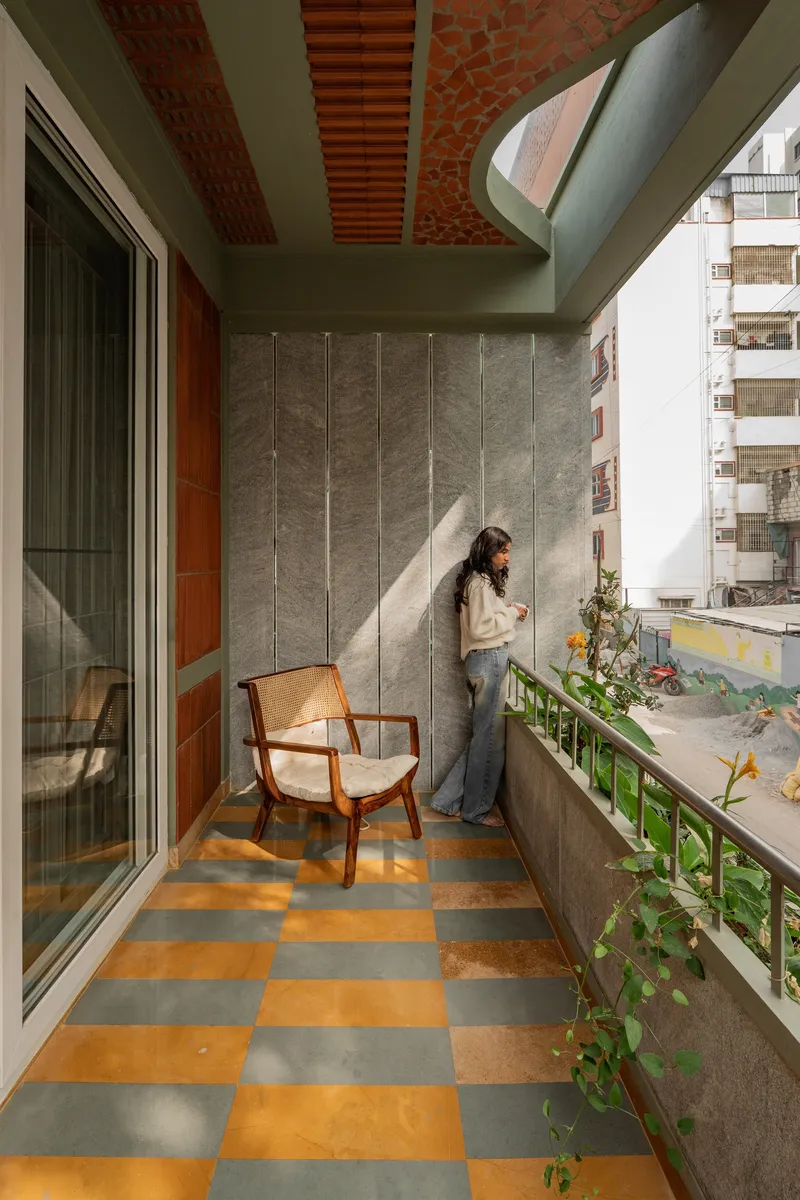
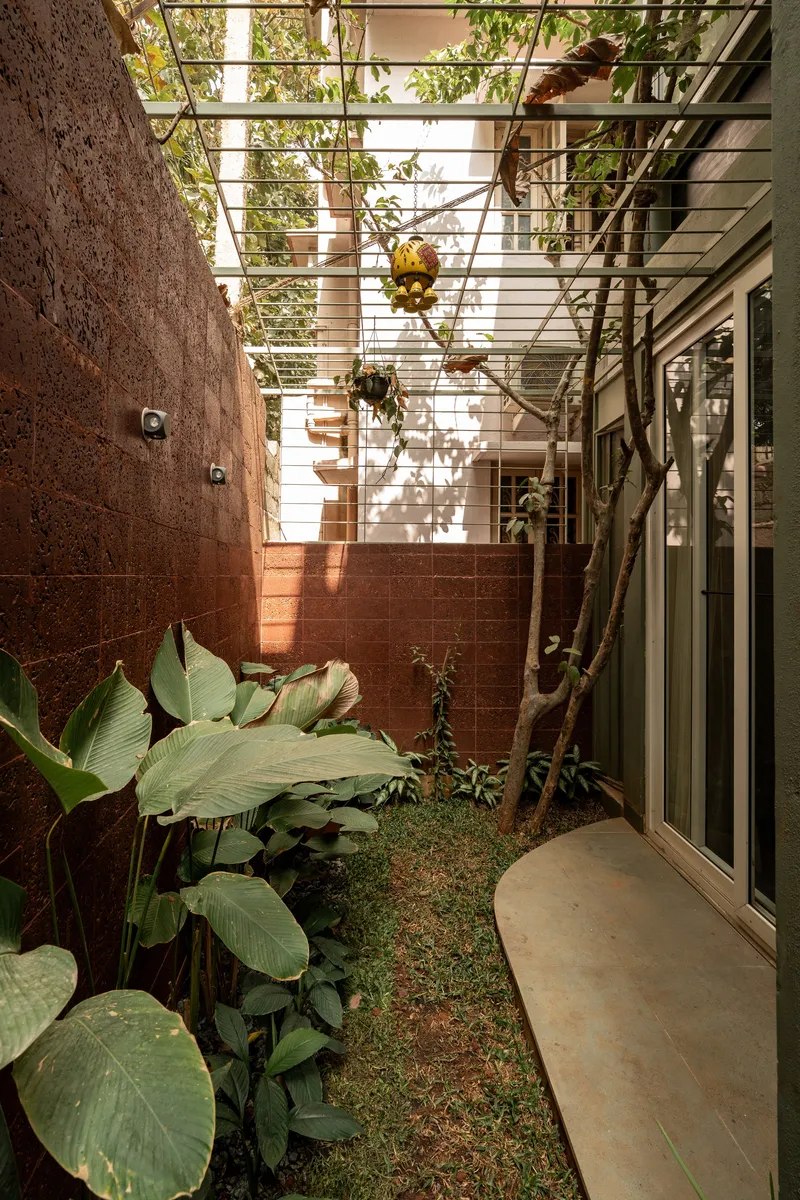
The narrow courtyard with red brick walls, a steel trellis overhead, and tropical planting below is especially effective. It is barely wider than a corridor, but the overhead structure and the lush greenery turn it into a genuinely atmospheric space. On the upper level, a balcony with orange and grey chequered tiles offers a quieter version of the same idea: a place to stand, lean, and watch the light change.
Entry and the Art of Arrival
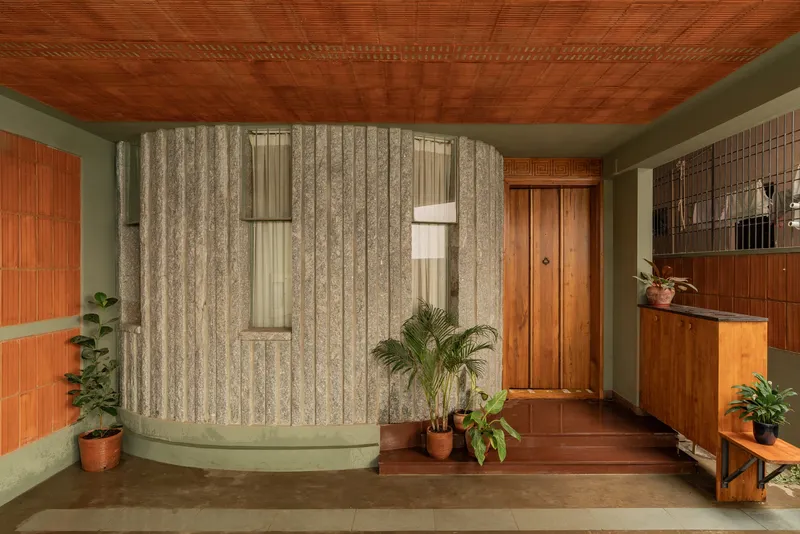
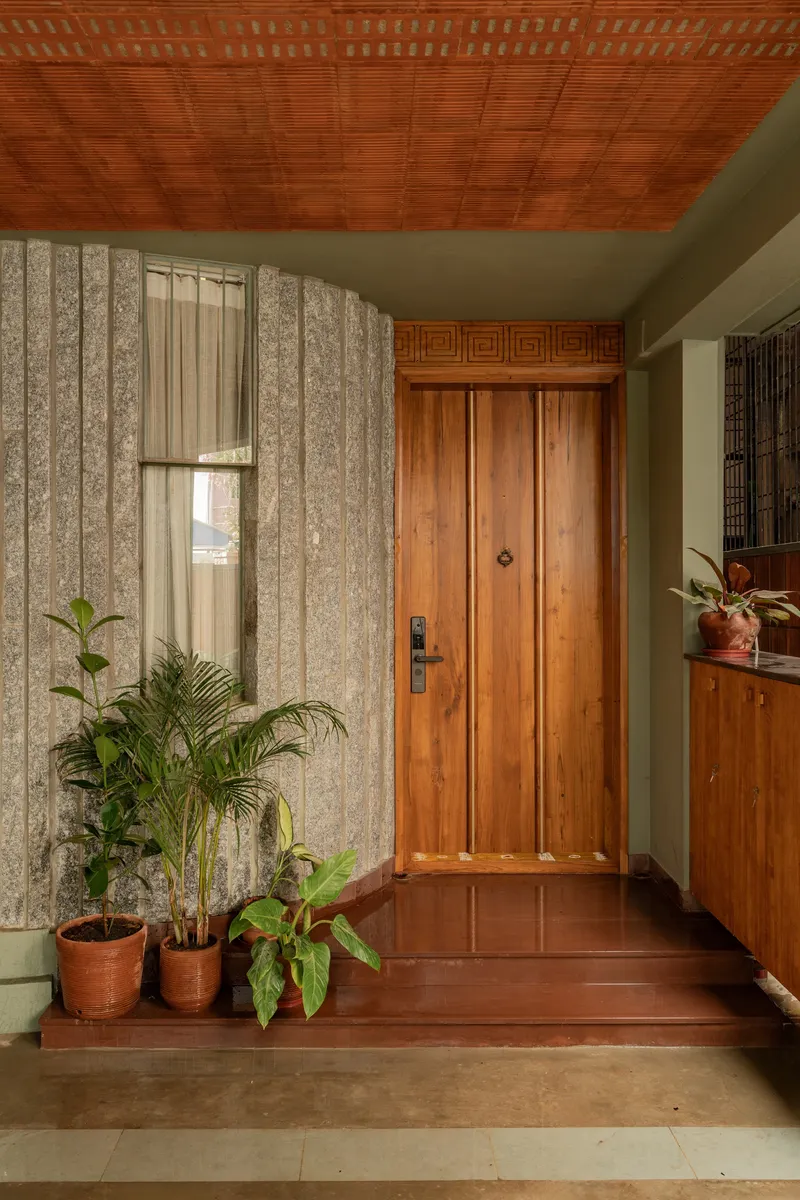
The entry foyer sets up the entire house in a single move. A curved concrete wall meets a patterned stone wall and a carved timber door. Above, a perforated brick ceiling admits controlled light while potted plants on terracotta tiles mark the transition from outside to in. The combination is dense without being cluttered: every surface is doing something, but the overall effect is calm. You walk in already aware that material texture is the house's primary language.
Bedrooms That Breathe
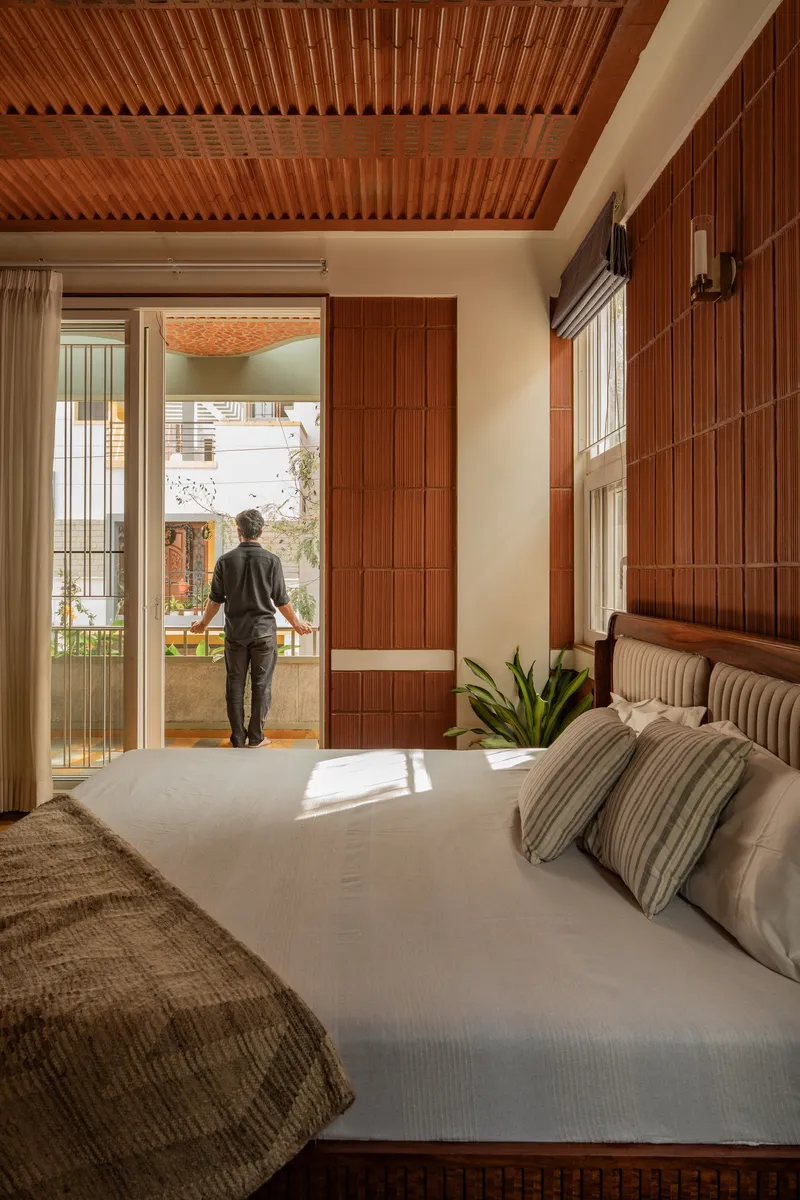
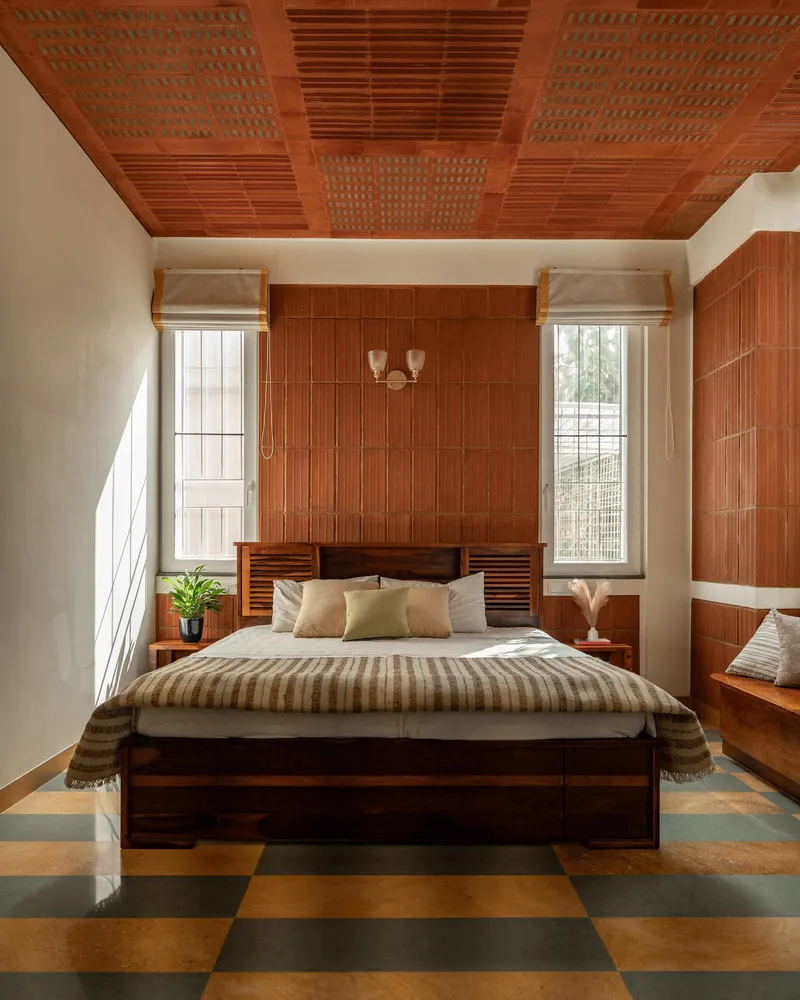
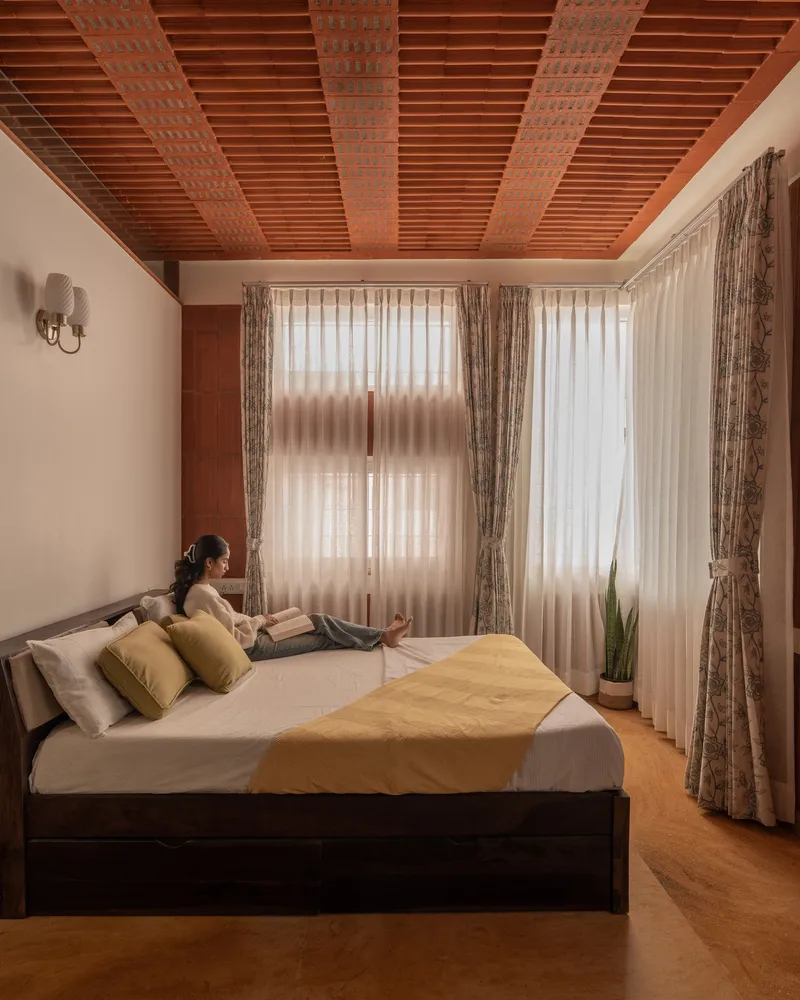
The upper-level bedrooms share the timber-slatted ceiling that runs through the rest of the house but modulate it in subtle ways: coffered panels in one room, continuous slats in another, sheer curtains diffusing morning light in a third. Each room opens to a balcony or terrace, ensuring cross-ventilation and a visual connection to planting. The Lingel windows, tall and narrow, frame garden views rather than panoramic vistas.
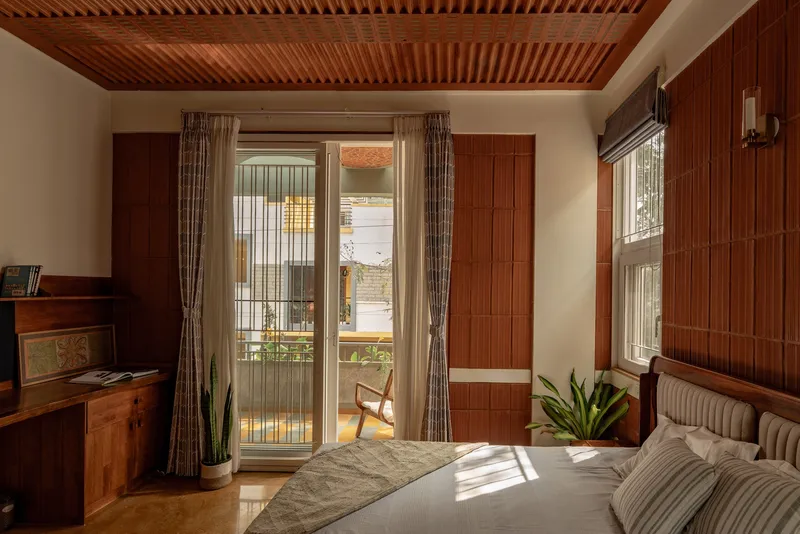
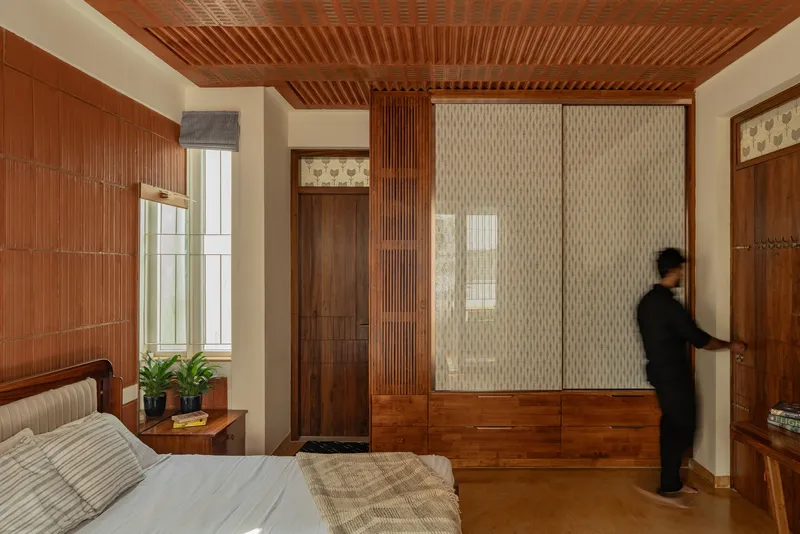
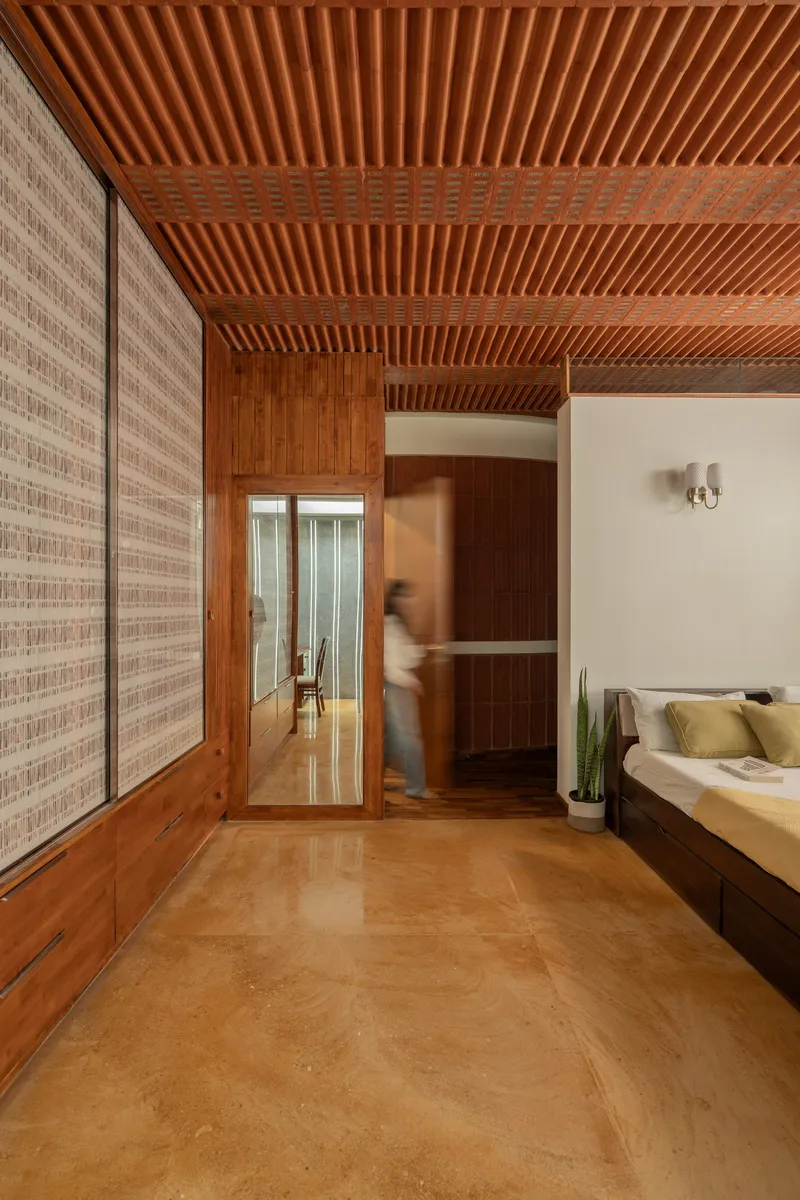
Built-in wardrobes with woven screen panels and hallways lined with exposed timber beams and woven wall panels continue the tactile quality established downstairs. The consistency is notable. Wright Inspires does not reserve craft for public rooms and hand the bedrooms over to drywall. Every surface, from the study alcove's terracotta ceiling inset to the translucent LED-lit wall panels beside a timber desk, receives the same attention.
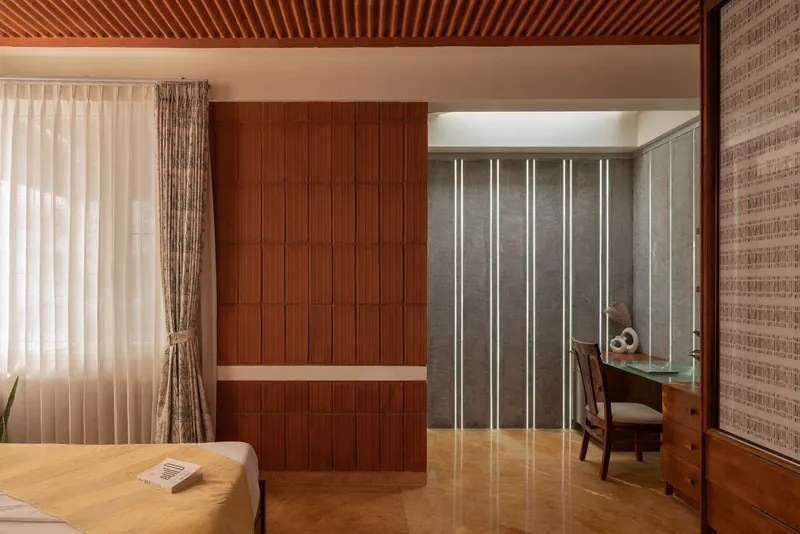
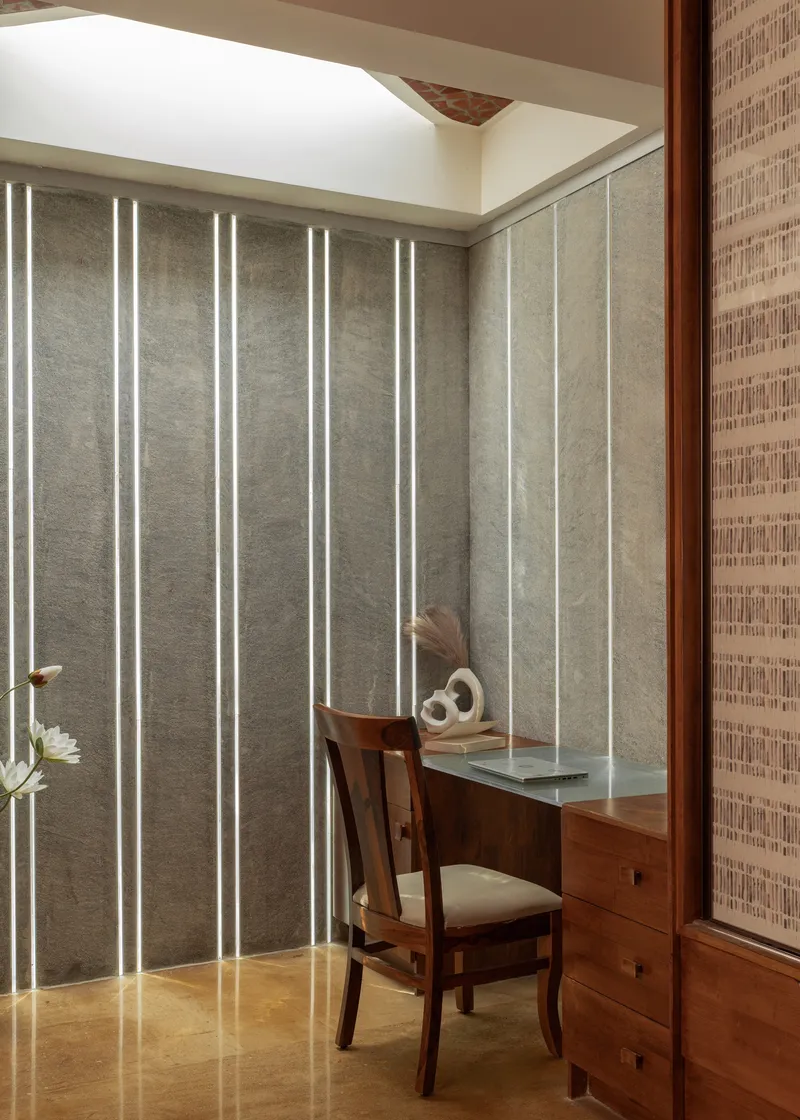
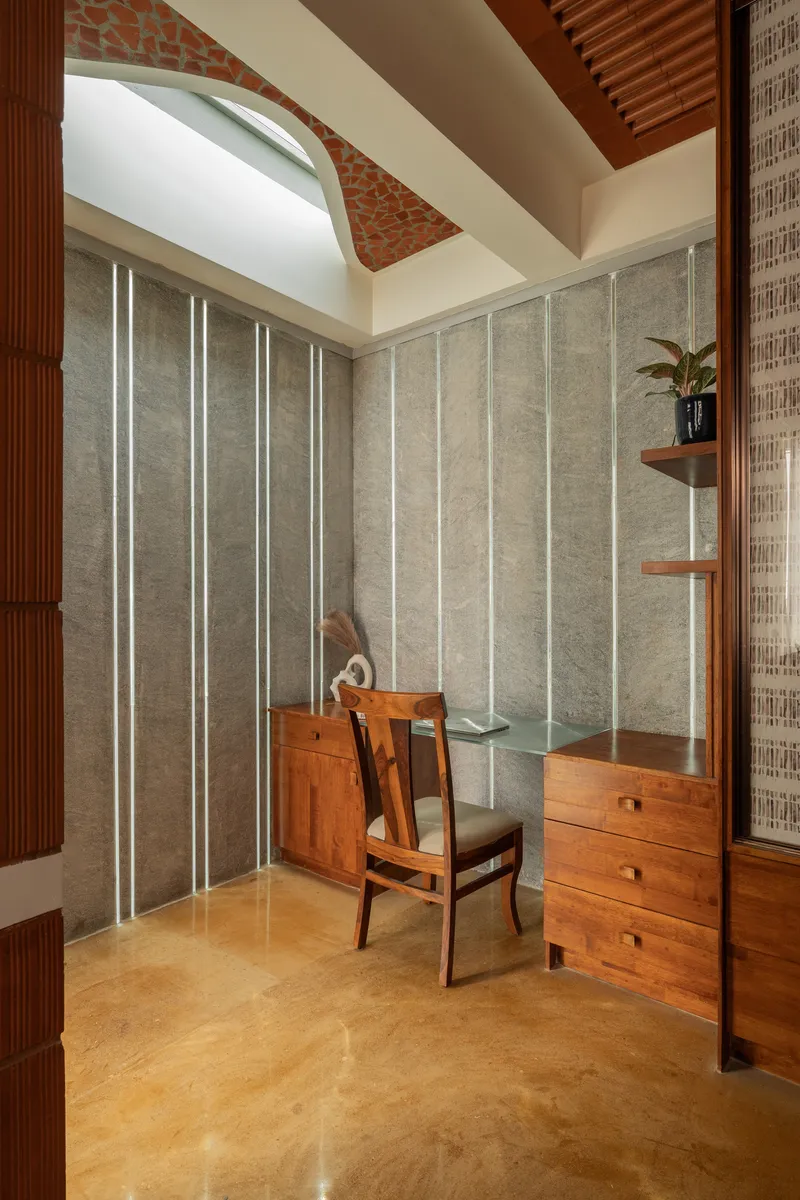
The study nooks tucked into bedroom corners are a clever spatial move. Vertical LED strips integrated into translucent panels create a warm glow without overhead fixtures, and the timber cabinetry wraps the workspace in the same material world as the rest of the house. These are small rooms, but they feel considered rather than leftover.
Plans and Drawings
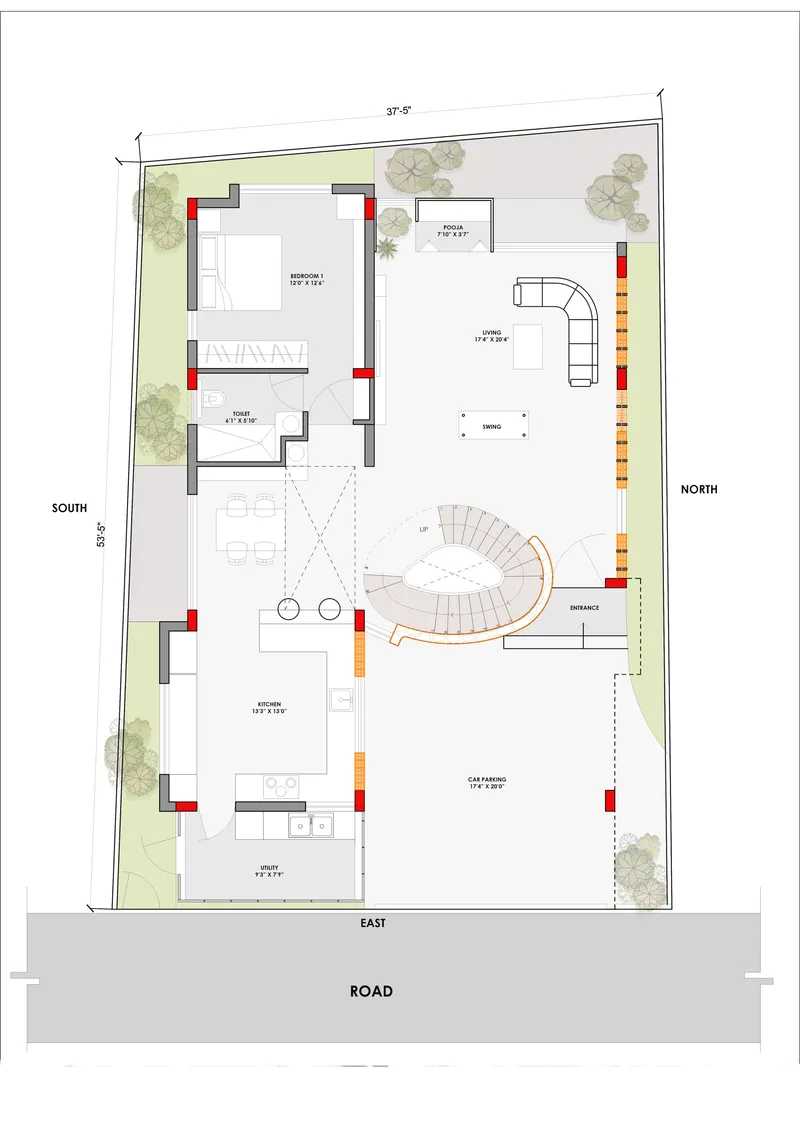
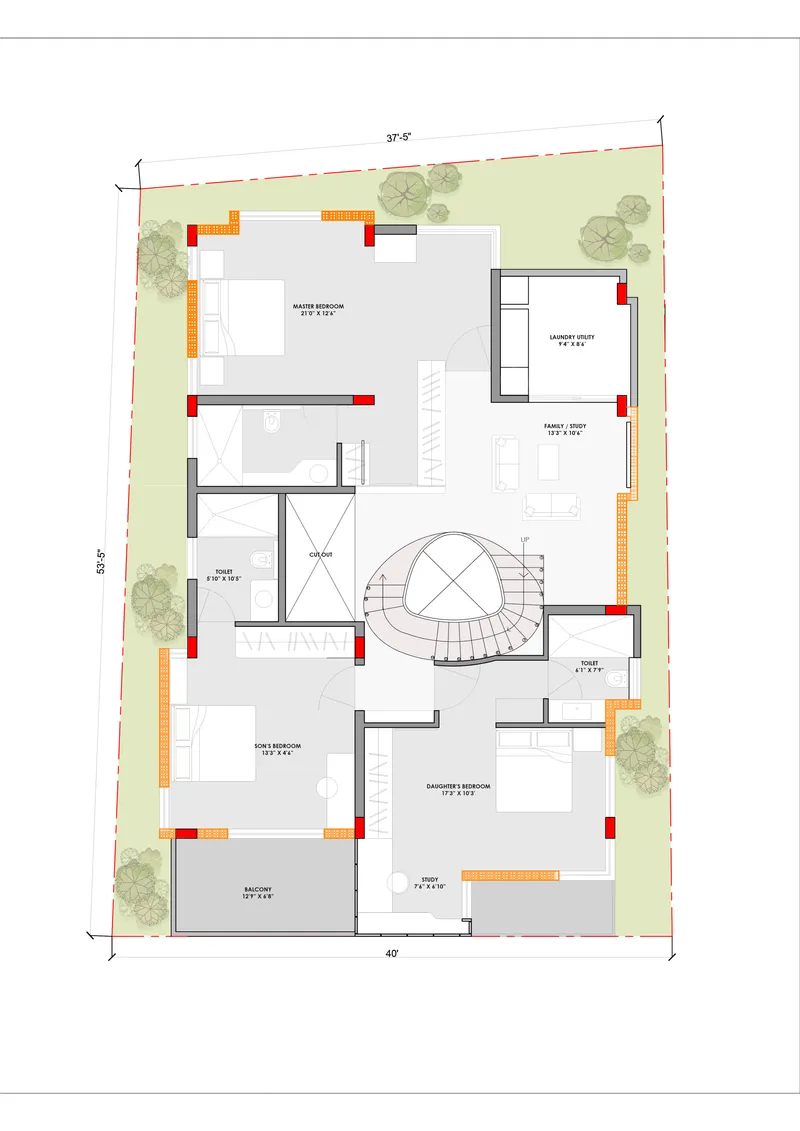
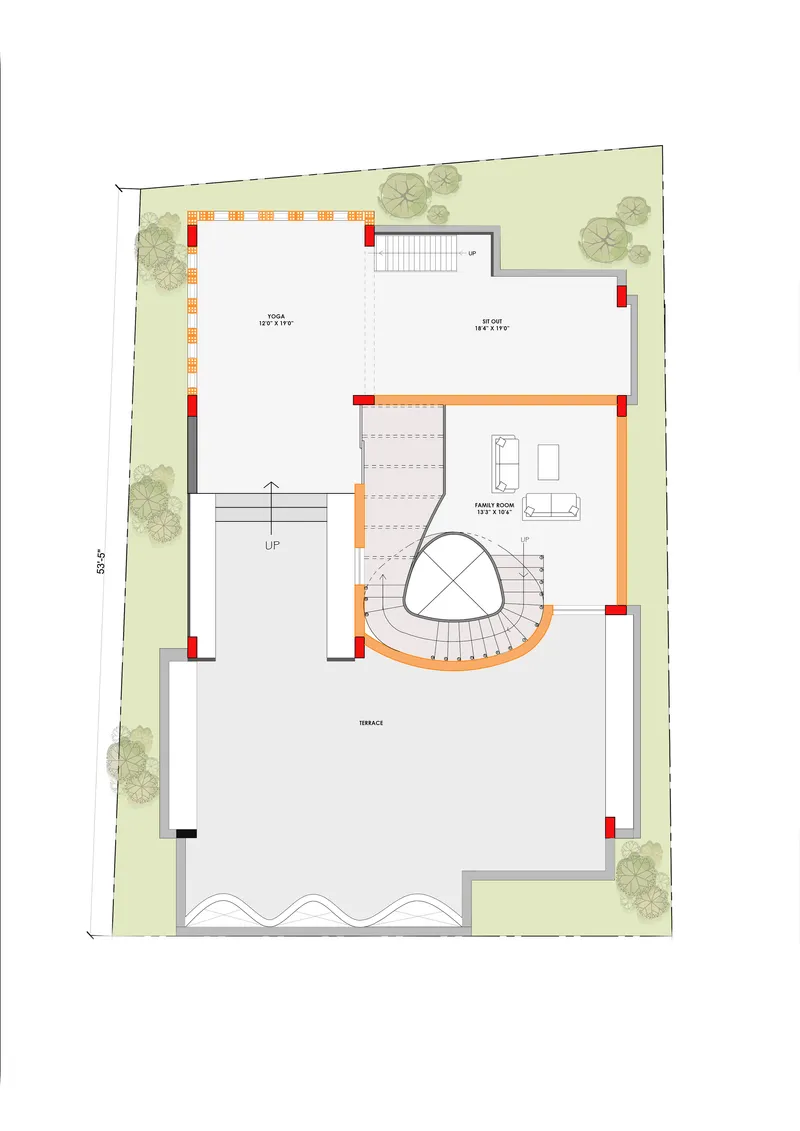
The floor plans reveal how the curved central staircase organizes everything. On the ground floor, rooms radiate outward from the circular void, with car parking pushed to the eastern edge and living spaces oriented toward garden courtyards. The upper floor clusters bedrooms and a family court around the same void, maintaining the stair as the spatial anchor. At the terrace level, an open family deck wraps the stair with planted borders, turning the roof into a usable outdoor room.
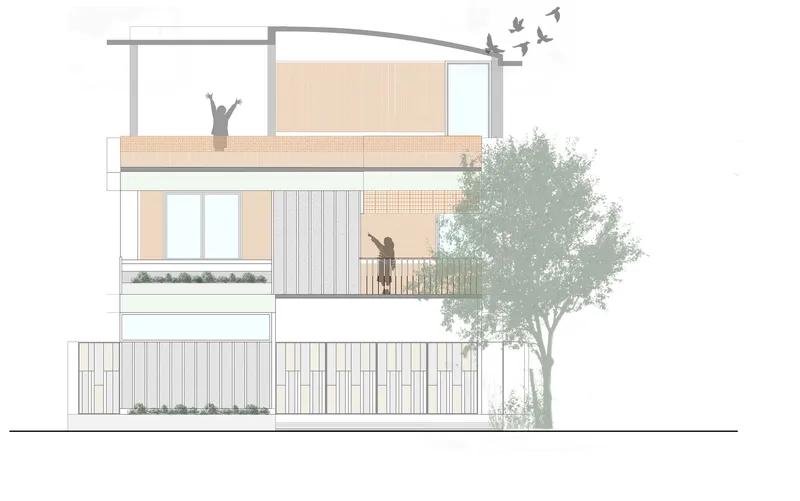
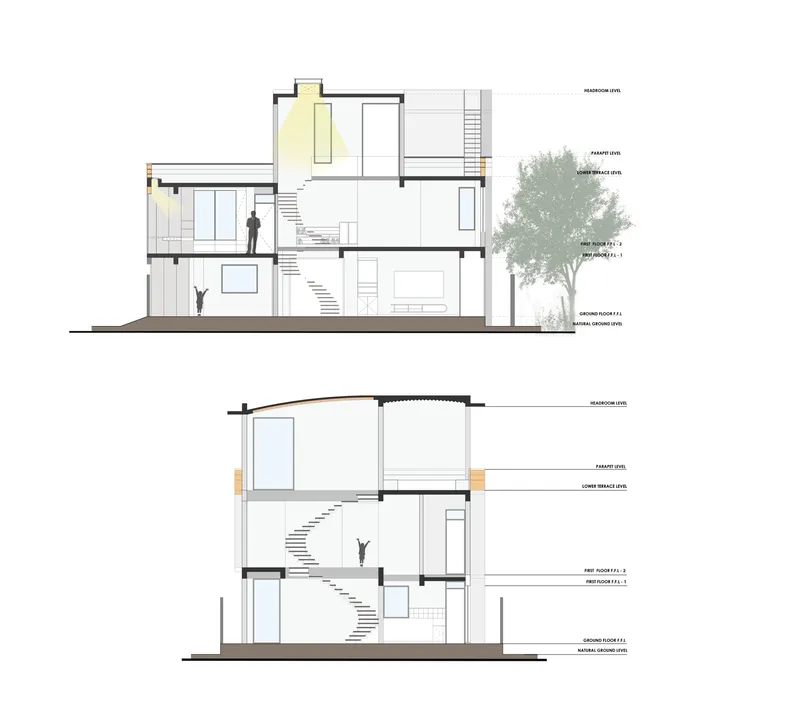
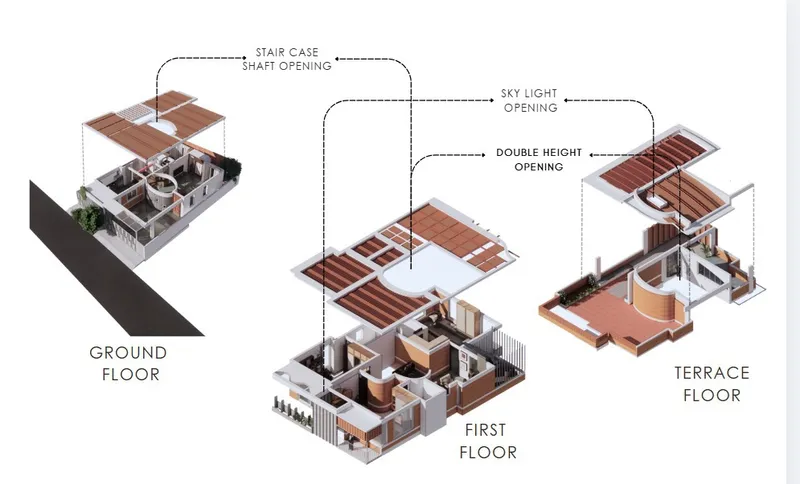
The elevation drawing shows a three-storey residence scaled carefully against an adjacent mature tree, its vertical screening and staggered balconies breaking the mass into a composition that reads as layered rather than monolithic. The section drawings are the most revealing: they expose the double-height living volume, the way the stair stitches all three levels together, and the relationship between interior ceiling planes and the tree canopy just outside. The exploded axonometric confirms that the timber roof planes and stair openings are the primary ordering devices, with everything else organized in their orbit.
Why This Project Matters
Bengaluru's residential architecture has spent years oscillating between two poles: nostalgic historicism that copies old forms without understanding them, and slick modernism that ignores climate and context entirely. Srila House occupies a productive middle ground. It takes the environmental logic and spatial generosity of Tamil Nadu's traditional homes, the breathable walls, the layered thresholds, the emphasis on shade and cross-ventilation, and reinterprets them within a compact urban footprint. That it does so while keeping to just 3,280 square feet makes the achievement more convincing, not less.
The spiral stair is the signature move, and it works because it serves multiple functions simultaneously: light well, ventilation shaft, visual anchor, and a piece of craft in its own right. But the quieter decisions matter just as much. The discipline of a narrow material palette applied consistently from foyer to bedroom. The investment in threshold spaces that slow you down. The refusal to treat any room as secondary. Wright Inspires, through lead architect Prathima Seethur and project architect Sujay V, has produced a house that feels rooted without being retrograde, specific to its place without being provincial.
Srila House by Wright Inspires (Lead Architect: Ar. Prathima Seethur; Project Architect: Ar. Sujay V), Bengaluru, India. 3,280 sq ft. Completed 2025. Photography by Studio f/8 - Mr. Dinesh.
About the Studio
Share Your Own Work on uni.xyz
If projects like this are the kind of work you want to make, uni.xyz is a place to publish your own, find collaborators, and enter design competitions.




Popular Articles
Popular articles from the community


The Musturak Paradise: Senior Living Architecture for a Connected Future in Temara, Morocco
The Musturak Paradise reimagines senior living architecture in Temara via private homes, social spaces, culture, community, and shared care.

The Earth Pod: 3D Printed Homes for Resilient Refugee Communities
The Earth Pod reimagines refugee housing through 3D printed homes made from clay, combining resilience, self-sufficiency, and rapid shelter.

Hill & Cross Opera: Sculptural Opera House Architecture Shaped by Tallinn’s Landscape and Identity
Hill & Cross Opera reimagines opera house architecture in Tallinn through its sculptural hill, civic plaza, glass wave and a luminous cross.

AL-JANNAH: Sustainable Architecture and Permaculture for Afghan Widows
AL-JANNAH uses sustainable architecture and permaculture to create resilient oasis of housing, learning, work and renewal for Afghan widows.


Similar Reads
You might also enjoy these articles

Bao Huynh Watercolor Atelier: A Serene Art Retreat in Hội An
Bao Huynh Watercolor Atelier in Hội An blends multifunctional art spaces, sustainable design, local materials, and family-friendly living in a serene environment.

Atelier Macri Concept Store Interior Design by CASE-REAL
Atelier Macri store features a "ko" counter, walnut wood details, cork displays, blending retail, gallery, and seamless customer experiences.

Manuel Vargas Izquierdo Stadium and High-Performance Sports Center: Architectural Excellence in Jalpa de Méndez
The Manuel Vargas Izquierdo Stadium blends sustainable design, inclusive sports facilities, and cultural-inspired architecture, revitalizing Jalpa de Méndez’s public spaces.

KAKR Buluh Awar Hall: Revitalizing Community and Ecology Through Bamboo Architecture
Community built bamboo hall revitalizes Buluh Awar village, empowering youth, restoring ecology, celebrating vernacular craftsmanship through sustainable architecture and culture.


Explore Residential Building Competitions
Discover active competitions in this discipline


Challenge to design mud housing for contemporary communities


Challenge to reimagine the Iron Throne


Photograph architecture without architects


Illustrate the lost glory of Angkor Wat - Render Challenge
Comments (0)
Please login or sign up to add comments
No comments yet. Be the first to comment!