
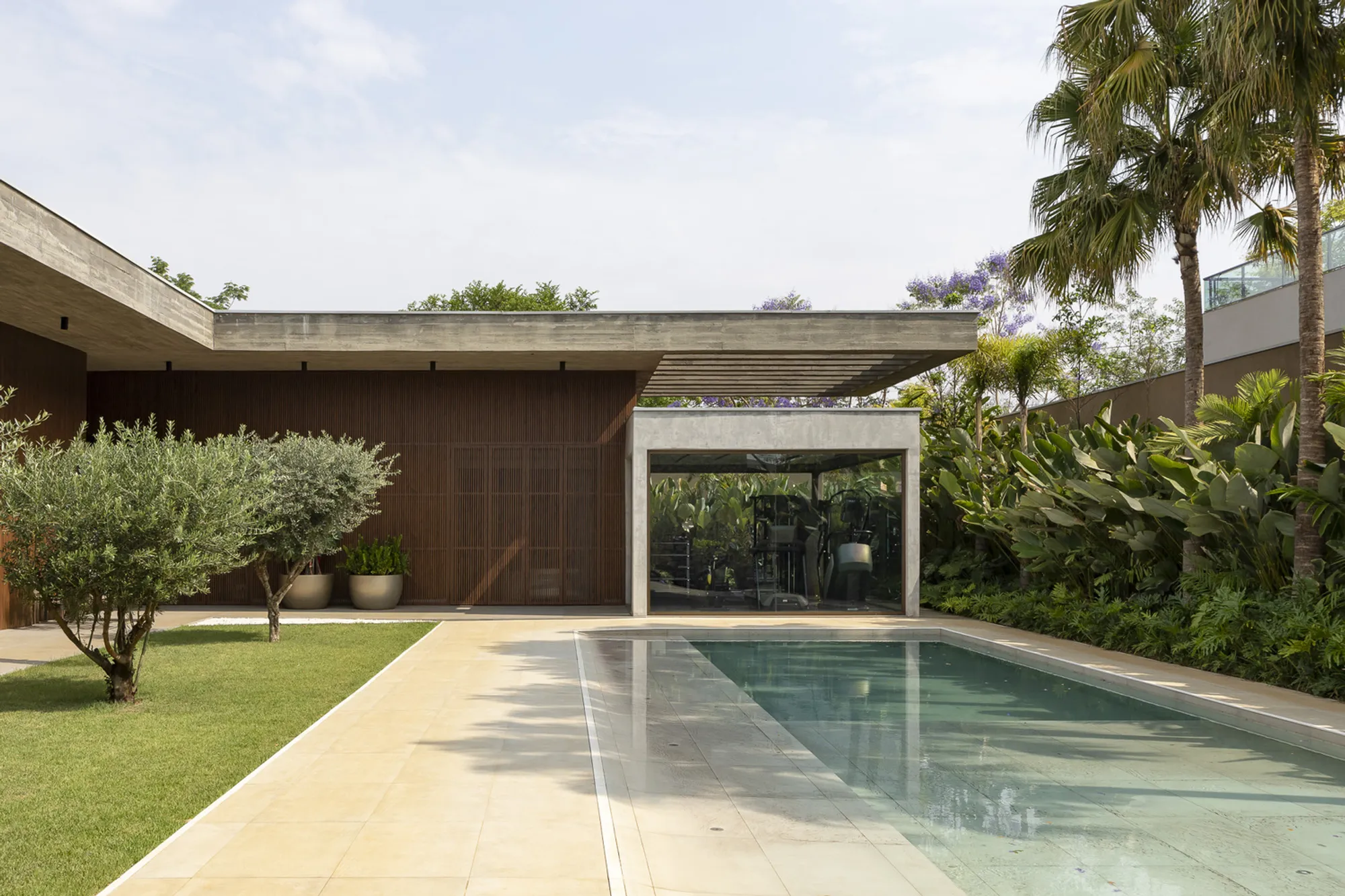
Rafael Granero Wraps a Feng Shui Courtyard House in Timber, Gabion, and Concrete in Brazil
WU House in São Paulo balances ancient spatial philosophy with a rigorous material palette of stone, wood, and raw concrete.


Feng shui is often reduced to interior decorating shorthand: move the bed, add a water feature, hang a mirror. But at WU House, Rafael Granero Arquitetura treats the philosophy as a genuine generative tool for planning. The result is a single-story residence near São Paulo that organizes every room around a central courtyard and pool, orienting its openings according to solar path and prevailing wind while maintaining the kind of clean, muscular materiality you'd expect from contemporary Brazilian architecture.
What makes the house worth studying is less the feng shui label and more the spatial discipline it produces. The plan is essentially a loop of timber-clad pavilions wrapping an open core of water, sky, and planting. Gabion stone walls anchor the house to its street edge while floor-to-ceiling glass dissolves the boundary between interior rooms and planted courts. The tension between a fortress-like public face and an almost liquid private one is the project's central move, and it is executed with serious material conviction.
A Closed Face to the Street
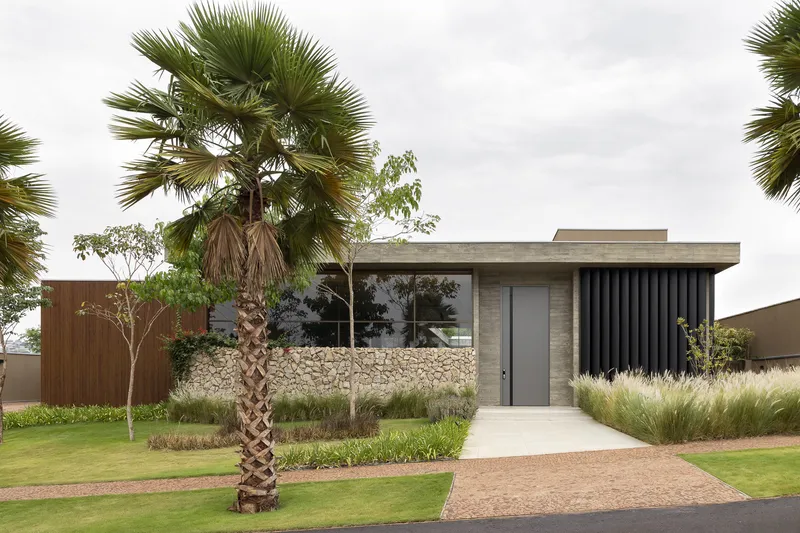
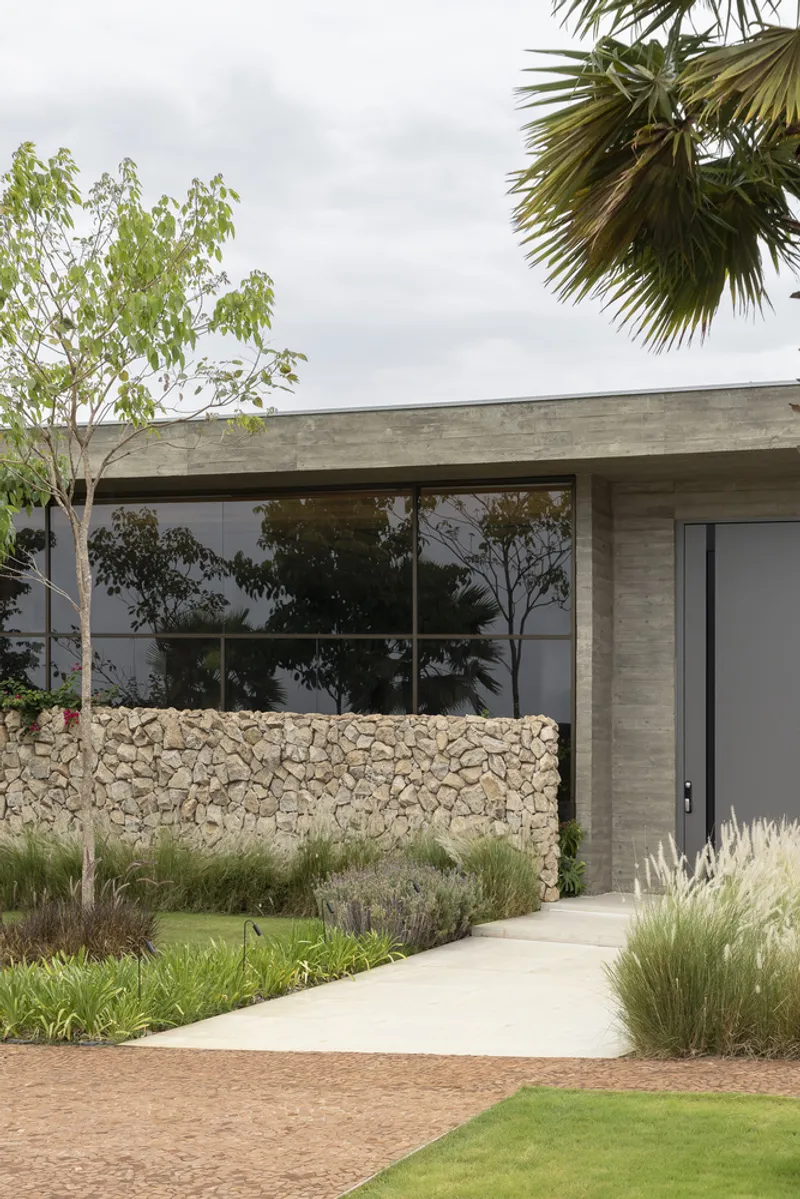
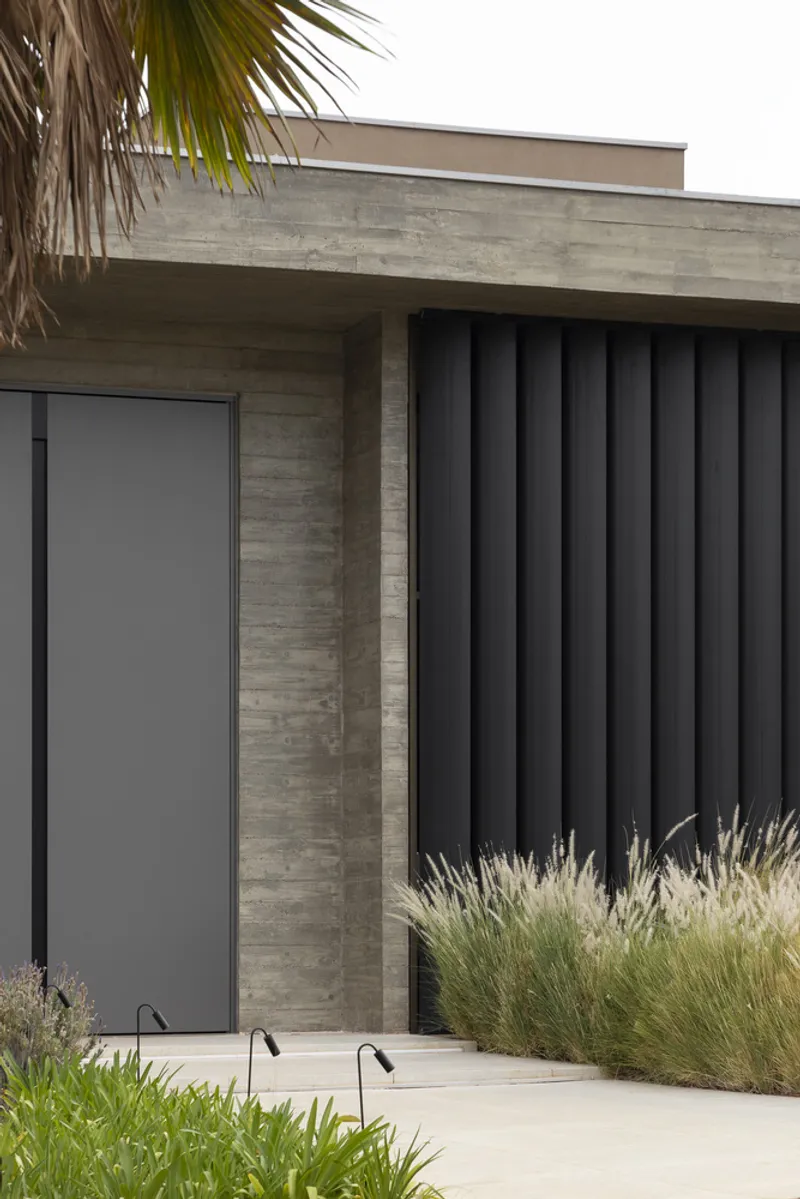
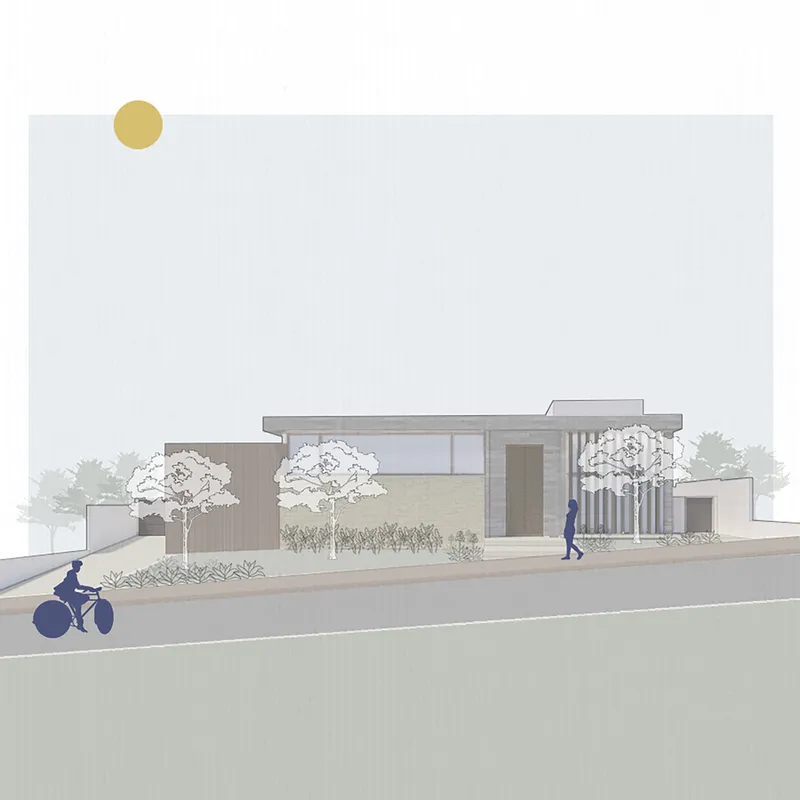
From the sidewalk, WU House barely registers as a dwelling. The street elevation is a composition of board-formed concrete piers, charcoal vertical slat screens, and stacked gabion stone. Ornamental grasses soften the base, and mature palms rise above the roofline, but the overall posture is deliberately guarded. There is no picture window, no double-height entry foyer advertising the life inside.
Granero uses the gabion wall as both a structural base and a textural bridge between the raw concrete overhead and the planted ground below. The stone cages carry an honest, almost geological weight that contrasts sharply with the precision of the charred timber cladding. It is a front facade that rewards close looking without giving anything away.
Entering Through Concrete and Light
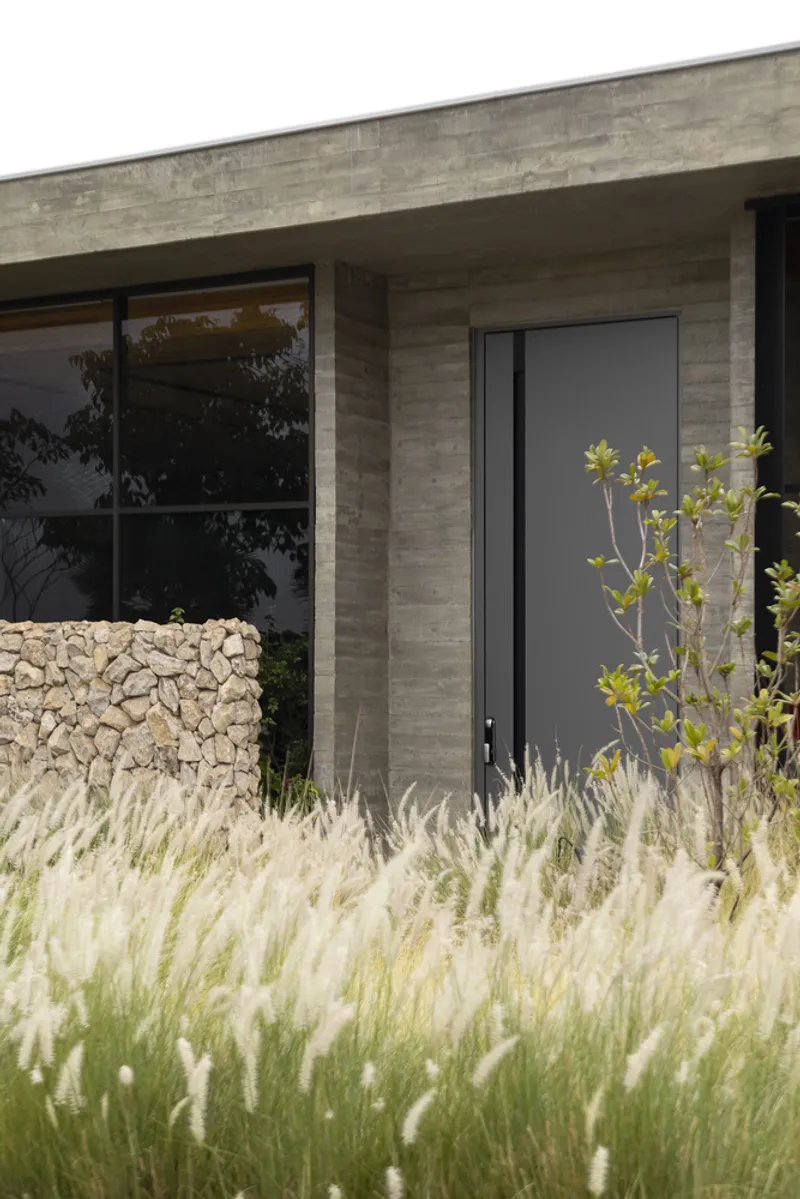
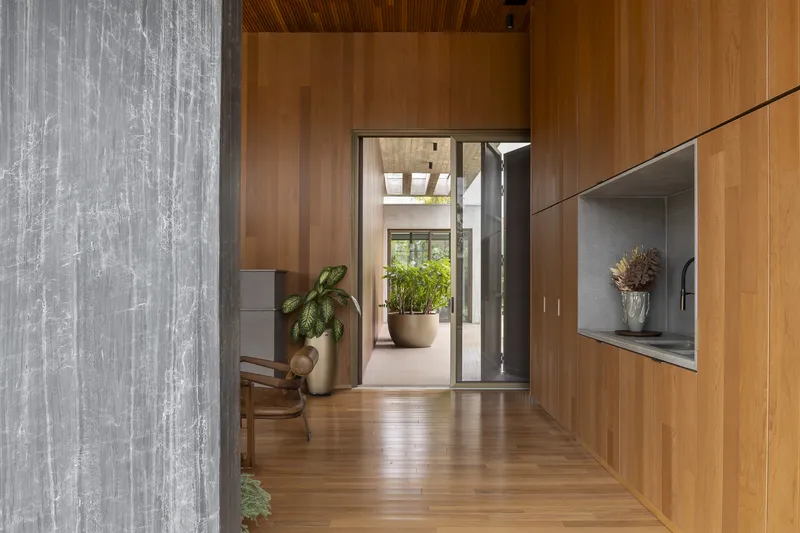
The entry sequence is compressed and theatrical. A board-formed concrete pillar frames a single door set among ornamental grasses. Once inside, a passage of raw concrete opens onto a planted courtyard, a moment of release after the deliberate constriction of the threshold. The transition from street noise to interior silence is almost physical.
This kind of procession, from narrow to wide, dark to bright, is fundamental to both feng shui thinking and good architecture in any tradition. Granero makes it legible without being didactic. The concrete soffit stays exposed, the planting stays loose, and the visitor is allowed to discover the courtyard rather than being led to it.
The Courtyard as Center of Gravity
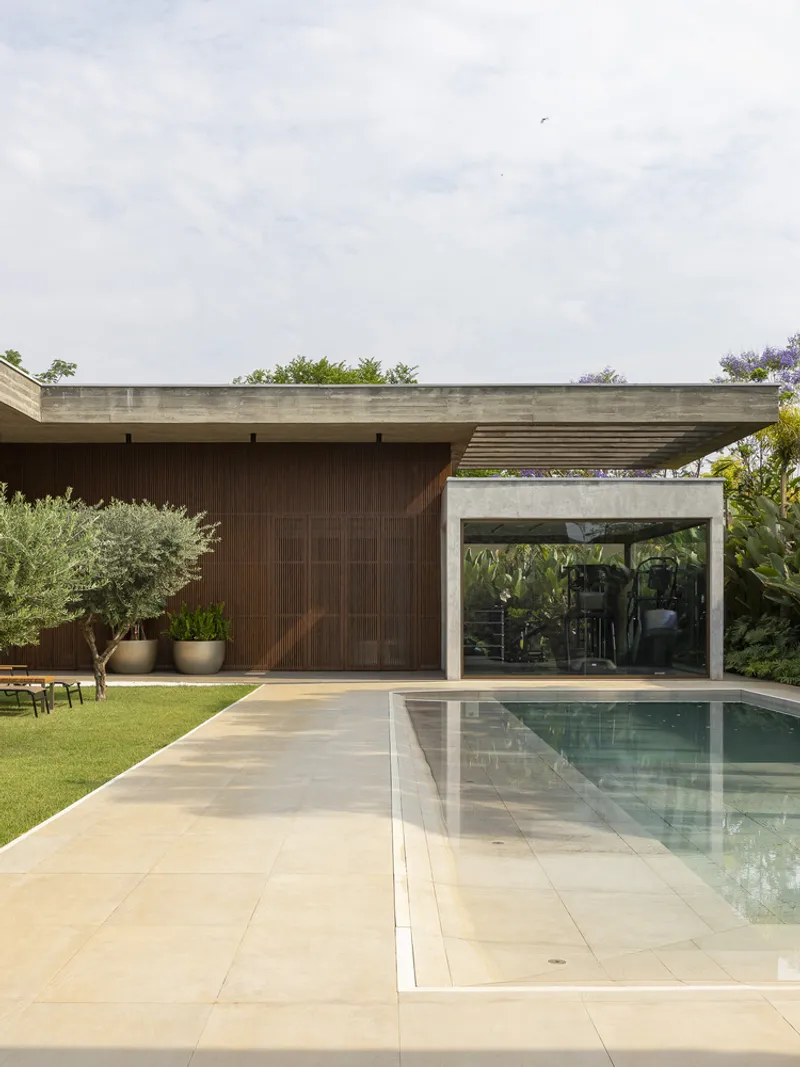
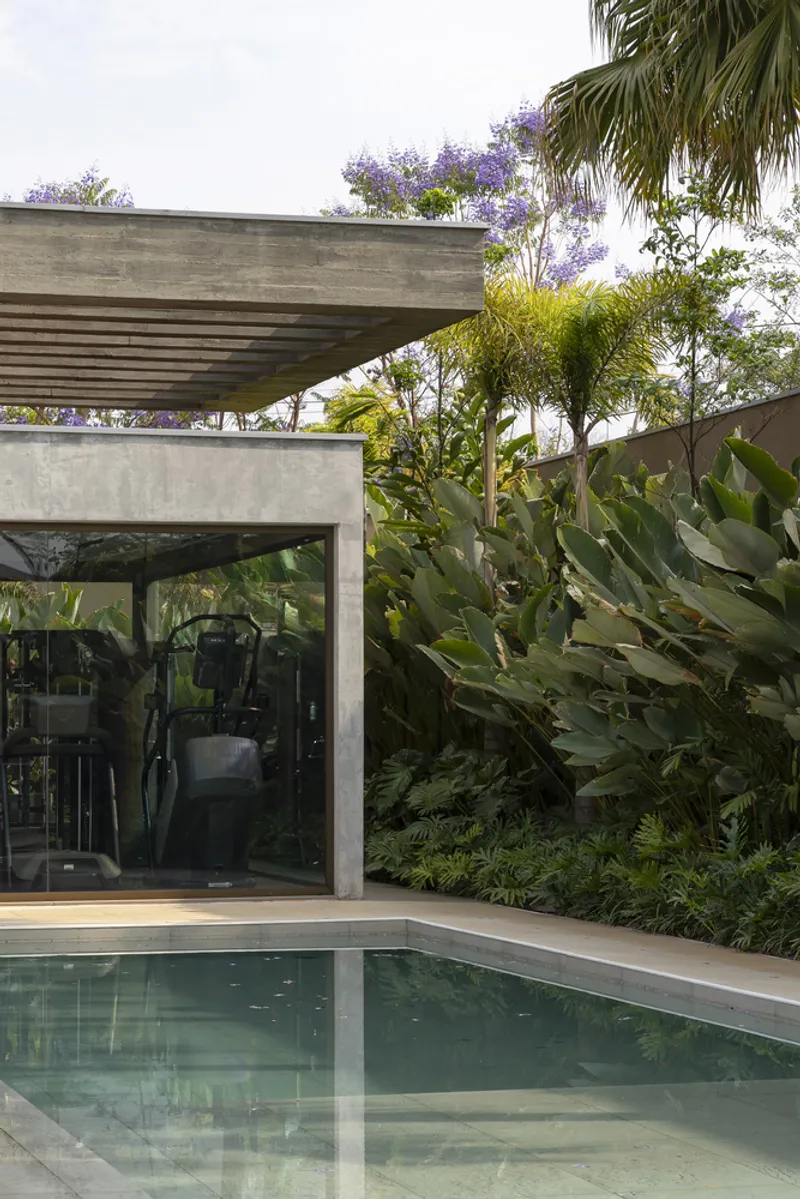
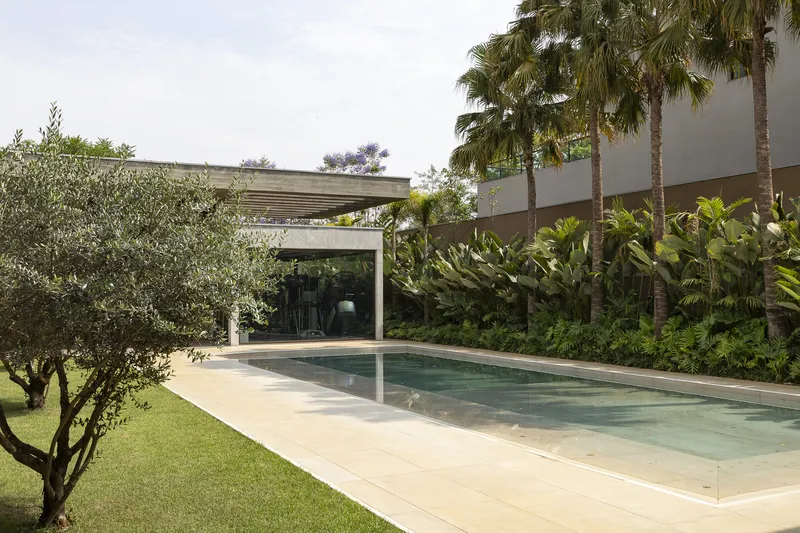
Every room in WU House takes its orientation from the central pool courtyard. The swimming pool sits on a limestone deck, flanked by a cantilevered concrete canopy on one side and rendered garden walls on the other. An olive tree anchors the lawn, and palms punctuate the skyline, lending vertical rhythm to a plan that is otherwise emphatically horizontal.
The pool is not an amenity tucked behind the house. It is the organizing element: the section drawing confirms that every pavilion faces it, every corridor runs alongside it, and the roof planes tilt to frame views of water and sky. In feng shui terms, water at the center of a dwelling represents accumulated energy. In architectural terms, it simply produces a house where every room has something worth looking at.
Timber, Glass, and Filtered Light
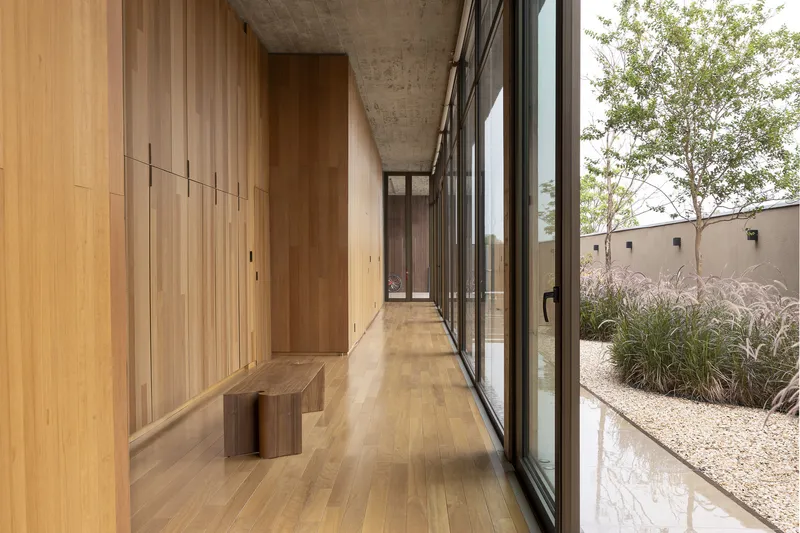
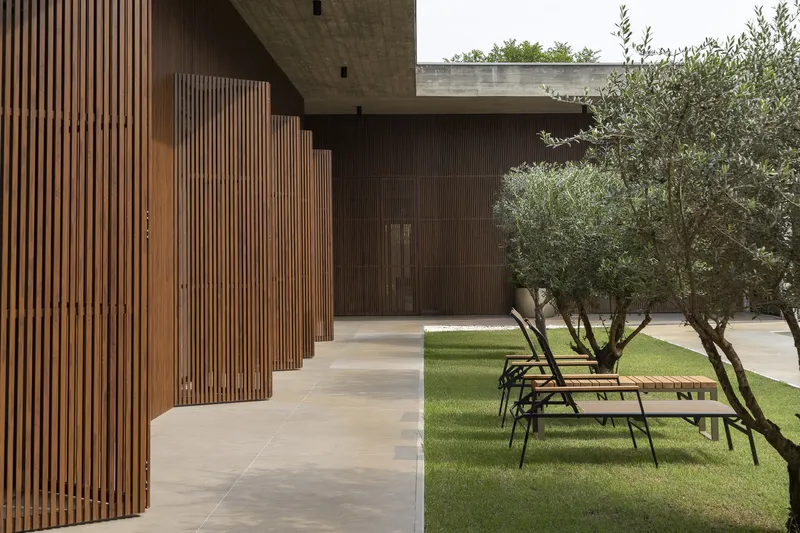
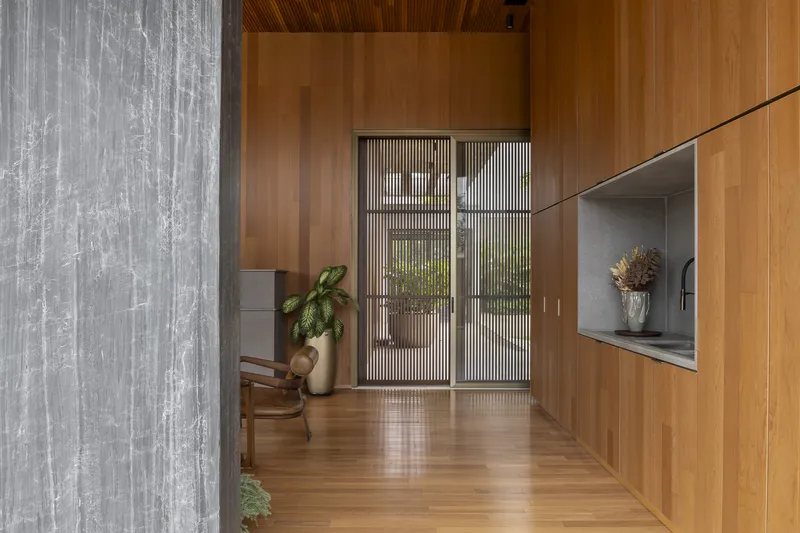
The corridors of WU House are among its finest spaces. Vertical timber slat screens line one side, filtering afternoon sunlight into rhythmic bands across the floor. On the other side, full-height glass opens to planted courtyards filled with grasses and olive trees. The effect is meditative: light and shadow shift through the day, marking time without the need for a clock.
These walkways do double duty. They circulate the house and they manage climate. The slat screens reduce solar gain while maintaining ventilation, and the covered overhangs keep rain off the glass. It is passive environmental control dressed in the language of craft, a strategy that Brazilian architecture has perfected over decades.
Living Spaces That Dissolve Outdoors
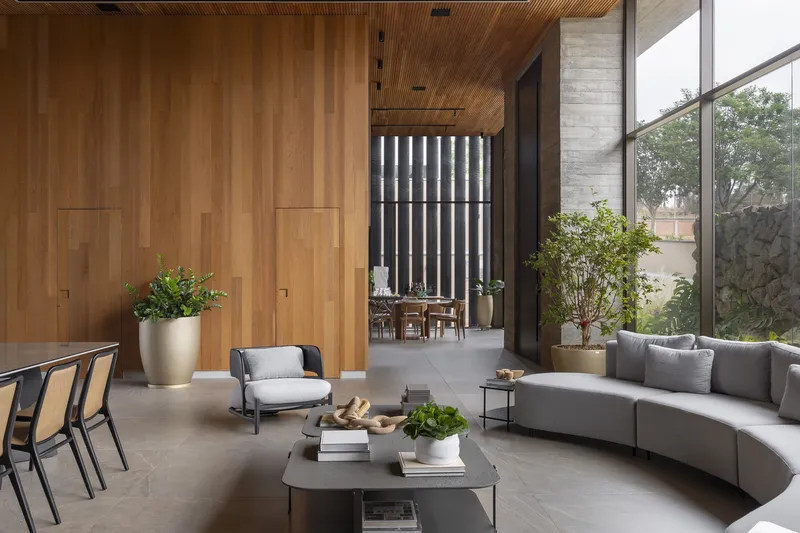
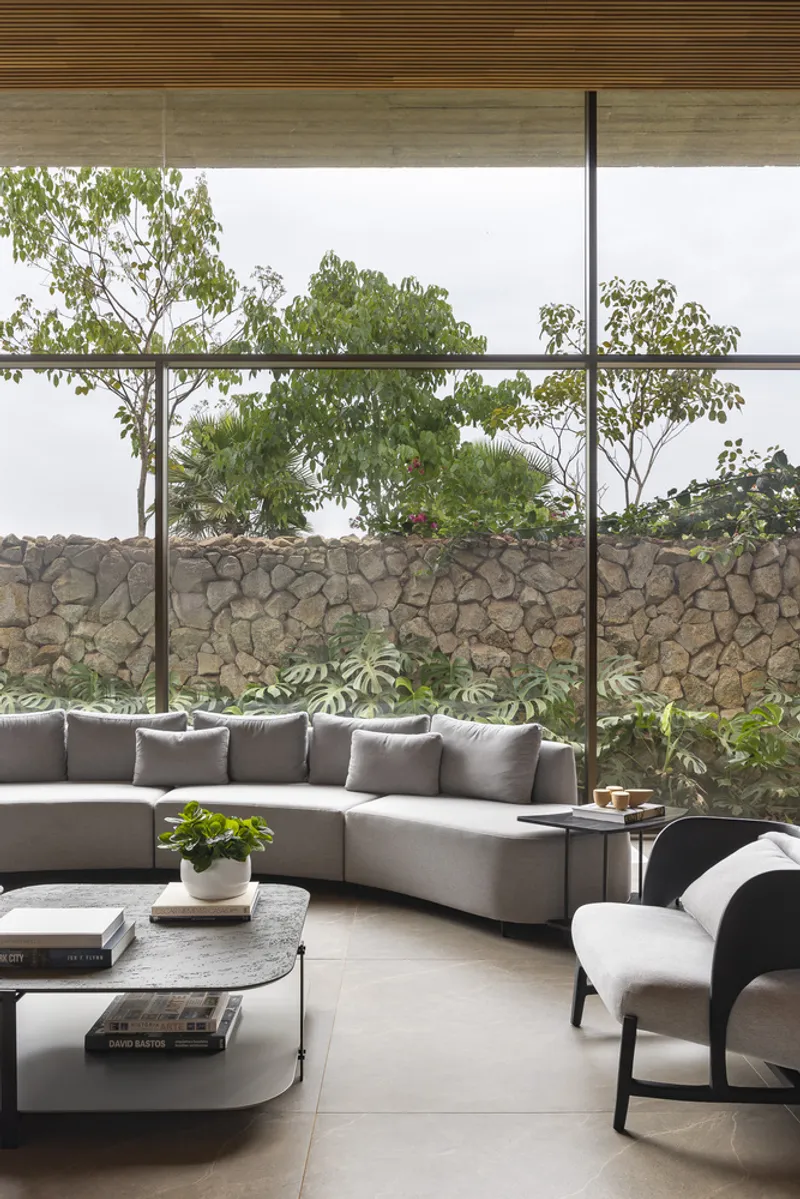
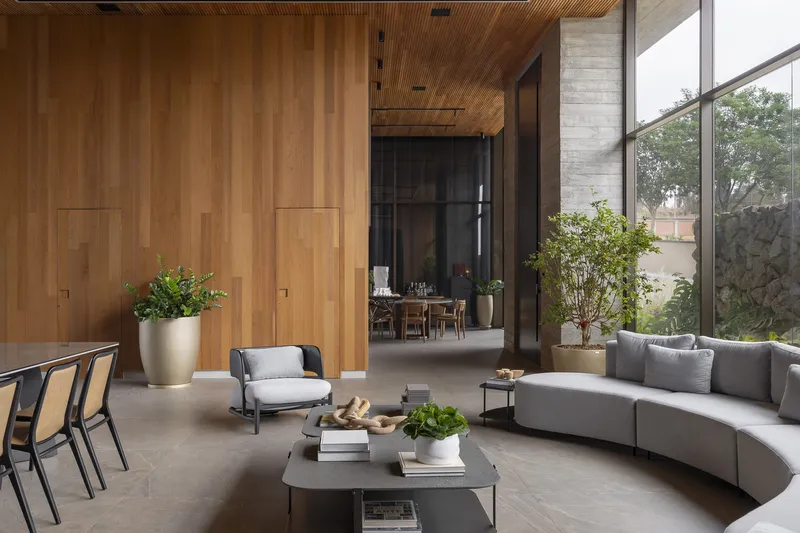
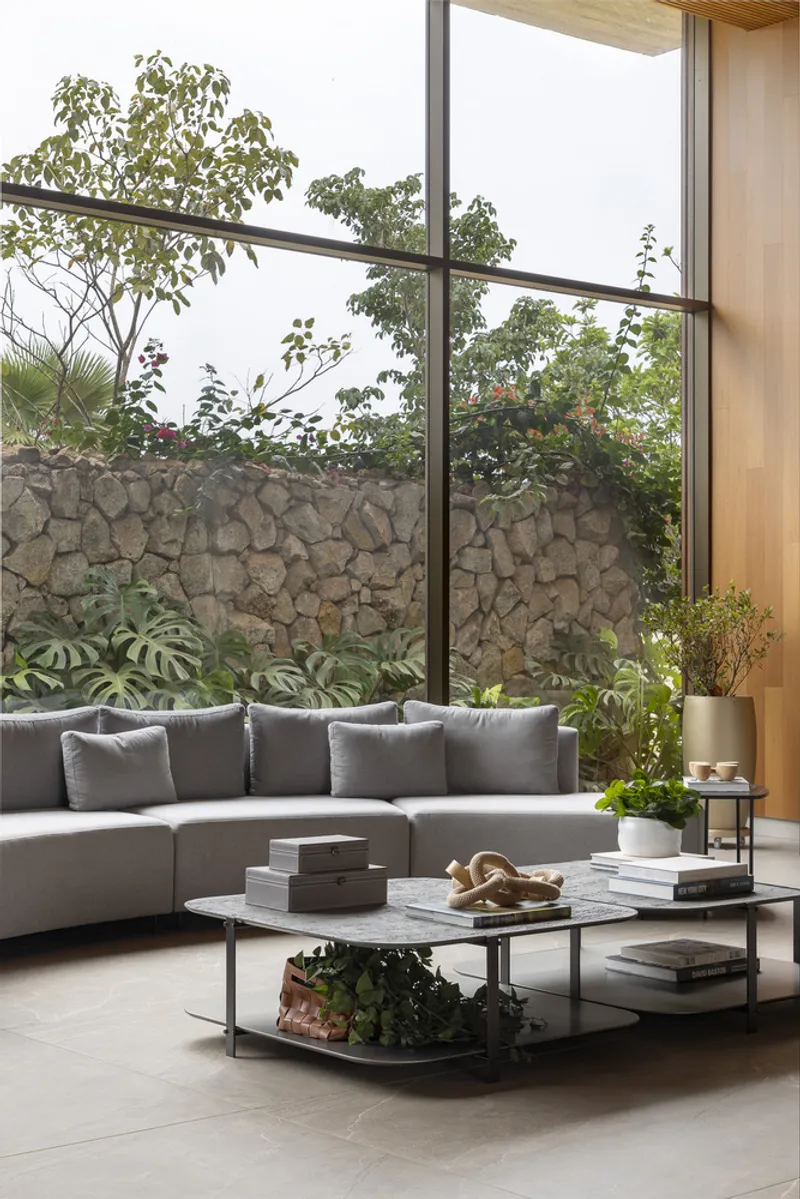
The main living room occupies a double-height volume clad entirely in timber, with floor-to-ceiling glazing on two sides. One wall faces the courtyard; the other opens to a gabion retaining wall and mature tree canopy beyond. When the glass is open, the room becomes a covered terrace. When it is closed, the views still carry the garden inside.
Granero avoids visible mullions wherever possible, using frameless glass to maintain the illusion of a room without walls. The timber paneling provides warmth and acoustic dampness, and a recessed display niche adds a quiet domestic note to what could otherwise feel institutional. The proportions are generous but not extravagant. The ceiling height earns its double volume because it lets the tree canopy fill the upper field of vision.
Private Rooms and the Quality of Rest
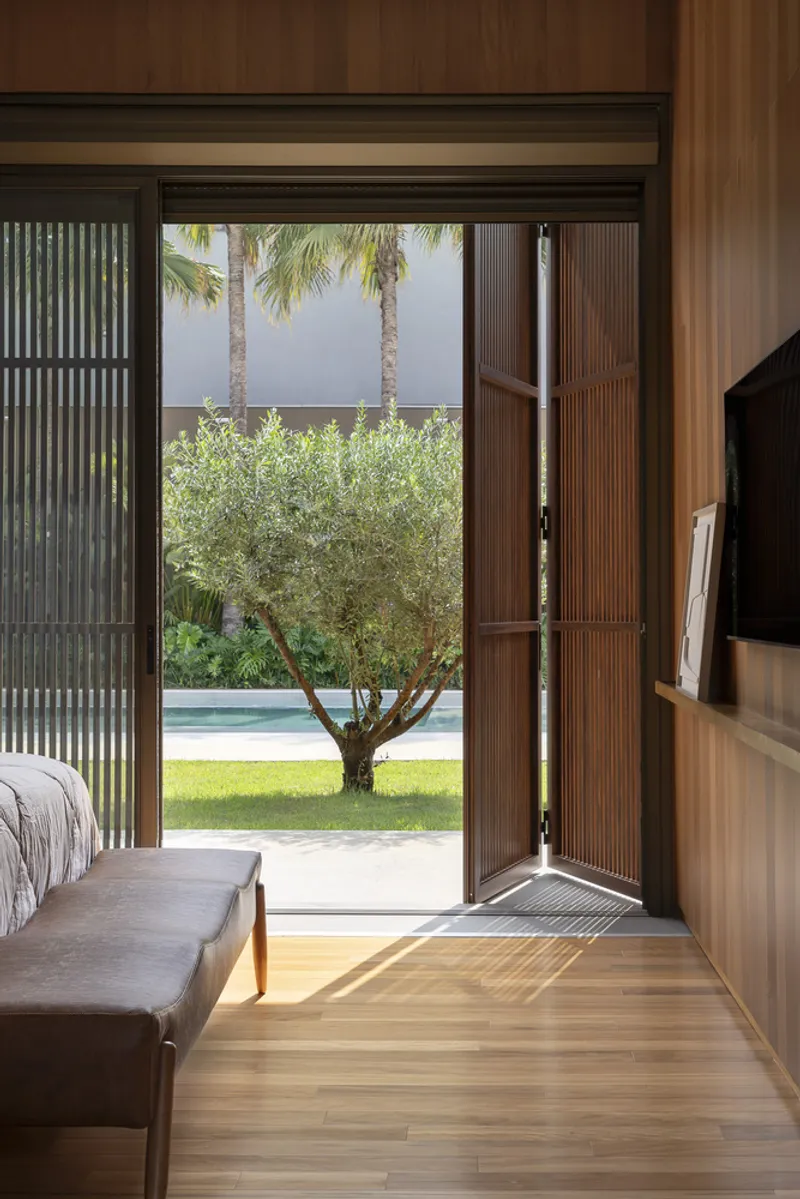
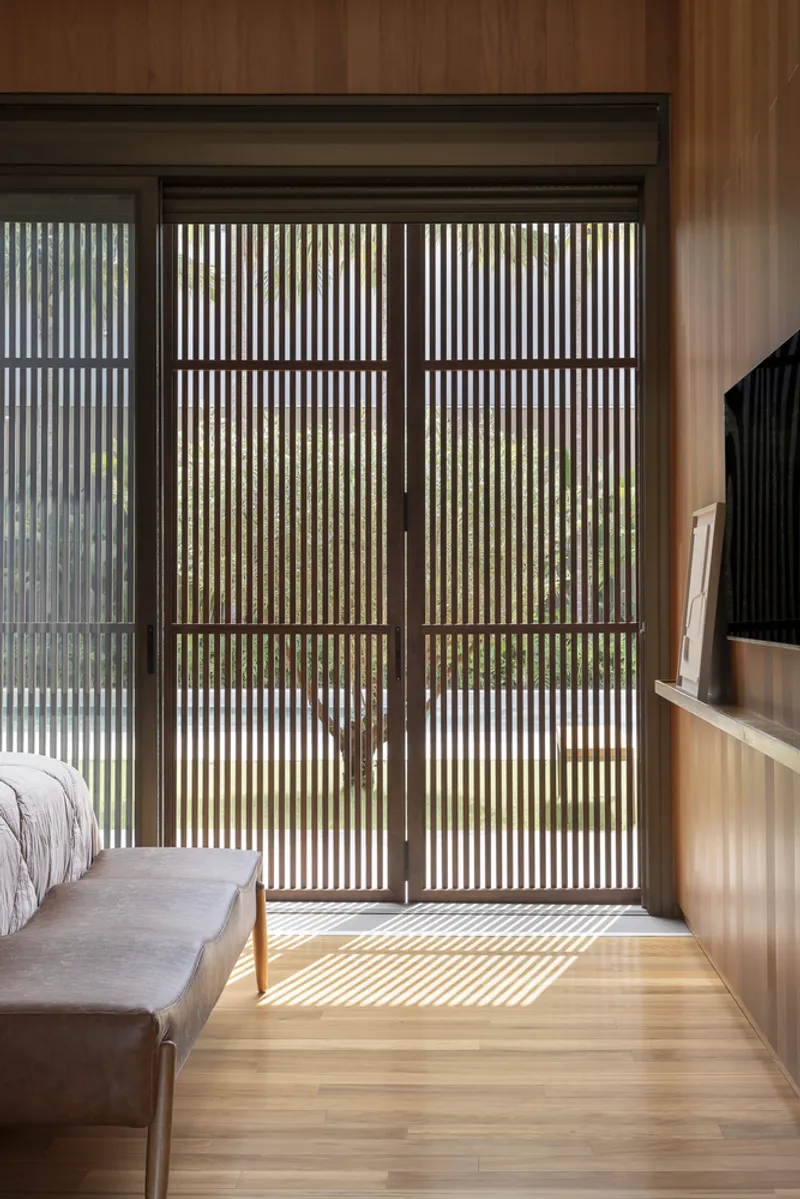
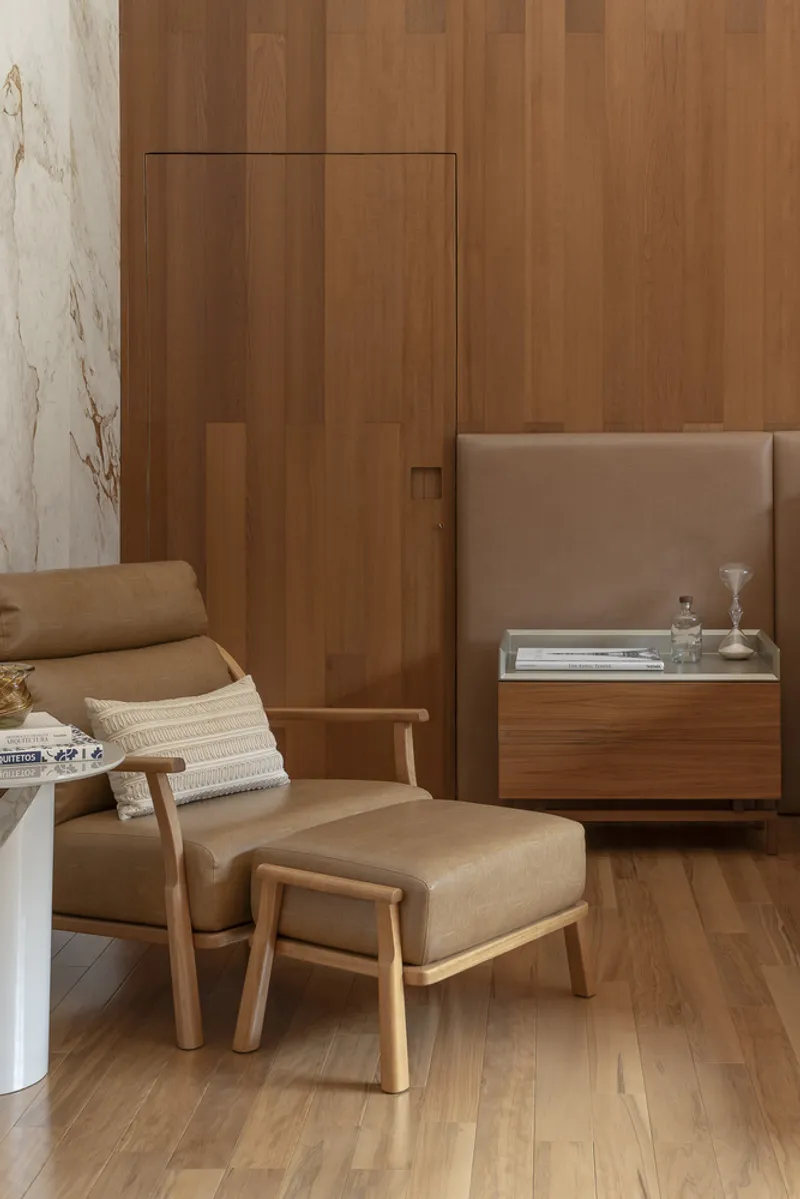
The bedrooms occupy the quietest wing of the plan, oriented away from the street and toward the garden. Sliding glass doors open directly to a view of palm trees and pool. Vertical slatted screen doors act as a secondary layer, filtering afternoon light into warm stripes across the timber floor.
Inside, the palette stays restrained: recessed timber wall panels, a floating walnut nightstand, an upholstered lounge chair. There is no accent wall, no statement lighting. The luxury here is spatial: ceiling height, material consistency, and direct access to landscape. These rooms would feel calm even without the feng shui framework, which is perhaps the highest compliment the design can receive.
Material Contrasts and Exterior Detailing
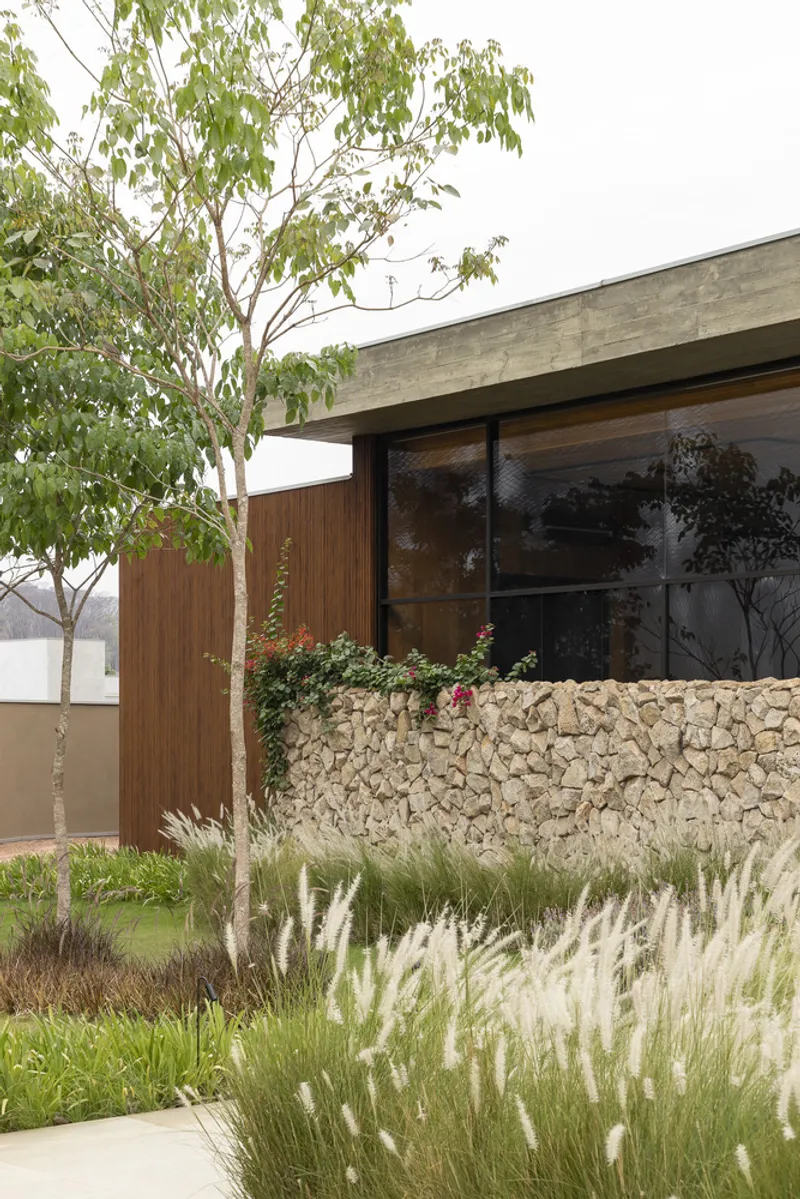
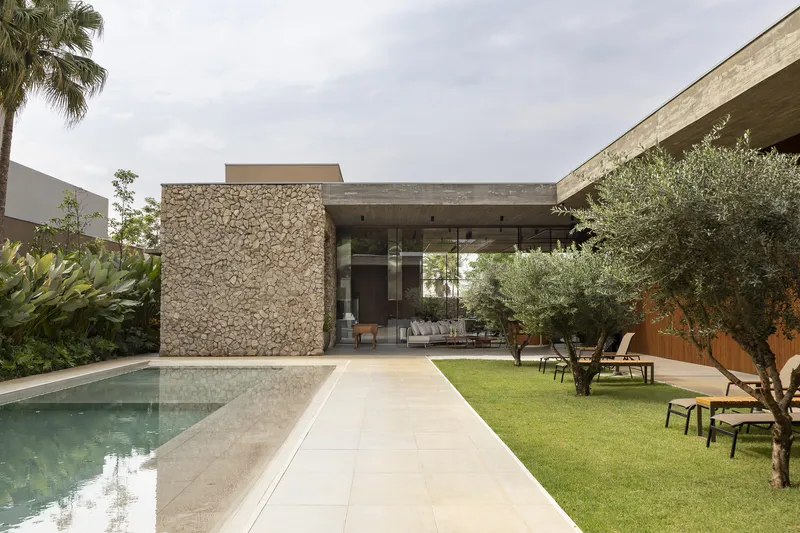
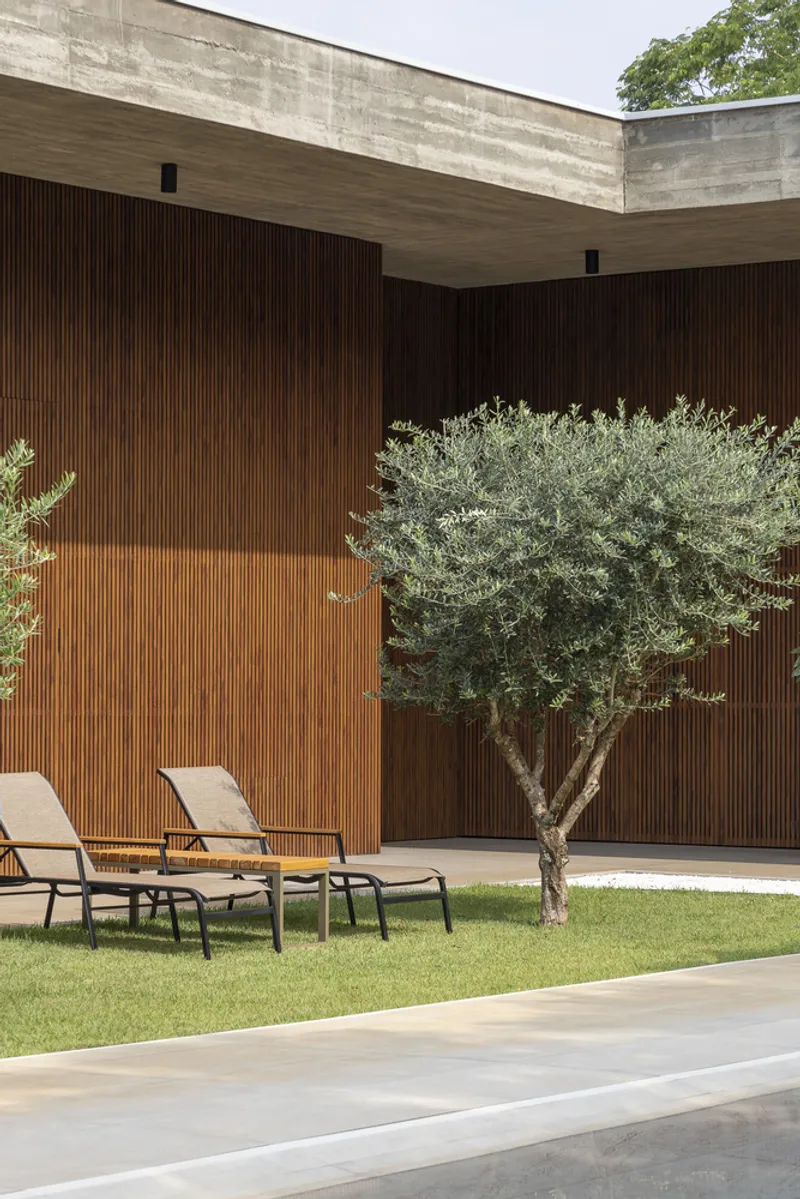
WU House speaks three material languages simultaneously. Board-formed concrete provides structural mass and cantilevered overhangs. Gabion stone walls ground the house and connect it visually to the earth. Timber cladding, both horizontal and vertical, wraps the habitable volumes in warmth. The three materials meet cleanly, without transition strips or awkward junctions.
At the rear, a concrete roof plane extends beyond the timber-clad volume to shade the pool terrace, its soffit exposed and unfinished. Gabion walls reappear at the garden perimeter, creating a consistent material boundary that reads as landscape rather than fence. Olive trees and grasses grow between the pavilions, reinforcing the sense that the house is a series of objects set within a garden rather than a container placed on a cleared site.
Interior Detail and Light Control
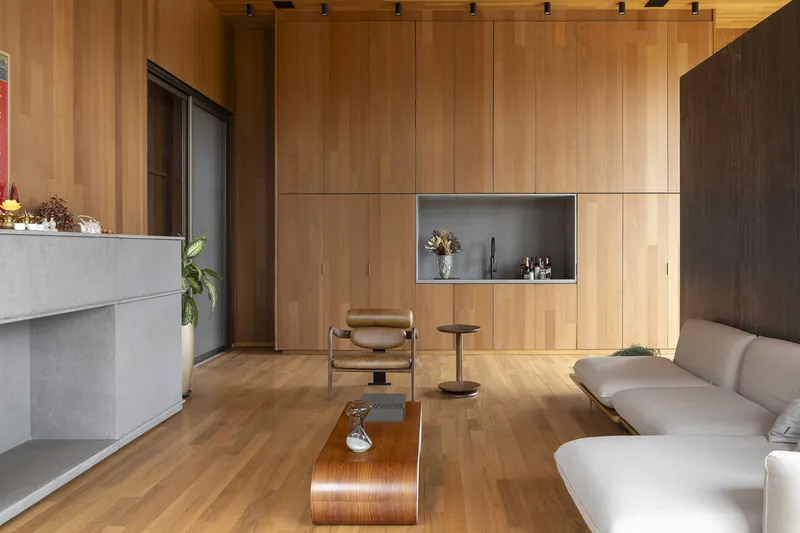
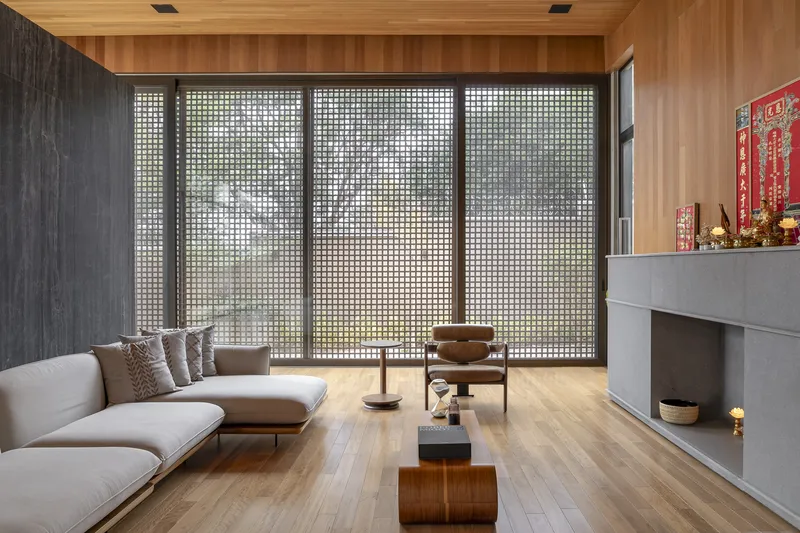
Throughout the house, the handling of natural light is deliberate and varied. Perforated metal screens diffuse incoming sun into soft, even illumination beneath timber-lined ceilings. In the living spaces, recessed display niches and timber paneling absorb and redirect light, preventing glare without resorting to heavy curtains or mechanical shading.
The consistency of the timber palette across walls, ceilings, and floors creates a warm monochrome that lets furniture and planting carry the color. It is a smart restraint: the material does not compete with the garden views, and it ages gracefully in the humid São Paulo climate. Every opening is calibrated not just for view but for the character of light it admits at different hours.
Plans and Drawings
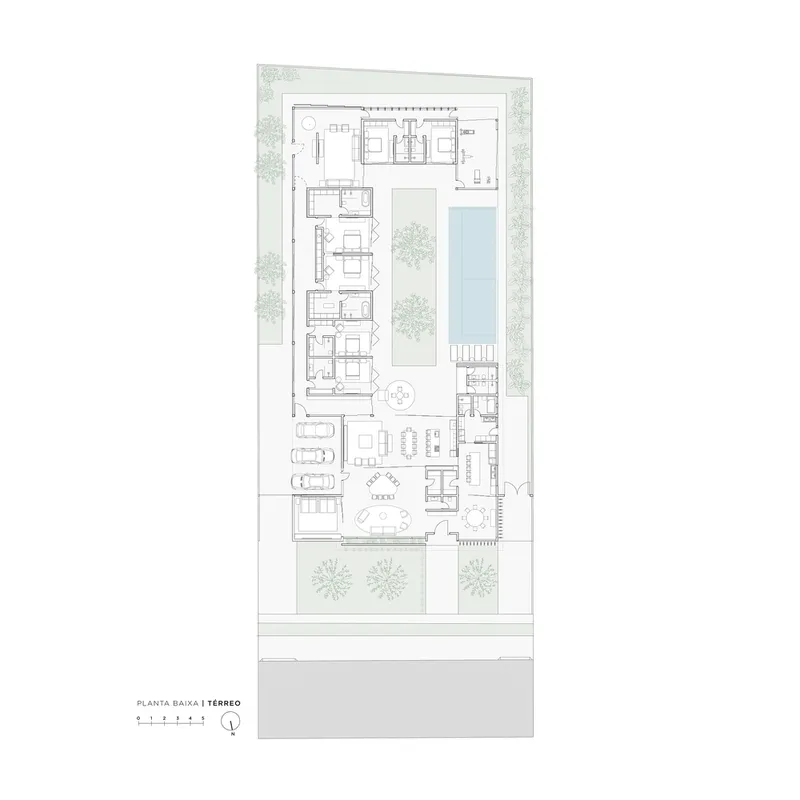
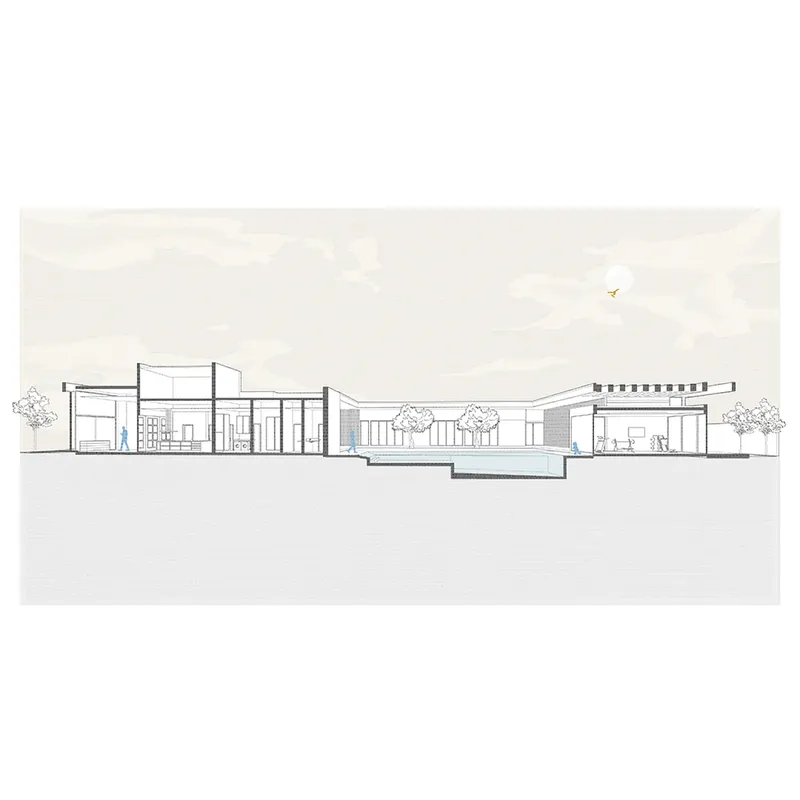
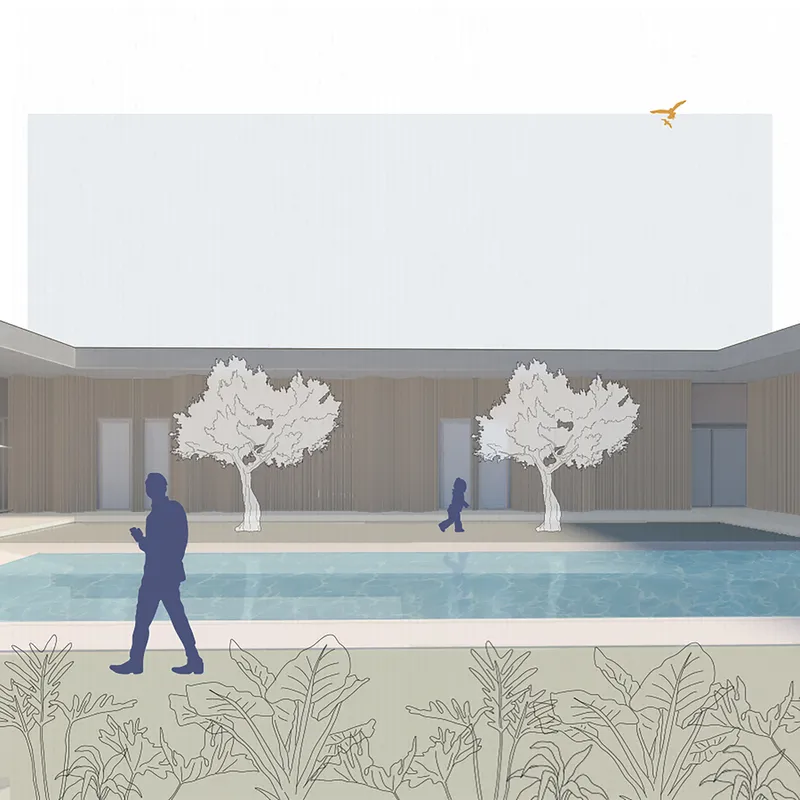
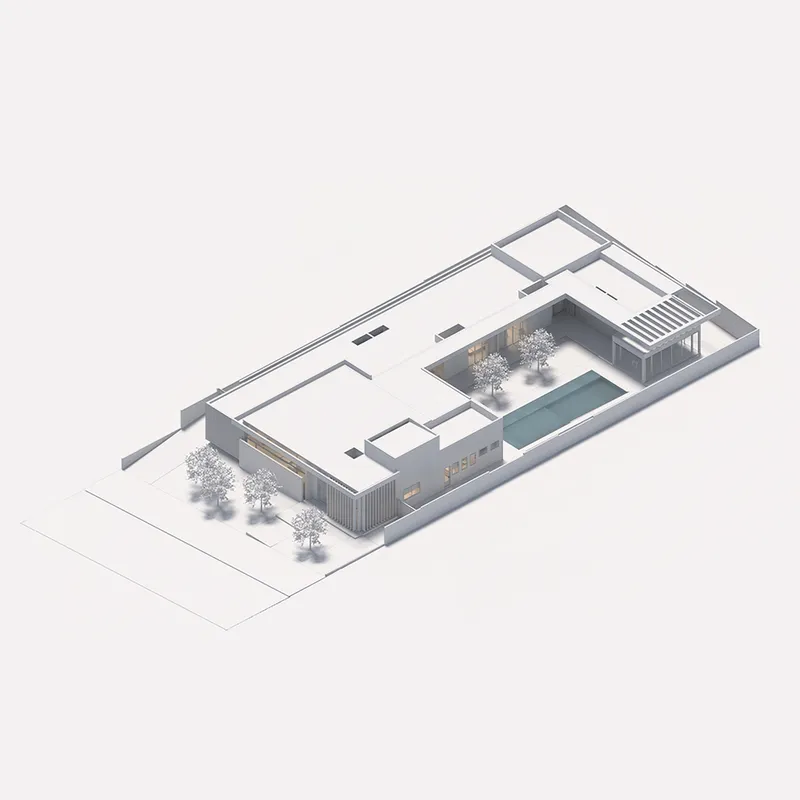
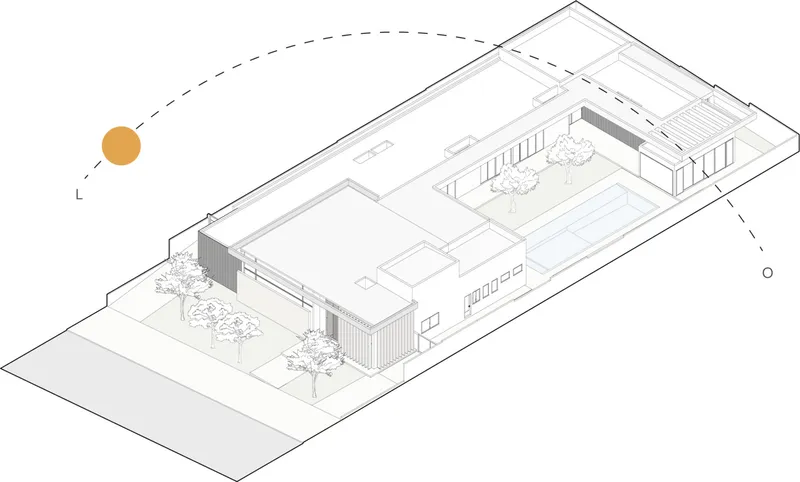
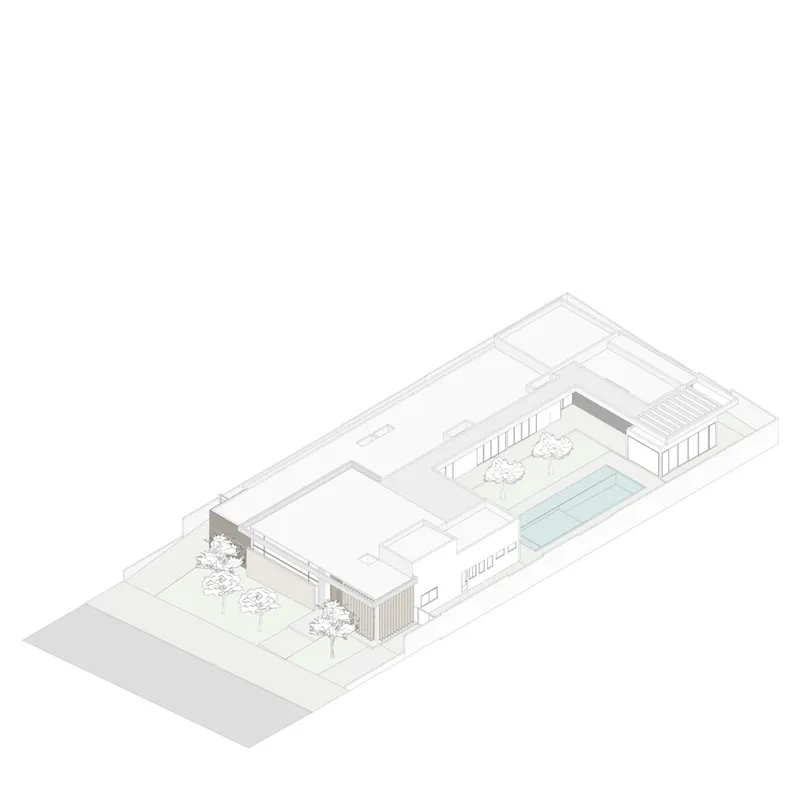
The ground floor plan reveals the organizing logic clearly: a residential wing wraps the central pool and courtyard in an L-shape, with service spaces buffering the street edge. The section shows how flat and sloped roof planes create varying ceiling heights, giving the double-height living room its vertical emphasis while keeping the bedrooms low and intimate.
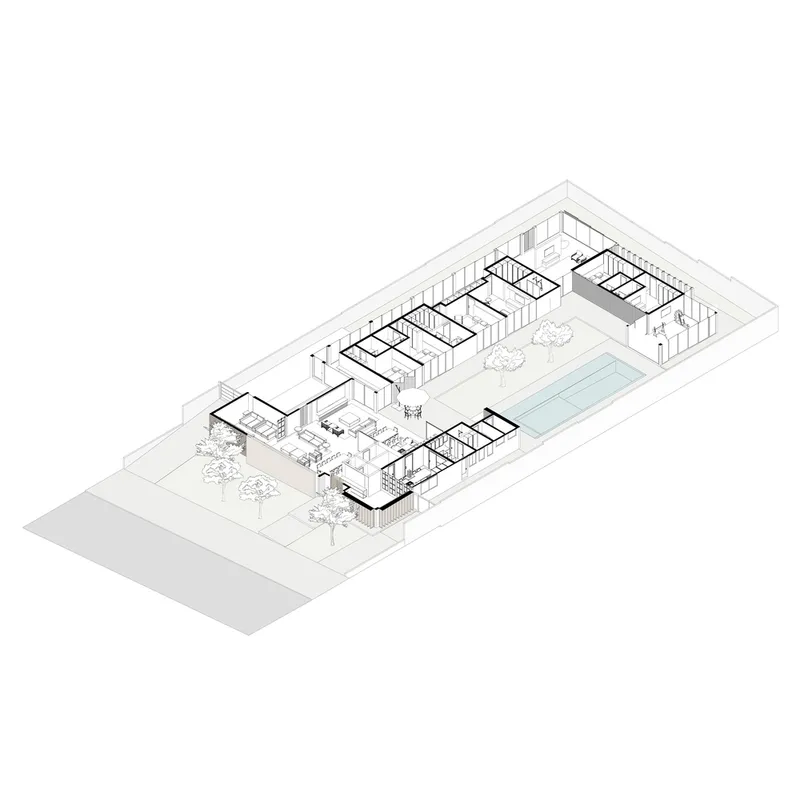
The axonometric and isometric drawings are especially revealing. They show the solar path diagram that informed room placement, the relationship between tree canopies and roof overhangs, and the way the interior volumes nest within the courtyard landscape. The elevation drawings confirm the restrained street presence: a horizontal composition of stone, concrete, and timber that reads as a garden wall with a house hidden behind it.
Why This Project Matters
WU House is interesting not because it applies feng shui to residential design but because it demonstrates how a structured spatial philosophy, any spatial philosophy, can generate architecture of real discipline. The plan is tight, the material palette is limited, and every opening has a reason. That those reasons happen to align with ancient Chinese environmental thinking and contemporary Brazilian building culture is what makes the project genuinely unusual rather than merely stylish.
Rafael Granero has produced a house that could teach a masterclass in how to use three materials well, how to make a courtyard plan feel inevitable, and how to give a family home a public face that is reserved without being hostile. If more residential projects took their organizing principles this seriously, we would have fewer beautiful houses and more good ones.
WU House by Rafael Granero Arquitetura, São Paulo, Brazil. Photography by Keniche Santos.
About the Studio
Share Your Own Work on uni.xyz
If projects like this are the kind of work you want to make, uni.xyz is a place to publish your own, find collaborators, and enter design competitions.




Popular Articles
Popular articles from the community


Co-Life: Senior Housing Design That Reconnects Older Adults With the City
Co-Life reimagines senior housing design through healing gardens, shared streets, workshops, and a sustainable community across generations.

The Ocean Hive: Sustainable Architecture for a Self-Sufficient Civilization at Sea
The Ocean Hive imagines sustainable architecture at sea, where modular habitats, algae, wave power and ocean waste sustain a growing colony.

Co-life: Sustainable Architecture for Age-Friendly Community Living
Co-life reimagines sustainable architecture for seniors through courtyards, rammed earth, shared gardens, and spaces designed for belonging.

Lunar Spiral: Space Architecture Shaped by the Mathematics of the Universe
Lunar Spiral reimagines space architecture through Fibonacci geometry, lunar regolith, levitating habitats, and self-sustaining Moon living.


Similar Reads
You might also enjoy these articles


Hodi-Mandai Geram
Project Function: Preservation and revitalization of the Intangible heritage and socio-spatial identity of the Hodi by Housing, Cultural Memory Center, Sacred Grove, landscape, local tourism economy


Olio Towers: A Mid-Rise for Performers That Fuses Housing, Rehearsal, and Stage
Located blocks from Houston's Theater District, this modular tower stacks living units around a central performance atrium.

Oasis: Modular Green Housing Carved into Dhaka's Urban Fabric
A shortlisted Plugin Housing entry reclaims unauthorized settlements in Dhaka with stepped concrete volumes, green roofs, and ventilation-driven design.

Black Hole: A Floating Megastructure for the Post-Physical Era
Emiliano Mazzarotto envisions a spherical, self-scaling arena where e-sports, digital hotels, and holographic stadiums replace traditional public space.

Explore Brazilian Architecture Competitions
Discover active competitions in this discipline



Challenge to reimagine the Iron Throne


Photograph architecture without architects


Illustrate the lost glory of Angkor Wat - Render Challenge


Design challenge to reuse E-waste
Comments (0)
Please login or sign up to add comments
No comments yet. Be the first to comment!