

XAUAT Wraps a Rural Chinese Dwelling in Glass Bricks and Passive Climate Strategy
A renovated village house in Weinan, Shaanxi Province, fuses Guanzhong vernacular traditions with zero-carbon heating and rainwater systems.


A flat-roofed house built around 2000, left vacant for years, suffering from roof leaks, mold, and poor ventilation: not exactly the kind of building that inspires architectural pilgrimages. But XAUAT, led by architects Bo Gao and Yiqiong Wang, saw in this deteriorating structure in Bayi Village an opportunity to test whether vernacular building intelligence could be genuinely fused with contemporary green technologies. The result, completed in 2021 at 400 square meters, is a dwelling that reads as quietly traditional from a distance yet operates as a small environmental machine up close.
What makes this project worth studying is not any single gesture but the density of its ambitions. Hollow glass bricks fill the south-facing sunrooms, admitting daylight while buffering noise. Phase-change materials in the sunroom walls absorb heat by day and radiate it back at night. Photovoltaic panels on the roof power a graphene heating device, achieving zero-carbon heating. Rainwater is collected, purified, and cycled through a courtyard water feature for irrigation. And all of this is delivered through the local construction crafts of the Guanzhong region, not imported prefab systems. The project argues that rural renovation can be both technologically serious and culturally grounded.
A Facade That Glows


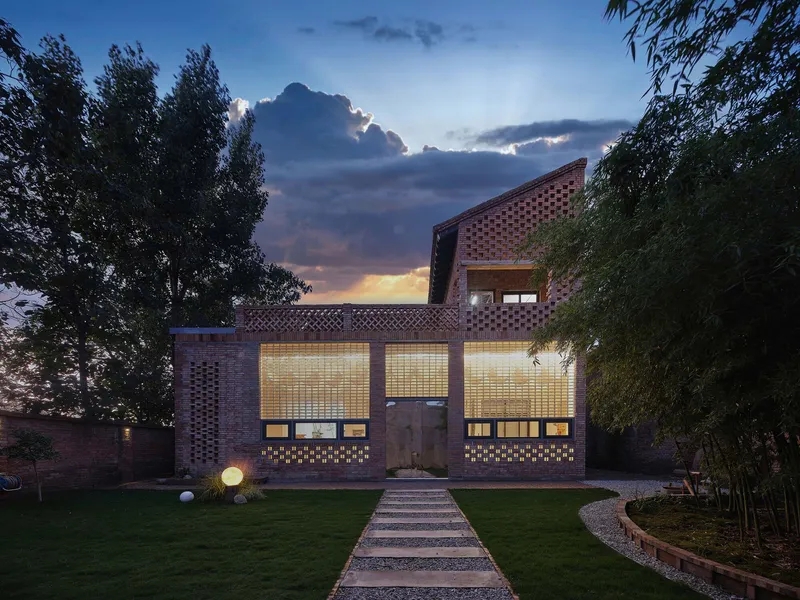
The most immediately striking element is the south-facing facade at dusk, when the hollow glass bricks transform from translucent screens into glowing panels set within the perforated brickwork. During the day, these blocks are functional: they channel diffused light deep into the interior corridors and sunrooms, reducing the need for artificial lighting. At night, they broadcast warmth outward across the surrounding agricultural fields, giving the house a lantern-like presence in the village.
The perforated brick patterning that frames these glass openings is not decorative filler. It controls solar gain and permits cross-ventilation while maintaining privacy. The material palette stays deliberately local: masonry, clay roof tiles, and the woven brick patterns characteristic of the Guanzhong region. There is no cladding, no composite panel, no imported stone. The facade does real thermodynamic work using things a village mason already knows how to build.
Courtyards and Thresholds

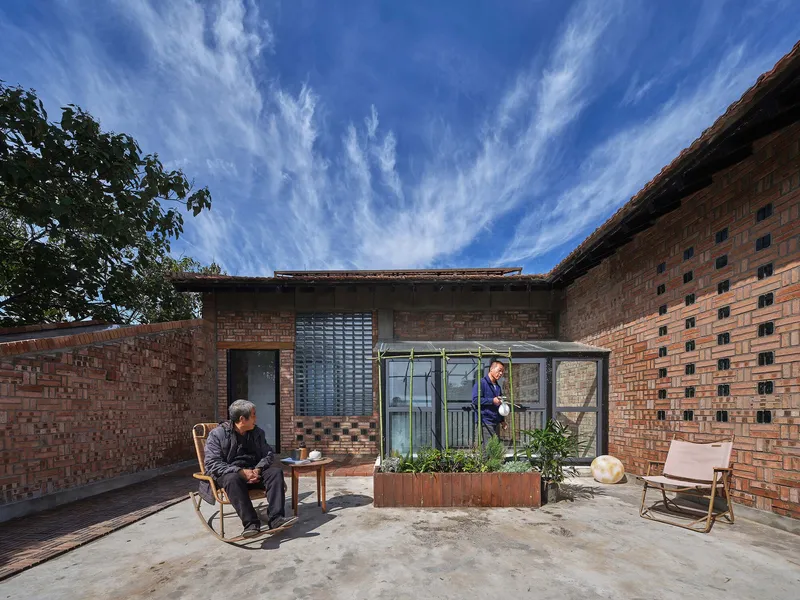
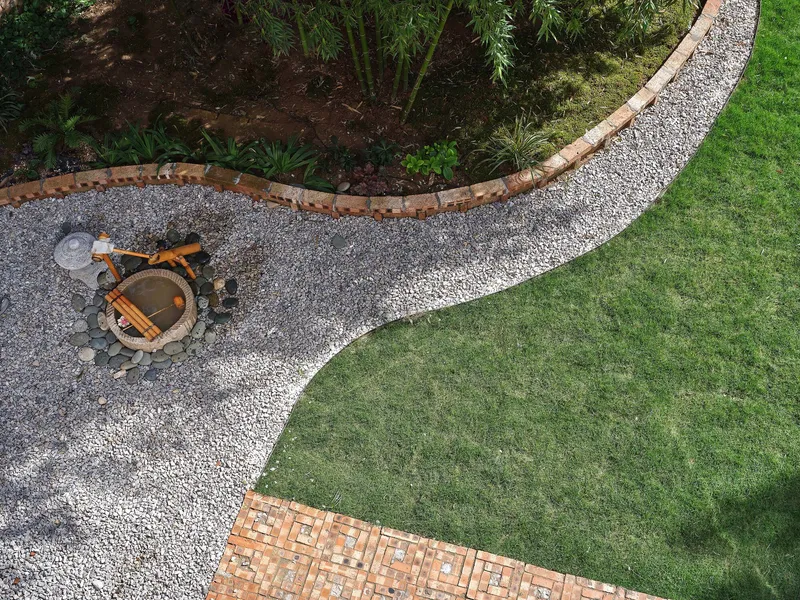
The site is organized across three courtyards sequenced from south to north. The front yard functions as a buffer zone for parking and crop planting, a pragmatic acknowledgment that rural homes are working landscapes, not just domestic ones. The central courtyard is the social heart, with lawn, planted beds, curved gravel paths, and a fire pit that ground daily life outdoors. The backyard handles storage and buried equipment, keeping infrastructure out of sight.
This tripartite courtyard structure echoes the spatial logic of traditional Guanzhong houses, where progression through thresholds marked a shift from public to private. Here, the courtyards also perform environmental roles. The central courtyard's water feature, fed by the rainwater purification system, provides landscape irrigation and evaporative cooling. A pair of seated figures on the terrace, framed by a metal planter, suggest the kind of unhurried domestic life that this spatial sequence is calibrated to support.
The Double-Height Living Core
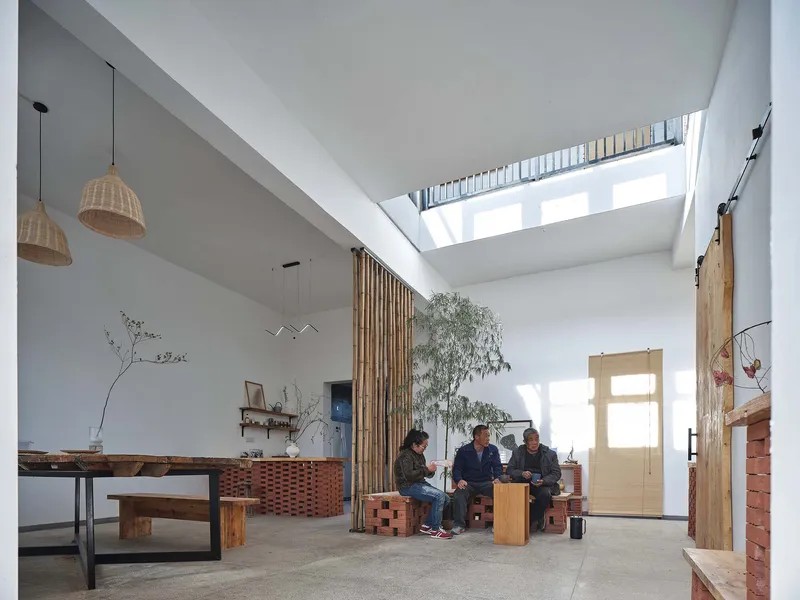


The most consequential spatial move is the partial removal of the first-floor living room ceiling slab to create a double-height volume. A continuous skylight and a ventilation shaft now occupy this void, using heat pressure to drive natural ventilation upward and out. It is a simple physics trick, but it solves the original building's worst problem: stagnant air, mold, and darkness.
The vertical bamboo screens that line this space are more than atmospheric. They filter light, provide visual separation between the dining area and the living room, and create a sense of depth that makes a 400-square-meter house feel considerably more generous. The polished concrete floor, perforated brick furniture, and woven pendant lamps compose a material vocabulary that is warm without being rustic. Everything is specific to its location without being nostalgic about it.
Material Intelligence in Detail


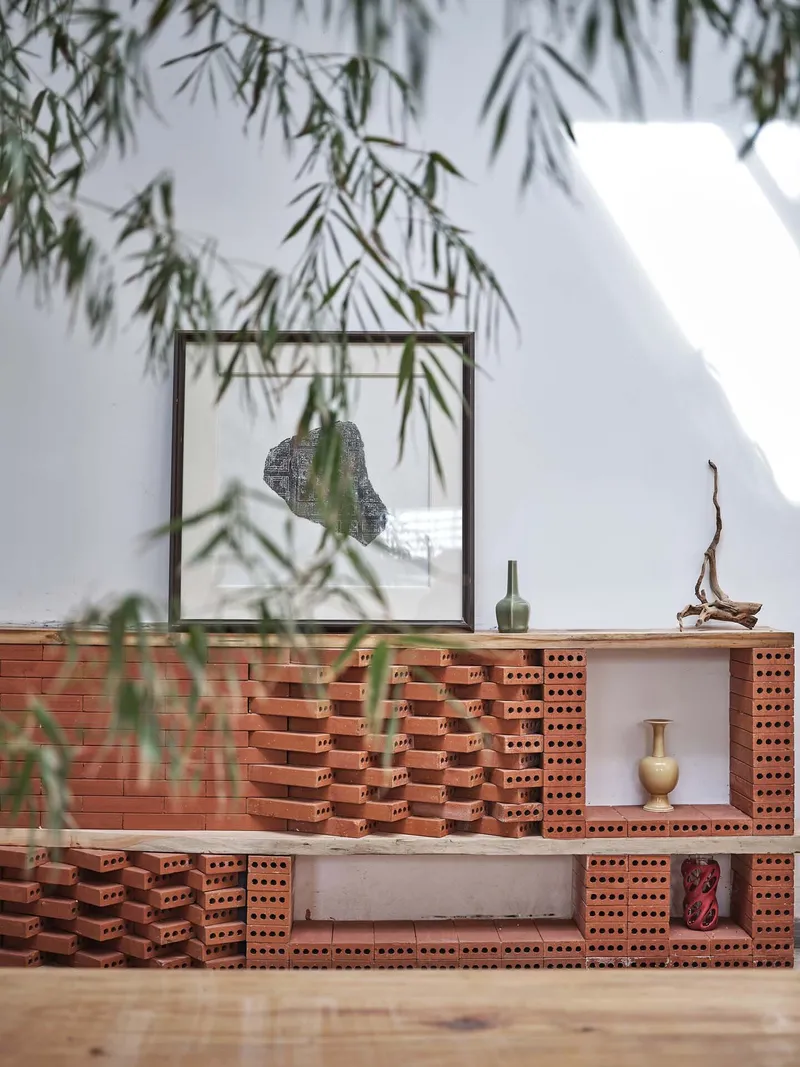
Perforated red brick appears not just in the walls but in the furniture and display platforms, unifying interior and exterior into a single material system. A kitchen counter sits on a brick base. A tiered display shelf beneath overhanging bamboo foliage doubles as a garden element. A sliding timber barn door on a black steel rail brings an industrial edge to what is otherwise a thoroughly handcrafted interior.
The basketweave ceiling detail visible in several rooms is a quiet flourish, proof that the builders' craft extended beyond structural necessity. These details matter because they demonstrate that the project was not assembled by a specialist contractor flown in from Beijing. Domestic construction crafts, the kind of skills available in a village in Shaanxi Province, were the primary delivery mechanism for the entire renovation.
Bedrooms and Private Spaces

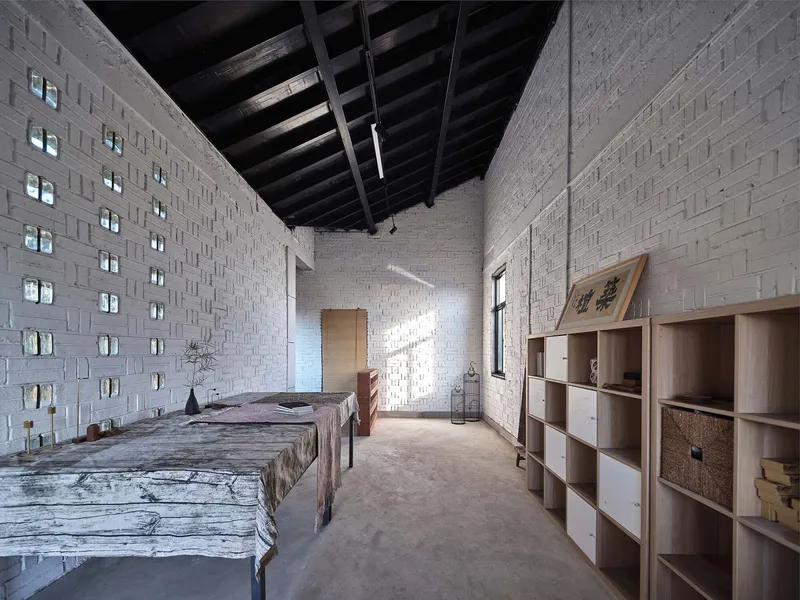

The bedrooms occupy the east and north sides of the plan, shielded from the most intense solar exposure and tucked away from the social core. White perforated brick walls and exposed timber ceiling beams give these rooms a monastic calm. The material shifts are subtle: a grey tile wall in the kitchen, a timber wardrobe in the bedroom, an exposed brick threshold between rooms. Each surface announces a change in program without requiring a door.
The traditional "stuffy top" roof space, a hallmark of local folk houses, is preserved here as a climate buffer. In winter it insulates; in summer it prevents direct solar heat from reaching the rooms below. It is not a visible feature, which is precisely the point. The best passive strategies are the ones you never notice.
Circulation and the Sloped Roof
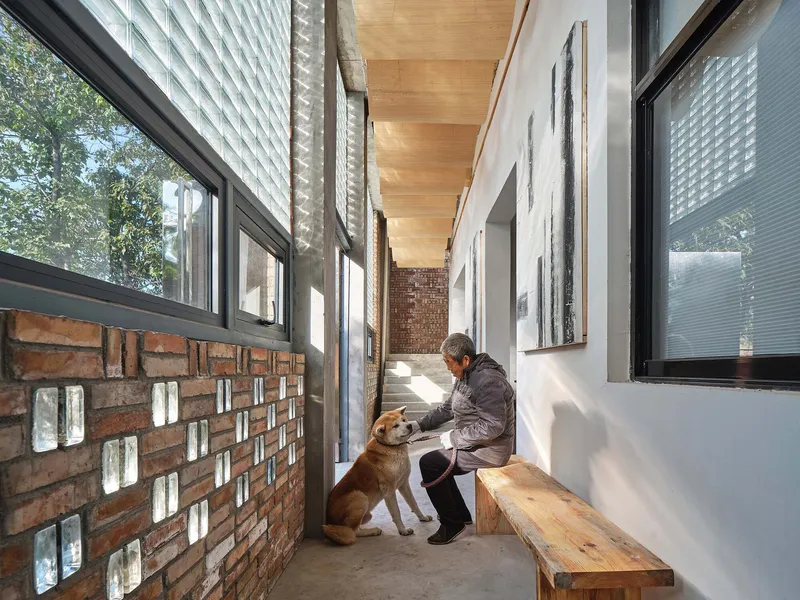
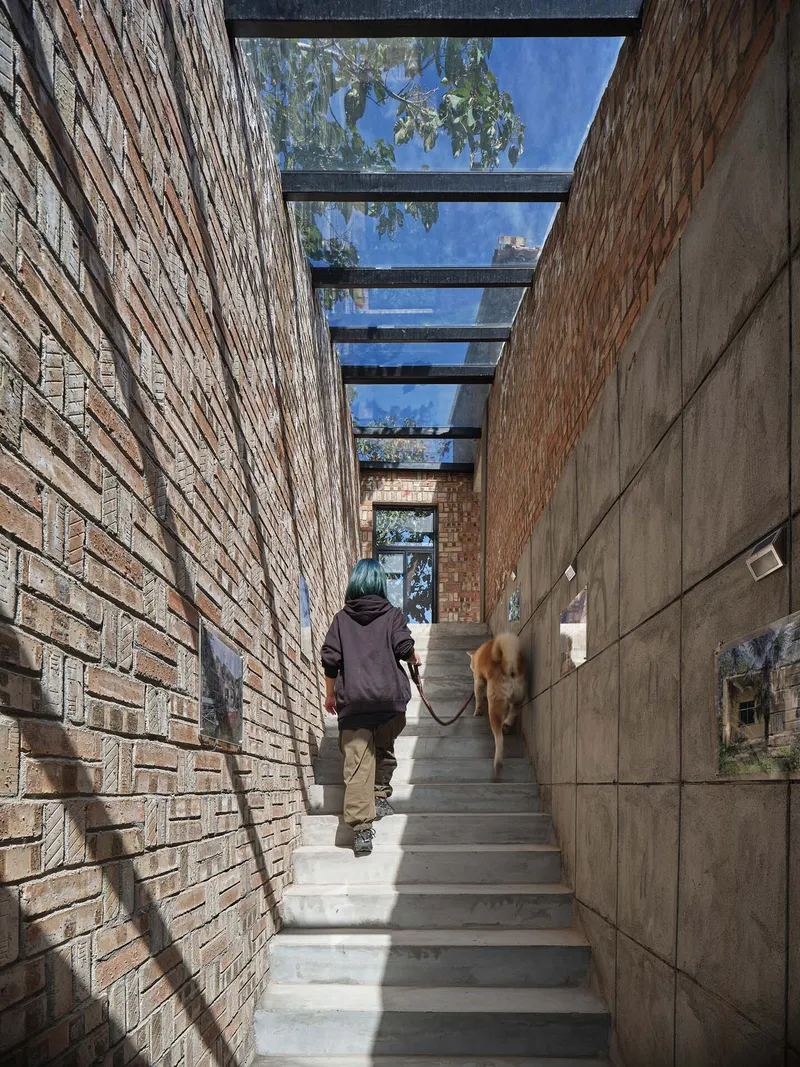

Traffic spaces wrap around the living spaces in a centralized layout, meaning you move along the perimeter to reach the core. The interior corridor with its timber ceiling and glass brick wall is the most photogenic expression of this strategy: daylight washes in from the side while the deep plan remains navigable. The narrow stairway between brick and concrete walls, topped with steel beams and glass, introduces a tighter, more compressed spatial experience that makes the double-height living room feel even more expansive by contrast.
The sloped roof continues the Guanzhong vernacular dwelling form rather than reverting to the flat roof of the original 2000-era construction. Clay tiles, solar panels, and a terrace on the second floor coexist under a roofline that makes the house legible as belonging to this region. The upper-level terrace, oriented for viewing and leisure, gives the family an outdoor room above the village.
Plans and Drawings


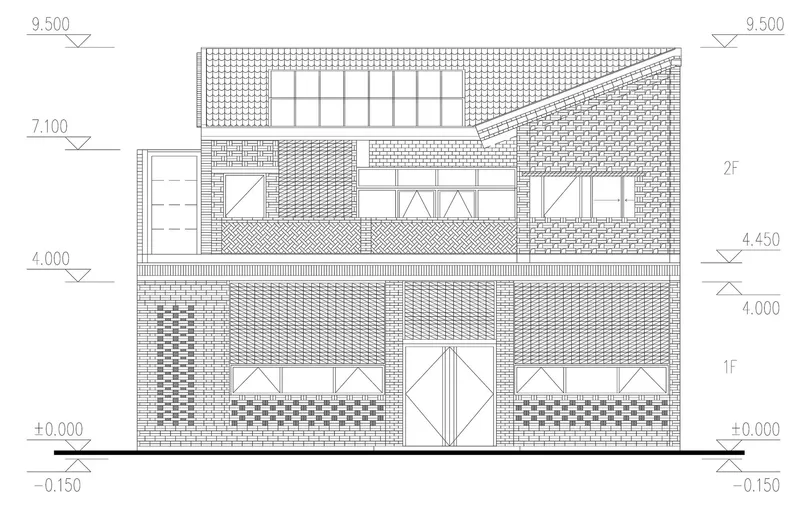
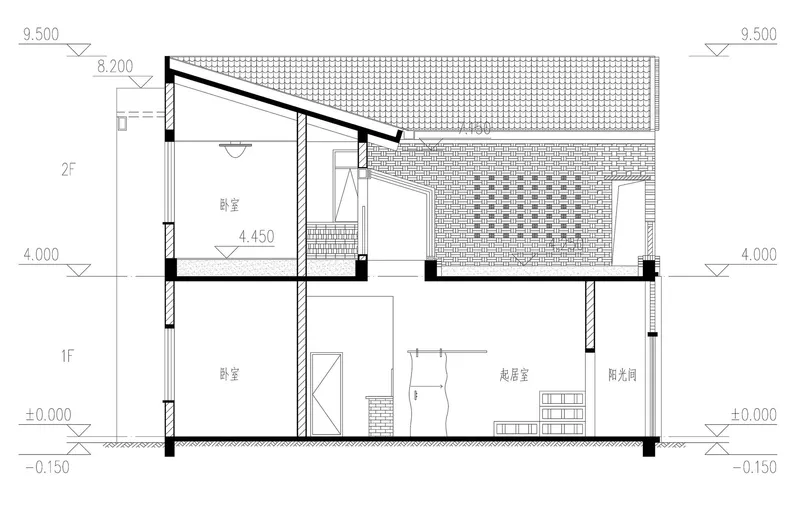
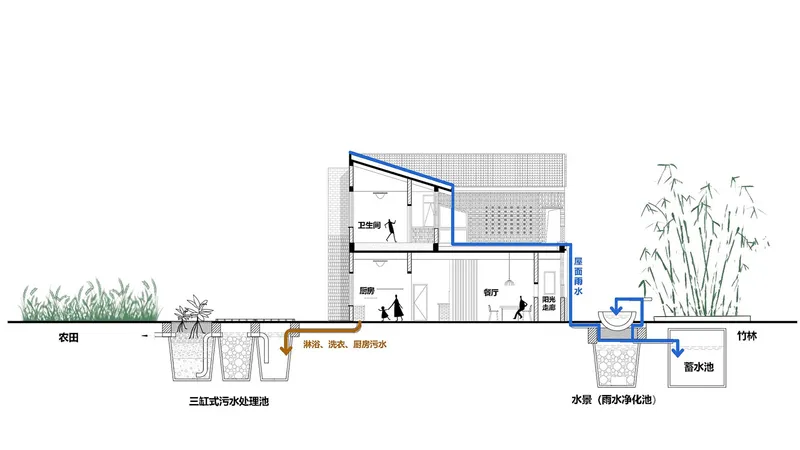


The floor plans reveal the centralized organization clearly: kitchen and three bedrooms surround a central living space on the ground floor, while the upper level opens up to a terrace, study workspace, and bathroom. The section drawings are the most telling. They show the sloped roof, the double-height space, and the ventilation shaft working together as a single thermal system. The rainwater collection diagram traces a path from roof to purification to courtyard water feature to irrigation, a closed loop that keeps the house nearly self-sufficient in water management.
The axonometric diagram labeling solar panels, rainwater systems, phase-change materials, and thermal insulation makes the environmental ambition explicit. The isometric construction drawing, showing the hybrid steel and masonry frame with its roof assembly, confirms that the structural intervention was modest: the original masonry walls and internal beams were retained, and new elements were grafted on rather than imposed. The site plan places the building on an irregular plot with trees and an access road, a reminder that this is not a pristine design site but an existing village parcel with its own constraints.
Why This Project Matters
Rural renovation in China is often framed as either preservation of heritage or modernization for tourism. The Glass Brick Dwelling sidesteps both traps. It is not a museum of Guanzhong building traditions, and it is not a boutique hotel disguised as a house. It is a working dwelling for a family, renovated using local crafts and local materials, that happens to achieve zero-carbon heating and closed-loop water management. The technology is embedded, not exhibited.
The broader lesson is about scalability. Phase-change materials, glass bricks, photovoltaic panels, and rainwater purification are not exotic. They are commercially available and, as this project demonstrates, installable by village-level construction teams when the design integrates them logically. If the approach XAUAT developed here can be replicated across Shaanxi's villages, the implications for rural sustainability are substantial. One house does not make a movement, but it can prove that the movement is technically possible.
Glass Brick Dwelling in Bayi Village, designed by XAUAT, led by Bo Gao and Yiqiong Wang. Located in Weinan, Shaanxi Province, China. 400 m². Completed 2021. Photography by Xiaoming Zhang.
About the Studio
Share Your Own Work on uni.xyz
If projects like this are the kind of work you want to make, uni.xyz is a place to publish your own, find collaborators, and enter design competitions.


Popular Articles
Popular articles from the community


Manzana Morphosis: Stretching Barcelona's Grid into a Living Landscape for 2050
A radical reworking of the Eixample manzana turns density into a tool for generous public space, vertical ecology, and environmental performance.


ETEH Reworks the Shared Spaces of São Domingos School in Brazil Around Timber, Color and Hanging Plants
At São Domingos School in Brazil, 436 m² of hall, refectory and library are recast with timber joinery, a yellow and blue code and trailing greenery.

David Ortega Stacks a Two-Story Mexico City Penthouse Around a Steel Stair and a Pergola-Shaded Roof Terrace
In Colonia Roma, a 300 m² penthouse uses oak joinery, a planted steel stair and a slatted roof pergola to make a new-build apartment feel like a house.

FCC Arquitectura Expands a Portuguese Granite House with a Board-Marked Concrete Wing
In Portugal, JV House pairs a cleaned-up whitewashed and granite dwelling with a timber-shuttered concrete extension, courtyards and a garden pool.

Similar Reads
You might also enjoy these articles

LAVA Architecten Gives Vocational Education a Sawtooth-Roofed Face on a Mechelen School Campus
In Mechelen, Belgium, a 2,053 m² STEM school on a 6×6 m grid turns workshops and classrooms into rooms that can be rearranged as teaching changes.

KEMA Studio Turns a Derelict Marvila Attic into a 60 m² Lighthouse Apartment Above Lisbon
In Lisbon's Marvila district, a rebuilt roof, four skylights and two plywood volumes turn an unlivable attic into a bright home facing the Tagus.

Pixel Gardens: One Repeated Module Stacked Into a Terraced Social Housing Tower for Famagusta
Salem Bader's shortlisted housing tower builds a vertical neighbourhood from one repeated module, offsetting units to carve terraces, light and air.

Bao Huynh Watercolor Atelier: A Serene Art Retreat in Hội An
Bao Huynh Watercolor Atelier in Hội An blends multifunctional art spaces, sustainable design, local materials, and family-friendly living in a serene environment.

Explore Adobe Brick Making Competitions
Discover active competitions in this discipline

Comments (0)
Please login or sign up to add comments
No comments yet. Be the first to comment!