
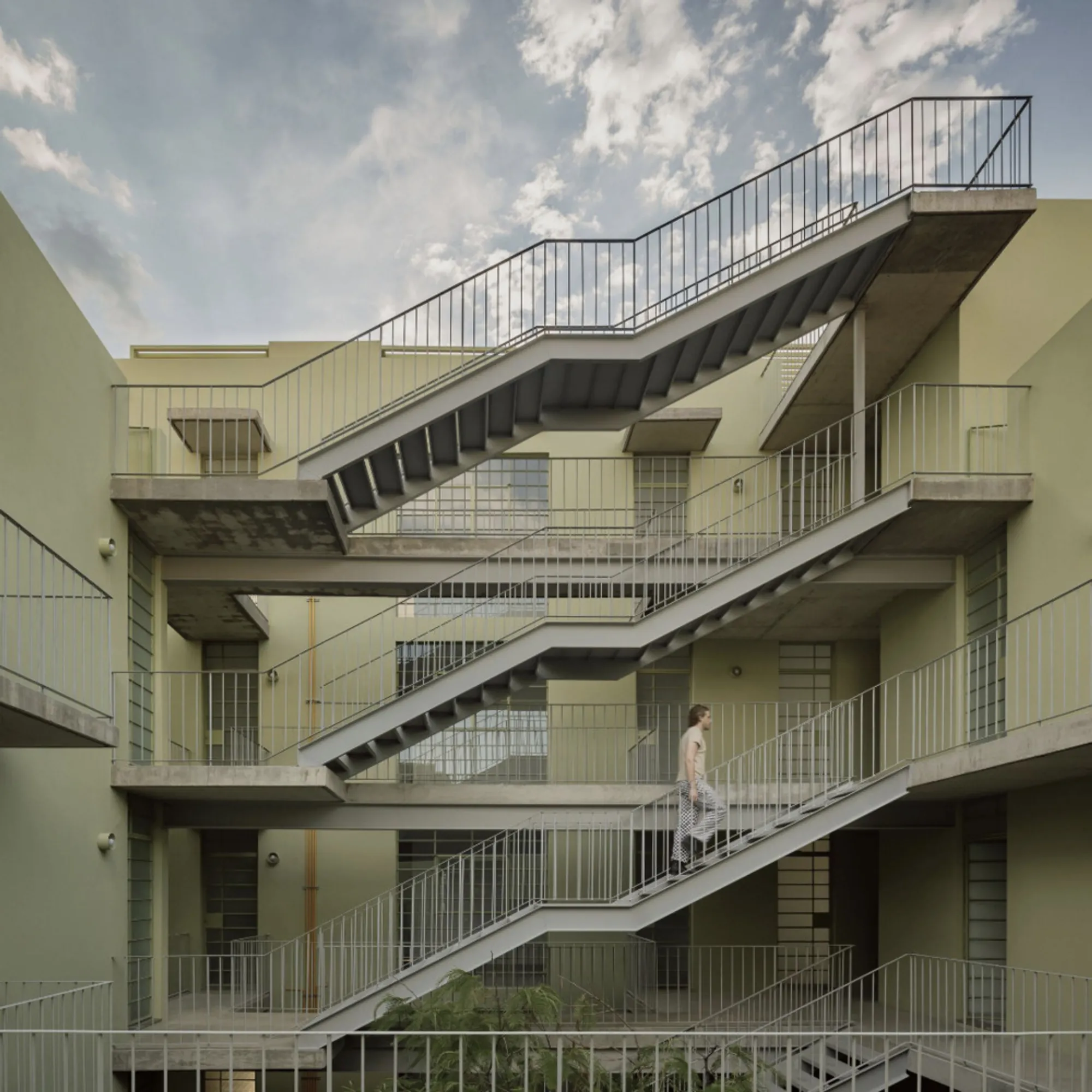
Estudio Hidalgo Turns a Guadalajara Courtyard into a Domestic Cloister for 21st-Century Living
A concrete and glass block apartment complex in Analco channels the neighborhood's colonial memory through a central planted void.


Guadalajara's Analco neighborhood sits a block off Calzada Independencia, hemmed in by Mercado Libertad, the Plaza de Los Dos Templos, and the Parroquia de San José de Analco. It is a district where colonial spatial habits (the vestibule, the courtyard, the cloister) still shape how buildings meet the street. Estudio Hidalgo, led by architects Alvaro Beruben Galván and Graziano Brau Pani, chose to build their 1,988 m² apartment complex not against that grain but directly through it, organizing the entire project around a central planted courtyard flanked by twin four-story volumes with a five-story block anchoring the rear.
What makes XX de Noviembre worth studying is not its reverence for context but the specificity of its translation. The courtyard is not decorative; it is the building's structural and social spine. Circulation bridges, zigzagging staircases, and glass block screens all orbit this void, turning movement through the complex into something closer to a public ritual than a private commute. The result is a housing project that feels simultaneously monastic and urban, intimate and porous.
The Street Wall and the Threshold
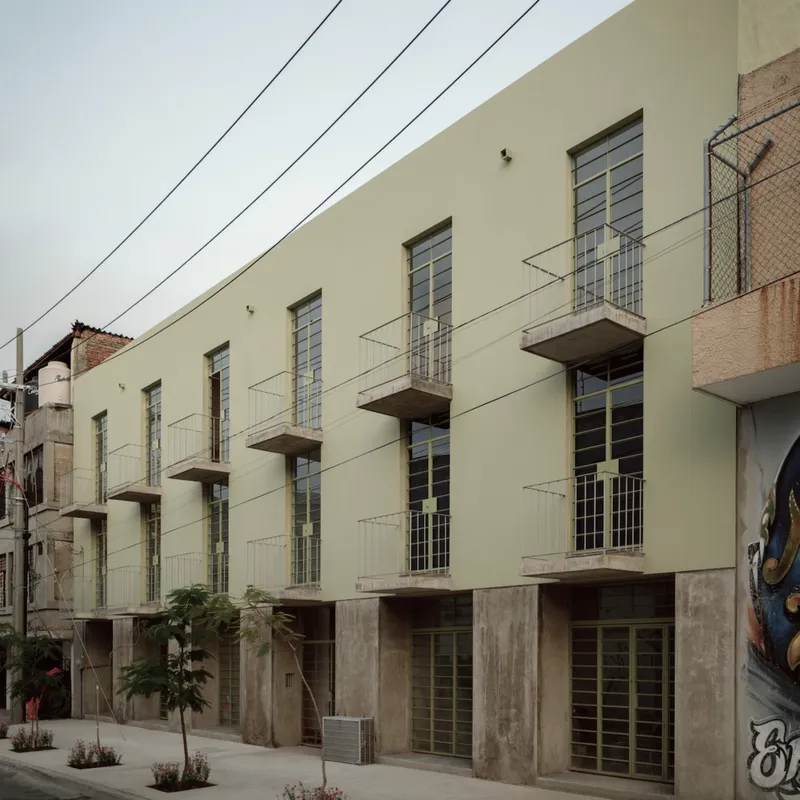
The street facade does two things well. At ground level, concrete pilotis lift pale yellow upper floors off the sidewalk, creating a sheltered zone that reads as semi-public. The natural plaster finish on the upper volumes and the rhythm of projecting metal-railed balconies keep the elevation from feeling monolithic, while the material shift between the raw concrete frame and the plastered infill gives the facade a legible tectonic logic. You can read how the building is made simply by looking at it.
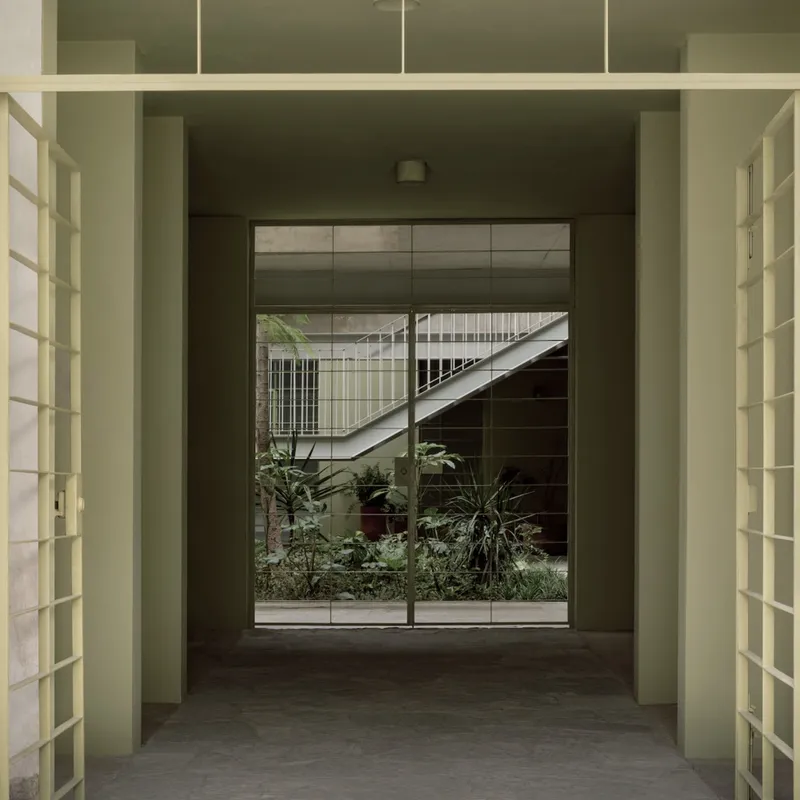
Behind the entrance gate, a glass block wall acts as a translucent membrane between street and courtyard. It lets you see the diagonal staircase and the planted interior beyond without fully revealing them. The vestibule, a spatial type Estudio Hidalgo explicitly borrowed from Analco's colonial houses, becomes the hinge between the neighborhood's public life and the complex's internal world. It is a small move with large consequences: it keeps the building from turning its back on the street while still protecting the domestic calm inside.
The Courtyard as Organizing Principle
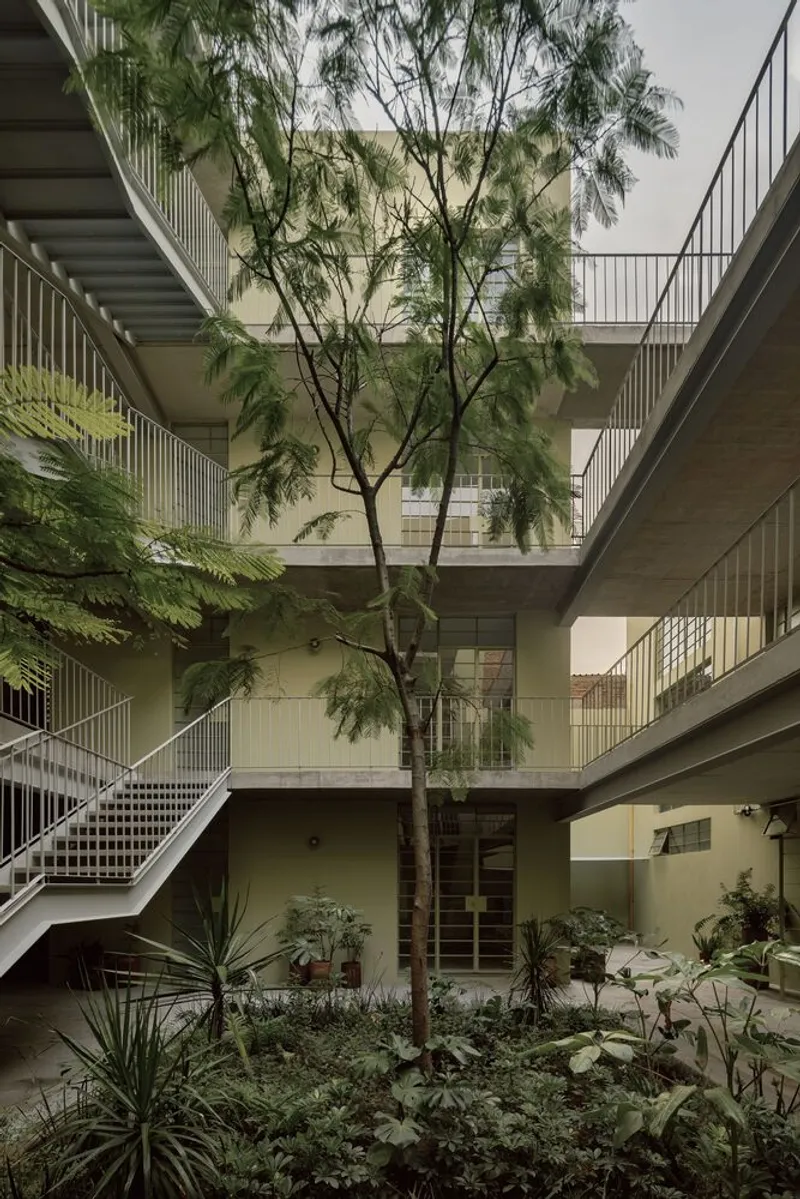
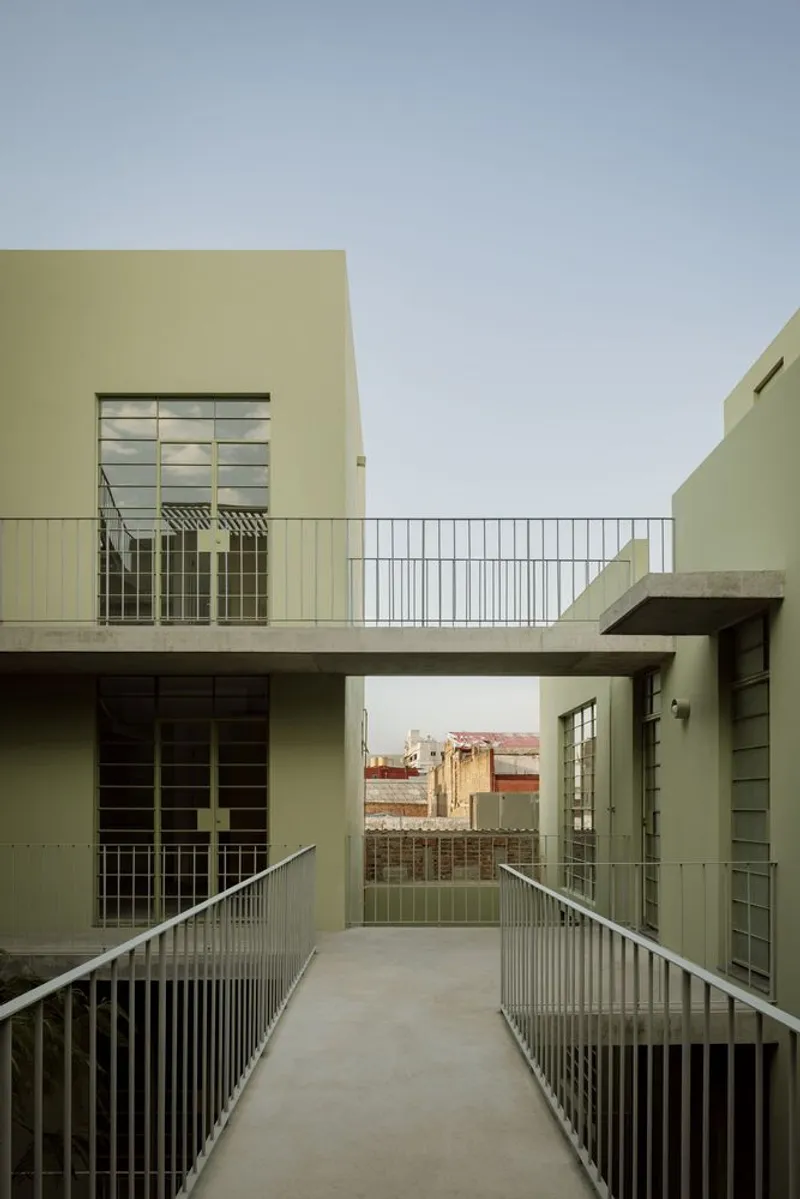
Everything in the complex answers to the central courtyard. Twin buildings rise symmetrically on either side, each four stories tall, while the tallest volume at the rear stretches to five stories to establish a presence on the Independencia skyline. The courtyard itself is planted with slender trees that reach upward through the gap between the volumes, softening the concrete surfaces and introducing a vertical green element that changes with the seasons.
The term Estudio Hidalgo uses, "domestic cloister," is apt. Like the cloister of a religious house, this void is simultaneously a garden, a corridor, and a place for contemplation. But it also functions as a light well, pulling daylight deep into the plan and ensuring that every unit faces some portion of it. The decision to leave the courtyard open to the sky rather than covering it gives the space a weather-dependent character: overcast days fill it with soft, even light; sunny afternoons throw hard shadows from the bridges and stairs across the planted beds.
Staircases and Bridges as Social Infrastructure
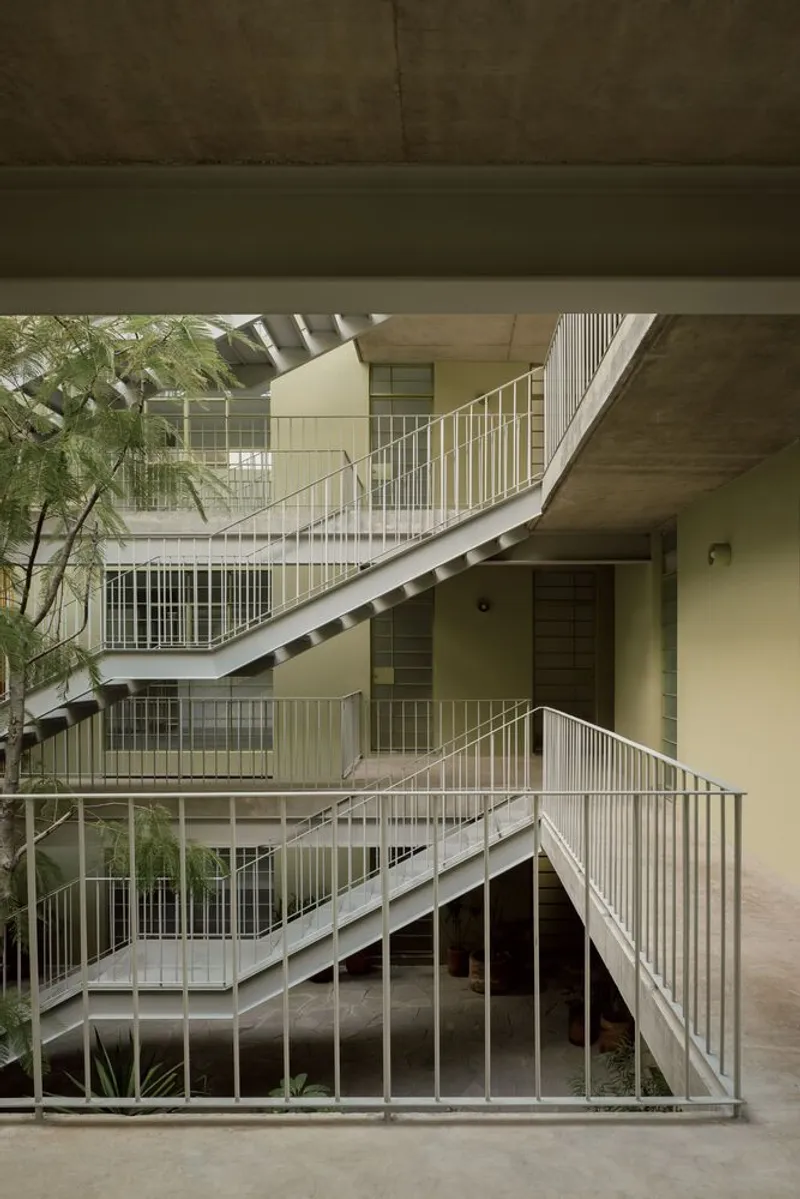
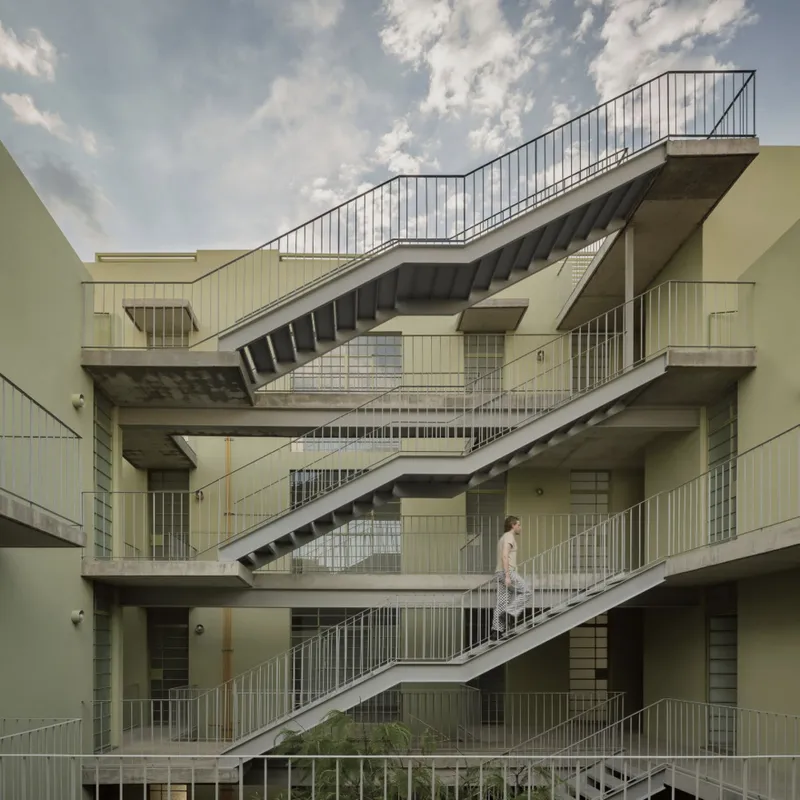
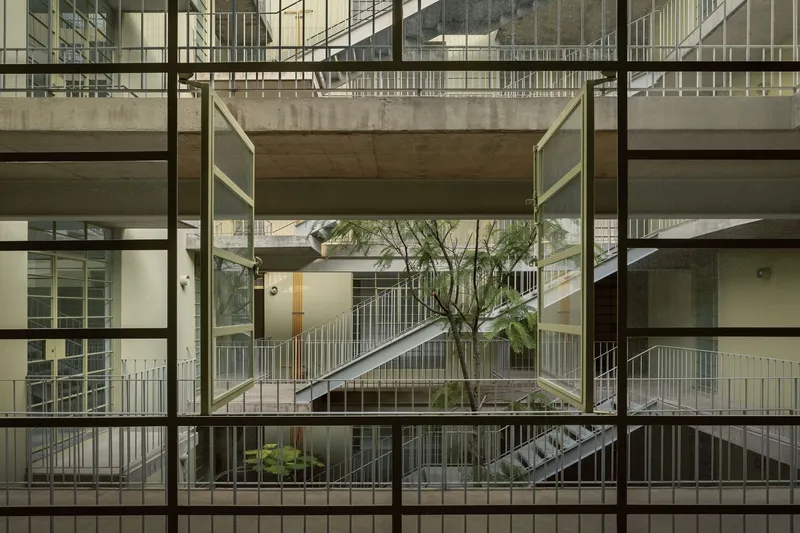
The circulation system is the most visually striking element of the project and, arguably, the most architecturally ambitious. Exposed concrete staircases zigzag up the courtyard facades, crisscrossing one another in a composition that invites comparisons to Escher but is better understood as a practical response to density. By placing all vertical circulation on the courtyard side, the architects freed the apartment interiors from corridor space and ensured that residents encounter one another daily.
Concrete bridges span the void at upper levels, connecting the twin volumes and creating a layered network of pathways visible from every unit. A figure on a landing, a neighbor crossing a bridge: these small moments of visual contact are designed into the building. The metal railings are deliberately minimal, just enough to satisfy safety without blocking sightlines. From inside the courtyard, looking up through the gridded windows and bridges, the effect is of an inhabited scaffold, a vertical neighborhood compressed into a single lot.
Material Honesty and Interior Restraint
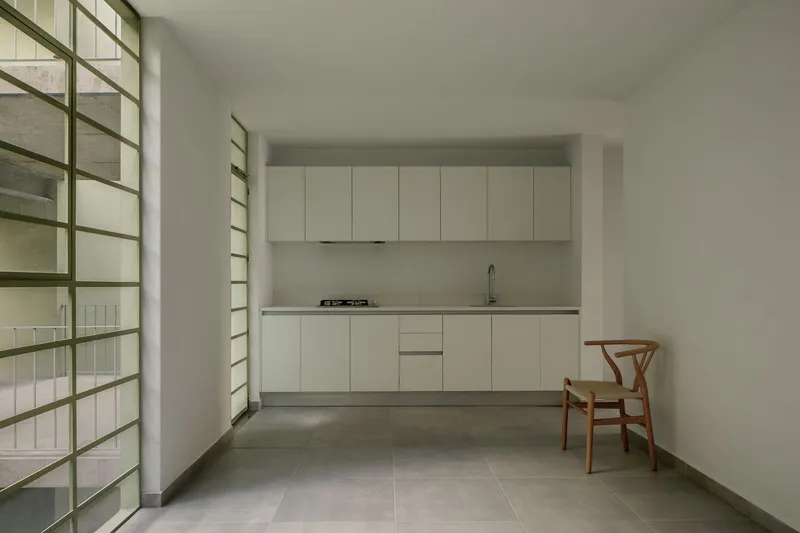
Inside the units, the palette is deliberately quiet. The kitchen captured here, with its white cabinetry, polished concrete floor, and glass block window, reveals how the building's external material strategy carries through to the domestic interior. The glass block is not merely decorative; it controls light and privacy simultaneously, filtering courtyard views into a soft diffuse glow while maintaining a visual connection to the planted void outside.
The overall material commitment, reinforced concrete structure by Cemex, natural plaster, steel railings, glass block, is both economical and legible. Nothing is clad or hidden. The building wears its construction openly, which gives it a directness that expensive residential projects in similar historic districts often lack. There is no performance of luxury here, just a clear set of spatial and material decisions executed with discipline.
Why This Project Matters
XX de Noviembre is a useful counter-example to two common failures in contemporary housing: the gated compound that ignores its neighborhood, and the pastiche project that mimics historical forms without understanding them. Estudio Hidalgo's building does neither. It takes the courtyard, the vestibule, and the cloister as organizational tools rather than stylistic references, and it deploys them within a frankly modern concrete frame. The result is a building that belongs to Analco without pretending to be old.
More broadly, the project demonstrates that mid-rise urban housing can be socially rich without relying on expensive amenity floors or token "community spaces." Here, the community space is the building itself: its courtyard, its bridges, its staircases, its rooftops. Every act of moving through the complex is an act of participation. For a 1,988 m² project on a single lot in a dense historic district, that is a significant achievement, and one that other cities grappling with infill housing would do well to study.
XX de Noviembre Apartment Building by Estudio Hidalgo (Alvaro Beruben Galván, Graziano Brau Pani). Guadalajara, Mexico. 1,988 m². Completed 2023. Photography by Cesar Bejar.
About the Studio
Share Your Own Work on uni.xyz
If projects like this are the kind of work you want to make, uni.xyz is a place to publish your own, find collaborators, and enter design competitions.



Popular Articles
Popular articles from the community


The Earth Pod: 3D Printed Homes for Resilient Refugee Communities
The Earth Pod reimagines refugee housing through 3D printed homes made from clay, combining resilience, self-sufficiency, and rapid shelter.

The Ocean Hive: Sustainable Architecture for a Self-Sufficient Civilization at Sea
The Ocean Hive imagines sustainable architecture at sea, where modular habitats, algae, wave power and ocean waste sustain a growing colony.

Co-Life: Senior Housing Design That Reconnects Older Adults With the City
Co-Life reimagines senior housing design through healing gardens, shared streets, workshops, and a sustainable community across generations.

Hill & Cross Opera: Sculptural Opera House Architecture Shaped by Tallinn’s Landscape and Identity
Hill & Cross Opera reimagines opera house architecture in Tallinn through its sculptural hill, civic plaza, glass wave and a luminous cross.

Similar Reads
You might also enjoy these articles


Hodi-Mandai Geram
Project Function: Preservation and revitalization of the Intangible heritage and socio-spatial identity of the Hodi by Housing, Cultural Memory Center, Sacred Grove, landscape, local tourism economy


Olio Towers: A Mid-Rise for Performers That Fuses Housing, Rehearsal, and Stage
Located blocks from Houston's Theater District, this modular tower stacks living units around a central performance atrium.

Oasis: Modular Green Housing Carved into Dhaka's Urban Fabric
A shortlisted Plugin Housing entry reclaims unauthorized settlements in Dhaka with stepped concrete volumes, green roofs, and ventilation-driven design.

Black Hole: A Floating Megastructure for the Post-Physical Era
Emiliano Mazzarotto envisions a spherical, self-scaling arena where e-sports, digital hotels, and holographic stadiums replace traditional public space.

Explore Mexican Design Competitions
Discover active competitions in this discipline


Challenge to design mud housing for contemporary communities


Challenge to reimagine the Iron Throne


Photograph architecture without architects


Illustrate the lost glory of Angkor Wat - Render Challenge
Comments (0)
Please login or sign up to add comments
No comments yet. Be the first to comment!