

Yaniv Pardo Architects Hides a Three-Story World Behind a Modest Street Wall in Ramat Hasharon
A 300-square-meter white box in central Israel dissolves the boundary between rooms, voids, and garden through layered perforations.


The most compelling houses are the ones that make you forget you are inside one. The White Box House by Yaniv Pardo Architects, designed by Yaniv Pardo and Natalie Zichrony, sits on a compact plot in Ramat Hasharon, a quiet neighborhood near the center of Israel's Gush Dan metropolitan area. From the street, a stone-clad wall and a steel gate give almost nothing away. The house reads as restrained, maybe even severe. Step through the threshold and the restraint inverts into a spatial generosity that is hard to reconcile with the façade.
What makes the project genuinely interesting is its refusal to behave like a conventional three-story house. Instead of stacking floors as isolated bands, Pardo perforates the white envelope in three dimensions: walls, ceilings, and floors are punctured so that adjacent spaces are always partially visible above, below, or beside you. The result is a house that functions simultaneously as a single room and as a collection of rooms, an ambiguity that keeps you aware of light, movement, and the garden at every turn.
A Façade That Conceals
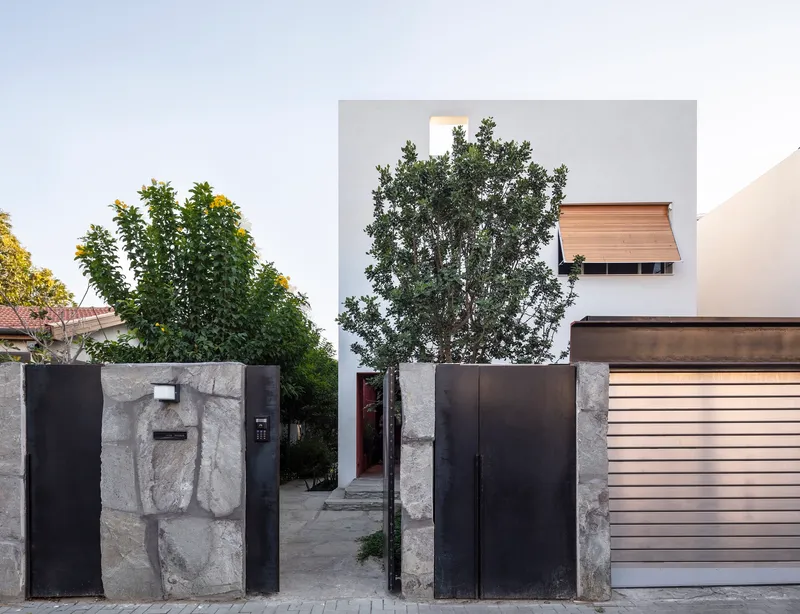
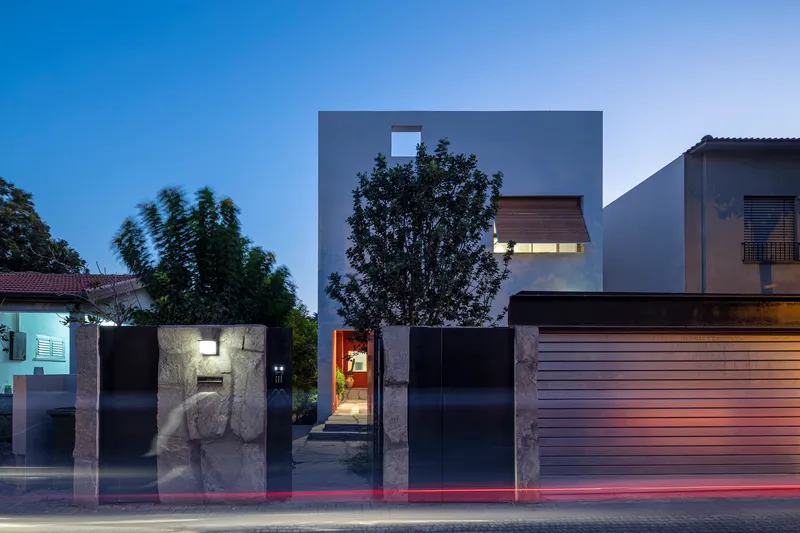
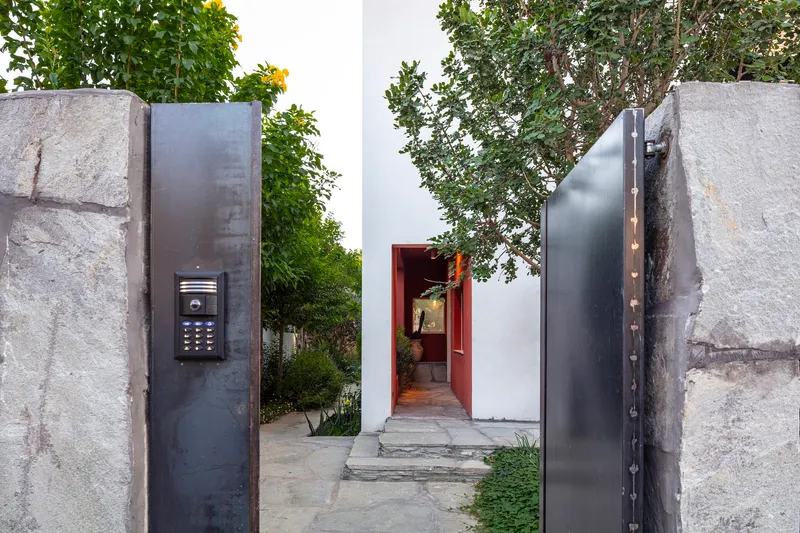
The street elevation is deliberately opaque. A rough stone pier frames a black steel gate, and the house volume behind it barely rises above the wall line. At twilight the composition looks almost fortified, the only warmth coming from a sliver of illuminated red at the threshold. It is a knowing strategy for a dense suburban context: give the street nothing, and save everything for the interior sequence.
The approach borrows from Mediterranean courtyard traditions without mimicking them literally. Rather than a defensive perimeter wall wrapping a garden, Pardo compresses the transition into a narrow entry corridor that turns a corner, so the reveal of the open plan and the garden beyond it lands with real force. The stone cladding at the entry reappears inside as a fireplace wall, threading one material through the entire depth of the house.
The Red Threshold
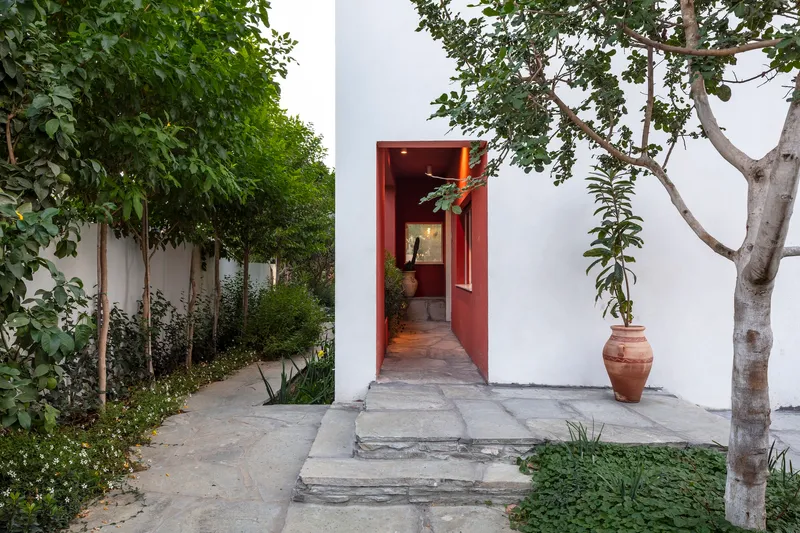

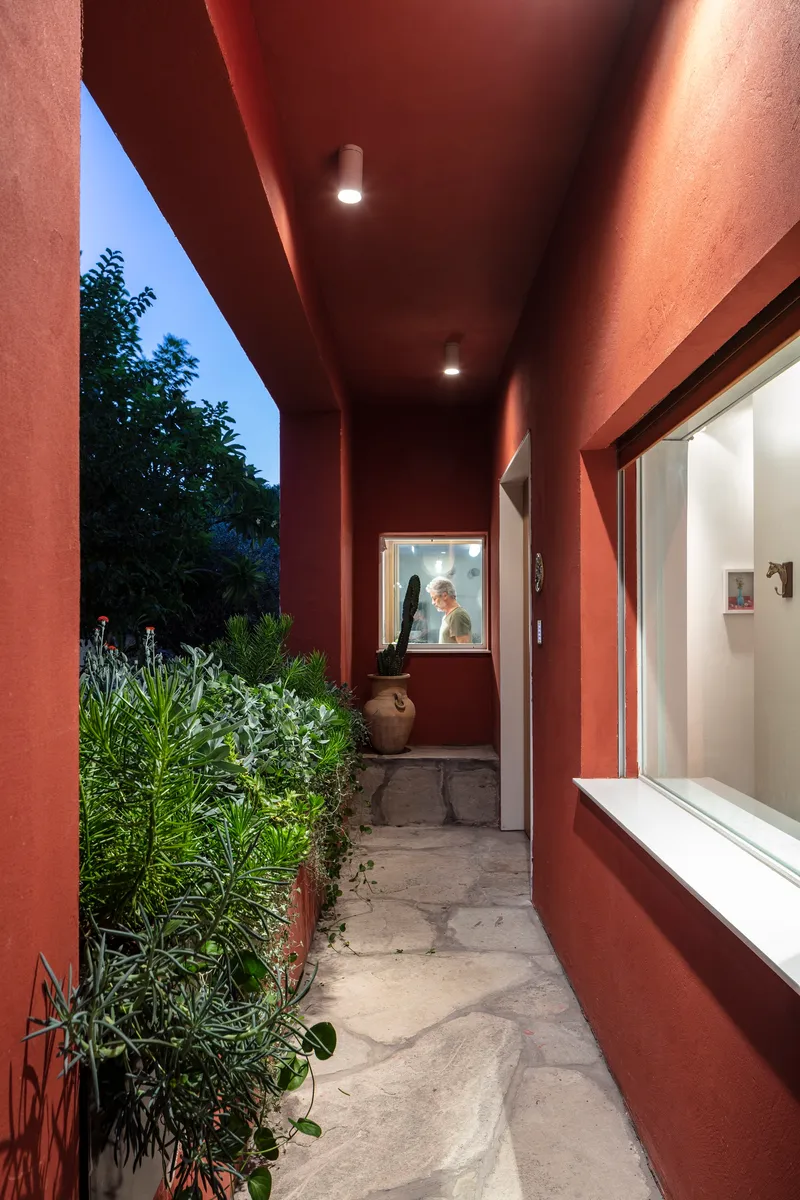
Between the fortress-like gate and the white interior, a surprising color intervention marks the passage. A covered walkway painted in saturated red acts as a decompression chamber: the color is warm and grounding, the proportions narrow enough to feel bodily, and the plantings along the stone paving soften the hard geometry. It is a brief but decisive spatial event, one that tells you the house is more layered than its exterior suggests.
The red portal frame reappears along the side passage, where dappled tree canopy filters light onto white walls. These transitional zones are where indoor and outdoor life genuinely overlap. There are no hard thresholds here, just gradations of enclosure that let air circulate through the house, a practical advantage in the Israeli summer and an atmospheric one year-round.
Vertical Perforations and Double-Height Voids

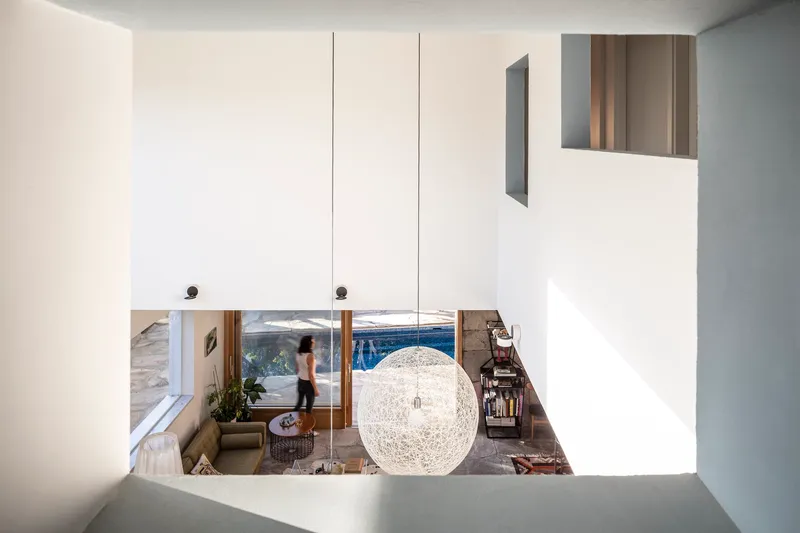

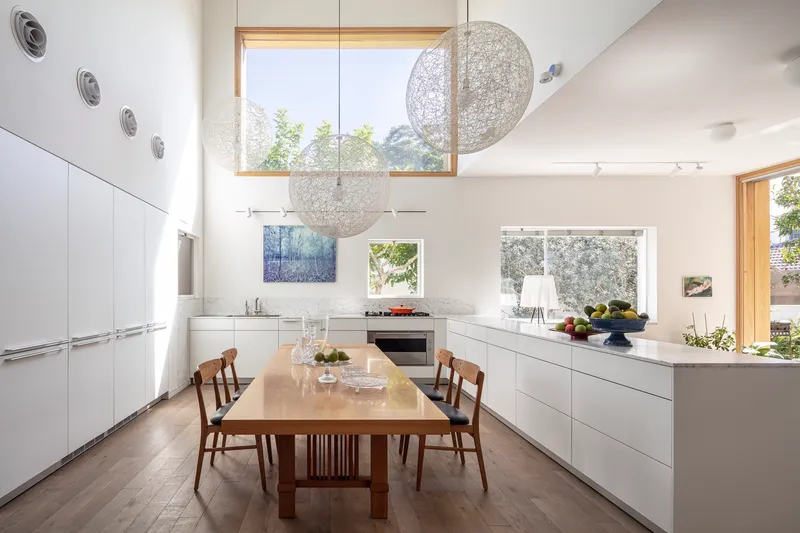
The central conceit of the house is its three-dimensional connectivity. Double-height voids allow you to see from the upper level down into the living space, and from the dining table up through a framed opening where someone might be sitting on the floor above. Wire-sphere pendants hang through these voids like markers of the vertical axis, their delicate geometry a counterpoint to the heavy masonry walls.
This is not a gratuitous open plan. Each opening is carefully sized and positioned so that privacy is maintained even as visual connection is preserved. A half-wall at the upper level screens most of the bedroom zone while still letting diagonal sunlight reach the ground floor. The recessed niches in the double-height wall serve as display shelves but also read as a thinning of the mass, reminding you that the walls here are doing more than holding up a roof.
Light as an Active Material

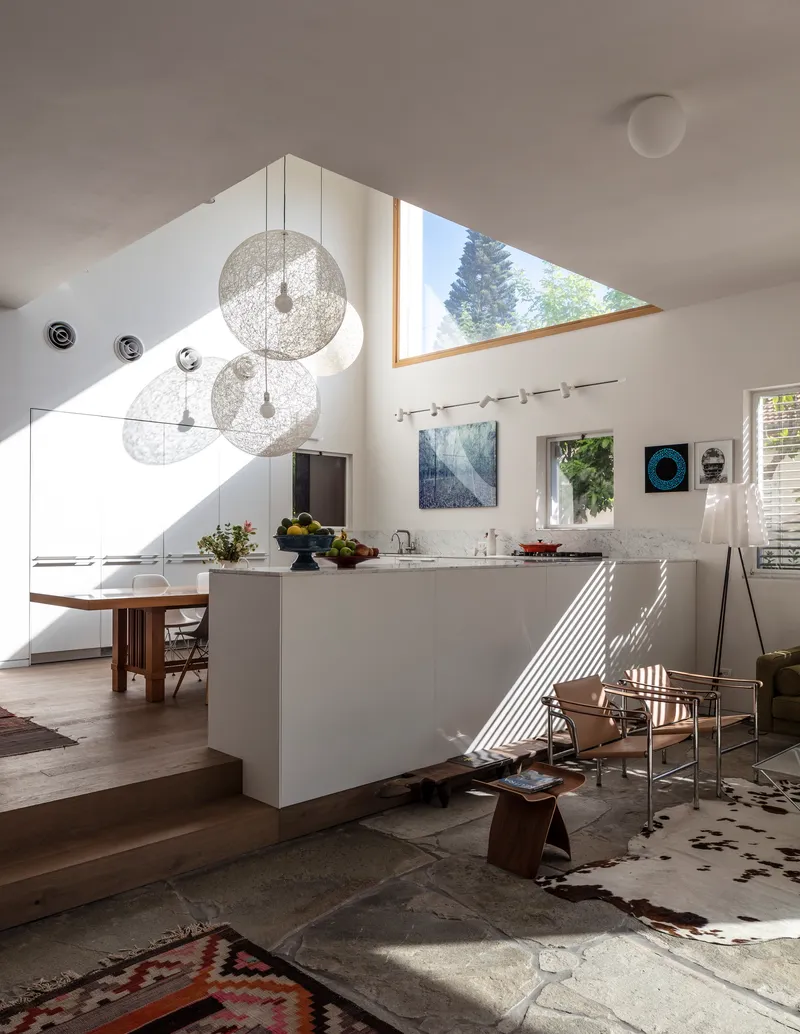
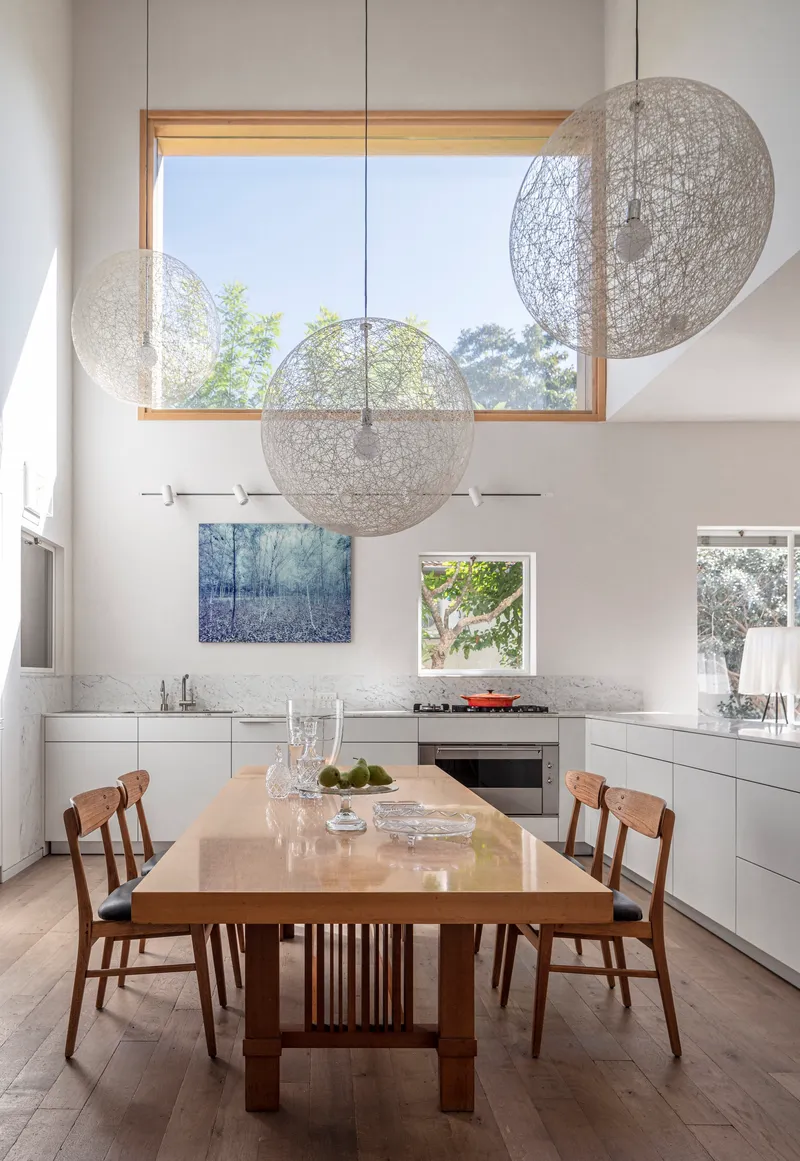
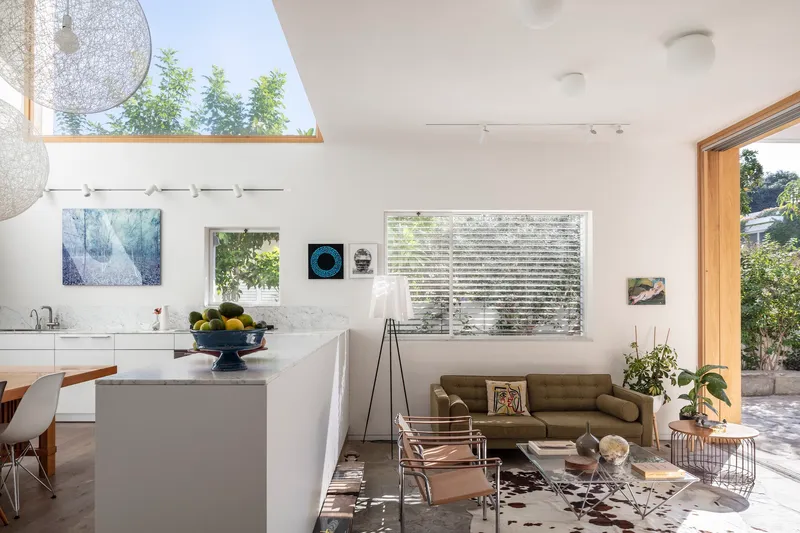
The house faces east and south, a deliberate orientation that pulls natural daylight through the spaces for most of the day. Triangular clerestory windows above the living room carve sharp geometric patches of sun across the white walls, shadows that shift with the hours and give the interior a kinetic quality that no artificial lighting can replicate. The white surfaces are not decorative minimalism; they are reflectors, bouncing light deep into zones that would otherwise be dim.
At the kitchen, a horizontal louvered window adds another rhythm. It filters light into parallel bands on the counter while allowing cross-ventilation, a detail that connects the passive climate strategy to the visual language. The spherical pendants above the dining table catch this light and glow softly, creating a layer of ambiance that changes from morning clarity to golden late-afternoon warmth.
Living with the Garden and Pool
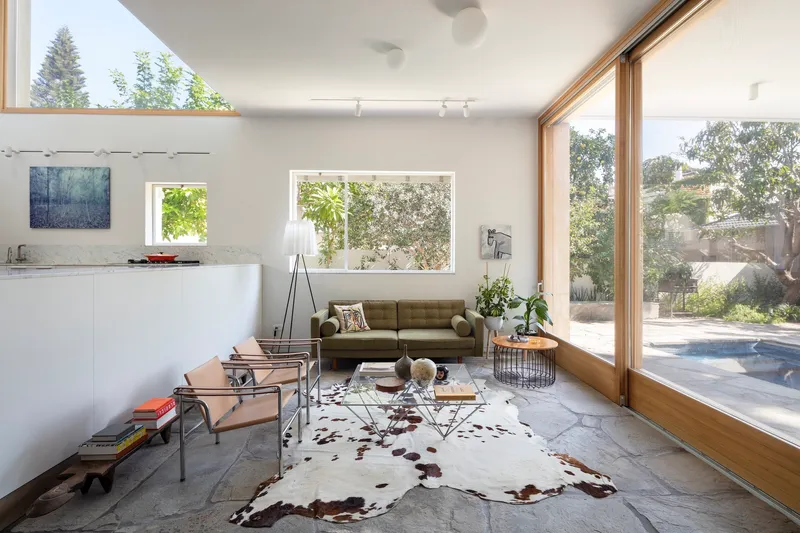
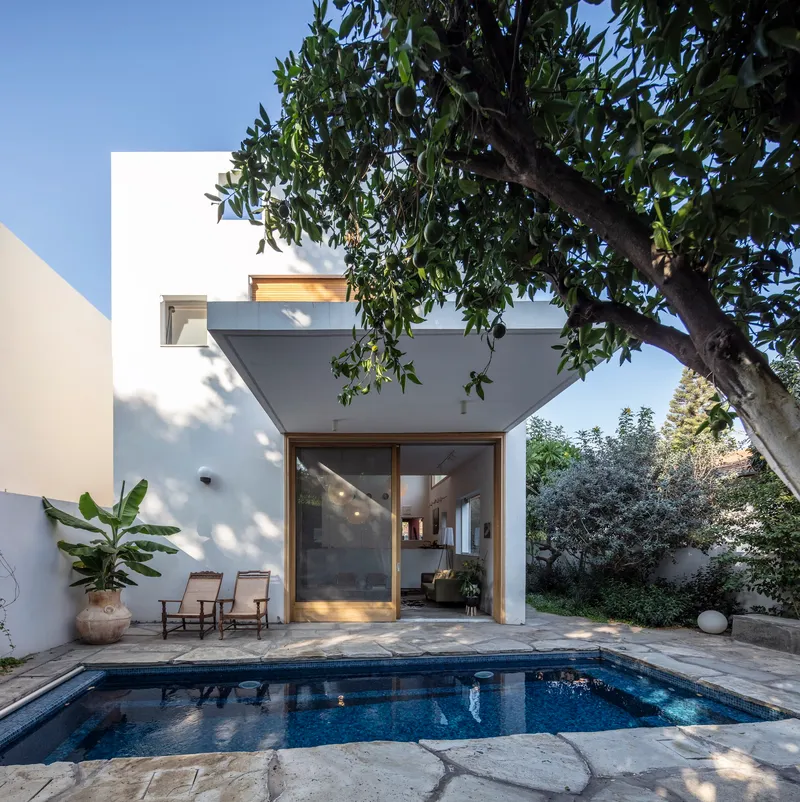
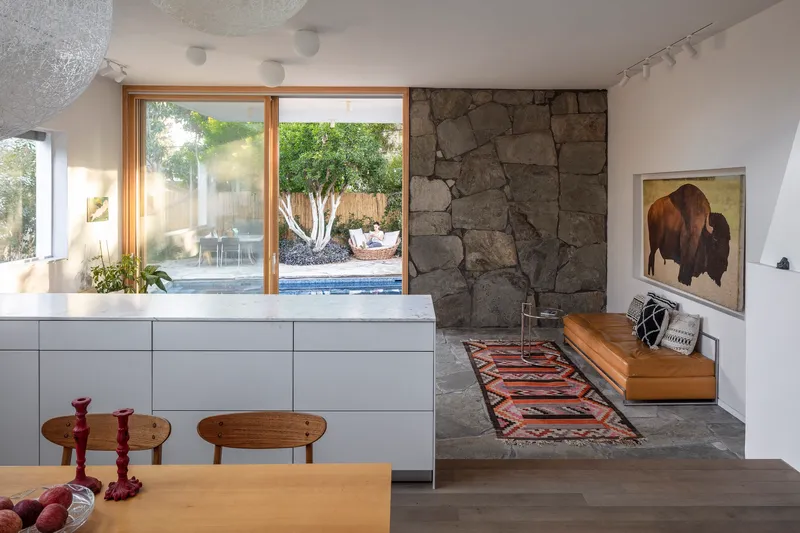
The rear of the house dissolves almost entirely into the garden. Floor-to-ceiling timber-framed glazing and sliding doors open the living room and dining area directly to the pool courtyard, where a mature white-barked tree provides dappled shade. The pool, heated by solar panels, sits close enough to the living room that it reads as an extension of the interior floor plane rather than a separate amenity.
A rough stone accent wall adjacent to the pool door anchors the transition between inside and out, its texture a deliberate contrast to the smooth white plaster everywhere else. The slate flooring runs continuously from interior to terrace, further blurring the boundary. In summer, the house essentially becomes an open pavilion, its walls folded aside so that life flows in and out without ceremony.
Material Restraint and Spatial Richness

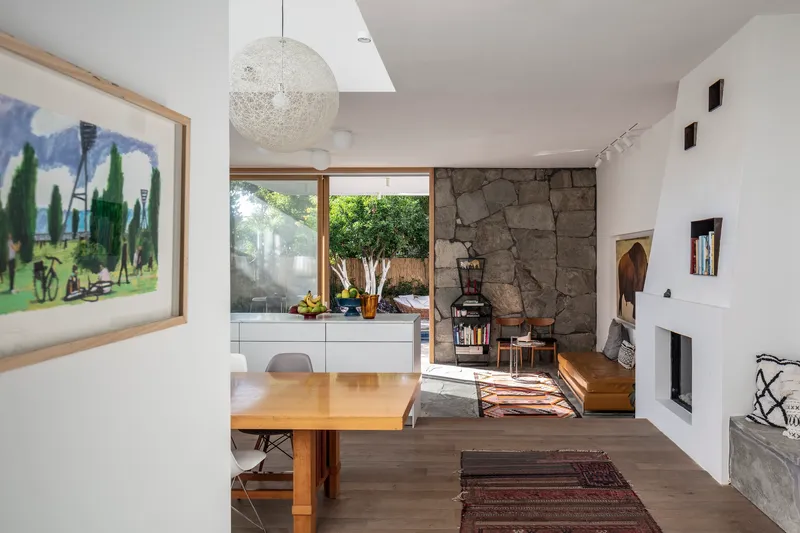
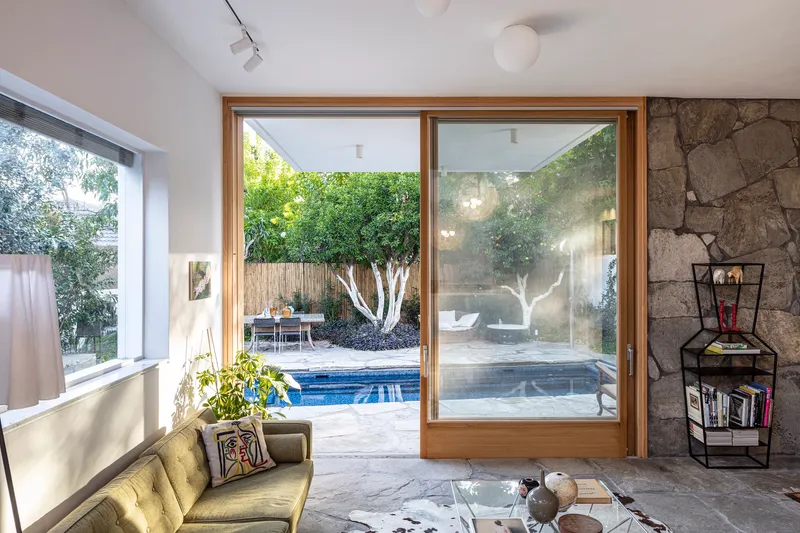
The material palette is short: white plaster, slate stone floors, timber window frames, and that single rough stone wall. It is a deliberate economy that forces spatial complexity to do all the heavy lifting. The double walls are massive construction, thick enough to hold niches and frame deep window reveals, giving every opening a sculptural quality that thin stud walls could never achieve.
Furniture is kept low and warm toned, with the timber dining table and kitchen island reading as landscape elements rather than objects placed against a backdrop. The fireplace wall at the far end of the living space grounds the composition and creates a focal point that draws you through the full depth of the plan, past kitchen, dining, and seating zones in sequence.
Entry Corridor and Side Garden

A narrow exterior corridor with terracotta-colored walls and a ceiling opening connects the entry to the side garden, introducing planting and sky before you reach the main interior. It is a Mediterranean move, one that acknowledges the value of shade, breeze, and planted ground in a hot climate. The corridor also separates the garage from the living zones, buffering noise and creating a sense of arrival that a front door alone cannot provide.
Inside, the kitchen benefits from a high clerestory window that floods the workspace with even, glare-free light. The spherical pendants here are oversized relative to the counter, a scale shift that compresses the space vertically and makes the room feel intimate despite its generous ceiling height. It is a small detail, but it reveals a sensitivity to proportion that runs through the entire project.
Plans and Drawings
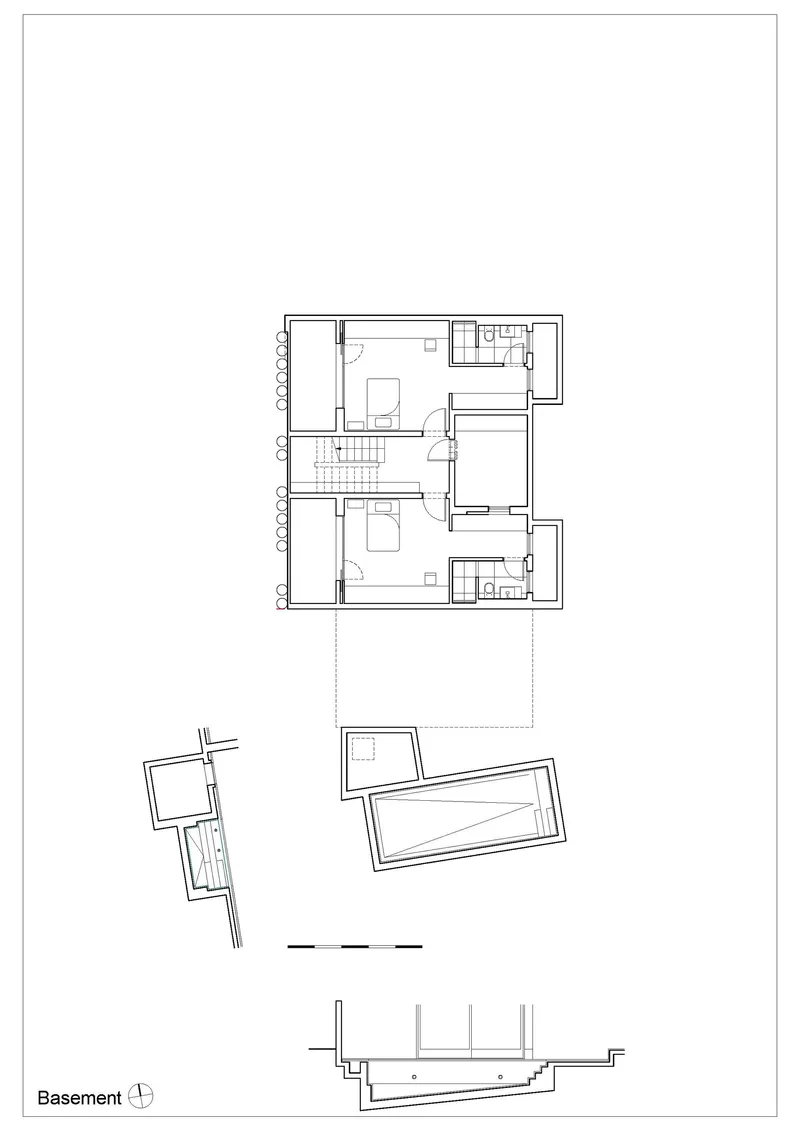

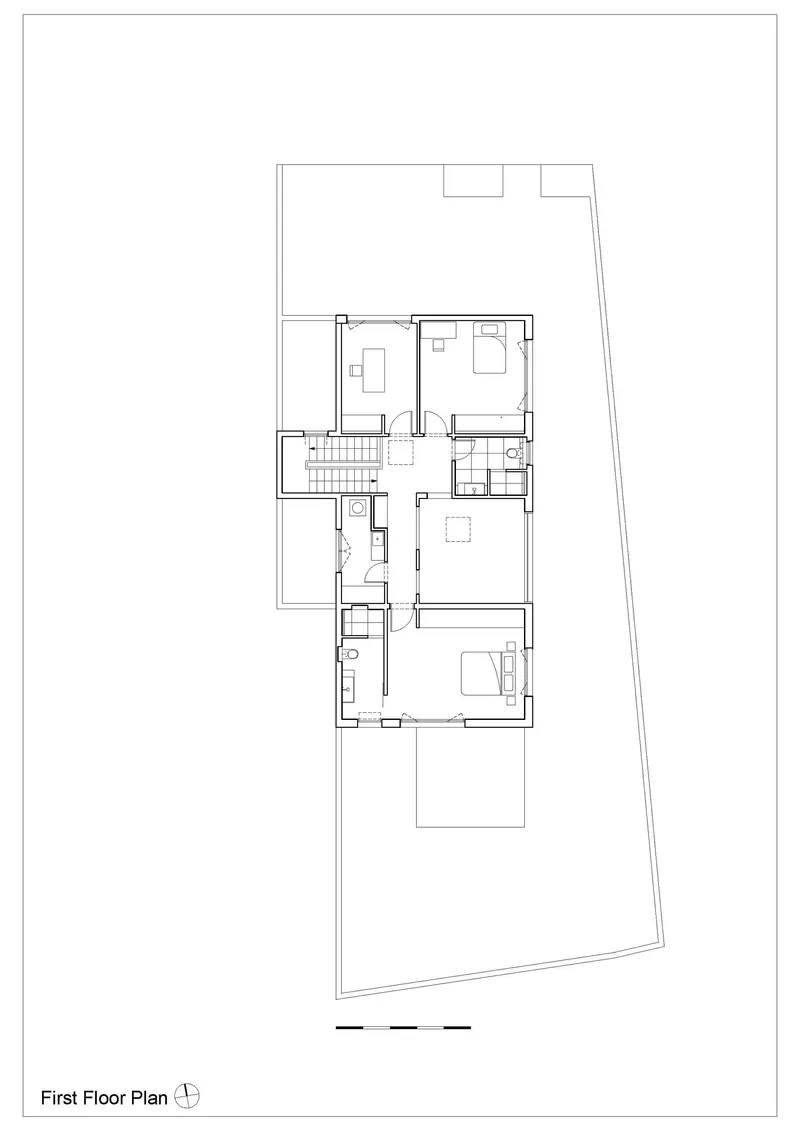
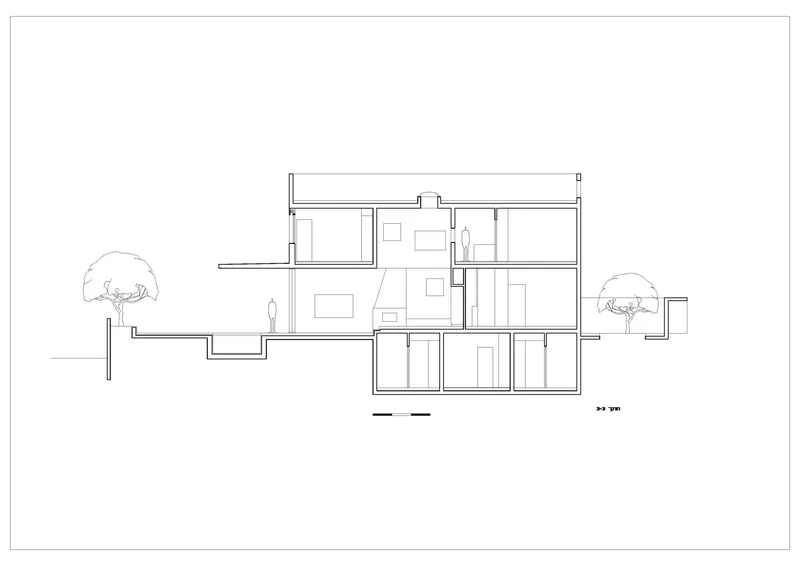

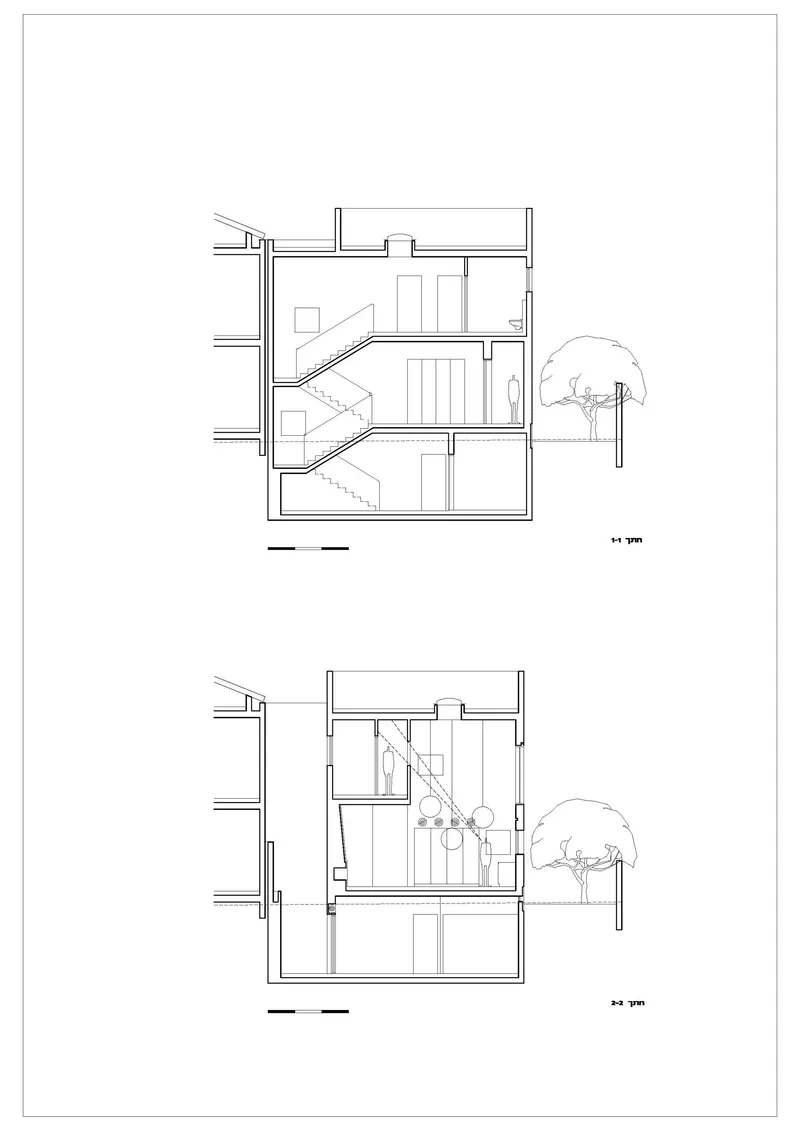
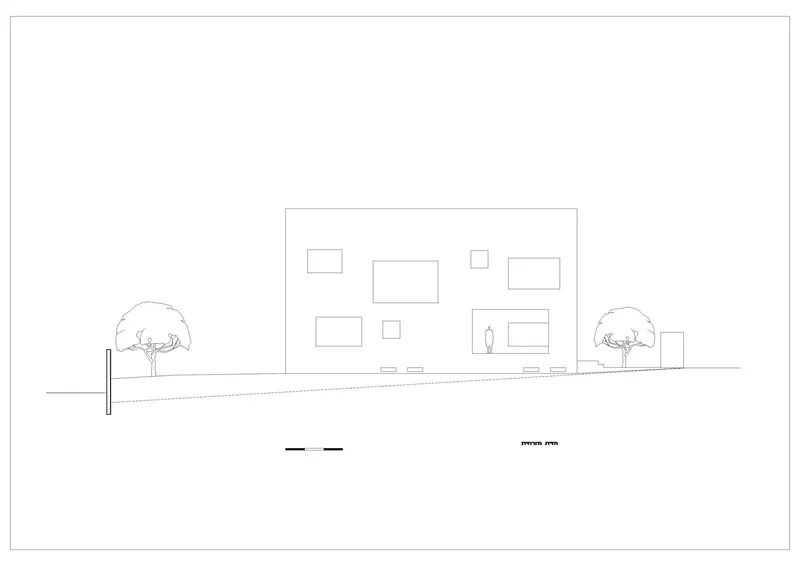
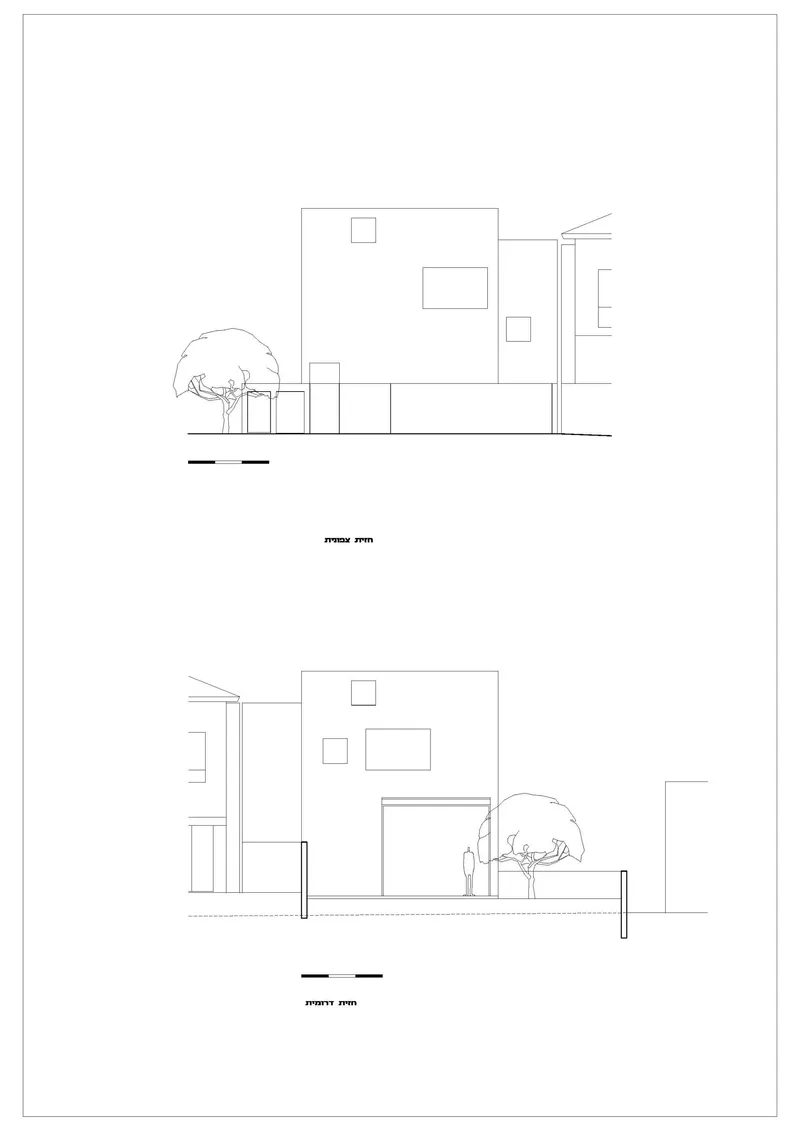
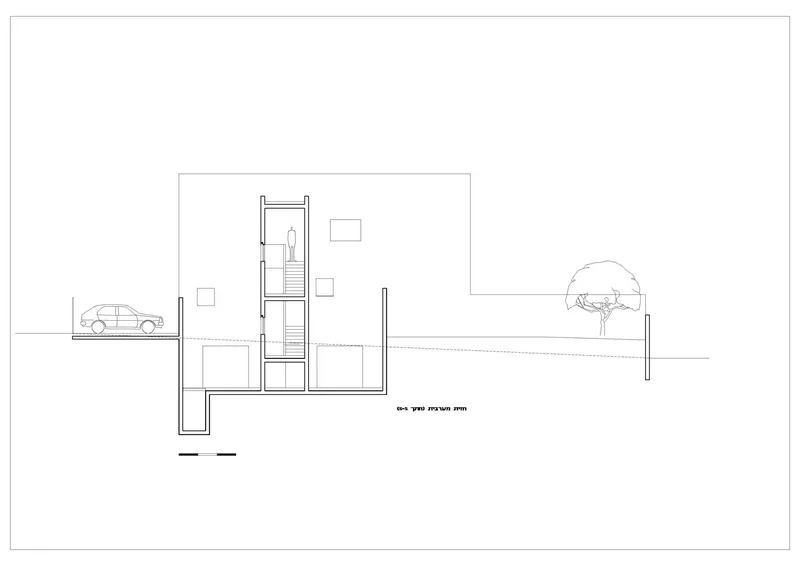


The floor plans confirm what the photographs suggest: the plot is angled and tight, and the house fills it almost entirely, relying on the garden court at the rear for its openness. The section drawings are the most revealing documents. They show how the three levels interlock through the central void, with the staircase acting as a vertical spine that links basement, ground, and first floors while admitting light from above. The double-height spaces are not carved out of a simple box; they are staggered so that each level reads the house differently.
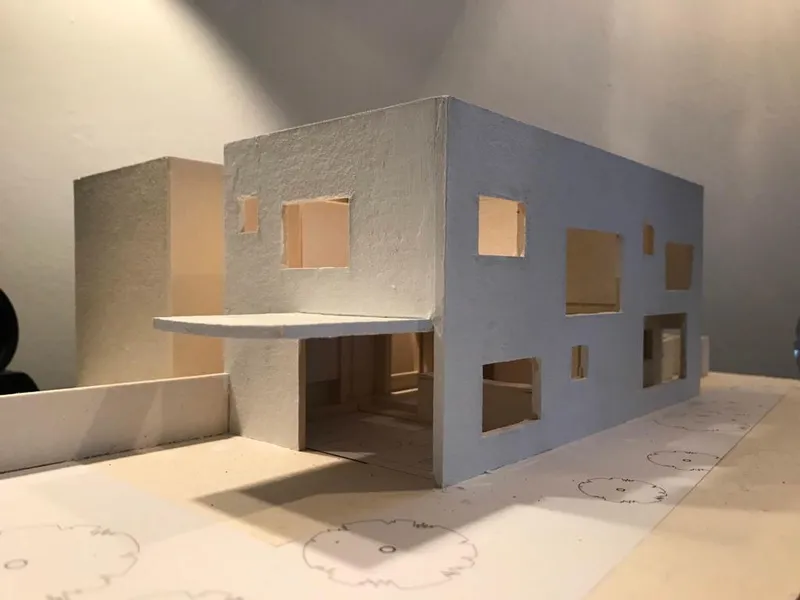
The watercolor elevation sketches and physical models show early explorations of the punched-window strategy. The final result is more restrained than some of the study models, which had a rougher, more textured massing. That editing process, from expressive to controlled, is visible in the finished building's precision: every opening earns its place, and there is not a single window that feels arbitrary.
Why This Project Matters
The White Box House is not trying to reinvent the suburban home. It is trying to prove that a small plot in a quiet Israeli neighborhood can produce architecture of genuine spatial intelligence, the kind that rewards you with a new discovery every time you move through it. The three-dimensional perforations lift the design well beyond the familiar white-box idiom; they create an internal landscape where rooms, voids, and garden are not separate categories but overlapping conditions.
In a residential market that often equates quality with surface finish, Pardo and Zichrony stake out a different position: that spatial generosity matters more than material opulence, and that the relationship between inside and outside is the most valuable thing architecture can offer a homeowner. The restrained palette, the climate-responsive orientation, and the carefully calibrated openings all serve that singular ambition. The house is quiet from the street because it saves its energy for the people who live in it.
The White Box House, designed by Yaniv Pardo Architects (lead architects Yaniv Pardo and Natalie Zichrony), Ramat Hasharon, Israel. 300 m², completed 2020. Photography by Amit Geron.
About the Studio
Share Your Own Work on uni.xyz
If projects like this are the kind of work you want to make, uni.xyz is a place to publish your own, find collaborators, and enter design competitions.




Popular Articles
Popular articles from the community


Co-Life: Senior Housing Design That Reconnects Older Adults With the City
Co-Life reimagines senior housing design through healing gardens, shared streets, workshops, and a sustainable community across generations.
EW PARK: Sustainable Architecture Reimagines the Future of Urban Parking
EW PARK reimagines city parking as a modular wooden tower combining automation, solar energy, electric mobility, and adaptable urban design.

The Ocean Hive: Sustainable Architecture for a Self-Sufficient Civilization at Sea
The Ocean Hive imagines sustainable architecture at sea, where modular habitats, algae, wave power and ocean waste sustain a growing colony.

The Earth Pod: 3D Printed Homes for Resilient Refugee Communities
The Earth Pod reimagines refugee housing through 3D printed homes made from clay, combining resilience, self-sufficiency, and rapid shelter.


Similar Reads
You might also enjoy these articles

Bao Huynh Watercolor Atelier: A Serene Art Retreat in Hội An
Bao Huynh Watercolor Atelier in Hội An blends multifunctional art spaces, sustainable design, local materials, and family-friendly living in a serene environment.

Atelier Macri Concept Store Interior Design by CASE-REAL
Atelier Macri store features a "ko" counter, walnut wood details, cork displays, blending retail, gallery, and seamless customer experiences.

Manuel Vargas Izquierdo Stadium and High-Performance Sports Center: Architectural Excellence in Jalpa de Méndez
The Manuel Vargas Izquierdo Stadium blends sustainable design, inclusive sports facilities, and cultural-inspired architecture, revitalizing Jalpa de Méndez’s public spaces.

KAKR Buluh Awar Hall: Revitalizing Community and Ecology Through Bamboo Architecture
Community built bamboo hall revitalizes Buluh Awar village, empowering youth, restoring ecology, celebrating vernacular craftsmanship through sustainable architecture and culture.




Comments (0)
Please login or sign up to add comments
No comments yet. Be the first to comment!