

YELLOW TRUMPET
"Unity and Faith, Peace and Progress"

The project, inspired by local architecture by showing sensitivity to African culture; it supports the empowerment of women by coming together. The Women's Skills Center includes ecological, locally relevant solutions and materials.
The aim of this project is to develop a model for the solution of social problems. During the project formation process, researches were conducted on vernacular architectural and sociocultural contexts. We tried to understand the habits, problems and spirit of the Nigerian society. Many trials and revisions have been made.
As a result of the researches; it is noteworthy that ın African vernacular architecture people predominantly live in urban clusters that form a circular pattern. Usually families live in structures that were built to enclose an open courtyard. Gathering around a circular form or in a circular space is the most common form of gathering in society. The circle form was instinctively seen as a bringing together, inclusive and inviting form. This form; just like a woman's place in social life, her role diversify in different situations. Because a woman has more than one role in society, such as being a mother, being a child, being a wife and being a producer.
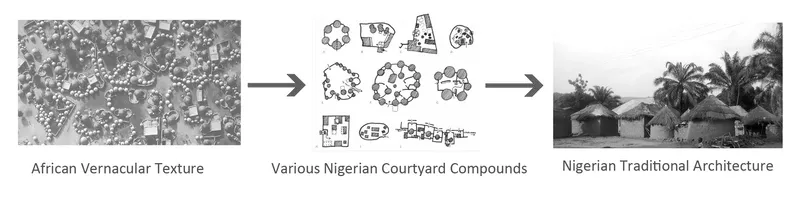
The circle form in the project, which was created based on African local architecture; it is aimed to emphasize with the meanings of "border, integrity and community" which are included in its universal meanings. A flexible space that develops around a central courtyard and cares about traditional lifestyles and community formation is aimed. Allowing more than one visual relationship, the project aimed to create a safe and friendly space for women and children. The traditional circular forms in the project promote equality, ensuring that everyone in the community is a part of it, with the same visibility. Dialogue development areas with equality were created.
The height limit given to us by the competition was 9 meters and 30% ground coverage was complied with. While the circular masses are distributed on the land, it is aimed to preserve the feelings of security, protection and privacy. While creating a free-flowing area where women and children can interact, it is also aimed to establish a healthy communication between the user and the staff.
In the interior design, spaces are created where individuals can live their daily lives comfortably. In the ground floor plan, there is the Health and Therapy center at the -1.5 level, while the -1 level includes the textile workshop, agricultural equipment production workshop, classrooms, main hall, dining hall, Daycare for the kids, management and warehouse units. On the 1st floor plan, there are the therapy hall, instrument workshop, library, seminar area, cafeteria and associated units of Daycare for the kids.
In the basement floor plan, the filtration and storage of the rain water transferred from the roofs and canopies are carried out. All the needs of the technical units are located in the basement floor plan.
When women enter the Women's Skills Center, it is aimed to give the feeling that they are in a safe area. It is aimed to relax the woman emotionally, socially and psychologically. In order to create a place where women can gather and share their daily experiences, the courtyard in the center was created. The courtyard plays an important role as a meeting place for residents. It also aims to provide optimum visual connections between women and their children. This flexible open courtyard will provide local gatherings, dances, events and educational opportunities common to African social features.
Considering that equality of opportunity can only be achieved through education and opportunities, basic education opportunities have been created for women. Classes were created for women to obtain information. It is aimed to enable women to engage in agricultural activities that can support their economic livelihood. Agricultural areas have been created where they can produce agricultural products. Agricultural equipment workshop, instrument workshop and fabric workshop were established where they could gain income and skills and make production. While making these plans, it was aimed to empower and liberate women by giving priority to education and production.
The project aims to improve the agriculture that women know and to enable women to get better yields from agriculture. For this, agricultural equipment and classes were created. The learning process is accelerated by quickly applying the knowledge of plants, seeds and fertilizers learned by women in agricultural lands.
The most produced agricultural products in the Nigerian region were researched. Considering the climatic conditions, seed accessibility and market needs, these plants are expected to be grown in the area. These plants are: tomato, peanut, corn, cowpea, cassava, marula, yam, plantain, ginger and cotton. A kitchen workshop is planned where they can process the local products they produce in agricultural areas.
In the researches, the slogan "Unity and Faith, Peace and Progress" on the coat of arms of Nigeria and the national flower yellow trumpet attracted attention. In design; it was aimed to establish a contextual relationship with Nigeria by addressing the concepts of unity, faith, peace and progress. Yellow Trumpet, the national flower of the country, in the coat of arms, symbolizes uniqueness and prosperity.
The Yellow Trumpet flower was stylized and used as a water collection canopy in certain places in the area. The canopy is created from natural material bamboo and fabric. Water collection canopies have multiple functions. The canopy provides shade in the open area and creates a connection with nature. Due to the meaning and functions of the canopies, it is intended to be an urban landmark. In times of rain, it becomes a funnel that collects rainwater. The rainwater runoff that occurs here symbolically draws attention to the fact that water is a fundamental resource for human life and water scarcity in the society. The rainwater collected in the canopies is intended to be used for irrigation of agricultural lands in the area.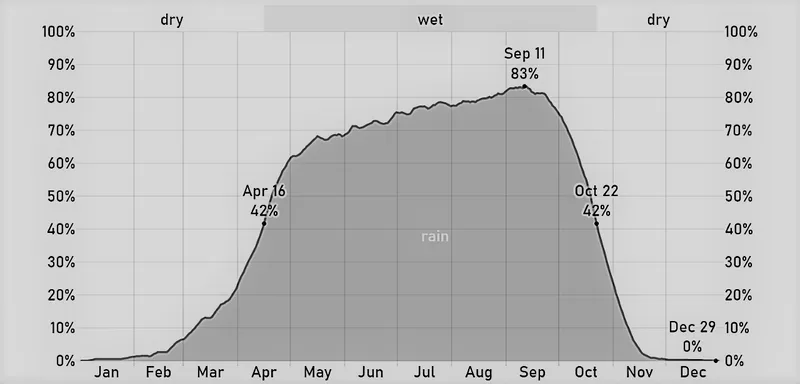 https://weatherspark.com/y/55097/Average-Weather-in-Abuja-Nigeria-Year-Round
When the climatic features are examined, it is seen that there are 3 distinct climate types in the Abuja region of Nigeria. These; are warm, humid, rainy and dry periods. It is quite rainy between April 16 and October 22. When Abuja climatic data is analyzed from January 1, 1980 to December 31, 2016; It has been determined that the region receives an average of 47.2 inches (≌1200 mm) of precipitation annually.
Annual amount of water to be collected (L) = Roof & canopy surface area where water will be collected (m²) x Drainage efficiency (0.8) x Filtration (0.95) x Annual precipitation (1200 mm)
Canopy surface area where water will be collected = 190.8 m²
Roof surface area where water will be collected = 607.6 m²
Annual amount of water to be collected (L) = 798.4 m² x 0.8 x 0.95 x 1200 mm ≌ 728141 L
Water has been thought of as a healing catalyst. For this reason; water therapy center is located in the center in the main hall, and main workshop spaces. The roof of the building has been converted into inward sloping roofs so that women can also benefit from rainwater harvesting. With roof holes, spaces are provided to connect with nature, also light enters the interior along with the water. The roofs were raised with truss structure made of rosewood by this way natural ventilation was provided in the buildings.
Considering the calming effect of nature on people's behavior, a therapy garden supporting the therapy center was created. Paths and soothing areas have been designed for walking and spending time with nature.
Local materials have been selected by considering the principles of sustainability in the selection of materials and technologies. Local materials are chosen to minimize shipping cost and carbon footprint.
The main material used in the project is the brick obtained by molding from red laterite soils. Two different sizes of bricks were used as the brick size. These; full (19 x 9 x 5 cm) bricks and half (9 x 9 x 5 cm) bricks. It is aimed to integrate with the socio-cultural context of the region by interpreting and bringing together local materials. It is recommended that women be included in the construction process so that women can create a greater sense of belonging to the community and earn additional income.

In the designed project, a sustainable environment is provided for women. Yellow Trumpet aims to encourage women's belief in their abilities by developing their talents and strengths. Support will be provided to women's individual transformation by increasing their awareness in the fields of education and production. The project aims to be a symbol and example for the whole city by giving importance to the local architecture and the use of local materials. The project aims to be an exemplary prototype project, especially by reviving the assimilated local architecture in the Abuja region of Nigeria.



Popular Articles
Popular articles from the community

AL-JANNAH: Sustainable Architecture and Permaculture for Afghan Widows
AL-JANNAH uses sustainable architecture and permaculture to create resilient oasis of housing, learning, work and renewal for Afghan widows.

The Ocean Hive: Sustainable Architecture for a Self-Sufficient Civilization at Sea
The Ocean Hive imagines sustainable architecture at sea, where modular habitats, algae, wave power and ocean waste sustain a growing colony.
EW PARK: Sustainable Architecture Reimagines the Future of Urban Parking
EW PARK reimagines city parking as a modular wooden tower combining automation, solar energy, electric mobility, and adaptable urban design.

Co-Life: Senior Housing Design That Reconnects Older Adults With the City
Co-Life reimagines senior housing design through healing gardens, shared streets, workshops, and a sustainable community across generations.


Similar Reads
You might also enjoy these articles

The Rhythm of Seasons
A Farmers' Market Connecting Nature and the City


More Than a Building-Designing a Living System
More Than a Building-Designing a Living System
Base Beyond
DESERT COMPOUND ARID: TOURISM OF ABSENCE AND ABUNDANCE

Explore Cultural Architecture Competitions
Discover active competitions in this discipline




Bring back Drive In's


Design challenge to reuse E-waste
Comments (0)
Please login or sign up to add comments
No comments yet. Be the first to comment!