
YH2 Architecture Restores an 1811 Patriot's Home on a Quebec Riverbank with a Discreet Dark Extension
Maison Aubé strips two centuries of additions from a heritage stone house in Saint-Eustache, then adds a cedar-clad volume that vanishes among the trees.


A house built in 1811 on the banks of the Rivière des Mille Îles has survived rebellion, farmland subdivision, and generations of ad hoc additions. Maison Aubé, designed by YH2 Architecture under the direction of Loukas Yiacouvakis and Marie-Claude Hamelin, is the rare heritage project that earns its credibility by subtraction. The firm stripped the stone dwelling back to its elemental envelope, reinstating original window proportions and exposing interior masonry that had been buried for decades, before attaching a contemporary volume clad in ebony-stained cedar that quietly disappears among the mature conifers on the property.
What makes the project worth studying is not the contrast between old and new, a formula architects have repeated to the point of exhaustion, but the way the extension behaves on the landscape. At 3,860 square feet total, the program is modest. The new volume expands and contracts in plan to avoid root systems and canopy lines, and a central interior ramp follows the natural slope of the terrain rather than leveling it out. The result is a house that reads as a single organism rooted in its site, not a heritage showpiece with a glass box bolted on.
The Stone Shell, Stripped Clean
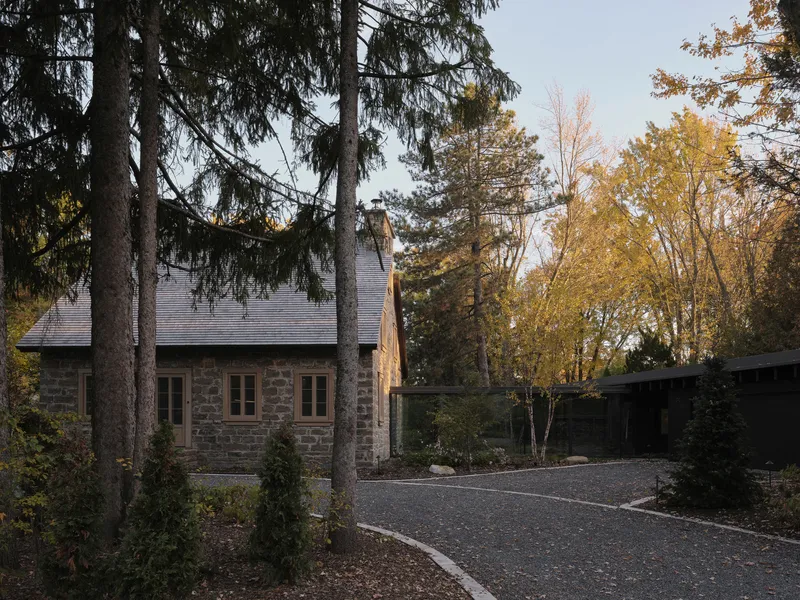
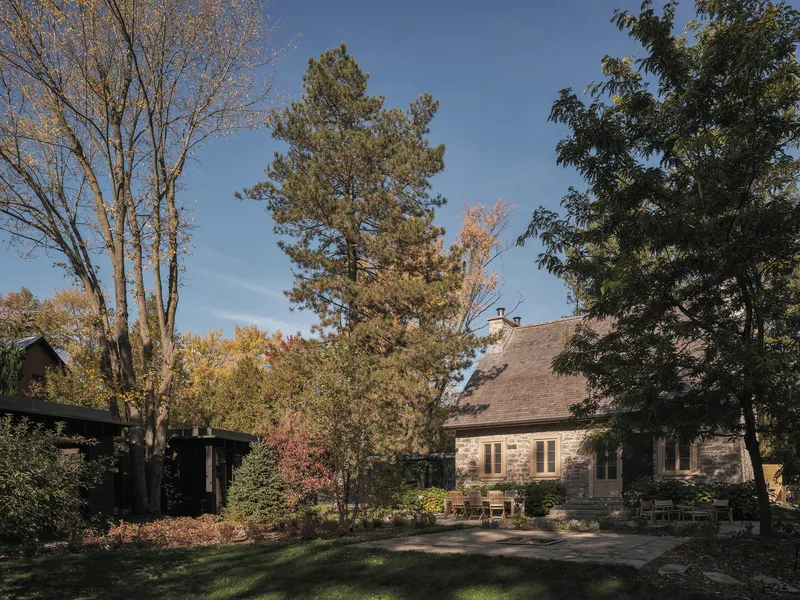
From the garden, the original masonry volume reads exactly as it should: pitched cedar shingle roof, proportioned timber windows, stone walls darkened by two centuries of weather. YH2's first move was to peel away the accumulated interventions that had obscured this clarity. Every window opening was returned to its original size and position. The stone was left exposed rather than re-rendered. The cedar shingle roof references a regional building tradition that predates the house itself.
The discipline here is worth noting. Many heritage renovations treat the old fabric as a curated backdrop, cleaning it up just enough to flatter the new work. YH2 went further, restoring the exterior envelope to what they describe as elemental purity. That phrase risks sounding precious, but the evidence supports it: the stone gable framed by tall evergreens looks almost geological, as if the house grew out of the riverbank rather than being placed on it.
The Glazed Seam Between Centuries
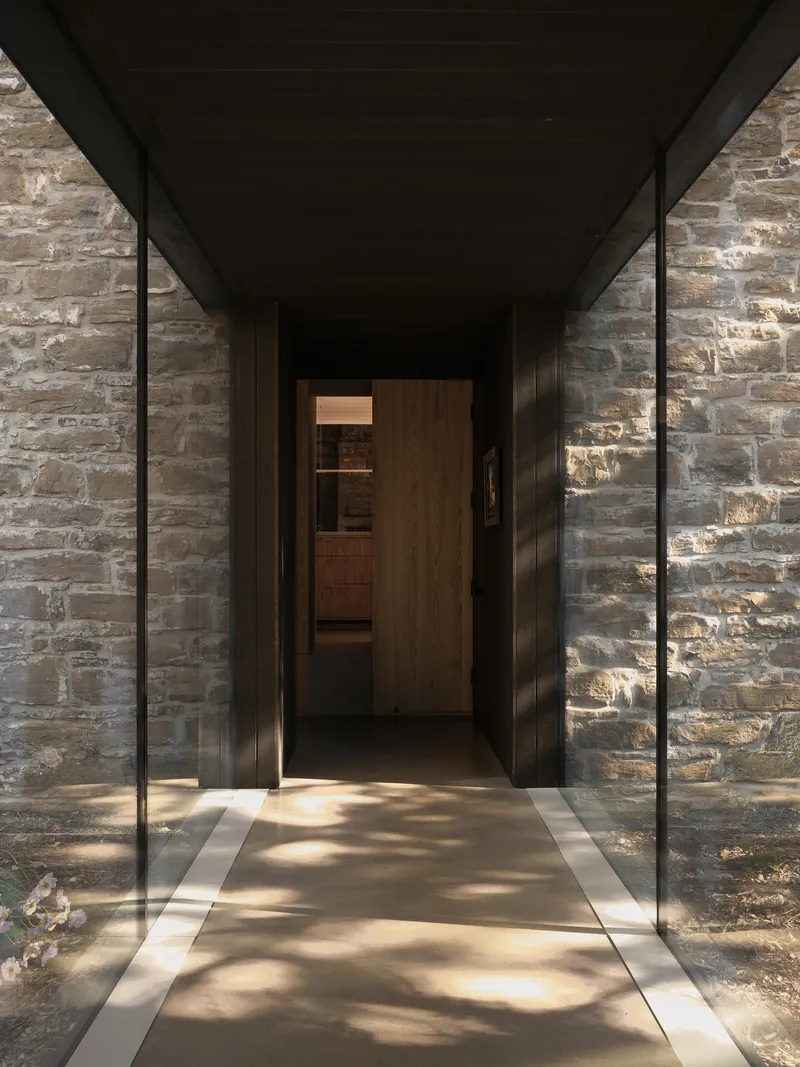
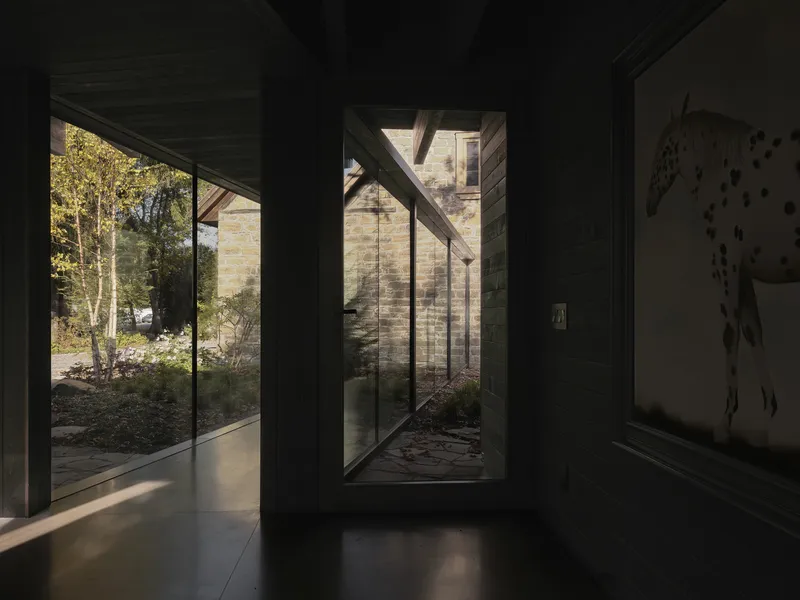
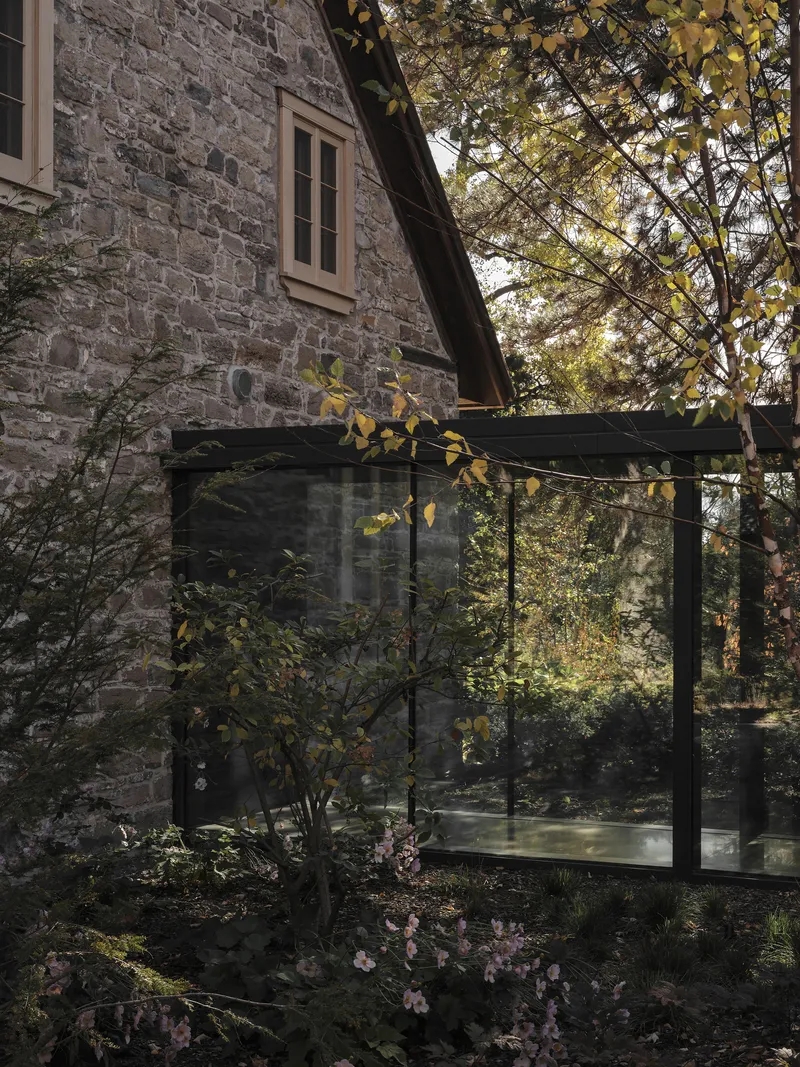
The connection between old and new is handled through a glazed passageway, a transitional space that makes the join legible without dramatizing it. Steel-framed glazing flanks timber doors and stone walls, creating a covered entry passage flooded with dappled light filtered through the surrounding canopy. It is a threshold, not a spectacle.
Interior corridors extend this logic, with tall glazed openings framing planted courtyards that pull landscape deep into the plan. These are not token lightwells. They function as orientation devices, letting occupants track the position of the garden, the trees, and the river as they move through the house. The ramp that follows the site's natural grade reinforces this sense of continuous ground, blurring the boundary between interior floor and exterior terrain.
Stone Walls and Timber Structure Exposed
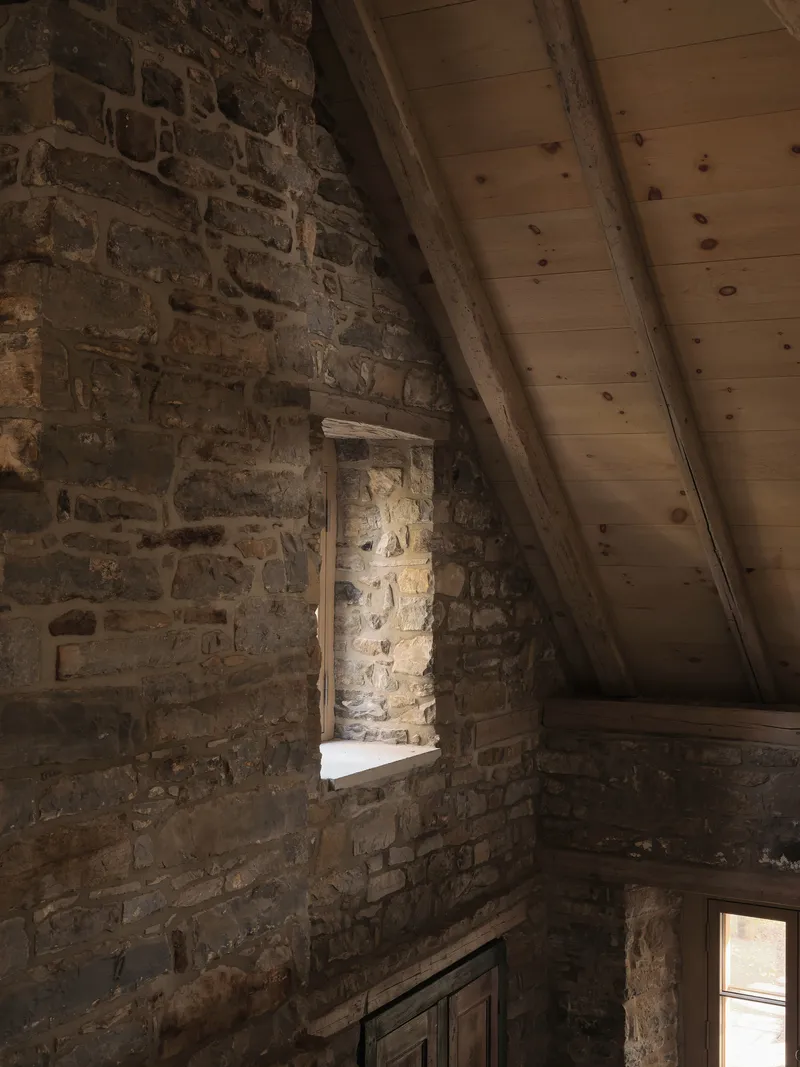
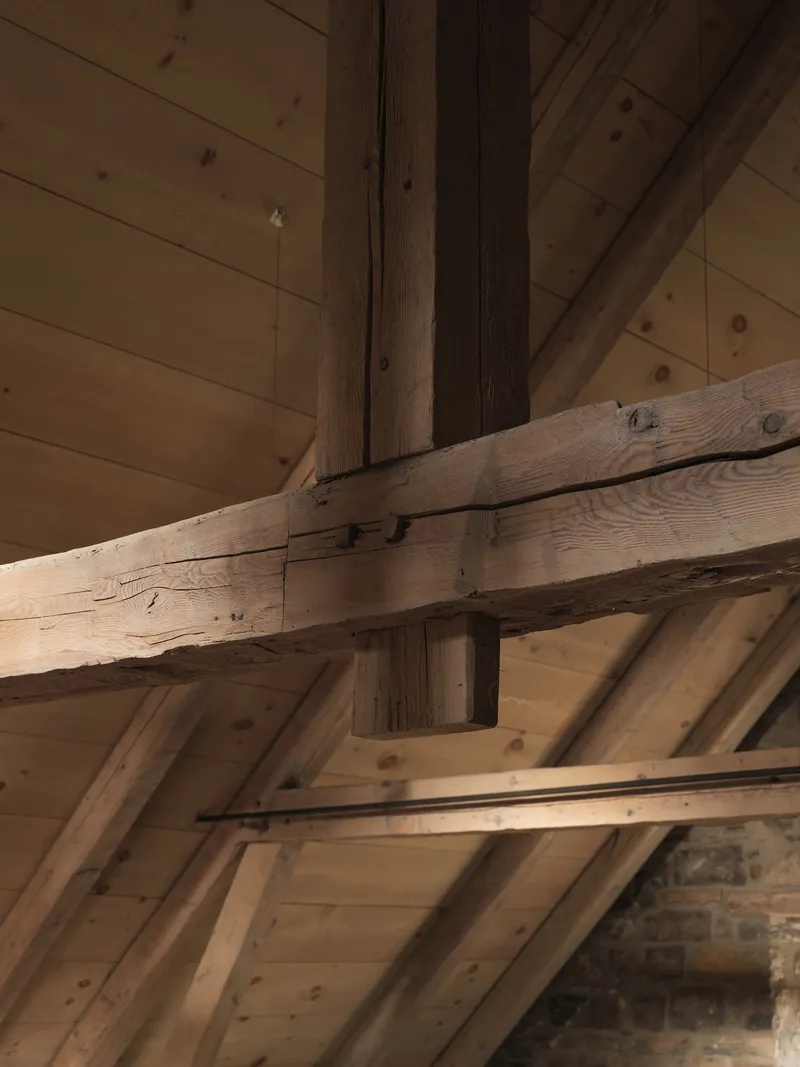
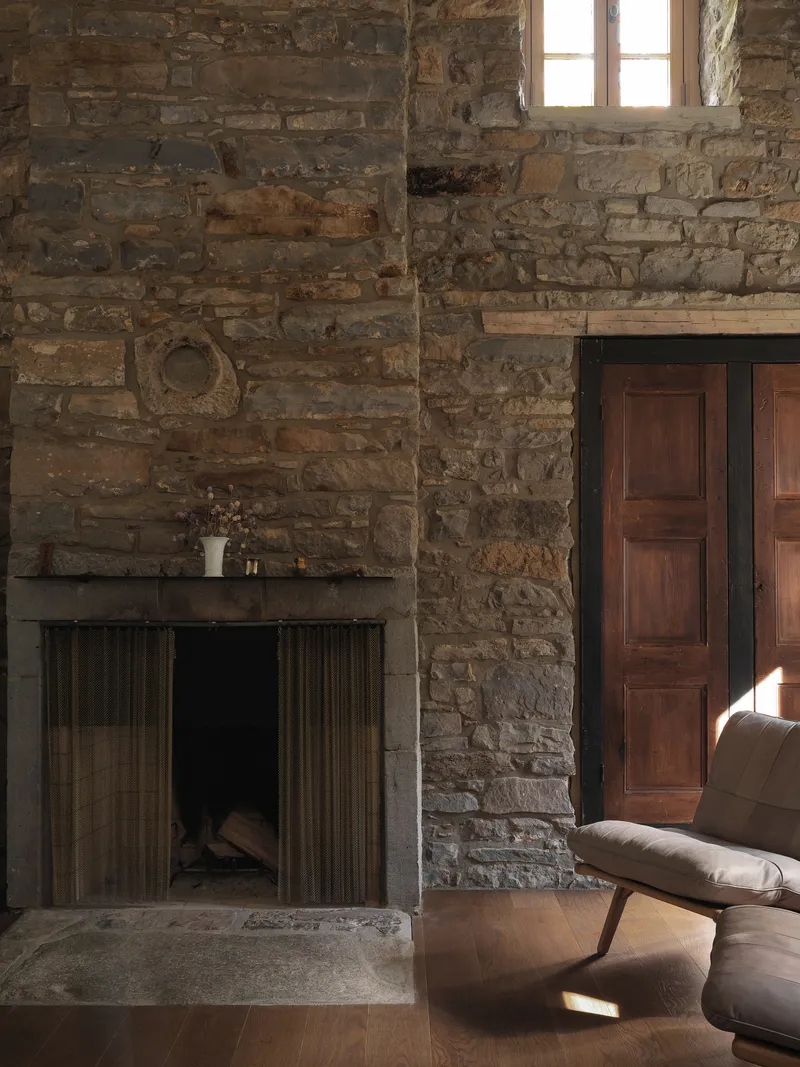
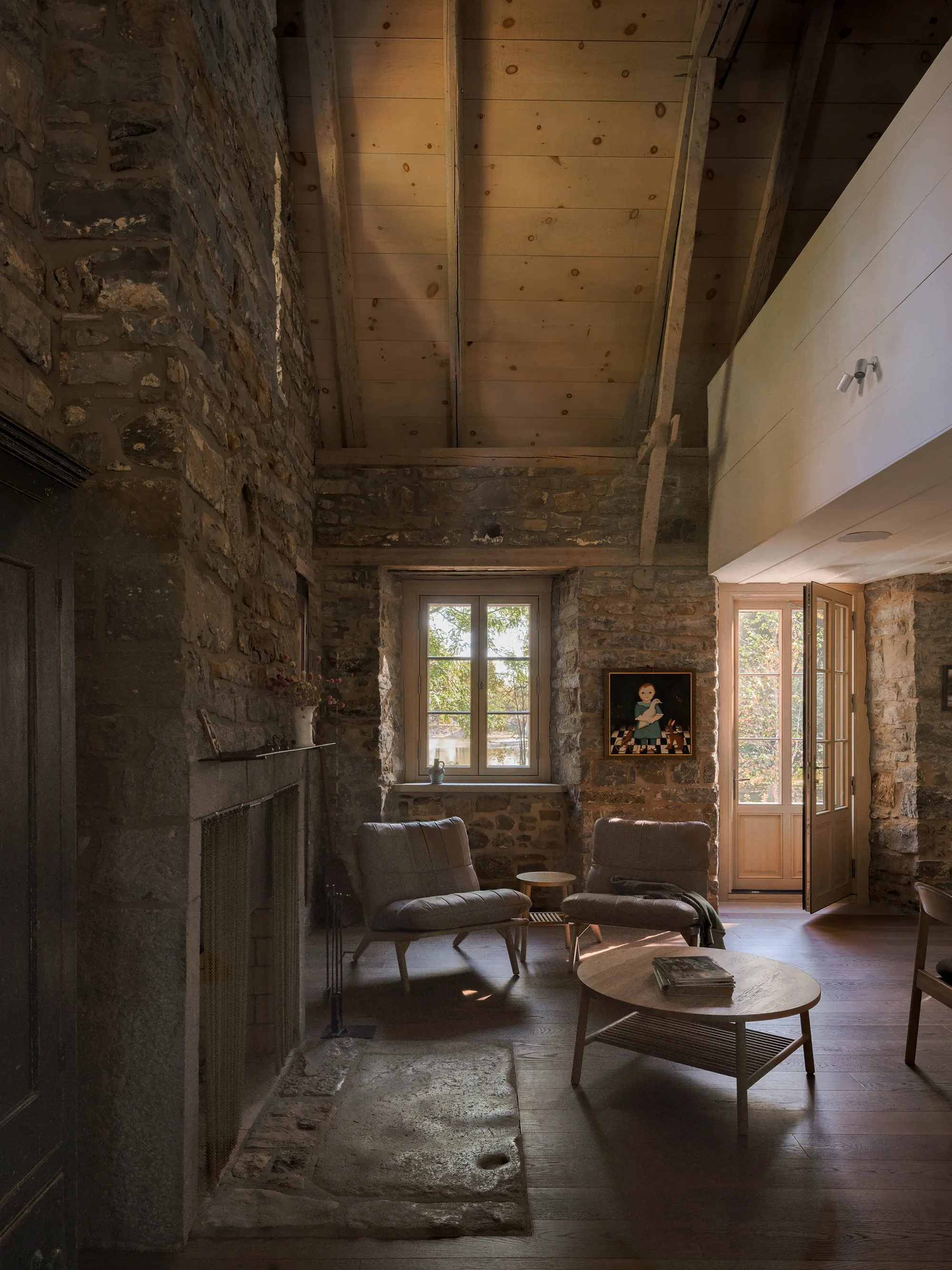
Inside the heritage volume, the payoff of all that careful demolition becomes clear. Stone masonry walls that had been concealed behind plaster and paneling are now fully revealed, their irregular coursing and mortar joints carrying the texture of early nineteenth-century construction. Above, original timber roof trusses and tongue-and-groove ceiling boards are left exposed, their joinery legible and honest.
A fireplace with a ribbed metal surround sits neatly in the stone wall, a contemporary insertion that respects the depth and weight of the masonry without mimicking it. Recessed niches and stone mantel shelves suggest that the architects spent considerable time studying how the original builders organized storage and display within the thick walls. These are small details, but they signal a project where the design team actually listened to the existing fabric.
The Double-Height Living Room
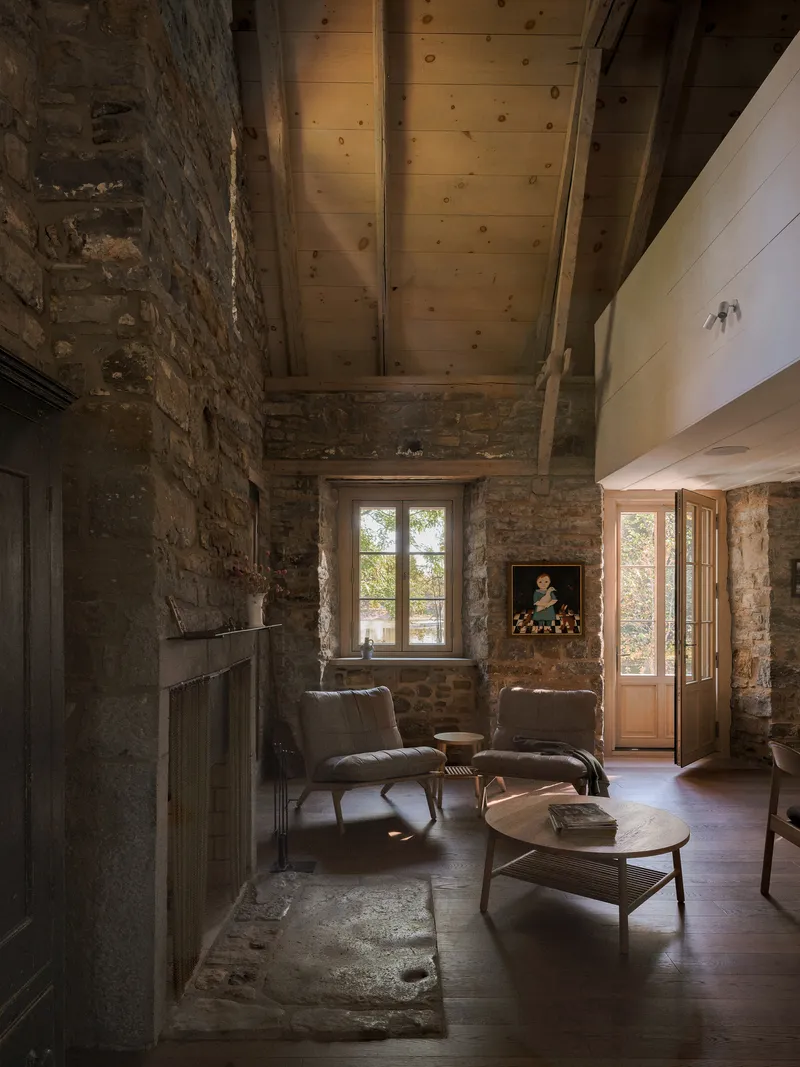
The most transformative interior move is the restructuring of the main living area into a double-height space. Exposed stone walls rise the full height of the room, meeting heavy timber ceiling beams at the ridge. Afternoon light enters through casement windows at two levels, washing the stone with warm tones that shift throughout the day. It is the kind of space that justifies all the structural surgery required to open it up.
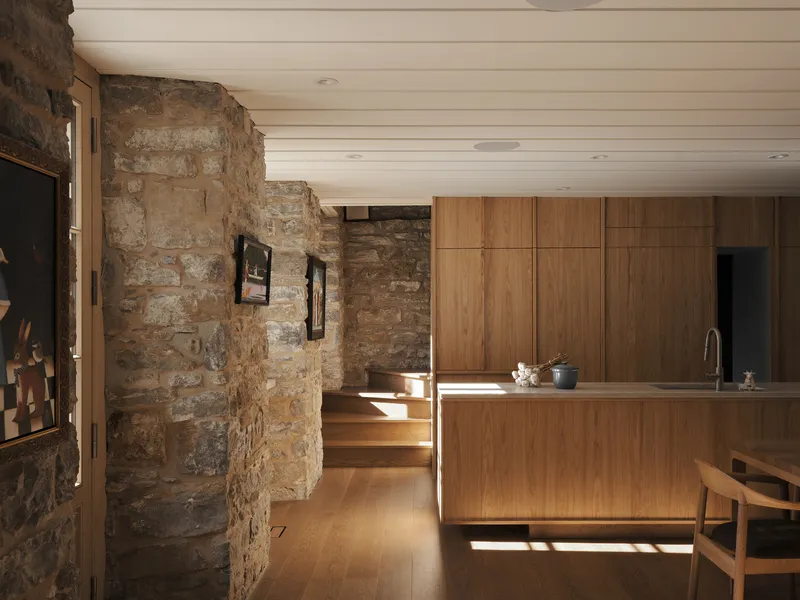
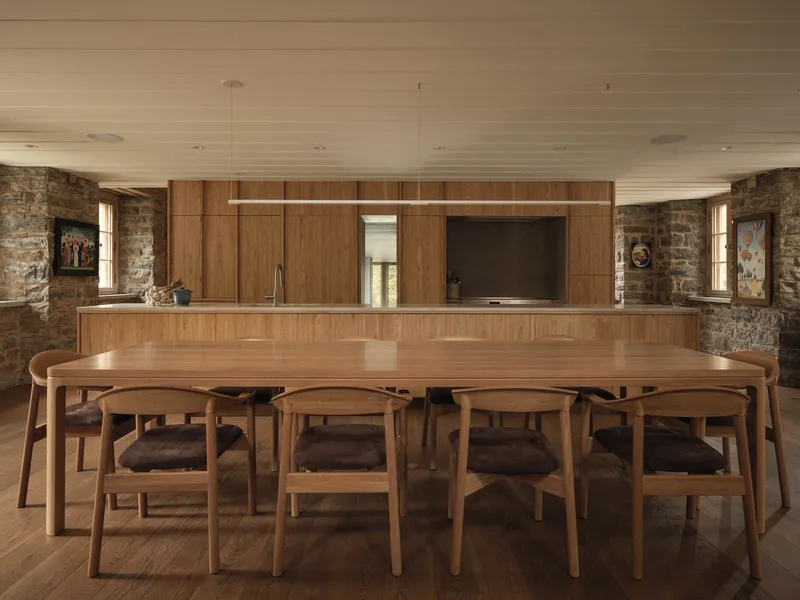
The kitchen sits at the base of this volume, its timber cabinetry and island reading as furniture placed against the stone walls rather than a fitted installation. A white plank ceiling differentiates the kitchen zone from the double-height living room beyond. The dining area, visible through an open threshold, picks up the same material palette: timber, stone, pendant lighting kept deliberately low and warm. The sequence from cooking to eating to sitting unfolds without doors or abrupt changes in level.
The Dark Extension
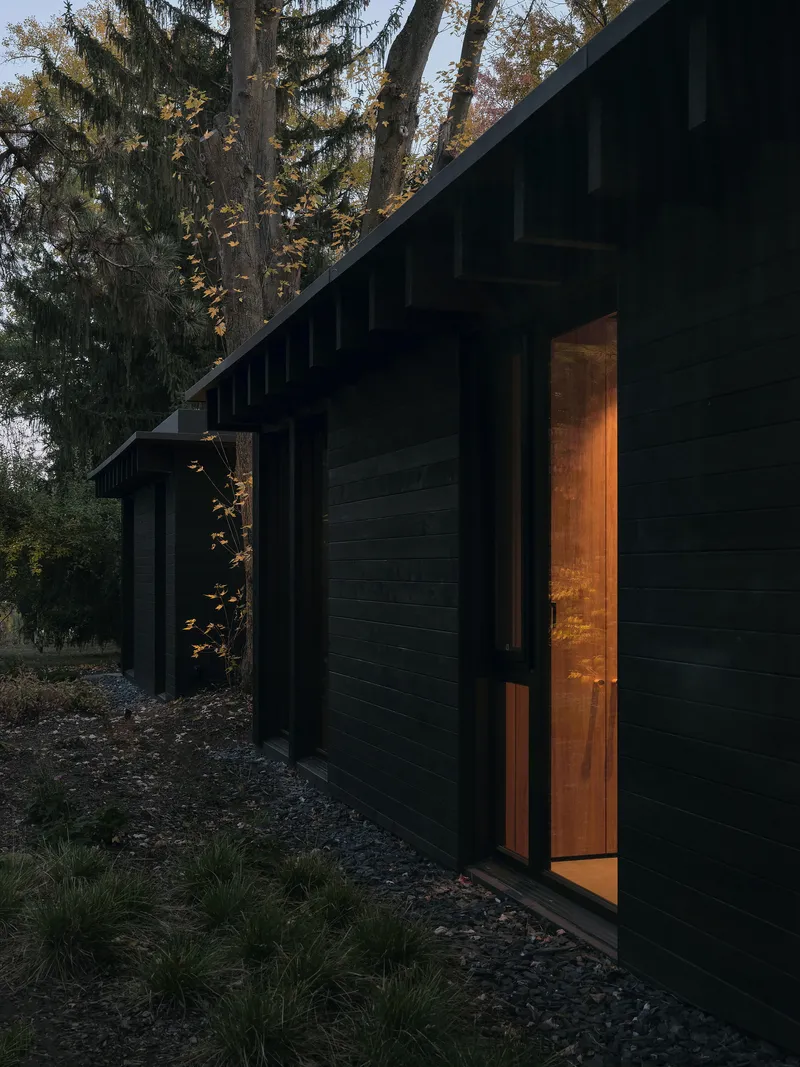
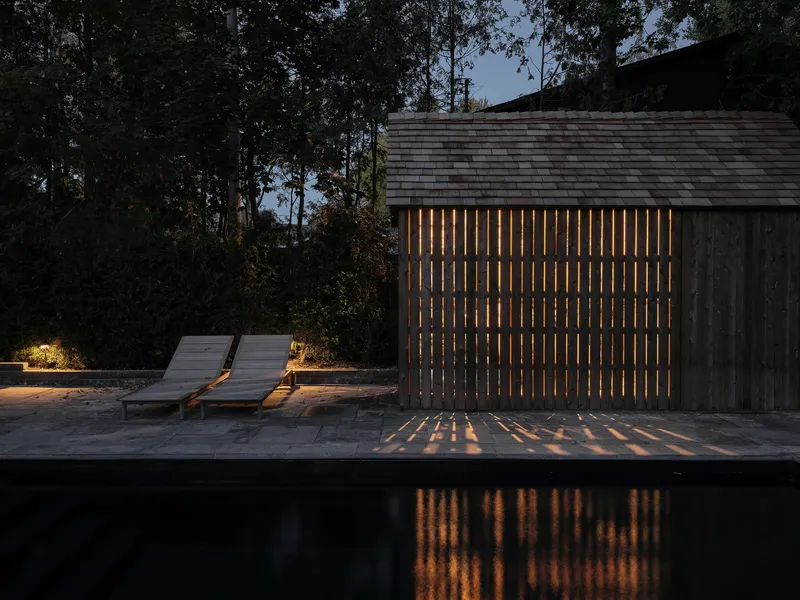
At dusk, the extension reveals its strategy most clearly. Ebony-stained cedar cladding absorbs ambient light, allowing the volume to recede into the surrounding conifers while warm interior light glows through precisely placed openings. A vertical timber screen casts striped shadows across the pool deck, turning the facade into a lantern without resorting to floor-to-ceiling glass.
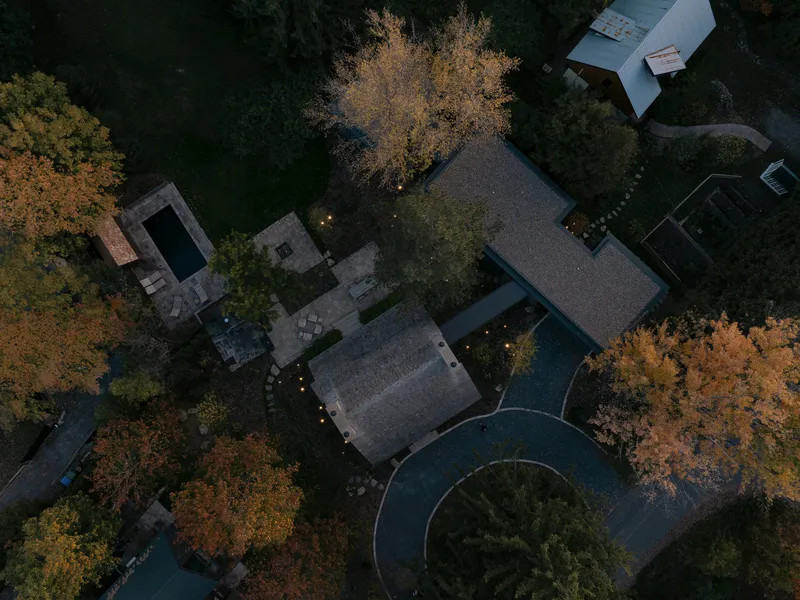
The aerial view confirms what the ground-level photographs suggest: the extension is genuinely discreet. Its pebble roof disappears against the autumn canopy, and the volume's footprint weaves between existing trees rather than clearing them. The curved gravel driveway reinforces the sense that the landscape is the organizing principle, not the architecture. YH2 understood that on a site this generous and this old, the worst thing you can do is compete with the trees.
Private Rooms in Two Registers
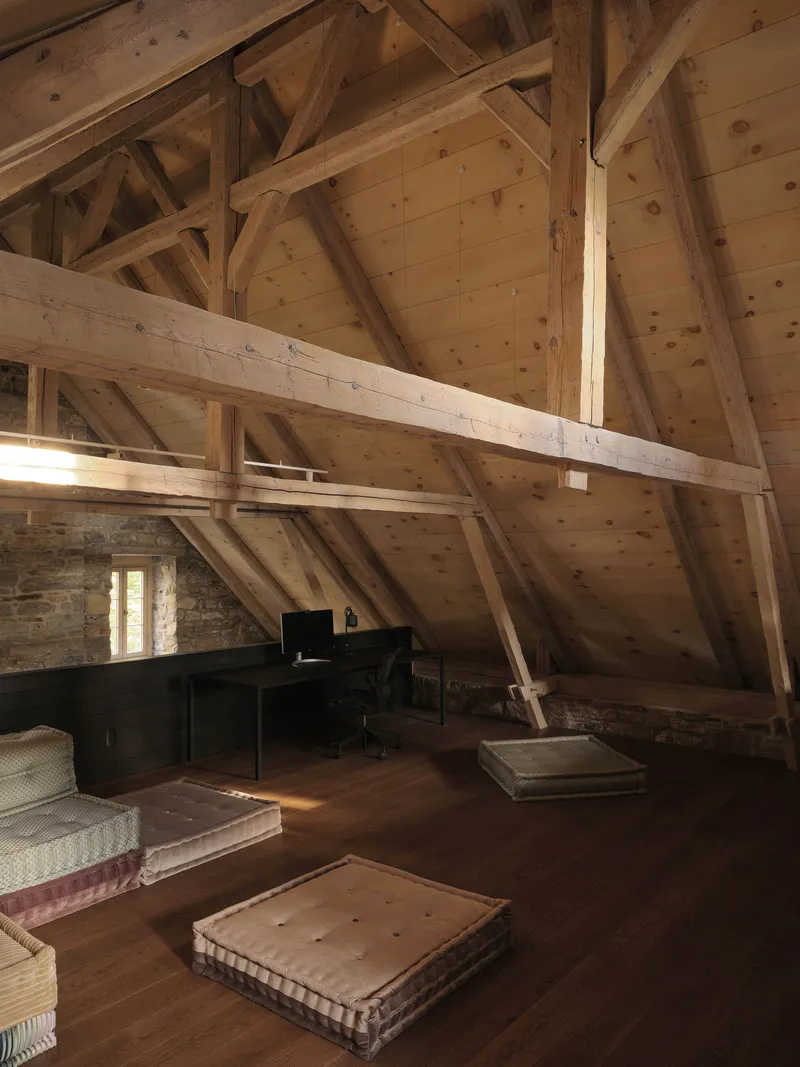
The upper level of the heritage volume contains an attic bedroom tucked beneath exposed timber roof trusses, its low proportions making the space feel protected and intimate. A dark workspace occupies one end, floor cushions the other. This is not a loft conversion that fights the roof geometry; it works with the steep pitch, treating the sloping planes as an asset rather than a constraint.
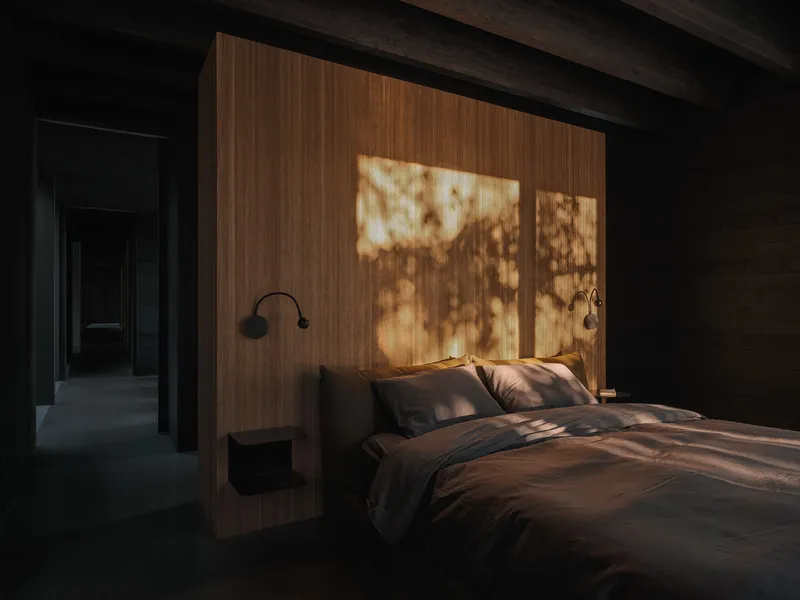
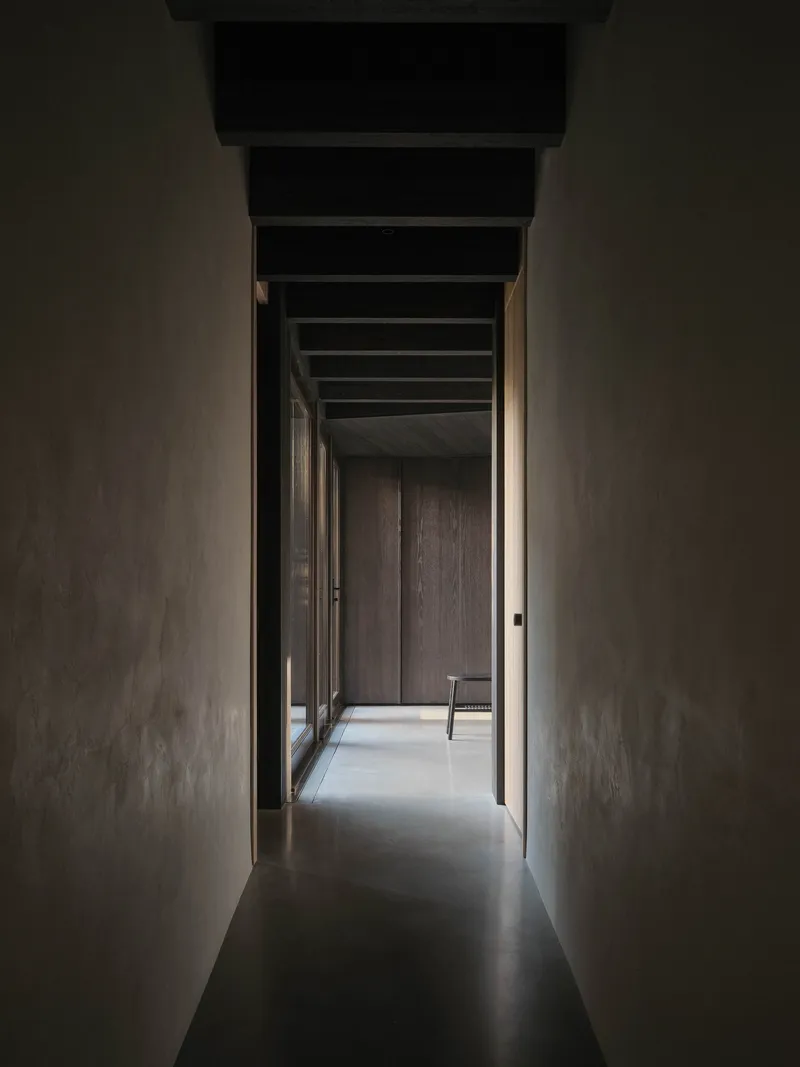
In the extension, bedrooms take a different character. A walnut headboard wall catches tree shadow patterns thrown by afternoon sun, linking the interior experience directly to the canopy outside. Corridors are narrow and precise, with polished concrete floors and smooth plaster walls that contrast sharply with the stone and timber of the heritage wing. The shift in material register between old and new is consistent and deliberate: you always know which century you are standing in.
Bathrooms as Dark Chambers
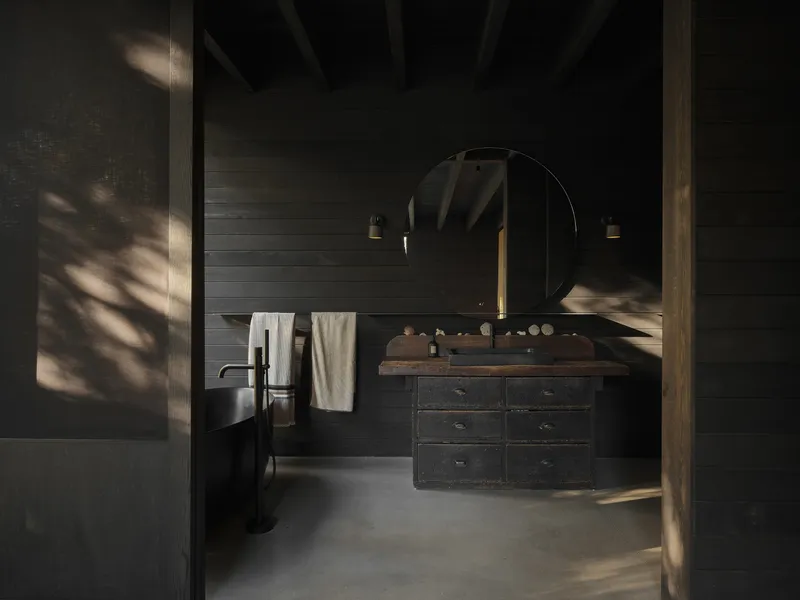
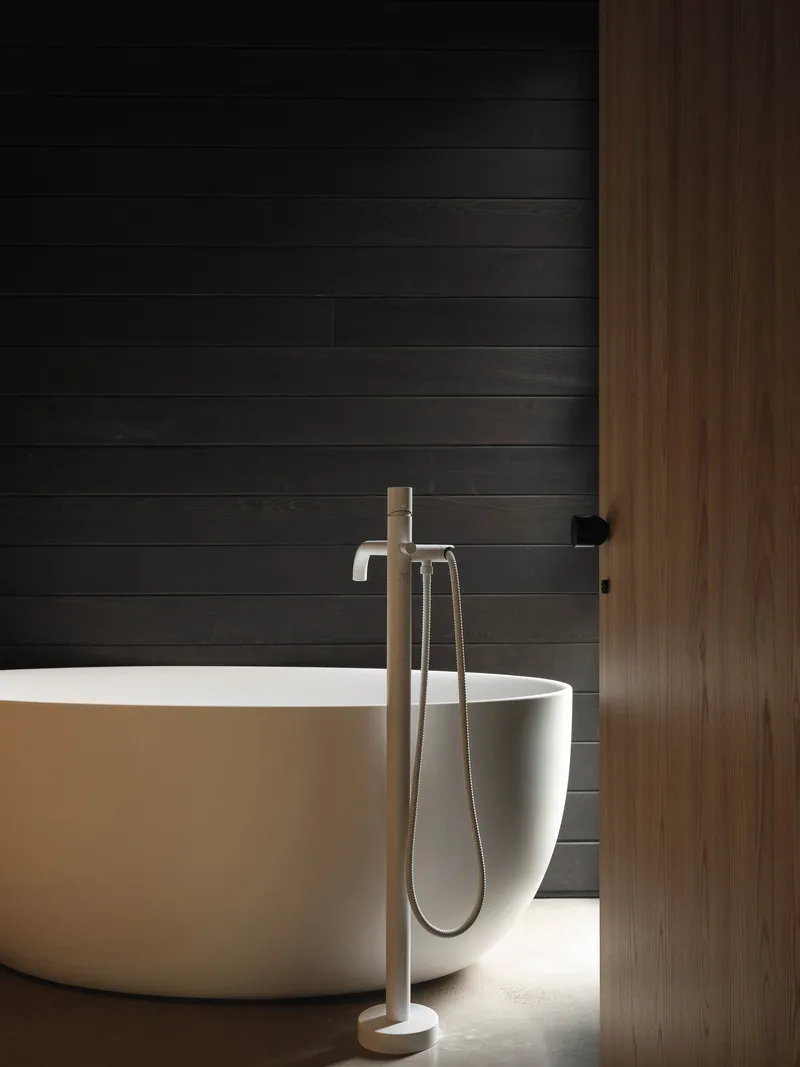
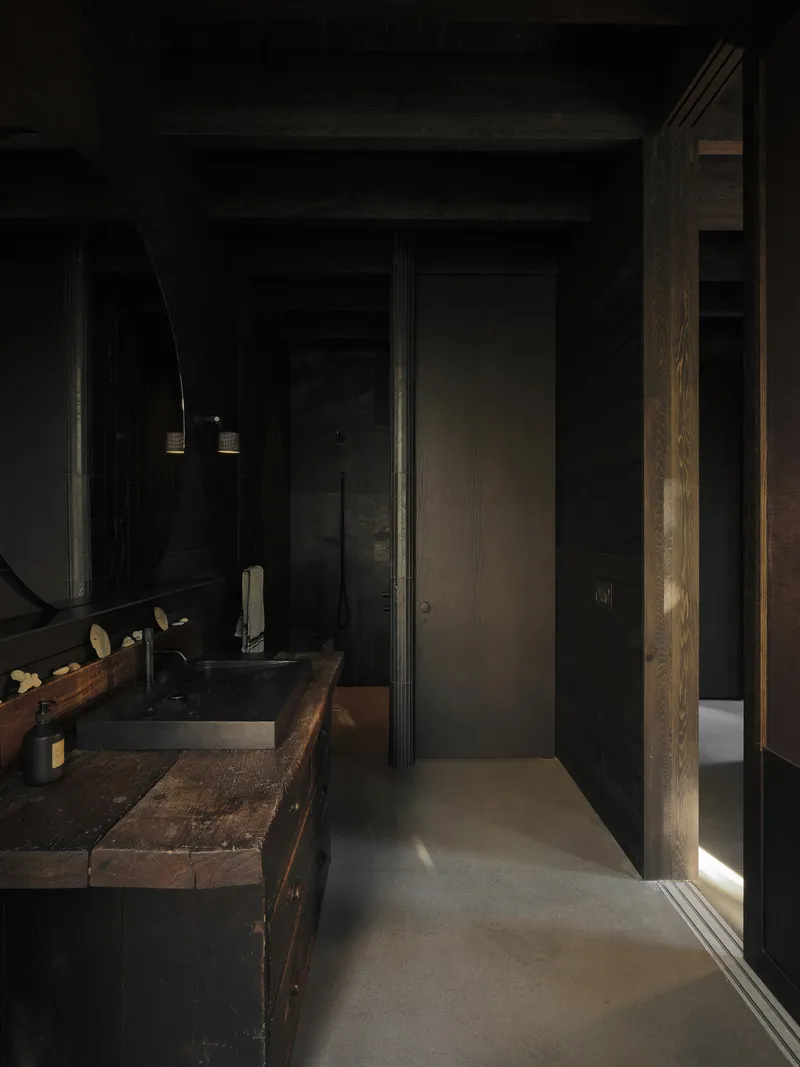
The bathrooms deserve attention for their tonal commitment. Black horizontal plank walls, dark marble tile, and reclaimed wood vanities create spaces that feel cave-like in the best sense. A freestanding tub against horizontal black timber cladding is lit by a controlled wash of natural light, enough to bathe by but not enough to break the mood. A narrow vertical strip of light at the edge of one bathroom corridor is the kind of detail that separates considered design from competent renovation.
These are not spa bathrooms designed for Instagram. They are quiet, dark, material-rich rooms that take their cues from the ebony cedar cladding outside. The round mirror and ribbed wall tile in one vanity area recall the ribbed fireplace surround in the living room, suggesting a project-wide vocabulary of textures that has been carefully controlled across both old and new volumes.
Plans and Drawings
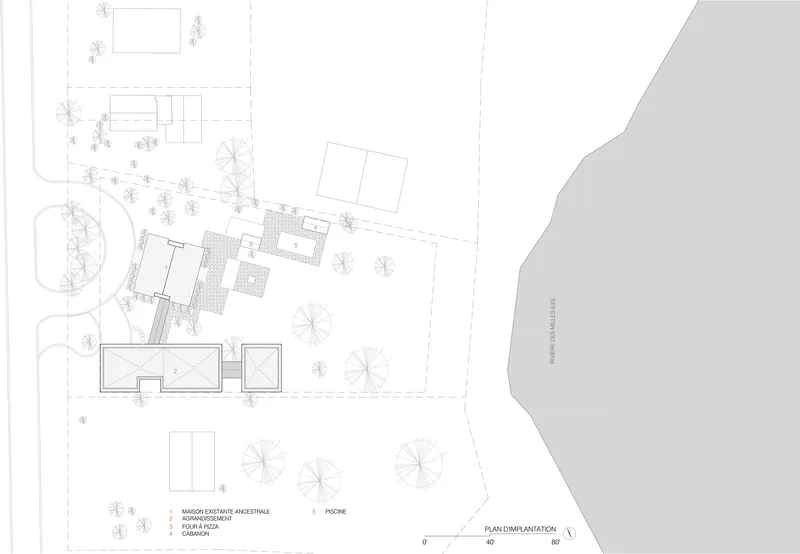
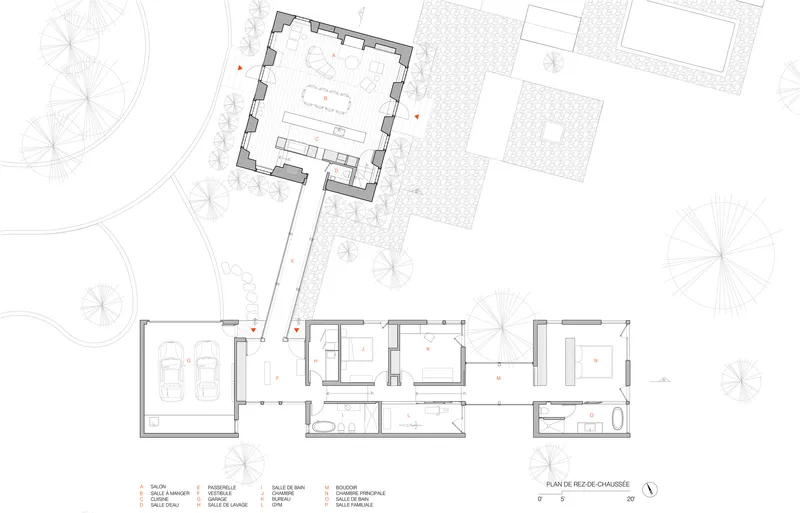
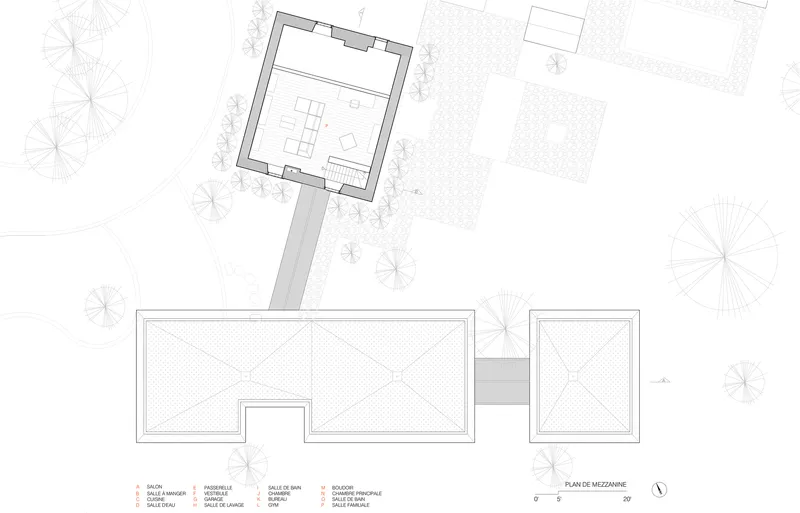
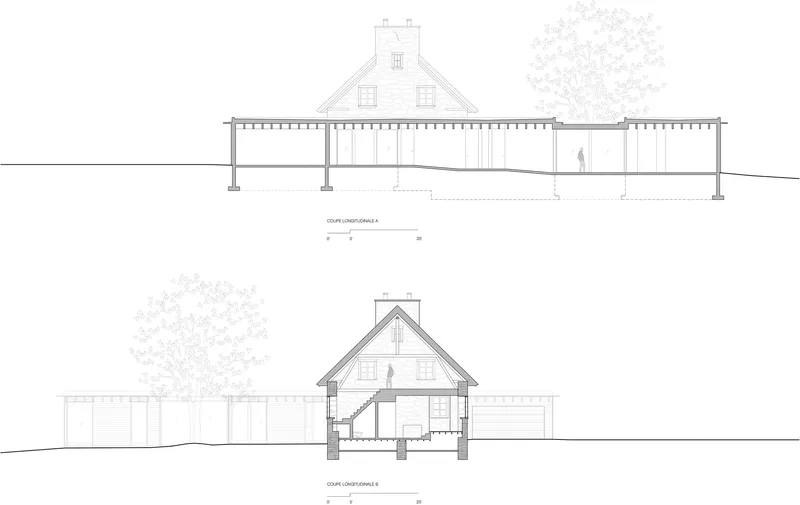
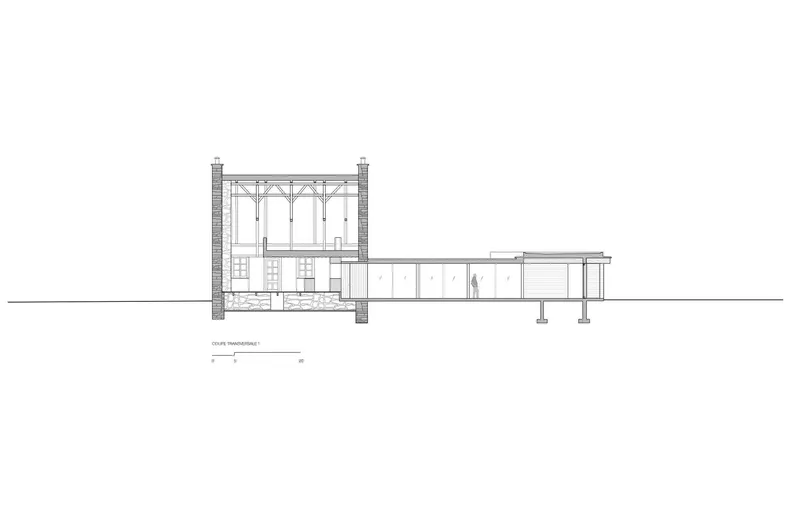
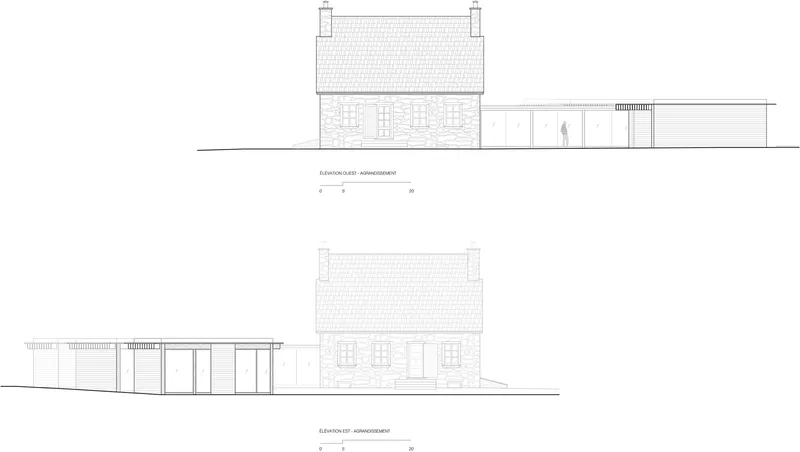
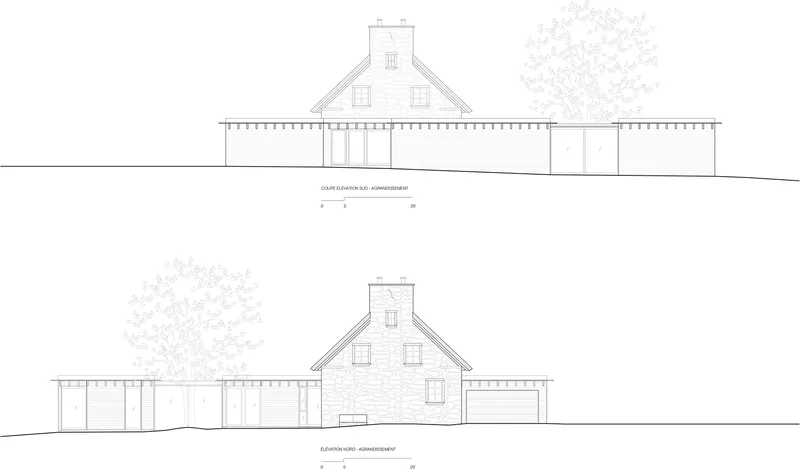
The site plan makes the landscape strategy explicit: building clusters are arranged among circular tree groupings and landscaped paths, with the architecture occupying gaps in the canopy rather than cleared platforms. The ground floor plan shows how the central ramp stitches together the garage, living spaces, and the square heritage volume, with a surrounding paved terrace mediating between interior and garden.
The sections are the most revealing drawings. The steep pitched roof with dormers is connected to covered colonnade extensions on either side, creating a sheltered perimeter that extends the usable ground plane. A transverse section cuts through the two-storey masonry volume, revealing arched openings that connect to the lower extension. The elevations confirm the height differential between the heritage gable and the low-profile wings, a proportion that keeps the new work subordinate to the old.
Why This Project Matters
Heritage renovation in Canada often falls into two traps: either the old building is embalmed as a museum piece, or it is gutted and used as a decorative wrapper for a completely new interior. Maison Aubé avoids both. YH2 treated the 1811 stone house as a living structure with its own logic, stripping it back to recover that logic rather than imposing a new one. The contemporary extension, far from upstaging the heritage volume, is designed to be invisible from most vantage points. That takes restraint, and restraint is the hardest thing to sell a client.
The project also offers a lesson in site-first thinking. The central ramp that follows the terrain, the extension footprint that weaves between trees, the pebble roof that merges with the canopy: these are not aesthetic choices but ecological ones, decisions that preserve the site's capacity to function as a landscape rather than a platform for architecture. For a house that has been inhabited by the same family for generations, that continuity between building and ground feels exactly right.
Maison Aubé, designed by YH2 Architecture (Loukas Yiacouvakis, Marie-Claude Hamelin). Saint-Eustache, Quebec, Canada. 3,860 sq ft. Completed 2025. Photography by Maxime Brouillet.
About the Studio
Share Your Own Work on uni.xyz
If projects like this are the kind of work you want to make, uni.xyz is a place to publish your own, find collaborators, and enter design competitions.




Popular Articles
Popular articles from the community


Play: Fragments of Their World
Familiar architecture becomes modular playground design, creating safe spaces where displaced children can learn, connect, imagine and play.

The Musturak Paradise: Senior Living Architecture for a Connected Future in Temara, Morocco
The Musturak Paradise reimagines senior living architecture in Temara via private homes, social spaces, culture, community, and shared care.

Co-Life: Senior Housing Design That Reconnects Older Adults With the City
Co-Life reimagines senior housing design through healing gardens, shared streets, workshops, and a sustainable community across generations.

Conexión: Biophilic Design Reimagines High-Rise Living in Hong Kong
Conexión reimagines high-rise living in Hong Kong through biophilic design, green facades, shared spaces, daylight, water and nature within.
Similar Reads
You might also enjoy these articles

Bao Huynh Watercolor Atelier: A Serene Art Retreat in Hội An
Bao Huynh Watercolor Atelier in Hội An blends multifunctional art spaces, sustainable design, local materials, and family-friendly living in a serene environment.

Atelier Macri Concept Store Interior Design by CASE-REAL
Atelier Macri store features a "ko" counter, walnut wood details, cork displays, blending retail, gallery, and seamless customer experiences.

Manuel Vargas Izquierdo Stadium and High-Performance Sports Center: Architectural Excellence in Jalpa de Méndez
The Manuel Vargas Izquierdo Stadium blends sustainable design, inclusive sports facilities, and cultural-inspired architecture, revitalizing Jalpa de Méndez’s public spaces.
KAKR Buluh Awar Hall: Revitalizing Community and Ecology Through Bamboo Architecture
Community built bamboo hall revitalizes Buluh Awar village, empowering youth, restoring ecology, celebrating vernacular craftsmanship through sustainable architecture and culture.




Comments (0)
Please login or sign up to add comments
No comments yet. Be the first to comment!