
YNAS Renovates a Junzo Sakakura Apartment in Tokyo to Challenge Japan's Scrap-and-Build Culture
A 96-square-meter renovation of a half-century-old modernist unit in Tokyo becomes both home and studio for two creative professionals.


Japan's default relationship with its building stock is demolition. The country's "scrap-and-build" cycle treats aging structures as liabilities, tearing down and rebuilding at a pace that makes most Western preservation debates look quaint. YNAS, led by architect Yuko Numata, took the opposite position with Jingu Studio: a 96-square-meter apartment inside a half-century-old modernist building designed by Junzo Sakakura, one of the country's most important postwar architects. The project treats the existing concrete frame not as a problem to overcome but as the primary material of the intervention.
What makes this renovation worth studying is its refusal to flatten the distinction between old and new. The exposed concrete beams and columns remain legible as Sakakura's structure, while curved white partitions, colored tile surfaces, and brass fixtures read clearly as YNAS's layer. The unit serves as both home and workspace for an architect and a casting director, and the spatial plan leans into that ambiguity. There is no hard boundary between domestic life and professional production. Instead, a sequence of rooms organized around a 600mm structural grid slides between the two programs with studied informality.
Sakakura's Frame, Held Visible
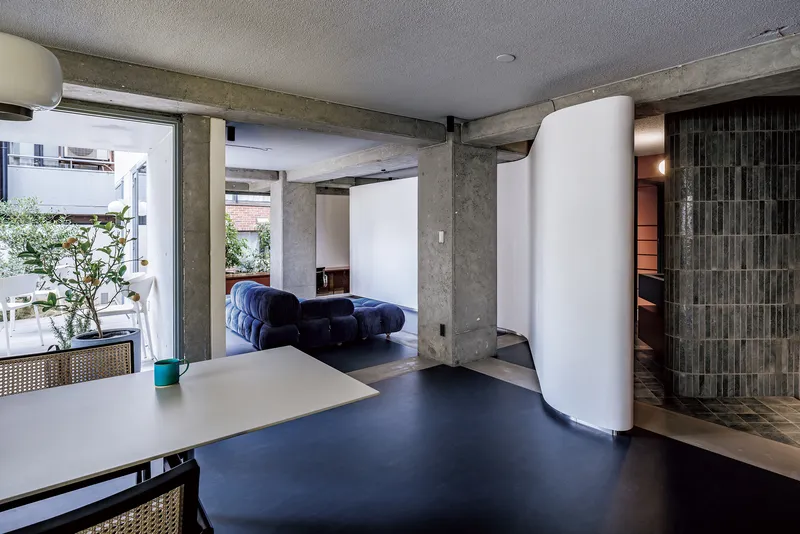
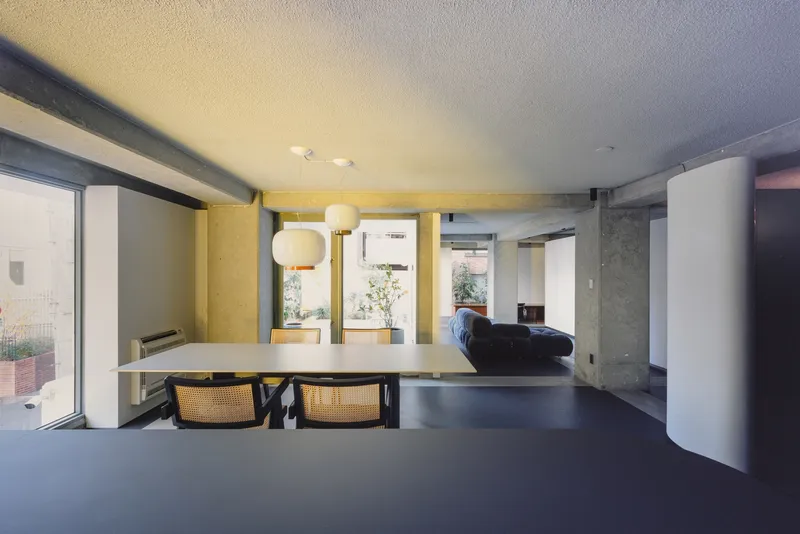
The most immediate decision in the renovation is the most consequential: the existing concrete structure is left exposed and celebrated. Beams run across the ceiling in an unbroken rhythm, their texture contrasting with the smooth white partitions and cylindrical columns introduced below. The concrete is not cosmetically restored to some idealized state. It carries its age, and the design banks on that patina to anchor the space in time.
White cylindrical columns appear at key junctions, standing as deliberate counterpoints to the rectilinear concrete grid. Their smoothness and geometry belong to YNAS's vocabulary, not Sakakura's. The effect is a kind of temporal dialogue where two architectural languages occupy the same room without competing for dominance.
Curves Against the Grid
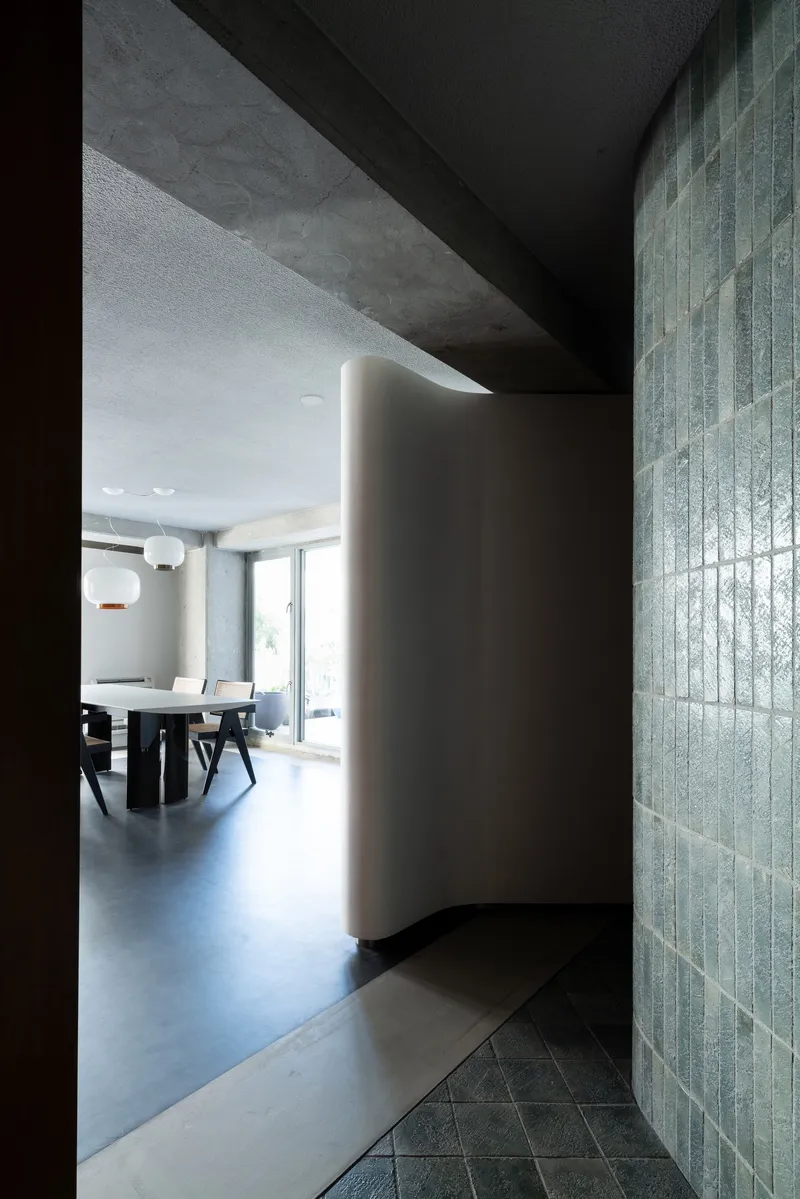
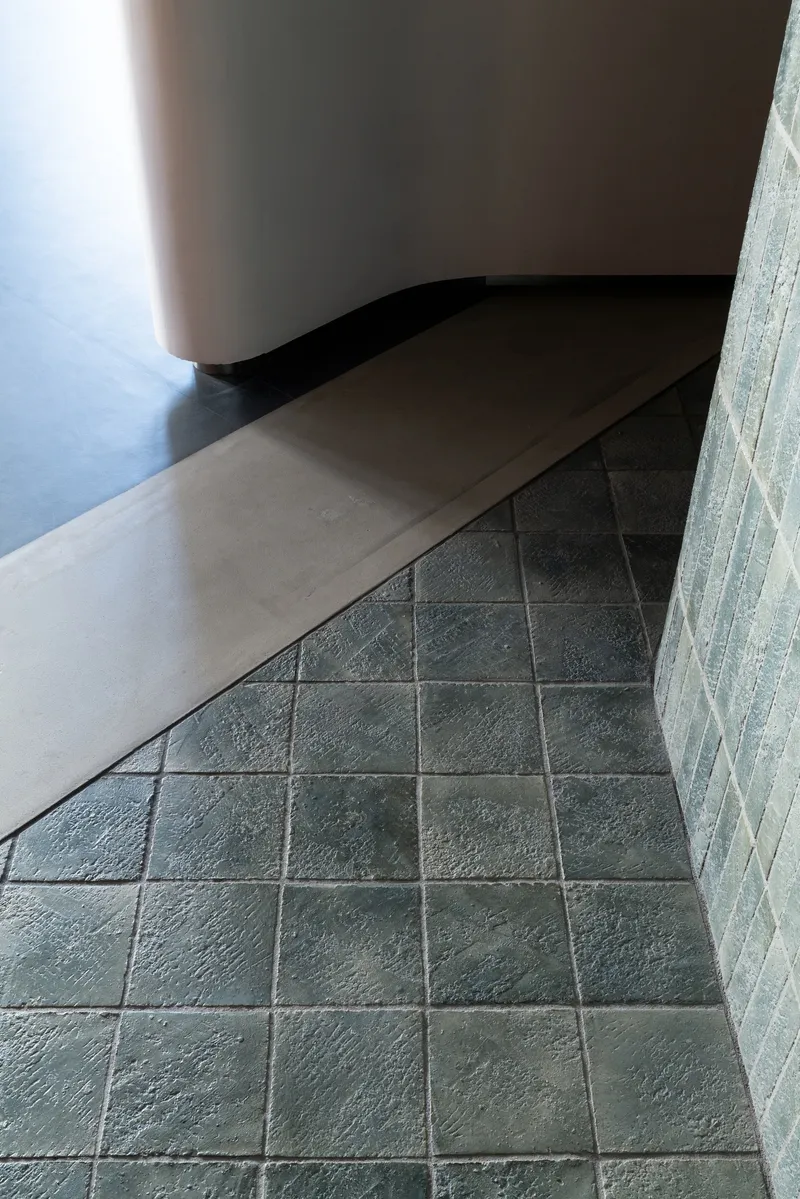
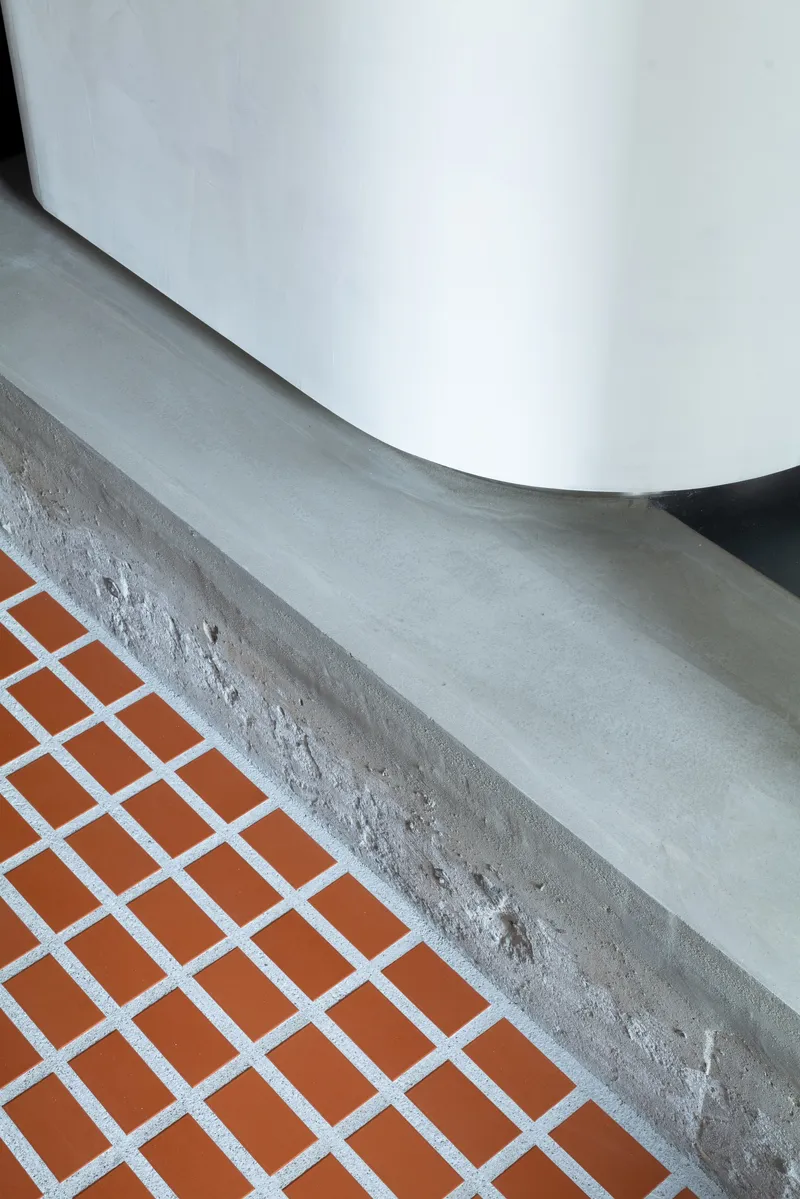
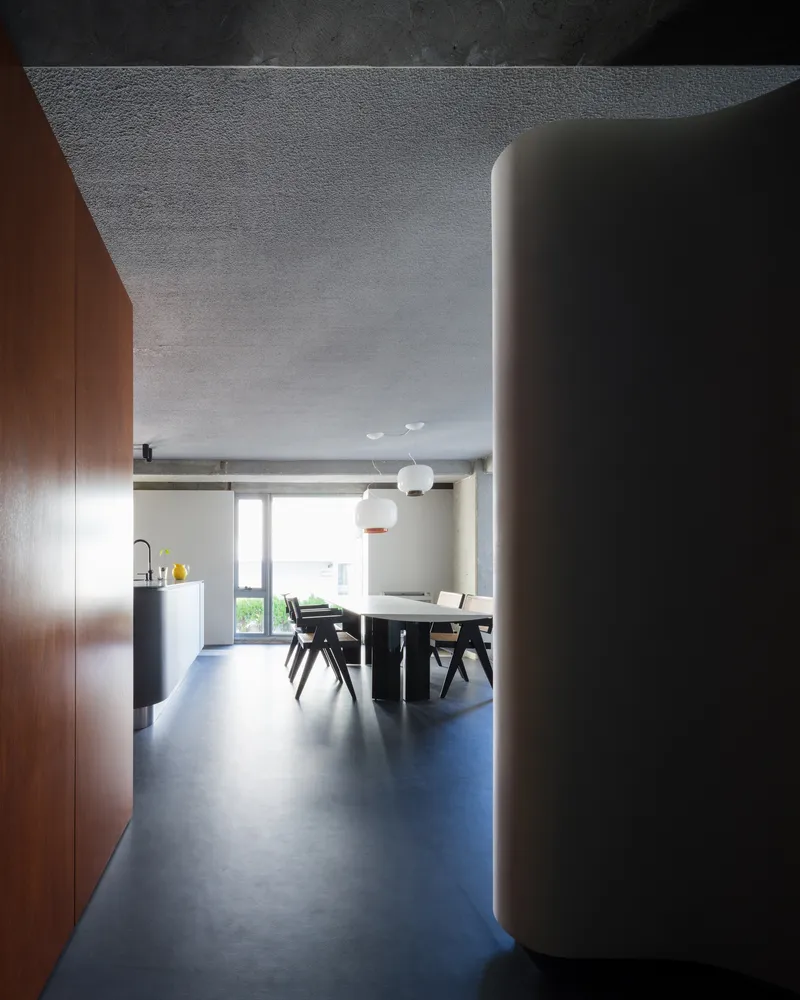
YNAS's insertions consistently deploy curves against the orthogonal discipline of the existing building. Walls sweep in arcs rather than meeting at right angles, guiding movement through the apartment without the abruptness of conventional corridors. The curved white bench meeting a dark tile floor along a textured concrete block wall is a precise detail: three materials, three eras, one corner.
These curves also serve a practical function in a compact apartment. By rounding transitions between zones, YNAS avoids the dead ends and tight corners that plague narrow renovation plans. The hallway leading to the dining area under the exposed concrete ceiling manages to feel generous despite the modest footprint.
Color as Signature
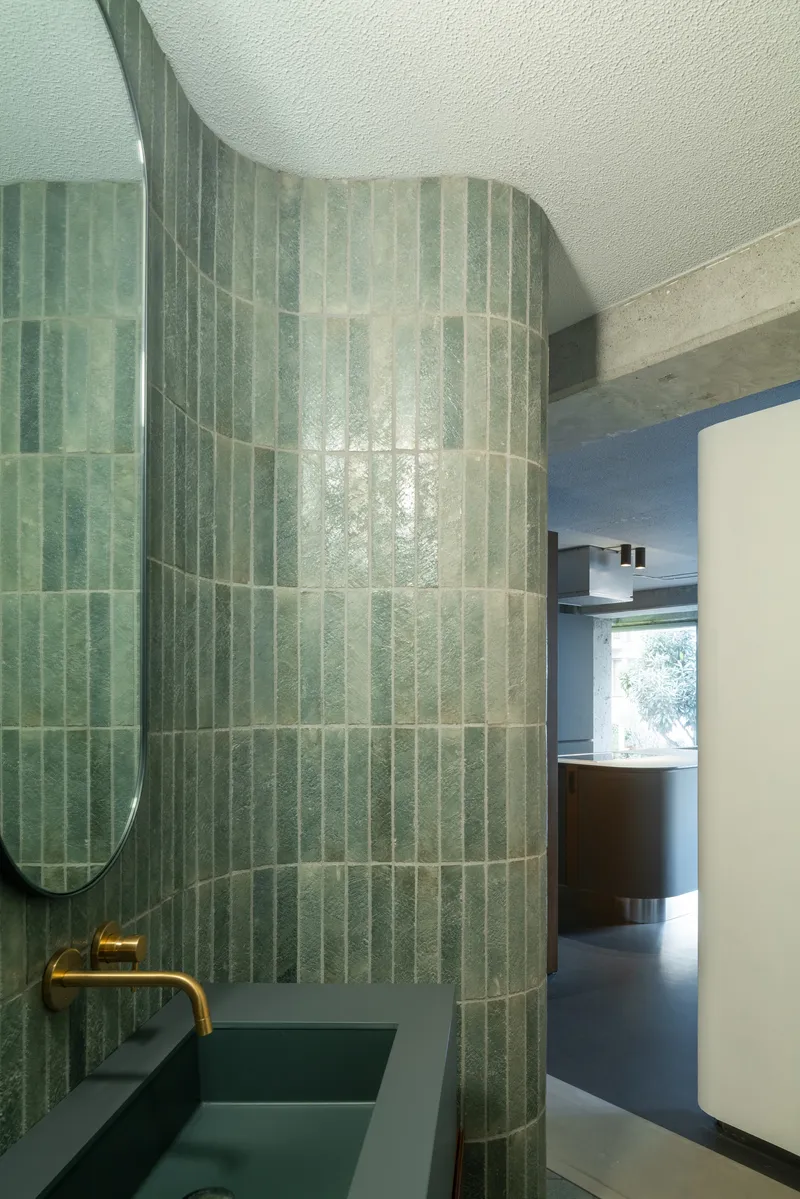
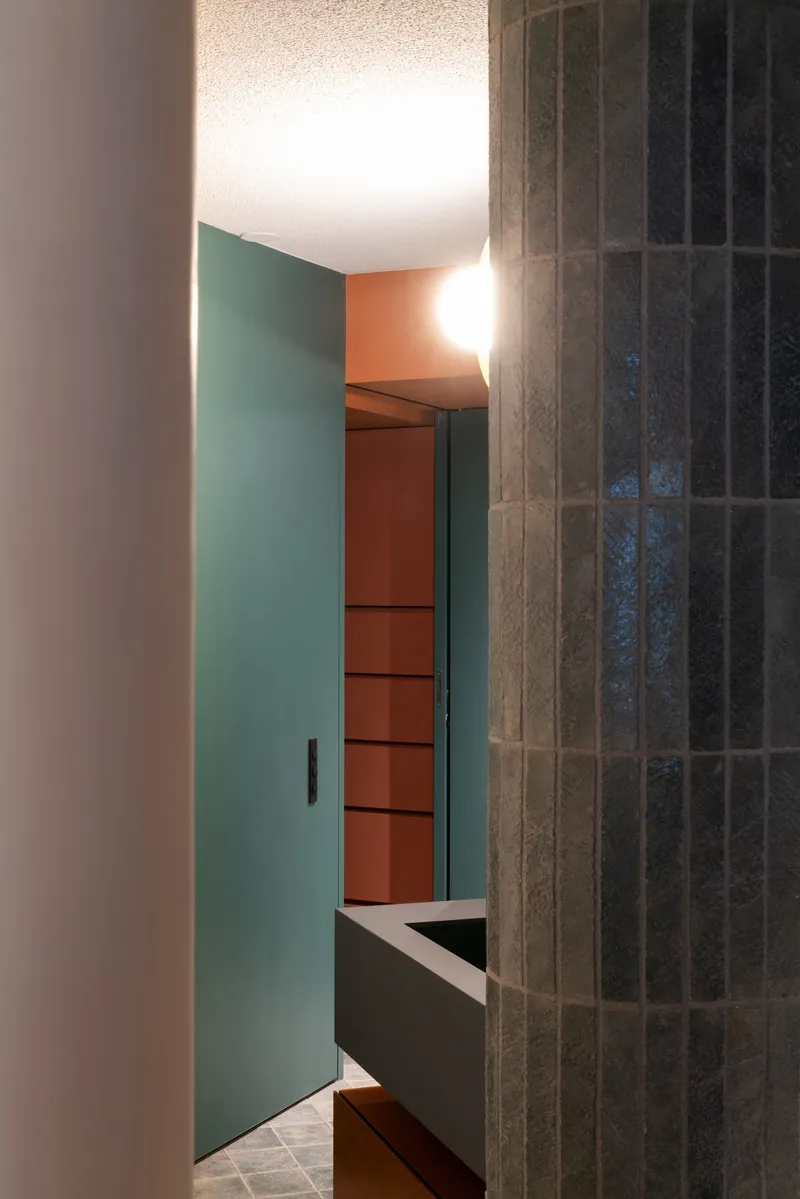
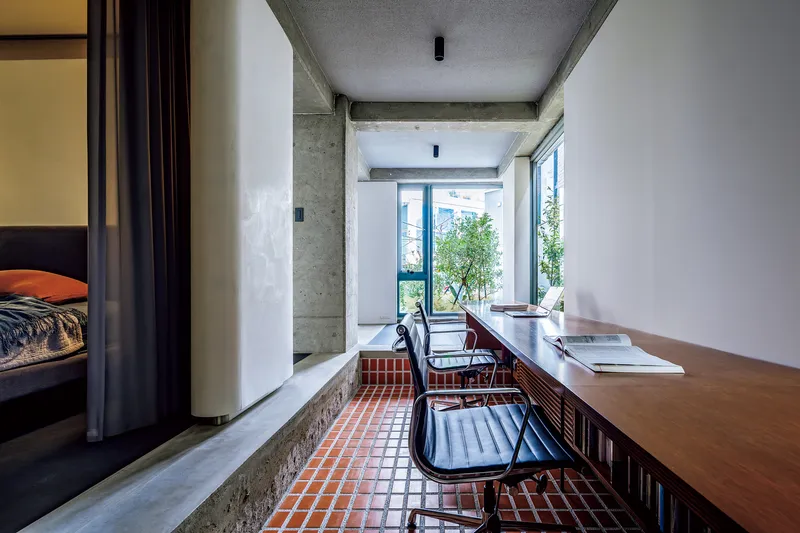
Each room stakes its identity through a specific palette of tile and finish. The powder room wraps itself in green vertical tile with brass hardware and an oval mirror. A doorway is framed by teal wall panels and dark vertical tile, opening to terracotta shelving beyond. The corridor uses a red checkered tile floor that runs boldly beneath a timber desk. None of these choices are shy.
The color strategy does more than decorate. It differentiates zones in an open plan where walls are deliberately scarce. You know where you are in the apartment by the surfaces underfoot and at your fingertips. It is wayfinding through material, not signage, and it works because each palette is restrained within its zone while being distinct from its neighbors.
Living and Working in the Same Frame
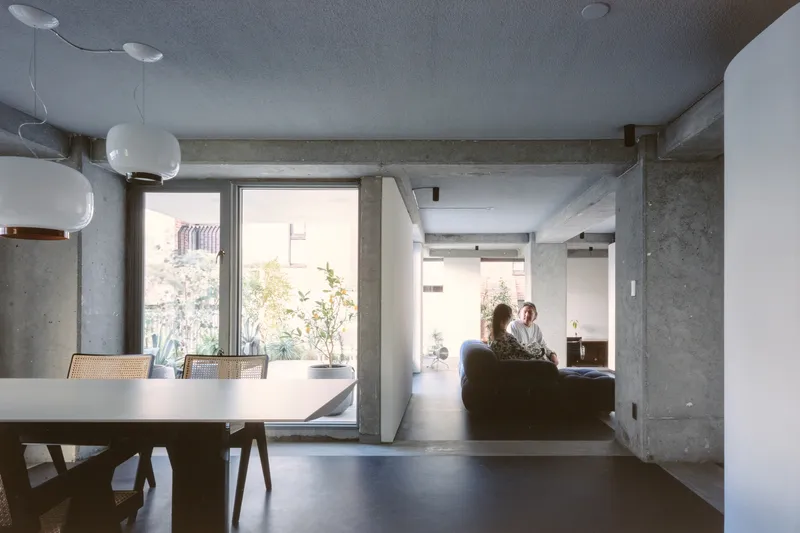
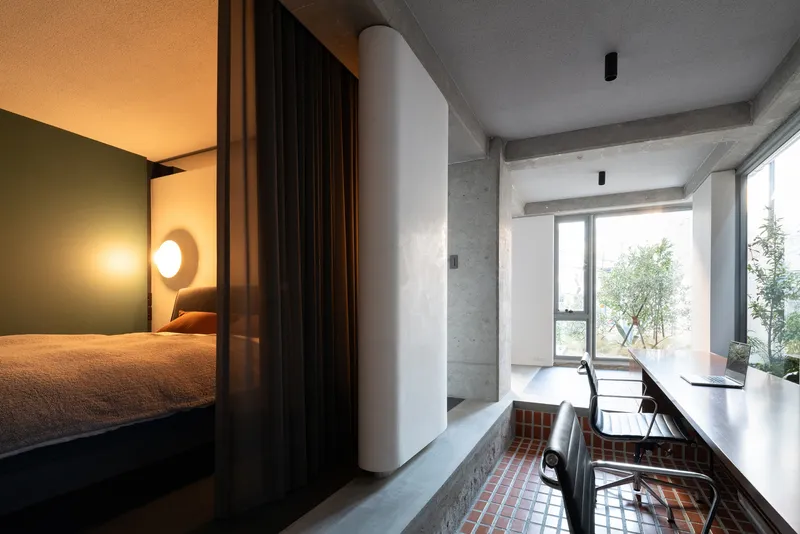
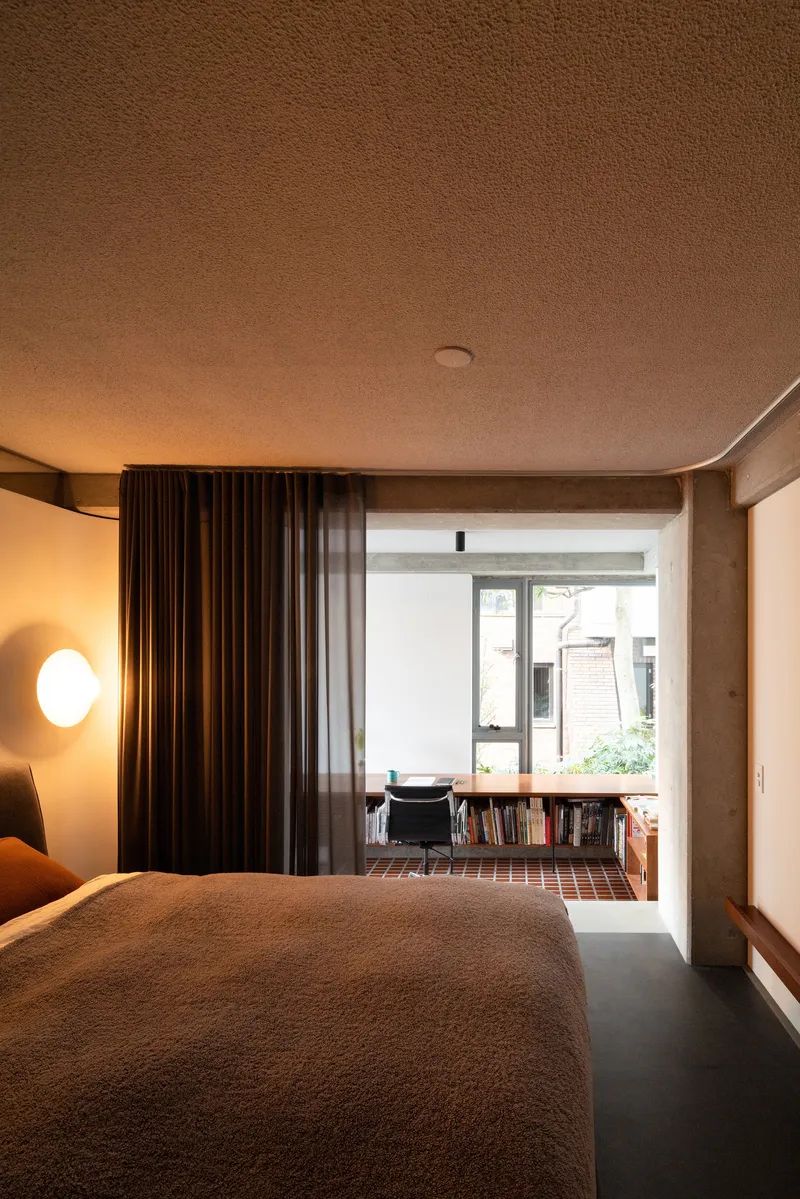
The apartment is occupied by two creative professionals, and the plan reflects a deliberate choice to let work and domestic life overlap. The living and dining zones are divided by a white partition, but it is low and permeable enough that the two spaces remain in visual conversation. A bedroom alcove with circular wall sconces sits steps from a workspace defined by a desk and bookshelves at the window. Brown curtains provide the only separation, and their softness reads as intentional informality rather than compromise.
The refusal to designate strict "office" and "home" zones reflects a broader trend in post-pandemic spatial design, but here it feels rooted in something older: the Japanese tradition of multipurpose rooms that shift function throughout the day. The 96-square-meter footprint would strain under rigid programming. By keeping boundaries soft, YNAS makes the apartment feel significantly larger than its numbers suggest.
Kitchen as Social Core
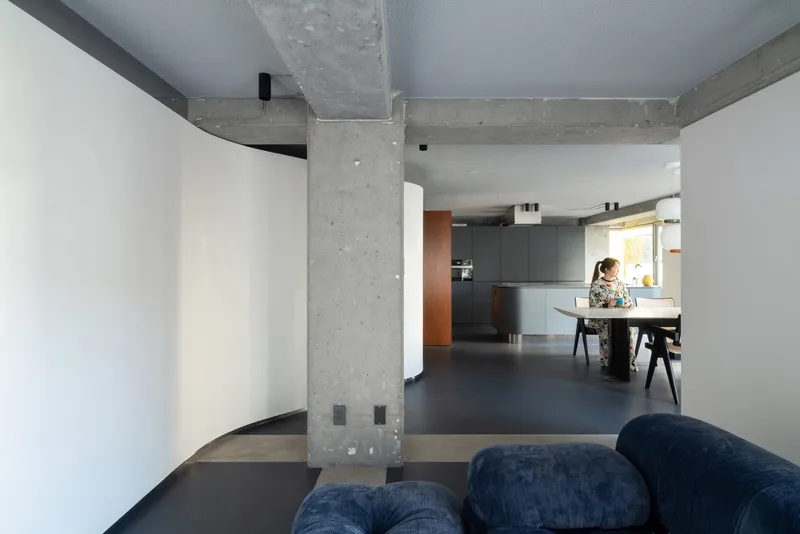
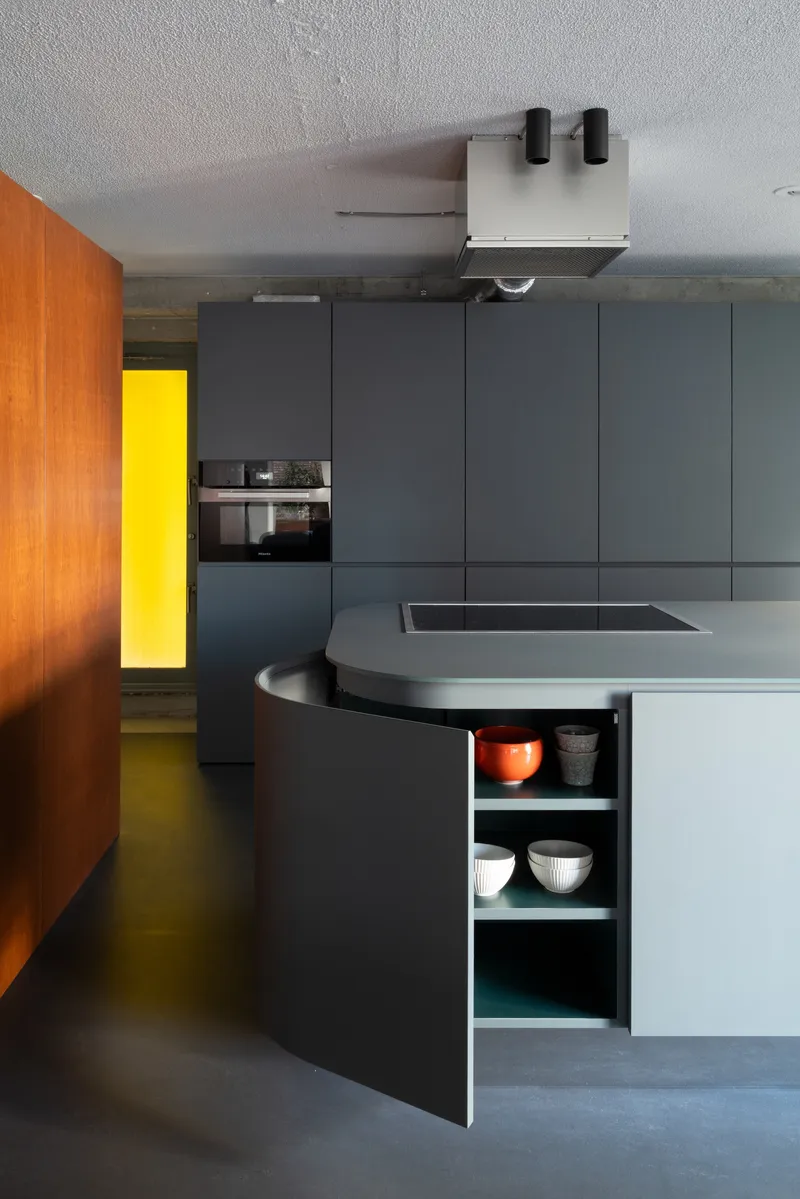
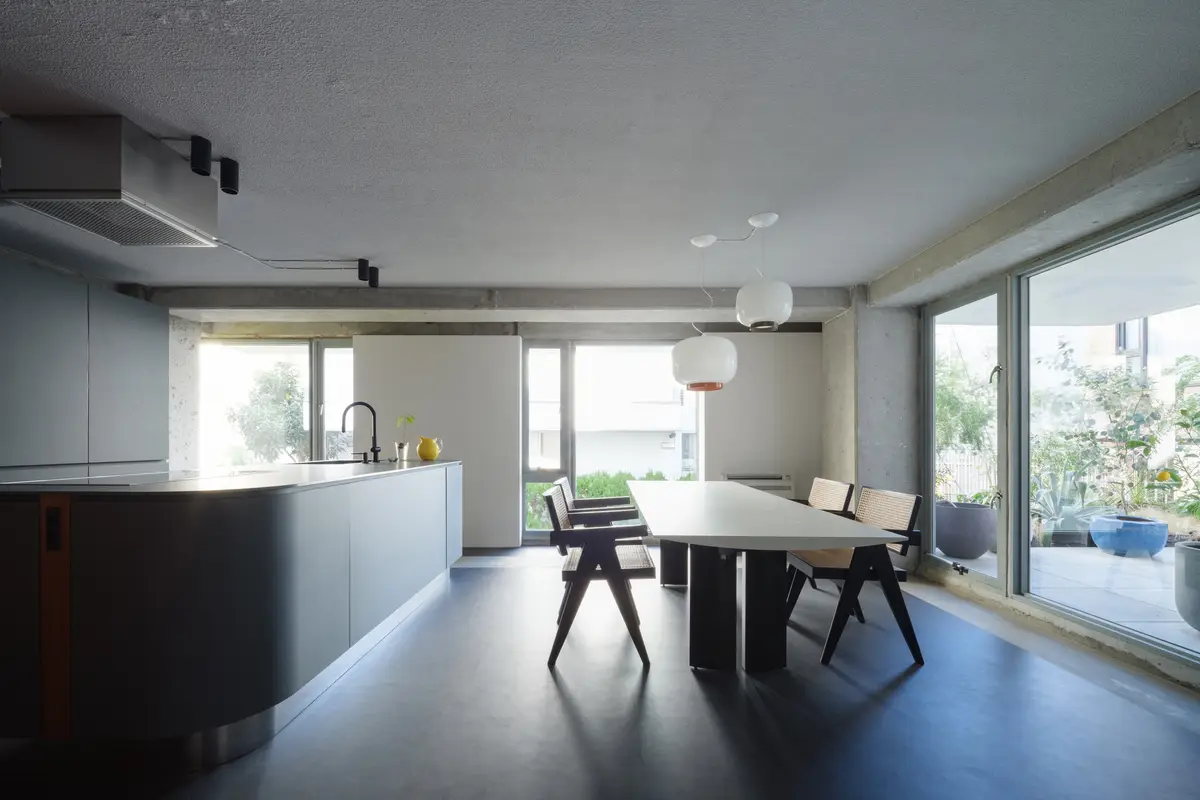
The kitchen anchors the plan. A curved island with open storage shelving sits at the intersection of several sight lines, visible through the exposed concrete columns from the living area and opening directly to the planted terrace through full-height glazing. It is both a workspace and a display case: bowls and dishware sit on white shelves behind curved cabinet doors, treated as objects worth seeing.
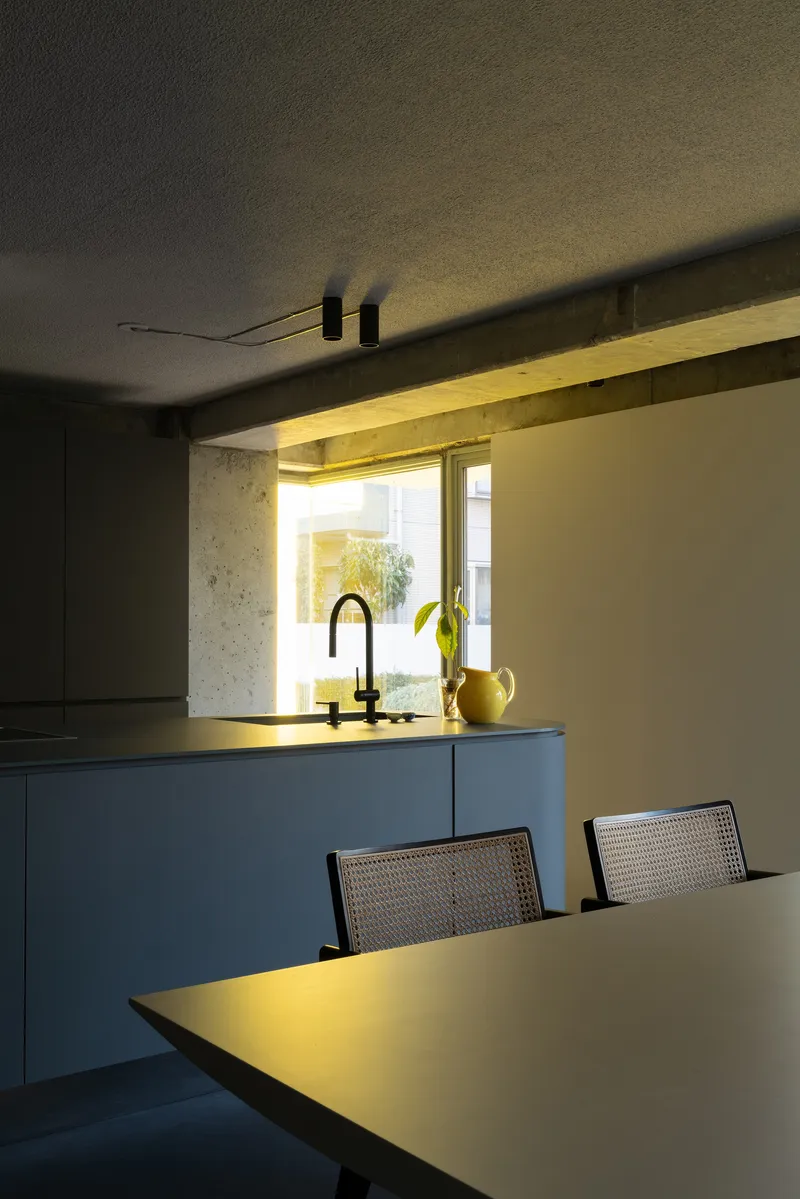
A concrete window niche at the kitchen sink is fitted with integrated yellow lighting, creating a warm frame at dusk that turns a utilitarian moment into something almost theatrical. A yellow pitcher on the ledge is either carefully staged or the product of people who understand that a renovation lives or dies by how it absorbs daily life. Either way, the detail lands.
The Building in Its Garden
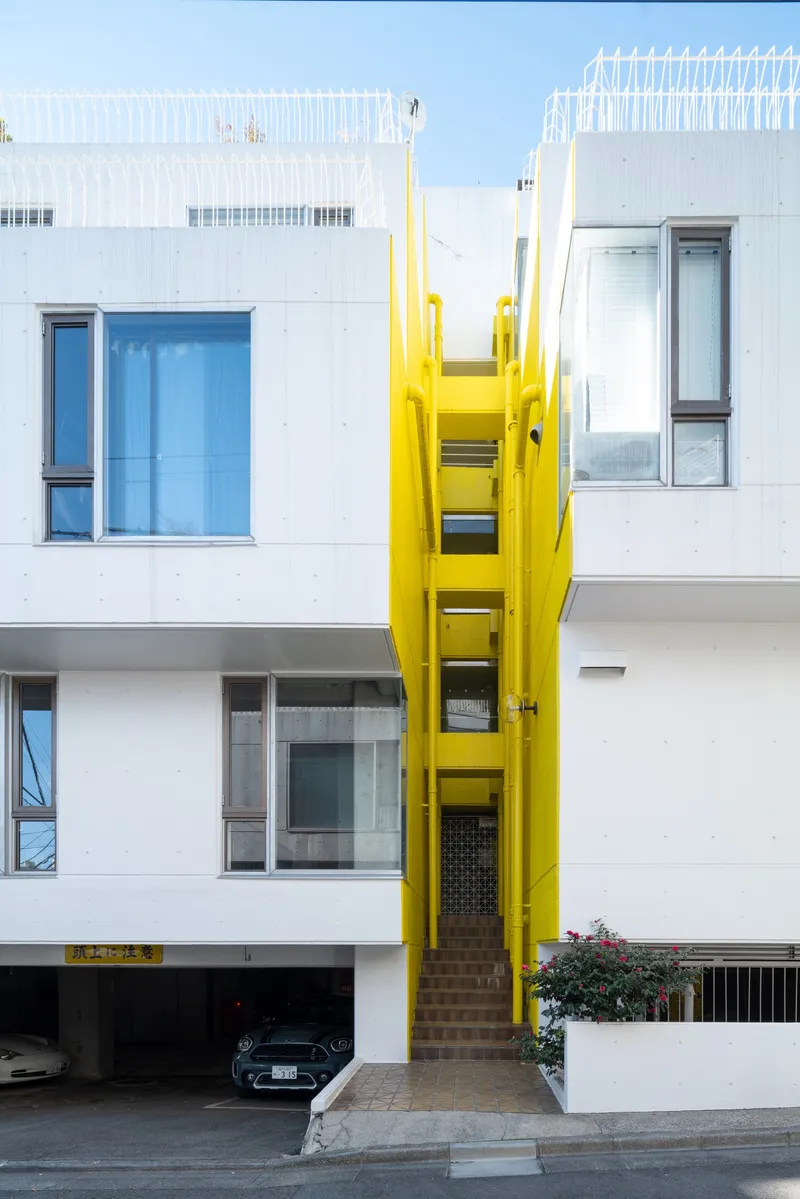
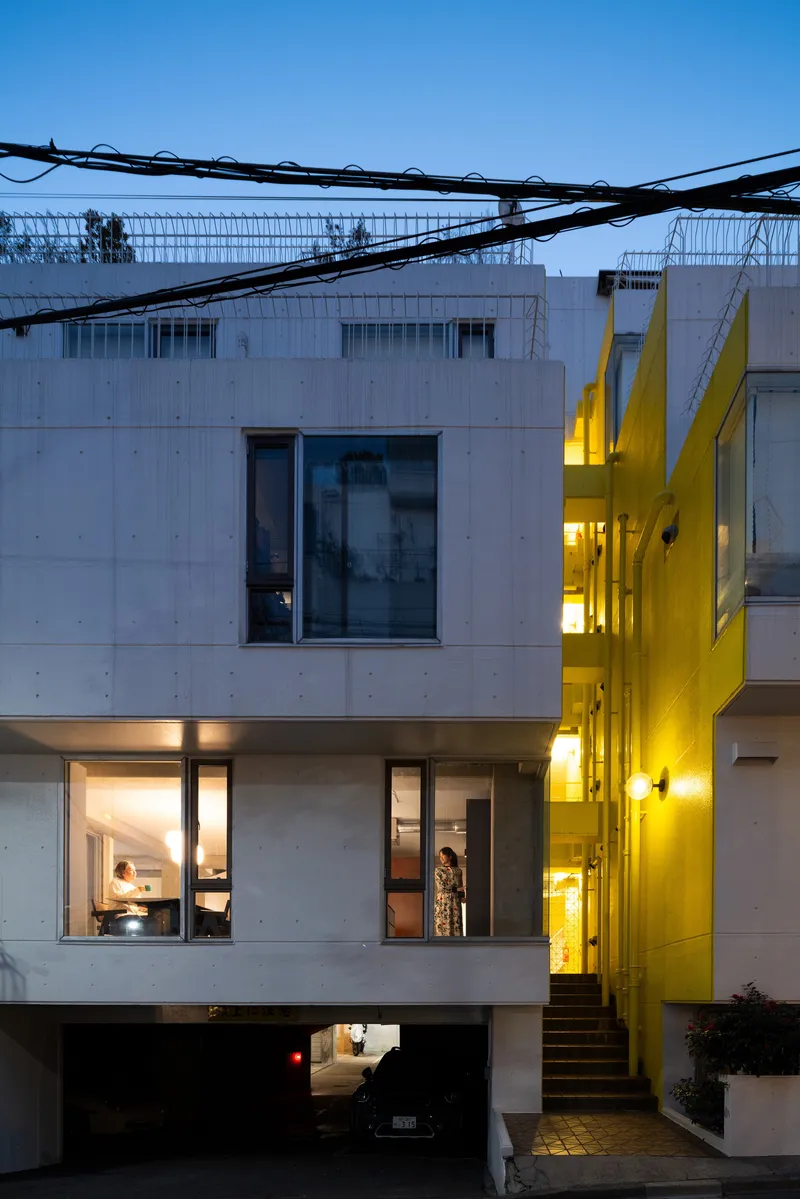
Sakakura's building, with its yellow-painted exterior stair and staggered window composition, sits in a landscape of planted beds and mature trees. The yellow hue of the stair shaft is distinctive and unapologetic, a move that feels more European modernist than typical Tokyo residential. At twilight, the white concrete facade and yellow-lit stair create a composition that explains why YNAS saw value in preservation rather than replacement.
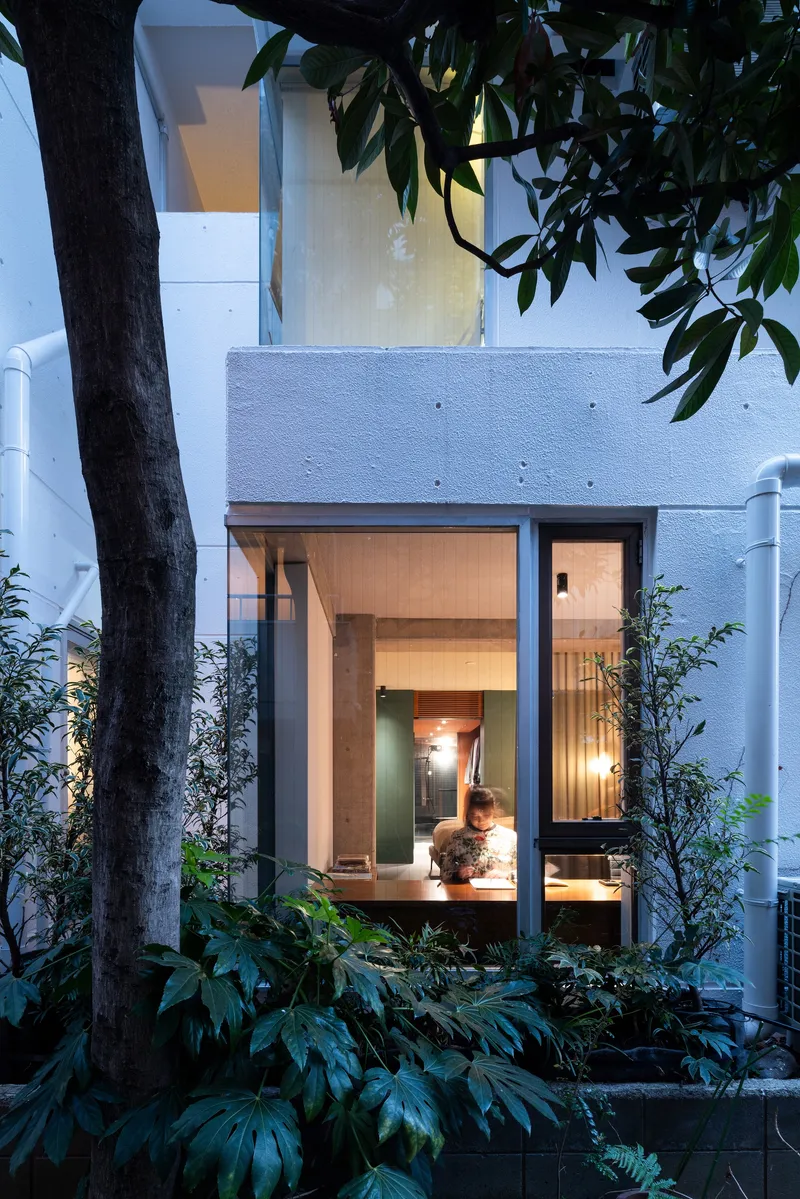
The glass-walled ground floor, illuminated at dusk and framed by a tree, reveals the building's generous relationship with its site. This is not a building crowded onto a lot. It breathes, and the planted beds at its base connect interior and exterior in a way that the terrace off the renovated apartment continues at the upper level.
Plans and Drawings
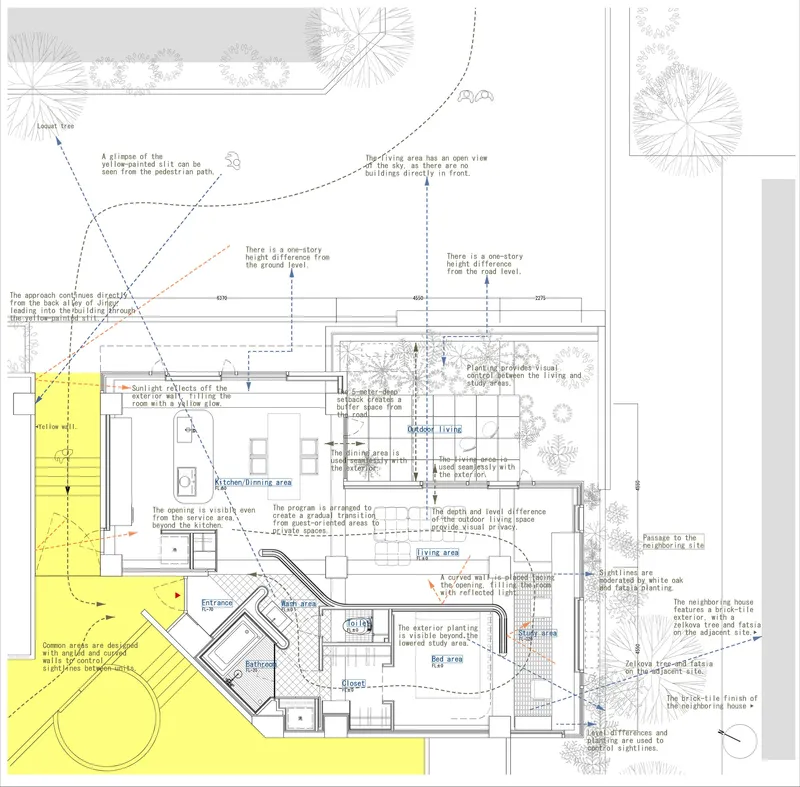
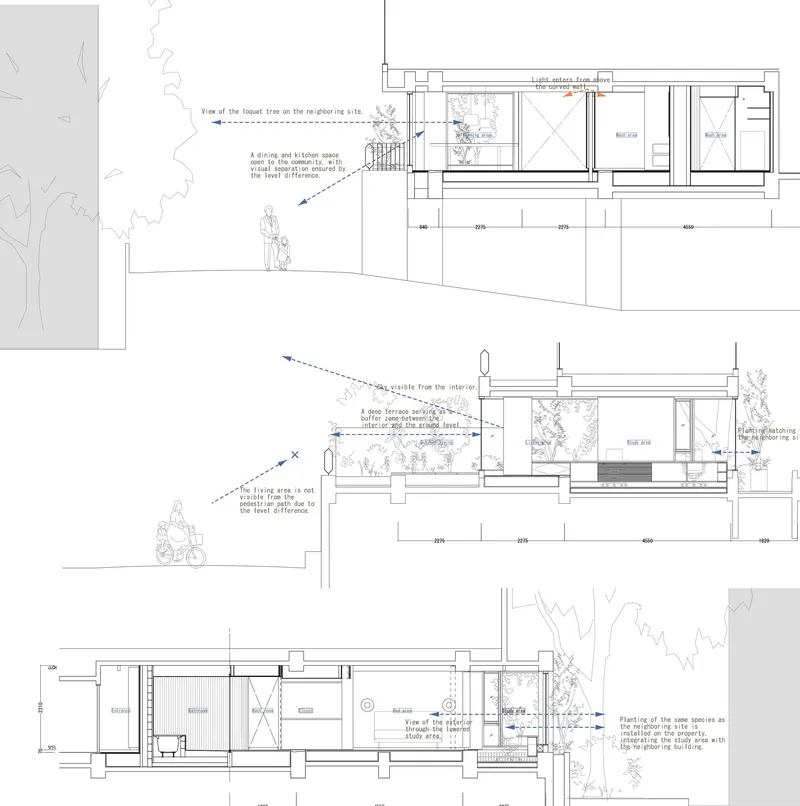
The annotated floor plan reveals the entry sequence and the careful positioning of outdoor living spaces relative to the interior. Yellow highlighting traces the threshold from corridor to main living volume, making the choreography of arrival legible. The section drawings show split-level relationships within the unit and the way interior spaces engage with surrounding trees, confirming that the terrace is not an afterthought but a structural extension of the living plan.
The 600mm structural grid inherited from Sakakura's original design is visible in the plan's proportioning. YNAS worked within this module rather than fighting it, aligning new partitions and cabinetry to the existing rhythm. The result is a renovation that reads as disciplined rather than decorative, its curves and color choices operating within a geometric logic that predates them by fifty years.
Why This Project Matters
Jingu Studio makes a pointed argument in a country where it is often cheaper and faster to demolish than to renovate. By working within a Junzo Sakakura building, YNAS raises the stakes: this is not just any aging apartment block but a work by one of Japan's significant modernist architects. The renovation demonstrates that preservation and contemporary living are not in tension. The exposed structure, the new curves, the colored tiles, and the soft programmatic boundaries all coexist without requiring the erasure of the original architecture.
More broadly, the project offers a model for how young practices can build credibility through intelligent renovation rather than new construction. YNAS, established in 2024, chose a first project that demands both technical skill and cultural sensitivity. The result is a 96-square-meter apartment that punches well above its weight, proving that thoughtful intervention can add value to aging buildings rather than merely extending their lifespan. In a construction culture defined by planned obsolescence, that is a position worth defending.
Jingu Studio by YNAS (lead architect: Yuko Numata), Tokyo, Japan. Renovation of Villa Serena 204. 96 m², completed 2024. Photography by Shinkenchiku Sha, Masao Nishikawa, and Mariko Yasaka.
About the Studio
Share Your Own Work on uni.xyz
If projects like this are the kind of work you want to make, uni.xyz is a place to publish your own, find collaborators, and enter design competitions.


Popular Articles
Popular articles from the community


Juan García Correa, John González and Claudia Rueda Sink a Circular Amphitheater into a Manizales Engineering Building
On the La Nubia campus in Manizales, Colombia, the S1 Building folds labs and offices into a hillside of ramped lawns that double as a campus route.

David Ortega Stacks a Two-Story Mexico City Penthouse Around a Steel Stair and a Pergola-Shaded Roof Terrace
In Colonia Roma, a 300 m² penthouse uses oak joinery, a planted steel stair and a slatted roof pergola to make a new-build apartment feel like a house.

U.GA Architects Wraps an Oval Rooftop Pool in Curved Board-Formed Concrete on Busan's Jeollidan-gil
In Busan's Jeonpo-dong, a 454 m² mixed-use block stacks a neighborhood facility, guest rooms and an oval rooftop pool inside spiraling concrete walls.

GROUP A Strips a 1969 Rotterdam Harbor Headquarters to Its Frame and Wraps It in Timber Louvers
In Rotterdam's M4H harbor district, Ferro Offices reuses a 1969 frame, adds one timber storey and reaches BREEAM-NL Outstanding.

Similar Reads
You might also enjoy these articles


LAVA Architecten Gives Vocational Education a Sawtooth-Roofed Face on a Mechelen School Campus
In Mechelen, Belgium, a 2,053 m² STEM school on a 6×6 m grid turns workshops and classrooms into rooms that can be rearranged as teaching changes.

KEMA Studio Turns a Derelict Marvila Attic into a 60 m² Lighthouse Apartment Above Lisbon
In Lisbon's Marvila district, a rebuilt roof, four skylights and two plywood volumes turn an unlivable attic into a bright home facing the Tagus.

Pixel Gardens: One Repeated Module Stacked Into a Terraced Social Housing Tower for Famagusta
Salem Bader's shortlisted housing tower builds a vertical neighbourhood from one repeated module, offsetting units to carve terraces, light and air.

Bao Huynh Watercolor Atelier: A Serene Art Retreat in Hội An
Bao Huynh Watercolor Atelier in Hội An blends multifunctional art spaces, sustainable design, local materials, and family-friendly living in a serene environment.

Explore Renovation Competitions
Discover active competitions in this discipline

Challenge to design luxury tourism on rails

VR headsets Storefront design competition

Designing a staircase for a client
Comments (0)
Please login or sign up to add comments
No comments yet. Be the first to comment!