

ZHA's Hangzhou Waterfront Bends Urbanism to Water
Zaha Hadid Architects shapes a new cultural district around Hangzhou's Qiantang Bay, turning canal infrastructure into civic choreography.


Hangzhou has spent centuries building its identity around water. The Grand Canal, West Lake, the Qiantang River: each has anchored a different chapter of the city's evolution. Now Zaha Hadid Architects is writing a new one along the Zhedong Canal in the Xiaoshan district, proposing a cultural district that treats the waterfront not as an edge condition but as the organizing spine of an entirely new piece of city.
What makes this scheme worth attention is not simply its formal ambition, which is considerable, but the way it attempts to dissolve the boundary between infrastructure, landscape, and public program. The design clusters a series of pavilion volumes along a central water axis, connecting them with elevated pathways that double as viewing platforms over a restored canal ecology. It is an argument that cultural districts do not need monumental anchors; they can instead be distributed, porous, and shaped by the terrain they occupy.
A Landscape of Connected Pavilions


Seen from above, the district reads as a constellation of curved white roof forms scattered across a deep green park. Each pavilion is its own entity, scaled more like a generous public room than a civic monument. The decision to break the program into discrete volumes rather than consolidating it into a single mega-structure is the project's most consequential move. It creates a district that can be experienced at walking speed, where the intervals between buildings matter as much as the buildings themselves.
Elevated pedestrian bridges stitch the pavilions together, lifting circulation above the park canopy and establishing a secondary datum that orients visitors toward the water. In the golden hour rendering, these timber walkways glow warmly against the cooler shell-like roofs, suggesting a deliberate material contrast between the connective tissue (warm, tactile, directional) and the pavilions it links (smooth, reflective, autonomously shaped). The effect is less campus and more archipelago.
The Water Edge as Public Face

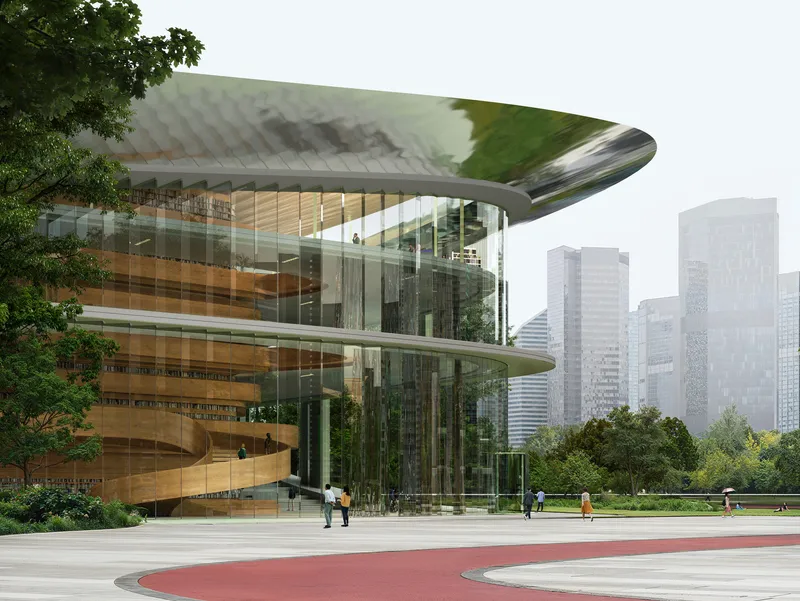
The project's most compelling elevation faces the canal. Here the architecture steps down in layered horizontal terraces that blur the line between building, garden, and quay wall. Roof gardens cascade toward the water, and the facade appears to dissolve into its own reflection, an effect that collapses the distance between structure and landscape. It is a rare instance where a ZHA project feels genuinely interested in repose rather than spectacle.
At ground level, the glass curtain wall entry sequence reveals a curving timber stair beneath a sweeping reflective ceiling. The interior language maintains the exterior's fluidity but translates it into warmer, more intimate materials. Timber dominates the circulation zones, grounding what could otherwise feel clinical. The reflective soffit overhead pulls parkland light deep into the interior, a detail that suggests the design team thought carefully about how these spaces will perform on overcast Hangzhou afternoons, not just in idealized renders.
Distributing Culture Instead of Concentrating It
Chinese cities have produced no shortage of cultural mega-projects over the past two decades, many of them signature buildings by international offices dropped onto cleared superblocks. The Qiantang Bay scheme pushes back against that model. By fragmenting the program into linked pavilions woven through a restored landscape, the project proposes that a cultural district gains civic value through permeability. You should be able to wander in without knowing where the park ends and the institution begins.
Whether the final built work delivers on that promise will depend on how much of the landscape strategy survives construction and how genuinely public the ground plane remains. But the intent is clear, and it represents a mature evolution in ZHA's approach to large-scale urban projects, prioritizing connectivity and topographic response over singular formal gestures.
Why This Project Matters
The Qiantang Bay Cultural District matters because it tests an alternative model for how signature architecture firms can operate at the district scale. Rather than designing one unforgettable object, ZHA has proposed a system: a family of forms, a network of paths, a gradient from water to park to interior. The risk is that the individual buildings become too diffuse to carry cultural weight on their own. The reward, if it works, is a public realm where architecture serves as connective infrastructure rather than competing with it.
For Hangzhou, a city already literate in the relationship between water and civic life, the project has the potential to extend a tradition rather than disrupt it. The Zhedong Canal has been a working waterway for centuries. Reframing it as a cultural axis, lined with terraced gardens and porous pavilions, is an act of continuity dressed in contemporary language. That balance, between heritage logic and formal invention, is what makes the scheme worth following as it moves toward realization.
Architect: Zaha Hadid Architects. Location: Xiaoshan District, Hangzhou, China. Year: Unbuilt / In Design. Area: Not disclosed. Photographer: Zaha Hadid Architects (renderings).
About the Studio
Share Your Own Work on uni.xyz
If projects like this are the kind of work you want to make, uni.xyz is a place to publish your own, find collaborators, and enter design competitions.


Popular Articles
Popular articles from the community


longwave studio Reorganizes a 112 m² Tainan Apartment Around the Daily Routines of a Family and Two Cats
In Tainan, Taiwan, birch plywood, rust-red furniture and a freestanding plaster wall link arrival, storage, work and family life in one apartment.

Cube Design Draws an Ecological Corridor Between Two Shenzhen Hills with the Nankai Building
Beside Shenzhen's container docks, the Nankai Building pairs stacked balconies with a climbing green screen to connect two hillsides across its height.

GROUP A Strips a 1969 Rotterdam Harbor Headquarters to Its Frame and Wraps It in Timber Louvers
In Rotterdam's M4H harbor district, Ferro Offices reuses a 1969 frame, adds one timber storey and reaches BREEAM-NL Outstanding.

David Macias Steps a Doorless Stone and Plaster House Down a Tropical Colombian Hillside
In the humid hills of Colombia, Threshold House replaces the front door with an open void and terraces its 850 m² down the slope instead of fighting it.

Similar Reads
You might also enjoy these articles


LAVA Architecten Gives Vocational Education a Sawtooth-Roofed Face on a Mechelen School Campus
In Mechelen, Belgium, a 2,053 m² STEM school on a 6×6 m grid turns workshops and classrooms into rooms that can be rearranged as teaching changes.

KEMA Studio Turns a Derelict Marvila Attic into a 60 m² Lighthouse Apartment Above Lisbon
In Lisbon's Marvila district, a rebuilt roof, four skylights and two plywood volumes turn an unlivable attic into a bright home facing the Tagus.

Pixel Gardens: One Repeated Module Stacked Into a Terraced Social Housing Tower for Famagusta
Salem Bader's shortlisted housing tower builds a vertical neighbourhood from one repeated module, offsetting units to carve terraces, light and air.

Bao Huynh Watercolor Atelier: A Serene Art Retreat in Hội An
Bao Huynh Watercolor Atelier in Hội An blends multifunctional art spaces, sustainable design, local materials, and family-friendly living in a serene environment.

Explore Infrastructure Design Competitions
Discover active competitions in this discipline

Challenge to design a portable theatre

Challenge to design a portable music platform

Challenge to design an open learning module for the elderly
Comments (0)
Please login or sign up to add comments
No comments yet. Be the first to comment!