


African Architecture
Architecture and design projects across Africa, exploring local materials, sustainable practices, and cultural contexts.
African architecture is the built work of a continent of 54 countries and thousands of building cultures, from the dry stone walls of Great Zimbabwe and the rock-hewn churches of Lalibela to Sahelian earthen mosques, Swahili coral stone towns, colonial forts, modernist capitals and the climate-led practice of architects such as Francis Kéré. It is not one style. It is best read tradition by tradition and period by period, each shaped by its own climate, materials, trade routes and politics.
What is African architecture?
The phrase covers an enormous range: courtyard houses in the Maghreb, earthen granaries in the Sahel, timber and thatch compounds in the forest belt, stone towns on the Indian Ocean, high plateau churches in Ethiopia, and the steel and concrete towers of Lagos, Nairobi and Johannesburg. Treating all of this as a single "African style" flattens it, and usually reduces it to a few photogenic mud buildings. A more honest definition is geographic and historical: architecture made on the continent, by its peoples and by those who settled, traded or ruled there, across roughly two thousand years of recorded building.
Three ideas help to organise that range. First, climate drives form far more than ornament does: shade, airflow, thermal mass and rain protection explain most traditional plans. Second, materials are local and often communal, which is why earth, stone, coral, timber, bamboo and thatch recur, and why so many buildings are maintained collectively rather than finished once. Third, African architecture has always been connected to the wider world through trade, religion and conquest, so Islamic, Christian, Indian Ocean, European and modernist influences sit alongside indigenous ones rather than replacing them.
The field overlaps with vernacular architecture and with earth architecture, but it is wider than both. It includes monumental and institutional work, colonial building and its afterlife, post-independence modernism, and a contemporary scene that is designed and built on the continent and increasingly exported from it.

A short history of African architecture
No short history can be complete, so what follows is a handful of well-documented milestones rather than a survey.
Great Zimbabwe and the stone enclosures of the south
Great Zimbabwe, near Masvingo, was settled from around 1000 AD, with major construction between the 11th and 15th centuries by ancestors of the Shona people. The Great Enclosure, built in the 13th and 14th centuries, has dry stone walls about 11 metres high laid without mortar, and more than 400 smaller "zimbabwes" are known across southern Africa. The site's history is also a lesson in politics: the white government of Rhodesia pressured archaeologists to deny that Black Africans built it, and its African origin only became scholarly consensus in the 1950s. The Zamani Project at the University of Cape Town has laser-scanned the Great Enclosure and the Hill Complex.

Lalibela's rock-hewn churches
In the Ethiopian highlands, the eleven churches of Lalibela were cut downward into soft volcanic tuff, some into cliff faces and others into pits reached by trenches. They are traditionally linked to the Zagwe king Gebre Meskel Lalibela (reigned around 1181 to 1221) and his project of a symbolic New Jerusalem. Bete Giyorgis, the Church of Saint George, was carved downward from a single mass of tuff and stands in an artificial trench: architecture made by removal rather than assembly.

Sahelian earth and Swahili stone
Across the West African Sahel, Sudano-Sahelian architecture uses mudbrick and adobe plaster, with timber beams projecting from the walls that double as scaffolding when the community replasters them. The earliest permanent mudbrick in the region appears at Jenné-Jeno in Mali, and the tradition runs through the Great Mosque of Djenné and Timbuktu's Djinguereber Mosque. On the east coast, Swahili architecture developed as a distinct local tradition, and towns such as Kilwa Kisiwani and Lamu were built in coral stone with mangrove poles. Kilwa's Great Mosque, with 16 domed and vaulted bays, is the oldest standing mosque on the East African coast.
"The city of Kilwa is amongst the most beautiful of cities and elegantly built."
Ibn Battuta, as quoted by the Zamani Project (14th century)
Colonial building, modernism and the present
European building arrived on the coast with trading forts such as Elmina Castle in Ghana, founded by Portugal in 1482, which later became a centre of the trans-Atlantic slave trade. Colonial rule brought planned capitals and imported styles. Most of central Asmara in Eritrea was built under Italian rule between 1935 and 1941, and the city was listed as a World Heritage Site in 2017 for its early modernist urbanism. The present chapter is led increasingly by architects from the continent: Diébédo Francis Kéré, born in Gando, Burkina Faso, was named the 2022 Pritzker Prize Laureate.
Key principles of African architecture
These are not rules shared by every building on the continent. They are recurring design logics that show up across many traditions and in the best contemporary work.
Design for heat, light and air
In much of Africa the problem is too much heat rather than too little. Kéré's primary school in Gando, which won an Aga Khan Award in 2004, pairs compressed earth block walls with a raised metal roof that lets cooling air flow between roof and ceiling. The same thinking shapes his Goethe-Institut in Dakar, covered in our journal: a double-skin facade of compressed laterite brick that filters light, encourages cross-ventilation and shields users from the dusty harmattan wind.

Build with the ground underfoot
Earth, stone, coral and timber recur because they are at hand and suit the climate. On uni.xyz, InsideOut School: Earth prototype in Ghana by francesca vittorini shows the principle at small scale: a school prototype in Yeboahkrom, built with the local population and international volunteers after wind destroyed the area's only school. The BAMA House journal describes rammed earth walls mixed and compacted on site on the Ghanaian coast.

Make building a shared process
Communal replastering in the Sahel and community-built schools in Burkina Faso share a belief that how a building is made matters as much as what it looks like. The Pritzker jury put it directly.
"He knows, from within, that architecture is not about the object but the objective; not the product, but the process."
Organise life around open space
Courtyards, verandas and shaded thresholds carry daily life in many traditions. Contemporary projects in our journals keep the idea: a planted courtyard at the centre of LOCALARCHITECTURE's Villa CROCODILE in Abidjan, shaded courtyards in Studio 1:1 Design's House E at Shela on the Kenyan coast, and a courtyard around a mature baobab at the Dakar Goethe-Institut.
Let craft carry identity
Pattern and craft often express identity better than borrowed historic forms. The Côte d'Ivoire embassy in Pretoria by GLH Architects wraps an oval volume in a perforated white screen that reads like woven cloth, and the Mami Dan temple in Benin borrows its structure from basketry rather than copying shrine forms.
African architecture on uni.xyz
The topic gathers more than sixty projects and over fifty journals. Many projects come from competitions with African sites, especially chapels for Ethiopia and housing in West Africa, while the journals track built work across the continent.
The most liked project is Eco Chapel Ethiopia by Andres Felipe Pinzon Holguin, which received a People's Choice Award in the Eco-Chapel competition under the motto "Water as a Source of Life". The same competition produced Robert Mannion's Urban Eco-Chapel, an Editor's Choice proposal for an ecological reserve, community space and place of worship in Addis Ababa, and An Urban Forest by GIUSEPPE MAZZEO and Stefano Pirazzi, also Editor's Choice, which takes the Tewahedo tradition of the chapel in the forest as its starting point.

Housing in West Africa is the other strong thread. THE TREE HOUSE by Rafaella Calderon and Abigail Bourg, a People's Choice Award winner in the Earth Made competition, proposes community housing in Bolgatanga, Ghana, that showcases locally sound building materials. Earthen Oasis by Jared Sliman, Lauren Cantu and Tanner Theisen, entered in the Earth Made 2020 competition, combines vertical living with earth block construction in the airport residential district of Accra. The InsideOut School, mentioned above, was a winning entry in the UnIATA '18 competition.

The journals add built work and critical reading. Our article on the Mami Dan Temple by Maison Bignon Sossou describes a 770 m² Vodun complex in the coastal village of Toligbé in Benin, in the Ouidah area, where banded rammed earth meets a woven bamboo canopy, and makes the case for invention over revival.
"That is a riskier move than revivalism, and in our view a more honest one."
UNI Editorial, on the Mami Dan Temple of Toligbé Cultural Center
Other journals cover Kéré Architecture's Goethe-Institut in Dakar, a 1,800 square metre campus built almost entirely of compressed laterite brick; the Thomas Sankara Mausoleum in Ouagadougou, also by Kéré; and House E, an 852 m² residence that draws on Swahili coral stone and carved timber traditions.

Challenges and future directions
The most pressing challenge is scale. Many African cities are growing fast, and the default response is a concrete frame, sealed glass and air conditioning, which the Lagos Wooden Tower journal describes as the familiar formula of new towers. Earth and timber work well for schools, houses and cultural buildings, but they still have to prove themselves in dense, tall and affordable housing at speed.
A second challenge is how the field is represented. Outside the continent, African architecture is still too often reduced to mud and thatch, while the colonial record is discussed as heritage without its violence. Great Zimbabwe shows how easily history can be bent for political ends, and a fair reading of Elmina or Asmara has to hold both the architecture and the regimes that produced it.
Third, there is the question of who designs. A growing number of practices are based on the continent, and education, publishing and competition juries are slowly following. Future work is likely to combine local materials with engineering evidence, such as tested earth blocks and measured comfort, rather than relying on image alone.

African architecture for students and designers
Strong thesis topics come from specific places rather than the continent as a whole. You could test compressed earth or laterite in a mid-rise housing block for a named West African city, document a Swahili coral stone house and propose a sympathetic extension, or study how a colonial building could be reused without erasing its history. Climate analysis is a good starting point: sun path, prevailing wind and rainfall usually explain more than style does. Related topics on uni.xyz include rammed earth and tropical modernism. Briefs with African sites appear regularly among the open architecture competitions.
Frequently asked questions
Is there one African architectural style?
No. Africa has 54 countries and many distinct building traditions, from Sahelian earthen mosques and Swahili stone towns to Ethiopian rock-hewn churches and Maghrebi courtyard houses. It is more accurate to speak of regional traditions and historical periods.
What materials are used in traditional African architecture?
Local materials dominate: earth as mudbrick, adobe or rammed earth, dry stone, coral stone, timber, bamboo and thatch. Choice depends on region. Coral stone and mangrove timber define the Swahili coast, while mudbrick with adobe plaster defines much of the Sahel.
Who built Great Zimbabwe?
Great Zimbabwe was built by ancestors of the Shona people between roughly the 11th and 15th centuries. Colonial-era claims that it had foreign builders were politically motivated and have been rejected by scholars since the 1950s.
Who is Francis Kéré?
Diébédo Francis Kéré is an architect born in Gando, Burkina Faso, in 1965 and based in Berlin. He received the Pritzker Architecture Prize in 2022, and his first building, the Gando Primary School, won an Aga Khan Award for Architecture in 2004.
References and further reading
- Diébédo Francis Kéré, The Pritzker Architecture Prize
- Jury Citation: Diébédo Francis Kéré, The Pritzker Architecture Prize
- Primary School, Gando, Aga Khan Award for Architecture (AKDN)
- Great Zimbabwe, Zamani Project, University of Cape Town
- Lalibela Rock-Hewn Churches, Zamani Project, University of Cape Town
- Kilwa Kisiwani, Zamani Project, University of Cape Town
- Great Zimbabwe, Wikipedia
- Sudano-Sahelian architecture, Wikipedia
- Asmara, Wikipedia


Popular projects
View all 61 projects


Latest journals
View all 54 journals

Maison Bignon Sossou Weaves a Bamboo Canopy over a Rammed Earth Vodun Temple in Ouidah
In the coastal village of Toligbé, Benin, a 770 m² temple to Mami Dan pairs banded rammed earth with woven bamboo to give living Vodun ritual a home.

LOCALARCHITECTURE Shades a Swiss Diplomat's Abidjan Residence under a Folded Concrete Roof
In Abidjan, a 305 m² residence for Switzerland's deputy head of mission pairs perforated brick, board-marked concrete and a planted courtyard.
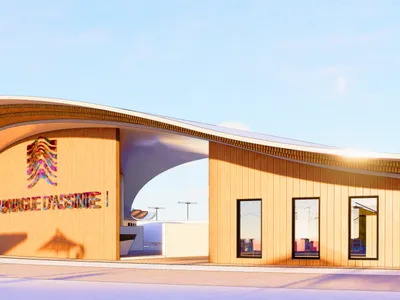
LA VAGUE D'ASSINIE
A Bioclimatic Tropical Hotel on the Ivorian Coast Assinie, Côte d'Ivoire · 1.5 ha · Hospitality & Leisure Raphael Bienvenu A. Abidjan School of Architecture
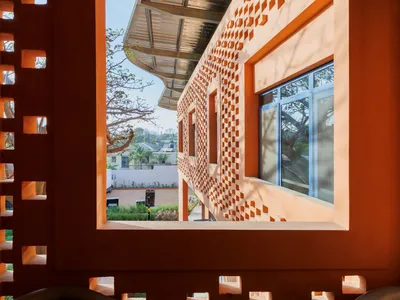
Kéré Architecture Builds the First Purpose-Built Goethe-Institut Around a Baobab Tree in Dakar
A compressed laterite earth campus in Senegal channels bioclimatic wisdom and oral culture traditions into a new civic landmark.


