
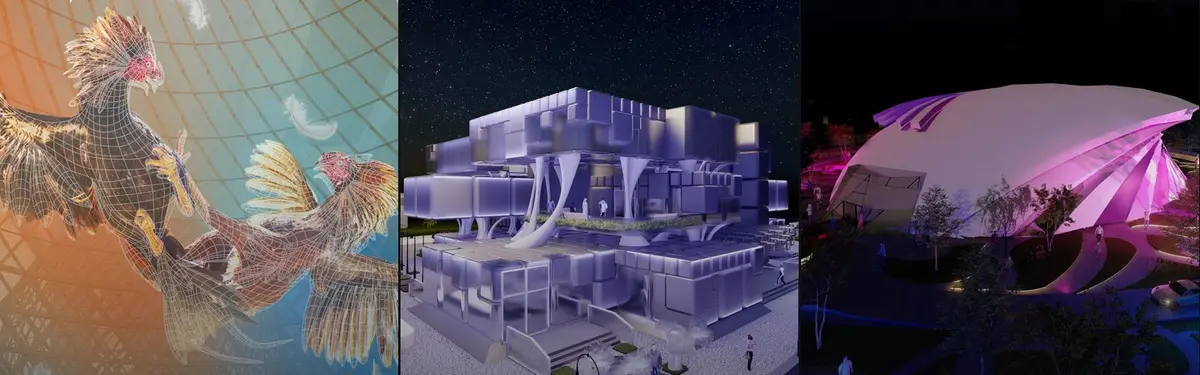


AR/VR
Augmented and virtual reality applications in architecture, design, and spatial experiences.
Augmented reality (AR) lays digital content over a live view of the physical world, while virtual reality (VR) replaces that view with a computer-generated environment. In architecture and design, both are used to walk through buildings before they exist, review models at full scale with clients and colleagues, overlay plans on a real site, and test how a space will feel to the people who will use it.
What are AR, VR and mixed reality?
The clearest way to separate the terms is the reality-virtuality continuum, introduced in 1994 by Paul Milgram of the University of Toronto with Haruo Takemura, Akira Utsumi and Fumio Kishino. At one end sits the real environment, at the other a fully virtual one. Everything in between is mixed reality. Augmented reality is the part close to the real end, where digital objects are added to what you see. Augmented virtuality is the part close to the virtual end, where real elements enter a mostly digital scene.
In practice, VR means a headset or a projection room that surrounds you with a modelled world, so that turning your head turns the view. AR usually means a phone, tablet or see-through headset that pins a model to a table, a wall or a building site. Mixed reality (MR) is often used for headsets that do both and let virtual objects respond to real surfaces. Extended reality (XR) is an umbrella term for all of them.
For designers, AR and VR are not a separate discipline but a way of seeing and testing work. They sit next to 3D visualization, which produces the models and renders, and virtual reality as a broader subject. The difference from a render is presence: a person inside a VR model judges height, distance and enclosure with their body, not only their eyes.
A short history of AR and VR
The ultimate display. In a 1965 paper the computer scientist Ivan Sutherland described a display that would go far beyond a screen.
"The ultimate display would, of course, be a room within which the computer can control the existence of matter. A chair displayed in such a room would be good enough to sit in."
Ivan Sutherland, "The Ultimate Display", Proceedings of IFIP Congress (1965)
The first head-mounted display. Around 1968 Sutherland, then at Harvard, built a head-mounted 3D display with his student Bob Sproull and others. The Computer History Museum notes that it was nicknamed "The Sword of Damocles" because of the large overhead beam needed to carry its weight, and that an early application showed a wire-frame room users could explore by moving their heads. A modelled room explored by moving your head is still the basic idea behind every architectural walkthrough in a headset.
The CAVE. In 1992 Carolina Cruz-Neira, Daniel J. Sandin and Thomas A. DeFanti created the Cave Automatic Virtual Environment at the Electronic Visualization Laboratory of the University of Illinois Chicago. Instead of a headset, images were projected on the walls and floor of a small room, so several people could stand inside a model together. That shared, room-scale idea is still how many design teams prefer to review work.

Consumer headsets. The 2010s brought VR within reach of studios and schools. Oculus VR launched a crowdfunding campaign for the Rift in August 2012, shipped its first development kit in 2013 and released the consumer headset in March 2016. Phone-based AR and standalone headsets followed, and architects began taking VR to client meetings instead of renting specialist rooms.
How AR and VR are used in architecture and design
Design review and client walkthroughs
The most common use is simple: put on a headset and walk through the design. Clients who struggle with plans and sections can understand a room at eye level, see what the view from a window will be, and notice that a corridor feels narrow. Design teams use the same walkthroughs to catch problems with sightlines, daylight and proportion before they reach site.
Collaborative BIM review and on-site AR
Building information models carry more than geometry, and immersive review lets architects, engineers and contractors meet inside the same model, sometimes from different cities. On site, AR can place the planned structure, services or a finished facade over the real view, so a team can compare what is built with what was designed. The value depends on how well the model and the site line up, which is discussed below.
Education
Schools use VR to let students stand inside their own designs and inside buildings they cannot visit. A research journal on uni.xyz, Design Strategy for Learning Environment through Theory of Fun Intervention via Augmented Reality by Muhamad Syariz Niza Salehhuddin, studies AR in Malaysian education. It found that infrastructure, educator training, cost and awareness were the main barriers, and proposes a staged learning framework that joins physical classrooms with immersive digital experiences.
Heritage reconstruction
AR and VR can show what a ruin looked like, place lost objects back in context, or let visitors enter a site that is too fragile to open. In Revitalizing Kolakopa's Heritage, a thesis entered in UnIATA '25, Maraj Mahmud proposes protecting a forgotten colonial-era site through adaptive reuse and cultural tourism, with visitors experiencing its history through role play, AR/VR, exhibitions and museum spaces.

The heritage drawing below shows the same idea at site scale, with the visitor route threaded through restored structures.

User testing and accessibility
Immersive models let designers test a space with the people who will use it: a wheelchair user checking turning circles, an older visitor reading signs, a child finding the way. AR can also make places more inclusive. In Playground E-2.0, Landon Puffer proposes a playground where a phone app adds games and activities to the physical equipment, and sets inclusion as a requirement from the start.
"Additionally, the app will be age appropriate and accessible to children and young adults of all abilities ensuring that all participants can participate and enjoy the play experience."
Landon Puffer, Playground E-2.0, a uni.xyz journal

AR/VR on uni.xyz
Many of the most discussed AR/VR projects on uni.xyz are buildings for gaming, e-sports and immersive cinema. They are architecture shaped by virtual experience: their designers have to decide what a physical building is for when the main event happens on a screen or in a headset.
Vr Chic(k) by Boontita Boonsusakul is the most liked project in the topic and a winning entry in The Digital Colosseum 2020 competition. It turns unused space under highways into an arena where virtual chickens replace real cockfighting, a way to keep a traditional pastime while ending the animal abuse.

The same competition produced several thoughtful journals. City of Memories by Maylis Lamaignère and Juliette Davet, an Editor's Choice entry, models an e-sports arena on the Lighthouse of Alexandria: players climb a ramp through the city's history, and the designers describe the tower as a vertical interface where competitive gaming, augmented reality and historical narrative meet. The Virtual Ring by Yulong Zhou and Gabriela Sofia Corvalan, shortlisted, spreads competitive gaming along the Petite Ceinture in Paris, with first-person shooters in the tunnels and no screens at all, replaced by AR overlays and holographic projection. Republic of Gamers by Hu Peiwei, 轩 杨, 佳薇 宋 and Zhu Weiqiang argues that e-sports is more social than athletic for most people, and gives AR/VR players their own place in a modular urban hub.

From the Reboot competition, Amorphous Gaming Center by Joud Alsaht, Hanan Alsahin and Fatima Almagboul, a People's Choice Award entry, presents itself as a digital universe open to everyone, not only gamers, that takes visitors away from the ordinary gaming field instead of confining them in a closed space.
Cinema is the other strong thread. Virtual Insanity by Keerthigan Thavaseelan and Tyler Bakhtiari, an entry in the Cinema Futurismo competition, treats VR not as a gadget added to ordinary seats but as a partner that changes the building itself.
"Our concept for the building was to illustrate the place VR has in cinema, and what spaces the interplay between the two creates."
Keerthigan Thavaseelan and Tyler Bakhtiari, Virtual Insanity project statement
Other members use immersive technology as part of a wider programme. In Through History, shortlisted in Moontrip 2019, Vitali Matevosian layers media facades, AR, VR and MR environments, projection mapping and holograms over a campus of museums, labs and classrooms. The Power Shift by Jai Karthick places VR labs inside a knowledge hub so users can simulate architectural experiences before they are built.

Challenges and future directions
Motion sickness. Virtual reality sickness produces symptoms similar to motion sickness, including discomfort, eye strain, headache, nausea and disorientation. Common causes are low frame rates, input lag and the conflict between where the eyes focus and where they converge. Unlike ordinary motion sickness it can be caused by seeing self-motion without any real movement, which is why gliding through a model with a joystick makes some clients queasy. Short sessions, teleport movement and smooth frame rates help.
Cost and effort. Headsets are cheaper than they were, but powerful computers, software licences and the time needed to prepare a clean, optimised model still add up. For small practices, the question is whether an immersive review saves more time than it costs.
Accuracy. A VR model is only as good as its data. Materials, lighting and scale can all be slightly wrong, and a convincing scene can hide that. On site, AR depends on precise positioning, and a model drifting even a little from the real structure can mislead.
The gap between headset and built reality. A headset shows sight and sound. It does not give the temperature of a room, the echo of a hall, the smell of timber or the effort of a stair. Designers should treat VR as a test of space and light, not a promise of experience. The most interesting work, like several entries above, uses the gap itself as material: what does a building add that the virtual world cannot? This links AR/VR to media architecture and interaction design, where the physical and digital have to work together.
AR and VR for students and designers
You do not need a lab to start. Many modelling programs can export to free viewers, game engines offer free licences for learning, and a phone is enough to try AR. Use VR to test your own design: walk through it at eye level and note what surprises you. That note is often more useful in a crit than the walkthrough itself.

For a portfolio, show what immersion taught you rather than screenshots of a headset view: a before and after of a space you changed, or a short screen recording with a clear caption. Strong thesis angles include e-sports and VR cinema buildings, heritage sites that cannot be opened to the public, and inclusive play. Competitions such as those on uni.xyz competitions often invite this kind of speculation, and game design is a good neighbouring topic to explore.
Frequently asked questions
What is the difference between AR and VR?
AR adds digital content to your view of the real world, usually through a phone, tablet or see-through glasses. VR replaces your view with a fully computer-generated environment, usually through a headset that blocks out the room.
How is VR used in architecture?
Architects use VR to walk through designs before they are built, present projects to clients, review models with consultants and test sightlines, daylight and proportion. Schools use it to let students experience their designs at full scale.
What is mixed reality?
Mixed reality is everything between a fully real and a fully virtual environment on the reality-virtuality continuum described by Paul Milgram and colleagues in 1994. Today the term usually means headsets that blend virtual objects with the real room.
Who invented virtual reality?
No single person did, but Ivan Sutherland's head-mounted display of around 1968 is widely seen as the first VR headset. The CAVE, a projection room built at the University of Illinois Chicago in 1992, was another milestone.
Does VR replace physical models and drawings?
No. Drawings remain the legal and technical record, and physical models show material and light in ways a headset cannot. VR is best used alongside them, as another way to test a design.
References and further reading
- Reality-virtuality continuum, Wikipedia
- Ivan Sutherland, Wikipedia
- The Sword of Damocles: Early head-mounted display, Computer History Museum
- Cave automatic virtual environment, Wikipedia
- Electronic Visualization Laboratory, University of Illinois Chicago
- Oculus Rift, Wikipedia
- Virtual reality sickness, Wikipedia


Popular projects
View all 76 projects


Latest journals
View all 17 journals
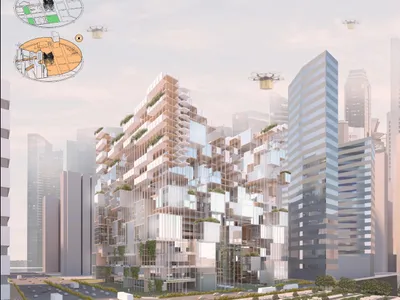
Treehouse@SG: Three Pixelated Towers Grown from Singapore's Pedestrian Paths for Digital Nomads
An Editor's Choice entry for NomadHouse 2020 that stacks living, working and play into bridged, stepped volumes modelled on how a tree grows.

DESIGN STRATEGY FOR LEARNING ENVIRONMENT THROUGH THEORY OF FUN INTERVENTION VIA AUGMENTED REALITY
A research-driven architectural framework integrating the Theory of Fun and Augmented Reality to transform conventional educational environments into engaging, interactive, and future-ready learning ecosystems.
Biosphere X: A Glass Tower That Stacks Earth's Ecosystems as the Last Monument to Humanity
A shortlisted Hourglass entry compresses soil, sea, glacier, wetland and rainforest into one vertical vessel standing in a barren desert.
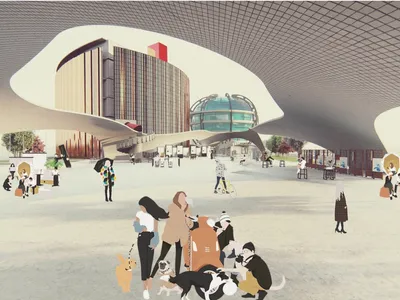
The Power Shift: A Knowledge Hub That Distributes Power Through Shared Space
Jai Karthick's knowledge-sharing hub pairs a glazed globe with a west-facing solar block, turning labs, forums and lawns into a civic exchange.


