
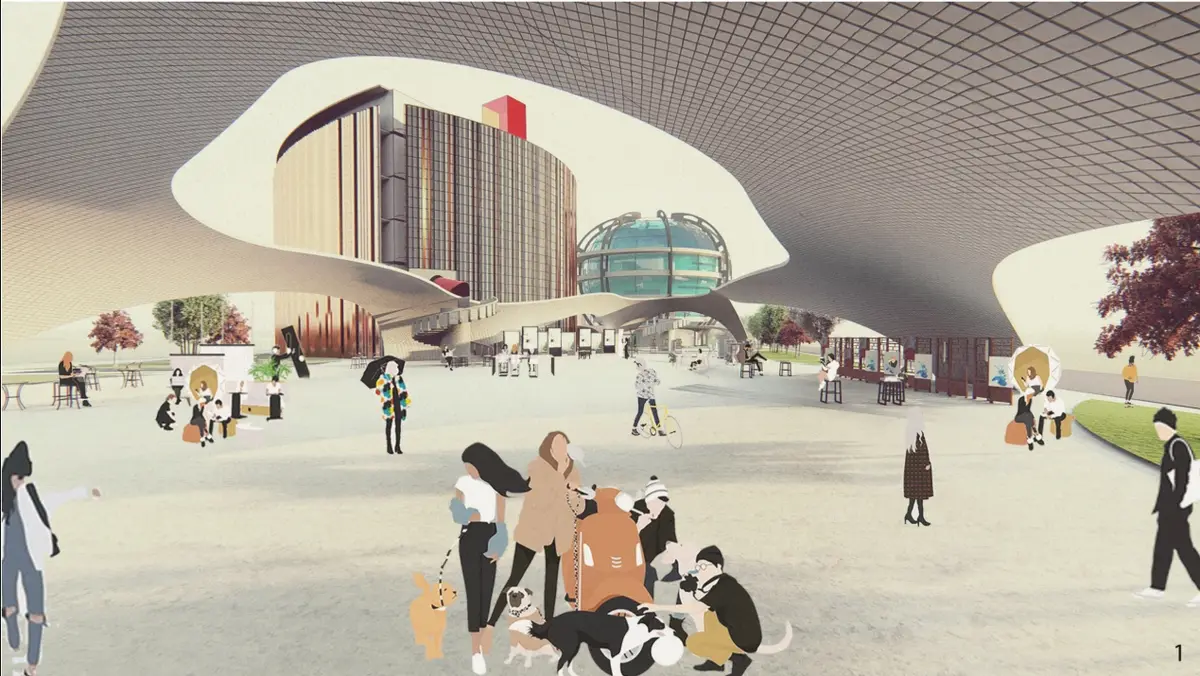
The Power Shift: A Knowledge Hub That Distributes Power Through Shared Space
Jai Karthick's knowledge-sharing hub pairs a glazed globe with a west-facing solar block, turning labs, forums and lawns into a civic exchange.


Power used to be built in stone: palaces, banks, ministries, each one a monument to wealth or force. The Power Shift argues that this vocabulary is obsolete. If influence now flows from knowledge, the building that represents it should not stand apart and look important. It should pull people in, mix their disciplines and send them back out better informed. The proposal replaces the iconic object with a spatial ecosystem, and its most memorable form, a glazed globe, is an emblem of exchange rather than dominance.
Designed by Jai Karthick, the project is a knowledge-sharing hub for sustainable architecture set within a technologically and academically active urban fabric. Karthick mapped the surrounding research centres, innovation clusters and academic institutions before fixing a site strategy. The building is pitched as a connective spine that links education, industry and the public, a place where learning, experimentation and professional practice share the same floor plates.
Stacked Rings Around a Red Core
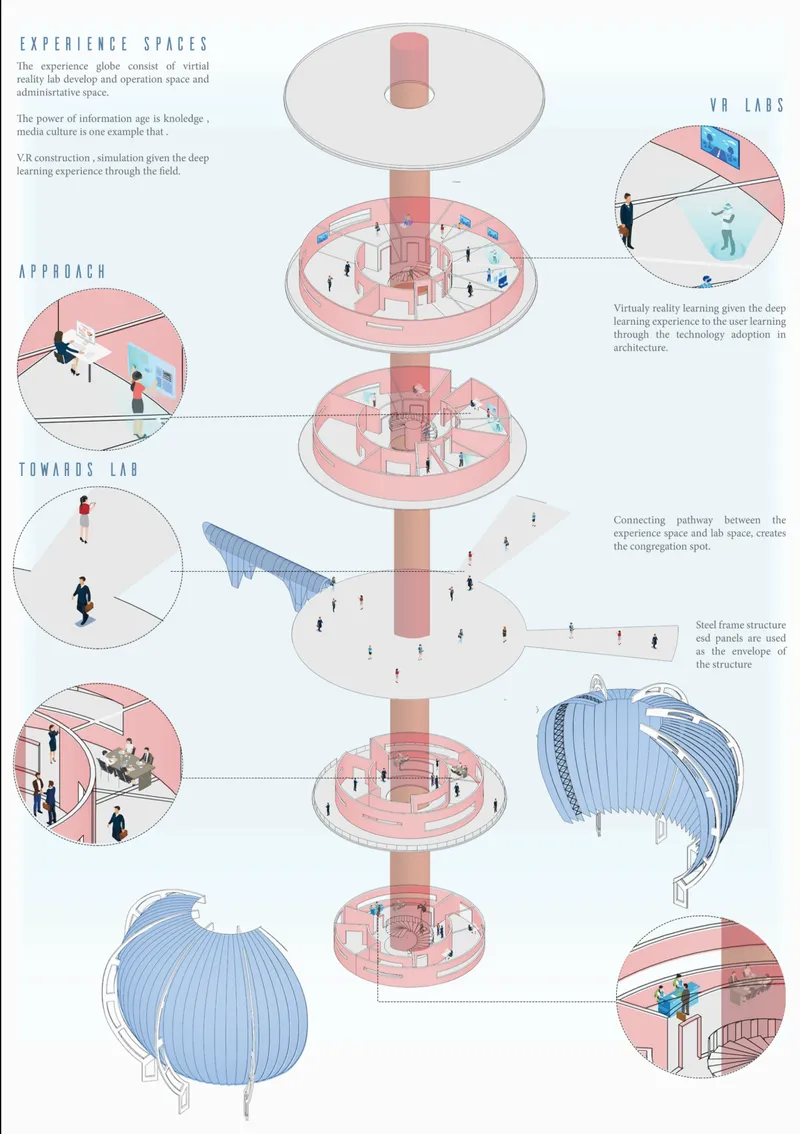
The exploded axonometric shows the logic plainly. Circular floors stack around a central red core, and that core does the conceptual work of the whole scheme: it is where knowledge concentrates before it is distributed outward to the rings. VR labs sit within this stack, detailed alongside the steel-framed panel envelopes that wrap each level. Virtual reality is not a gimmick here. Karthick uses it to let users simulate architectural experiences, closing the gap between reading about space and standing inside it.
What makes the organisation interesting is its gradient of interaction. The designer frames the programme as moving from intradisciplinary work, specialists among specialists, to transdisciplinary collaboration where boundaries dissolve. Flexible labs, discussion forums and demonstration zones are arranged so that isolated studios give way to convergence. The circular plan helps: there is no back of house on a ring, and every room faces the same centre.
A Globe Seen From Beneath the Canopy
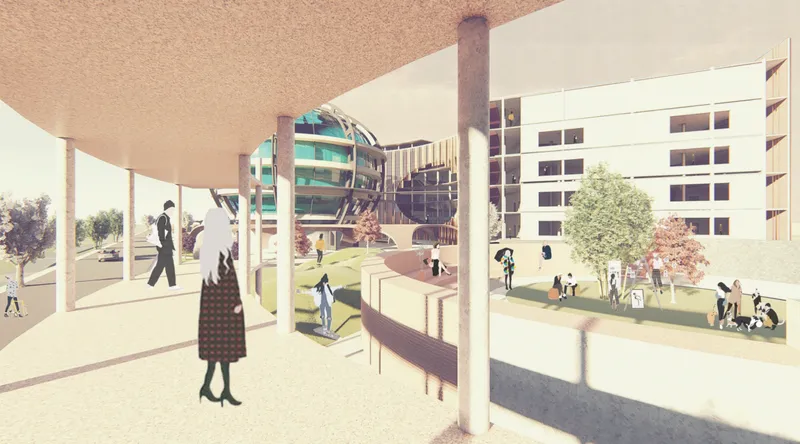
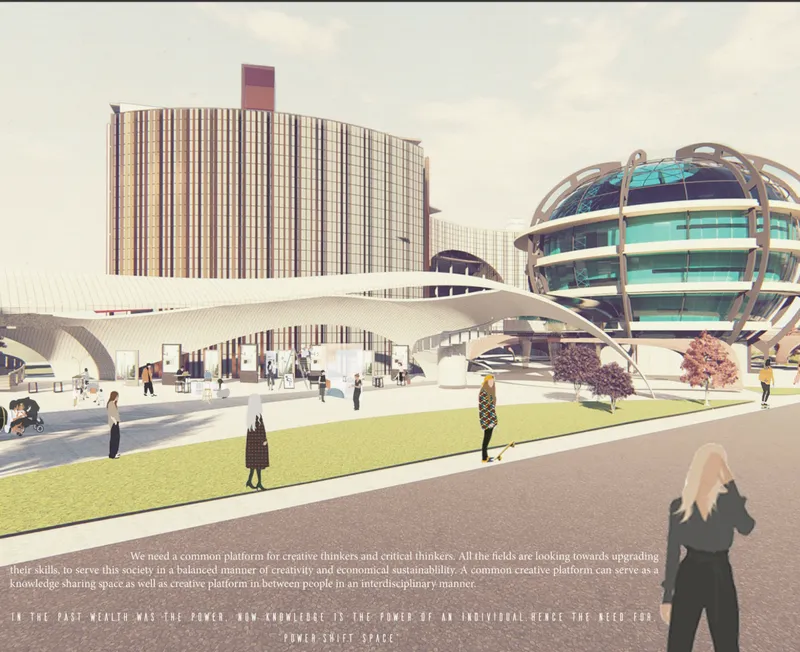
The ground-level render reframes the globe as a civic object. Seen from under a canopy carried on round columns, the glazed sphere and the terraced block beside it sit beyond a lawn where people gather informally. This is the project's public face, and it matters that the approach is shaded, porous and generous rather than gated. The canopy works as a threshold that invites passersby to linger before they decide whether to enter.
The terraced block reads as the working counterpart to the symbolic sphere. Together they set up a dialogue between concentration and spread, which is precisely the story the project wants to tell about knowledge in a networked city.
One Amphitheatre, Three Ways to Gather
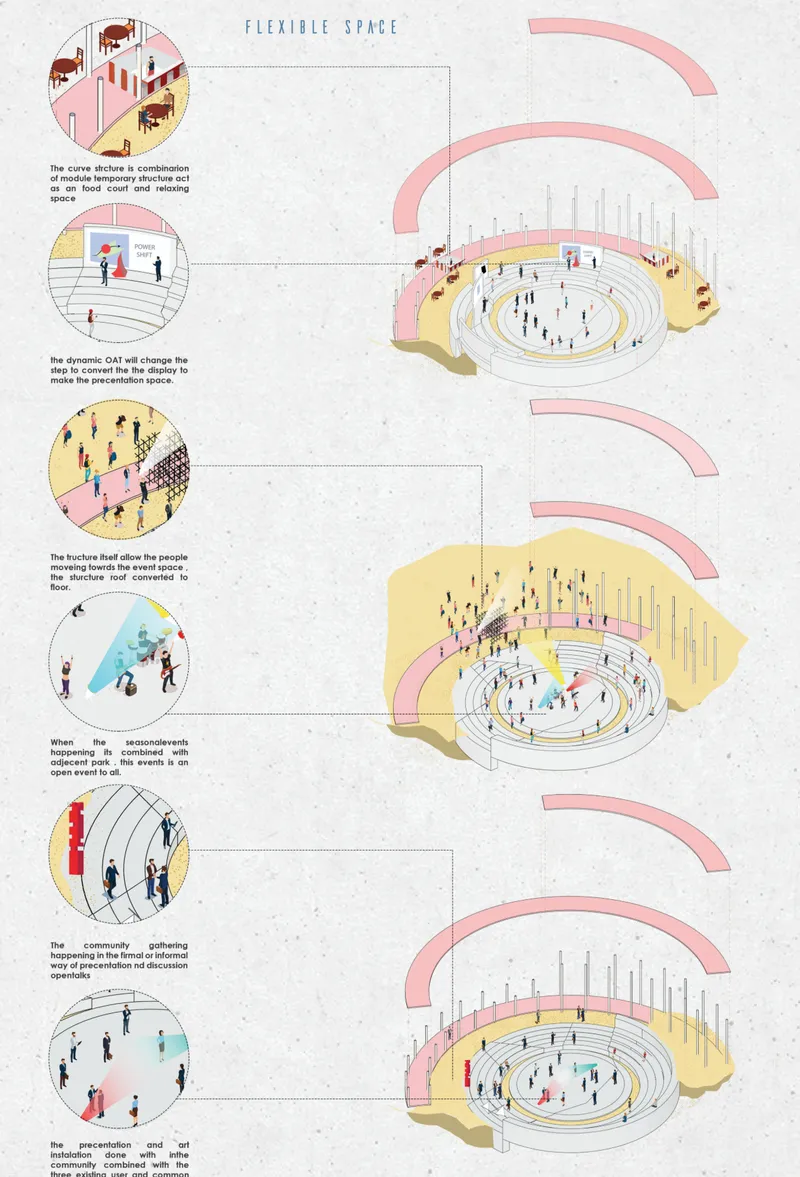
The strongest diagram in the set shows a tiered circular amphitheatre cycling through three identities: food court, presentation space and open park event. This is where Karthick's open shell outreach spaces and multipurpose front yards become tangible. Rather than assigning a dedicated hall to every activity, the scheme lets a single landscape absorb lunch crowds, lectures and public events in turn.
The move is quietly radical for a knowledge institution. Presentations happen where people already eat and loiter, so an audience can form by accident. Outreach stops being a scheduled programme and becomes a condition of the site, which is exactly how professionals and learners are meant to meet in this project.
A Perforated Skin Tuned to the Western Sun
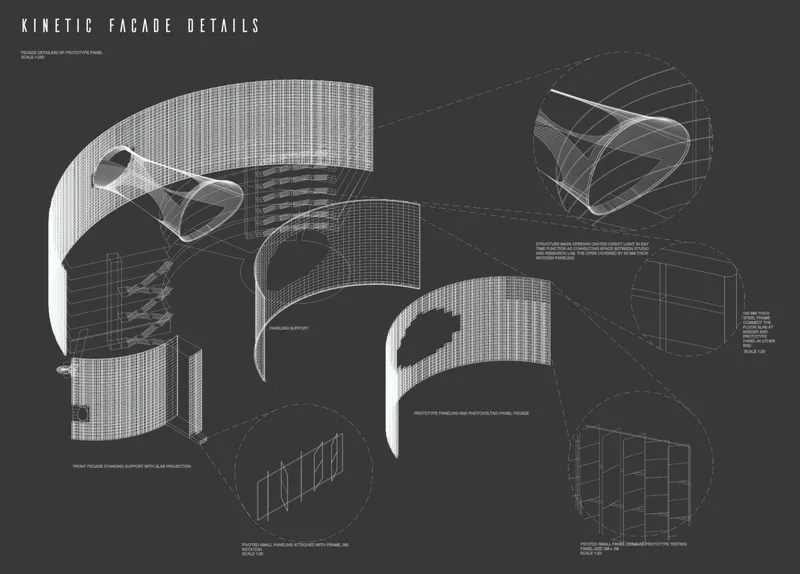
Sustainability is handled at the scale of the panel. The facade detail shows curved perforated panels, a funnel-shaped opening and steel frame connections, the components of a dynamic facade that adapts to environmental conditions. Perforation filters light and heat while the curvature lets the skin follow the building's sweeping geometry without faceting awkwardly.
The plaza render puts those details in context. The curved block, wrapped in vertical fins, faces west and is shaped to harvest maximum solar exposure, while the ribbed glass sphere stands beside it on the lawn. Orientation here is doing double duty: the western arc gathers energy, and its fins temper the low afternoon sun that would otherwise overheat the interiors. The building earns its environmental credentials through form and envelope working together, rather than through equipment bolted on afterwards.
Why This Project Matters
The Power Shift takes a familiar idea, that knowledge is the defining resource of our time, and asks what it would actually look like as a plan. Karthick's answer is spatial rather than rhetorical: a ring around a shared core, a lawn that turns into a lecture venue, labs that sit next to forums instead of down separate corridors. The ambition to choreograph movement from intradisciplinary to transdisciplinary work gives the programme a structure that most knowledge hubs only claim to have.
The project is strongest where its symbolism and its performance align. The globe announces openness, the amphitheatre enacts it, and the west-facing curved skin makes the building pay its own environmental way. For young designers thinking about civic architecture, it is a useful reminder that a building can represent power without hoarding it, and that the most persuasive way to distribute knowledge is to design rooms where strangers end up sharing it.
View the Full Project
About the Designers
Designer: Jai Karthick
Enter a Design Competition on uni.xyz
uni.xyz runs architecture and design competitions year-round that reward proposals with spatial conviction and real site intelligence.
Project credits: The Power Shift by Jai Karthick.


Popular Articles
Popular articles from the community


Architekt Andreas Gruber Scatters 23 Dark Timber Chalets Across a South Tyrolean Forest Edge
In Molini di Tures, Amonti Chalets breaks a resort into a hamlet of gabled timber houses, with parking, storage and services pushed into the slope.

David Ortega Stacks a Two-Story Mexico City Penthouse Around a Steel Stair and a Pergola-Shaded Roof Terrace
In Colonia Roma, a 300 m² penthouse uses oak joinery, a planted steel stair and a slatted roof pergola to make a new-build apartment feel like a house.

Cube Design Draws an Ecological Corridor Between Two Shenzhen Hills with the Nankai Building
Beside Shenzhen's container docks, the Nankai Building pairs stacked balconies with a climbing green screen to connect two hillsides across its height.

David Macias Steps a Doorless Stone and Plaster House Down a Tropical Colombian Hillside
In the humid hills of Colombia, Threshold House replaces the front door with an open void and terraces its 850 m² down the slope instead of fighting it.

Similar Reads
You might also enjoy these articles
Healing Façade: A Modular Chapel System That Restores Ethiopia's Sacred Forests
Winner of the Eco-Chapel competition, this circular timber façade collects water from air to rebuild soil and reforest degraded Ethiopian landscapes.
Kaffeebühnen: Where Coffee Shop Architecture Becomes a Civic Stage in Vienna
A linear sequence of timber boxes, transparent shells, and open yards turns the Viennese café tradition into a public performance space.
Eco Chapel: A Modular Forest Pavilion That Grows Like the Landscape It Protects
Hexagonal timber modules weave through existing trees, turning a chapel into a living system for prayer, education, and reforestation.


Urban Forest: A Vertical Ecosystem for 5,000 Workers in Singapore's Changi Business Park
Radially stacked pods and layered green decks turn a 7-acre plot into 47 acres of ecological workspace projected for 2040.


Comments (0)
Please login or sign up to add comments
No comments yet. Be the first to comment!