

City of Memories: Alexandria's Lighthouse Reborn as a Vertical E-Sports Arena
A speculative ramp-based arena embeds competitive gaming within Alexandria's layered history, turning the city itself into the stage.


What if an entire city could become a game level? Not a flattened digital replica, but a living, climbable structure where players ascend through centuries of history, dodging floods, battling invaders, and navigating collapsing architecture along the way. City of Memories proposes exactly that: a speculative e-sports arena modeled on the Lighthouse of Alexandria, where the competition unfolds not inside a sealed stadium but along an open ramp system threaded through the real and mythologized fabric of one of the ancient world's most storied cities.
Designed by Maylis Lamaignère and Juliette Davet, the project received an Editor's Choice award in The Digital Colosseum 2020 competition. Set in Alexandria, it reimagines the ancient lighthouse not as a static monument but as a vertical interface where competitive gaming, augmented reality, and historical narrative converge. The arena has no walls. The city is the boundary, and time is the playing field.
Ascending Through Eras: The Ramp as Timeline
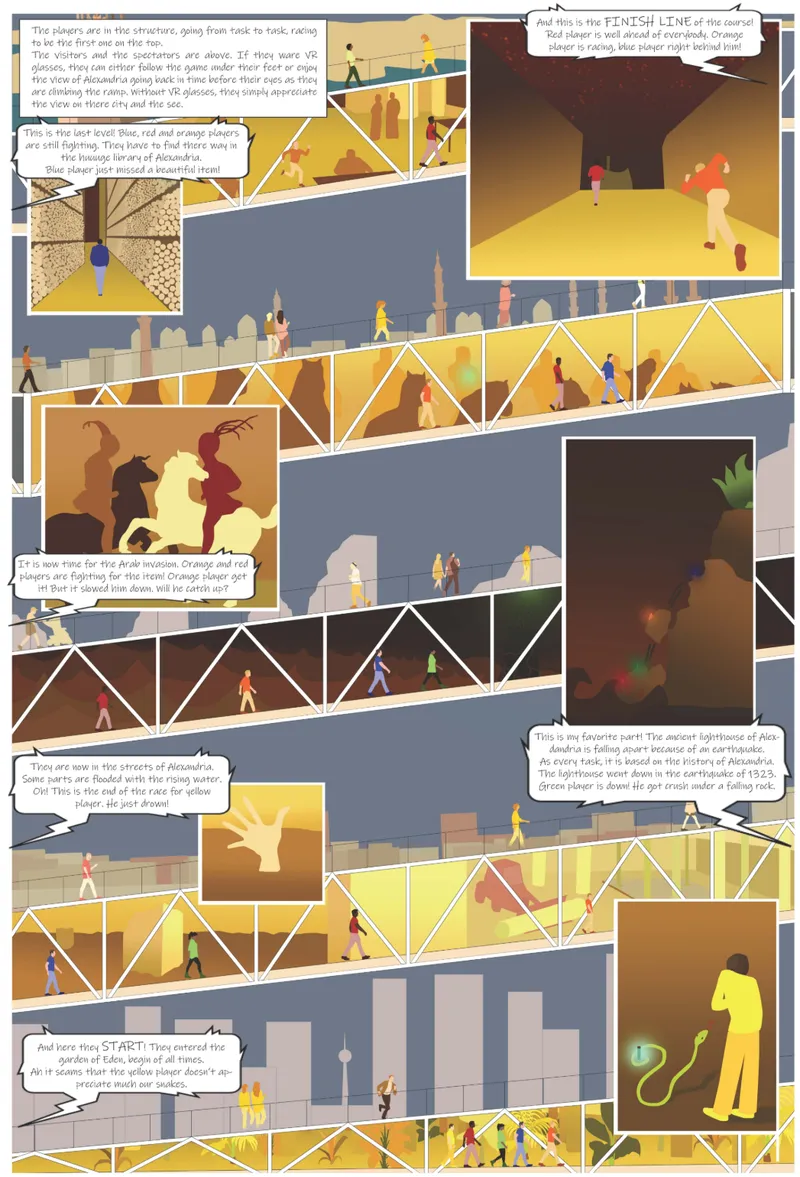
The game begins at what the designers call the Garden of Eden, a poetic origin point for all time, and spirals upward through Alexandria's successive eras. Players physically and virtually ascend through flooded streets, ancient invasions, and the catastrophic earthquake of 1323 that toppled the original lighthouse. These aren't passive backdrops. Each level is a dynamic, interactive stage: players must survive rising waters, outmaneuver hostile forces, and cross crumbling architectural fragments to advance. The angular interior spaces shown here, with their triangular skylights and sharp geometric doorways, suggest a built environment designed to disorient and challenge, forcing players to read spatial cues as part of the competition itself.
Spectators observe through VR glasses or augmented viewpoints, watching the race unfold across temporal layers. Those walking the inclined paths without headsets still experience the cityscape filtered through historical overlays. The distinction between player and visitor blurs; everyone inhabits the narrative at some level of immersion.
The City as Platform: Dissolving the Stadium Boundary
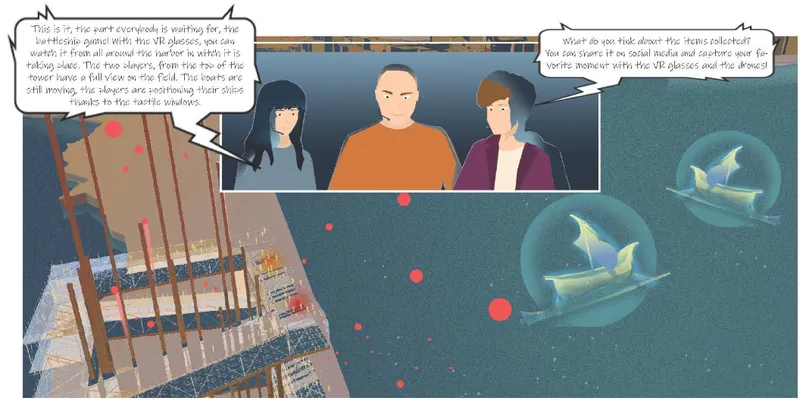
Conventional arenas seal the spectacle inside. Lamaignère and Davet do the opposite: they dissolve the container entirely and let the game spill into Alexandria's urban landscape. The timber pier extending over water, with illuminated pods floating beneath the surface, captures this logic perfectly. The arena's infrastructure reaches into the harbor, the streets, the ruins. Competition happens at the interface between land and water, between built form and open sky. There is no perimeter fence. The city participates.
This move redefines what an e-sports venue can be. Rather than replicating the hermetic environments of traditional stadiums or LAN halls, the project treats Alexandria as both inspiration and medium. Historical events become game mechanics. Mythological elements become obstacles and rewards. The result is a new typology of public space where play is educational, movement is symbolic, and architecture operates as an active agent rather than passive backdrop.
Virtual Agency: Drones, Holograms, and Inclusive Access
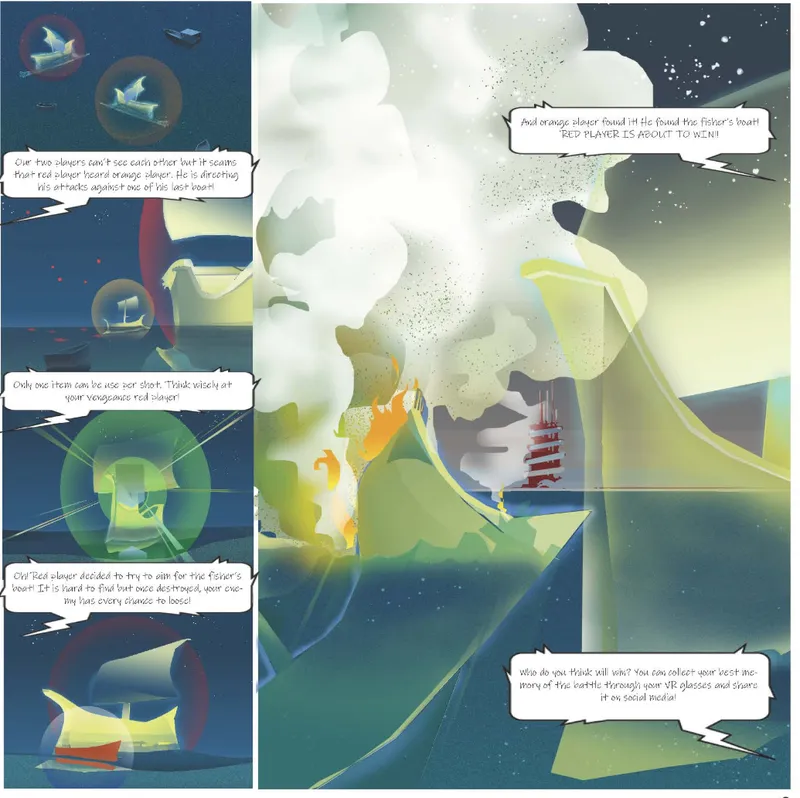
Inclusivity shapes the project's technical ambitions. For visitors unable to physically climb the ramp, drones and holographic projections extend access. Elderly or disabled participants can observe the evolving race as holograms projected across the surreal landscape of translucent dome structures and curved pathways visible here, while their avatars perform actions in sync within the arena. Physical limits are overridden by virtual agency, a principle that positions the project firmly within the emerging discourse around immersive architecture and spatial accessibility.
The translucent domes and organic pathways suggest an architecture that is less about enclosure and more about permeability. Light passes through. Views extend outward. The built environment serves as a membrane between the real city and its digital twin, inviting multiple modes of inhabitation simultaneously.
Why This Project Matters
City of Memories does something rare in speculative design: it takes a familiar brief (build an e-sports arena) and reframes the entire premise. The lighthouse is not rebuilt as nostalgia. It is reconceived as a vertical interface where technology meets legend, where competitive gaming becomes a vehicle for cultural memory rather than its antithesis. Lamaignère and Davet demonstrate that heritage preservation and digital entertainment need not occupy separate conversations.
The project's lasting provocation is its insistence that architecture can animate forgotten spaces and re-engage cities with their own histories. Alexandria here is both playground and museum, both city and interface. In a discipline increasingly preoccupied with immersive technologies, this entry offers a clear thesis: the most powerful arena is one with no walls at all, where the city itself becomes the game.
View the Full Project
About the Designers
Designers: Maylis LamaignÈre, Juliette Davet
Enter a Design Competition on uni.xyz
uni.xyz runs architecture and design competitions year-round that reward proposals with spatial conviction and real site intelligence.
Project credits: City of Memories by Maylis LamaignÈre, Juliette Davet The Digital Colosseum 2020 (uni.xyz).


Popular Articles
Popular articles from the community


longwave studio Reorganizes a 112 m² Tainan Apartment Around the Daily Routines of a Family and Two Cats
In Tainan, Taiwan, birch plywood, rust-red furniture and a freestanding plaster wall link arrival, storage, work and family life in one apartment.

Architekt Andreas Gruber Scatters 23 Dark Timber Chalets Across a South Tyrolean Forest Edge
In Molini di Tures, Amonti Chalets breaks a resort into a hamlet of gabled timber houses, with parking, storage and services pushed into the slope.

David Macias Steps a Doorless Stone and Plaster House Down a Tropical Colombian Hillside
In the humid hills of Colombia, Threshold House replaces the front door with an open void and terraces its 850 m² down the slope instead of fighting it.

LT2A and OPEN Architectes Thread a Brick and Glass High School Through a Wooded Belgian Campus
In Braine-l'Alleud, a 3,000 m² wing for Collège Cardinal Mercier pairs pale brick with a glazed colonnade, deferring to a small chapel and a dense wood.

Similar Reads
You might also enjoy these articles


Vereda Arquitetos Renovates a 40-Square-Meter Apartment Inside Niemeyer's Copan Building
A compact unit in São Paulo's most iconic residential tower gets a material overhaul that pairs exposed concrete with bold blue Formica.

Shakur's House: Exposed Brick as an Interior Organiser in a 168 m² Mashhad Residence
Brick moves indoors in this Mashhad residence, where masonry walls, glass partitions and teal planes sequence a compact home without closing it off.

Day and Night Park: A Time-Based Urban Newsstand in Beijing
A temporary urban newsstand in Beijing blending travel, light, and reading through poetic colors, compact form, and community-focused design.

Modernist Patio Renovation in El Masnou, Barcelona by Oliver Segura Arquitectura + Cebrià Arquitectura
Modernist patio renovation blending tradition and innovation with a movable pool, leveled floors, and Catalan materials in El Masnou.

Explore E-Sport Arena Competitions
Discover active competitions in this discipline

Challenge to reimagine the Iron Throne

Photograph architecture without architects

Illustrate the lost glory of Angkor Wat - Render Challenge

Design challenge to reuse E-waste
Comments (0)
Please login or sign up to add comments
No comments yet. Be the first to comment!