


Circular Design
Design and architecture work that reuses, reconfigures, and extends materials, buildings, and systems so they stay in use rather than becoming waste.
Circular design is the practice of designing buildings, products and spaces so that their materials stay in use instead of becoming waste. It replaces the linear take, make, dispose model with loops of maintenance, reuse, repair, remanufacture and recycling, and it plans for those loops from the first sketch. In architecture that means designing for disassembly, adaptation and the recovery of components over a building's whole life.
What is circular design?
Circular design is the design side of the circular economy. The Ellen MacArthur Foundation describes a circular economy as one in which products and materials are kept in circulation through maintenance, reuse, refurbishment, remanufacture, recycling and composting, and it sets out three principles, all driven by design: eliminate waste and pollution, circulate products and materials at their highest value, and regenerate nature.
"The circular economy is a system where materials never become waste and nature is regenerated."
It overlaps with sustainable design but asks a narrower and more practical question. Sustainable design looks at energy, health, comfort and impact in general. Circular design looks at what happens to every component when its first use ends: can it be taken apart, moved, repaired, sold back, composted or used again at the same quality? A highly efficient building glued together from composite materials can be sustainable in use and still be a dead end for its materials.
The stakes are highest in construction. The Foundation's built environment overview states that buildings, roads and infrastructure use almost half the materials extracted globally every year. For neighbouring collections on uni.xyz, see the circular architecture topic, which collects buildings designed around reuse and reversibility.
A short history of circular design
The idea of closed material loops began in economics. In his 1966 essay "The Economics of the Coming Spaceship Earth", the economist Kenneth Boulding contrasted a "cowboy economy" that treats nature as limitless with a closed system in which resources have to keep circulating; the Wikipedia article on the circular economy notes that the essay is often cited as the first expression of the concept.
The Swiss architect Walter R. Stahel turned that idea into a design strategy. In the 1981 book Jobs for Tomorrow: The Potential for Substituting Manpower for Energy, he and Geneviève Reday-Mulvey described how increasing labour could reduce energy-intensive activities, a foundation for the principles of the circular economy. His later work on a looped, performance-based economy, in which goods are kept in use and sold as services, shaped how designers think about product life.

Environmental economists David Pearce and R. Kerry Turner then described, in Economics of Natural Resources and the Environment, an economy in which waste from extraction, production and consumption becomes an input again. In 2002 the chemist Michael Braungart and the architect William McDonough published Cradle to Cradle: Remaking the Way We Make Things. As the Wikipedia article on cradle-to-cradle design explains, it sorts every material into one of two cycles: technical nutrients that circulate without losing quality, and biological nutrients that can safely return to the soil.
Policy followed. The European Commission adopted its first Circular Economy Action Plan in December 2015 and its second in March 2020, with initiatives covering the whole life cycle of products, including how they are designed.
Key principles of circular design
Design for disassembly
A building can only give back its materials if it can be taken apart without destroying them. That means mechanical fixings instead of glue, accessible joints and a record of what went where.

Our journal on the forest kindergarten by BauLab in Pinzberg, Germany, shows the principle at small scale. The 60 m² prototype is a mobile modular system assembled exclusively with screws, without nails, adhesives or sealants, so each component can be removed and reused, and it is built from untreated local timber that includes beetle-affected wood.
Design for change
Buildings outlive their first use. Separating parts that change quickly from parts that last lets a building adapt without demolition.
"Our basic argument is that there isn't any such thing as a building. A building properly conceived is several layers of longevity of built components."
Frank Duffy, quoted in Stewart Brand, How Buildings Learn (1994)
Duffy's layers (shell, services, scenery and set) each run on their own clock, and designing their connections to be separable is what makes reuse possible later.
Keep the durable part, replace the worn part
Many products fail at one point while the rest is still sound. Designing the long-lived part to last, and the wearing part to be returned, keeps most of the material in use.

Build materials into a service
When a maker leases components and takes them back, materials stay in a managed loop instead of reaching landfill. This is Stahel's performance idea applied to design: the customer pays for use, the supplier keeps responsibility for the parts.

Use what already exists
The most circular material is the one already built. Adaptive reuse keeps structures standing, and urban mining treats demolition sites as sources. Our journal on the Gjuteriet renovation in Malmö by Kjellander Sjöberg follows a former foundry turned into a coworking and public hub, completed in 2023, while the Tree House by Studio ACTE is a 20 m² pavilion in Amsterdam built almost entirely from locally sourced reused materials.
Let biological materials return to the soil
The biological cycle asks for materials that can safely decompose. The Inverted Architecture installation by Studio Link-Arc, shown at the 2022 Shenzhen Biennale, hangs 400 mycelium bricks grown from agricultural waste such as straw, bagasse and wheat bran, bricks that can later return to the soil.
Circular design on uni.xyz
The Circular Design topic on uni.xyz gathers 97 projects and 70 journals. This section focuses on the work that deals most directly with material loops, reuse and reversibility.
Cylinder Park, by Sahar Issapour, Lynden Savage and Emma Ng, was shortlisted in Re-imagining Play 2020. It starts from the plastic buckets that pile up in refugee camps faster than they are reused and turns that surplus into a play kit of seats, tunnels, musical instruments, screens, platforms and climbing structures, all derived from the geometry of a single cylinder.

'Toolkit' of Self-Resilience, by Nurul Azman, Feeyz Mohammad, Lyana Ibrahim and Calvin Thoo, received an Editor's Choice in the same Re-imagining Play 2020 competition. It develops a set of modular typologies for the Kutupalong refugee camp, using adaptable and flexible design so that play structures can respond to the camp's social and cultural needs.

HILT: A Toothbrush Split Into the Part That Lasts and the Part That Wears Out covers Joe Miller's project, which received a Citation in the International Product Design Awards '19. Five permanent handles in bamboo, titanium alloy, stainless steel, a recycled composite made from discarded toothbrushes and a patterned plastic pair with minimal-plastic heads that users send back for recycling, supported by a subscription, return packaging and a digital tracker.
"The toothbrush becomes the visible tip of a small circular system."
UNI Editorial, HILT journal on uni.xyz
Eazyfit, by Ankur Gupta, treats furniture as architecture at reduced scale. A 30 mm perforated steel cube acts as a universal joint for bamboo rods and planks, the kit assembles without tools, and a leasing model lets renters return parts to a bank so that materials stay in circulation.
The Reversible Shop by Francesca Perani Enterprise and Bloomscape Architecture is a 100 m² store in Milan built around a blue anodised steel grid, poplar shelving and prefabricated concrete blocks, designed so that elements can be reconfigured, relocated or reused. The Circular Living Room and Temporary Housing by VLOT architecten in Haarlem applies modular thinking at housing scale, with 86 temporary homes for around 200 Ukrainian refugees around a shared courtyard.
Challenges and future directions
Circular design is easy to draw and hard to deliver. Reclaimed materials need to be found, tested, stored and certified, and supply rarely matches a project's timetable. Designers who specify salvaged components often have to design around what is available, which reverses the usual order of design and procurement.

Design for disassembly also depends on information. A building can only be mined in fifty years if someone knows what is inside it and how it was fixed. Material passports and digital models of components are one response; simple, visible connections are another.
There is also a risk of the label outrunning the practice. A single reused element or a recycled finish does not make a project circular. The more useful test is the Ellen MacArthur Foundation's: does the design eliminate waste, keep materials at their highest value and help regenerate nature? Regulation is moving the same way: the EU's Ecodesign for Sustainable Products Regulation, which entered into force in July 2024, targets how products are designed.
Circular design for students and designers
Circular design suits thesis work because it can be tested at every scale. Strong angles include a building designed with a disassembly manual, an adaptive reuse scheme that keeps an existing structure, a kit of parts that can be leased and returned, or a material study using bio-based or salvaged components. Physical prototypes help here, and our model making topic shows how members test assemblies by hand.
Open briefs on uni.xyz competitions are a good place to try these ideas against a jury. To keep exploring, browse the recycled material topic.
Frequently asked questions
What is circular design in architecture?
It is an approach that plans for a building's materials to stay in use after its first life. Typical strategies include reusing existing buildings, specifying salvaged or bio-based materials, using mechanical rather than glued connections, and designing layouts that can change without demolition.
What are the principles of circular design?
The Ellen MacArthur Foundation sets out three principles of the circular economy, all driven by design: eliminate waste and pollution, circulate products and materials at their highest value, and regenerate nature. Design for disassembly, adaptability and repair are the practical tools that put them into a building or product.
How is circular design different from sustainable design?
Sustainable design is the broader field and covers energy, health and environmental impact generally. Circular design focuses on material flows: what happens to each component when its first use ends, and whether it can be reused, repaired or safely returned to nature.
What is design for disassembly?
Design for disassembly means planning a building or product so it can be taken apart without damaging its components. It relies on screws, bolts and clips instead of adhesives, accessible joints, standard dimensions and a record of materials, so parts can be recovered and used again.
What is cradle to cradle?
Cradle to cradle is a design framework set out by Michael Braungart and William McDonough in their 2002 book. It divides materials into technical nutrients, which circulate in industry without losing quality, and biological nutrients, which can safely return to the soil.
References and further reading
- What is a circular economy?, Ellen MacArthur Foundation
- Circular economy in construction: regenerative built environments, Ellen MacArthur Foundation
- Circular economy, Wikipedia
- Cradle-to-cradle design, Wikipedia
- Shearing layers, Wikipedia
- Circular economy, European Commission


Popular projects
View all 186 projects


Latest journals
View all 108 journals

gaSSz arquitectos Builds a Demountable Circular-Economy Garden from Rubble and Tires in Madrid's Vicálvaro
In Vicálvaro, Madrid, a 2,400 m² garden of bolted yellow steel, rubble gabions and tire-rubber paving treats public space as a reversible material bank.

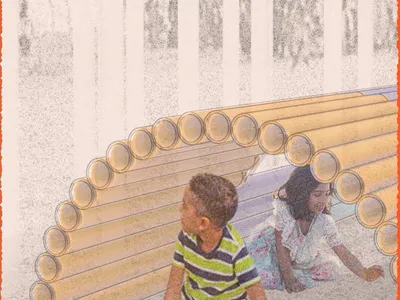
Cylinder Park: Turning Surplus Buckets into a Modular Play System for Refugee Camps
A shortlisted entry in Re-imagining Play 2020, Cylinder Park extracts architectural potential from discarded plastic buckets to build adaptable playgrounds

Tag-it Central: A Berlin Gallery That Turns Graffiti From Urban Damage Into a Circular Economy
Shortlisted in Commercial '20, Benjamin Babilis channels Berlin's tagging culture into sustainable ink, artist training, exhibition and community living.

MAMOU-MANI Builds a Fractal Timber Pavilion That Refuses to Burn at Burning Man
Catharsis brings hyperbolic geometry to the Nevada desert as a reusable, modular amphitheater designed for radical inclusion.


