


Vertical Farming
Architectural and design approaches to growing food vertically in urban and rural environments.
Vertical farming is the practice of growing crops in stacked layers inside a controlled building, usually without soil, using hydroponic, aeroponic or aquaponic systems and artificial or carefully managed light. For architects it turns a question of agronomy into a question of building design: floor loads, ceiling heights, daylight, ventilation, energy supply and how a farm meets the street.
What is vertical farming?
Vertical farming is a branch of controlled environment agriculture (CEA). The Ohio State University defines CEA as crop production "conducted in an enclosed structure that allows for complete or partial control of growing conditions", and its extension fact sheet on controlled environment agriculture places indoor vertical farms at the high-technology end of a range that starts with simple shade structures and hoop houses. An indoor farm stacks multiple tiers of growing systems inside a shipping container, warehouse or purpose-built block, and grows mostly short-cycle crops such as leafy greens, microgreens and herbs.
The field overlaps with urban farming but is not the same thing. Rooftop beds, allotments and community plots are covered in the uni.xyz article on urban agriculture; vertical farming is narrower and more technical. Its defining move is to replace land area with building volume, and sunlight with engineered light and climate. That shift is what makes it an architectural subject. A vertical farm is a building type with its own structural, mechanical and economic logic, and when it is combined with housing, markets or offices it becomes a mixed-use program that architects have to resolve in section.
"Cities eat what they do not grow."
UNI Editorial, opening line of the uni.xyz journal on Atlantis 2023 by Jakub Sokólski
The closest related topic on uni.xyz is aquaponics, which pairs fish tanks with plant beds and appears in many of the stacked farm proposals below.
A short history of vertical farming
The phrase is older than the technology. According to the Wikipedia entry on vertical farming, the term was coined by Gilbert Ellis Bailey in his 1915 book Vertical Farming, though he used it to describe soil and plant life rather than stacked growing floors. The same article traces an architectural line back to the 1909 Life magazine drawing of homesteads stacked one above another, later discussed by Rem Koolhaas in Delirious New York, and to Le Corbusier's Immeubles-Villas of 1922.
Built precedents arrived with hydroponics. Tower hydroponicums were documented in Sholto Douglas' 1951 book on the Bengal system, and a glass growing tower was shown at the Vienna International Horticulture Exhibition in 1964. Later precursors include Ken Yeang's bioclimatic Menara Mesiniaga tower (1992), and Yeang has long promoted mixed-use skyscrapers that combine living units with food production; MVRDV's speculative PigCity (2000) carried the idea into livestock.

Space research pushed the soilless methods further. NASA's Spinoff account of aeroponics describes how AgriHouse, trading as Aeroponics International, worked with NASA and BioServe Space Technologies in 1997 on a soil-less growth experiment for the Mir space station, a process in which plants grow "in an air/mist environment that is free from soil or an aggregate media."
The modern idea of the farm skyscraper comes from Dickson Despommier at Columbia University, who developed it with graduate students from 1999. Wikipedia reports his speculation that a 30-floor farm on one city block could feed 50,000 people, with crops on the upper floors and fish and poultry below. In a 2012 interview he summed up the concept plainly:
"The concept of vertical farming is really quite simple. You simply take a greenhouse that’s high-tech, and stack (another) on top."
Dickson Despommier, interview with Inter Press Service (2012)
In the same interview he counted seven vertical farms in operation, from Korea and Japan to Chicago, where a former meat packing plant had been retrofitted. Commercial indoor farms multiplied over the following decade, and the 2020s brought the first wave of closures, discussed below.
Key principles of vertical farming
Control the whole climate
Ohio State lists the variables a CEA grower manages: air and root-zone temperature, humidity, vapour-pressure deficit, carbon dioxide, light intensity and spectrum, photoperiod and airflow. Air temperature is the most important. Every one of these is a building services decision, so a vertical farm is closer to a laboratory or data centre than to a greenhouse.
Grow without soil
Hydroponics feeds roots with a nutrient solution; common indoor methods include nutrient film technique, ebb and flow and deep water culture. Aeroponics suspends the roots in air and mists them. Both remove the weight and mess of soil, which is what makes stacking possible at all, and both demand reliable pumps, tanks and drainage on every floor.

Close the loop with fish
The UN Food and Agriculture Organization's technical paper Small-scale aquaponic food production defines aquaponics as "the integration of recirculating aquaculture and hydroponics in one production system." Water from the fish tanks passes through filters where bacteria convert ammonia into nitrate, feeds the plant beds and returns to the fish. The same paper is frank about the costs: daily management is mandatory, the system is energy demanding, and mistakes can cause a collapse.

Treat light as the main energy load
Indoor farms grow under artificial light with little or no daylight. Ohio State notes that the lights generate a large amount of heat, so cooling and dehumidification become constant tasks. Architects can reduce the load with daylighting, heat recovery and renewable supply, but in a sealed indoor farm the electricity bill is the crop's real input.
Design the building as a farm
Water-filled racks are heavy, wet and serviced daily. Stacked farms need generous floor-to-floor heights, robust slabs, wash-down finishes, clean and dirty circulation, and loading for daily deliveries. Member projects often make the structure itself the growing frame. The rendering of The Nexus Urban Farm by Hetvi Patel, which brings farming to Nine Elms so that people can see the difference between hybrid and organic food, shows tall planting racks enclosing a public space where visitors sit among the crops.

Give the farm a public face
A sealed box of racks contributes little to a street. The stronger proposals put markets, kitchens, classrooms and viewing routes at ground level, so that the farm is legible and the public helps pay for it.
Vertical farming on uni.xyz
The topic gathers competition entries, theses and editorial journals from many briefs. Several come from the Urban Meal Mine competition, which asked for farming hubs in London's Nine Elms, but the strongest ideas are spread across very different prompts.
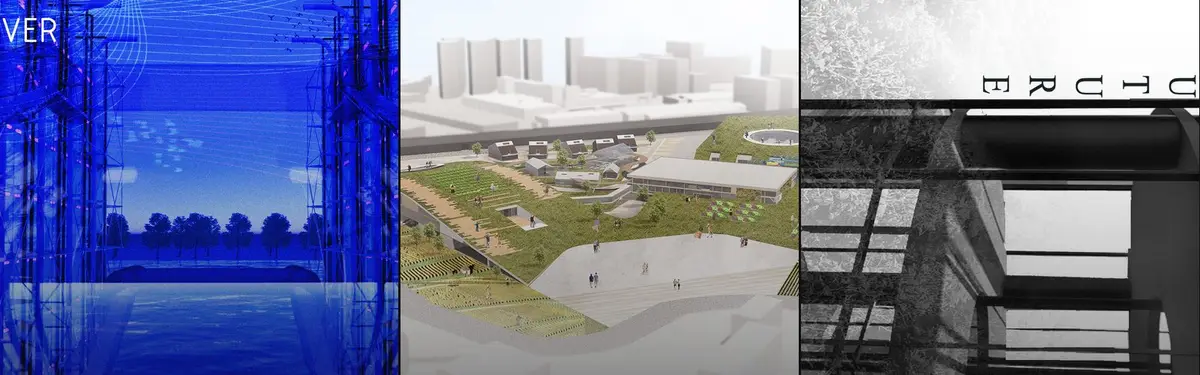
Mother river by Katarina Vlašković is the most liked project in this topic and an Editor's Choice in the Transfarm competition. It starts from climate change and proposes a climate adaptable system so that food production can continue as conditions shift.

The uni.xyz journal on Atlantis 2023 follows Jakub Sokólski's network of timber farming towers, each stacking automated cultivation, laboratories, logistics, public space and renewable energy in a closed loop where organic waste becomes feedstock. Its most persuasive move happens at street level, where a market plaza under the towers lets people meet the farm before they see it as a factory.
Futurra by Henry, Minhui Lee and Lim Puisan reworks a market site in Nine Elms around the relationship between growers and buyers, and received the Urban Meal Mine competition's People's Choice Award.
"It seeks to reconsider the traditional agricultural activities between the land and architecture and also the relationship between farmers and consumers."
Henry, Minhui Lee and Lim Puisan, project statement for Futurra
The winning entry in that competition, Toolset for a City's Metabolism by Katarzyna Soltysiak and Petter Habostad, goes the other way from the megastructure: a reusable scaffolding frame that grows and shrinks with the engagement of local people.

Housing is a recurring partner. Farm/House by Amelia Aussie and daniel -, entered in Hustle Hub 2019, lets young renters lease a minimum unit and extend it later, with the space they do not rent working as an urban farm. Aazil Abdul Jamal's B.Arch thesis at MES School of Architecture, covered in the journal Urban Agricultural Community, threads vertical farms, hydroponics and aeroponics through a neighbourhood so that food production becomes part of daily routine.
Built work appears in the editorial journals. The journal on VTN Architects' Urban Farming Office in Ho Chi Minh City describes a six-storey concrete frame whose planters yield roughly 1.1 tons of harvest a year, with a green ratio of 190 percent and LEED Gold certification.

Further afield, Fight for hunger by matiur jony, an Honorable Mention in UnIATA '18, designs an institution that trains low-income farmers, a reminder that the topic is about livelihoods as well as towers.
Challenges and future directions
The economics are the hardest part. Wikipedia's vertical farming article notes that vertical farms need substantial start-up funding and that some companies went bankrupt before reaching profit. The record is now long: AeroFarms, once known for its Newark farm, filed for Chapter 11 bankruptcy in June 2023 and emerged that September focused on a single site in Virginia. Jones Food Company opened a 14,500 square metre farm in Gloucestershire in 2024, powered by renewable electricity, and entered administration in April 2025. The high-tech greenhouse grower AppHarvest, a close cousin, filed for Chapter 11 in July 2023.

Energy explains much of this. Light that the sun gives a field for free must be bought, and if the electricity is not low-carbon, the same article notes, a vertical farm can produce more pollution than a field or greenhouse. Critics also argue that food miles are a small share of food's footprint, which weakens a common argument for urban siting.
The future is likely to be more modest and more architectural: farms that borrow daylight, share heat with housing or offices, sit on cheap structural space and earn part of their keep from education and retail. Crop choice matters too, since stacked systems suit fast, high-value greens far better than staple grains.
Vertical farming for students and designers
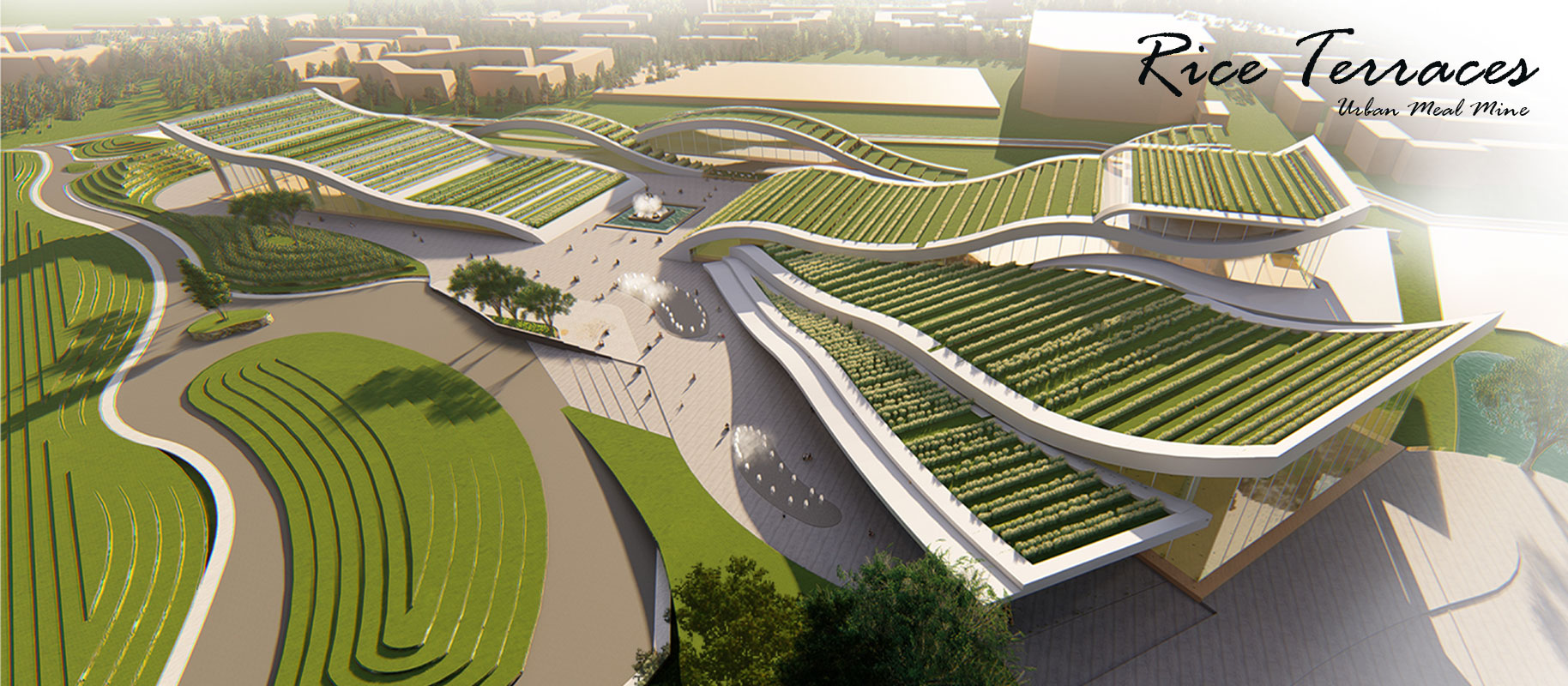
Good thesis questions start from the section. What floor-to-floor height does a growing floor need, and can it convert to offices or housing later? How does a farm share heat, water and waste with its neighbours? How does a market or school at ground level make the building pay? Rural sites are worth testing too: Rice Terraces by KITTITHAT PHUBUNJERDSAK combines farming on the rooftop with the stepped form of a rice terrace.
Current briefs are listed on uni.xyz competitions, and related reading sits under food production and sustainable food systems.
Frequently asked questions
What is the difference between vertical farming and hydroponics?
Hydroponics is a growing method: plants take nutrients from a water solution instead of soil. Vertical farming is a way of organising production in stacked layers inside a building, and it usually relies on hydroponics, aeroponics or aquaponics to make that stacking possible.
What crops grow best in a vertical farm?
Short-cycle, fast-growing crops such as leafy greens, microgreens and herbs are the most common, according to Ohio State's CEA guidance. Tall, long-cycle crops like tomatoes and cucumbers are more often grown in greenhouses, and staple grains are rarely economic indoors.
Why have so many vertical farming companies failed?
High start-up costs, expensive electricity for lighting and cooling, and competition from cheap field produce have squeezed margins. AeroFarms and AppHarvest both filed for Chapter 11 in 2023, and Jones Food Company entered administration in 2025.
Who invented the vertical farm?
Gilbert Ellis Bailey coined the term in 1915, but the modern idea of a farm skyscraper is credited to Dickson Despommier and his Columbia University students, who developed it from 1999.
References and further reading
- What Is Controlled Environment Agriculture (CEA)?, The Ohio State University CFAES
- Vertical farming, Wikipedia
- AeroFarms, Wikipedia
- AppHarvest, Wikipedia
- Progressive Plant Growing Has Business Blooming, NASA Spinoff
- Q&A: The Future of Agriculture May Well Be in Cities, Inter Press Service
- Small-scale aquaponic food production, Food and Agriculture Organization of the United Nations


Popular projects
View all 60 projects


Latest journals
View all 58 journals
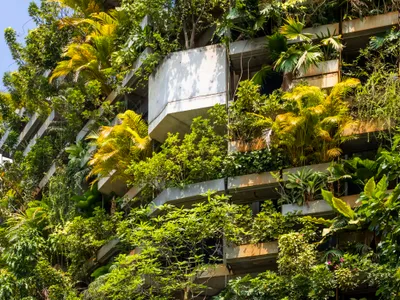
VTN Architects Wraps Their Own Ho Chi Minh City Studio in a Vertical Tropical Forest
A six-story office in Vietnam's Thu Duc district uses modular planters and passive cooling to achieve a 190 percent green ratio.


Atlantis 2023: Vertical Farm Towers That Turn a City's Waste Into Its Own Food Supply
Jakub Sokólski proposes a network of timber farming towers where organic waste, water and energy circulate in a closed loop inside the dense city.
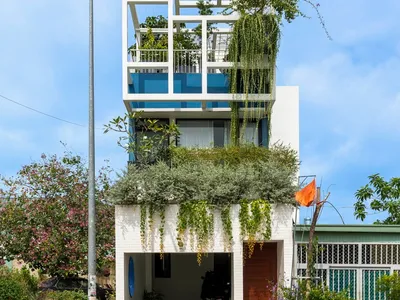
Urban Farming Home by Farming Architects: A Symbiotic Model for Sustainable Urban Living in Vietnam
Urban Farming Home integrates architecture and agriculture, creating a climate-responsive urban ecosystem that enhances biodiversity, energy efficiency, and healthy living.
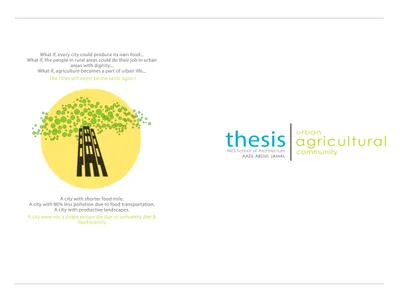
Urban Agricultural Community: A Housing Thesis That Puts the Farm Inside the Neighbourhood
Aazil Abdul Jamal's B.Arch thesis threads vertical farms, community plots and production space through housing, making food security a design parameter.


