

Aleppo Rising: Post-War Urban Regeneration Architecture Through Talent, Memory, and Collective Renewal
A visionary architectural project that transforms public performance into a catalyst for healing, identity, and post-war urban regeneration in Aleppo.

In the aftermath of war, cities often struggle not only with physical devastation but also with emotional, cultural, and social fragmentation. Aleppo Rising, an architectural vision by Fatemeh Hasanpour and Amirhossein Mousavi, redefines how post-war urban regeneration architecture can restore civic pride, cultural vitality, and human connection. Through the symbolic framework of "Syria’s Got Talent," the project uses performance, participation, and shared spaces to revive the spirit of a wounded city.
Rather than revisiting the bitterness of the past, Aleppo Rising calls for renewed passion, collective longing, and a shared aspiration for the future. The project proposes an interactive cultural landscape designed to rekindle hope, motivation, and community engagement at the heart of Aleppo. It emphasizes that the city’s reconstruction cannot rely solely on economic or governmental intervention—its rebirth must emerge from the talents, creativity, and self-confidence of its own people.


Architecture as a Catalyst for Healing and Identity
The foundation of the proposal lies in the belief that cultural identity is revived when hidden talents and collective memories re-enter public life. This project centers on discovering, celebrating, and amplifying the diverse abilities of the Syrian people—especially the youth—through a dynamic architectural platform.
Spatial Identity Through Performance
The design merges circular, concentric architectural forms with social participation, representing the voice of the people as the pulse of the city. Every spatial gesture—bridges, decks, layered platforms—echoes Aleppo’s fragmented yet resilient identity. Performance stages become communal gathering points, symbolizing rebirth through expression.
Reconnecting a Broken Community
War disrupts cultural continuity, but architecture can stitch together fractured social layers. By fostering interactions between participants and audiences, the project rekindles self-perception and belonging. These shared experiences cultivate cultural resilience, providing a new narrative for the city—one rooted in creativity rather than conflict.
A Monument for the New Syria
The project’s spatial evolution reflects Syria’s social healing. As interactions grow, the architecture transforms from a regional gathering space into a symbolic national monument representing unity, hope, and new beginnings.
Design Principles
- Openness: Maximum accessibility creates immediate connection between people and space.
- Participation: Multiple performance stages enable inclusive engagement.
- Symbolism: Circular geometry references Aleppo’s historic citadel and the cycles of war and renewal.
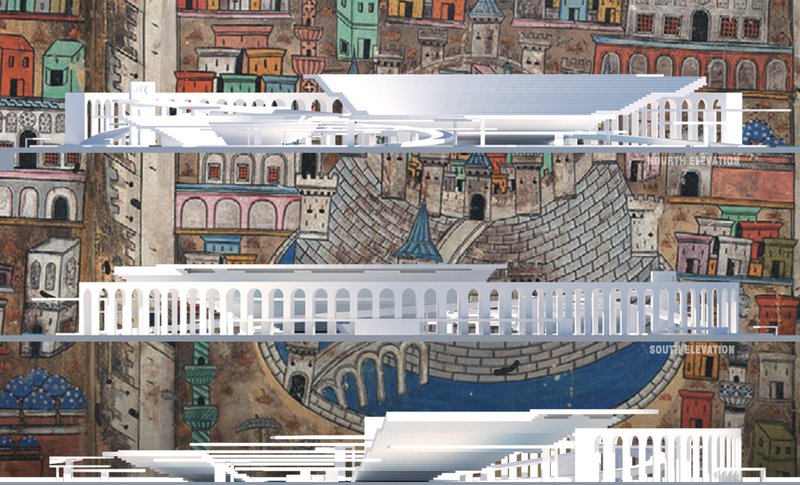
- Memory: Spatial layering mirrors the city’s ancient fabric and its contemporary realities.
The architecture becomes a living organism—fluid, evolving, and socially driven. Its continuous spatial loops allow people to move freely, interact, and experience the environment as both audience and performer.
Site, History, and Conceptual Foundations
Situated near the historic Aleppo citadel, the site is deeply embedded in the memory of Syria’s cultural heritage. The ruins, layered city fabric, and damaged urban textures tell the story of resilience.
Formal Concept
The design transforms two-dimensional plates into a multi-layered three-dimensional composition, symbolizing movement, perception, and temporal depth. These layers function as metaphorical city strata—allowing users to understand Aleppo’s past while navigating its future.
Historical Resonance
The project acknowledges wartime destruction, including attacks on cultural monuments. Instead of erasing trauma, it offers viewpoints where people can observe, reflect, and gain motivation to rebuild Aleppo with renewed clarity.
People as the Core
Every spatial decision centers on the creative potential of Syrian youth. The architects propose a framework where citizens—not institutions—lead urban transformation. Talent becomes a foundational resource for reconstruction.
Urban Regeneration Through Talent and Interaction
Aleppo Rising functions as a citizen-driven, interactive city within the city. The project establishes:
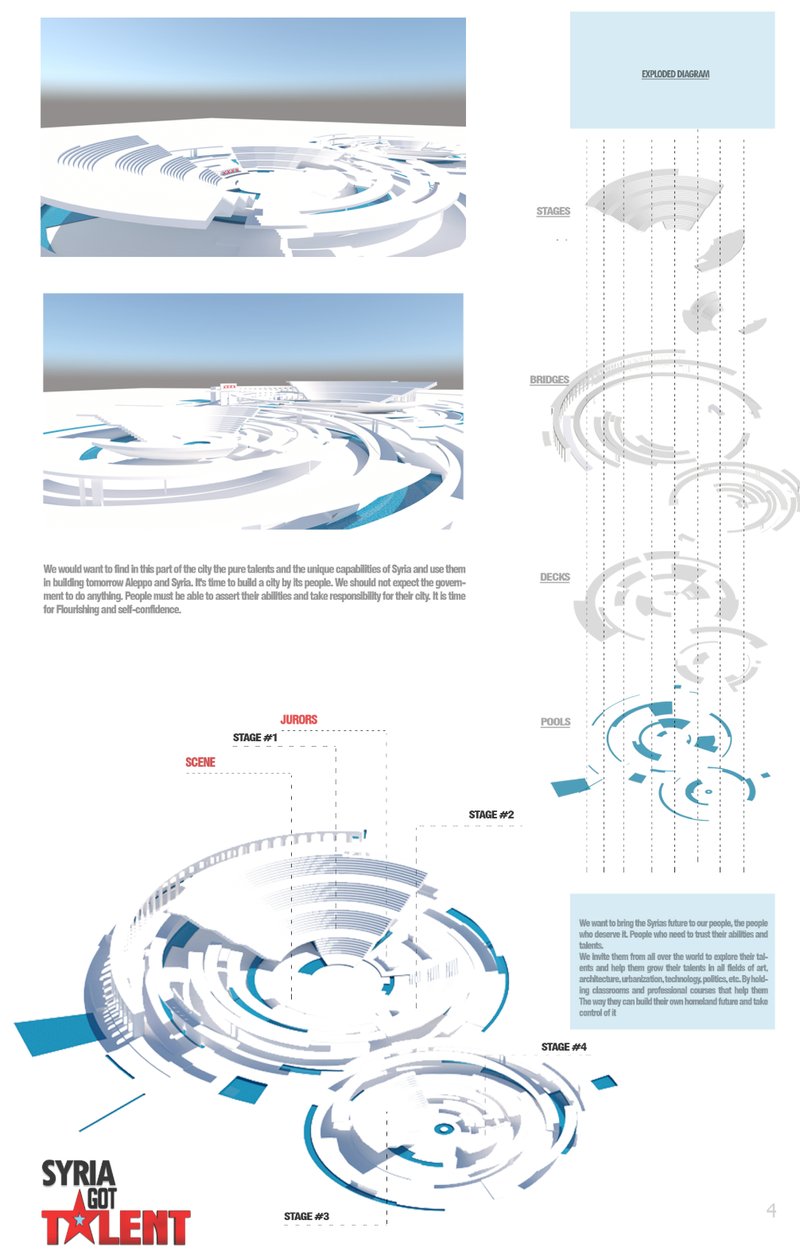
1. Multi-stage performance arenas
Four main stages enable simultaneous performances, symbolizing the multiplicity of Syrian identity.
2. Bridges and elevated walkways
These create spatial dialogue between levels, allowing movement and visual connectivity.
3. Pools and reflective surfaces
Water elements symbolize healing and continuity—central themes in post-war regeneration.
4. Public classrooms and creative workshops
These spaces nurture artistic, architectural, technological, and cultural growth.
Through these elements, the architecture becomes a platform for collective learning and emotional renewal.
The Interactive Urban Fabric: A City That Performs
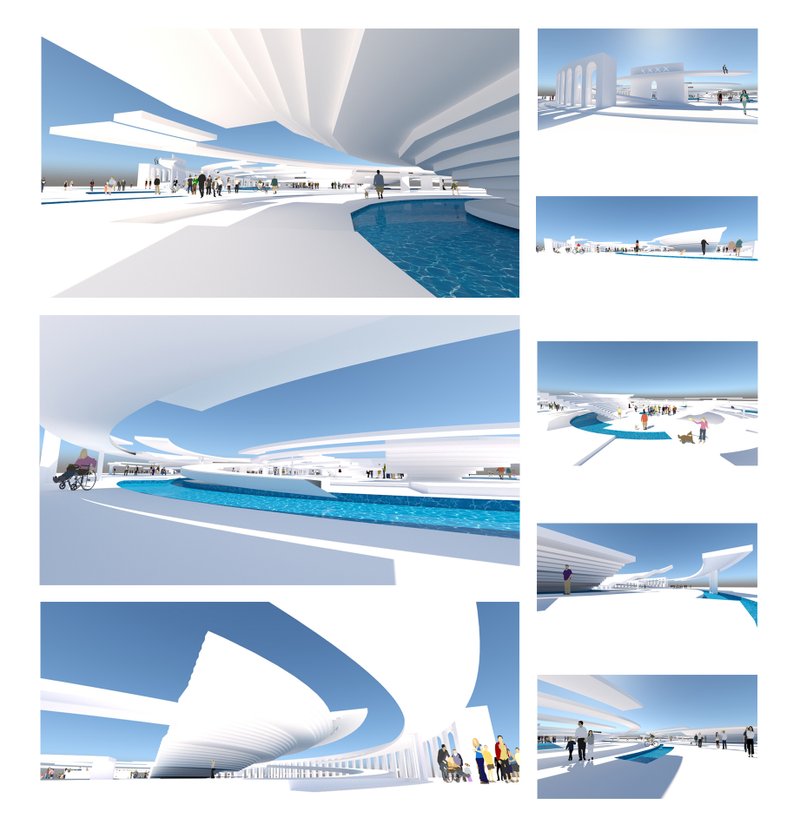
The project’s renderings reveal a luminous architectural landscape—white sculpted surfaces, sweeping forms, and fluid curves. The built environment feels both futuristic and deeply contextual, inspired by Aleppo’s historical motifs.
Design Features
- Elevated decks overlooking water channels
- Sweeping canopies creating shaded gathering zones
- Open courtyards for communal festivals
- Amphitheater-inspired seating integrated into urban circulation
This interactive fabric creates a psychological uplift for the community, encouraging hope and shared strength.
A Vision for the Future: Flourishing Through Self-Confidence
The architectural narrative concludes with a powerful call: to awaken the courage of a new generation and build Aleppo’s future through unity, creativity, and self-belief.
Key Messages of the Project
- Syria’s youth possess the talent necessary for national reconstruction.
- Architecture can heal trauma by fostering community participation.
- Cultural performance is a powerful mechanism for identity recovery.
- The project serves as a beacon for a new Aleppo—one built by its own people.
Aleppo Rising transforms ruins into opportunities, despair into determination, and silence into performance. It is not merely a building—it is a movement toward a brighter, self-shaped future.
From destruction emerges a new framework for post-war urban regeneration architecture. Aleppo Rising demonstrates that rebuilding a city is not solely a structural task—it is an emotional, cultural, and social reconstruction powered by the talents of its people.
New Syria.New Aleppo.New Generation.
Project by Fatemeh Hasanpour and Amirhossein Mousavi




Popular Articles
Popular articles from the community

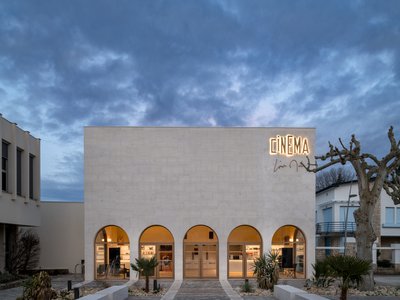
Louis Malle Cinema: A Limestone Cultural Landmark Revitalizing Community Life in Prayssac
Limestone cinema extension with public forecourt, blending heritage and modern design to create flexible cultural spaces and strengthen community interaction.
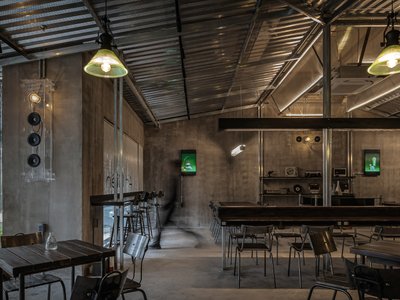
An Miên Lumière Cafe by xưởng xép, Ho Chi Minh City, Vietnam
An industrial-inspired café where layered steel and warm light create a dynamic, immersive environment shaped by reflection, depth, and perception.
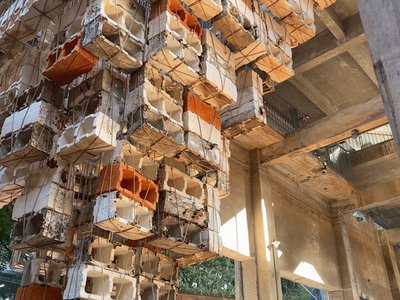
Inverted Architecture Installation by Studio Link-Arc: Exploring the Intersection of Architecture and Living Organisms
Inverted Architecture Installation by Studio Link-Arc blends mycelium, sustainability, inverted design, ecological cycles, and urban adaptive architecture in Shenzhen.
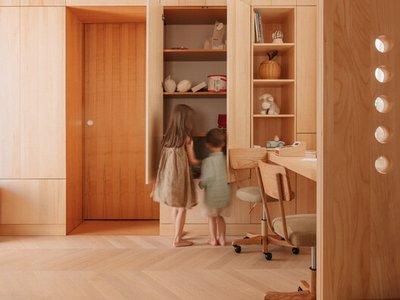
Treehouse Apartment: A Warm Timber Interior Blending Craft, Play, and Contemporary Living
Warm timber apartment with integrated treehouse, combining natural materials, craftsmanship, and playful design to create a flexible, family-oriented living environment.


Similar Reads
You might also enjoy these articles

Digital Façade Design for our cities’ urban fronts
Prima Facie - Result Story
Protecting avian biodiversity: Bird observatories to help spread awareness & save rare bird species.
Results for ‘Fly’ - Landscape design competition out now
Connecting with nature: Forest interpretation center in Australia's Wollemi National Park
‘Asatti’ - Landscape design competition - Result story






Comments (0)
Please login or sign up to add comments
No comments yet. Be the first to comment!