
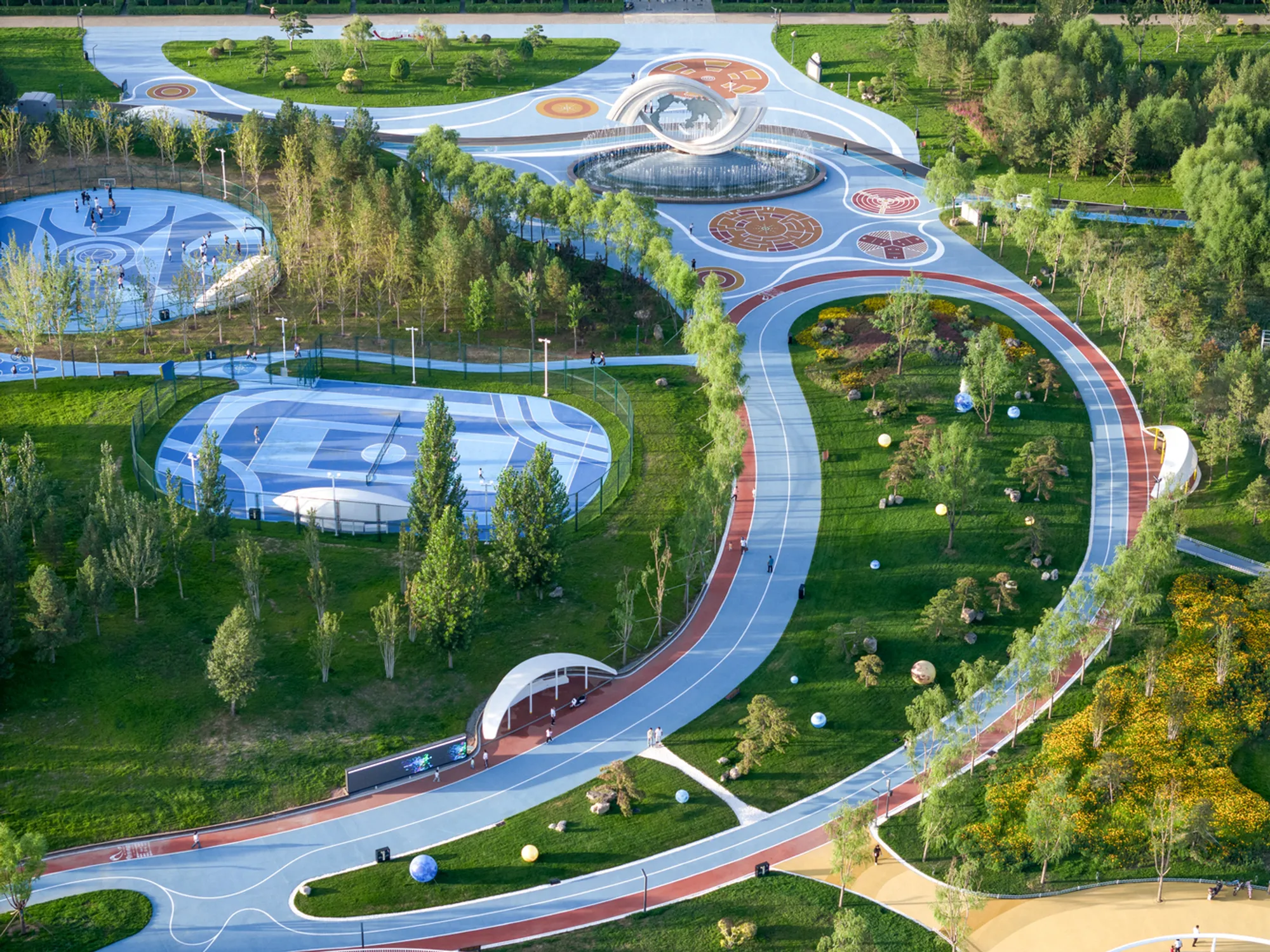
PLAT ASIA Sculpts a 20-Hectare Smart Sports Park from Ordos' Desert and Steppe Landscape
A derelict urban square in Kangbashi District becomes a terrain-driven recreation hub shaped by dunes, rivers, and native grassland.


Ordos sits at the convergence of the Kubuqi Desert, the Mu Us Sandy Land, and the Yellow River plain, a geography that most architecture in the city politely ignores. PLAT ASIA, led by principal designer Bian Baoyang, took the opposite approach when the firm was asked to renovate a 19.7-hectare urban square in Kangbashi District. Rather than layering a generic sports park over the site, the team read the region's landforms as a design language: micro-terrain that mimics dune slopes, a looping blue runway that traces the curves of the Hongliu and Yellow Rivers, and a planting palette rooted in the local steppe. The result, completed in 2023 after roughly thirteen months of construction, is a park that feels less like an amenity dropped onto a grid and more like a piece of Ordos landscape that happens to contain basketball courts, football pitches, and a children's playground.
What makes the project worth close attention is not merely its scale but its argument about how public space should be organized. The original SHIJIE square was a classic case of underperformance: a vast open surface surrounded by residential towers, offices, and schools, yet offering little beyond a few gate ball courts and a line of themed sculptures. PLAT ASIA restructured the entire site around five programmatic arrays, each calibrated to a different age group, stitched together by a sinuous circulation network and shaded by PTFE membrane pavilions that respond to the arc of the sun. Smart systems, including real-time traffic monitoring along the jogging loop, solar-powered charging furniture, and an integrated visual-impairment navigation system, are woven into the landscape without overwhelming it. The park is technologically ambitious but materially grounded, using permeable concrete, desert sand, and colored asphalt to connect its surfaces back to the terrain beneath them.
Terrain as Blueprint
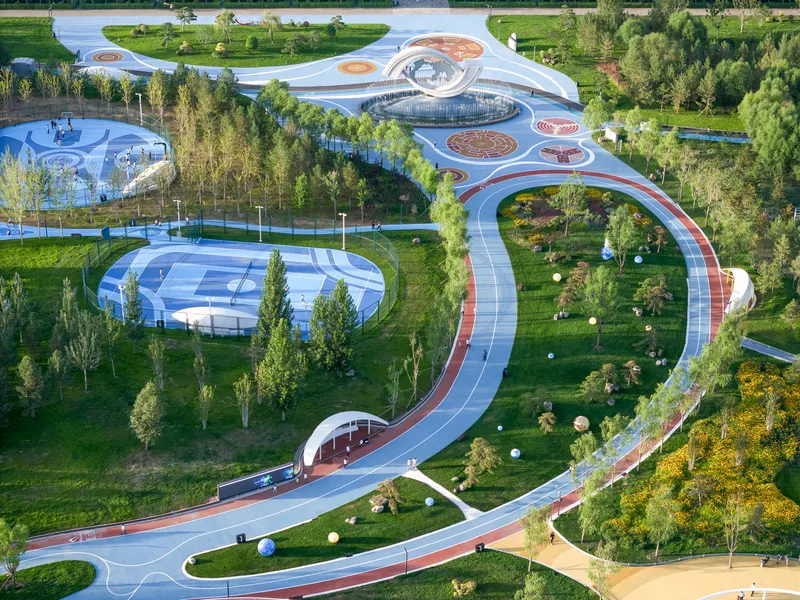
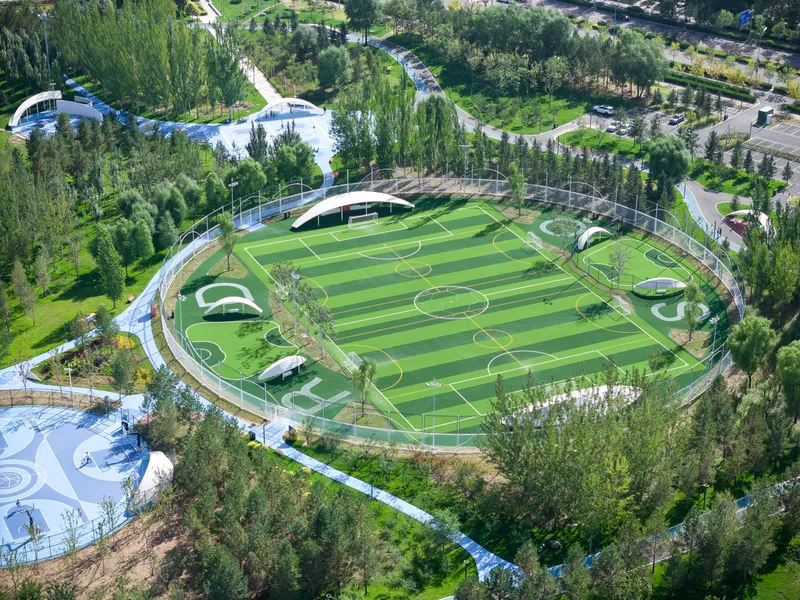
Seen from above, the park's layout reveals its debt to geomorphology. Serpentine pathways connect circular pavilions and sports courts through planted landscape, their curves derived from the dynamic bends of the Hongliu River. Between these paths, gently sculpted micro-terrain rises and falls in blocks that echo the slow dune formations shaped by the region's prevailing northwest winds. The effect is legible even at ground level: walking through the park, you gain and lose elevation in subtle increments, which breaks up sightlines and creates distinct spatial pockets without walls.
PLAT ASIA preserved the site's existing tall arbor trees, principally Populus alba, Pinus sylvestris, and Salix matsudana, while clearing the dense, low undergrowth that had blocked views and movement. New native grass species were added to reinforce the steppe character, creating a woodland-pasture atmosphere that invites informal activities like camping and picnicking alongside structured sport.
The Blue Runway and Circulation Logic
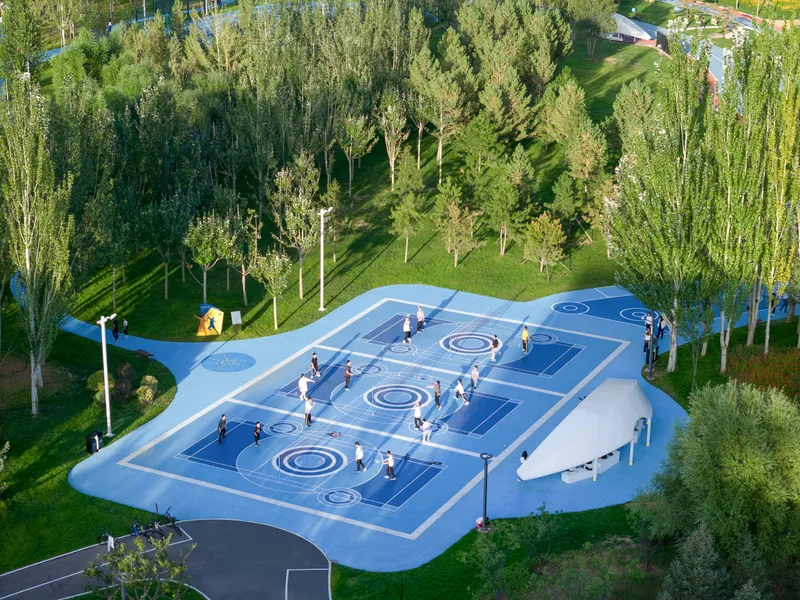
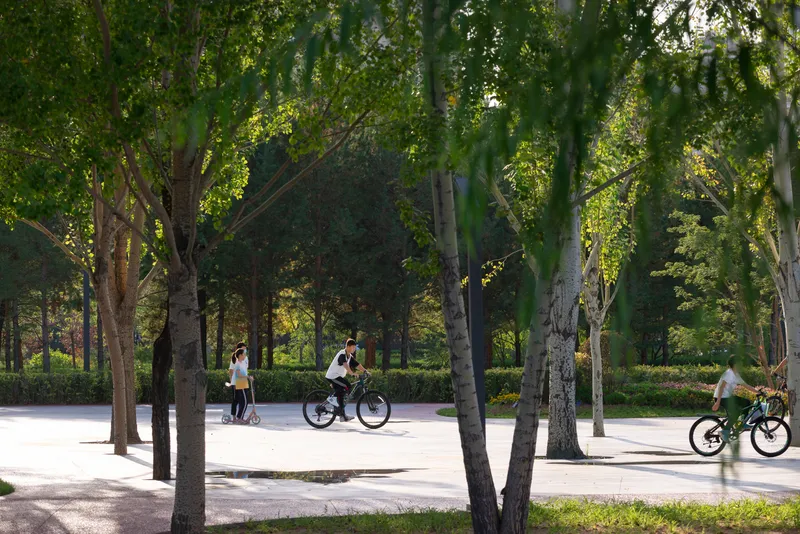
The park's most visible gesture is its blue runway, a continuous jogging loop that threads through the entire site. Its color is no accident: it reflects the expansive Ordos sky and the river systems that inspired the park's plan. Built from a combination of all-plastic and hybrid plastic surfaces, the track doubles as a wayfinding spine, connecting the five functional arrays while channeling foot traffic and cycling along predictable routes. Real-time monitoring sensors embedded along the loop feed data on pedestrian density to park management, allowing dynamic adjustments to lighting and signage.
The patterned play courts visible from overhead, with their circular and geometric markings, demonstrate how PLAT ASIA treats ground surfaces as graphic design. Color-coded zones clarify program without fencing, and the permeable materials beneath ensure that rainwater infiltrates rather than pooling, a practical necessity in a semi-arid climate where every drop counts.
Sports Courts Woven into Landscape
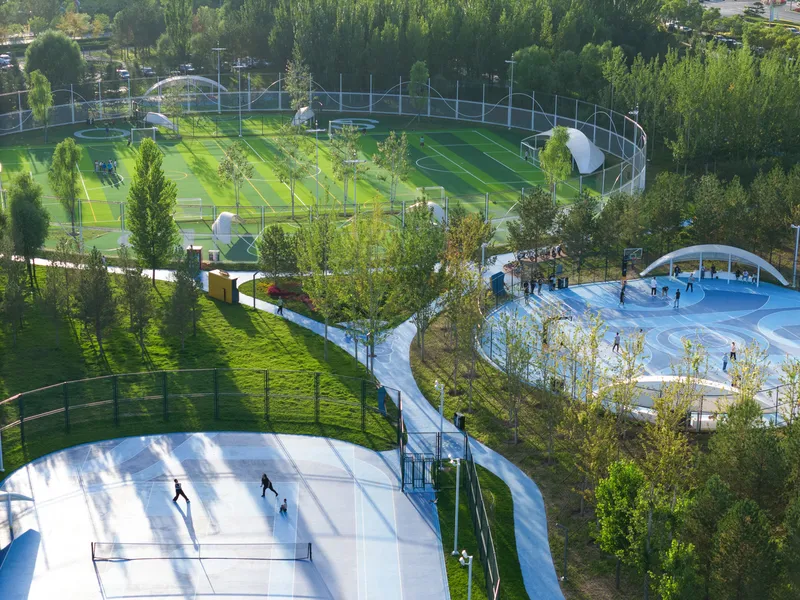
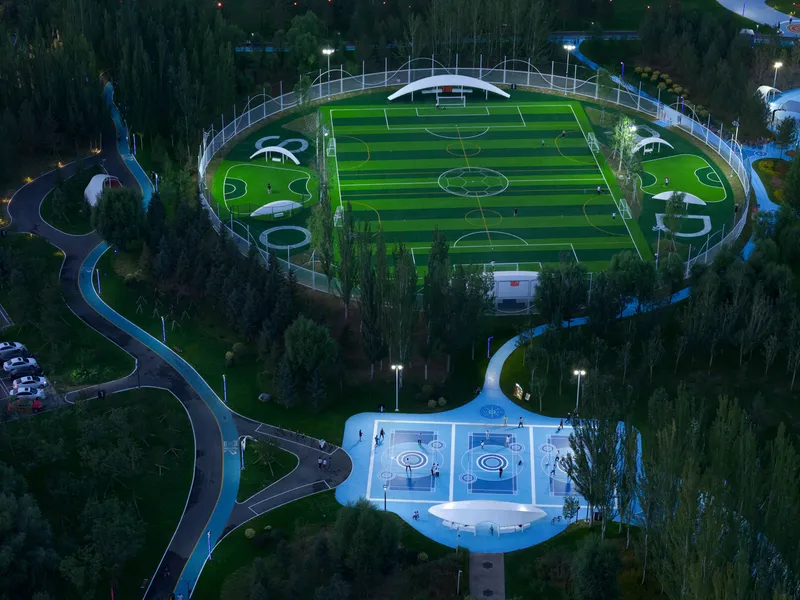
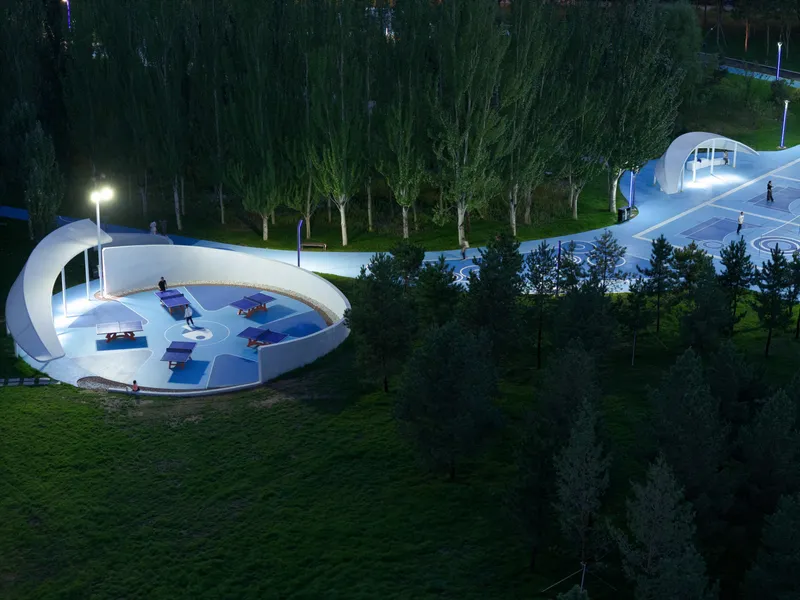
The comprehensive ball courts area occupies the park's northwest quadrant, offering five-a-side and seven-a-side football pitches, basketball courts, tennis courts, badminton courts, and table tennis courts. What distinguishes these facilities from a standard municipal sports complex is their integration into the planted landscape. Courts wind through green fields and tree groves rather than sitting on a cleared slab, and flowing pathways connect them so that spectators, joggers, and players share a continuous ground plane.
At night, the strategy becomes even clearer. Controlled lighting isolates active courts in pools of white light while the surrounding landscape remains softer, creating a lantern effect visible from the residential towers that ring the park. The circular basketball platform, sheltered beneath a white canopy, reads as a glowing social hub after dark, a piece of urban furniture scaled to the neighborhood.
Membrane Pavilions and Climate Response
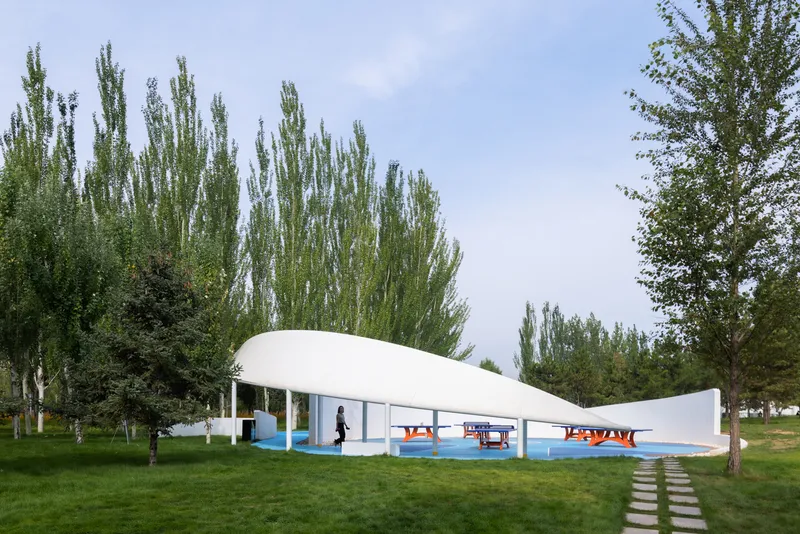
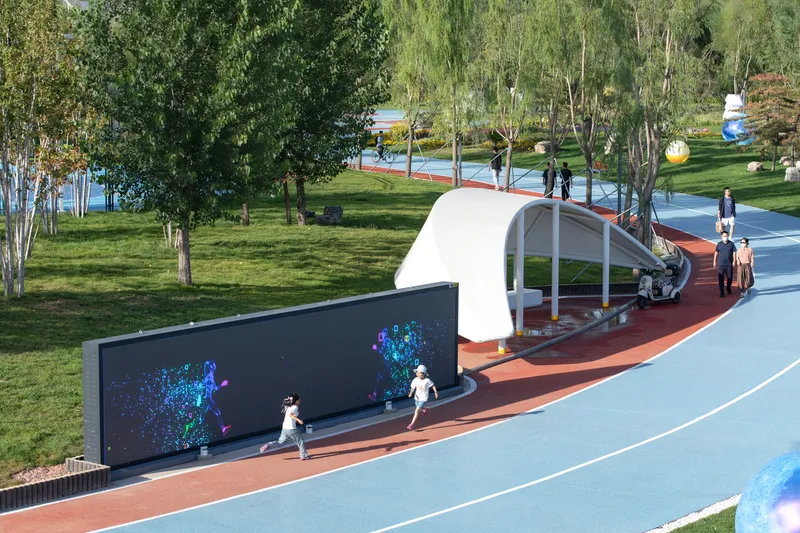
Ordos summers are hot and exposed; its winters are bitter. PLAT ASIA's PTFE membrane pavilions address both conditions. Their curved ridge lines and careful orientations are calculated to cast shade throughout the day, and their semi-open form allows cross-ventilation while blocking direct solar gain. Positioned as rest stops along tracks and gathering points for families, these structures do the work of buildings without the mass or cost of enclosed architecture.
The main service center, capped at a modest 1,180 square meters and nine meters in height, pushes this logic further. Its semi-open corridors and vertically shaded facade maintain transparency to the park while housing practical program: offices, a sports store, a café, and restrooms on the ground floor. Most strikingly, sections of the facade are assembled with recreational climbing equipment for children, turning the building envelope into play infrastructure. A rooftop lookout offers panoramic views that connect visitors visually to the full sweep of the park and the city beyond.
A Center Built for Children
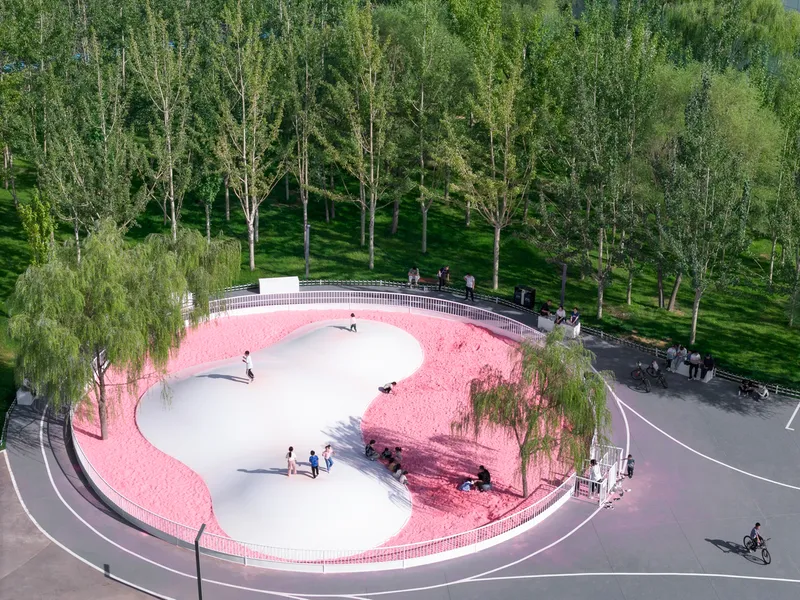
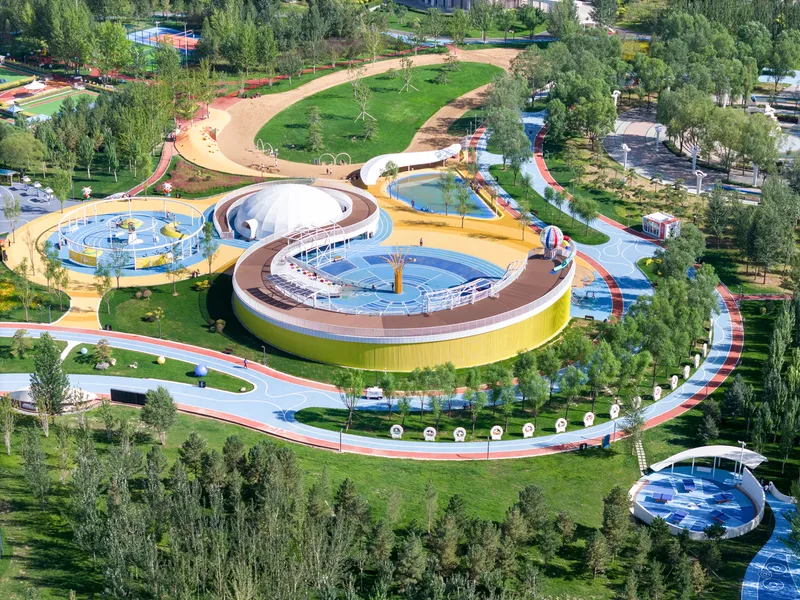
The kids' square occupies the park's core, a deliberate choice that places the youngest users, and the families who accompany them, at the center of gravity. A circular white play area ringed by pink gravel and curved railing sits among the existing poplars, while nearby, a spiral ramped water feature with yellow and brown banding encircles blue pools, offering sensory play that references the park's broader terrain narrative. These elements are not generic playground catalogue pieces; their forms echo the dune-and-river vocabulary of the larger landscape.
An interactive digital screen wall along one of the terracotta pathways adds a smart-park layer to the children's experience, but the design resists the temptation to make technology the spectacle. The screens sit within a shaded canopy structure and complement, rather than replace, physical play. It is a measured integration that suggests PLAT ASIA understands the difference between a smart park and a park full of screens.
Why This Project Matters
Ordos Smart Sports Park matters because it refuses the false choice between performance landscape and ecological design. The park is unambiguously a sports facility, with professional-grade courts, a monitored jogging loop, and age-segmented programming. But it is also a serious landscape project that reads the regional ecology, preserves existing trees, uses permeable and locally sourced materials, and manages stormwater through topographic strategy rather than buried infrastructure. In a city that became internationally famous for its empty monuments and underused public spaces, this is a pointed correction: a park designed around how people actually move, play, and rest.
For designers working on large-scale public recreation projects, the takeaway is in the method. PLAT ASIA did not start with a programme spreadsheet and then landscape the gaps. They started with the landform, the wind, the rivers, and the steppe, then embedded programme into that reading. The result is a 20-hectare park that feels specific to its place in a way that most smart parks, with their universal sensor kits and modular play equipment, simply do not. Ordos has enough generic urbanism. It needed a park that remembered it was built on a desert.
Ordos Smart Sports Park, designed by PLAT ASIA, Kangbashi District, Ordos, China. Site area: 197,000 m². New building area: 1,180 m². Completed 2023. Photography by Holi Landscape Photography.
About the Studio
Share Your Own Work on uni.xyz
If projects like this are the kind of work you want to make, uni.xyz is a place to publish your own, find collaborators, and enter design competitions.




Popular Articles
Popular articles from the community


Hill & Cross Opera: Sculptural Opera House Architecture Shaped by Tallinn’s Landscape and Identity
Hill & Cross Opera reimagines opera house architecture in Tallinn through its sculptural hill, civic plaza, glass wave and a luminous cross.

The Ocean Hive: Sustainable Architecture for a Self-Sufficient Civilization at Sea
The Ocean Hive imagines sustainable architecture at sea, where modular habitats, algae, wave power and ocean waste sustain a growing colony.
EW PARK: Sustainable Architecture Reimagines the Future of Urban Parking
EW PARK reimagines city parking as a modular wooden tower combining automation, solar energy, electric mobility, and adaptable urban design.

Riyadh For All: Intergenerational Urban Design for Active Aging in Rabat
Riyadh For All reimagines urban design in Rabat with intergenerational co-living, adaptive courtyards, and Moroccan cultural exchange today.


Similar Reads
You might also enjoy these articles


Hodi-Mandai Geram
Project Function: Preservation and revitalization of the Intangible heritage and socio-spatial identity of the Hodi by Housing, Cultural Memory Center, Sacred Grove, landscape, local tourism economy


Olio Towers: A Mid-Rise for Performers That Fuses Housing, Rehearsal, and Stage
Located blocks from Houston's Theater District, this modular tower stacks living units around a central performance atrium.

Oasis: Modular Green Housing Carved into Dhaka's Urban Fabric
A shortlisted Plugin Housing entry reclaims unauthorized settlements in Dhaka with stepped concrete volumes, green roofs, and ventilation-driven design.

Black Hole: A Floating Megastructure for the Post-Physical Era
Emiliano Mazzarotto envisions a spherical, self-scaling arena where e-sports, digital hotels, and holographic stadiums replace traditional public space.


Explore Public Building Competitions
Discover active competitions in this discipline



Challenge to design locus for the upliftment of human rights


Challenge to reimagine the Iron Throne


Photograph architecture without architects


Illustrate the lost glory of Angkor Wat - Render Challenge
Comments (0)
Please login or sign up to add comments
No comments yet. Be the first to comment!