
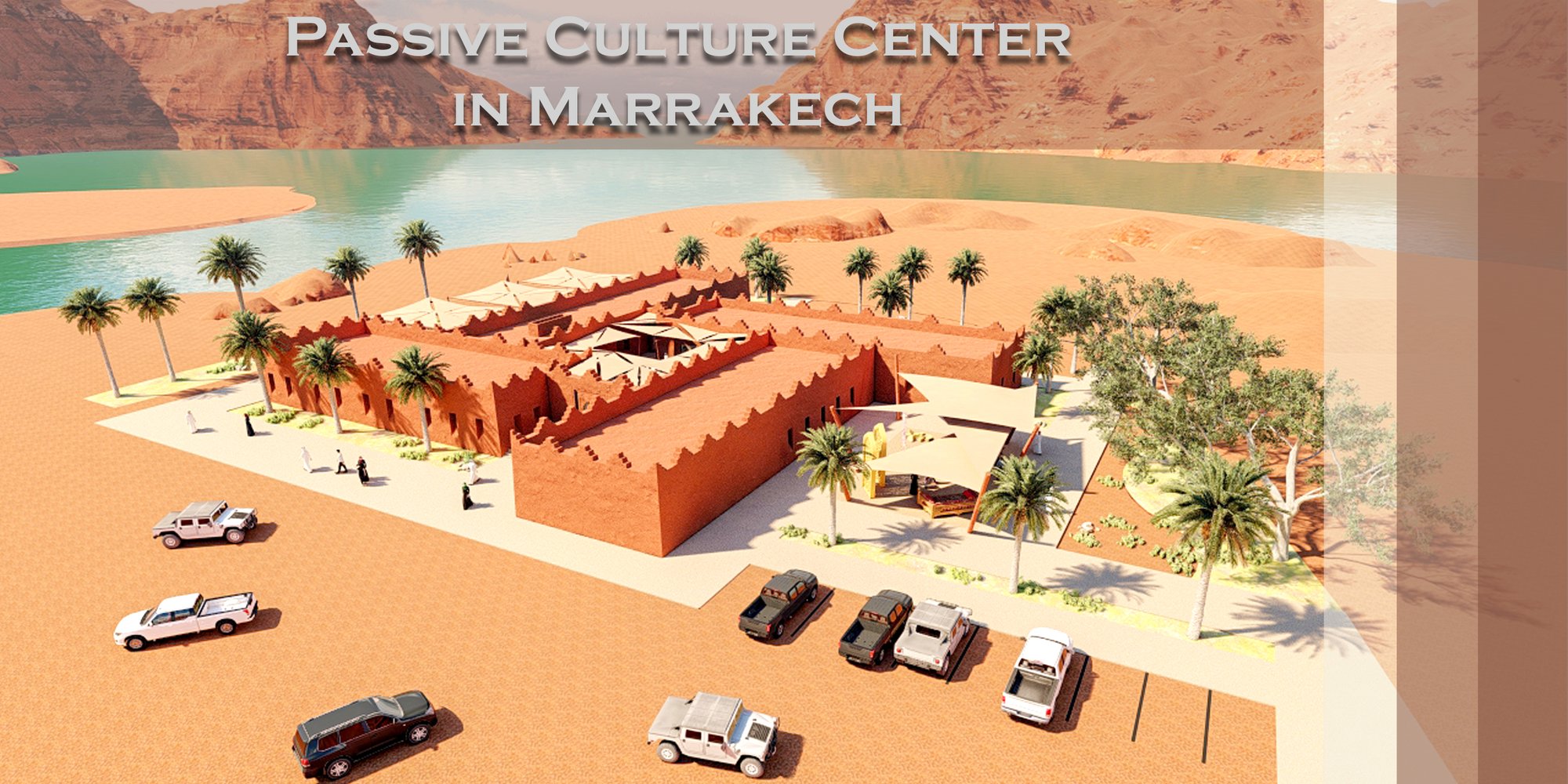
Passive Culture Center in Marrakech
Adopting identity and promoting sustainable approaches

FAQs
1) What was the concept behind the project?
The concept of the project is to design a passive cultural center in Marrakesh (Agafay desert) that combines traditional architectural principles with solar and wind energy control as well as the use of natural properties of building materials to ensure that the interior spaces remain cool in summer and warm in winter.
2) What was the intent behind the organization of elements across various levels?
The building’s form was influenced by the vernacular architecture of Marrakesh. Through a modular form, the components of the project fulfill the needs of occupants and functions in spaces. The building is designed as a compact structure composed of four connected wings with a central open courtyard. The building is appropriate for the location since the main entrance is on the main street and leads to an inner courtyard with artisanal training rooms that are located in the north and a dining area (café and restaurant) that has a view on the Lalla Takerkoust lake. At the national and regional scale, the site has a strategic position as well as a strong authentic value related to its physical components and intangible features. For this reason, the lake is a popular tourist destination and a significant landmark that play an important role in delivering water to the urban region of Marrakech. Also, it is considered as a tourist attraction for swimming, sunbathing and paddle boating.
3) How does your design reflect the Moroccan culture?
The design of the building reflects the identity of the area through the traditional architecture of the facades that is inspired from the Kasbahs. It contains a music conservatory and several artisanal training rooms for local crafts such as carpet weaving, wickerwork, clay sculpture, … etc.
4) How was the program condensed into final?
- Indoor closed components:
The project consists of single compact building (cultural center) with four wings.
The first wing contains a theater and a storage room.
The second one the artisanal training rooms for various local crafts, music conservatory and mediatheque (library and AV room).
The third one contains the administration offices and services (toilets).
The forth and the last one is the dining area (café and restaurant) overlooking the lake and a kitchen.
- Outdoor open co
An extension to the theater serves as an outdoor exhibition for showcasing the products of the center. In addition, the artisanal training rooms have extended open spaces where users have the opportunity to work outside during winter days.
This sequence tends to improve the users’ experience of the building through the permanent transition between closed spaces that offers social interactions through providing a cozy atmosphere within human scaled spaces that enable visual and sensory contact with the surroundings.
5) How was the material chosen?
- Building material:
The structure of the building is load bearing walls. It was built from rammed earth (a local available material in site) that has several advantages such as high thermal mass, temperature and noise control inside the building. The thickness and density of the material means that heat penetration to the wall is very slow and the internal temperature of the building is low. It provides the building with strength, durability and fire resistance.
- Shade (camel skin):
A camel’s fur is a strong insulator against the sun’s heat. Camels, unlike humans, do not sweat to preserve water, even when ambient temperature reaches 49C0. As a result, the skin of the camel is used to cover and regulate the temperature in the passageways around the courtyard.
6) What are the environmental aspects of this culture center?
To address the region’s severe environment and harsh climate, the culture center employed several passive techniques and systems in its design, construction and operation to achieve a green building.
- On the building scale:
Courtyard:
The diurnal variations in temperature is higher in the desert hot climate. The cool night air descends into the courtyard until it enters the surrounding rooms. It is considered as a good source of ventilation and light.
Water element (fountain):
Evaporative cooling is an effective technique in hot dry climate where the atmospheric humidity is low. The sensible heat of air is used to evaporate water which then cools the building’s different spaces.
Sunscreens (mashrabiya):
Adjustable rotating sunscreens are used on windows (in the café and restaurant) to control the falling sun rays which allow filtration of solar radiation during summer as well as good solar reception during winter.
In-depth windows:
In-depth windows with slopes under the windows (in the artisanal training rooms) to control daylight and shading inside the space.
Cross ventilation and openings:
There are small openings on the opposite walls of a single space to allow natural ventilation.
- On the site Scale:
Vegetation:
Different vegetation elements were used in the site to provide shade for the extended outdoor artisanal training space such as Eucalyptus trees olive and orange orchards trees.
Greywater treatment:
This was achieved through collecting greywater from the washbasins to be filtered, recycled and reused once again in the irrigation system in the site.
7) How does passive design affect energy efficiency and affordability?
The building adopted passive design techniques that have high adaptability with climate changes and reduce energy needs during the construction and operation processes. The building is considered affordable due to the use of several environmental treatments for solar and wind energy that controls heating and cooling inside the building.
Natural daylight analysis was monitored and assessed in the artisanal training rooms. It was found that using in depth windows in the artisanal training rooms promoted daylight and shade inside the spaces. As a result, the building uses less artificial lighting and this is considered to be more economical during the operation process.



Popular Articles
Popular articles from the community

Gads Hill Early Learning Center by JGMA: Adaptive Reuse Shaping Community-Focused Educational Architecture
Adaptive reuse transforms fragmented structure into vibrant early learning center with playful façade, natural light, and community-focused sustainable design.
Louis Malle Cinema: A Limestone Cultural Landmark Revitalizing Community Life in Prayssac
Limestone cinema extension with public forecourt, blending heritage and modern design to create flexible cultural spaces and strengthen community interaction.


The Ken Roberts Memorial Delineation Competition (Krob)
As the most senior architectural drawing competition currently in operation anywhere in the world, it draws hundreds of entries each year, awarding the very best submissions in a series of medium-based categories.

Solar Steam: A Climate-Responsive Architecture That Redefines the Monument
A climate-responsive memorial architecture that transforms heat, decay, and time into a living system reflecting humanity’s ecological impact.

Similar Reads
You might also enjoy these articles
Scientific and Educational Monitoring Center of the Yenisei, Krasnoyarsk
Architecture as an instrument for ecological research, education, and environmental awareness along Russia’s largest river.
Development of Andretta Artist’s Village, Palampur, Himachal Pradesh, India
Reimagining Andretta as a living cultural landscape where art, architecture, and community converge to shape a global creative village.
The NEON Culture: Experiential Architecture Shaping Contemporary Urban Life
Exploring how experiential architecture responds to accelerated lifestyles through immersive spaces, adaptive programs, and sensory-driven urban design.
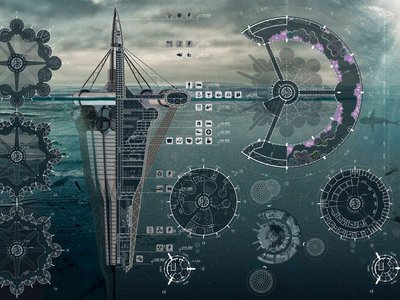
Narwall: Autonomous Offshore Architecture for Extreme Environments
A visionary model of sustainable offshore architecture, Narwall redefines public life, energy autonomy, and resilience in extreme Arctic waters.
Explore Cultural Architecture Competitions
Discover active competitions in this discipline




The Global Benchmark for Architecture Dissertation Awards


The Global Benchmark for Graduation Excellence

Challenge to design an urban locus of culture and heritage

Bring back Drive In's
Comments (0)
Please login or sign up to add comments
No comments yet. Be the first to comment!