
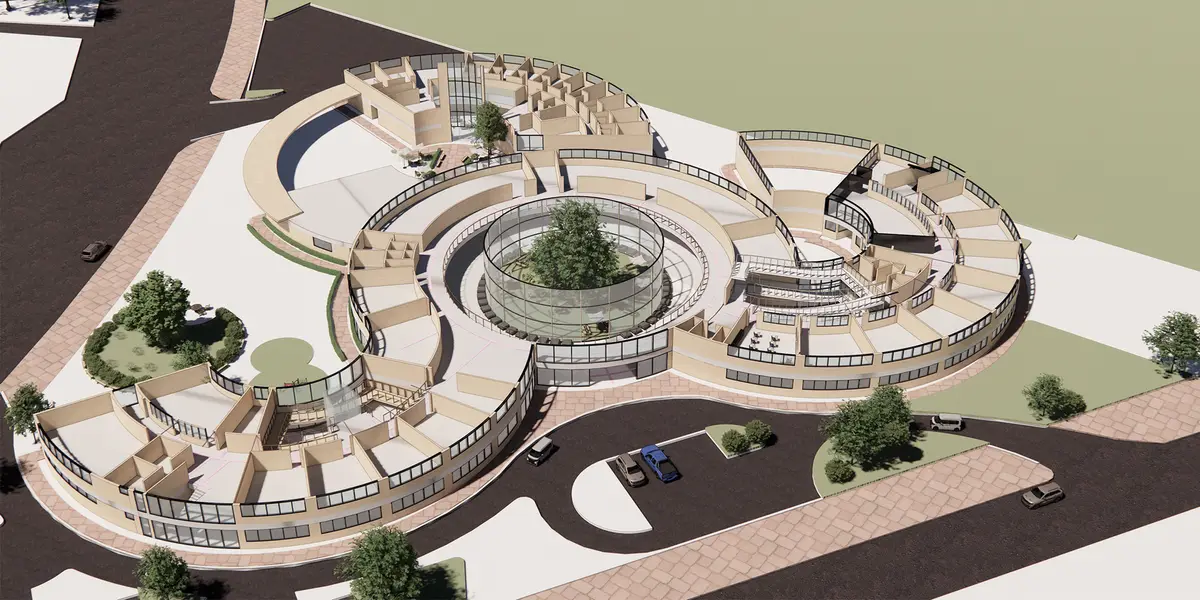
SENSORY LANDMARK
ELEMENTARY SCHOOL for the BLIND CHILDREN

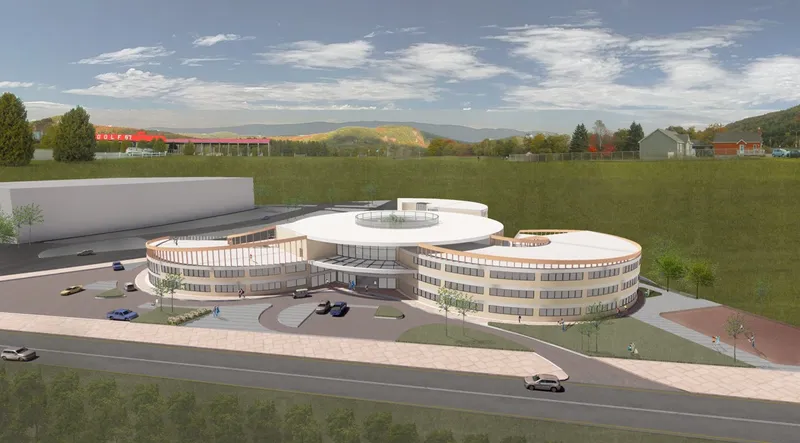 PERSPECTIVE
We designed an elementary school for blind children.
Fear of the unknown environment leads to a lack of activity, directly linked to children's creativity.
The focus was on spending the most extended hours of the day and living without fear in the most stimulated schools.
What if they could perceive the school's environment with their own senses?
What if they had their maps in their heads?
We started designing out of these questions and constructed sensory landmarks that they could recognize throughout the school as solutions. This will play a significant role in drawing maps in children's minds.
 SITE PLAN
The site for this concept school is located in Moscow, Russia.
Moscow is the capital city of Russia with a geographical influence. We hope to be a milestone in the construction of a design school for blind children.
The feature of the site is that it has excellent accessibility because two sides touch the road.
Using this accessibility, we put the main entrance on a relatively narrow driveway, which leads to a drop off zone.
This guarantees stability in children's attendance.
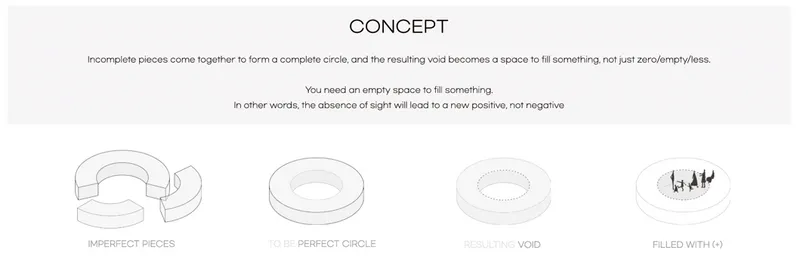
CONCEPT
Incomplete pieces come together and become a complete circle that has an empty space. It means the absence of vision doesn't just work as a defect but a space for children to grow up and fill their own positive things. The building contains ideas of design throughout the actively designed process with the courtyard.
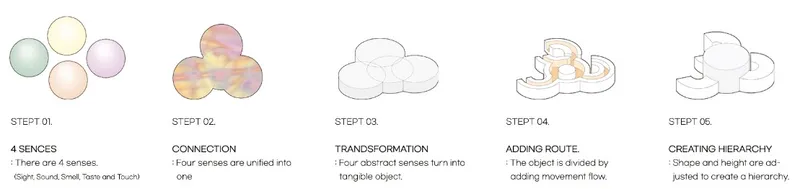
MASS PROCESS
Four senses work together and become tangible one thing. And then it consists of lines of circulation that minimize collisions. Lastly hierarchies of each spaces were established according to height, size, and importance.

SENSORY LANDMARK DIAGRAM
The building zoned to Landmark, Elementary School (age for 5-6), Kindergarten(age for 7-12), and Dormitory has a flow path that excludes danger by minimizing crossing or twisting, and IN and OUT direction, which naturally occurs depending on the type of building, helps whether it is a direction. Space is constructed for each module so that a map of the head can be drawn, and each module has a landmark of the senses. There are Wind Landmark at the entrance that intuitively recognizes the transition of spaces. The sense of openness that depends on the size of the sound and the size of the space also helps to recognize the space.
01. MINIMIZE INTERSECTION
It excludes risk factors that are prone to collision, such as intersections, in advance and designs safe movement plans with curves that seem to flow naturally.
Even if you get lost, you can reach your destination by following the flow of movement.
02. IN ADD OUT DIRECTION
The opposite-shaped curves indicate direction.
The "Curve to out" walls and "Curve to in" walls construction complemented the existing flat walls that can't recognize the direction.
It makes one's position and direction easier to recognize by touch.
03. MENTAL MAP : route & landmark
'Route' and 'Landmark' help organize mental map in your head. This mental map helps you reach your desired destination quickly and safely by yourself.
04. EACH MODULE
The building consists of modules installed for each module to help prevent twisting of the movement when it is bent while heading towards the entrance or straight line.
This module is used in schools to make up each classroom and special rooms and in dormitories to make up each room.
05. WIND LANDMARK
Mass is largely divided into landmark, elementary school, and dormitory.
There are Wind Landmark at the entrance that intuitively recognizes the transition of spaces.
06. ACOUSTIC LANDMARK
There are three main levels of openness divided into classrooms, corridors, ramp's floor, and the landmark's floor.
As the sense of openness is divided depending on the floor height, the auditory nature of the space is different so that it can be intuitively recognized.

FIRST FLOOR PLAN
The entrance to the landmark is the main entrance where the drive-through is considered, and two sub entrances are accessed from the dormitory.
The zoning consists of Landmark, Elementary School (age for 5-6), Kindergarten(age for 7-12), and Dormitory. Each space has its own courtyard.
Along with the flow of the building, a spinning road is created to help children walk actively.
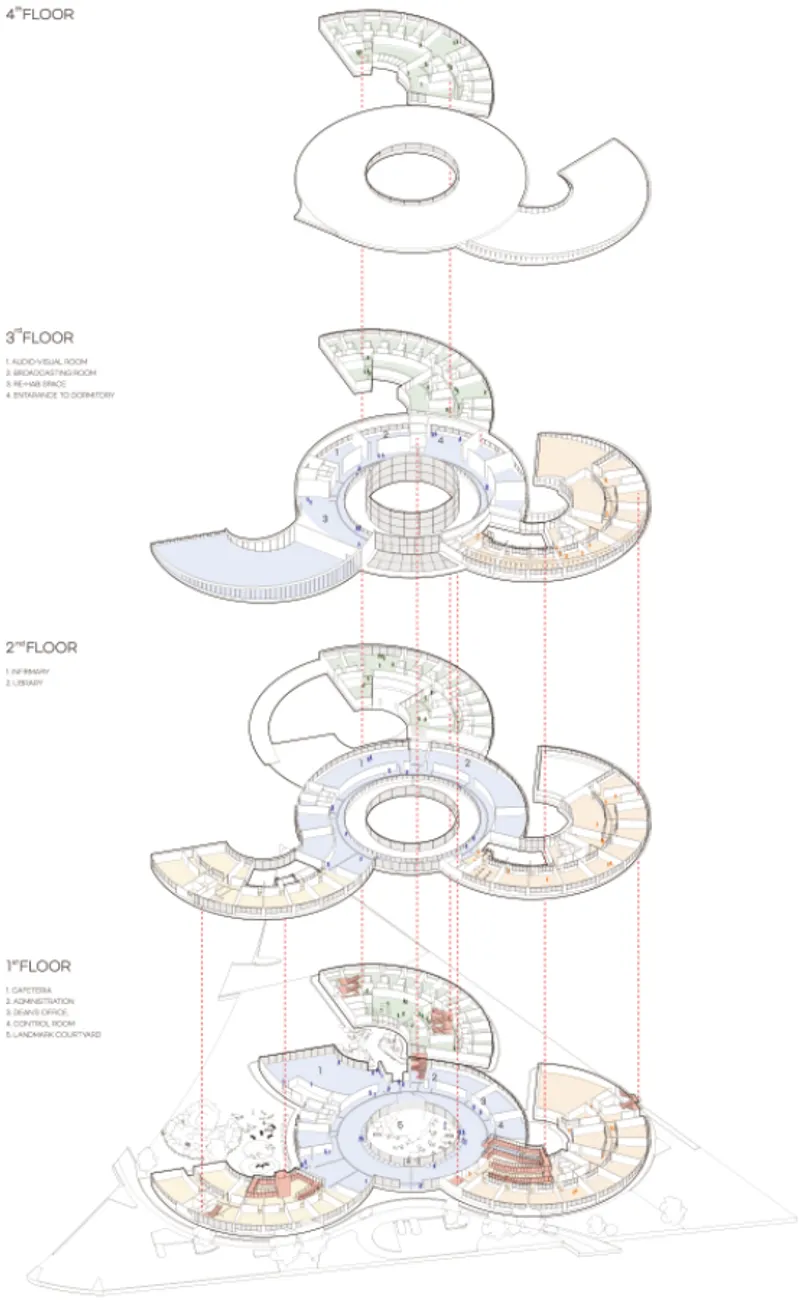
EXPLODED DIAGRAM
The circulation travels through landmarks to each building, helping to find a single corridor.

ACTIVITY DIAGRAM
PHYSICAL
Children are playing ball in the elementary school playground as a program to improve their physical ability.
ART FORMS
3rd-floor Elementary School gymnasium has an external workshop on the roof to help children engage in art activities regardless of size or size of space.
WORLD
The rain falls in the middle of the landmark and can be felt by the sound and smell.
EVOLUTION
For a society where cooperative activities are increasingly valued, children, achieve their goals through joint work
MENTAL
This is the dormitory lounge. Encourage active communication between children.
CREATIVITY
Playing in the courtyard of elementary school, expressing creativity and spreading various thoughts in various spaces.

COURTYARD
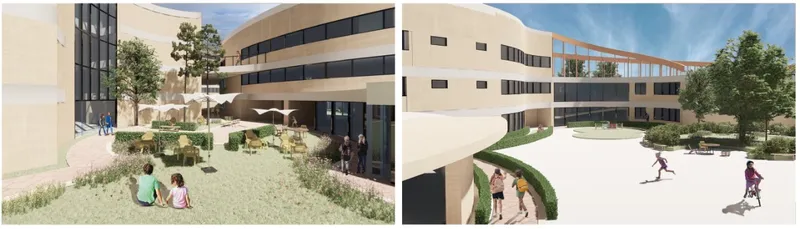
The courtyard acts as an important factor in this project. It enhances openness, establishes a hierarchy of space, and helps to ensure smooth space. Children perceive space through other senses.
 CONCEPT SECTION
IMAGES


Popular Articles
Popular articles from the community


Singing Woman: An Opera House That Performs Before the Curtain Rises
Ovidiu Cristian Pavel's conceptual opera house translates Estonia's choral identity into a sculpted waterfront landmark facing the Baltic Sea.
Temporary Home for Dogs: A Reversed Zoo Rethinks Animal Shelter Architecture
In Bucharest, a sinuous corridor and freed landscape flip the logic of containment, designing a shelter that works to make itself unnecessary.

Manzana Morphosis: Stretching Barcelona's Grid into a Living Landscape for 2050
A radical reworking of the Eixample manzana turns density into a tool for generous public space, vertical ecology, and environmental performance.

The Amber Palace Opera: A Geological Fiction Surfaces on Tallinn's Baltic Waterfront
Pierre Brillard reimagines a Baltic legend as a public landscape, opera house, and waterfront promenade rooted in Tallinn's coastal identity.

Similar Reads
You might also enjoy these articles

Shakur's House: Exposed Brick as an Interior Organiser in a 168 m² Mashhad Residence
Brick moves indoors in this Mashhad residence, where masonry walls, glass partitions and teal planes sequence a compact home without closing it off.

Day and Night Park: A Time-Based Urban Newsstand in Beijing
A temporary urban newsstand in Beijing blending travel, light, and reading through poetic colors, compact form, and community-focused design.

Modernist Patio Renovation in El Masnou, Barcelona by Oliver Segura Arquitectura + Cebrià Arquitectura
Modernist patio renovation blending tradition and innovation with a movable pool, leveled floors, and Catalan materials in El Masnou.
Alto Residencial Coop: Cooperative Housing Development in Santiago de Compostela by Carbajo Barrios Arquitectos
A linear cooperative housing complex blending white volumes and perforated metal façades, enhancing community living, natural light, privacy, and urban integration.

Comments (0)
Please login or sign up to add comments
No comments yet. Be the first to comment!