

Nikken Sekkei Builds a Theater from 27,000 Cedar Cubes on the Ruins of a Japanese Castle
Takatsuki Arts Theatre channels local forestry and castle-town memory into a porous cultural complex threaded with gardens and light.


Most performing arts centers treat their halls as sealed containers: acoustically precise, thermally controlled, and cut off from the world outside. Nikken Sekkei's Takatsuki Arts Theatre, completed in 2023 on the former grounds of Takatsuki Castle in Osaka Prefecture, takes the opposite approach. Three halls and ten studios are organized as discrete volumes separated by courtyards, voids, and circulation bands, so that daylight, greenery, and the memory of the castle town's latticed streetscape infiltrate the entire complex. The result is a 17,261 square meter building that feels less like an institution and more like a small district you can wander through.
What makes the project genuinely significant is its material story. Roughly 350 cubic meters of timber were sourced from the Hokusetsu mountain range over a three-year construction period, a quantity calibrated not to exhaust but to sustain Osaka Prefecture's modest annual output of about 1,600 cubic meters. Weather-resistant red heartwood wraps the exterior louvers; fire-retardant-treated sapwood lines interior surfaces. And in the main hall, approximately 27,000 offcut cedar cubes, repurposed from discarded core sections, project at varying depths to form a pixelated acoustic surface that doubles as the building's most striking visual gesture. Nothing here is decorative for decoration's sake.
A Porous Threshold Between Park and Performance
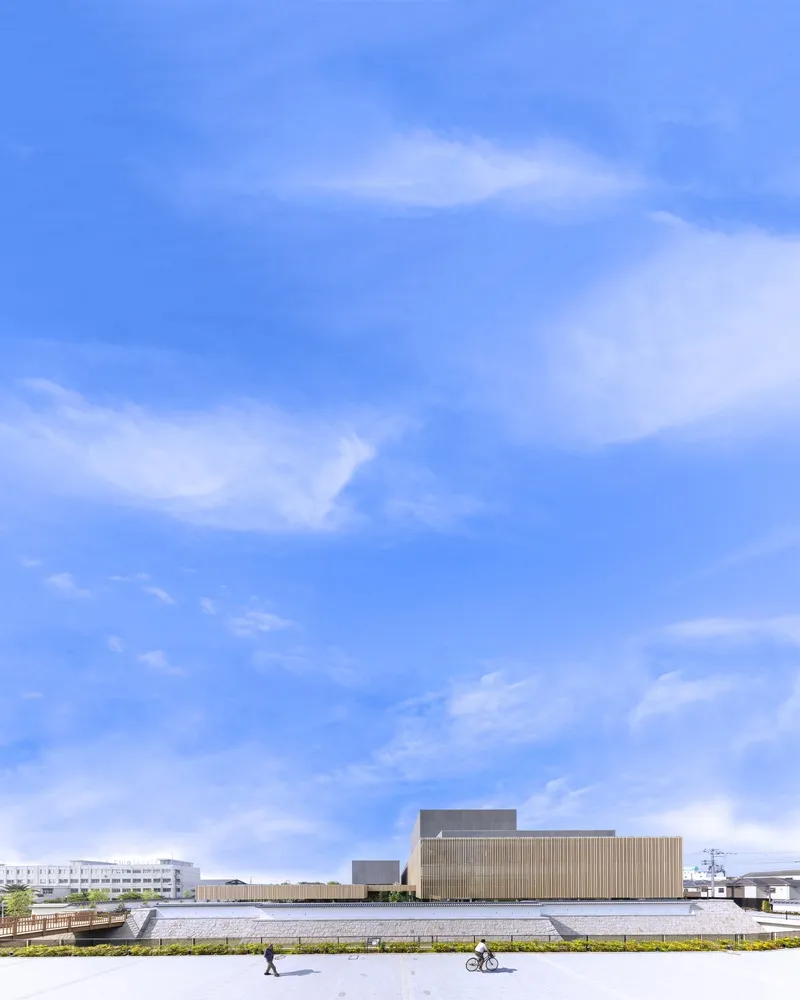
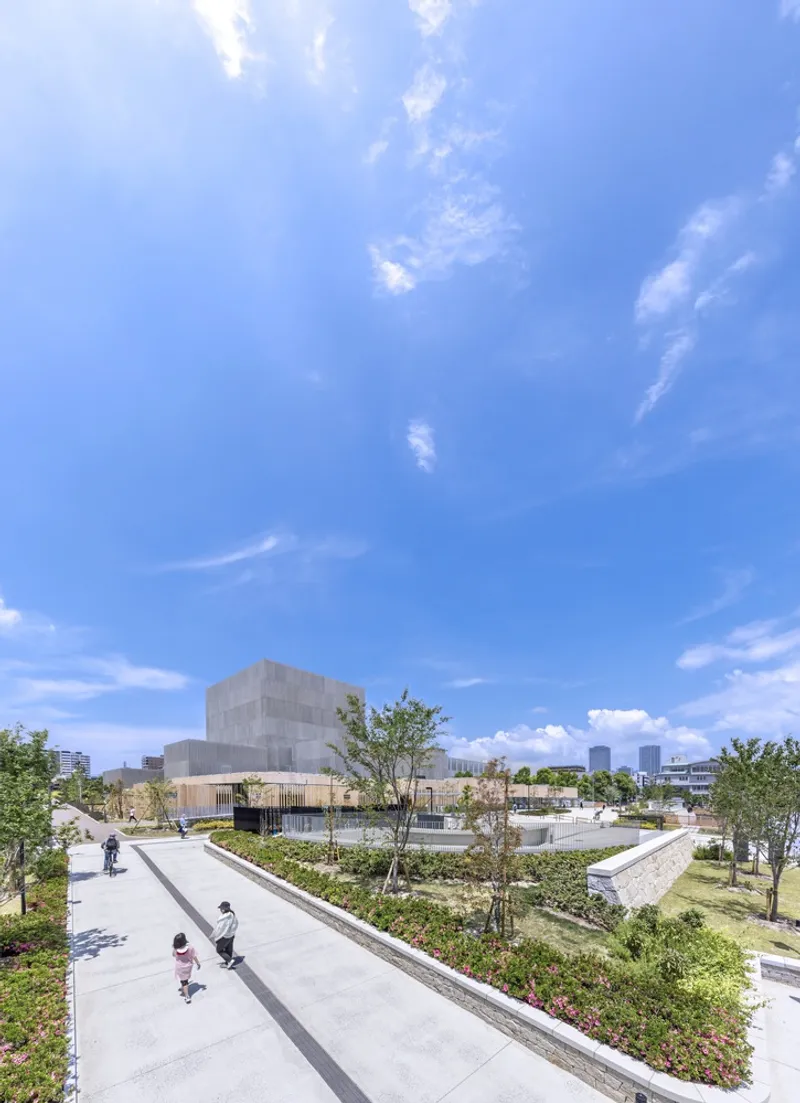
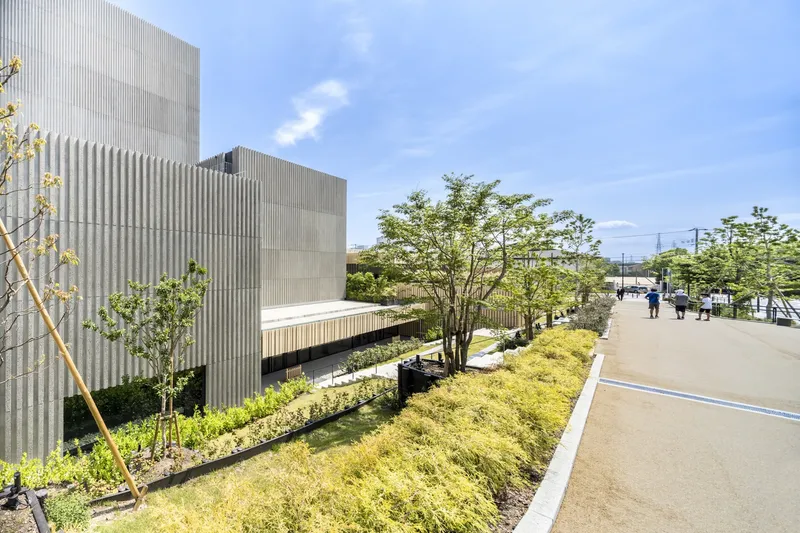
Takatsuki Arts Theatre sits within a municipal park that occupies the historic castle site, and Nikken Sekkei treated that context as a design generator, not a constraint. The building's perimeter dissolves into planted terraces, covered plazas, and elevated walkways that blur the line between civic park and cultural infrastructure. Pedestrians and cyclists pass freely along its horizontally slatted facades, encountering the building as a landscape feature before they ever buy a ticket.
The porosity is deliberate and structural. Narrow gaps between tall concrete walls frame strips of sky; broader courtyards introduce trees and gravel into the complex. These interstitial spaces are the project's primary ordering device, admitting daylight deep into the plan and establishing interior streets that link entrances, foyers, and rehearsal rooms without corridors feeling like afterthoughts.
Timber Louvers and the Castle Town's Ghost Grid
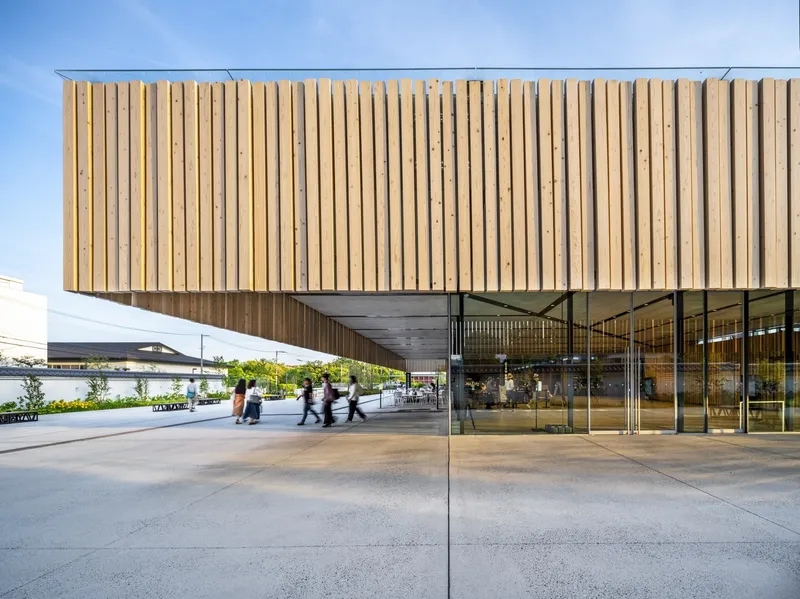
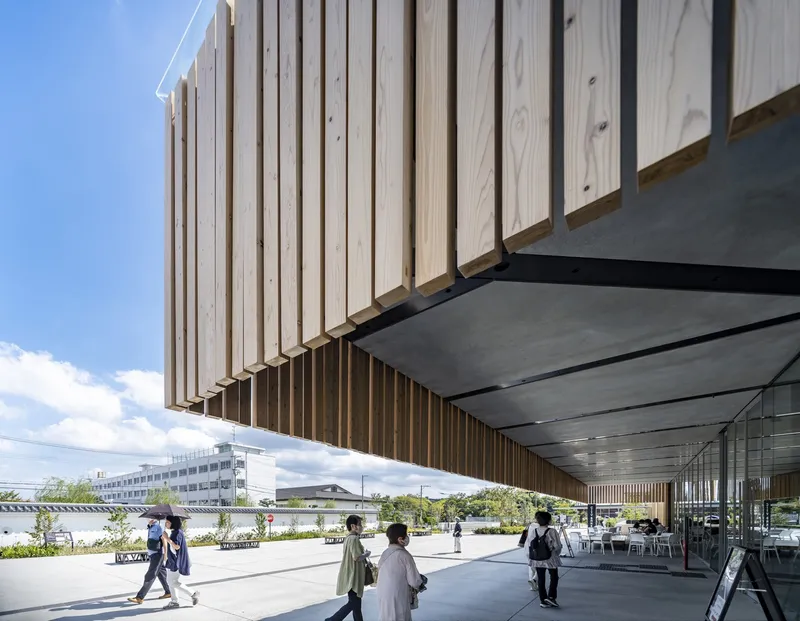
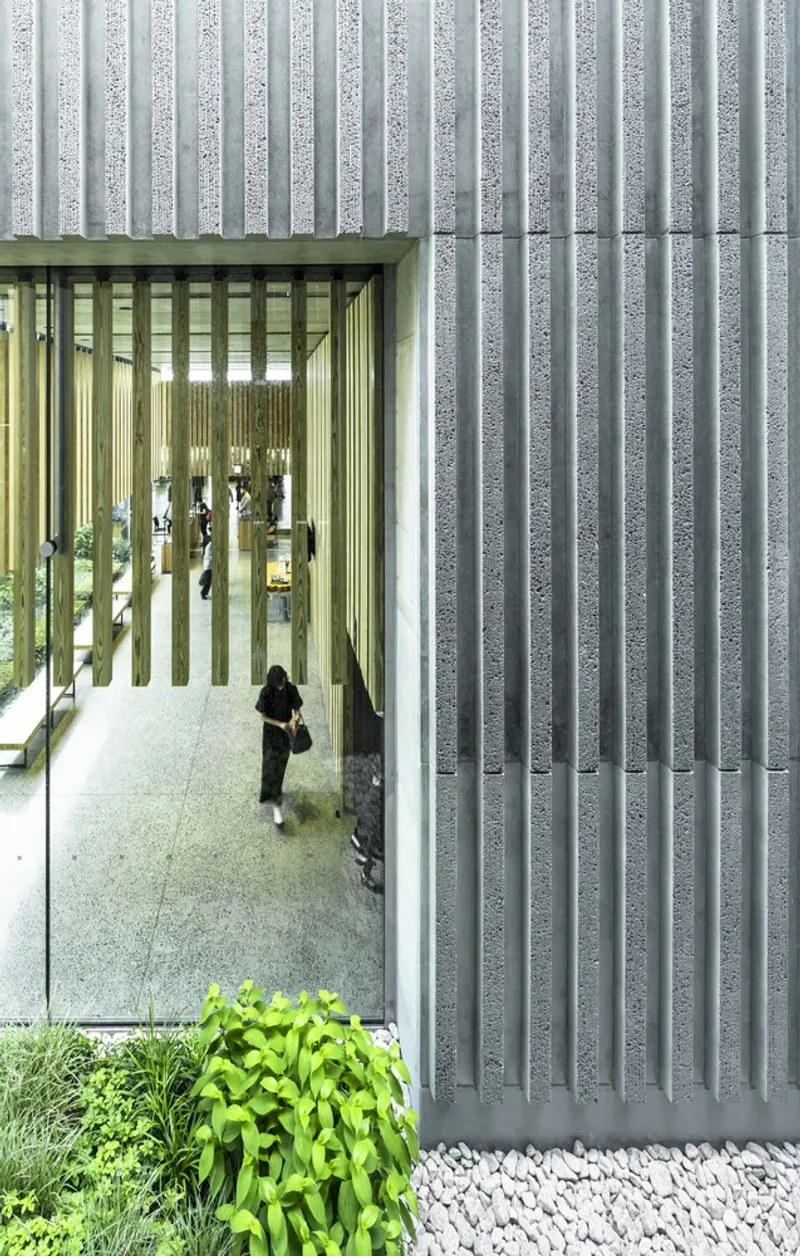
The vertical cedar louvers that wrap the building's cantilevered volumes are not uniform. Their widths and rhythms shift in a pattern Nikken Sekkei describes as random, though the effect recalls the vertical latticework of Takatsuki's historical castle town. The louvers are impregnated with liquid glass for durability and sit in front of full-height glazing, filtering sunlight and tempering glare without sealing off views. Standing beneath the timber-clad canopy of the entry plaza, you look up at metal soffit panels and exposed structural supports that make the engineering legible.
The exterior concrete surfaces add another textural layer. Nikken Sekkei employed the OSHIROX Water Jet Peeling Method to achieve a ribbed, almost geological finish on the vertical fins. The interplay between raw concrete and warm cedar establishes a material dialogue: one geological, one biological, both rooted in the region.
Interior Streets and Filtered Light
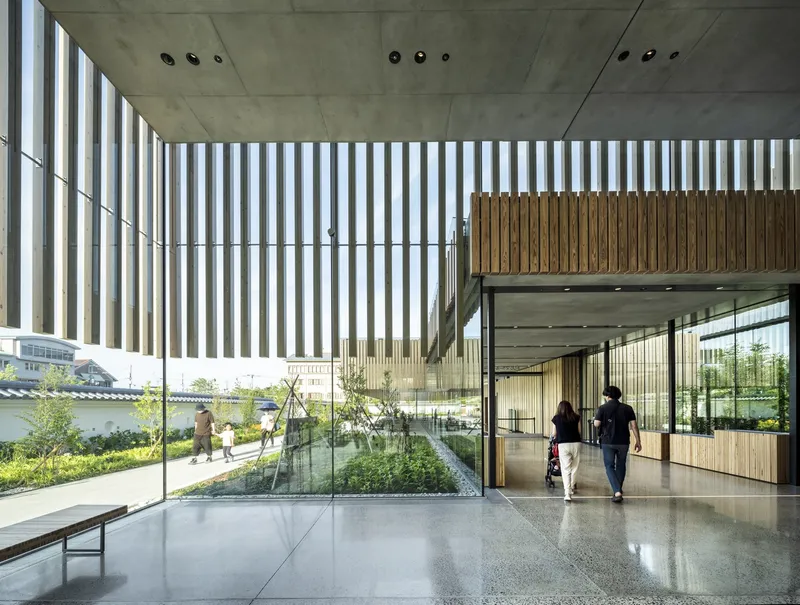
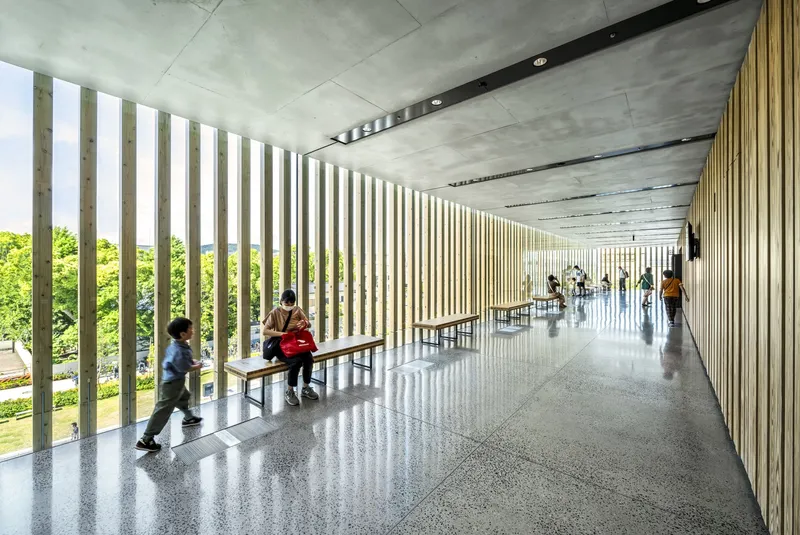
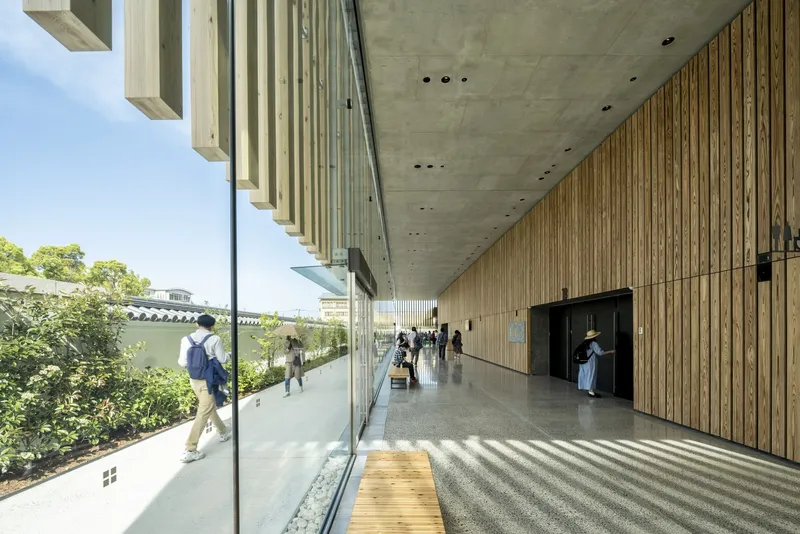
Inside, the circulation system reinforces the concept of a theater you stroll through. Double-height lobbies lined with vertical timber screens filter daylight onto polished terrazzo floors. Children play near benches in corridors that feel more like covered arcades than backstage passageways. The foyer's orderly arrangement of slender timber elements evokes a forest canopy, with cantilevered truss beams and thin columns keeping the structure visually light.
Performance spaces never directly abut one another. Service zones, corridors, and planted gardens act as buffers, which solves the acoustic isolation problem spatially rather than through brute-force mass. You feel the gaps as moments of decompression: a glazed courtyard here, a strip of greenery there, always reminding you that the building is organized around absence as much as enclosure.
Courtyards as Rooms Without Roofs
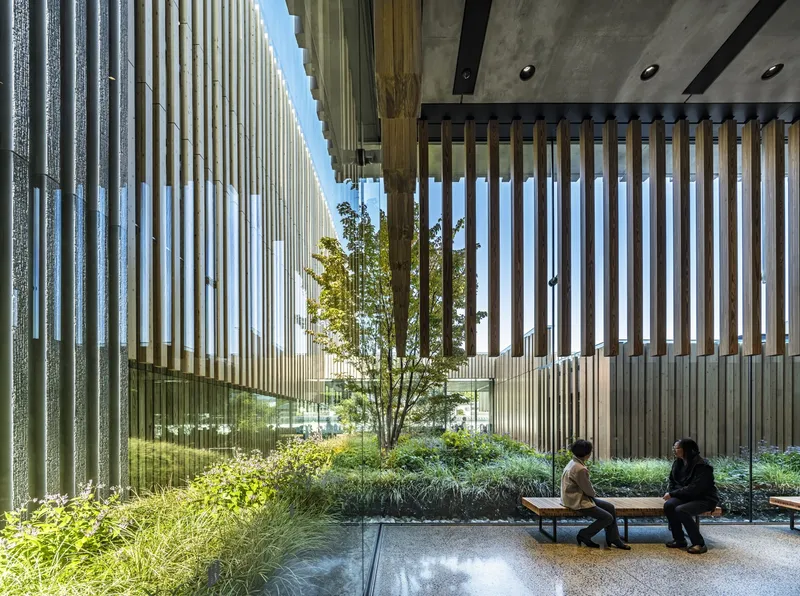
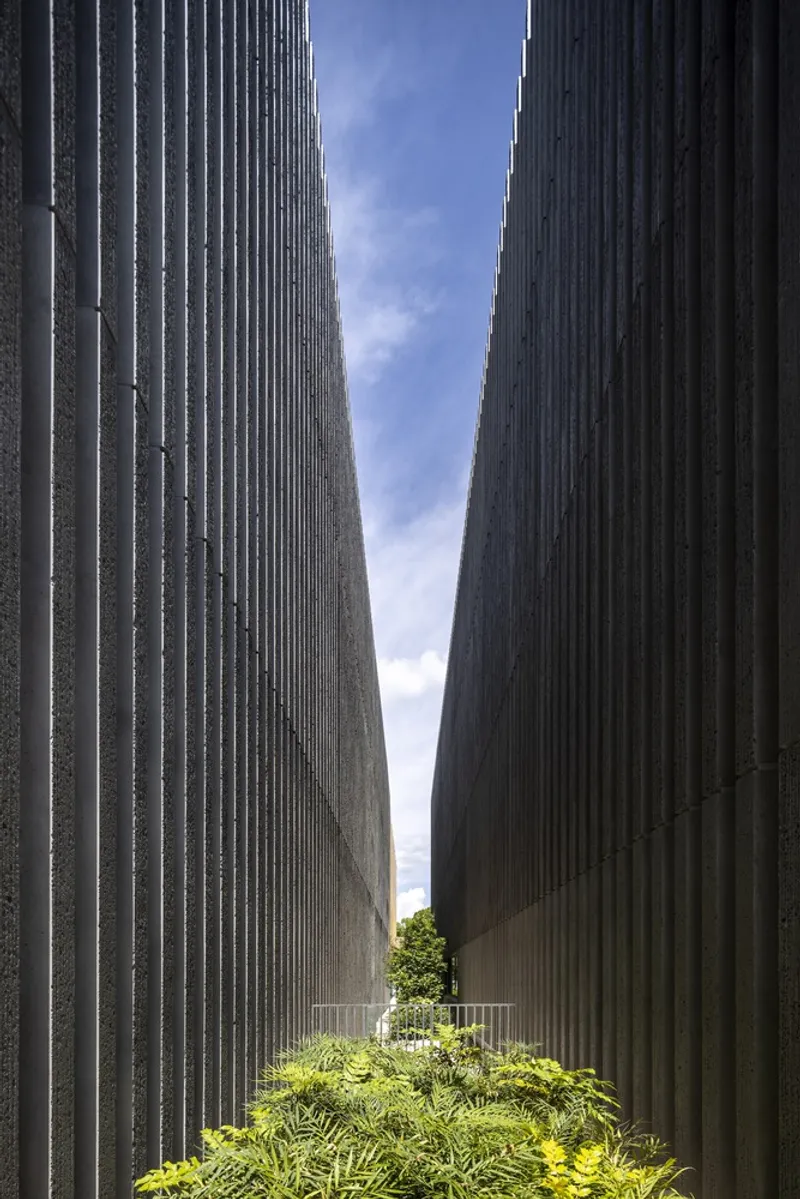
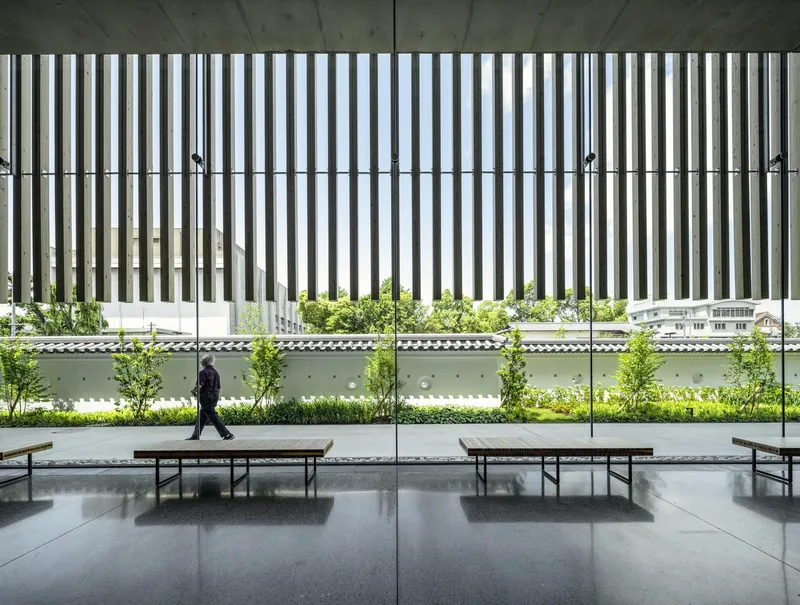
The courtyards deserve attention as architectural spaces in their own right. Some are narrow slots between tall vertically ribbed concrete walls, their floors softened by ferns and open to a sliver of sky. Others are broader planted courts with benches, framed by vertical wood and metal screens that give seated visitors a sense of enclosure without confinement. These outdoor rooms connect the building's scattered volumes into a legible whole, providing orientation cues and moments of calm between events.
Common Spaces That Earn Their Keep
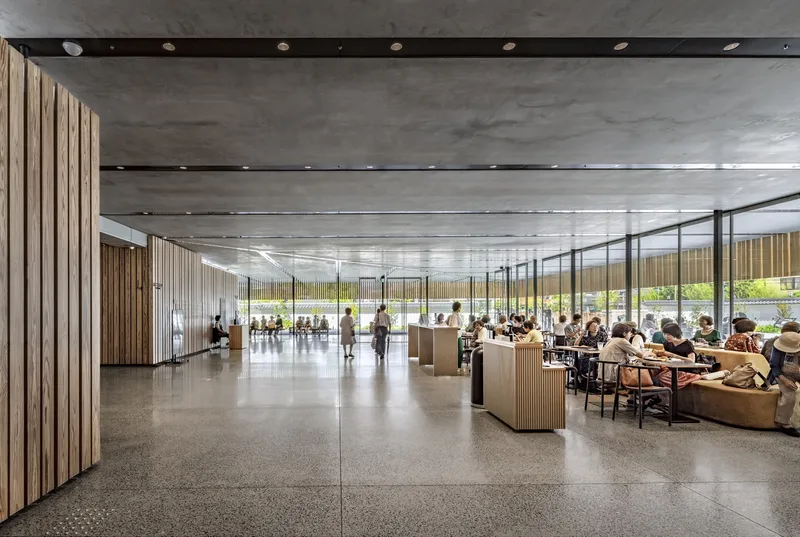
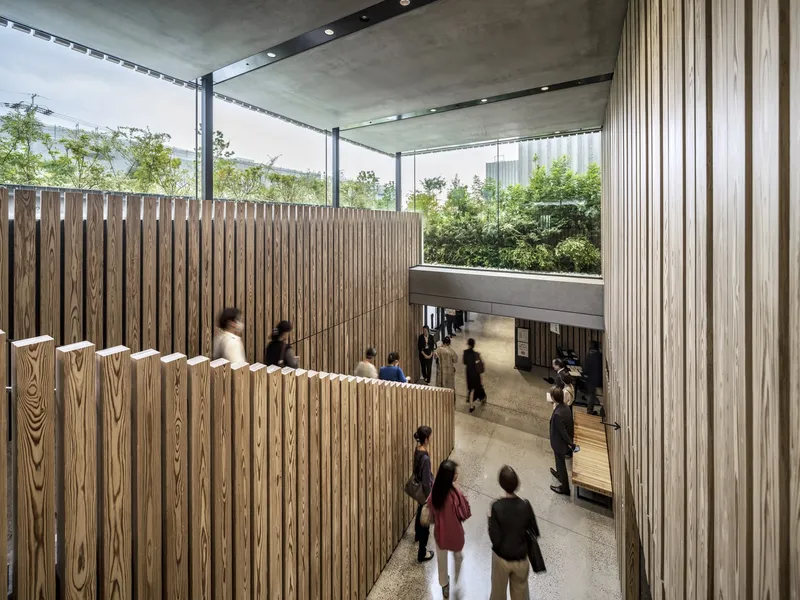
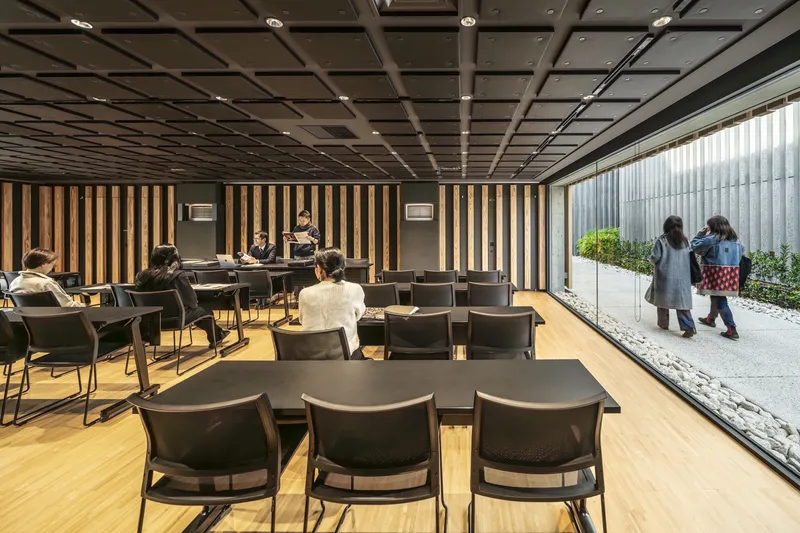
Too many cultural buildings treat lobbies as holding pens between acts. Takatsuki's common areas function as destinations. Open seating groups, glazed partitions, and coffered ceilings establish zones of varying intimacy across the ground and mezzanine levels. A multi-level atrium space with a timber-clad mezzanine and glass-roofed upper terrace brings greenery overhead, collapsing the distinction between indoors and out.
The material consistency helps. Cedar and terrazzo recur throughout, so moving from lobby to corridor to courtyard feels like navigating a single continuous environment rather than passing through a series of disconnected rooms. The design fosters lingering, which is exactly what a civic cultural building should do.
27,000 Cedar Cubes and the Acoustics of Waste
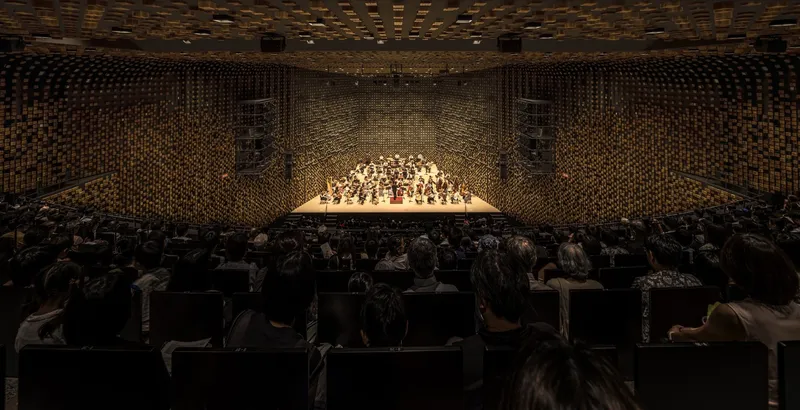
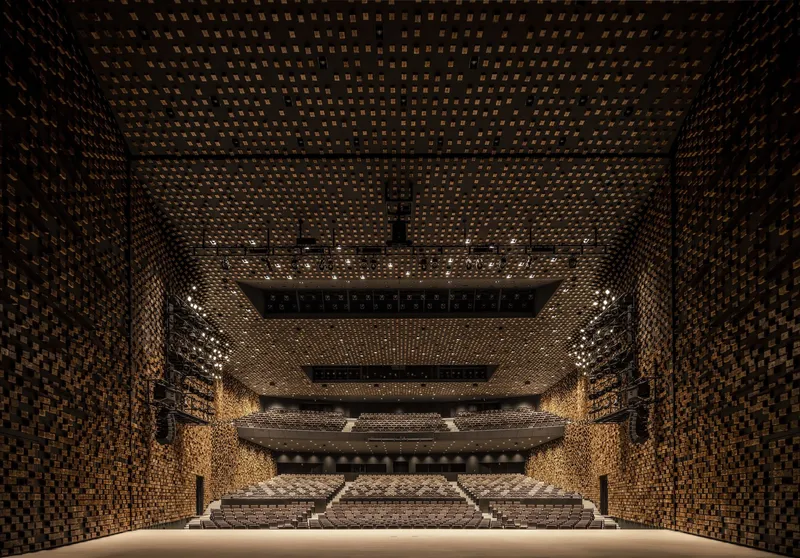
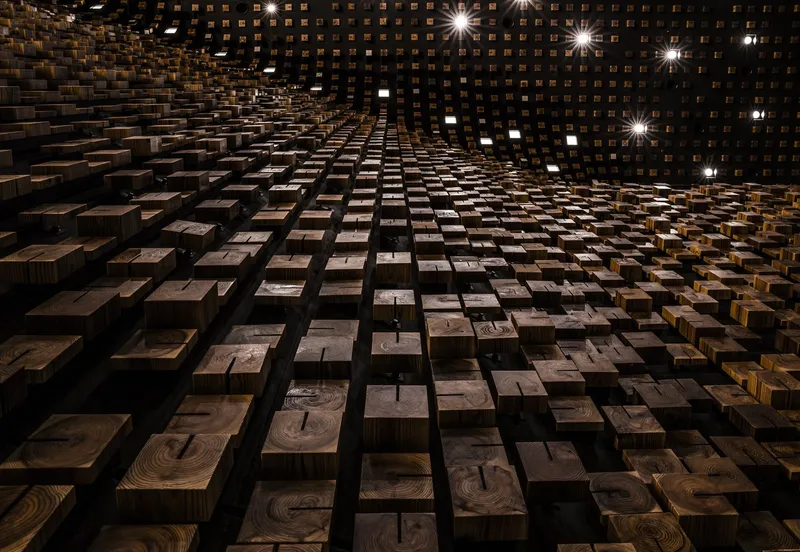
The main hall is the building's most talked-about space, and rightly so. Approximately 27,000 small cedar cubes, each projecting at a different depth, cover the walls and ceiling in a pixel-like arrangement that wraps the orchestra stage in warm, scattering surfaces. Developed through acoustic simulation, test specimens, and mock-ups in collaboration with Nagata Acoustics, the cubes are not decorative appliqué. They diffuse sound at multiple frequencies, giving the room a rich, enveloping acoustic character.
The material origin matters as much as the acoustic performance. These cubes were fabricated from offcuts and discarded core sections, the parts of a log that typically end up as waste. BIM technology helped allocate timber across the entire project, matching each piece to the location where its properties were most useful. It is a convincing argument that sustainable timber use in architecture is less about volume than about intelligence.
Performance Halls in Context
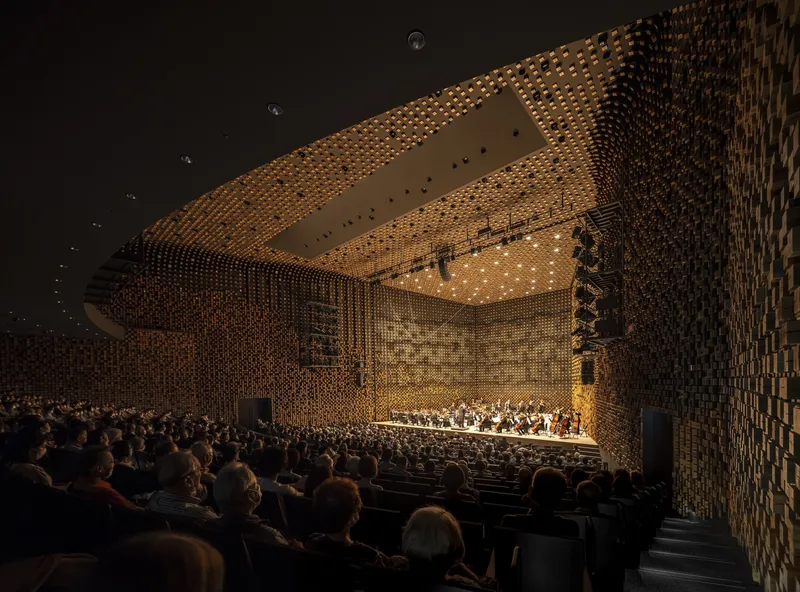
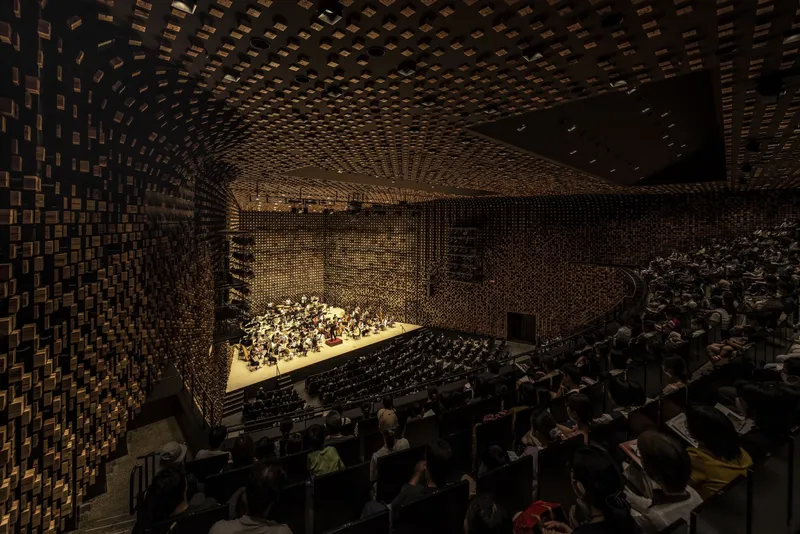
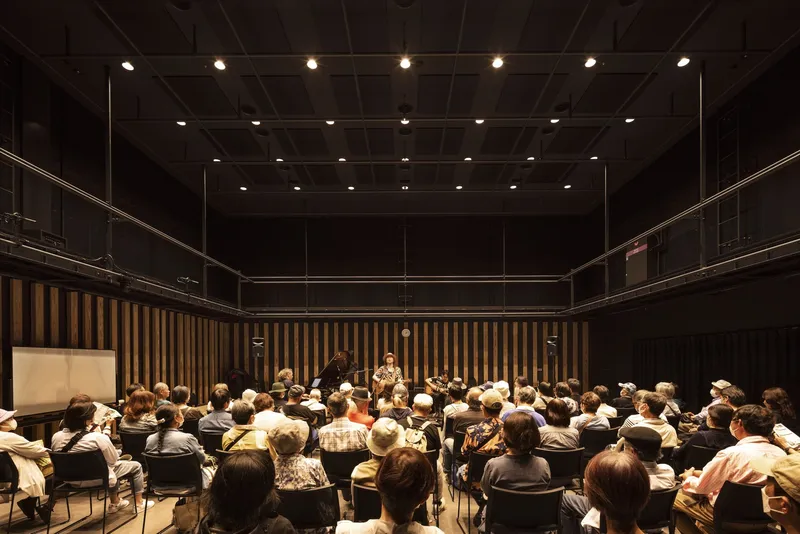
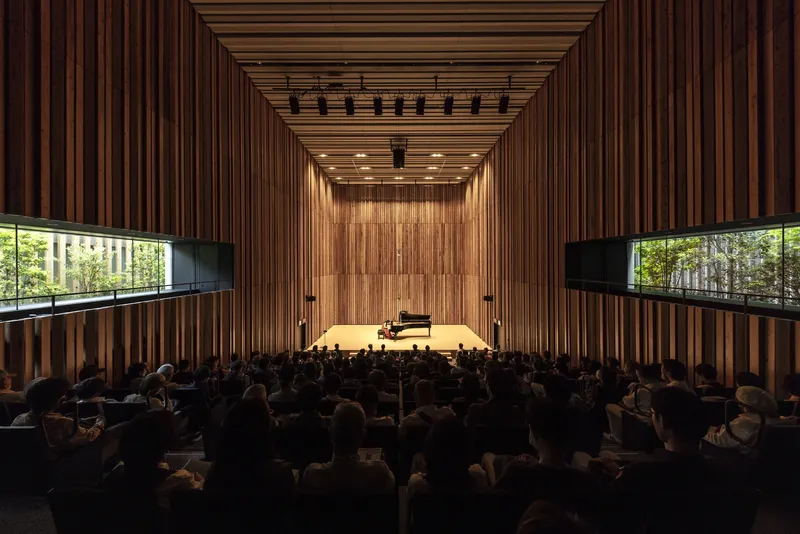
Watching an orchestra perform beneath the undulating timber block ceiling is a sensory experience that photographs only partially convey. The cubes catch stage lighting at different angles, creating a shimmering, almost geological texture that shifts as you move through the balcony tiers. A secondary hall features coffered dark ceilings and vertical timber acoustic paneling, offering a more intimate register for rehearsals and smaller ensembles.
Even the seating rows address the relationship between interior and exterior. Horizontal window slots reveal vertical timber fins and green landscape beyond, so that even seated audience members maintain a connection to the building's broader spatial logic. The theater never lets you forget the park outside.
Rooftop and Aerial Perspectives
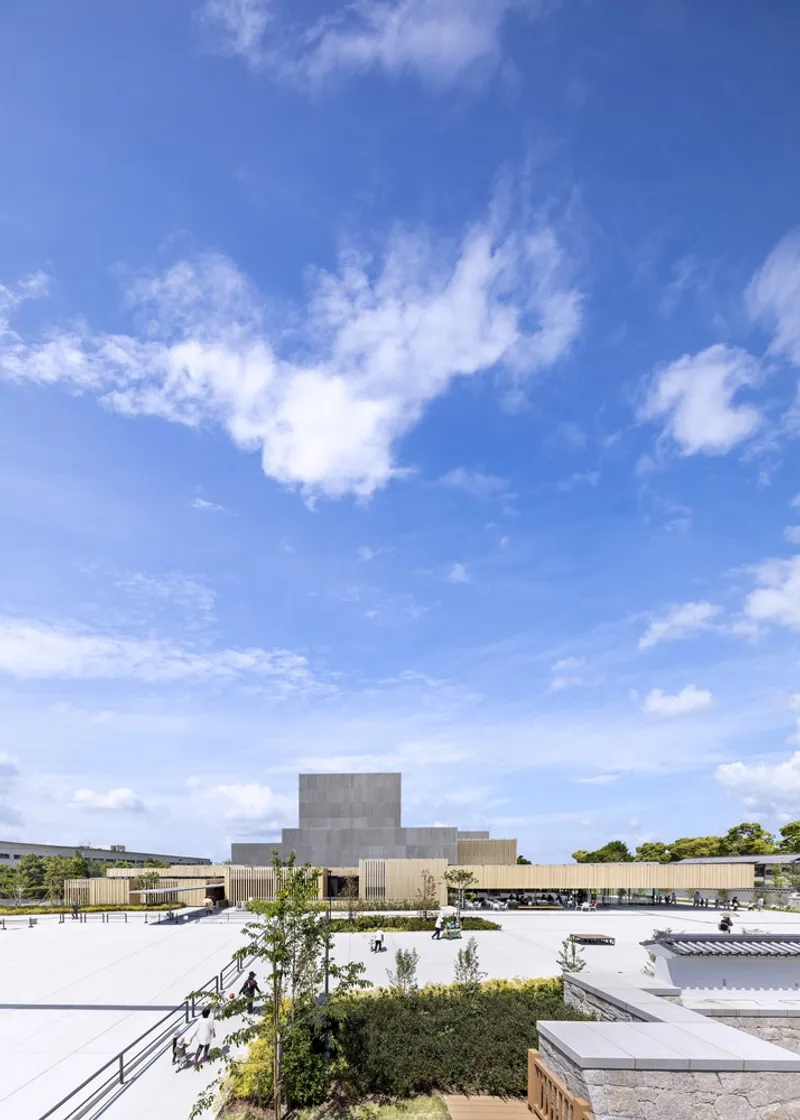

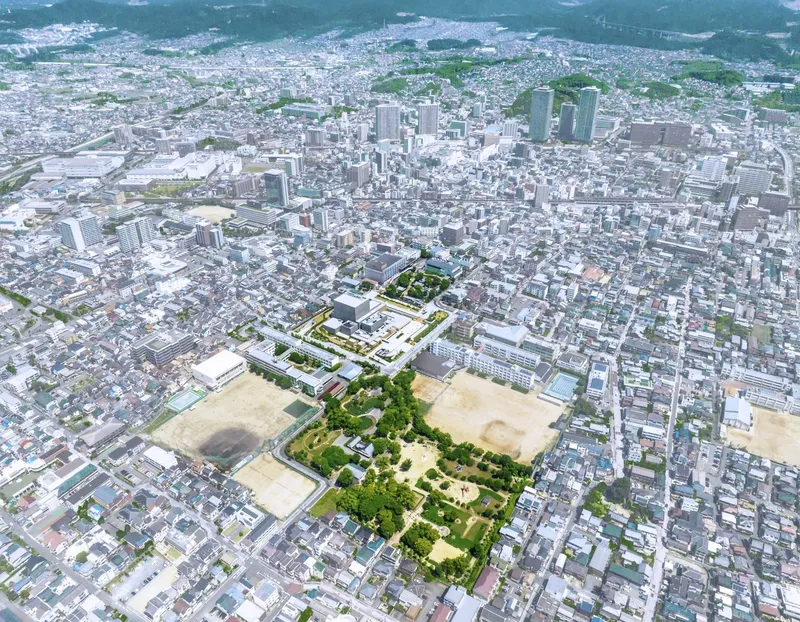
From above, the building reads as a cluster of rectilinear volumes interlocked with rooftop gardens, white gravel terraces, and planted beds. The aerial view confirms what the ground-level experience suggests: this is not a monolithic block but a collection of pieces with space between them, embedded in a dense urban fabric of residential and commercial development. A rooftop promenade lined with flowering plants extends the public realm vertically, giving visitors another register of engagement with the sky and the city.
Plans and Drawings
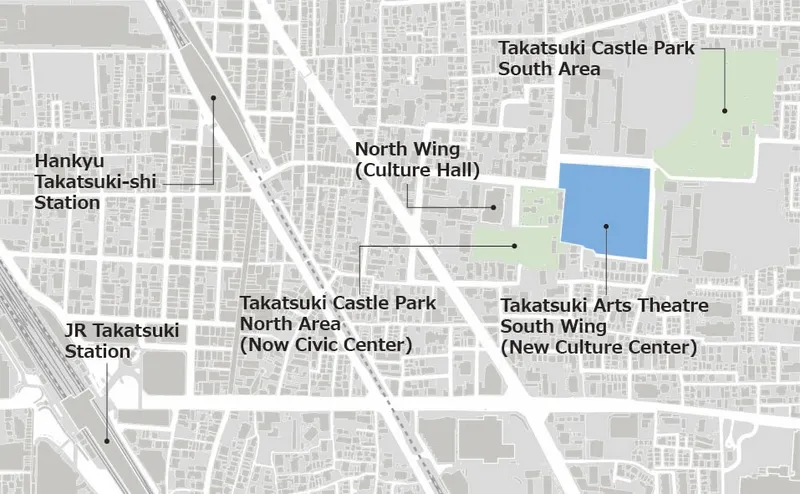
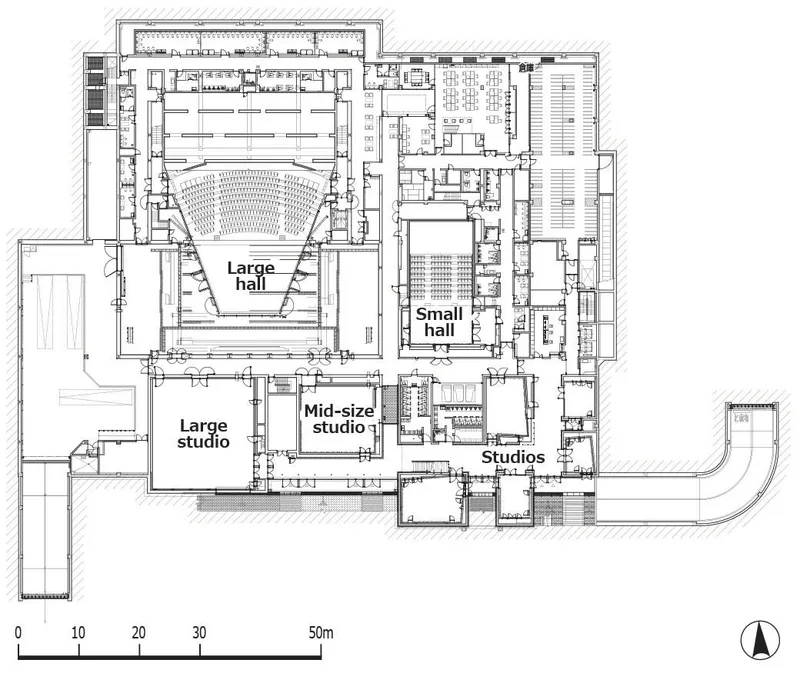
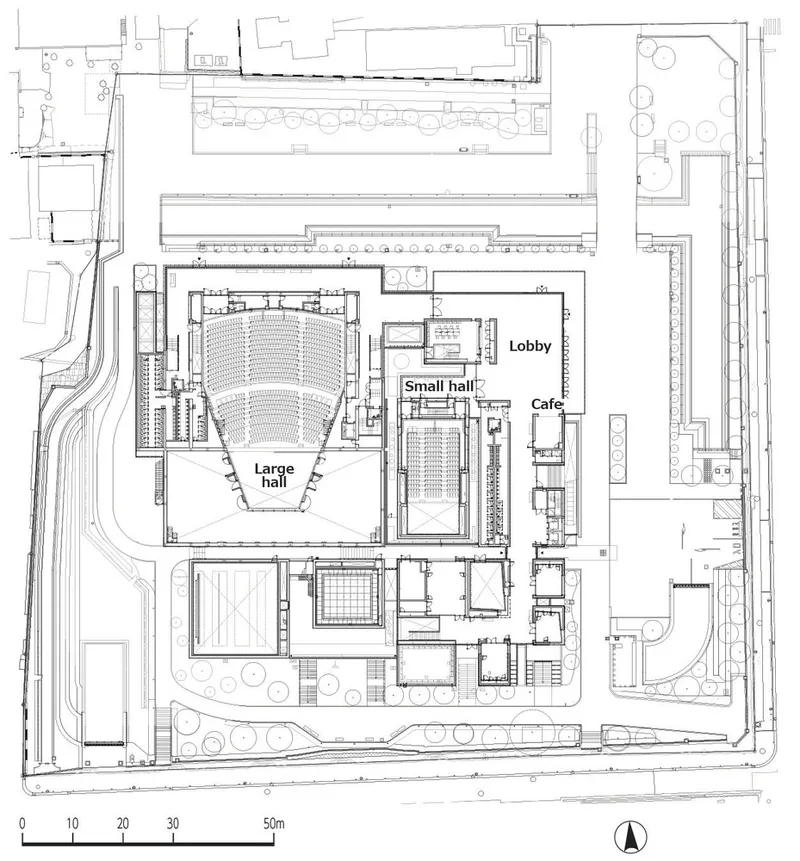
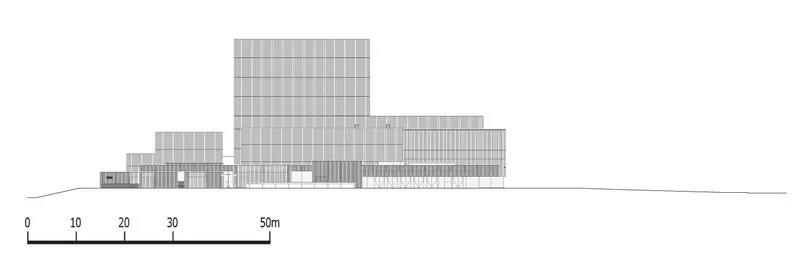
The site map clarifies the building's position between railway stations and adjacent park areas, reinforcing its role as a connector in the urban fabric. Floor plans reveal how the fan-shaped seating of the large hall, the smaller performance spaces, and the café are organized around a central circulation core that is never purely instrumental. The elevation drawing shows the stacked rectilinear volumes with their gridded facades, confirming the project's commitment to articulation over monolith. Even horizontal clerestory windows framing views to green foliage outside appear as calculated cuts in the section, evidence of a design team that considered every opening as a framing device.
Why This Project Matters
Takatsuki Arts Theatre demonstrates that a large civic building can be both acoustically rigorous and spatially generous without defaulting to hermetic enclosure. By fragmenting the program into discrete volumes and filling the gaps with gardens, courtyards, and daylit corridors, Nikken Sekkei created a cultural complex that breathes. The building's relationship to its castle-town site is not a nostalgic gesture but a genuine spatial inheritance: the narrow streets, vertical lattices, and layered thresholds of a historic Japanese urban fabric find new expression in reinforced concrete and cedar.
The timber strategy may be the project's most transferable lesson. In a construction industry increasingly drawn to mass timber spectacles, Nikken Sekkei made a quieter argument: use wood where it matters acoustically, visually, and culturally, and use only what the local forest can sustainably yield. The 27,000 cedar cubes in the main hall are a persuasive proof of concept, transforming waste material into the building's defining spatial experience. For any city with modest forest resources and ambitious cultural aspirations, Takatsuki offers a model worth studying closely.
Takatsuki Arts Theatre by Nikken Sekkei. Takatsuki City, Osaka Prefecture, Japan. 17,261 sqm. Completed 2023. Photography by aifoto.
About the Studio
Share Your Own Work on uni.xyz
If projects like this are the kind of work you want to make, uni.xyz is a place to publish your own, find collaborators, and enter design competitions.




Popular Articles
Popular articles from the community


Co-Life: Senior Housing Design That Reconnects Older Adults With the City
Co-Life reimagines senior housing design through healing gardens, shared streets, workshops, and a sustainable community across generations.

Riyadh For All: Intergenerational Urban Design for Active Aging in Rabat
Riyadh For All reimagines urban design in Rabat with intergenerational co-living, adaptive courtyards, and Moroccan cultural exchange today.

Co-life: Sustainable Architecture for Age-Friendly Community Living
Co-life reimagines sustainable architecture for seniors through courtyards, rammed earth, shared gardens, and spaces designed for belonging.

The Ocean Hive: Sustainable Architecture for a Self-Sufficient Civilization at Sea
The Ocean Hive imagines sustainable architecture at sea, where modular habitats, algae, wave power and ocean waste sustain a growing colony.


Similar Reads
You might also enjoy these articles


Hodi-Mandai Geram
Project Function: Preservation and revitalization of the Intangible heritage and socio-spatial identity of the Hodi by Housing, Cultural Memory Center, Sacred Grove, landscape, local tourism economy


Olio Towers: A Mid-Rise for Performers That Fuses Housing, Rehearsal, and Stage
Located blocks from Houston's Theater District, this modular tower stacks living units around a central performance atrium.

Oasis: Modular Green Housing Carved into Dhaka's Urban Fabric
A shortlisted Plugin Housing entry reclaims unauthorized settlements in Dhaka with stepped concrete volumes, green roofs, and ventilation-driven design.

Black Hole: A Floating Megastructure for the Post-Physical Era
Emiliano Mazzarotto envisions a spherical, self-scaling arena where e-sports, digital hotels, and holographic stadiums replace traditional public space.


Explore Open Air Theatre Competitions
Discover active competitions in this discipline



Challenge to reimagine the Iron Throne


Photograph architecture without architects


Illustrate the lost glory of Angkor Wat - Render Challenge


Design challenge to reuse E-waste
Comments (0)
Please login or sign up to add comments
No comments yet. Be the first to comment!