
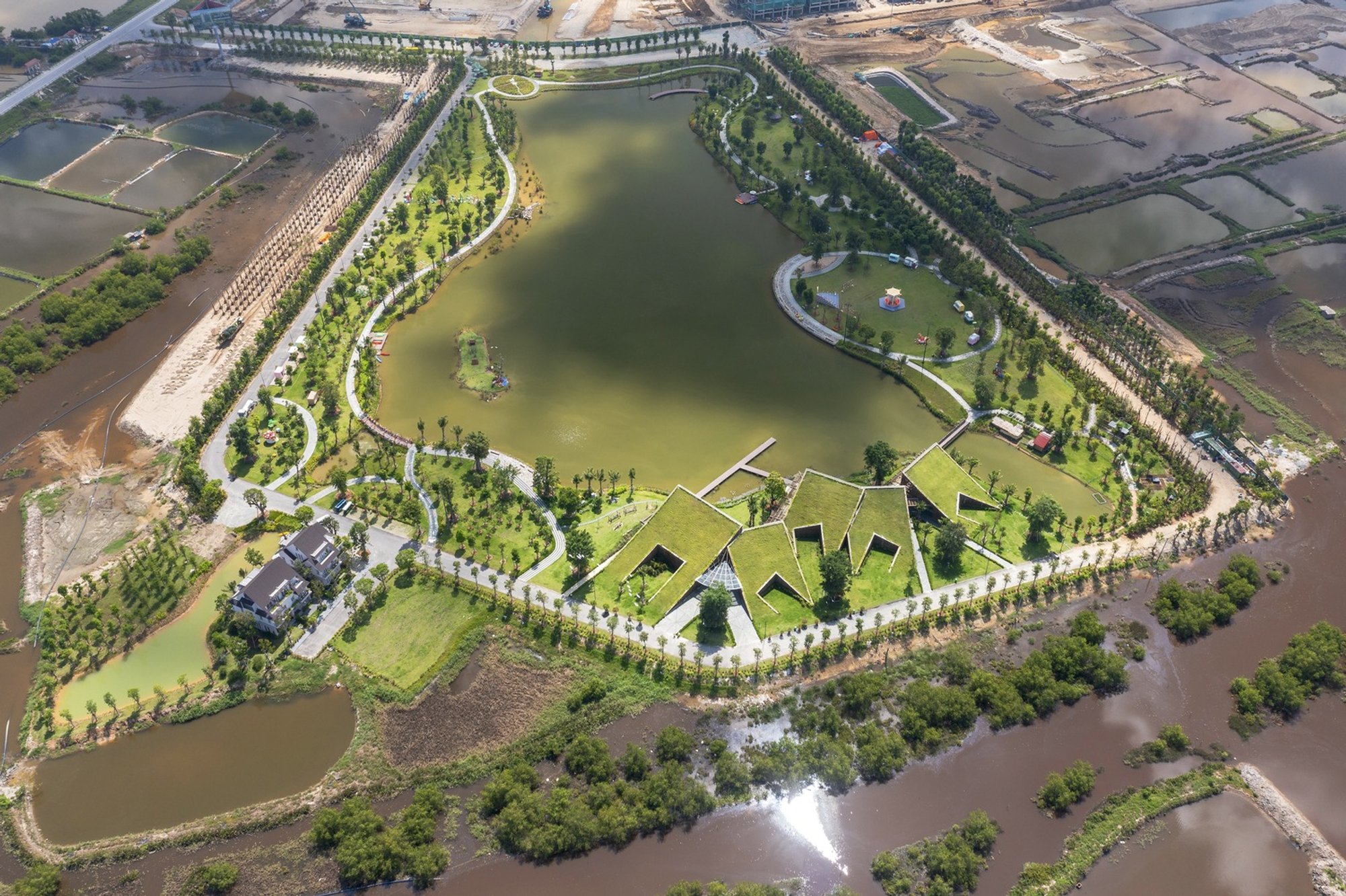
MIA Design Studio Disguises Five Pavilions as Grassy Hillsides on a Vietnamese River Peninsula
Wedge-shaped volumes with sloped green roofs rise from reclaimed paddies beside the Lam River in Vinh City, Vietnam.

On a narrow peninsula of reclaimed rice paddies in Vinh City, five wedge-shaped buildings tilt their planted backs toward the afternoon sun and open lattice faces toward the Lam River. MIA Design Studio designed The Park as a multi-use community center within Swan Lake Park, a ten-hectare entertainment hub in Nghe An Province, and the ambition was straightforward: make the architecture nearly invisible. Completed in 2023 after a six-year development arc, the project covers just over 6,300 square meters of site area, yet from the air it reads less as a building complex and more as a series of green hillocks.
What makes the project genuinely interesting is not the camouflage itself but the precision of its orientation logic. Each volume is rotated so that its grassy slope faces west and southwest, absorbing and deflecting the harshest afternoon heat, while the engineered-wood lattice facades face the river to the east and northeast, catching soft morning light and breezes. The result is a set of passive strategies baked into the geometry rather than bolted on as systems. It is architecture shaped by climate before it is shaped by form.
Landscape as Roofscape
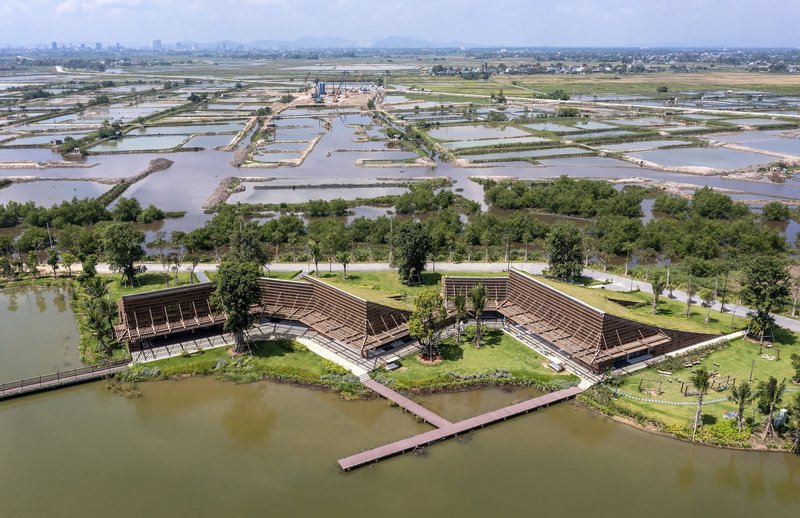
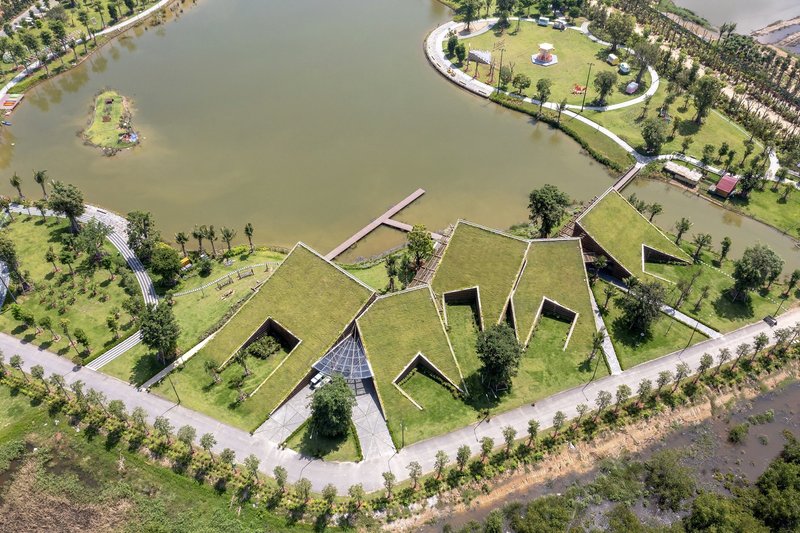
Seen from above, The Park's five volumes collapse into the terrain. The sloped green roofs, set at angles between 15 and 30 degrees and stretching 25 to 40 meters in length, are planted with grass that visually extends the surrounding paddies and parkland right over the buildings' steel-and-concrete frames. Rainwater is absorbed by the vegetated surfaces and gradually released through a harvesting system, reducing the complex's reliance on external water supply. The roofs are not decorative meadows; they are engineered drainage infrastructure.
Voids cut at the summits of these hillside gardens introduce daylight and ventilation into the interiors below, turning each ridge into a chimney effect that pulls warm air upward and out. The acute-triangle cross sections, rising to heights of 8 to 12 meters, create a surprising amount of interior volume beneath their modest exterior profiles.
The Lattice Facade as Light Filter
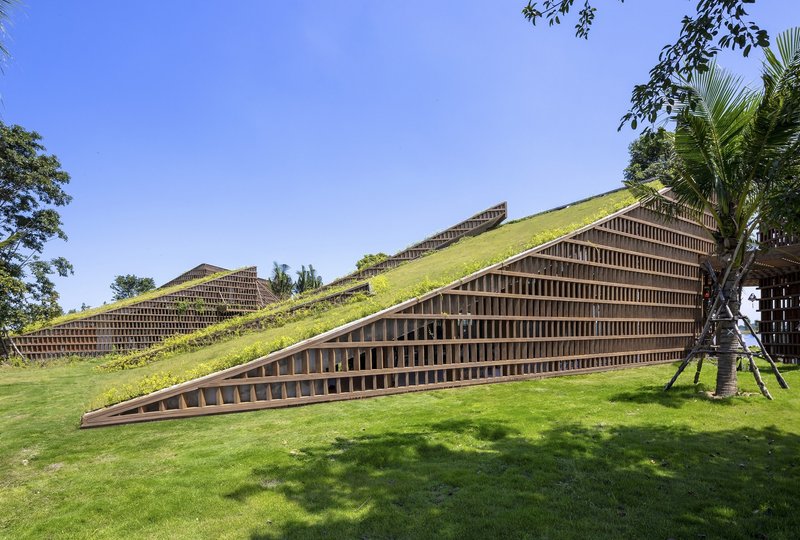
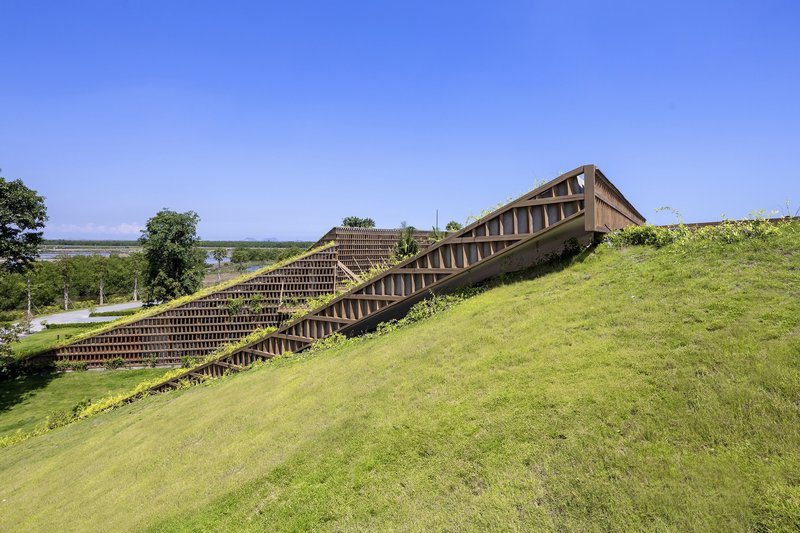
Where the planted roofs handle heat from above, the lattice walls handle it from the side. Engineered wood panels, textured and stained to read as timber, are set at regular intervals to create a partially transparent screen that filters up to two-thirds of incoming solar glare. The gaps between elements are calibrated to admit light without overheating: tight enough to shade, open enough to ventilate. At night, this permeability reverses its role. Interior lighting escapes through the grid, and each pavilion becomes a lantern shimmering across the lake surface.
The decision to use engineered wood rather than natural timber is pragmatic. Vietnam's humid climate is unforgiving to untreated hardwoods, and the engineered alternative gives MIA Design Studio the warmth of grain and color without the maintenance liability. Structurally, the heavy loads of grass, soil, maintenance equipment, and accumulated rainwater on the roofs are carried by a reinforced steel-and-concrete framework hidden behind these lighter cladding layers.
Threshold and Pathway
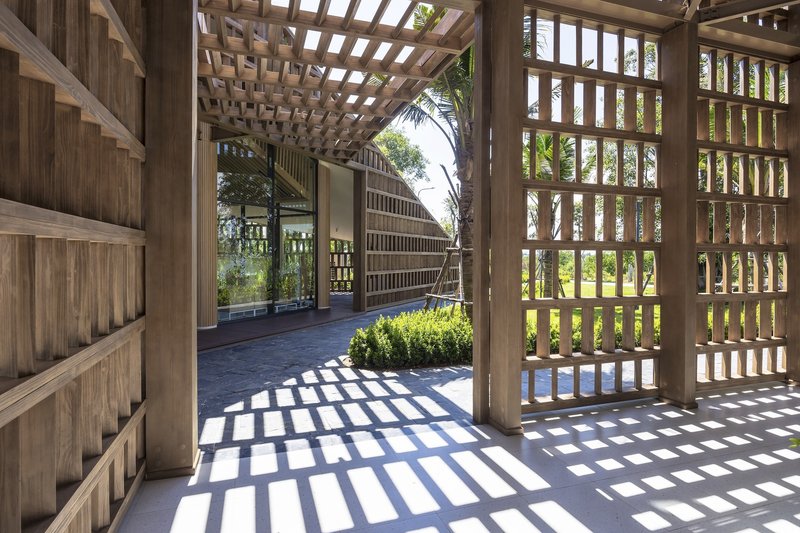
The five buildings are organized by proximity to arrival. A primary welcome volume connects via a covered hallway to the restaurant building, while three additional structures housing the fitness center, sauna, and changing rooms are positioned further along the peninsula. Connecting pathways thread between the pavilions and lead to a jetty for boat docking on the Lam River, a 512-kilometer waterway that runs between 200 and 400 meters wide at this point. The sequence from land arrival to water's edge gives visitors a sense of gradual immersion into the landscape.
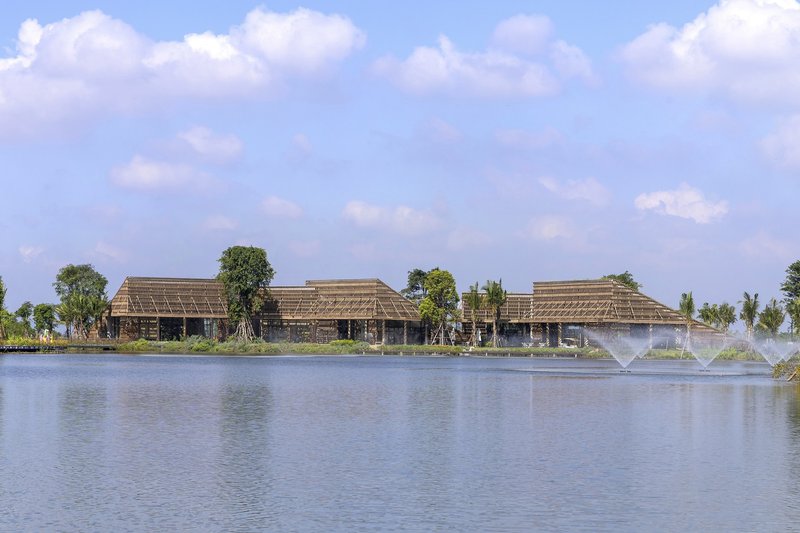
The covered walkway shown here is one of the project's most tactile moments. Timber columns support lattice screens that throw geometric shadow patterns across the floor, transforming what could be a utilitarian corridor into a spatial experience in its own right. Daylight, shadow, and breeze are all present simultaneously, and the walker feels simultaneously sheltered and outdoors. Across the pond, the low profile of the pavilions confirms how effectively the architecture defers to its setting: three planted ridges, a fountain, summer clouds.
Orientation and Climate Logic
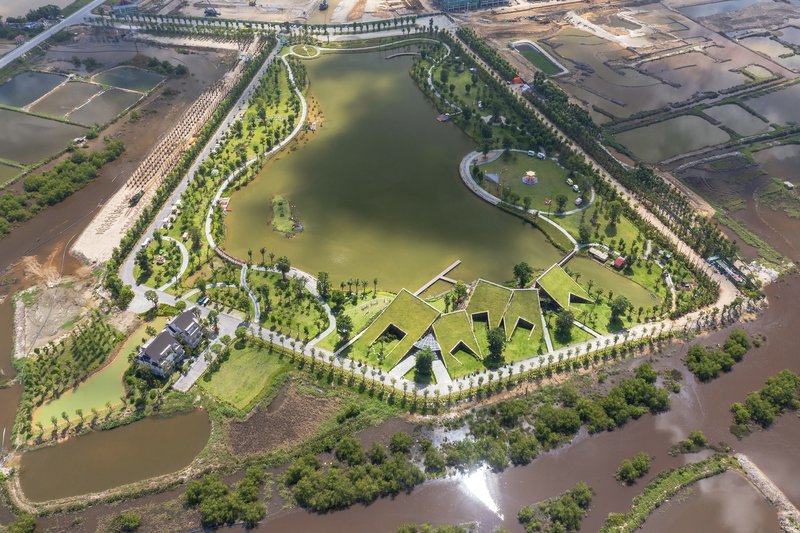
The drone perspective makes the orientation strategy legible. Each volume's grassy back faces the hot western and southwestern exposure, while the open lattice facades invite the cooler morning light from the east and northeast. This is not a symbolic gesture toward sustainability; it is the structural logic of the plan. The angular arrangement around a central lake and tree-lined paths creates sheltered courtyards between the buildings, further moderating the microclimate at ground level.
Existing trees on the site were preserved using root barriers and protective fencing during construction, and additional species suited to local soil conditions were planted to reinforce the canopy. The site had previously been vacant land and flooded rice paddies, so the transformation into a functioning park landscape required careful grading and drainage coordination between architecture and terrain.
Why This Project Matters
The Park succeeds because its green-roof strategy is not an aesthetic appliqué but a direct consequence of climate analysis. Rotating the buildings, tilting the roofs, calibrating the lattice gaps: every formal decision traces back to sun angle, wind direction, or water management. The result is a project where passive performance and visual identity are the same thing. You cannot separate the look of The Park from the way it works, and that integration is what elevates it above the growing catalogue of buildings that simply put grass on top and call it sustainable.
For a community center in a mid-sized Vietnamese city, the ambition is notable. MIA Design Studio has produced a piece of infrastructure that serves the public, a lobby, restaurant, gym, sauna, and multipurpose hall, while reading as a continuation of the agricultural and riverine landscape that defines Nghe An Province. In a region of rice fields, mountains, and hillsides, the architecture does not compete. It folds in.
The Park by MIA Design Studio. Vinh City, Nghe An Province, Vietnam. Site area: 6,345.6 square meters. Designed 2017, completed 2023. Photography by Trieu Chien.
About the Studio
Share Your Own Work on uni.xyz
If projects like this are the kind of work you want to make, uni.xyz is a place to publish your own, find collaborators, and enter design competitions.



Popular Articles
Popular articles from the community

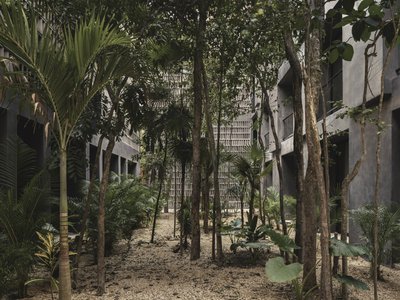
Three Studios Build 200 Affordable Units for Tulum's Displaced Hospitality Workers
Casa Selva embeds dark concrete housing blocks into Yucatán rainforest, offering dignified shelter to those priced out by the tourism they serve.
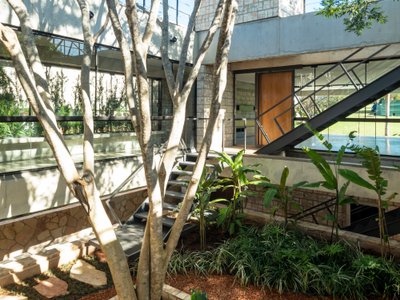
OMCM arquitectos Builds a Summer House in Paraguay from Quarry Waste Blocks and Three Sacred Trees
In the young hillside neighborhood of Altos, a 696-square-meter concrete volume hovers on six pillars around three preserved native Yvyraju trees.
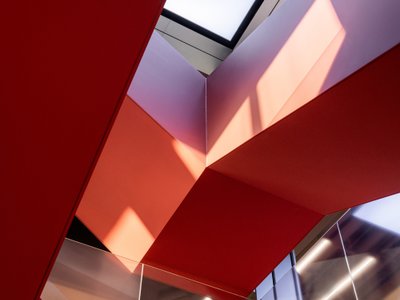
Ippolito Fleitz Group Identity Architects Turn Eight Floors in Shanghai into a Vertical Creative City
Publicis Groupe's new headquarters in Xintiandi reimagines the office as a courtyard-driven urban landscape stacked across eight floors.
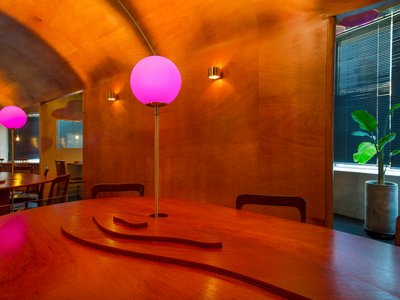
Indiesalon Carves a Plywood Cave into a Seoul Bistro's Second Floor
Munhwa Bistro's second Seongsu branch wraps diners in a laminated timber vault laced with colored light and mirror illusions.

Similar Reads
You might also enjoy these articles

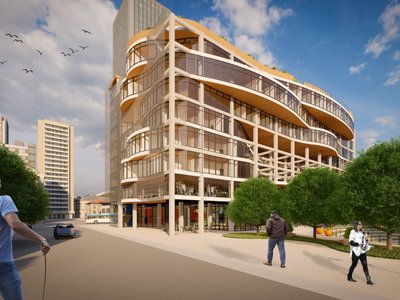
Olio Towers: A Mid-Rise for Performers That Fuses Housing, Rehearsal, and Stage
Located blocks from Houston's Theater District, this modular tower stacks living units around a central performance atrium.
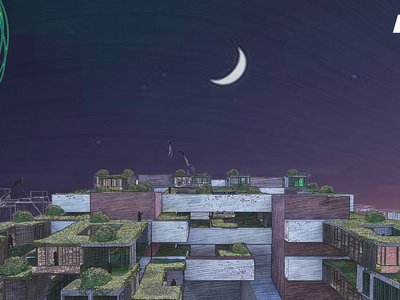
Oasis: Modular Green Housing Carved into Dhaka's Urban Fabric
A shortlisted Plugin Housing entry reclaims unauthorized settlements in Dhaka with stepped concrete volumes, green roofs, and ventilation-driven design.

Black Hole: A Floating Megastructure for the Post-Physical Era
Emiliano Mazzarotto envisions a spherical, self-scaling arena where e-sports, digital hotels, and holographic stadiums replace traditional public space.
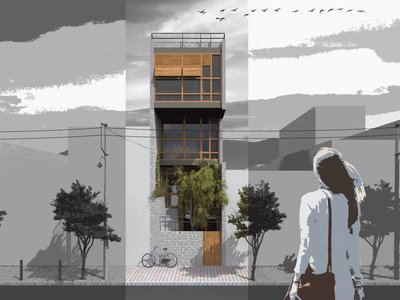
Compact & Sustainable Living in Piraeus: A Four-Level Family Home Built Around Light and Air
A narrow townhouse in one of Greece's densest port cities uses a central atrium and passive strategies to house three generations under one roof.

Explore Architecture Competitions
Discover active competitions in this discipline




The International Standard for Design Portfolios


The Global Benchmark for Architecture Dissertation Awards


The Global Benchmark for Graduation Excellence


Challenge to reimagine the Iron Throne
Comments (0)
Please login or sign up to add comments
No comments yet. Be the first to comment!