
Super Future Collective Squeezes a Zigzag Aluminum Housing Block into a Nuremberg Backyard
A three-unit infill building on Fürther Street uses corrugated cladding and generous glazing to bring light into a tight courtyard site.


On Fürther Street in Nuremberg, a construction gap in a backyard hemmed in on three sides by existing buildings is exactly the kind of leftover urban space most architects walk past. Super Future Collective, a five-person architecture collective, saw it differently. Their Backyard House, completed in 2022, slots a three-story, three-unit residential building into this residual plot and turns what could have been a claustrophobic courtyard condition into something genuinely livable.
What makes the project worth studying is not the mere fact of densification. It is the series of specific, interlocking decisions: a zigzag aluminum skin that bounces daylight deep into the courtyard, an external staircase whose landings double as terraces, and a repeating open plan clever enough to make 'compact' feel like a choice rather than a constraint. The building does not try to blend in. It announces itself, and the courtyard is brighter for it.
A Facade That Earns Its Strangeness
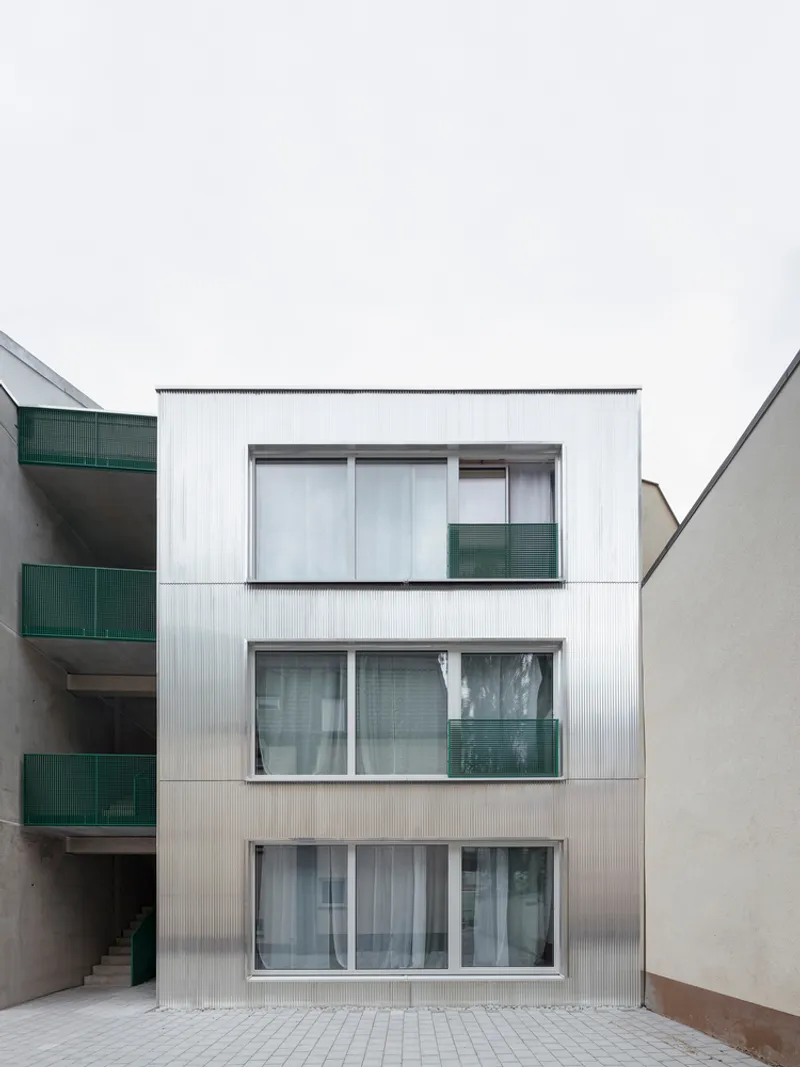
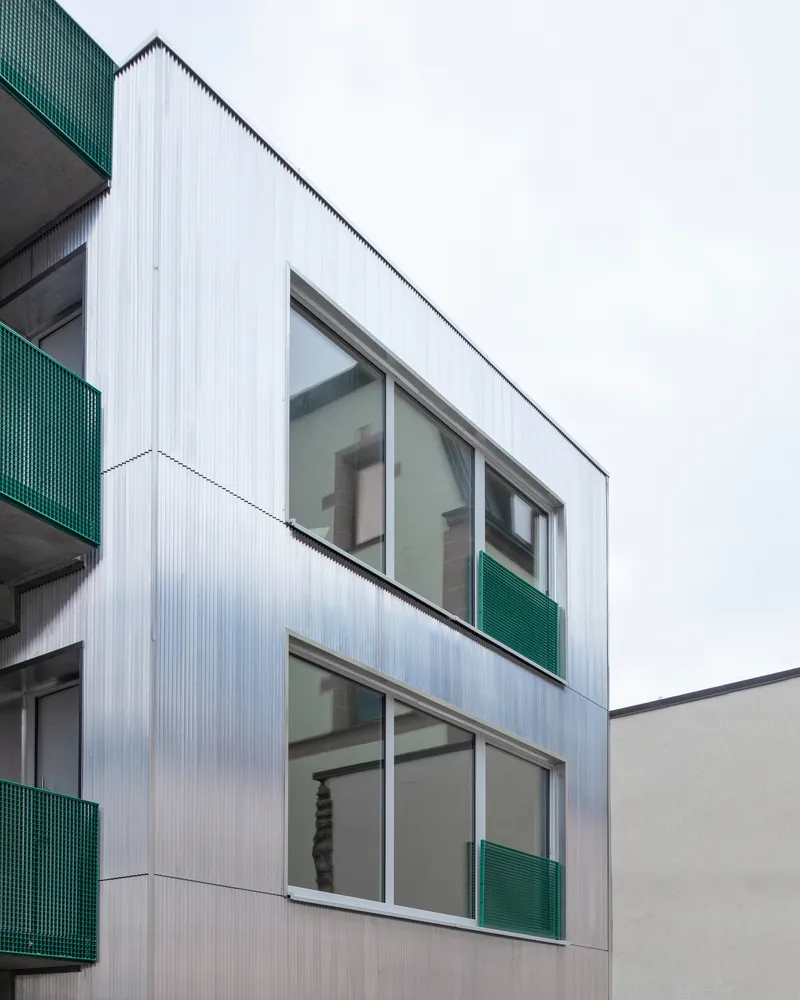
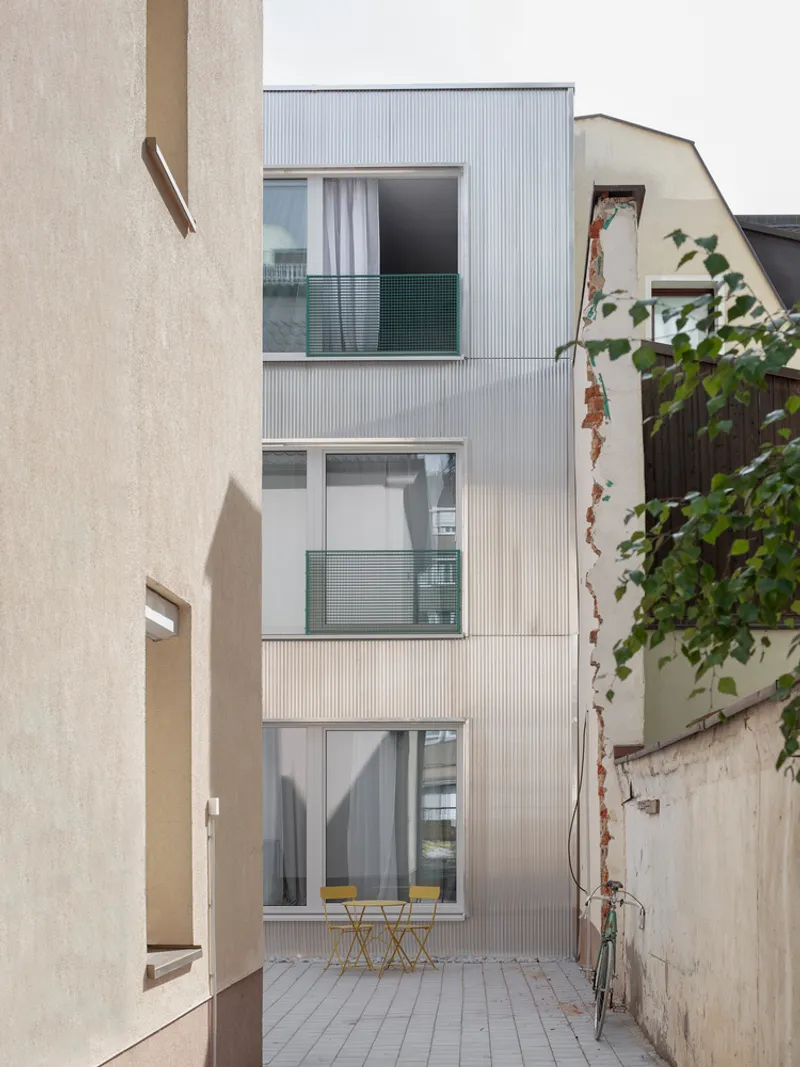
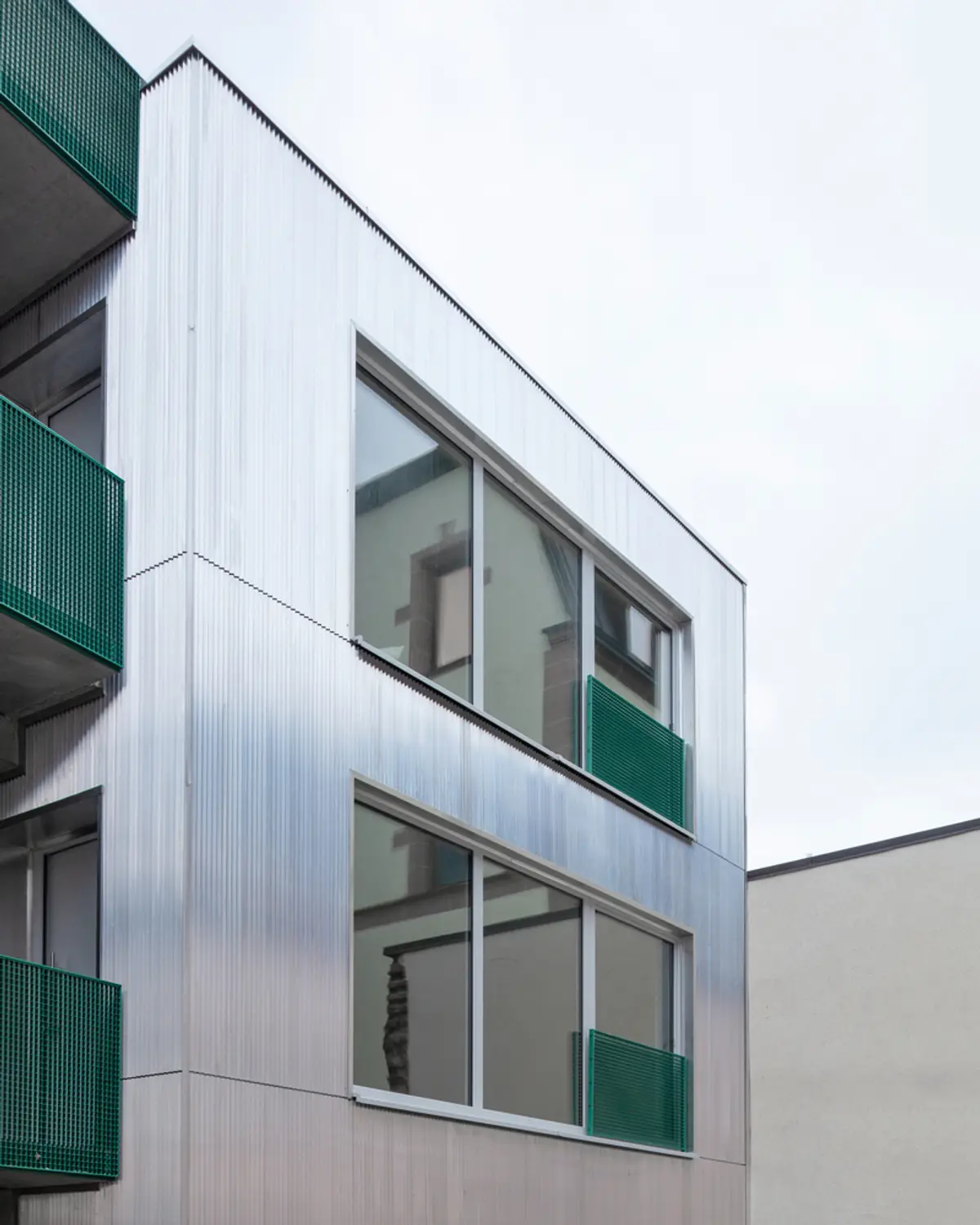
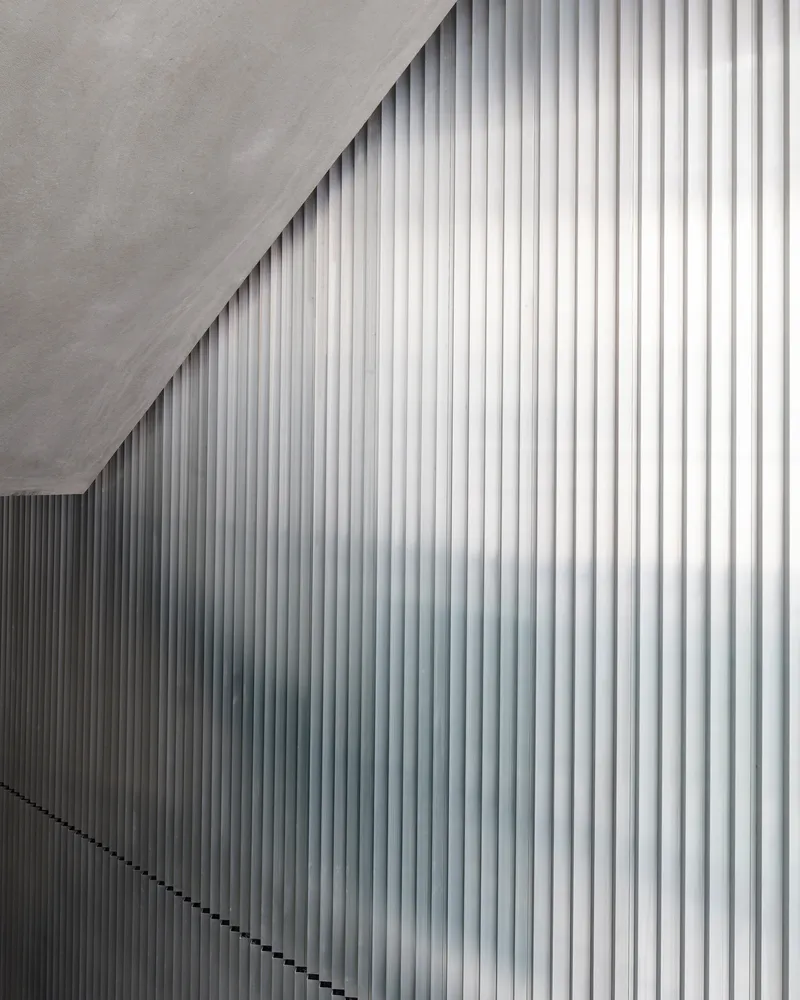
The ventilated facade of bare aluminum corrugated cladding reads differently depending on the angle and the light. From the street side, vertical ribbing gives the building a taut, almost industrial presence against the pitched roofs of its neighbors. Seen obliquely from the courtyard, the zigzag profile catches and scatters light in a way that flat plaster never could. The reflective, pale surface was chosen deliberately: in a north-facing, tightly enclosed site, every lumen bounced back into the shared courtyard counts.
This is not decoration. The light color and angular geometry of the cladding are doing real environmental work, compensating for an orientation that would otherwise condemn the ground-floor apartments to perpetual dimness. The building sets itself apart from its brick-and-render context and, in doing so, improves the microclimate for all the residents who share the yard.
Green Metal as a Unifying Thread
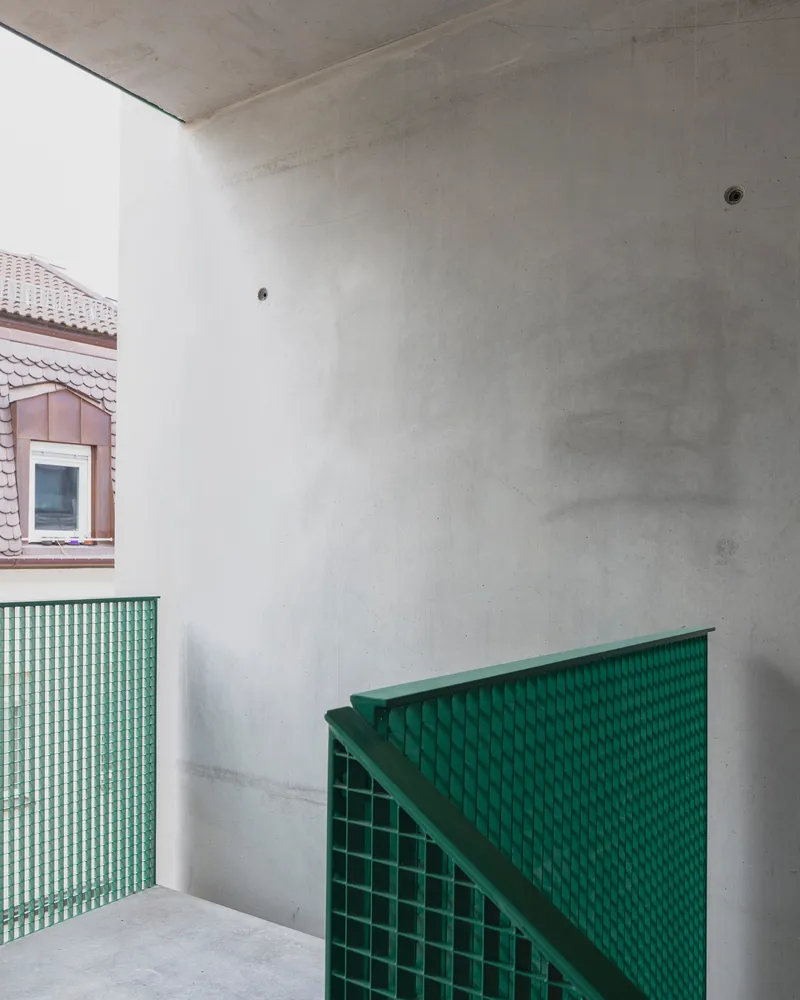
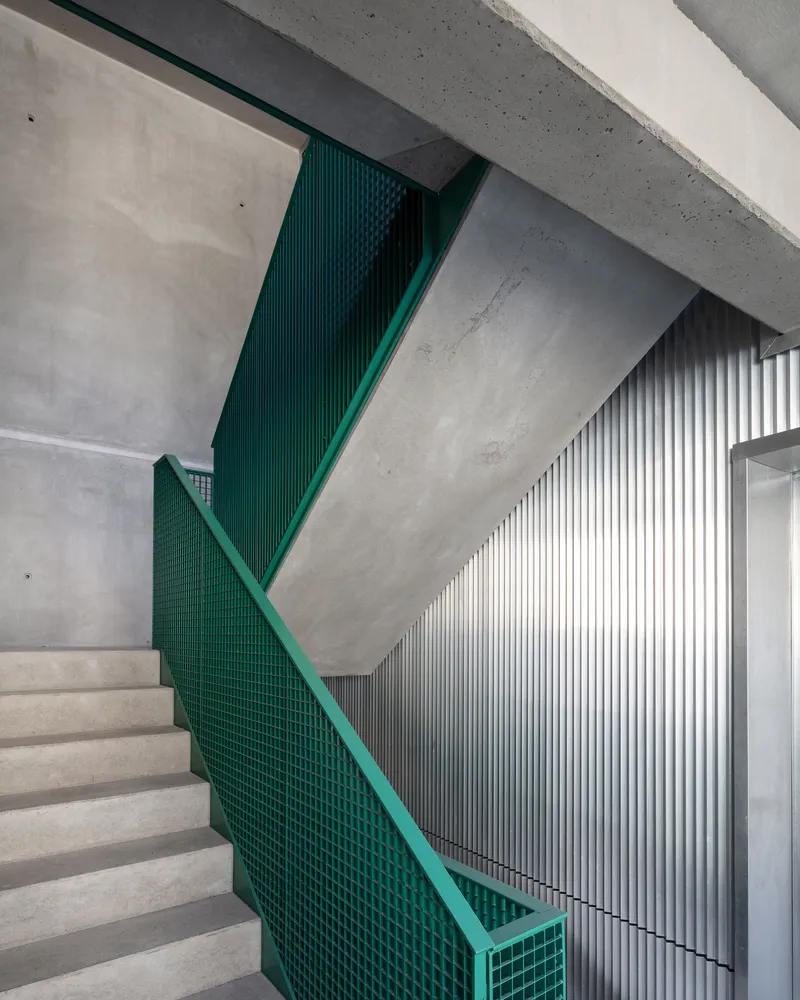
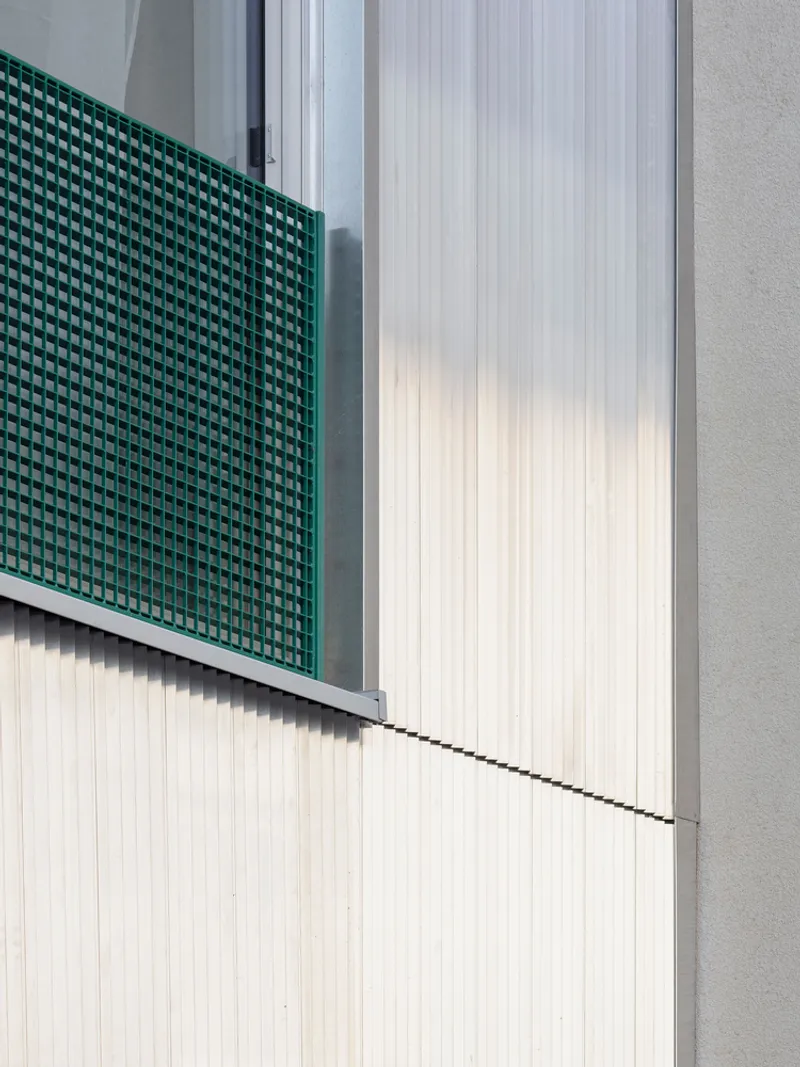
A signature green appears everywhere: perforated balcony screens, stair balustrades, handrails, kitchen cabinetry, even bathroom tiles. In a project this materially restrained (concrete, aluminum, timber), the green functions almost like a wayfinding system, marking the points where residents touch the building. The perforated metal panels filter views from the stair landings without closing them off, maintaining visual contact with the courtyard while providing a degree of privacy.
The detailing at the stair balustrades deserves a closer look. Gridded mesh panels meet diagonal cable stays and concrete soffits with a precision that suggests careful coordination between the prefabricated stair elements and the in-situ structure. Nothing looks forced. The green reads as confident rather than trendy, a deliberate contrast to the neutral aluminum and raw concrete that dominate the palette.
The External Staircase as Social Infrastructure
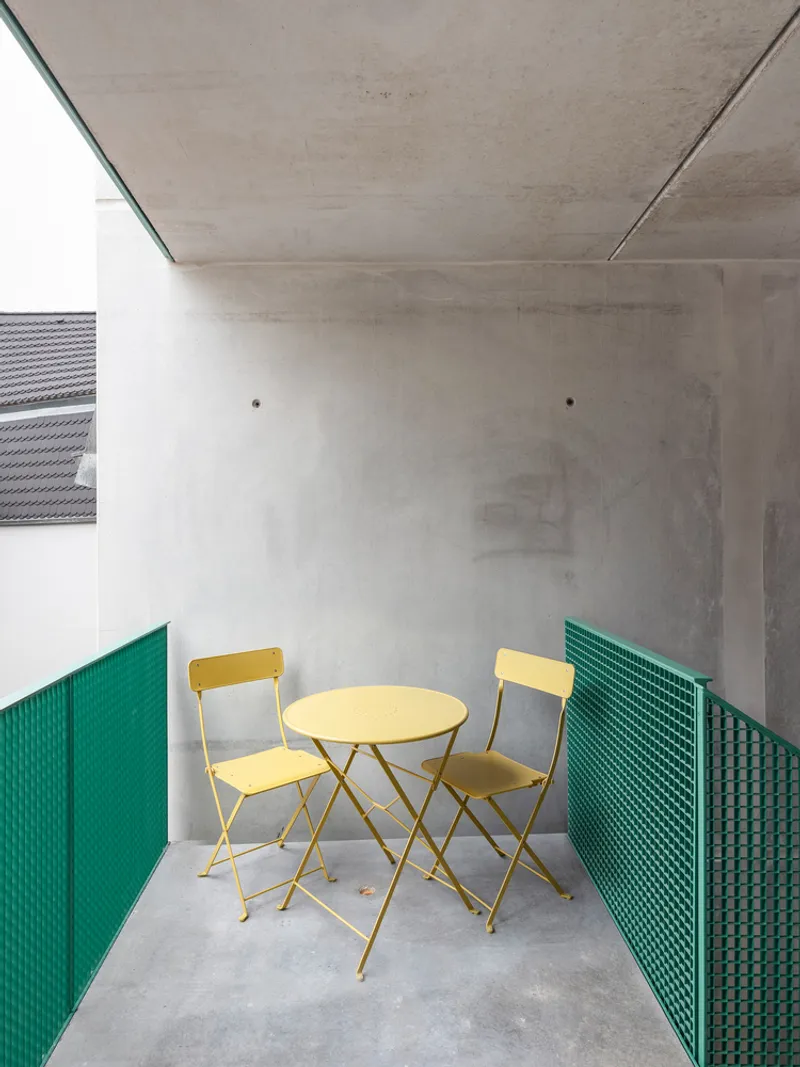
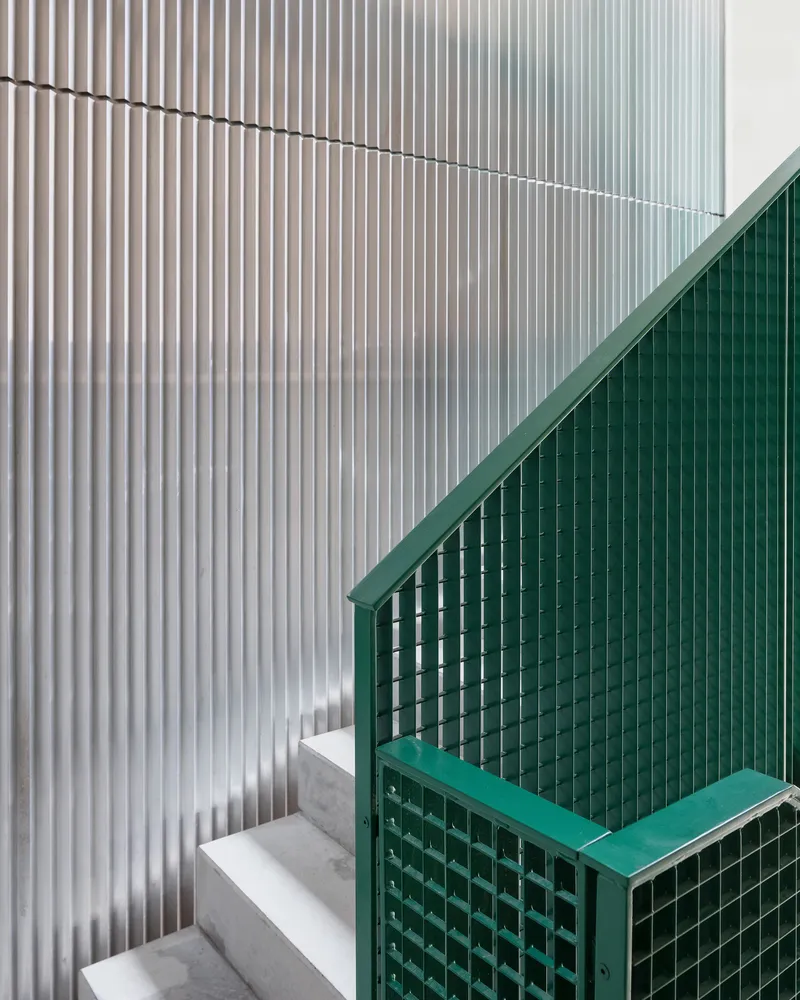
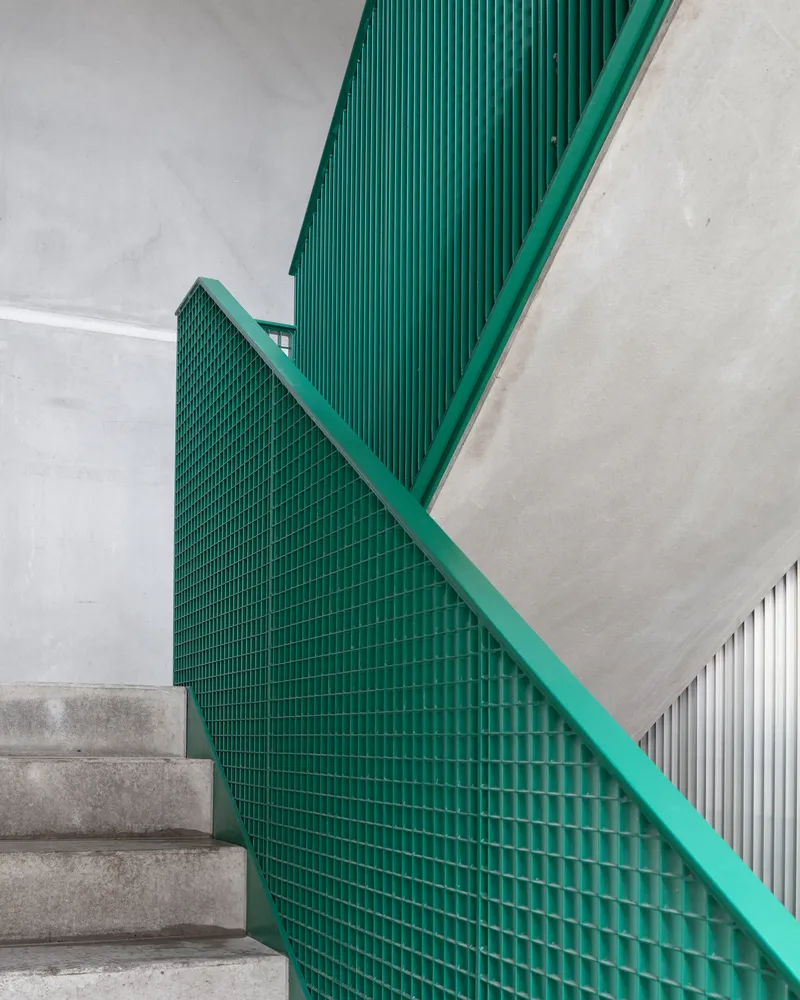
Pulling the staircase out of the building envelope was a critical move. It frees up interior floor area for living space and eliminates the dark internal corridor that plagues most small apartment buildings. More importantly, the deep landings at each level become usable outdoor rooms. At the balcony level, a yellow bistro table and chairs sit beneath an exposed concrete ceiling, framed by green perforated railings. It is a proper terrace, not a gesture.
These landings also provide something harder to quantify: casual visual connection. Residents on different floors share sightlines to the courtyard and to each other. In a building with only three units, this kind of incidental social contact matters. The staircase becomes the building's most communal space, a threshold between the private apartment and the shared courtyard below.
One Plan, Three Ways to Live
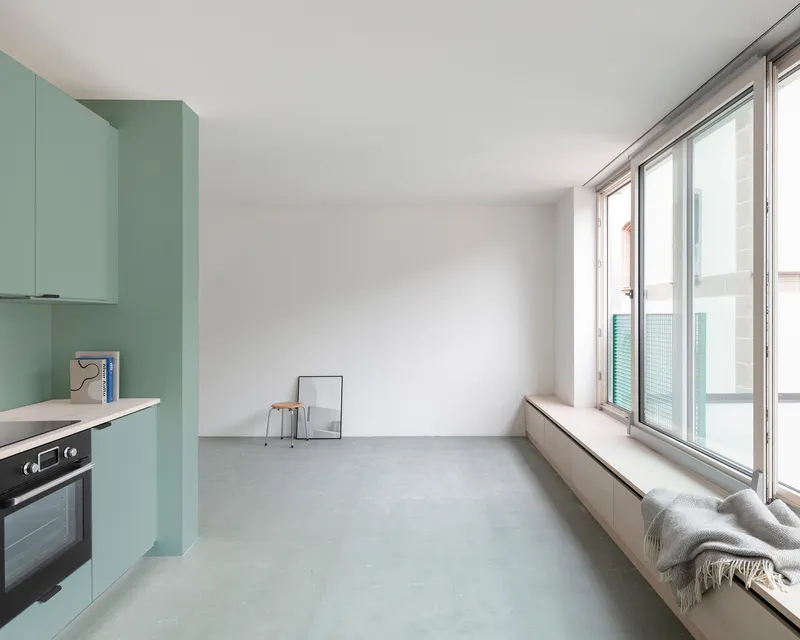
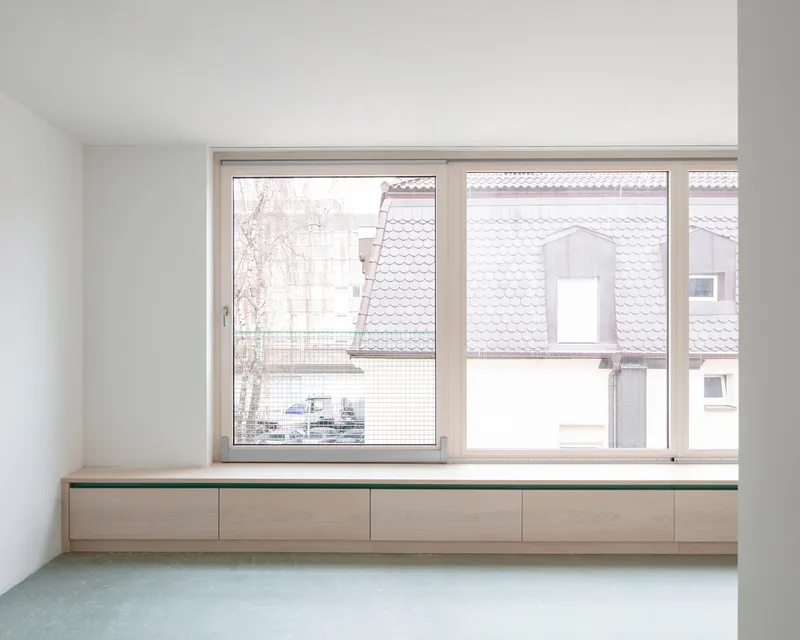
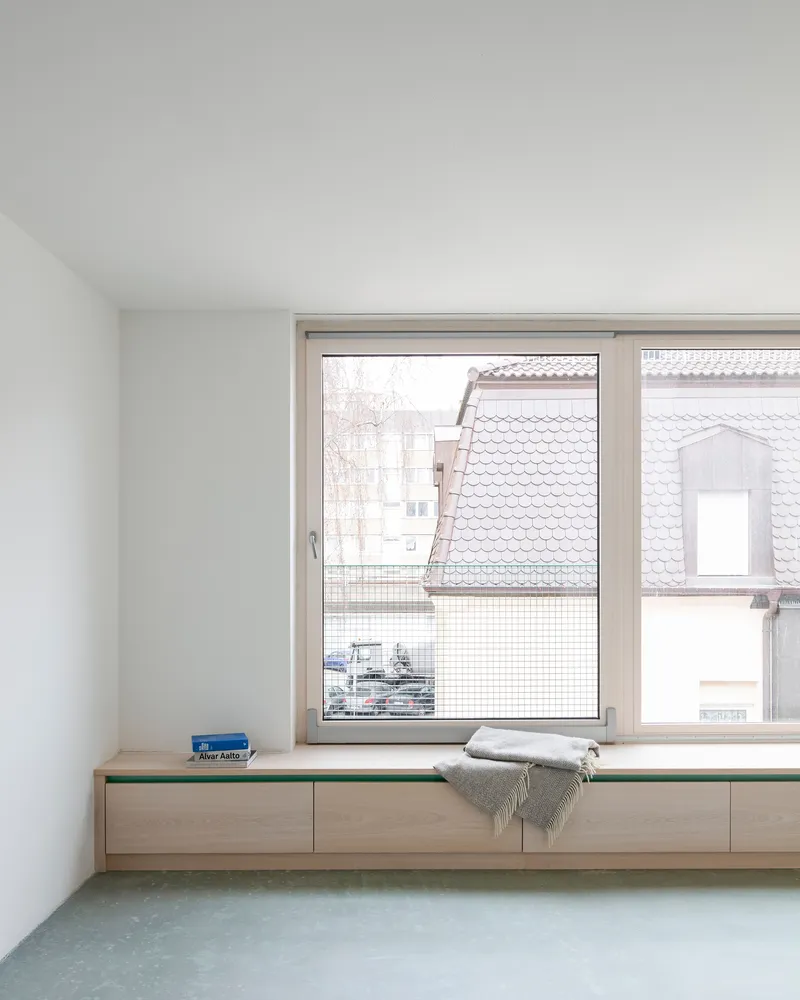
All three apartments share an identical floor plan, organized around a single large room divided by a rear core containing the bathroom, dressing area, and storage. The sleeping zone can be screened off with a curtain, which means the living and dining area feels substantially larger than it is when the curtain is open. This is a well-worn strategy, but the execution here is careful: the kitchen cabinetry in pale green lines the courtyard wall, and a long built-in timber bench runs beneath the window, offering storage drawers and a daybed-like perch overlooking the rooftops.
That window bench deserves particular credit. It solves several problems at once: additional seating for the dining area, concealed storage in a compact apartment, and a place to sit and read in what is clearly the best light in the room. The view out to neighboring clay-tile rooftops, framed by the deep window reveal, gives each unit an unexpected sense of context and calm.
Material Honesty in Tight Quarters
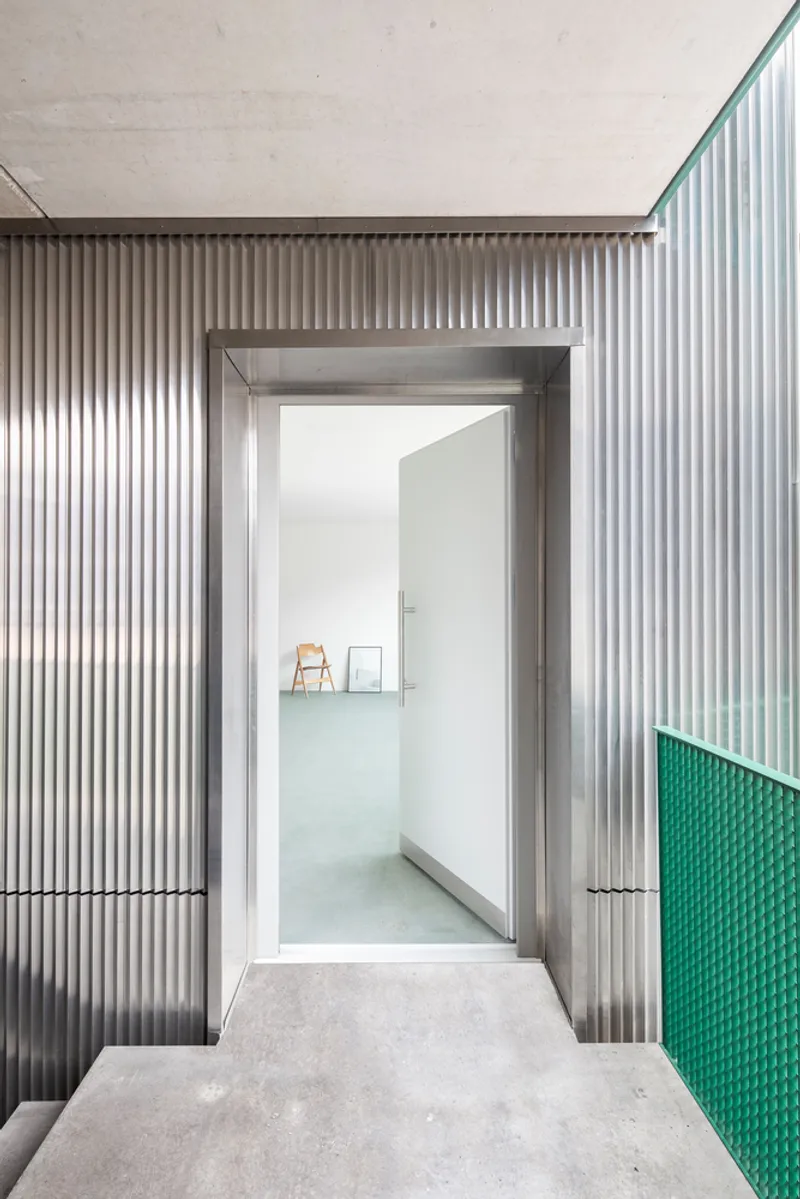
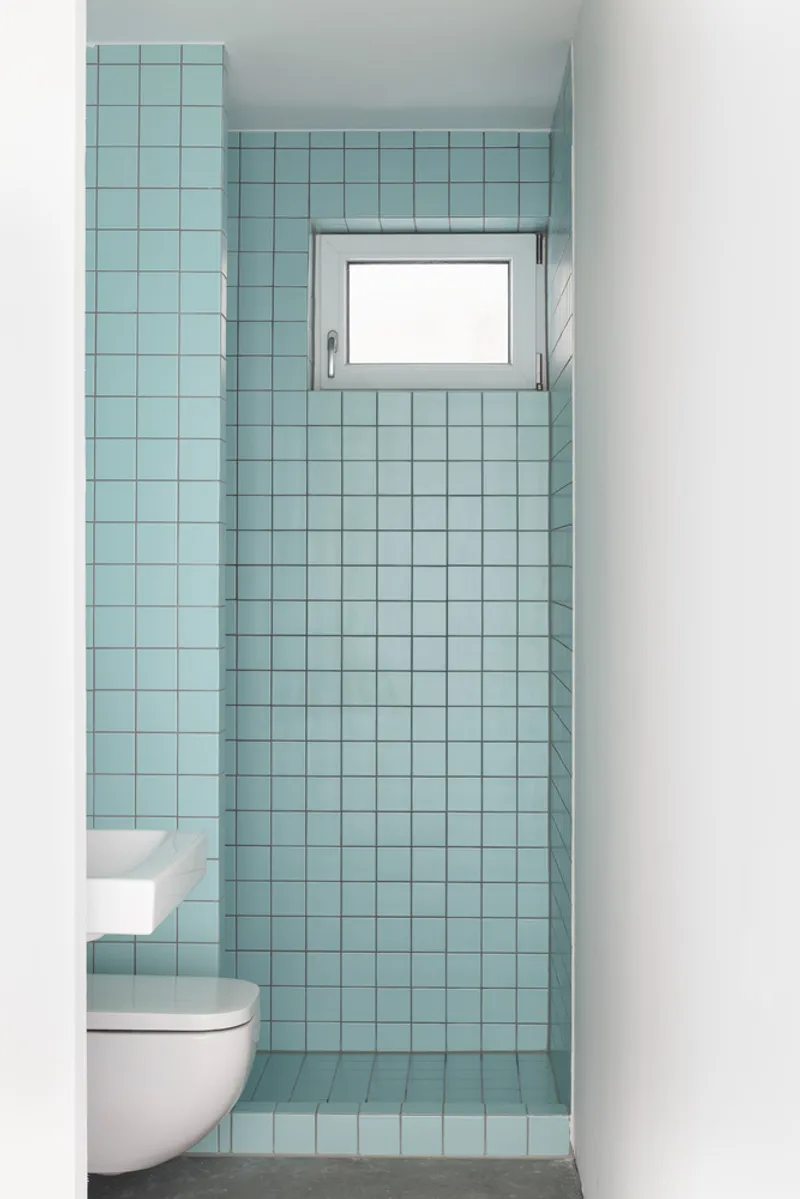
The material choices are restrained but not austere. Polished concrete floors, white vertical ribbed wall panels, and exposed concrete ceilings form the backdrop. The recessed entrance pairs corrugated aluminum with a green perforated panel, establishing the building's material identity at the threshold. Inside the bathrooms, pale blue square tiles surround the fixtures, introducing just enough warmth to keep the spaces from feeling institutional.
The high-hole brick construction behind the ventilated facade provides solid thermal mass, while the prefabricated ceiling and stair elements kept the build tight on a constrained site where staging space was essentially nonexistent. Beneath it all, micro-bored pile foundations navigate war-era fill material in the subsoil: a reminder that building in the middle of a European city always means building on top of history, literally.
Facade Texture and Light
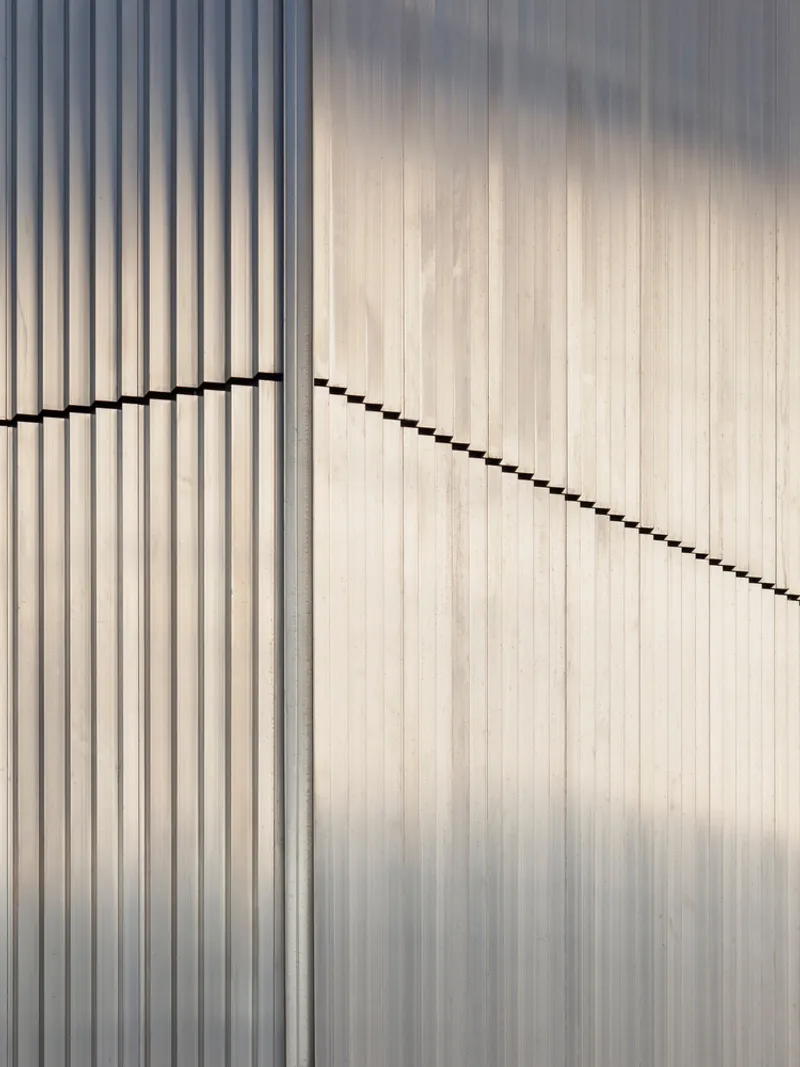
Close-up, the vertical slat facade reveals itself as more than a rain screen. Diagonal shadow lines cut across the ribbed surface as the sun moves, producing a constantly shifting pattern that animates what is otherwise a flat plane. The angular meeting point of ceiling and wall panels creates subtle geometry in diffused light. These are details that reward proximity, something residents will notice daily even if visitors never do.
Plans and Drawings
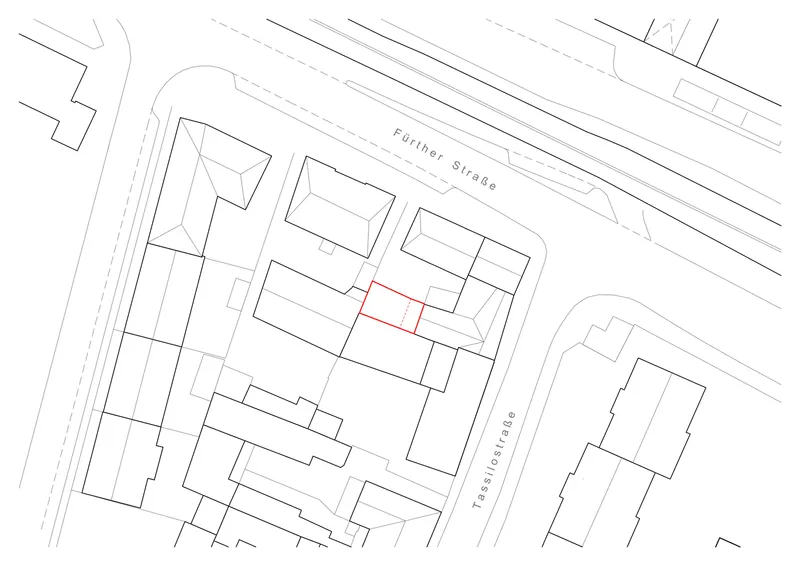
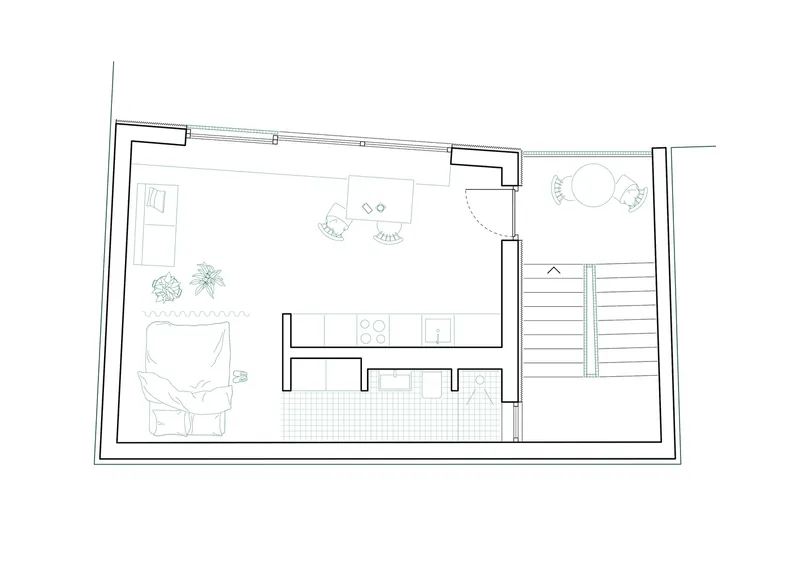
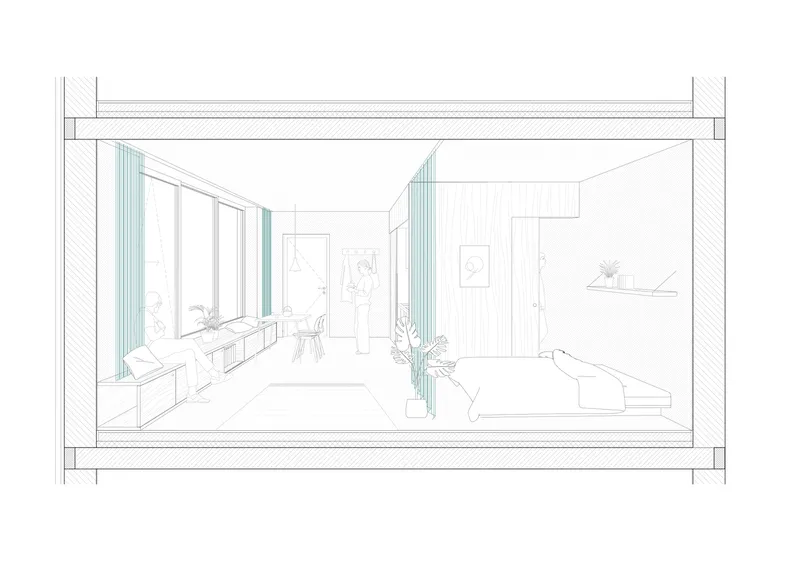
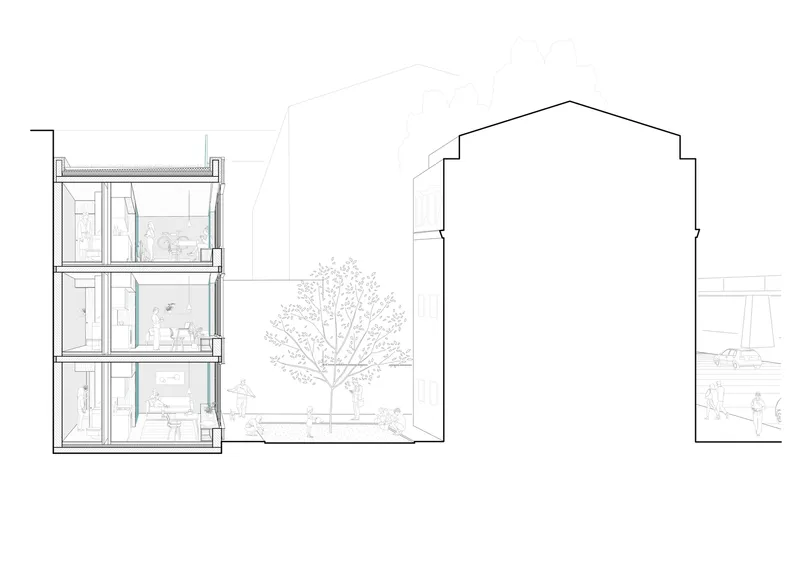
The site plan makes the constraint legible: the red-highlighted footprint sits deep within a block, accessible only through the gap between existing street-front buildings. The floor plan confirms the efficiency of the open layout, with the kitchen and living zone flowing uninterrupted toward a planted terrace. In section, the floor-to-ceiling glazing and the curtain partition are visible, as is the relationship between the built-in cabinetry and the generous window openings. The elevation drawing, placing the three-story volume beside a taller pitched-roof neighbor, makes the scalar modesty of the intervention clear. This is not a grand architectural statement. It is a precise insertion.
Why This Project Matters
European cities are full of gaps like this one: backyard plots, leftover lots, spaces between party walls that seem too small or too awkward to build on. The Backyard House proves that these sites are not merely viable but capable of producing housing that is spatially generous, materially honest, and socially engaged. The shared courtyard, the staircase terraces, and the reflective facade all work together to make the dense urban fabric around them function better, not just for the new residents but for the existing ones.
Super Future Collective's approach here is not revolutionary in any single gesture. It is revolutionary in the accumulation of smart, specific decisions: prefabricated elements for a site with no laydown area, a light-colored skin to compensate for north-facing orientation, an external stair that gives back more than it takes. If cities are serious about densification without displacement, this is the scale and the attitude that will actually deliver it.
Backyard House by Super Future Collective, Fürther Street, Nuremberg, Germany. Completed 2022. Photography by Kim Fohmann.
About the Studio
Share Your Own Work on uni.xyz
If projects like this are the kind of work you want to make, uni.xyz is a place to publish your own, find collaborators, and enter design competitions.


Popular Articles
Popular articles from the community


Singing Woman: Contemporary Architecture Inspired by Estonia’s Voice and the Sea
Singing Woman turns Estonia’s song culture into flowing opera house architecture, blending public life, landscape, sea, and national memory.

Manzana Morphosis: Stretching Barcelona's Grid into a Living Landscape for 2050
A radical reworking of the Eixample manzana turns density into a tool for generous public space, vertical ecology, and environmental performance.

Extended Shell: Retrofitting Kolkata's Balconies as Living Urban Thresholds
A modular retrofit system recovers the social and environmental intelligence of Kolkata's historic verandas for contemporary Park Street residents.
Opera on the Sea: Driftwood Logic Shapes a Timber Opera House on Estonia's Coast
Trevor Orgill's opera house translates the entangled drift of floating timber into a civic building where wood, water, and music converge.

Similar Reads
You might also enjoy these articles


Hodi-Mandai Geram
Project Function: Preservation and revitalization of the Intangible heritage and socio-spatial identity of the Hodi by Housing, Cultural Memory Center, Sacred Grove, landscape, local tourism economy


Olio Towers: A Mid-Rise for Performers That Fuses Housing, Rehearsal, and Stage
Located blocks from Houston's Theater District, this modular tower stacks living units around a central performance atrium.

Oasis: Modular Green Housing Carved into Dhaka's Urban Fabric
A shortlisted Plugin Housing entry reclaims unauthorized settlements in Dhaka with stepped concrete volumes, green roofs, and ventilation-driven design.

Black Hole: A Floating Megastructure for the Post-Physical Era
Emiliano Mazzarotto envisions a spherical, self-scaling arena where e-sports, digital hotels, and holographic stadiums replace traditional public space.

Explore Urban Dweller Competitions
Discover active competitions in this discipline

Challenge to reimagine the Iron Throne

Photograph architecture without architects

Illustrate the lost glory of Angkor Wat - Render Challenge

Design challenge to reuse E-waste
Comments (0)
Please login or sign up to add comments
No comments yet. Be the first to comment!