
Vertical Village
A small community of manufactured & affordable student housing; living closely together in a block of industrial containers

● What was the concept behind the project?
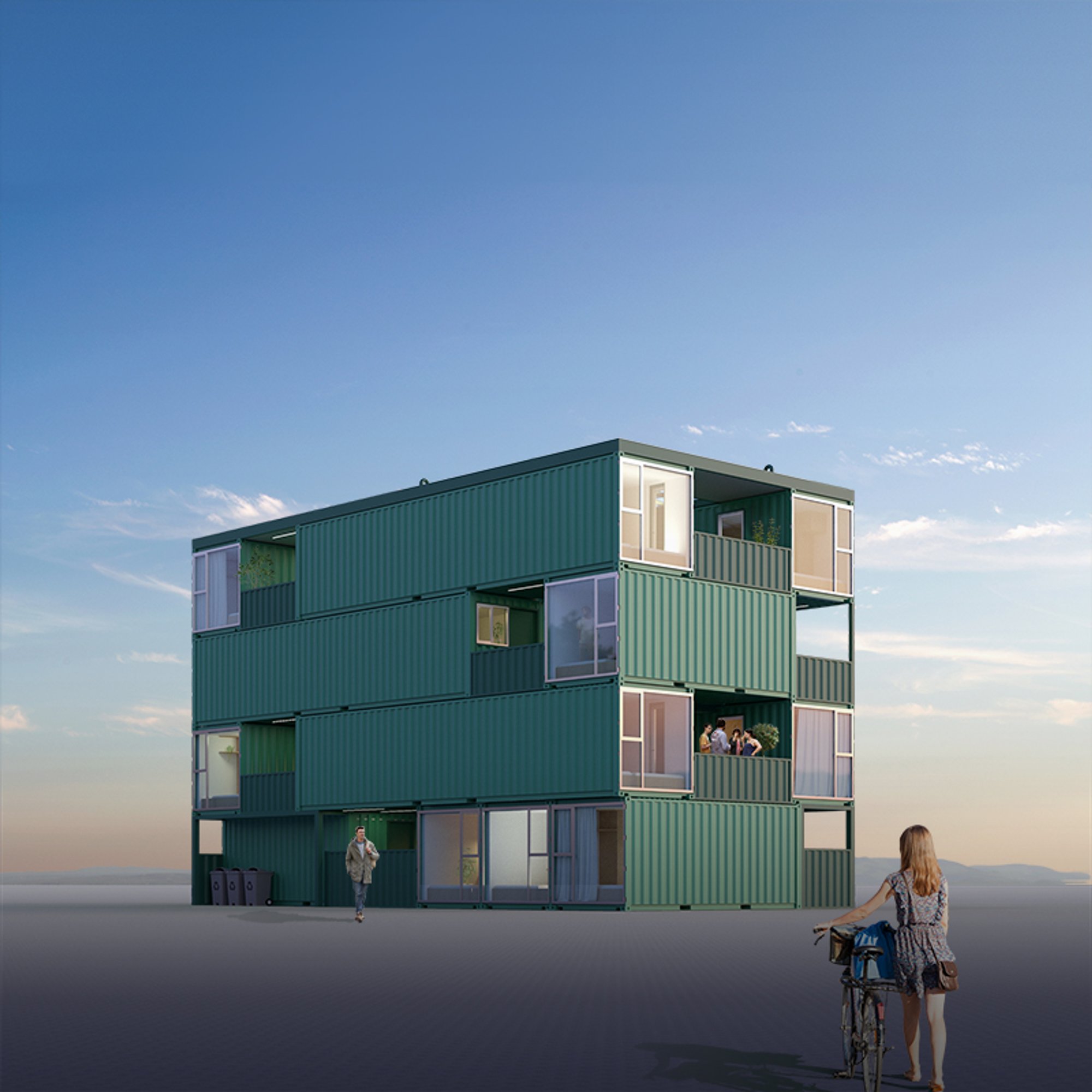
Vertical Village is the creation of a compact 4-storey block structure, where the student residents can live small-scale and close, within an environment with room for social gathering and shared spaces.
The block, which can be replicated, offers a framed and covered zone for the housing units that can exist in multiple contexts around different cities in the world.
Variations and staggering of the containers creates facades with outdoor niches and spaces making the block structure appear solid yet open.
The major windows located in each end of the 15 containers are orientated towards 3 directions away from the block, to increase the quality of daylight and privacy, leaving a 4th facade closed for the possibility of replicating the block.
● What was the intent behind the organization of elements across various levels?
The different housing units are tied together via the common atrium in the block, covered by a glass roof, where the major vertical circulation happens between the different levels.
Across the various levels different outdoor spaces are connected to the housing units, providing room for the residents to personalize it with outdoor furniture, plants, etc.
The Vertical Village will consist of 15-21 student residents who will be living closely together in the block, which is organized in such a way that a sense of sharing and neighbourhood can happen, avoiding a more solitary feeling by spreading housing containers over a too open and exposed site or context.
In this sense the density of the block makes a community feeling for the people living there.
● How many iterations were tried to arrive at the final outcome?
In the design process a number of conceptual models were developed, and narrowed down to 6 typologies, each with a different expression and logic of assembling the containers.
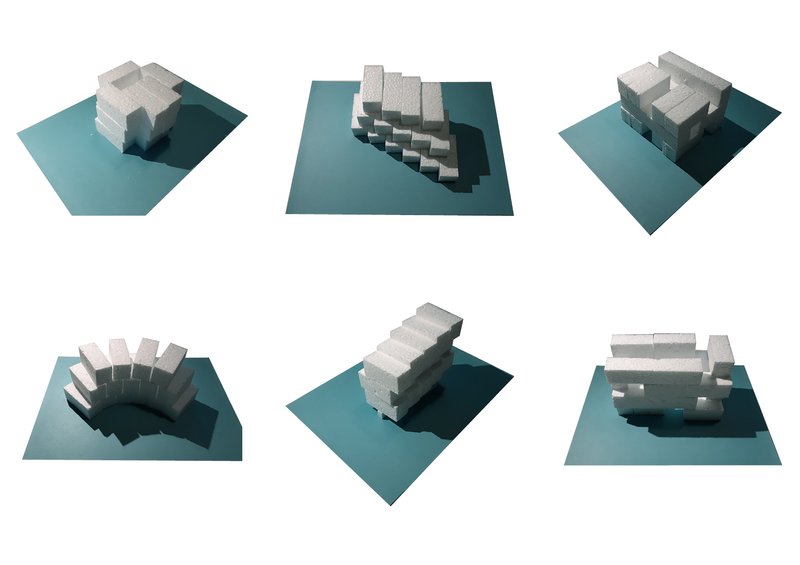 conceptual model studies
To achieve a dense yet airy solution the concept of the Vertical Village was selected and developed further because of its minimal footprint of 143 m2, measuring only 8,3 x 17,2 m, as well as having a mixed division between container sizes which is effectively connected and accessed between the levels.
● Which methods of design investigation?
During the design process accessibility and outdoor spaces were tested in various scenarios. These were depending on the staggering and distances between the containers where the leftover area could be giving a concrete use for access, stairs and shared spaces.
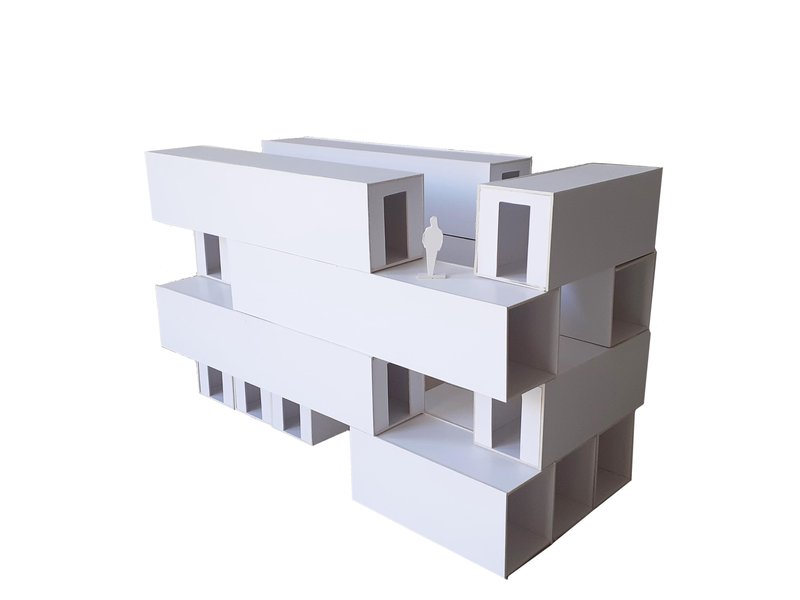 Vertical Village model testing
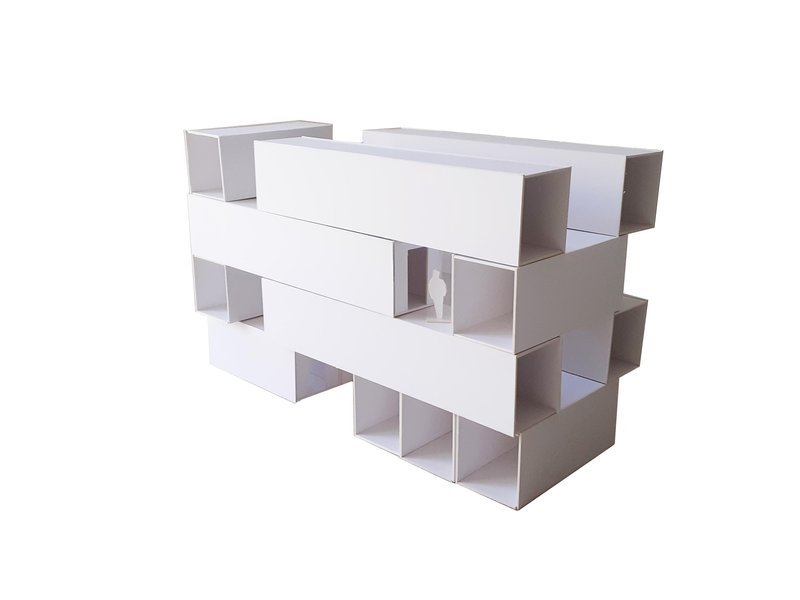 Vertical Village model testing
● How was the programme condensed into final?
The 15 housing units consist of 6 long and 9 short containers, each with its own bathroom and kitchen / kitchenette, with most of the short containers located on the 1st floor in 2 rows.
For all housing units there is an adjacent outdoor space, shared with the nearest neighbours, and on the 2nd level a larger area below the atrium glass roof gives space for social gatherings within the block.
The long containers also have direct access to a shared space from their side glass doors located in the opposite end of the entrance.
These shared spaces serve as an additional place for staying and relaxing besides the more compact housing units; a semi private area with a sense of common ownership.
● What/How were the materials chosen?
The exterior appearance is kept in an industrial look with the containers repainted but otherwise mostly unchanged on the outside, with a few new elements such as windows, steel columns and beams.
The removed facade parts of the containers from cutting openings for doors and windows are reused as exterior fencing on the outer facades of the block, repainted in a different colour variation than the containers to achieve a visual dynamic on the facades.
Within the atrium additional materials and colours are added to the impression, with wooden planks used for surfaces of the outdoor spaces and a variation of plants such as ivy or creeping fig vine, creating the feeling of a greenhouse.
The interior of the containers are made in bright simple materials, with a warm plywood for the cupboards, bed and other furniture as a contrast to the more ‘hard’ exteriors.
● How was a specific objective attempted to be met?
By keeping the exterior changes to the containers minimal, creating a small but light interior with the basic necessities for a quality of living, the containers can be converted and manufactured elsewhere and transported to a given site for the block assembly keeping the construction time and prices minimal.
The additional needed load bearing structures are also minimized by the stacking system of the block, with a maximum usage of leftover surfaces for outdoor areas of common value.
● What is the expansion plan of the project?
As seen on poster boards 4 and 5, the Vertical Village can be replicated as a module in several different ways and scales, with a number of various compositions and repetitions depending on a given site’s logic or specific contextual situation.
By keeping the 4th facade closed without windows or doors, the blocks can be mirrored and connected via the outdoor areas between the containers in several compositions and patterns.
The Vertical Village can be built as shown directly on the ground level of a leased land plot, but could also exist as a lifted block on a structural grid with ground level functions (parking or social facilities) or on a water deck depending on the specific context scenario.
Especially the cross-shifting and long-shifting compositions can work well located on top of rectangular plinth structures, making large outdoor spaces available in the voids between each block.
● How will the project transform with the passing time? etc.
The containers can be repainted in different colours if needed to achieve larger variations when repeated in large scale, as well as blending in with a specific context colour theme.
Over time the paint and outer facades will appear more worn out which will match well with the industrial look and urban setting.
The inner facades in the atrium will be more shielded and less worn, appearing more overgrown with the vegetation planted by the residents, making their own inner urban garden.
There should also be given room for the small communities of residents to affect and shape the outer areas of the Vertical Village to create lively and local spaces, making it an attractive place to live and visit.



Popular Articles
Popular articles from the community


Solar Steam: A Climate-Responsive Architecture That Redefines the Monument
A climate-responsive memorial architecture that transforms heat, decay, and time into a living system reflecting humanity’s ecological impact.


The Ken Roberts Memorial Delineation Competition (Krob)
As the most senior architectural drawing competition currently in operation anywhere in the world, it draws hundreds of entries each year, awarding the very best submissions in a series of medium-based categories.
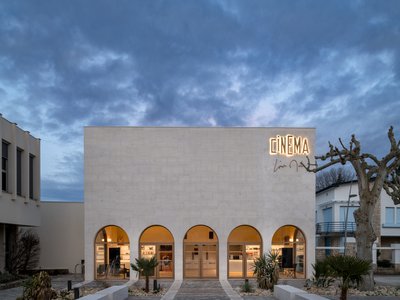
Louis Malle Cinema: A Limestone Cultural Landmark Revitalizing Community Life in Prayssac
Limestone cinema extension with public forecourt, blending heritage and modern design to create flexible cultural spaces and strengthen community interaction.
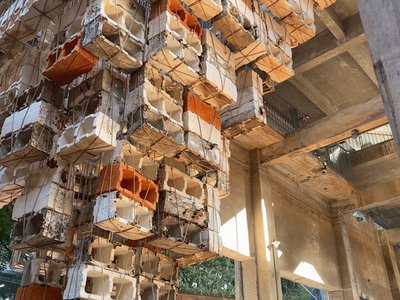
Inverted Architecture Installation by Studio Link-Arc: Exploring the Intersection of Architecture and Living Organisms
Inverted Architecture Installation by Studio Link-Arc blends mycelium, sustainability, inverted design, ecological cycles, and urban adaptive architecture in Shenzhen.

Similar Reads
You might also enjoy these articles
The Ken Roberts Memorial Delineation Competition (Krob)
As the most senior architectural drawing competition currently in operation anywhere in the world, it draws hundreds of entries each year, awarding the very best submissions in a series of medium-based categories.
A Contemporary Take on Iranian Residential Architecture
A modern interior design in Mashhad that reinterprets brick, light, and spatial flow to create a warm, contemporary residential architecture.
Franche-Comté Advanced School of Engineering by Dominique Coulon & associés, Besançon
A flexible engineering school immersed in woodland, combining concrete minimalism, adaptable spaces, and natural light to support evolving educational environments.

Waterfront Redevelopment and Urban Revitalization in Mumbai: Forging a New Dawn for Darukhana
A transformative waterfront redevelopment project reimagining Darukhana’s shipbreaking heritage into an inclusive urban future.


Explore Urban Design Competitions
Discover active competitions in this discipline




The Global Benchmark for Architecture Dissertation Awards


The Global Benchmark for Graduation Excellence


Challenge to design an urban locus of culture and heritage

Bring back Drive In's
Comments (0)
Please login or sign up to add comments
No comments yet. Be the first to comment!