
LAN Architecture Wraps a 50-Meter Timber Tower in Glass on the Banks of the Seine
Wood Up Tower brings 132 homes in locally sourced timber to Paris Rive Gauche, redefining what collective housing can feel like.

Paris has been cautious about height for decades. The city's rooftop horizon, that famous datum of zinc and stone, is more cultural artifact than building code. So when a 16-story timber residential tower rises 50 meters at the eastern edge of Paris Rive Gauche, directly above the Seine and staring across the périphérique at an Ivry waste-incineration plant, it registers as both provocation and proposition. LAN Architecture's Wood Up Tower, completed in 2024, is one of France's tallest timber buildings, and it plants its flag in the 13th arrondissement's Massena-Bruneseau sector: a stretch of former rail yards gradually being remade by institutions like the Bibliothèque Nationale, the Université Paris Cité campus, and Snøhetta's headquarters for Le Monde.
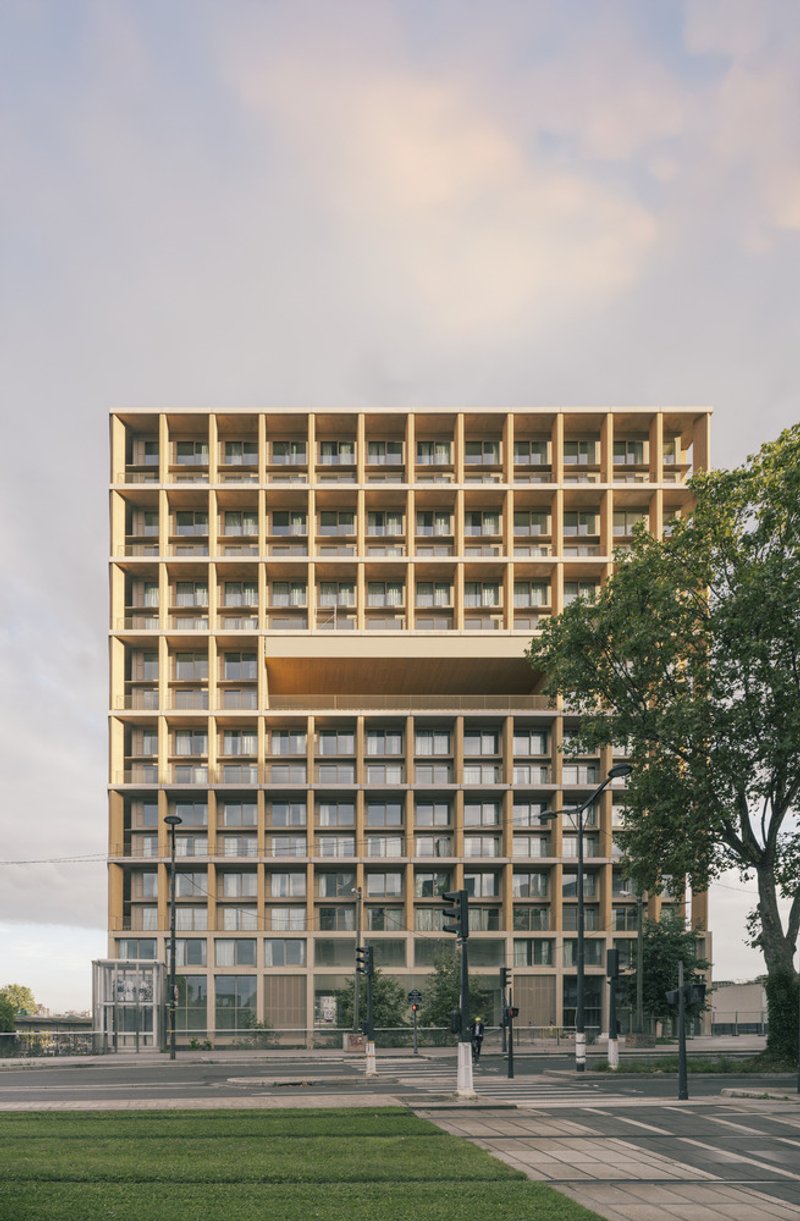
What makes Wood Up genuinely interesting is not just the fact that it is tall and wooden, though that alone required significant engineering ambition. It is the decision to encase the entire timber structure in glass, turning the building's skeleton into its primary visual expression. There is no cladding hiding the glulam. The wood is the architecture, and the glass is its vitrine. That transparency reads as both confidence and argument: that timber construction at urban scale deserves to be seen, not concealed behind render or rain screen. The 8,900-square-meter tower houses 132 residential units, a commercial base that mediates between the boulevard and the riverbank, and a 300-square-meter communal terrace at the eighth floor that functions as a threshold between the old ceiling of Paris and its new vertical ambitions.
A Timber Grid Against the Paris Skyline
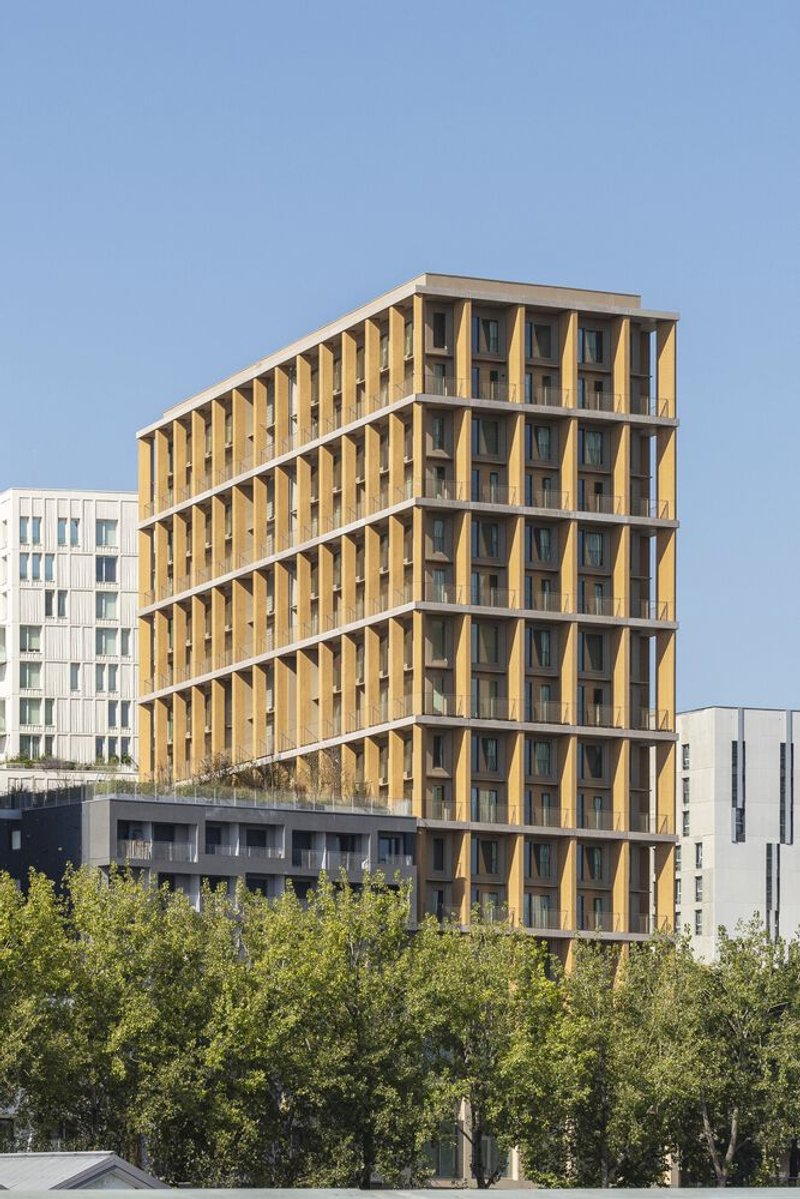
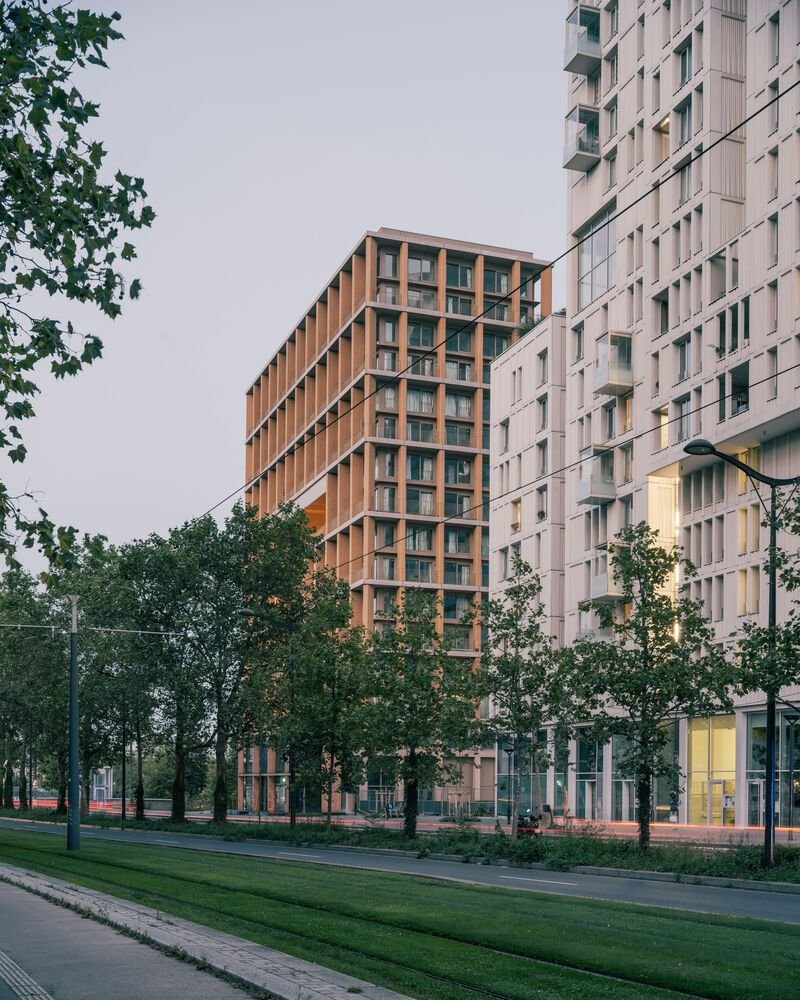
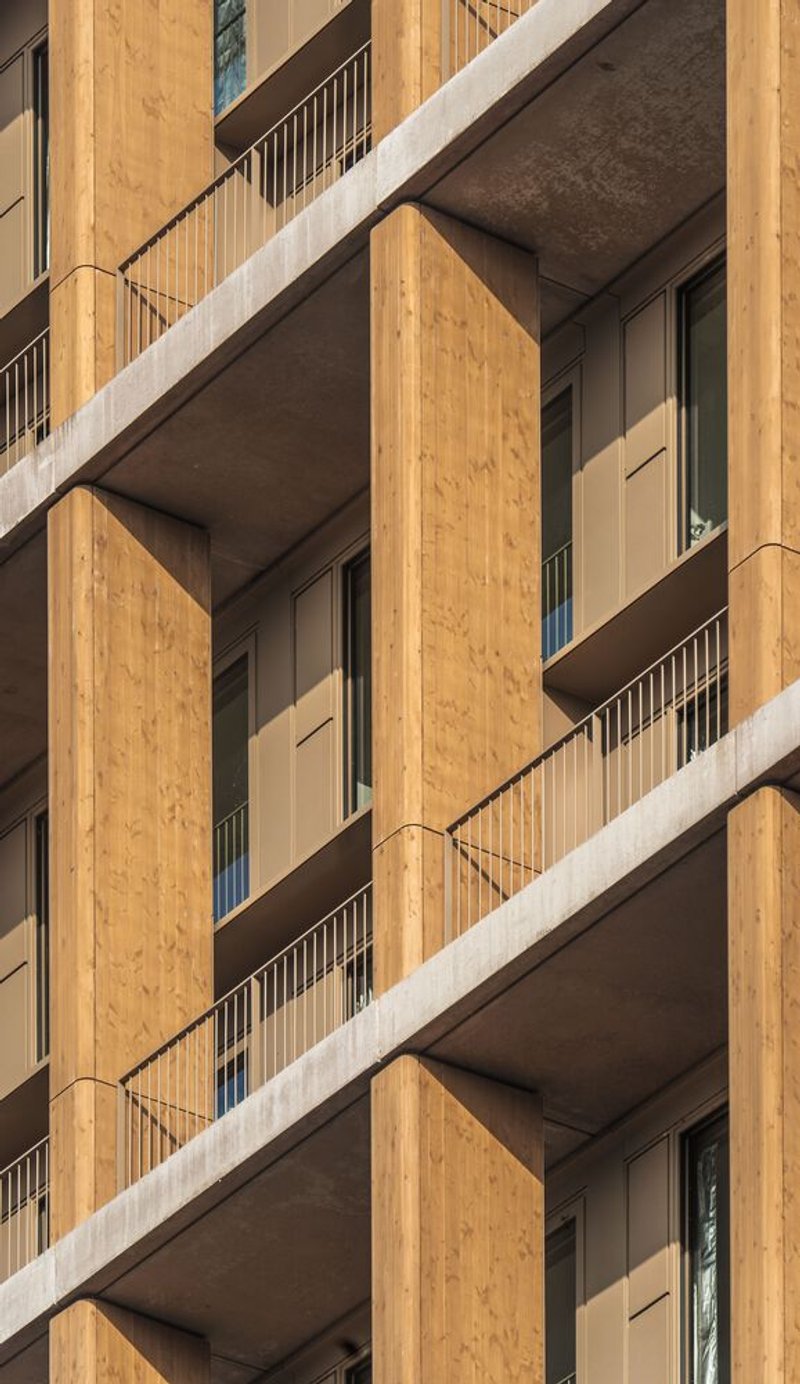
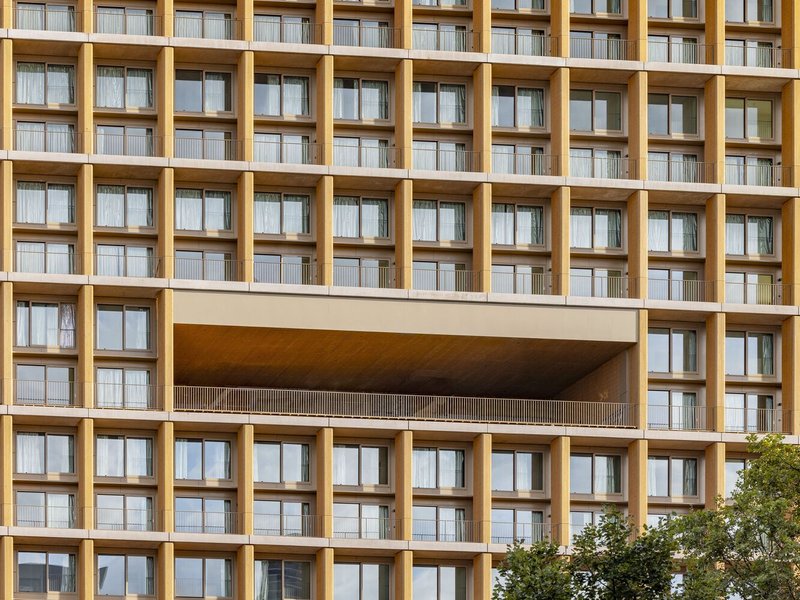
The facade is the argument made visible. A regular grid of vertical and horizontal timber elements, glulam brise-soleil framing glazed openings, gives the tower a texture and warmth that reads clearly against the concrete and metal of its neighbors. The grid is not decorative; it is the structural logic pushed to the surface. Each module corresponds to the building's 3.90-meter framing dimension, a measurement chosen specifically to accommodate every dwelling type from studios to five-room family apartments.
Staggered balconies with white metal railings break the rhythm just enough to prevent monotony, while recessed openings at the communal level create a legible pause in the elevation. At dusk, the timber catches warm light and the tower glows against the tree-lined boulevard, an effect that is earned rather than engineered. The material does the work.
A River Address at the City's Edge
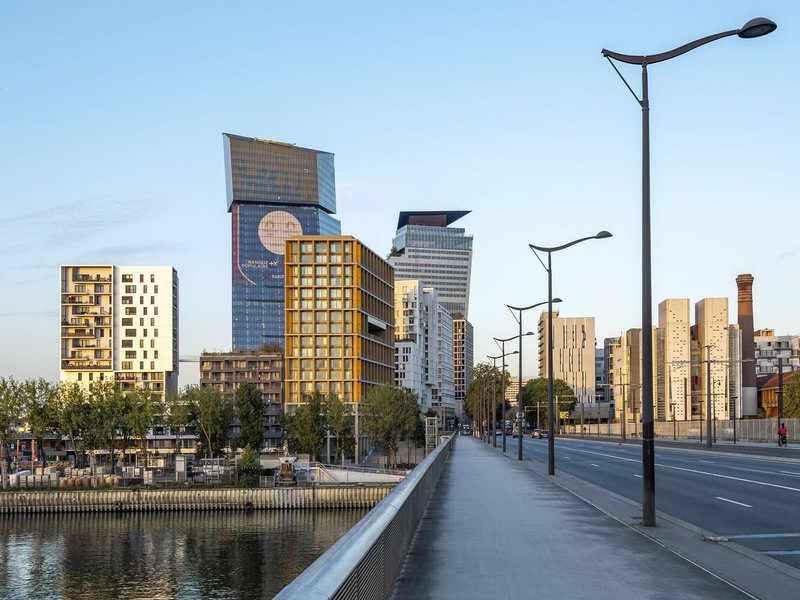
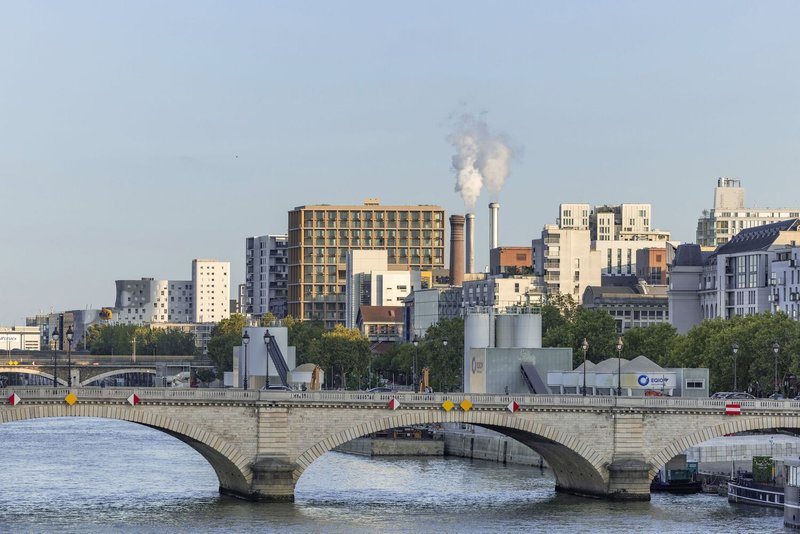
Wood Up's site is as loaded as its structure. It sits at the easternmost point of Paris Rive Gauche, where the city's progressive urban renewal gives way to the still-industrial landscape of Ivry-sur-Seine beyond the ring road. The tower acts as a pivot, mediating between the elevated boulevard and the lower quay of the Seine. Its commercial base absorbs the grade change, stitching together two different levels of the city and anchoring a new stretch of waterfront promenade.
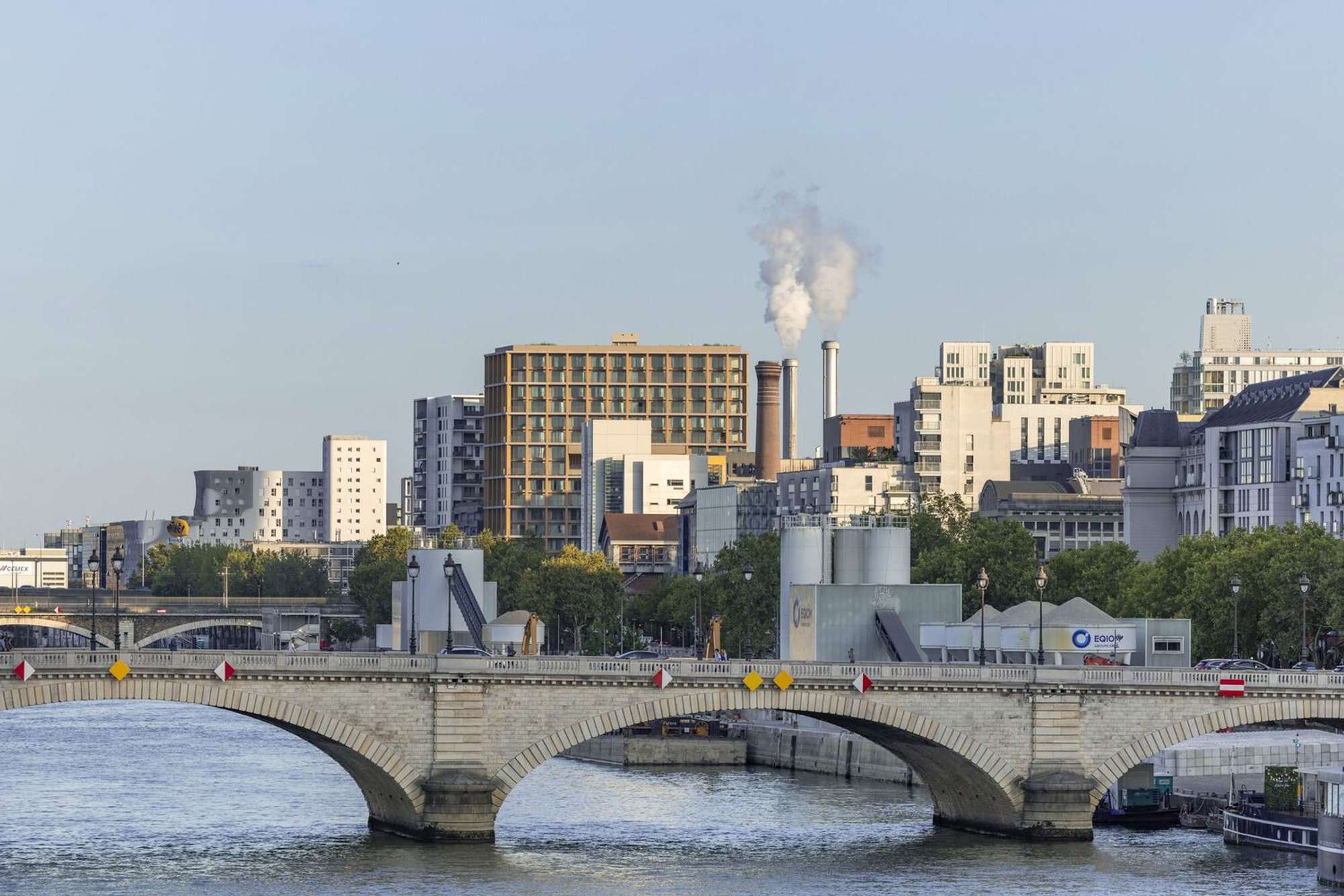
From across the river, the tower rises cleanly above the stone bridge and industrial skyline, its proportions slender enough to read as a marker rather than a barrier. The distant view reveals something important: this is not a building trying to disappear into context. It announces a new condition for this part of Paris, one where timber and density coexist at the water's edge. All of the project's wood was sourced from French forests and transported to site via the Seine itself, a logistical detail that doubles as a poetic one.
Living Inside the Structure
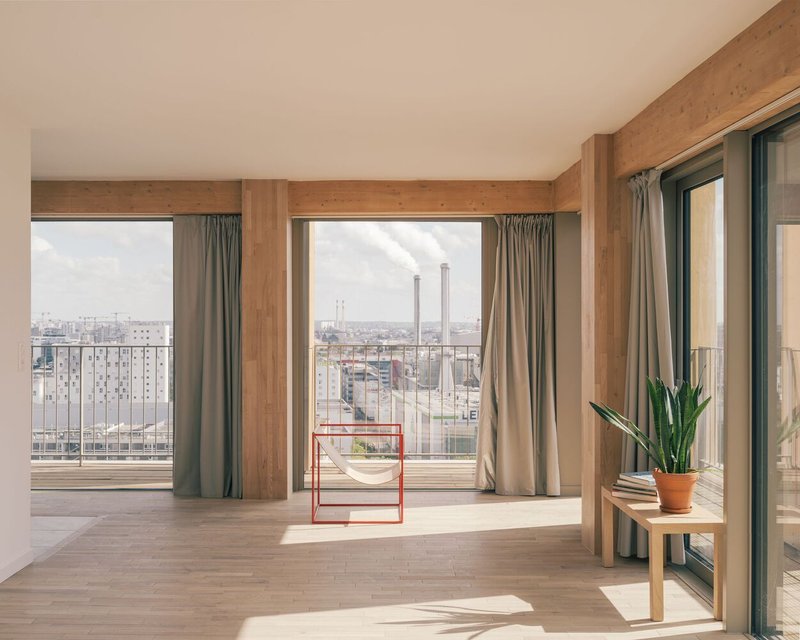
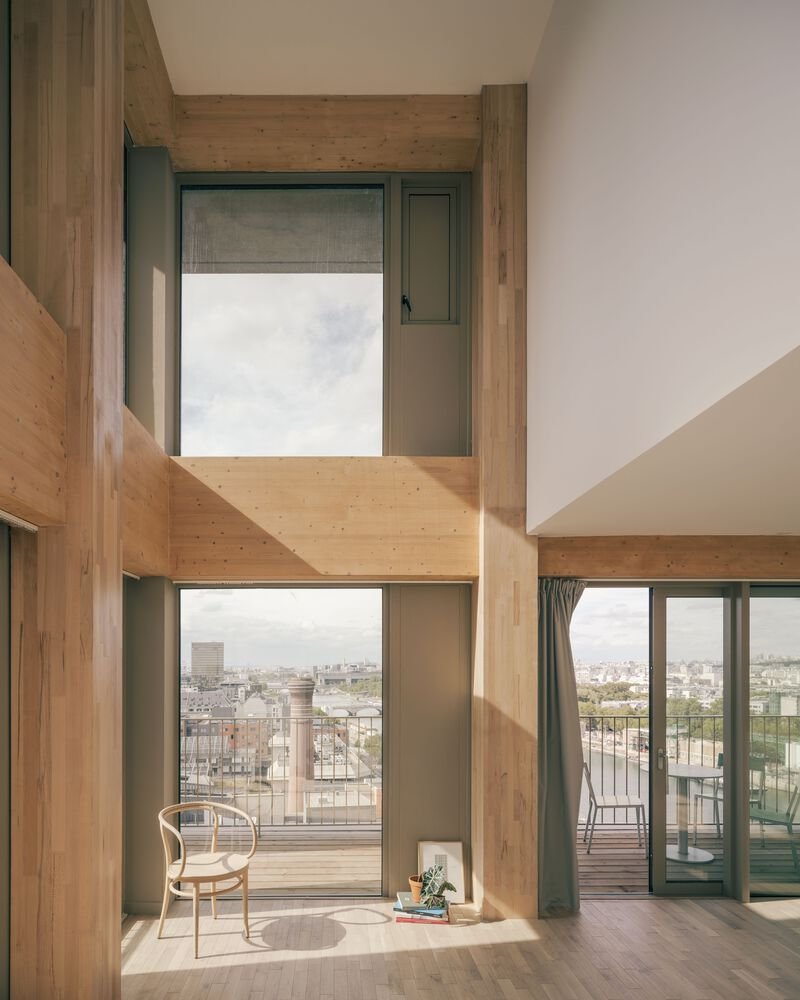
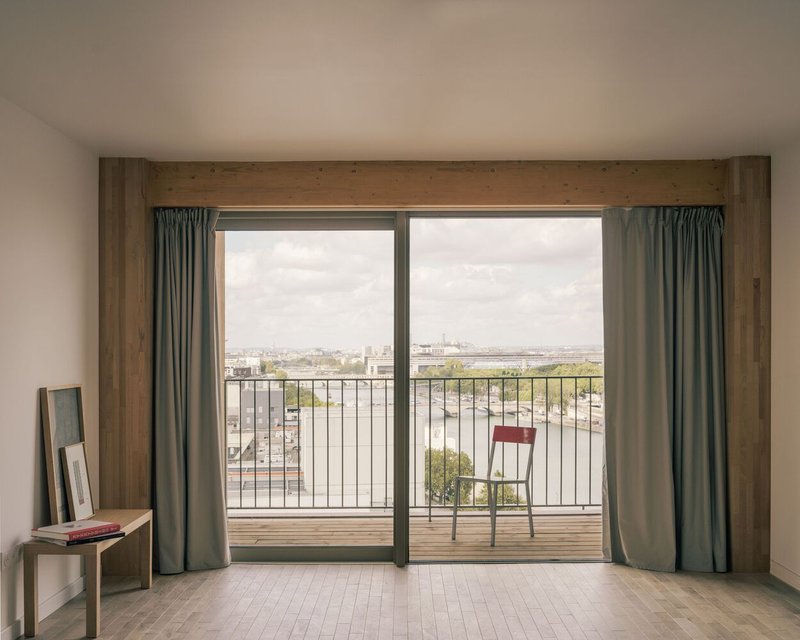
Inside the apartments, the decision to expose the timber structure pays off most directly. Laminated columns and beams are left visible, creating interiors that feel more like refined loft spaces than typical Parisian social housing. Sunlight enters through floor-to-ceiling glazing and bounces off the pale wood, producing rooms that are simultaneously warm and luminous. The structural rhythm organizes each unit without constraining it: the 3.90-meter module is wide enough for generous living rooms, and the alternation of larger apartments (T3 to T5) with floors of smaller T1 and T2 units produces a genuine diversity of dwelling types within a single shaft.
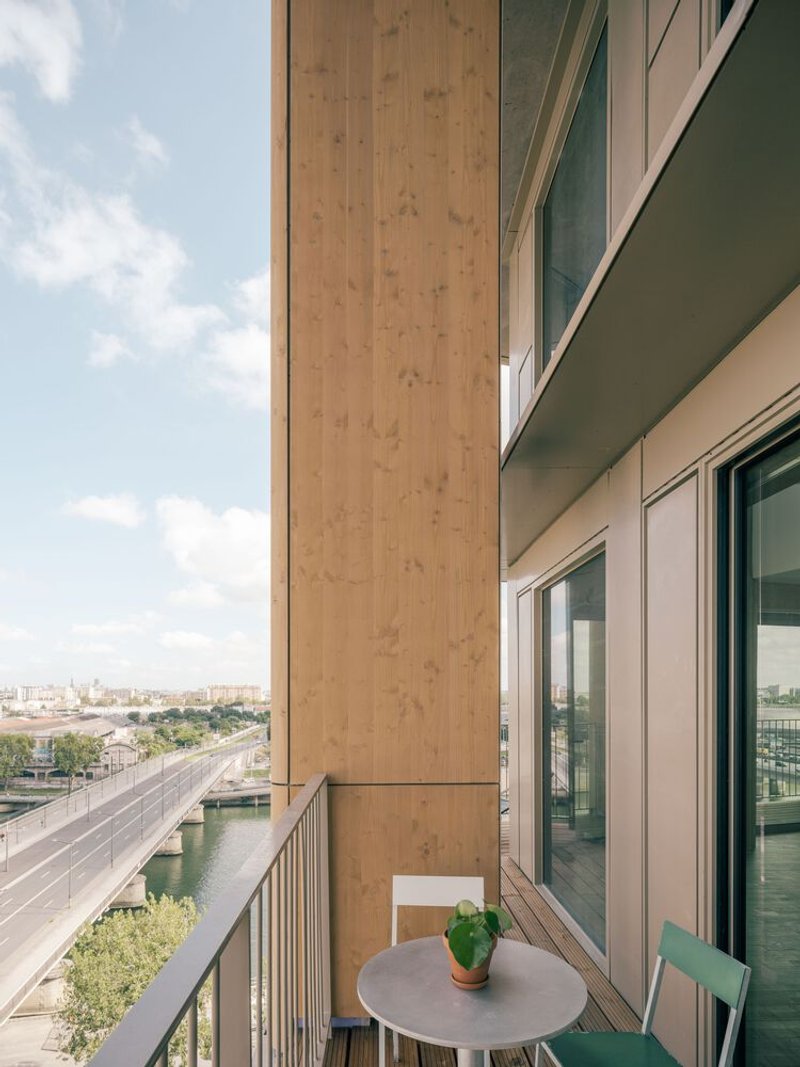
Corner duplexes, accessed by outdoor walkways, offer something closer to the independence of a townhouse. Sliding glass doors open onto timber-decked balconies with metal railings, and from the upper floors these private outdoor spaces frame views that range from the Seine to the smoking chimneys of Ivry. LAN's stated goal was to offer the qualities of a single-family home within a collective structure: privacy, outdoor space, a sensory connection to the outside. The evidence in these rooms suggests they came close.
Shared Ground at the Eighth Floor
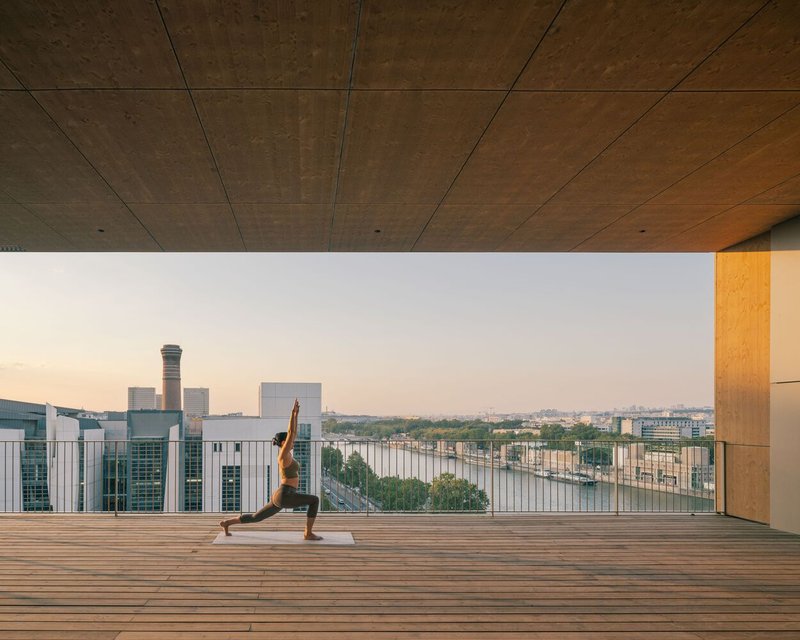
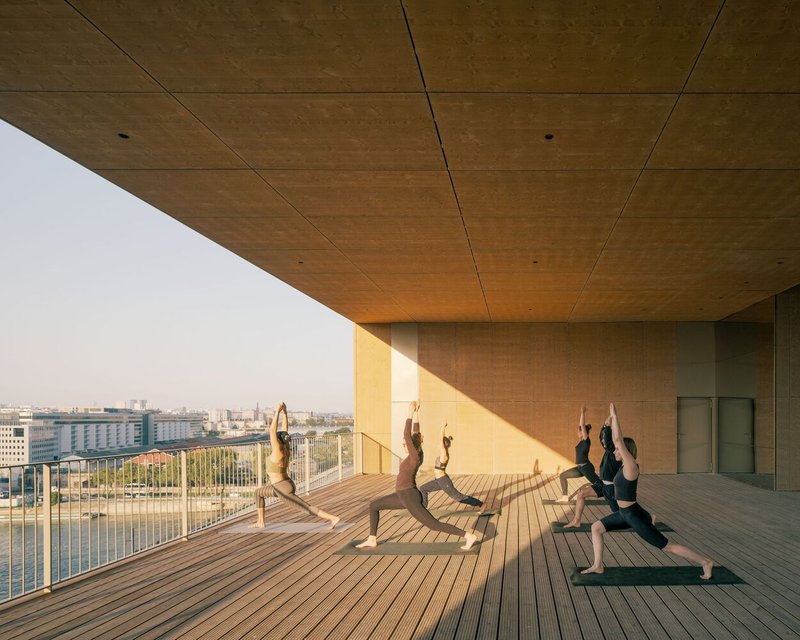
The communal terrace at the eighth floor is the building's social hinge. Measuring 300 square meters, roughly 23 by 10 meters, it sits at the symbolic altitude of the traditional Parisian roofline: a deliberate gesture connecting the old city's horizontal datum to the new tower's vertical ambition. The space functions as loggia, courtyard, and event terrace simultaneously. Its furniture is made from recycled wood offcuts left over from the building's own construction, a detail that turns waste into amenity.
Under a timber-lined soffit, the terrace offers a protected yet open-air room where residents practice yoga at dawn or gather in larger numbers for community events. The recessed facade at this level, visible from the street as a gap in the grid, signals the collective life within. It is one of the project's smartest moves: locating shared space not at ground level where it competes with commerce, and not at the roof where it becomes exclusive, but at a mid-height that belongs to everyone and is legible from the city.
Threshold and Corridor
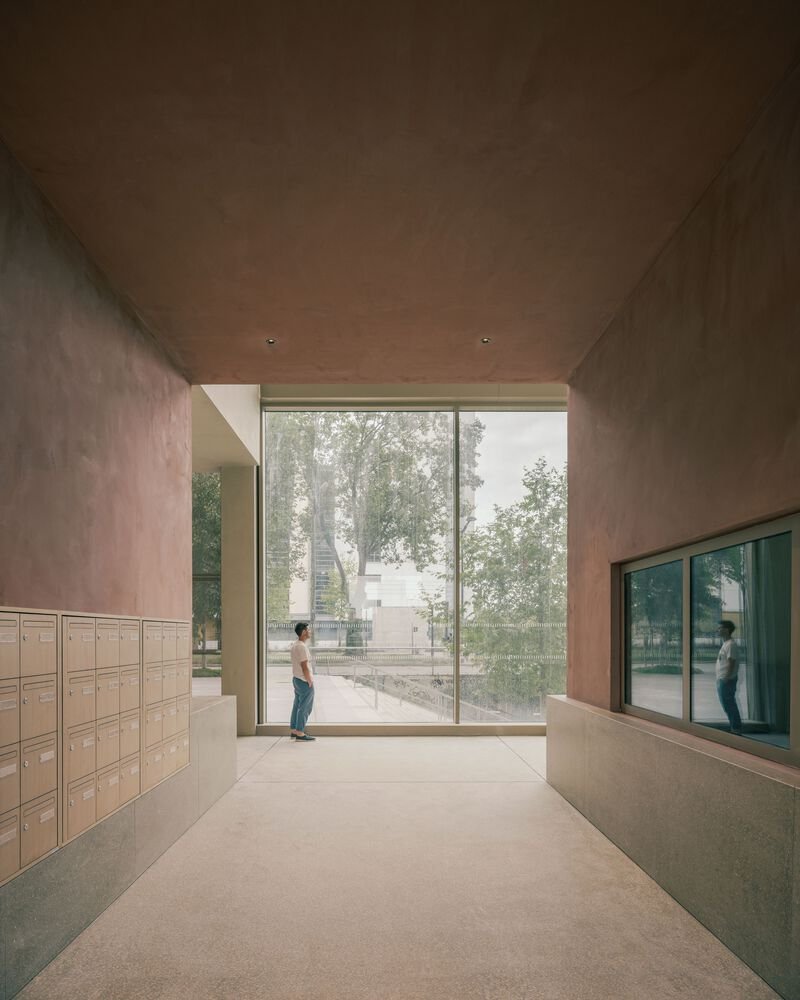
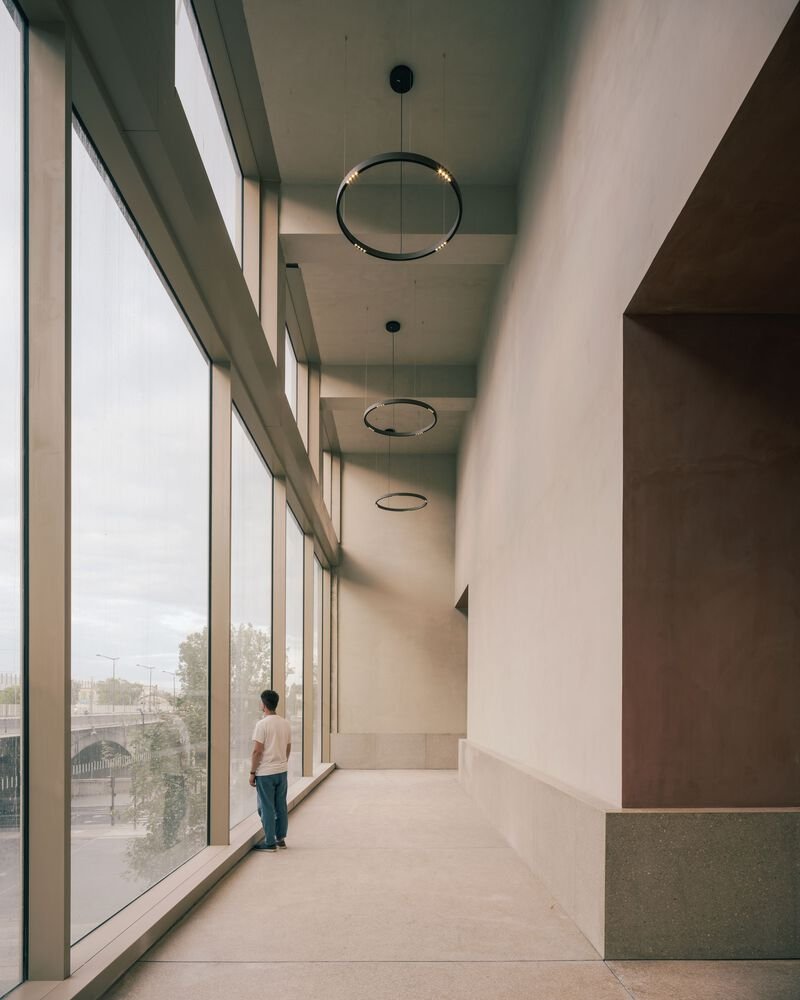
The entry lobby sets the tone immediately: terrazzo flooring, a wall of timber mailboxes, and a glazed corner that opens the ground floor to the trees outside. It is modest and precise, avoiding the over-designed lobbies that often plague high-end residential towers. Circulation corridors above are lined with full-height glazing, turning what could be anonymous hallways into spaces with genuine outlook. Circular pendant lights provide a domestic scale.
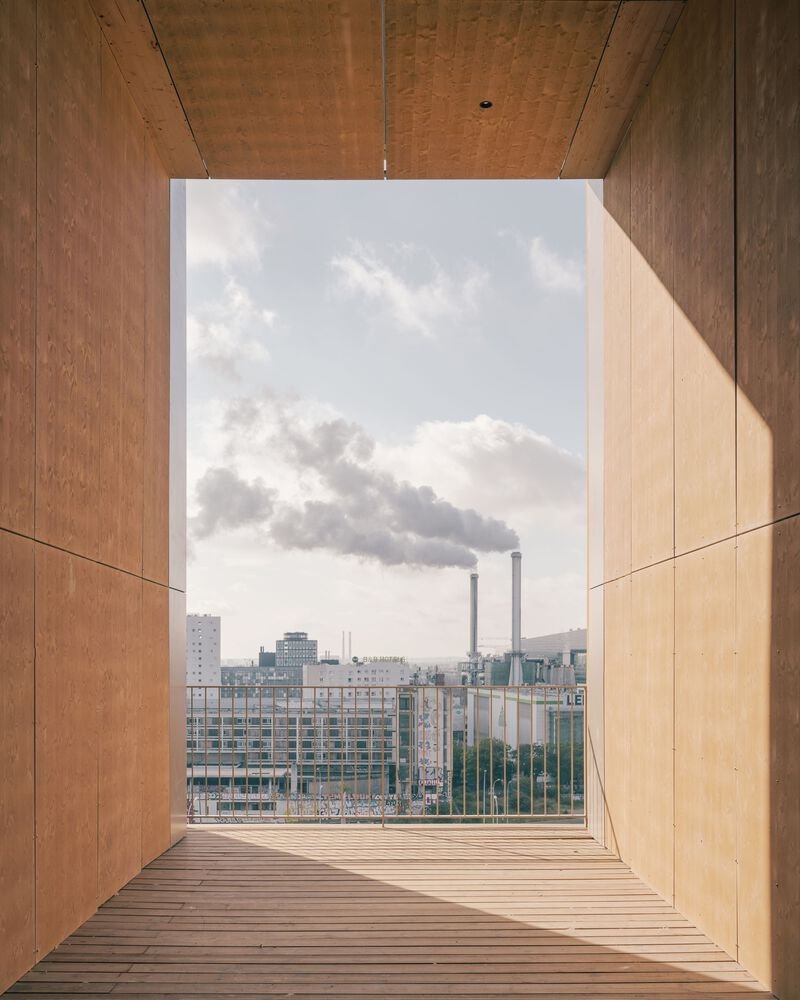
From the timber-framed balconies, the industrial hinterland is not hidden but framed. One window opening looks directly at the smoking chimney stacks of the Syctom plant in Ivry, an honest acknowledgment that this building exists on a frontier. The view is not curated for marketing; it is simply what is there. That lack of pretense is consistent with LAN's broader approach: showing the structure, showing the context, trusting that transparency is a stronger design strategy than concealment.
Hybrid Structure, Low-Carbon Ambition
The structural system is a hybrid of timber and concrete, each material deployed where it performs best. A concrete base handles the ground and first floors, absorbing the site's grade change and providing the necessary robustness for commercial program. Above, glulam posts and beams carry the primary loads, while a concrete central core and wall elements handle lateral bracing. Mixed wood and concrete floor plates complete the system. The result holds a BBCA low-carbon label, and the use of prefabrication kept construction timelines and energy consumption in check.
Split levels reinforce a double scale: from outside, the tower reads as an eight-story building with clearly legible slab lines, even though it contains 16 floors internally. This trick compresses the tower's apparent mass and makes it a more comfortable neighbor on the boulevard. Rigorous acoustic engineering by Jean-Paul Lamoureux addressed the considerable noise from the nearby ring road, a practical challenge that timber construction handles differently than concrete and one that required specific attention at this site.
Plans and Drawings
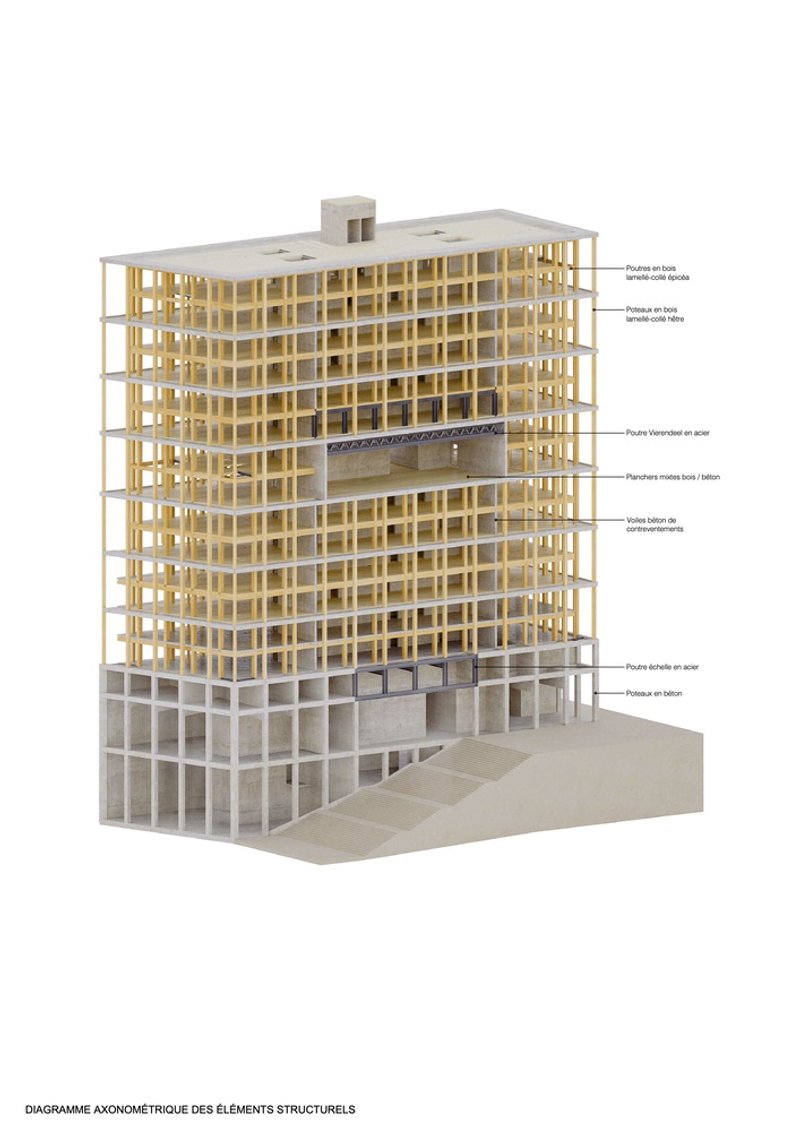
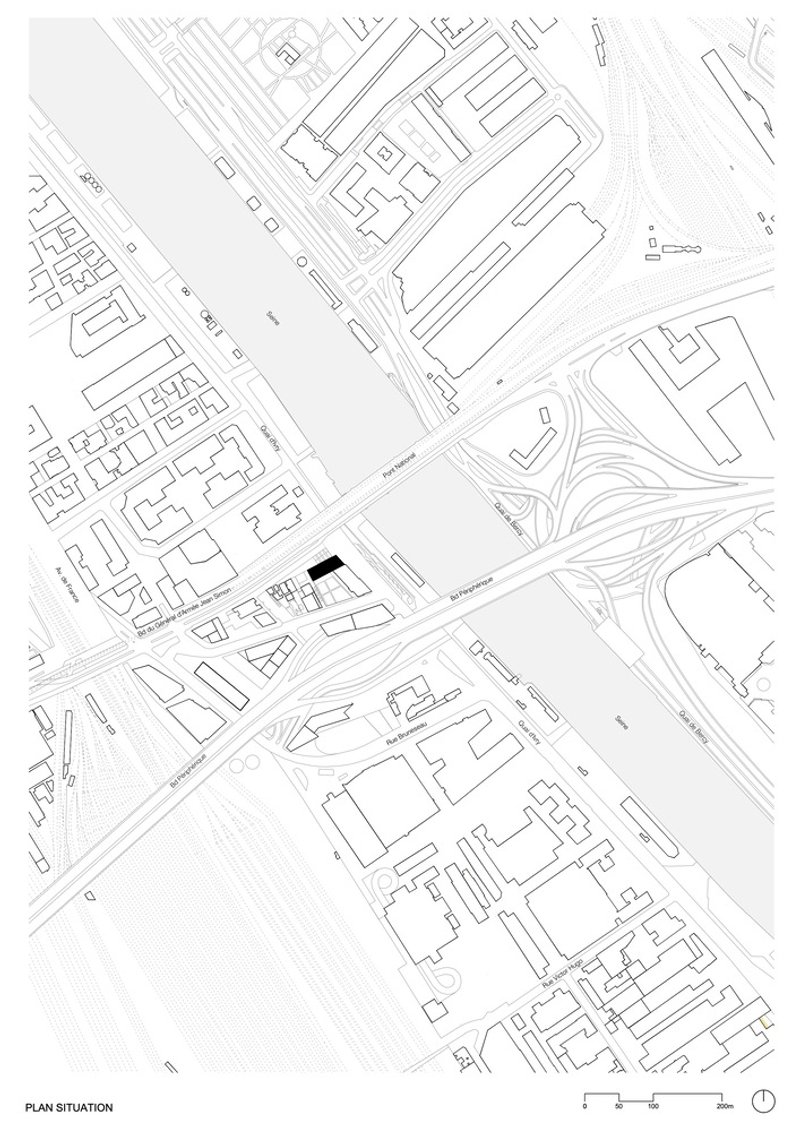
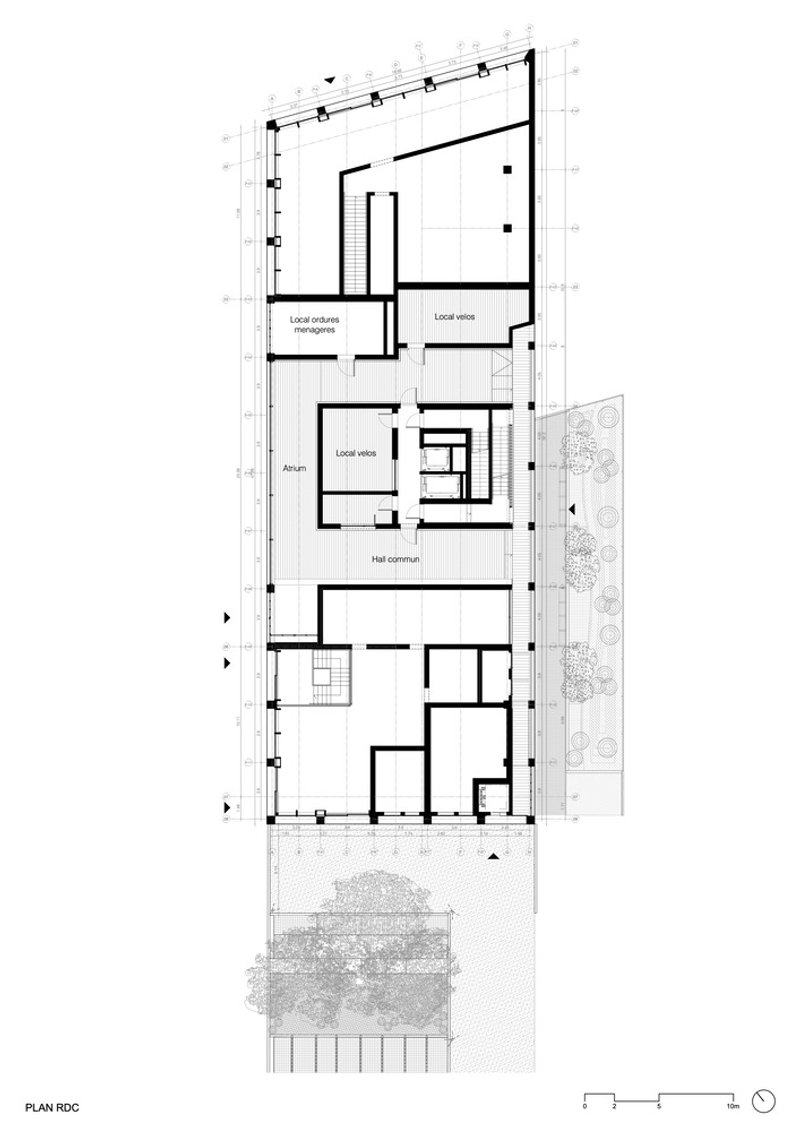
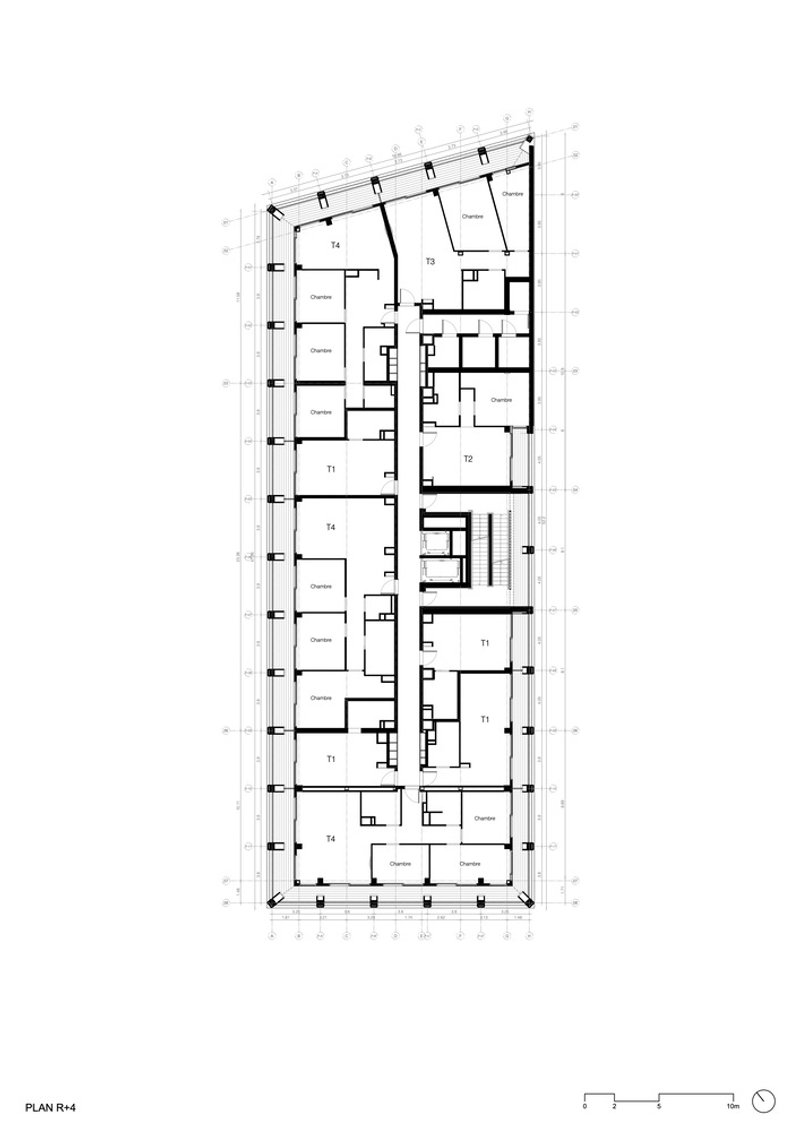
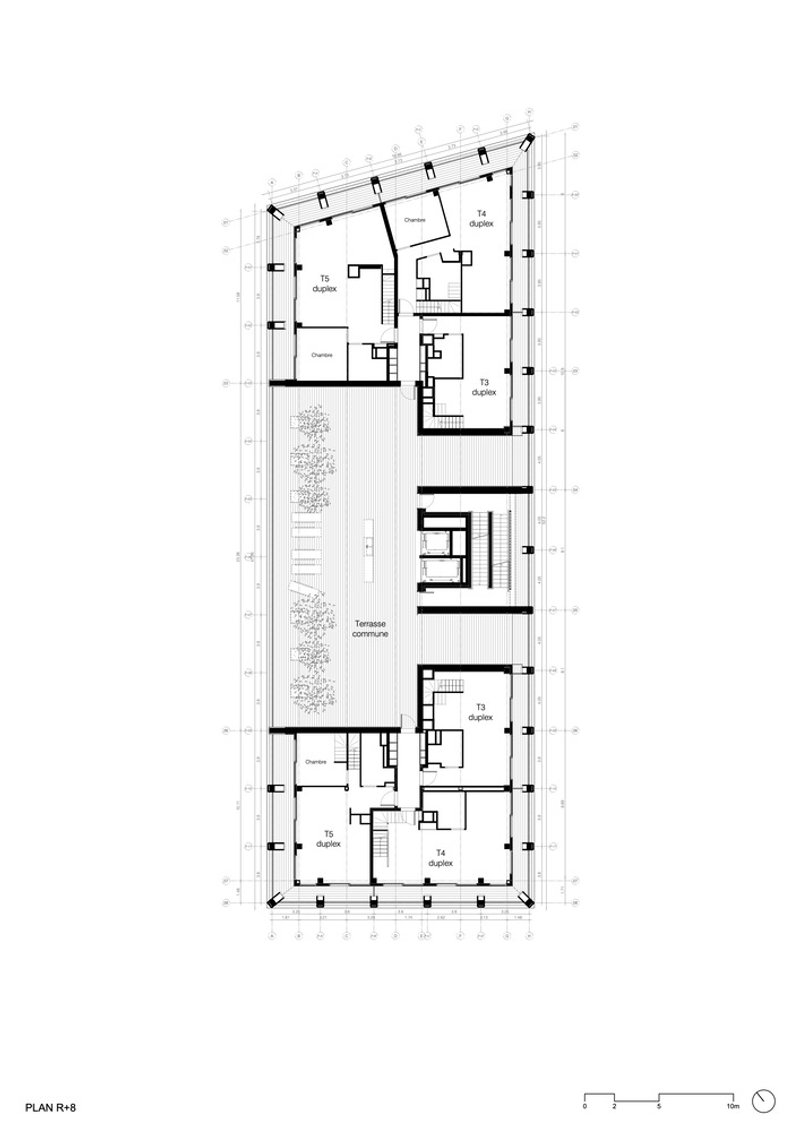
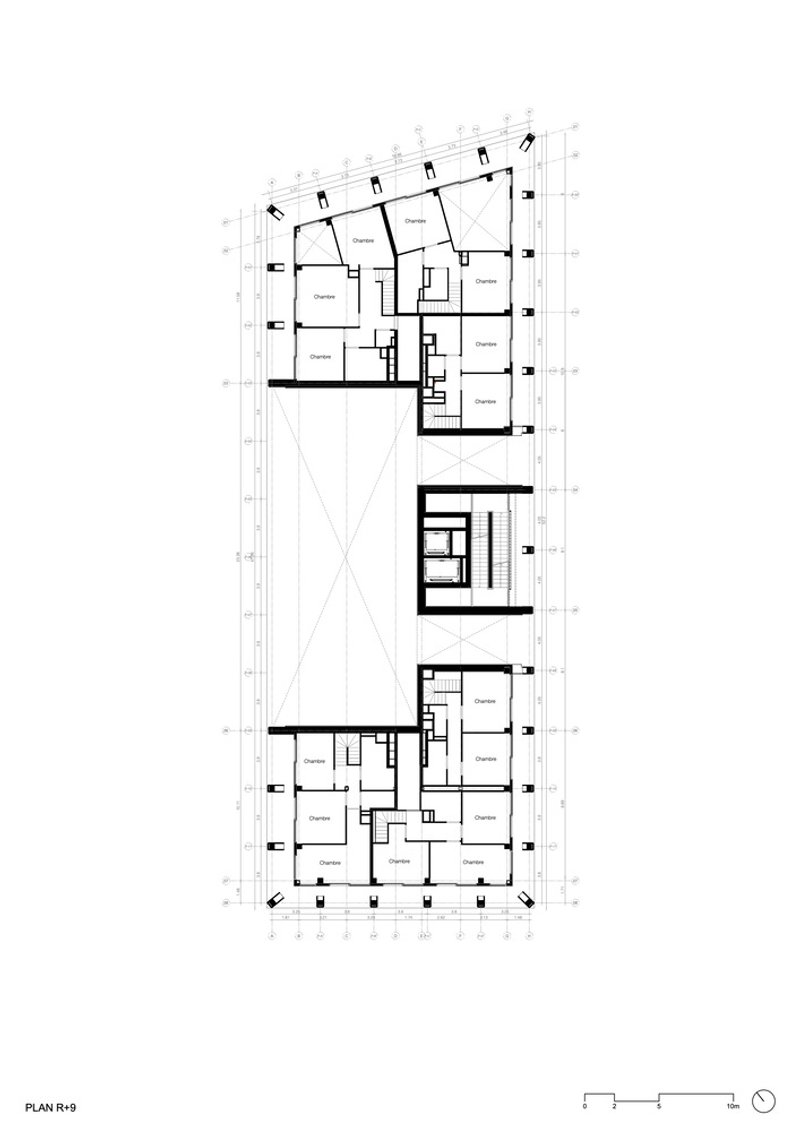
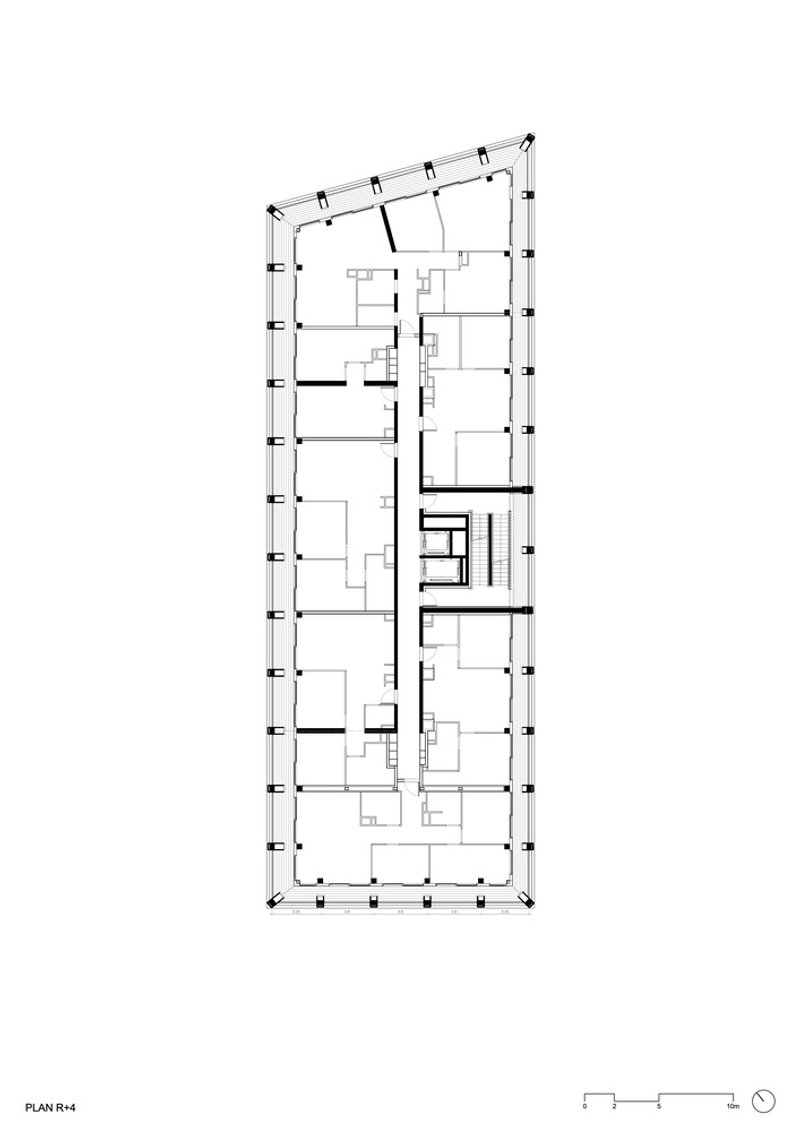
The axonometric model reveals the structural hierarchy with clarity: the concrete base, the timber superstructure rising in its regular grid, and the rooftop element capping the composition. The site plan shows how tightly the building is woven into the surrounding urban block, pinched between railway infrastructure to the south and the boulevard to the north. Floor plans at various levels illustrate the alternation of unit types: larger apartments give way to pairs of smaller units on the floor above, with diagonal bracing elements visible at the upper floors and the communal terrace registered as a central void on the eighth level. The narrow, angled footprint is not arbitrary but responds to the geometry of the plot and the need to maintain views through to the river.
Why This Project Matters
Wood Up Tower matters because it refuses to treat timber construction as a novelty or a footnote. At 50 meters, it operates at a scale where material choices have real consequences for carbon, for construction logistics, for acoustics, for fire safety. LAN Architecture addressed every one of these constraints without hiding the result. The glass encasement of the structure is the key decision: it transforms what could have been a standard mixed-use tower with a green credential into a building that visibly argues for a different way of constructing cities. Every resident, every passerby on the Seine, can see the wood holding the building up.
The project also succeeds as housing. The diversity of unit types, the quality of the shared terrace, the private outdoor spaces at every level, and the honest relationship with the surrounding industrial landscape all point to a design team that understood the brief as more than structural ambition. Wood Up is proof that low-carbon construction, residential density, and spatial generosity are not competing goals. They are, when the architecture is this precise, the same goal.
Wood Up Tower by LAN Architecture. Located in Paris, France (13th arrondissement, Massena-Bruneseau sector). 8,900 m². Completed 2024. Photographs by Daisy Reillet, Charly Broyez, and Nicolas Grosmond.
About the Studio
Share Your Own Work on uni.xyz
If projects like this are the kind of work you want to make, uni.xyz is a place to publish your own, find collaborators, and enter design competitions.



Popular Articles
Popular articles from the community

Foster + Partners Wraps a 200-Meter Shanghai Tower in Stainless Steel and Industrial Memory
The Suhe Centre Office Tower anchors a regenerated waterfront district in Shanghai with an all-steel structure that nods to local warehouse heritage.
VEIVE Architects Builds a Mountain Hostel That Disappears into a Hangzhou Hillside
On the Huihang Ancient Trail in Xiangjian Village, a shelter of wood, steel, and rammed earth roots itself in the rural landscape.
Constanti Architects Builds a Fortress of Privacy in Nicosia with House 345
A concrete and timber residence in Cyprus reinterprets the traditional introverted courtyard house for a new urban landscape.
Johnston Architects Reimagines the Methow Valley Hay Barn as a Small-Town Library in Winthrop
A 7,300-square-foot timber library channels the region's agrarian vernacular to serve a rural Washington community of 400 year-round residents.

Similar Reads
You might also enjoy these articles

Olio Towers: A Mid-Rise for Performers That Fuses Housing, Rehearsal, and Stage
Located blocks from Houston's Theater District, this modular tower stacks living units around a central performance atrium.
Oasis: Modular Green Housing Carved into Dhaka's Urban Fabric
A shortlisted Plugin Housing entry reclaims unauthorized settlements in Dhaka with stepped concrete volumes, green roofs, and ventilation-driven design.

Black Hole: A Floating Megastructure for the Post-Physical Era
Emiliano Mazzarotto envisions a spherical, self-scaling arena where e-sports, digital hotels, and holographic stadiums replace traditional public space.
Compact & Sustainable Living in Piraeus: A Four-Level Family Home Built Around Light and Air
A narrow townhouse in one of Greece's densest port cities uses a central atrium and passive strategies to house three generations under one roof.
Explore Architecture Competitions
Discover active competitions in this discipline




The International Standard for Design Portfolios


The Global Benchmark for Architecture Dissertation Awards


The Global Benchmark for Graduation Excellence


Challenge to reimagine the Iron Throne
Comments (0)
Please login or sign up to add comments
No comments yet. Be the first to comment!