
HÜTTE
Competition

Take your time; look at the scenic lake Vågåvatnet and the delicate mountain peaks of the Jotunheimen Nasjonalpark, which transform this piece of land into an exhibition of nature.
For some, this is just an outlook, but for others, this might be a sanctuary.
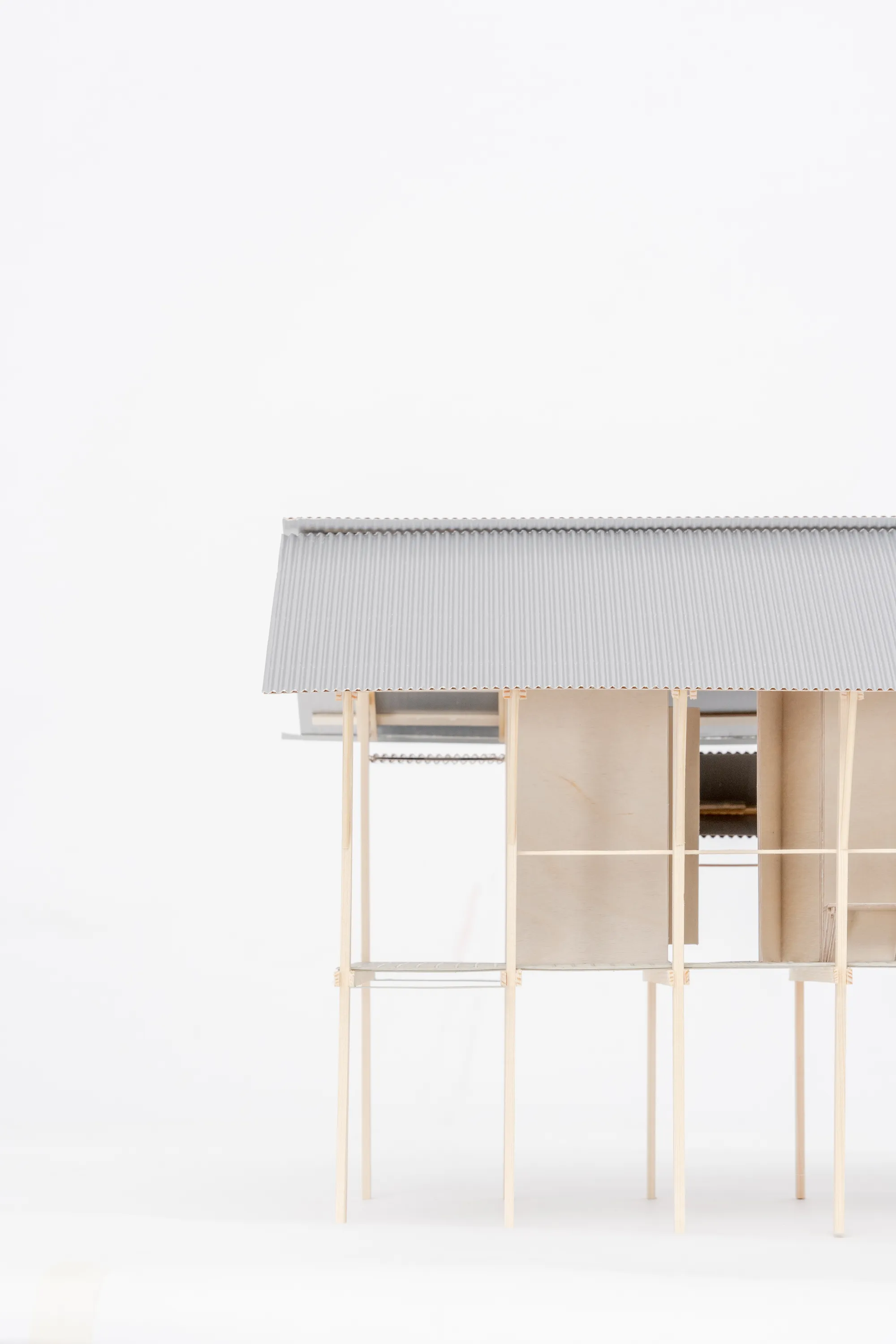
By Studying the local and historical architecture, we have taken inspiration from the traditional style of the „hytte“. The focus of the presented concept lies within its simple structure and minimal usage of long-lasting and self-sufficient local materials such as wood, wool, and steel.
With the aim to generate a minimal impact on the surroundings and a minimal footprint, the structure is risen up onto buttresses, to counter the undulating land of Norway.
To catch the landscape, this project takes the concept of a minimal trekking cabin, reducing the size of inner space, and extending a covered and leveled outer area. Resulting in the opportunity to fully experience the exceptional scenery. Furthermore, the building is pointed towards the view in the south to create a path for an outlook as well as a more subtle fit-in.
Whether it is raining, snowing, or stormy, folding walls are the core element to protect the weather side from the east. Their adaptability ensures that they can be optimally changed to weather conditions. Speaking of weather conditions leads to the pitched roof which counters heavy snow and uses its slope to collect water and fit in by adapting the roof structure of the buildings around.
The „Hütte“ is zoned into three areas. Starting with the entrance, located to the north which is followed up by the sanitary and the cabins on the east. The corridor, which leads to the fire pit is the last area; the communal zone.
The sleeping cabins can be considered to be minimal. They offer space for the essentials of sleeping and storage of your belongings. A window gives light, as well as ventilation. The anteroom is a more ventilated area by a half-closed construction. Therefore, it becomes the best place to dry your clothes after a long hike. For hygiene, a sink is implemented as well as a pit toilet. As a result of our aim to generate a minimal impact on the surroundings with the project, water is collected by the roof and fed into a water container.
As you walk onto the building, you are led by a corridor to the south. On the right, the view opens up. You can sit down on a bench on the left or walk straight on. After the cabins, the view opens up to both sides. A lowered part gives the opportunity to sit down next to a fireplace. This is the common area. After a long day of hiking, you can sit together and enjoy the night sky while being warmed up by a crackling fire.
A grid is used in the open spaces as the floor structure. This is not only efficient by weight but in addition, has the advantage of low maintenance over the years. Whereas hikers can be pleased that dirt from hiking boots will fall right through.
Screw-foundations create the base on which the Twenty-six buttresses are constructed. They take less impact on the ground and are a more ecological foundation than e. g. a concrete footing. Support bars hold the cabins as well as the grate with a pincer construction. The same system is used to hold the substructure of the corrugated metal roof. Stiffening braces furthermore support the roof in case of heavy snow or strong winds. The construction of our cabins is made out of a timber frame construction with sheep wool as insulation, a common material used by the local and historical architecture. On the outside, treated wood finishes the cabins and creates a reference to the local housings. The omission of cover-up for the construction saves weight and leads to easy maintenance as well as creating an unadulterated and fine character of the „Hütte“.
The simple and quiet construction aims to give peace to each visitor. Reduction leads to the focus on the surrounding nature. Whether you are a hiker, adventurer, or a local; the „Hütte“ is a place to rest, maintain or refresh. Take your time and enjoy the scene, the landscape, and the wildlife.




Popular Articles
Popular articles from the community

AL-JANNAH: Sustainable Architecture and Permaculture for Afghan Widows
AL-JANNAH uses sustainable architecture and permaculture to create resilient oasis of housing, learning, work and renewal for Afghan widows.

Co-life: Sustainable Architecture for Age-Friendly Community Living
Co-life reimagines sustainable architecture for seniors through courtyards, rammed earth, shared gardens, and spaces designed for belonging.

The Musturak Paradise: Senior Living Architecture for a Connected Future in Temara, Morocco
The Musturak Paradise reimagines senior living architecture in Temara via private homes, social spaces, culture, community, and shared care.

The Earth Pod: 3D Printed Homes for Resilient Refugee Communities
The Earth Pod reimagines refugee housing through 3D printed homes made from clay, combining resilience, self-sufficiency, and rapid shelter.

Similar Reads
You might also enjoy these articles

Day and Night Park: A Time-Based Urban Newsstand in Beijing
A temporary urban newsstand in Beijing blending travel, light, and reading through poetic colors, compact form, and community-focused design.

Modernist Patio Renovation in El Masnou, Barcelona by Oliver Segura Arquitectura + Cebrià Arquitectura
Modernist patio renovation blending tradition and innovation with a movable pool, leveled floors, and Catalan materials in El Masnou.

Alto Residencial Coop: Cooperative Housing Development in Santiago de Compostela by Carbajo Barrios Arquitectos
A linear cooperative housing complex blending white volumes and perforated metal façades, enhancing community living, natural light, privacy, and urban integration.
Vil Genis School by BPA ARCHITECTURE – Massy, France
Vil Genis School in Massy, France, features sustainable design, south-facing classrooms, community integration, accessible spaces, and modern educational architecture.

Explore İshak Şimşek Arhitecture Competitions
Discover active competitions in this discipline




Challenge to reimagine the Iron Throne


Photograph architecture without architects


Illustrate the lost glory of Angkor Wat - Render Challenge


Design challenge to reuse E-waste
Comments (0)
Please login or sign up to add comments
No comments yet. Be the first to comment!