
Atelier RZLBD Rotates Two Brick Volumes Ten Degrees Apart to Rethink the Toronto House
A pair of interlocking gabled forms, offset by a precise angular move, carve out skylights, courtyards, and new spatial rituals on a tree-lined Toronto lot


The name says it all, almost literally. Atelier RZLBD's 10° of Separation House in Toronto takes two gabled volumes and rotates them ten degrees relative to each other, generating a catalogue of spatial consequences that would not exist in a conventional plan. The gap between the volumes becomes courtyard. The overlap becomes double-height living space. The misalignment becomes skylight. Every secondary move in the house, from circular roof openings to angled stairwells, descends from that single geometric decision.
What makes the project worth studying is not the gesture itself but the discipline with which it is executed. The ten-degree offset is not decorative. It organizes circulation, determines where natural light enters, and dictates the relationship between interior rooms and the mature trees that surround the lot. In a city where residential infill is often reduced to maximizing square footage behind a polite street facade, this house argues that the plan is still architecture's most powerful tool.
Two Faces to the Street
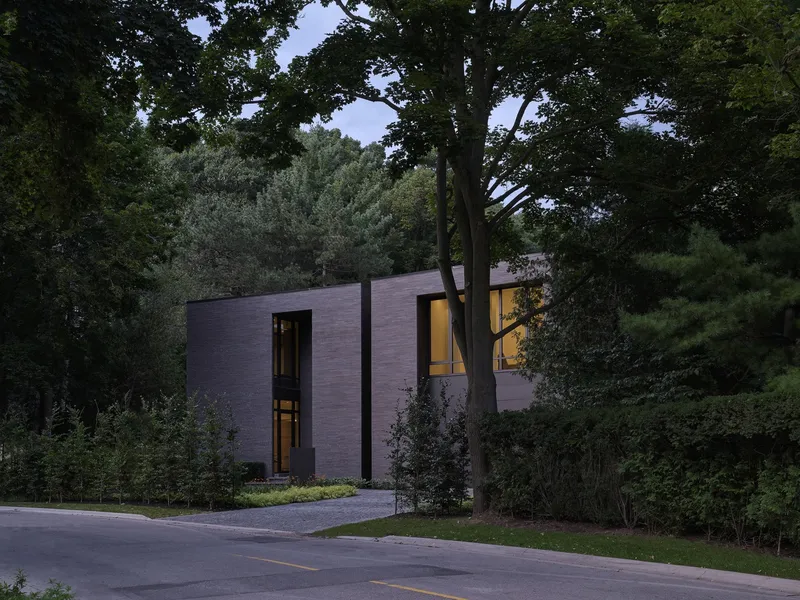
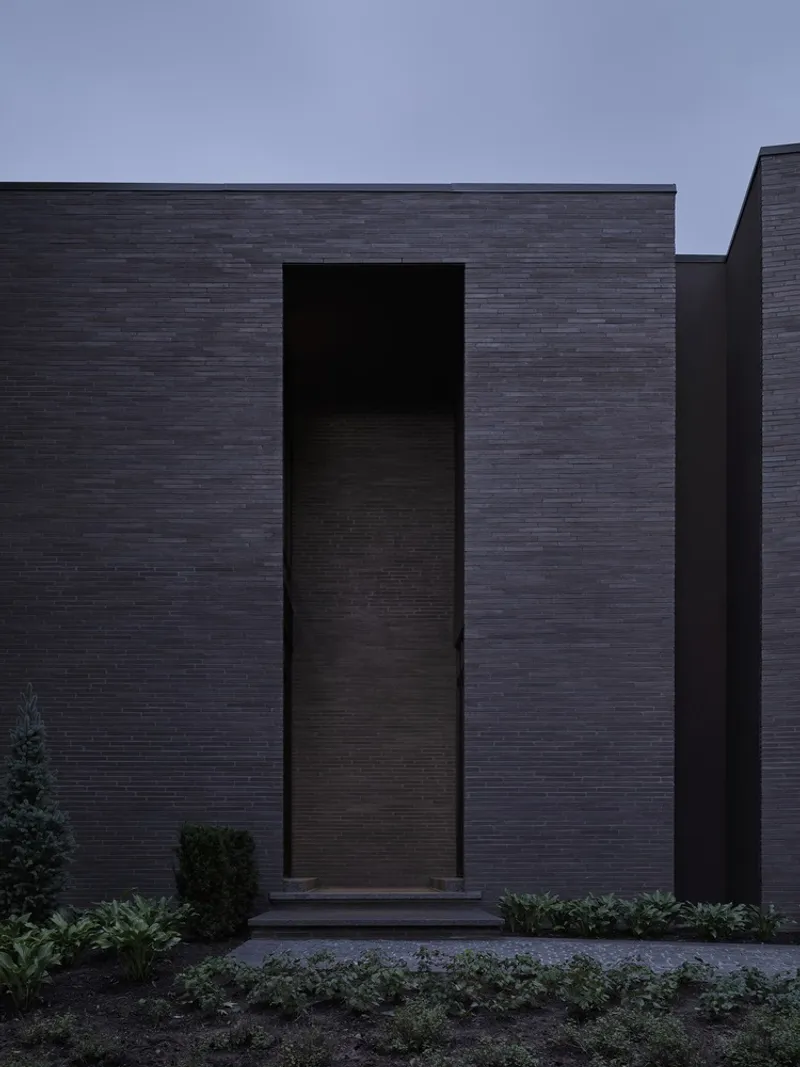
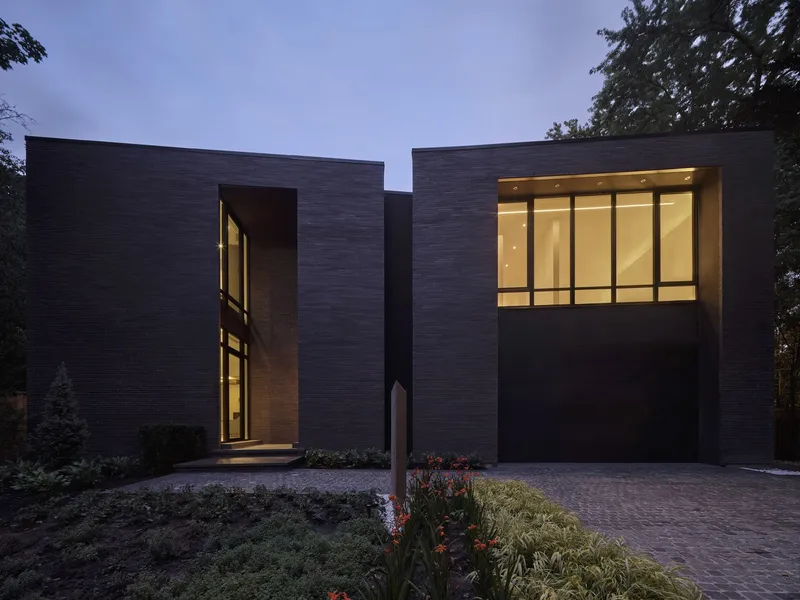
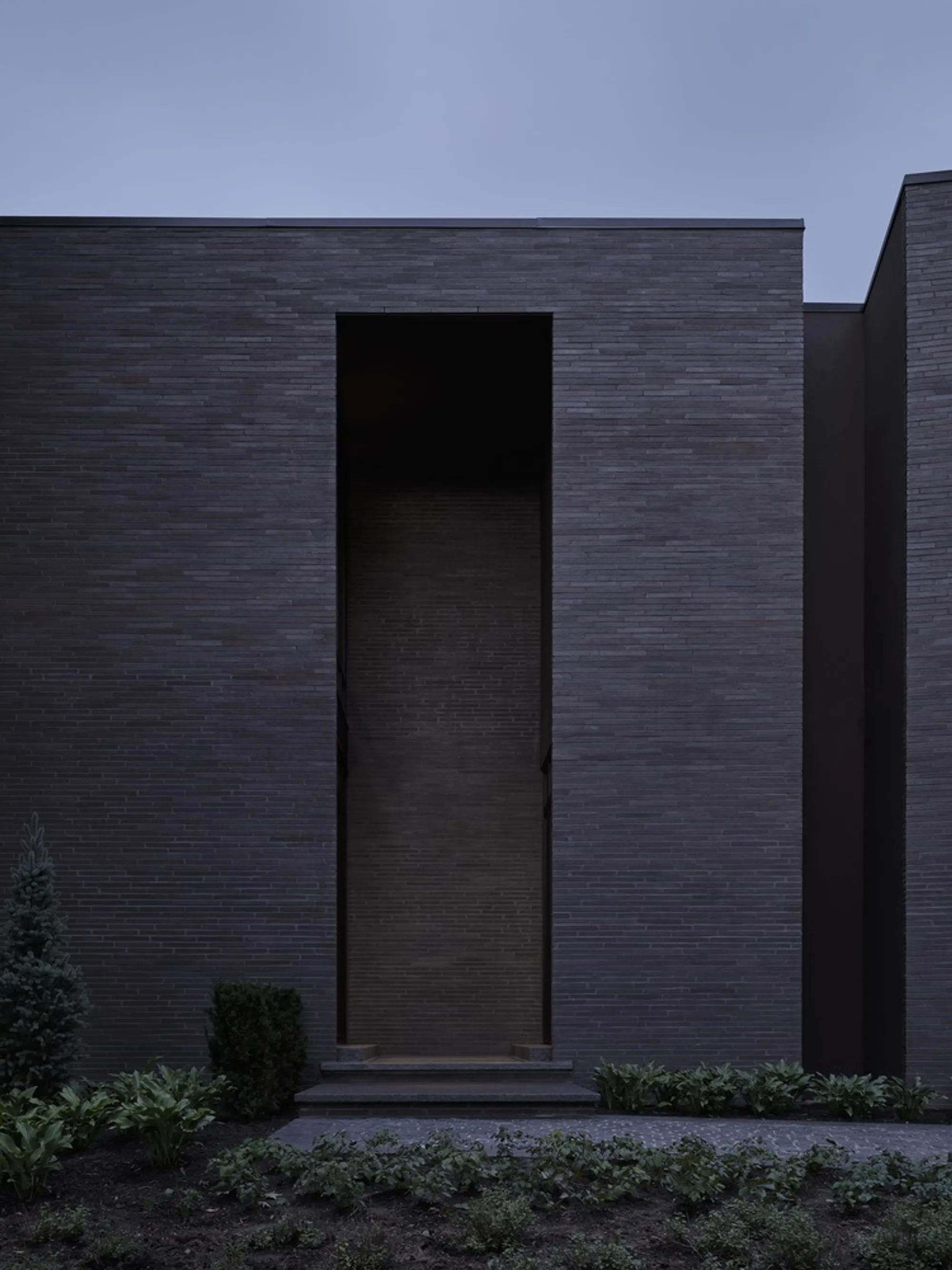
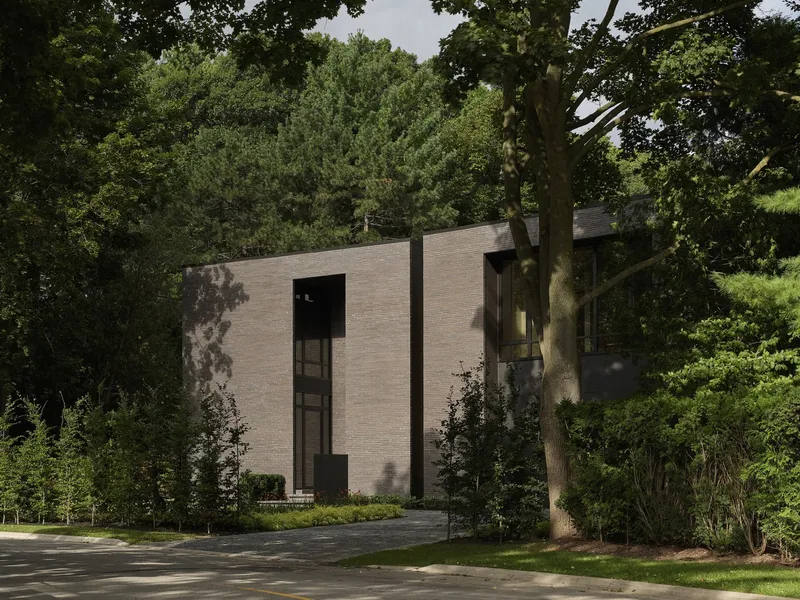
From the street, the house reads as a single dark brick mass set among mature trees, its scale calibrated to the surrounding residential fabric. The recessed timber entrance door is almost invisible against the charcoal brickwork, pulling visitors into a compressed threshold before the interior opens up. At dusk the effect reverses: the interior rooms glow behind glazed openings, revealing the depth of the house while the brick planes recede into shadow.
The material choice is restrained but deliberate. Dark brick dominates the street-facing volume while a lighter, paler brick wraps the garden-facing form. The shift in tone signals the rotation between the two masses without resorting to a visible seam. It is a quiet way of making a geometric argument legible at the urban scale.
Garden Volumes and the Pale Counterpart
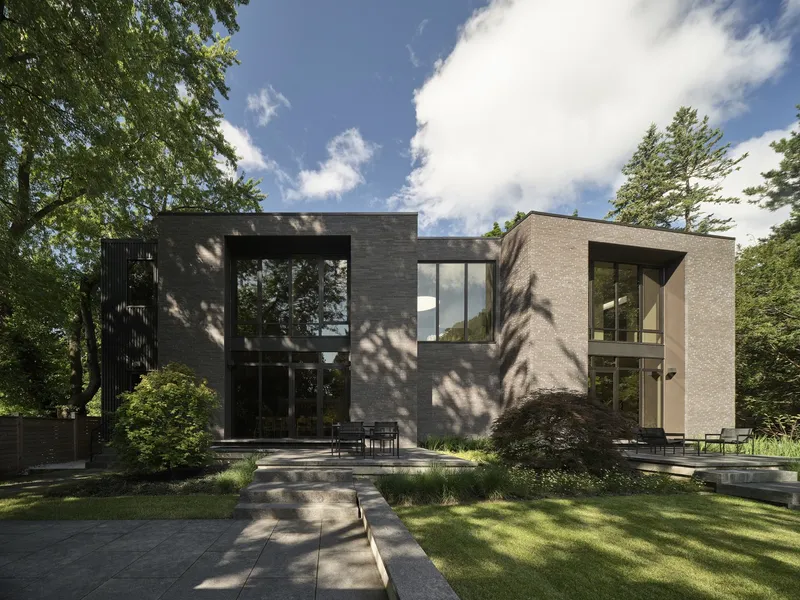
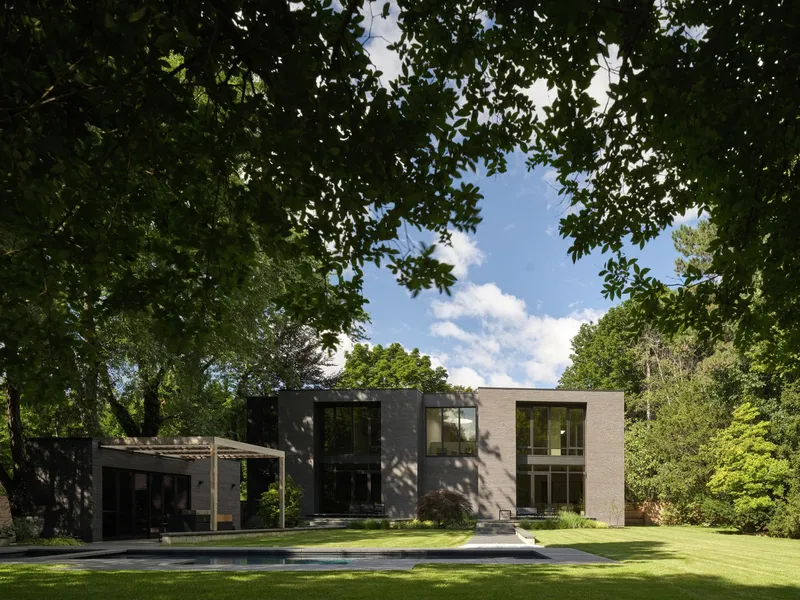
The rear of the house tells a different story. Where the street elevation is introverted and monochromatic, the garden elevation celebrates contrast. The pale brick volume steps forward and opens tall vertical window bays between existing trees, establishing a direct relationship between interior living spaces and the planted lawn. Dark metal elements frame upper-level openings, registering the presence of the second, rotated volume behind.
The architects clearly worked around the site's trees rather than against them. Window bays are positioned to slot between trunks, and the building footprint bends to preserve root zones. The result is a house that looks like it was threaded through a canopy rather than dropped onto a cleared lot.
Skylights as Spatial Events
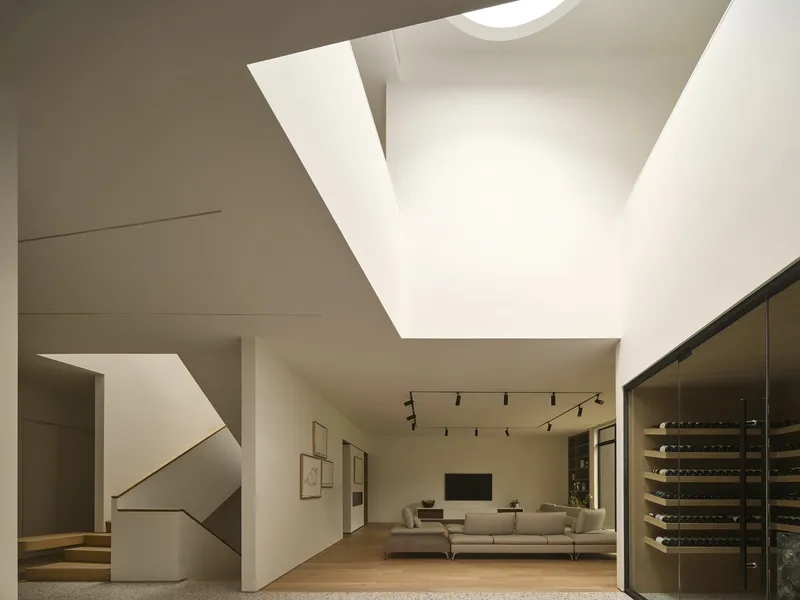
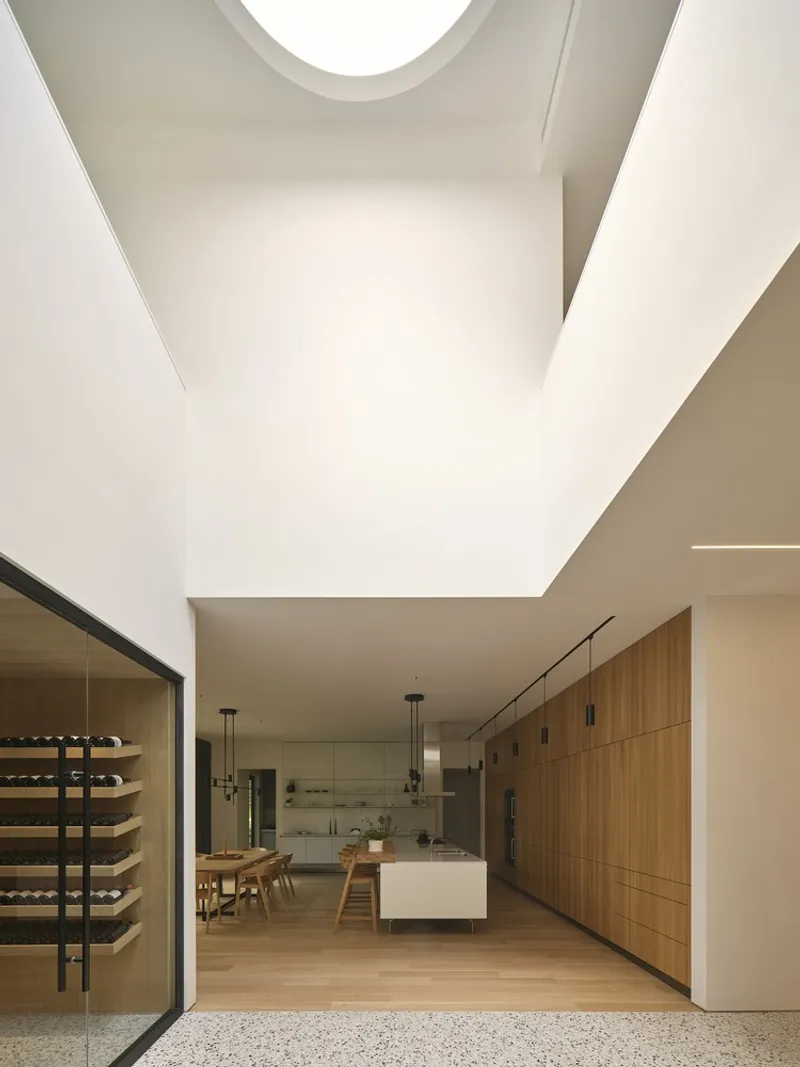
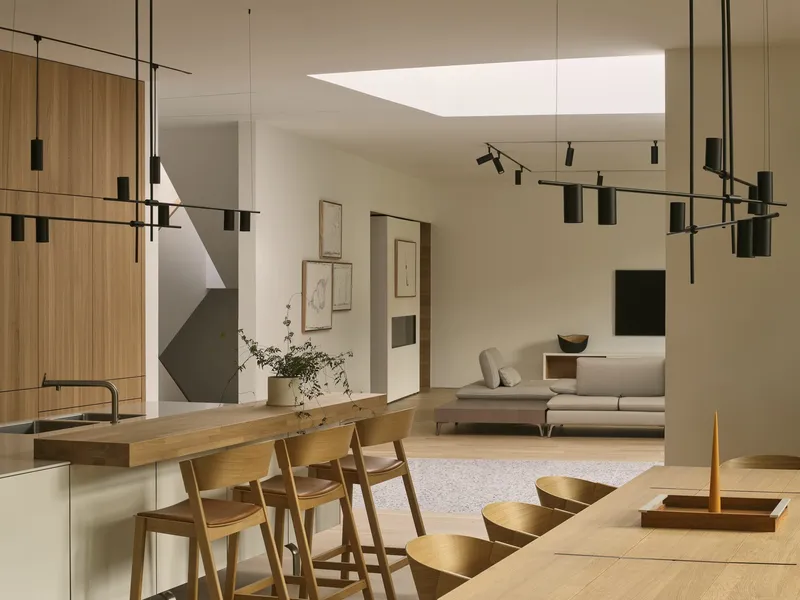
The ten-degree rotation creates gaps in the roof plane, and RZLBD converts every one of them into a skylight. In the living room, an angular slash overhead sends a blade of light across a floating geometric ceiling plane. In the double-height kitchen, a circular opening punches through the roof directly above the timber cabinetry, turning a utilitarian room into something closer to a chapel. Along the dining bar, a rectangular skylight runs the full length of the suspended track lighting, washing the terrazzo floor in diffused daylight.
None of these openings feel arbitrary. Each one traces the geometry of the offset volumes above, so the quality of light in a given room tells you something about where you sit within the larger composition. It is an unusually legible strategy: look up and you understand the plan.
Interior Sequences and Controlled Views
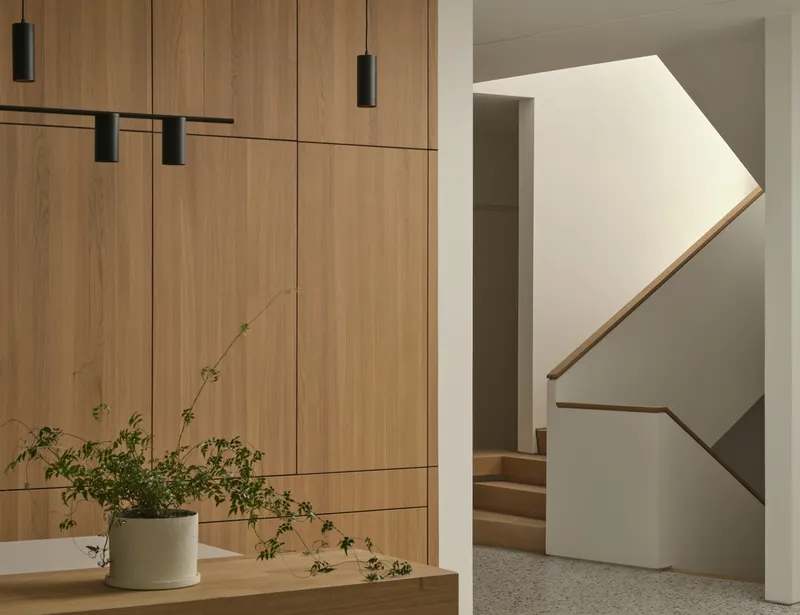
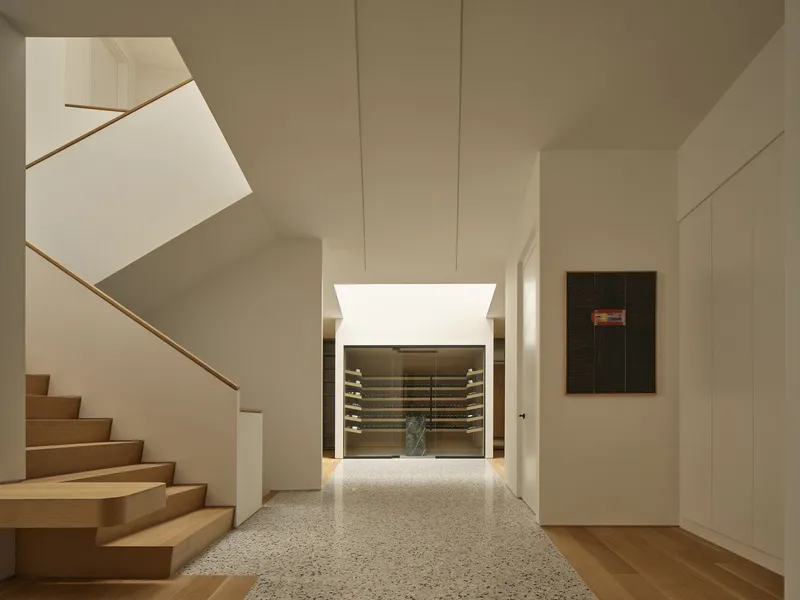
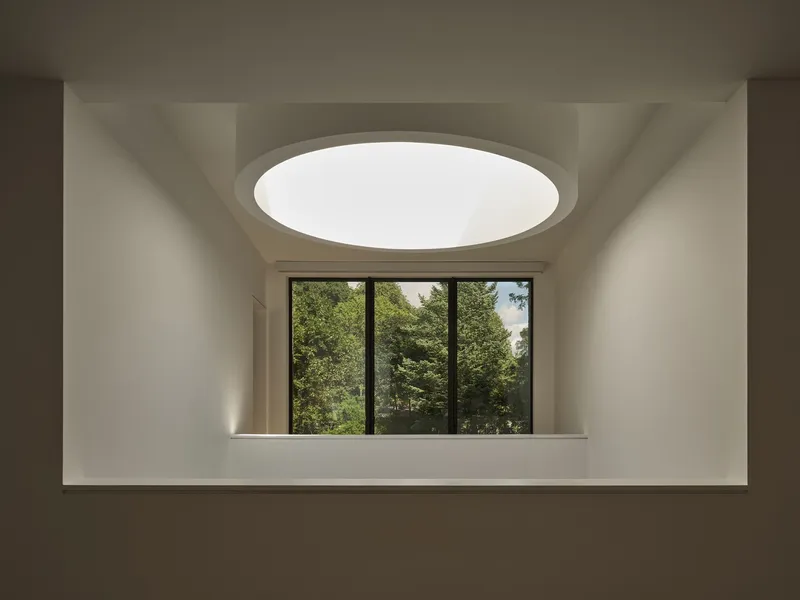
Circulation through the house is not neutral. The angled stairwell is glimpsed through a white portal framed by timber wall panels, compressing your field of vision before opening it again at the next landing. A terrazzo-floored hallway terminates in a backlit wine cellar, turning storage into a visual anchor. Elsewhere, a deep niche pairs a horizontal window framing the garden with a circular skylight overhead, creating a pocket of light that functions almost as a room in itself.
The strategy borrows from the sequential unfolding of traditional Japanese residential architecture, where every threshold reframes what you see. RZLBD uses the angular misalignment of the two volumes to generate these thresholds naturally: where the plans overlap, walls thicken and openings narrow, compressing space before releasing it.
Material Discipline in the Private Rooms
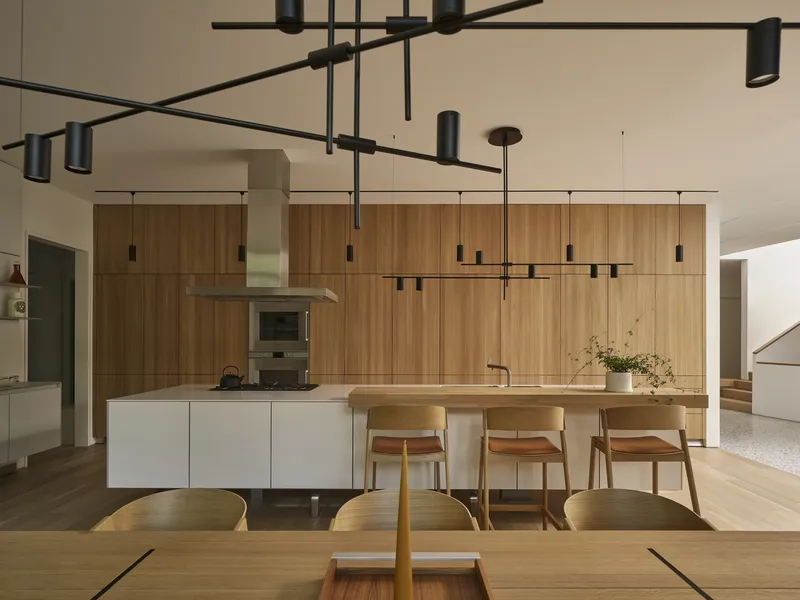
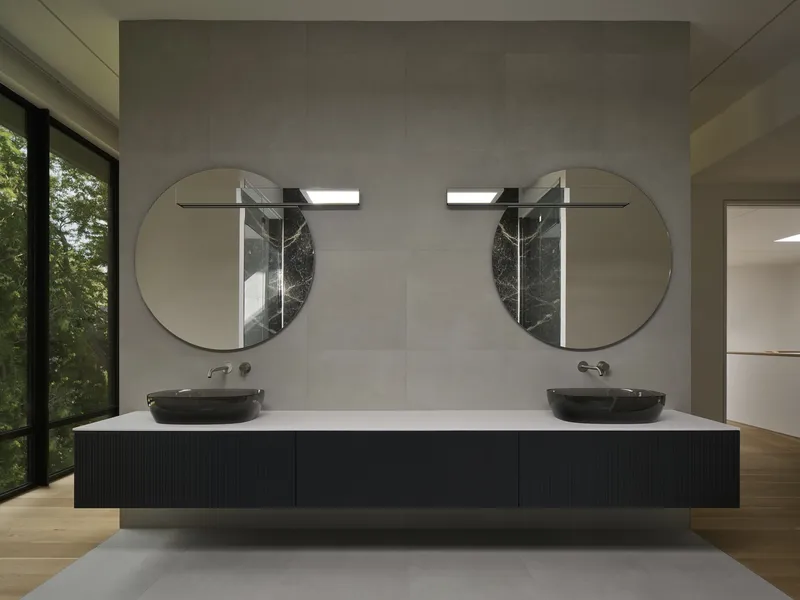
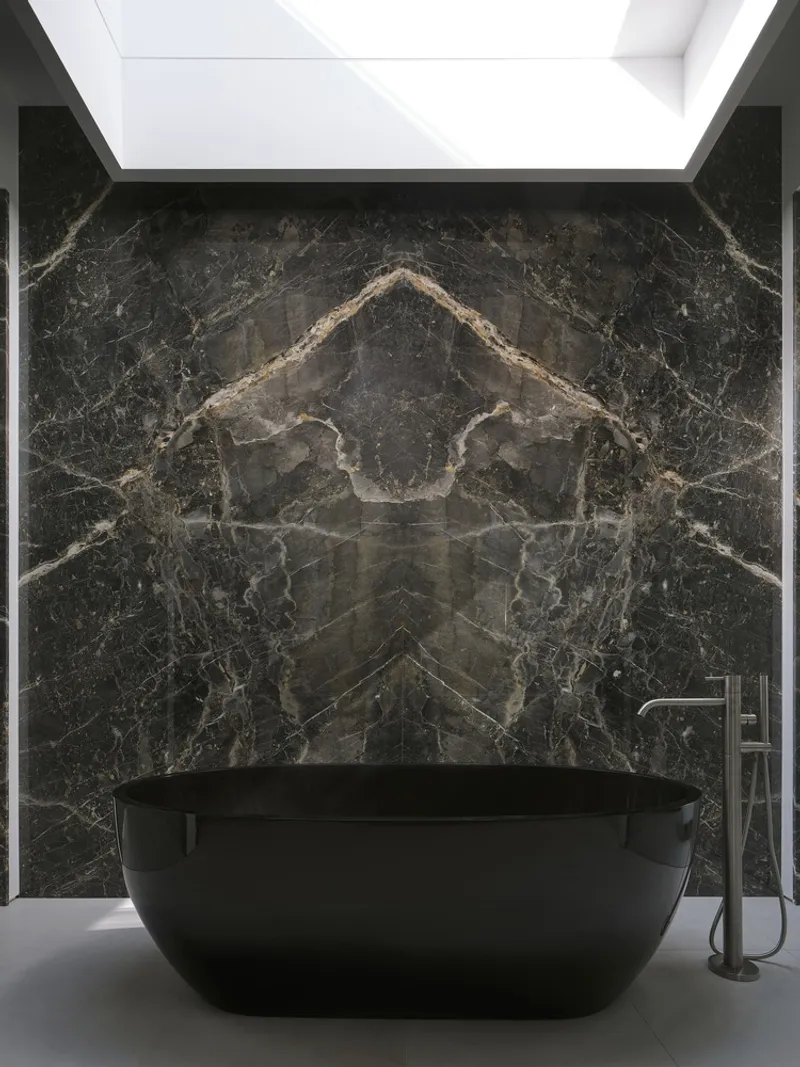
The kitchen anchors the house's material palette: warm timber cabinetry, a white island, terrazzo flooring, and black track lighting. These four materials recur through every room with minor variations, establishing a consistency that prevents the angular geometry from becoming chaotic. In the bathroom, the palette shifts toward stone. A floating vanity with twin black basins sits below paired circular mirrors, and bookmatched dark marble wraps the wall behind a freestanding black bathtub. A recessed skylight above the tub completes the composition, proving that even the most private spaces participate in the roofline logic.
The restraint is notable. Where many contemporary houses multiply finishes to signal luxury, RZLBD limits itself to a tight family of surfaces and lets the geometry do the heavy lifting. The result feels expensive without feeling ostentatious.
Study Models and Process
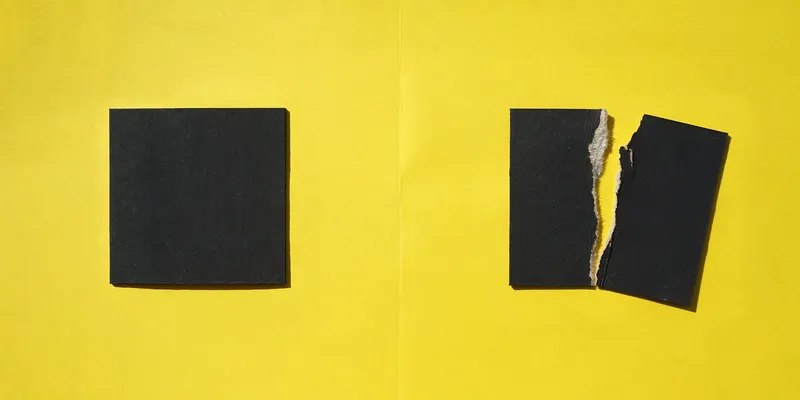
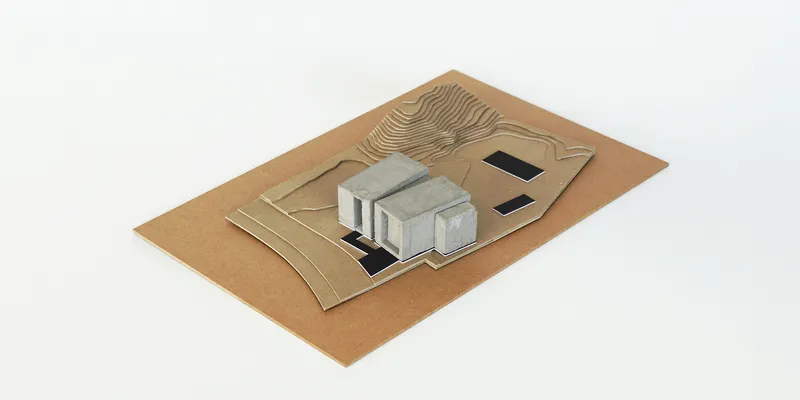
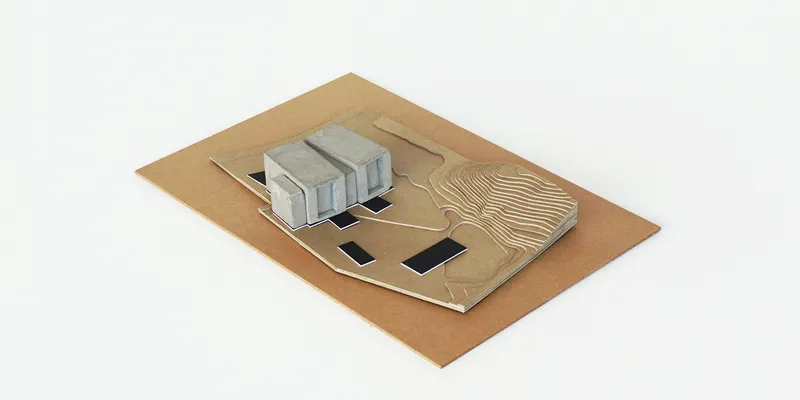
The physical models reveal the project's working method. Concrete-like volumes are set into carved topographic bases that register the slope of the lot, showing how the house negotiates grade changes. A separate study in torn yellow paper with black square openings suggests an early exploration of punched apertures and surface texture. These are not presentation models. They are thinking tools, and their rough materiality makes the intellectual process behind the ten-degree move tangible.
Plans and Drawings
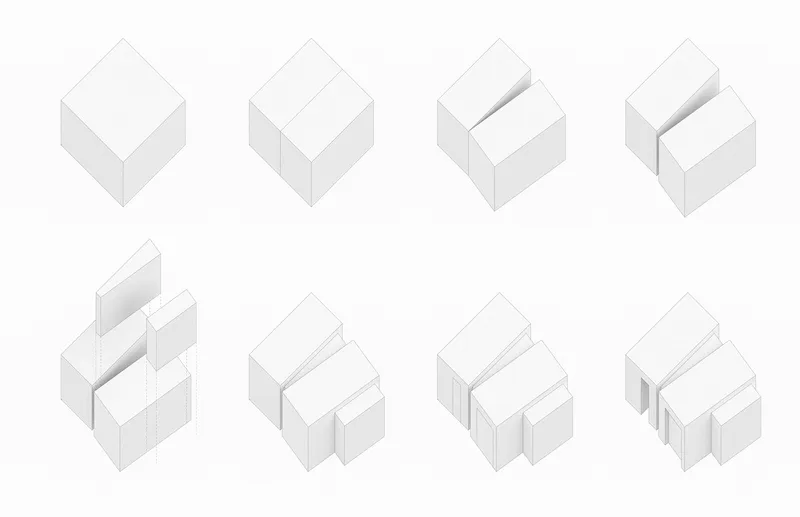
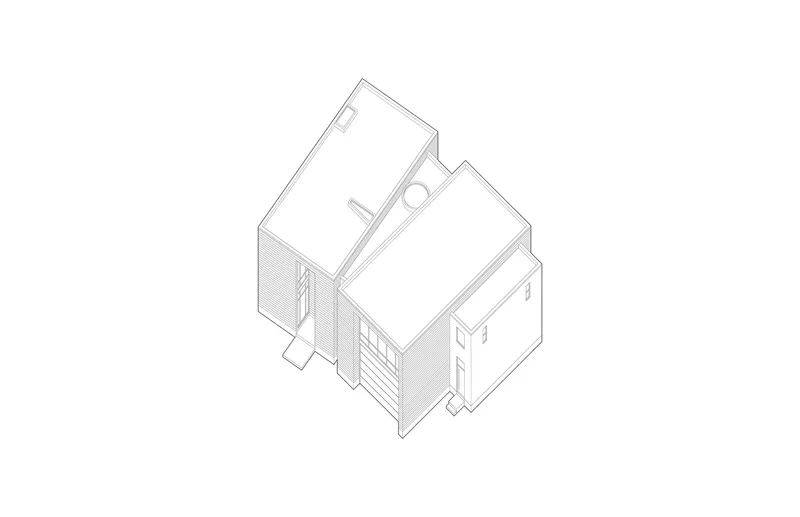
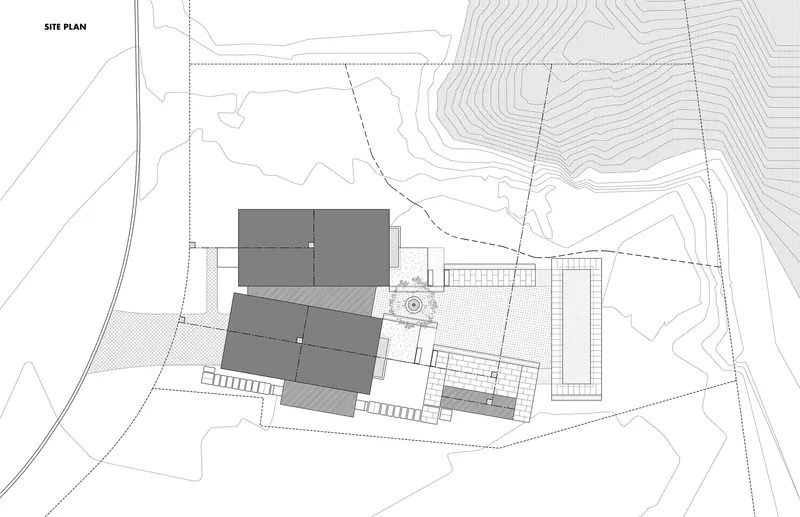
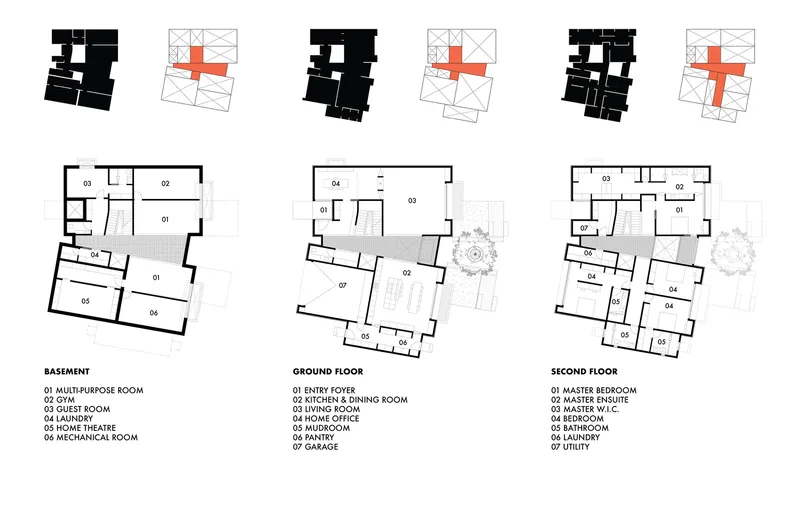
The axonometric diagram is the project's Rosetta Stone. Eight sequential steps illustrate how the two gabled volumes are generated, rotated, and interlocked to produce the final form. Read alongside the floor plans, basement through second floor, you can trace the ten-degree offset through every room: walls splay, corridors pinch, and skylights appear wherever the rooflines diverge. The site plan confirms that the rotation also orients one volume slightly toward the street and the other toward the garden, splitting the house's loyalties between public and private landscapes.
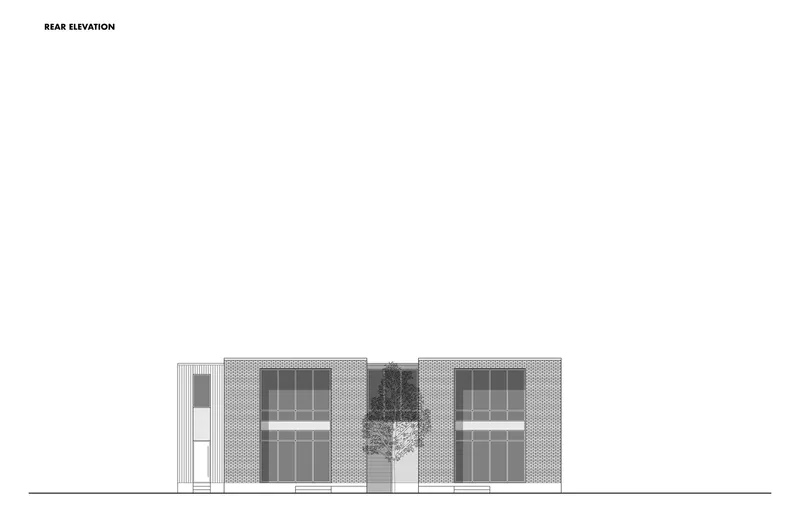
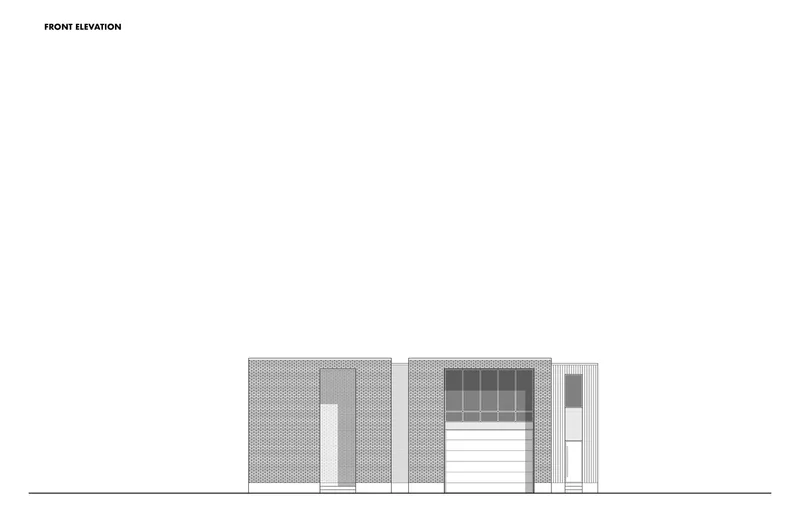
The elevations are instructive in a different way. The front facade, with its large window opening and recessed entry, appears almost symmetrical. The rear elevation, with its gridded windows and central vegetation element, reveals the duality. Taken together, they describe a house that presents a composed face to the neighborhood while reserving its spatial complexity for the people who live inside.
Why This Project Matters
The 10° of Separation House matters because it demonstrates that a single, clearly stated geometric operation can organize an entire residential project without becoming a gimmick. The ten-degree rotation is not a formal flourish applied to a conventional plan. It is the plan. Every skylight, threshold, and view corridor derives from it, and the house reads as a coherent whole because of that discipline. In an era when residential design often defaults to open-plan neutrality or stylistic pastiche, RZLBD's commitment to a generative idea is refreshing.
The house also offers a quiet lesson in site sensitivity. By working around existing trees, calibrating brick tones to distinguish street and garden, and using the rotational gap to bring light deep into the plan, the architects treat context not as a constraint but as a collaborator. Toronto's residential neighborhoods are full of generous lots and mature canopies. This project suggests that the best way to honor that inheritance is not to preserve it in amber but to design through it with precision.
10° of Separation House by Atelier RZLBD, Toronto, Canada. Photography by Riley Snelling.
About the Studio
Share Your Own Work on uni.xyz
If projects like this are the kind of work you want to make, uni.xyz is a place to publish your own, find collaborators, and enter design competitions.




Popular Articles
Popular articles from the community


The Musturak Paradise: Senior Living Architecture for a Connected Future in Temara, Morocco
The Musturak Paradise reimagines senior living architecture in Temara via private homes, social spaces, culture, community, and shared care.

Co-Life: Senior Housing Design That Reconnects Older Adults With the City
Co-Life reimagines senior housing design through healing gardens, shared streets, workshops, and a sustainable community across generations.

Conexión: Biophilic Design Reimagines High-Rise Living in Hong Kong
Conexión reimagines high-rise living in Hong Kong through biophilic design, green facades, shared spaces, daylight, water and nature within.

The Earth Pod: 3D Printed Homes for Resilient Refugee Communities
The Earth Pod reimagines refugee housing through 3D printed homes made from clay, combining resilience, self-sufficiency, and rapid shelter.


Similar Reads
You might also enjoy these articles


Hodi-Mandai Geram
Project Function: Preservation and revitalization of the Intangible heritage and socio-spatial identity of the Hodi by Housing, Cultural Memory Center, Sacred Grove, landscape, local tourism economy


Olio Towers: A Mid-Rise for Performers That Fuses Housing, Rehearsal, and Stage
Located blocks from Houston's Theater District, this modular tower stacks living units around a central performance atrium.

Oasis: Modular Green Housing Carved into Dhaka's Urban Fabric
A shortlisted Plugin Housing entry reclaims unauthorized settlements in Dhaka with stepped concrete volumes, green roofs, and ventilation-driven design.

Black Hole: A Floating Megastructure for the Post-Physical Era
Emiliano Mazzarotto envisions a spherical, self-scaling arena where e-sports, digital hotels, and holographic stadiums replace traditional public space.


Explore Architecture Competitions
Discover active competitions in this discipline



Challenge to reimagine the Iron Throne


Photograph architecture without architects


Illustrate the lost glory of Angkor Wat - Render Challenge


Design challenge to reuse E-waste
Comments (0)
Please login or sign up to add comments
No comments yet. Be the first to comment!