
Neil Cownie Architect Turns a Former Petrol Station into a Memory-Laden Home in Nedlands
On a busy corner in Nedlands, 123 House weaves references to an Ampol service station, Greek heritage, and 1930s apartment typology into one dwelling.


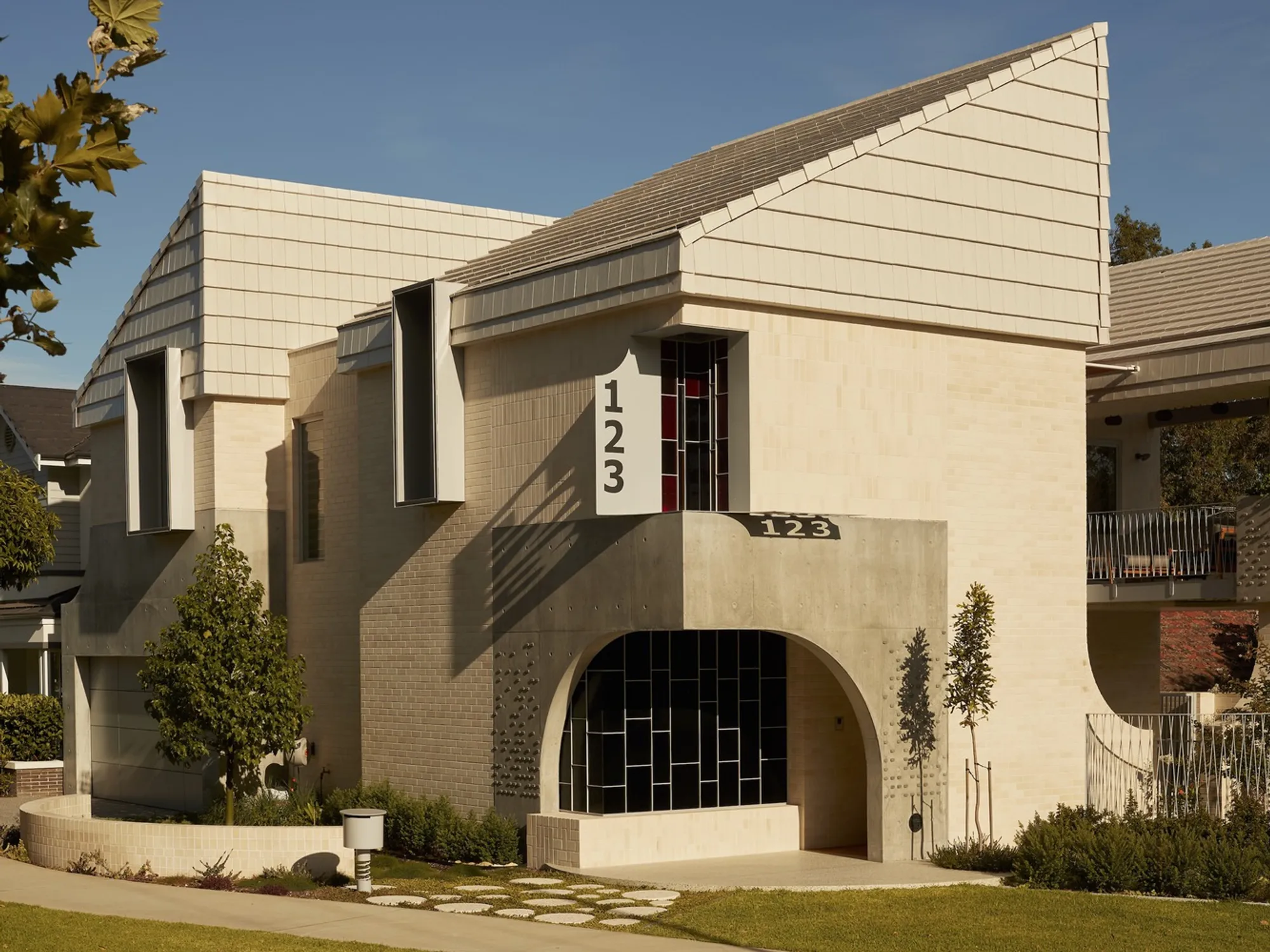
For thirty years, a family ran an Ampol petrol station on the corner of Dalkeith Road in Nedlands, a Perth suburb where Arts and Craft bungalows sit beside Mediterranean-flavored walk-ups and the occasional Art Deco holdout. When the station was demolished in 2014 and the site subdivided, one of the resulting 350-square-meter lots went back to the same family, this time for a house. Neil Cownie Architect took on the commission and produced 123 House, a two-storey dwelling that smuggles an entire autobiography into its brickwork, glass, furniture, and even its letterbox.
What makes the project genuinely interesting is not the fact that it references its site's history (many architects claim to do that) but the specificity and wit with which it does so. Concrete projections mirror the geometry of the old Ampol logo. Green glass windows recall the color of petrol; amber and red glass stand in for engine oil. A letterbox wobbles on an actual vehicle suspension spring. A custom dining table is shaped after the Ampol emblem, its circular legs evoking stacked car tyres. At the same time, the house must function as a passive-solar, low-maintenance home for owners with Greek heritage, on a noisy corner lot, in a neighborhood full of arched verandahs and terracotta roofs. The tension between all these agendas is what gives the building its density.
Corner Presence and Street Character
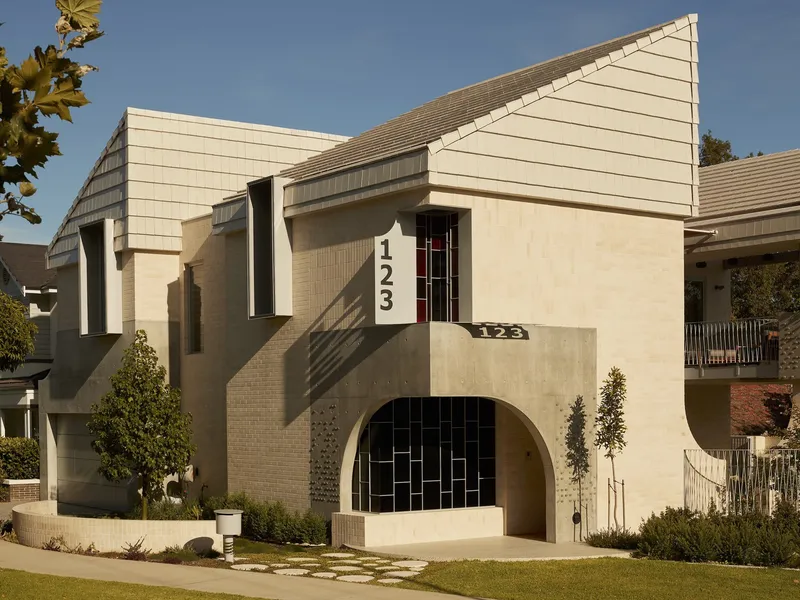
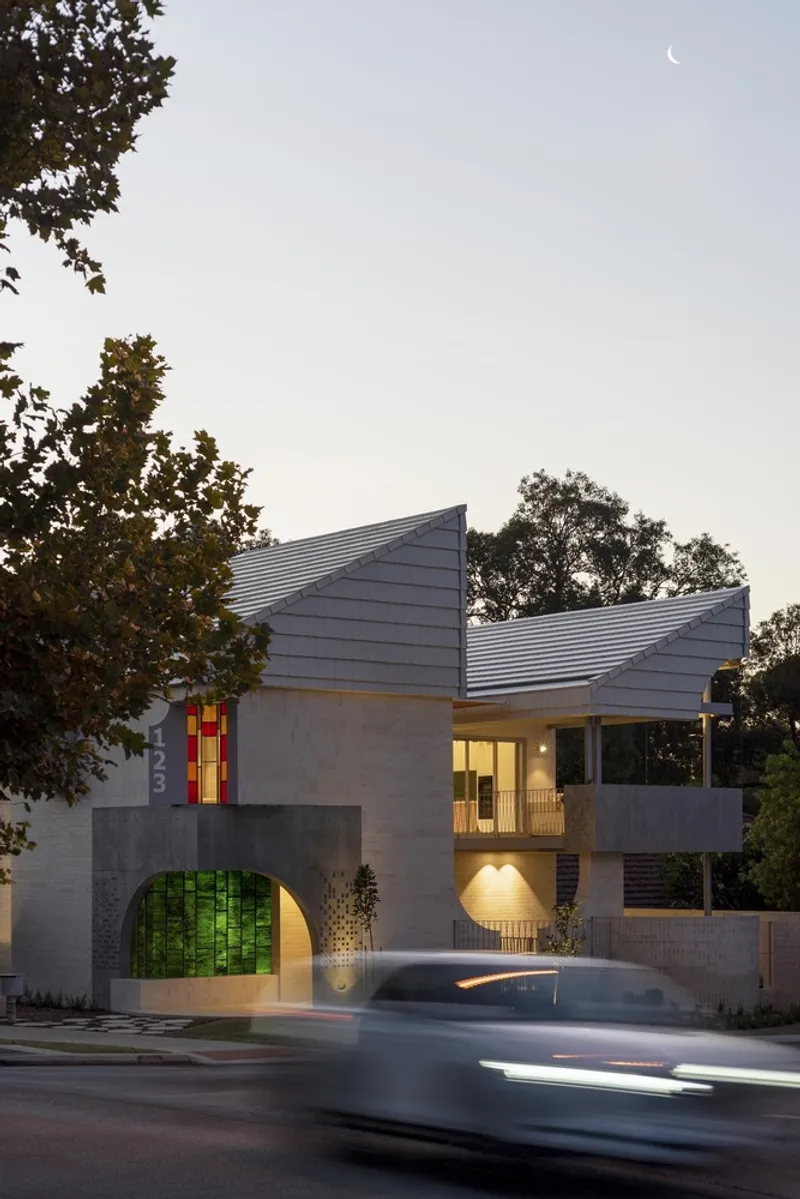
The house hugs the front boundaries of its corner site, a posture borrowed from the 1930s walk-up apartments that still punctuate Nedlands' intersections. Where those buildings used arched openings and white-painted masonry, 123 House translates the same grammar through sandy mottled face-brickwork and a stepped roofline clad in glazed terracotta tiles. A laser-cut aluminium "123" marks the entry point, recalling the metal street numbers that were once standard on the suburb's apartment frontages.
At dusk, the folded roof and concrete facade register as a crisp silhouette against the sky, monumental enough to hold the corner yet domestic in scale. The building's mass does double duty: it screens the interior from traffic noise on Dalkeith Road while channeling northern light down into living spaces. Passive solar performance and urban manners turn out to be the same move.
Curves Without Mimicry
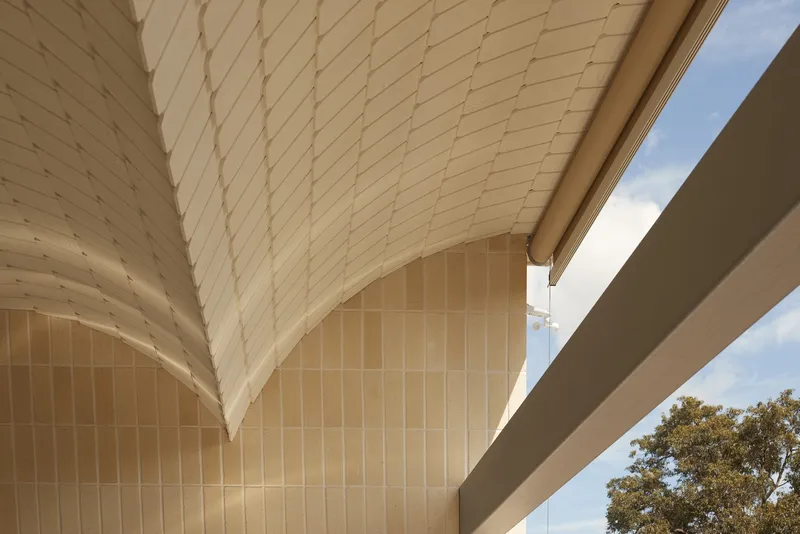
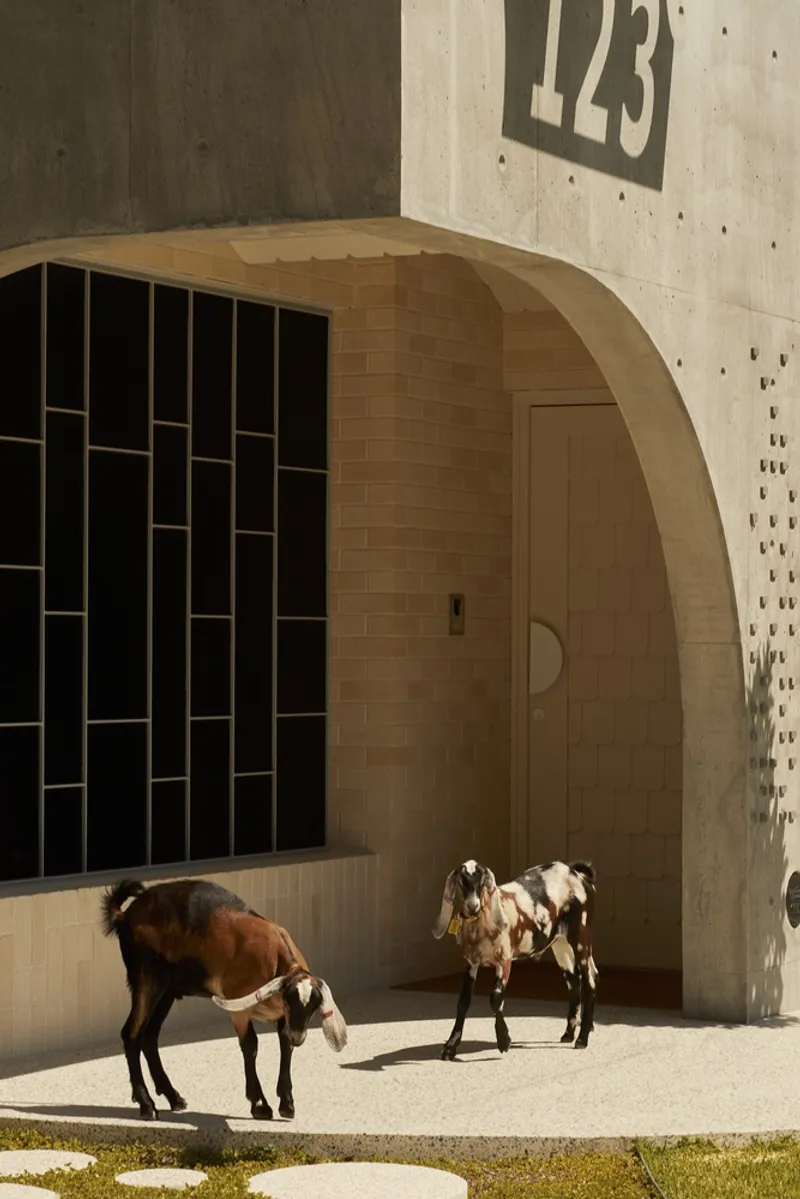
Nedlands is full of arches, from verandah enclosures to Spanish Mission doorways, and Cownie clearly wanted to acknowledge them without pastiche. His solution is to use part-circles rather than full arches, a distinction that sounds minor on paper but reads clearly in person. The curved timber portal at the entry, the scalloped hood over the kitchen, and the barrel-vaulted ceiling upstairs all share this logic: they invoke the neighborhood's arch forms while staying firmly in a contemporary register.
The curved wall meeting the cream-tiled soffit is a good case study. Seen from below against the sky, it has the confidence of a piece of civic infrastructure, yet it is simply the underside of a balcony. The geometry tells you this building knows its neighbors without trying to impersonate them.
Material Palette as Cultural Biography
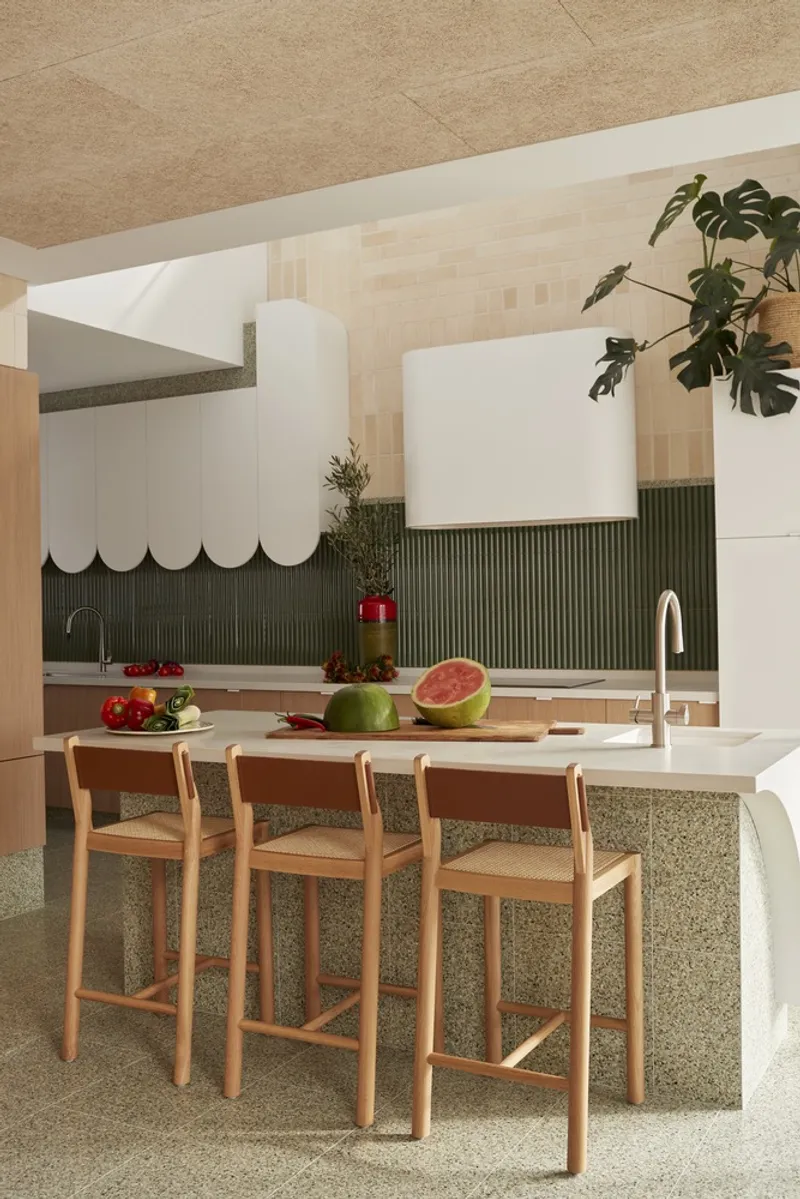
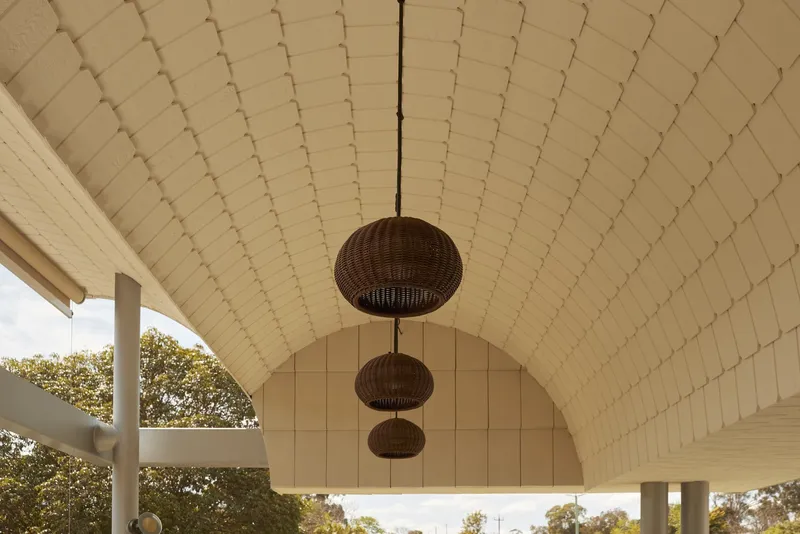
The interior material choices read like a double helix of the owners' two identities: the petrol station years and their Greek Mediterranean roots. Terrazzo floor tiles in a color called "Laguna" run through the ground floor, providing a cool, durable surface that could belong equally to an Aegean courtyard or an Australian verandah. Cork-toned Troldtekt acoustic panels line the ceilings in a natural finish, absorbing road noise while giving the rooms a warm, matte texture that offsets the colored glass.
The barrel-vaulted ceiling clad in cream shingle boards is perhaps the most atmospheric space in the house. Three woven pendant lights hang in sequence along its spine, emphasizing the curve's length. The palette here, all natural fibre and soft white, strips away the playful automotive references found elsewhere and offers something quieter: a room shaped like the hull of a boat, or the inside of a chapel, depending on your frame of reference.
The Kitchen and Dining Rooms as Narrative Centerpieces
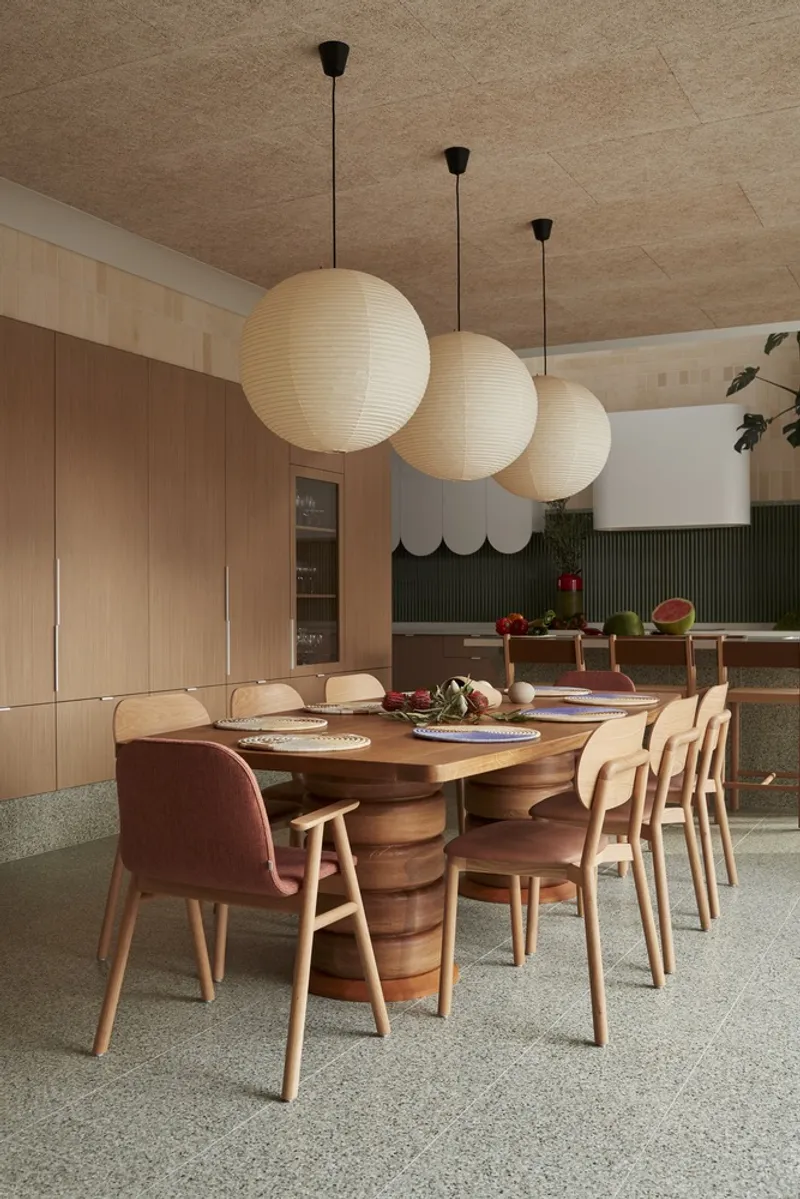
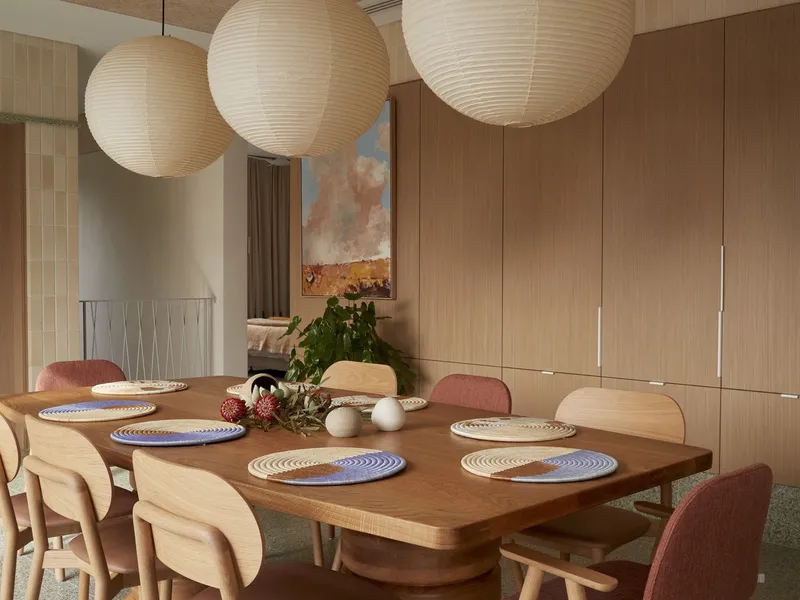
The dining room is where Cownie's layered storytelling is most legible. The custom timber table, shaped after the Ampol logo with legs that recall stacked tyres, seats eight beneath three spherical paper pendant lights. Behind the table, a green fluted backsplash glows like a panel of bottled petrol. It is a room that rewards close looking: the more you know about the family's history, the more details resolve.
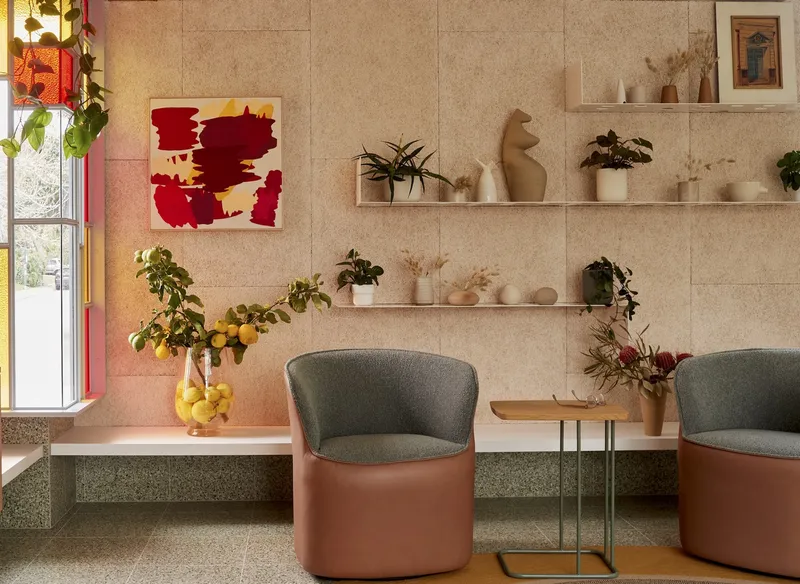
The kitchen island, with its terrazzo base and timber stools, sits under a scalloped white range hood that reinforces the house's part-circle motif. Adjacent, a built-in banquette with leather-wrapped chairs and floating shelves turns a breakfast nook into a small gallery. Powder-coated cantilevered aluminium shelving along the wall features water-jet-cut openings in the Ampol logo profile, a detail so specific it verges on obsession, but that is exactly the quality that lifts the project above generic contextual design.
Elevated Living and the Balcony Garden
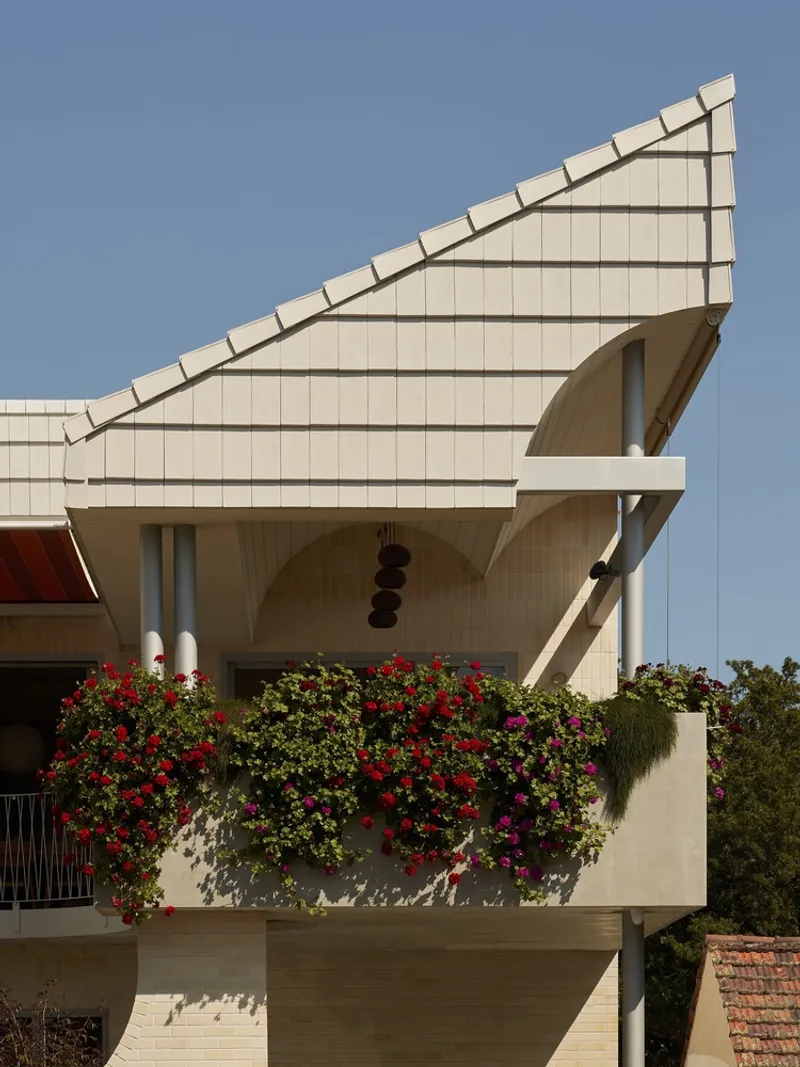
Placing the primary living and alfresco zones on the first floor was a pragmatic response to a noisy corner, but it also creates a distinctive relationship with the street. The balcony, overflowing with red and purple flowers tended by horticulturalist Sabrina Hahn, softens the building's angular roofline and gives the facade a seasonal quality that pure masonry could not. From above, the owners can watch the neighborhood without being consumed by it.
The northern orientation of these upper rooms was no accident. During Perth's mild but real winters, sunlight penetrates deep into the first-floor spaces, warming them passively. In summer, the building mass and highlight windows promote cross-ventilation, keeping mechanical cooling demands low. For a house that was briefed as "maintenance-free," the passive strategy is essential: it reduces reliance on systems that inevitably need servicing.
Why This Project Matters
123 House demonstrates that contextual architecture does not have to be timid. Cownie takes cues from Nedlands' streetscape, the owners' biography, and the land's pre-colonial history (a custom curtain rod traces the former Noongar track that became Dalkeith Road) and synthesizes them into a building that feels genuinely new. The references are specific enough to be meaningful yet abstract enough to avoid kitsch. That balance is extraordinarily hard to achieve, and it is the reason the project warrants attention beyond its Perth suburb.
More broadly, the house poses a useful question for suburban residential practice: when a site carries memories, how much should a building remember? Cownie's answer is: everything, but obliquely. The petrol station is gone, the lot subdivided, the street widened. What remains is encoded in glass colors, table shapes, letterbox springs, and a family that still lives on the same corner. Architecture, at its best, does exactly this kind of work.
123 House by Neil Cownie Architect. Nedlands, Perth, Australia. 350 square meters (site area). Completed 2022. Photography by Traianos Pakioufakis and George Vavakis.
About the Studio
Share Your Own Work on uni.xyz
If projects like this are the kind of work you want to make, uni.xyz is a place to publish your own, find collaborators, and enter design competitions.



Popular Articles
Popular articles from the community


The Ocean Hive: Sustainable Architecture for a Self-Sufficient Civilization at Sea
The Ocean Hive imagines sustainable architecture at sea, where modular habitats, algae, wave power and ocean waste sustain a growing colony.

Co-life: Sustainable Architecture for Age-Friendly Community Living
Co-life reimagines sustainable architecture for seniors through courtyards, rammed earth, shared gardens, and spaces designed for belonging.

Co-Life: Senior Housing Design That Reconnects Older Adults With the City
Co-Life reimagines senior housing design through healing gardens, shared streets, workshops, and a sustainable community across generations.

Hill & Cross Opera: Sculptural Opera House Architecture Shaped by Tallinn’s Landscape and Identity
Hill & Cross Opera reimagines opera house architecture in Tallinn through its sculptural hill, civic plaza, glass wave and a luminous cross.

Similar Reads
You might also enjoy these articles


Hodi-Mandai Geram
Project Function: Preservation and revitalization of the Intangible heritage and socio-spatial identity of the Hodi by Housing, Cultural Memory Center, Sacred Grove, landscape, local tourism economy


Olio Towers: A Mid-Rise for Performers That Fuses Housing, Rehearsal, and Stage
Located blocks from Houston's Theater District, this modular tower stacks living units around a central performance atrium.

Oasis: Modular Green Housing Carved into Dhaka's Urban Fabric
A shortlisted Plugin Housing entry reclaims unauthorized settlements in Dhaka with stepped concrete volumes, green roofs, and ventilation-driven design.

Black Hole: A Floating Megastructure for the Post-Physical Era
Emiliano Mazzarotto envisions a spherical, self-scaling arena where e-sports, digital hotels, and holographic stadiums replace traditional public space.

Explore Architecture Competitions
Discover active competitions in this discipline



Challenge to reimagine the Iron Throne


Photograph architecture without architects


Illustrate the lost glory of Angkor Wat - Render Challenge


Design challenge to reuse E-waste
Comments (0)
Please login or sign up to add comments
No comments yet. Be the first to comment!