

2050 Skyscraper: A Tower Where No Two Floors Match
A stacked, shifted, non-orthogonal tower designed around social connection, where AI mediates space and every floor is a different geometry.


Most skyscrapers stack identical floors. The 2050 Skyscraper stacks different ones. Each volume is shifted, rotated, and scaled independently, creating a tower that looks less like a building and more like a vertical village of distinct rooms piled on top of each other. Designed by Rabah Saoud, Safaa Abdelwahab, and Maha Alahmad, the project was shortlisted in the Hybrid Futures '19: Work x Fly competition on uni.xyz.
The concept explores what happens when a skyscraper is designed around social connection rather than floor-plate efficiency. The form is derived from a network web: the idea that every space in the building should be physically and visually connected to others, creating constant opportunities for encounter, collaboration, and informal interaction.
The Tower: Stacked, Shifted, Open
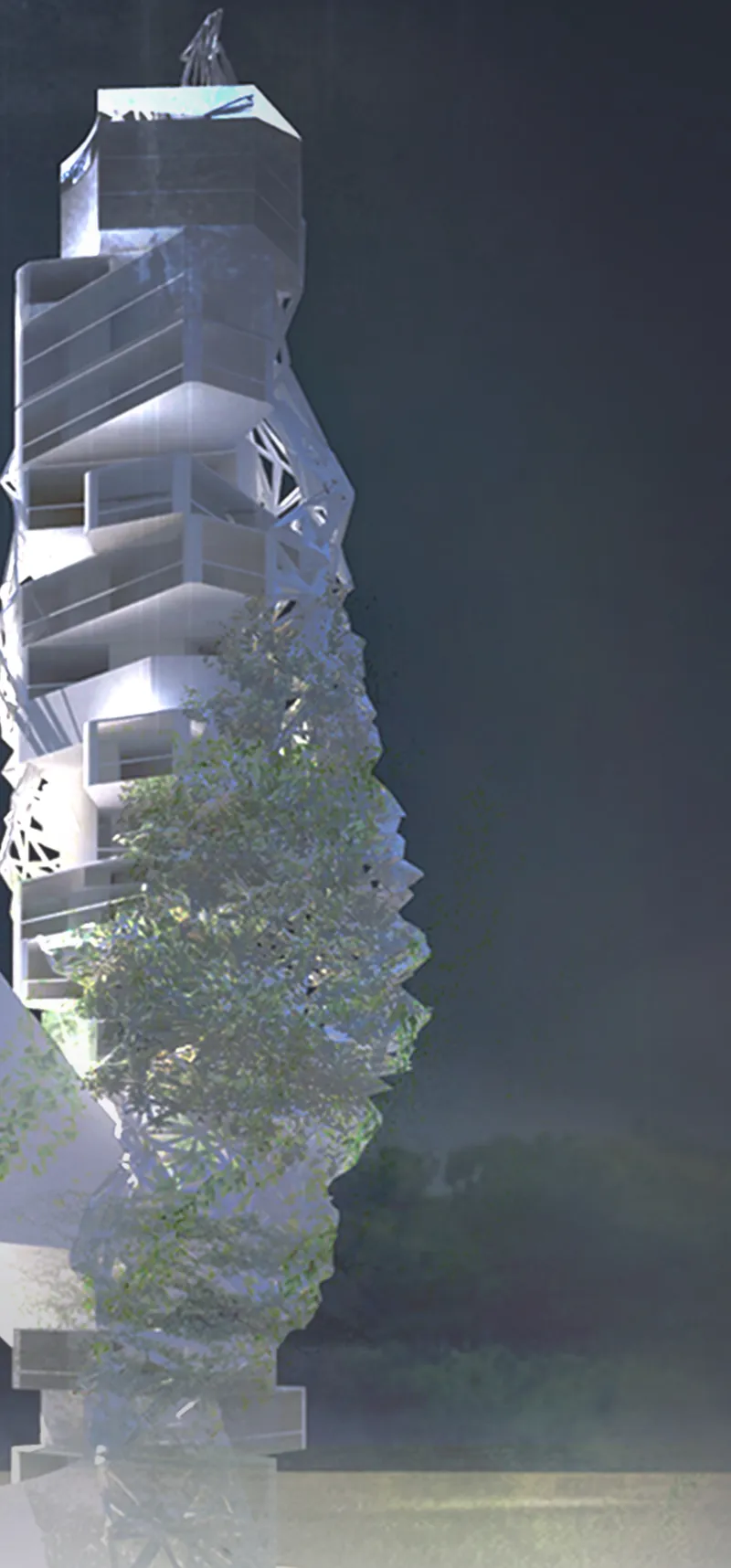
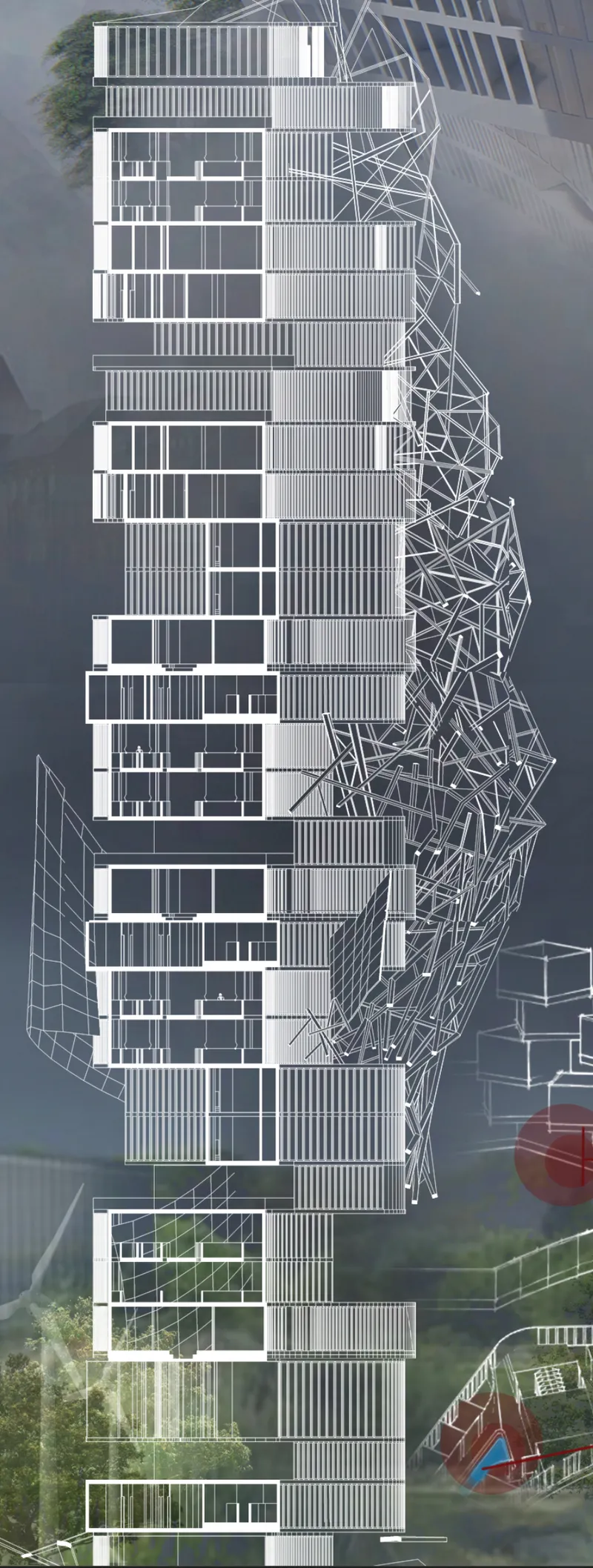
The full tower render shows the logic immediately. Volumes of different sizes are stacked and shifted off-axis, leaving gaps between them where structure is exposed, terraces emerge, and trees grow. The mid-section hosts a large tree that passes through multiple floors, rooting the building in biology even as it reaches upward. The top of the tower dissolves into an exposed wireframe, suggesting incompleteness or growth.
The closer view reveals the second layer of the design. One side of the tower is enclosed with facades. The other side is open wireframe, exposing the steel structure and allowing air, light, and views to penetrate. This asymmetry is not decorative. It is programmatic: the enclosed side houses offices and bedrooms, the open side provides terraces, recreation, and interaction spaces.
The Plans: Non-Orthogonal, Angular, Unique
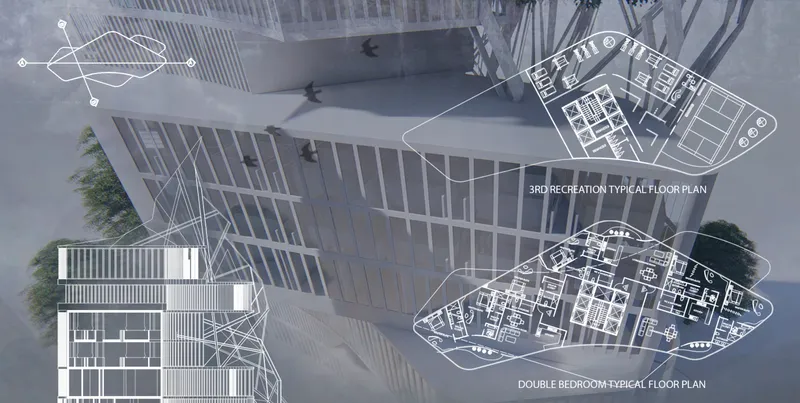
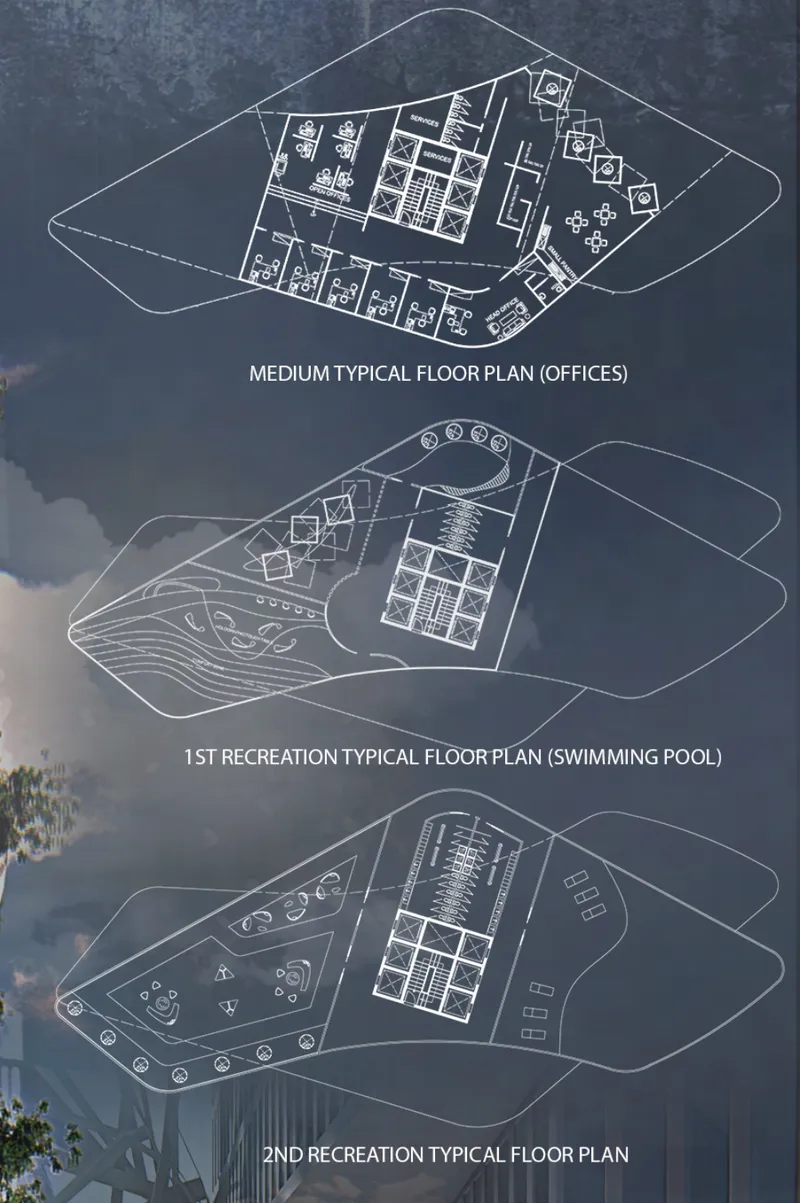
The floor plans confirm what the renders suggest: no two floors are the same. The plans are angular, non-orthogonal, and rotated relative to each other. A medium office level has a different geometry from the recreation level below it, which has a different geometry from the swimming pool level below that.
This variety has a cost in structural complexity, but it has a benefit in spatial richness. Walking through this building would never feel repetitive. Each floor is a discovery. The swimming pool floor is not a standard rectangular room with a pool in it. It is an angular landscape with the pool carved into an irregular form. The office floor is not a grid of desks. It is a fragmented plan with clusters and voids.
The Site: Network Web as Ground Plan
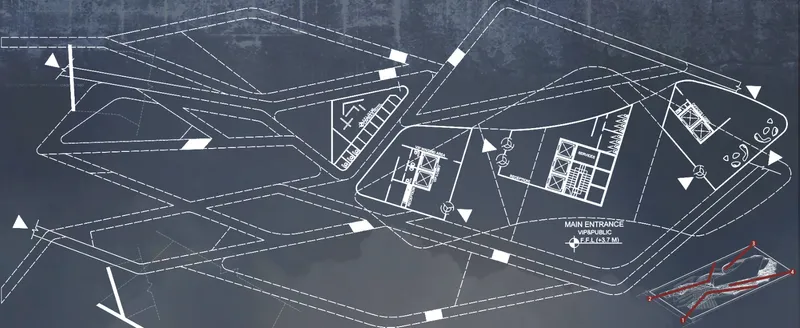
The site plan extends the network-web concept to the ground. Angular pathways, ramps, and landscaped zones radiate from the tower base, creating a public realm that mirrors the building's logic above. The main entrance is marked but not centred: you approach the building through a field of paths, choosing your own route.
This is a small detail that reveals a large idea. If the building is about social connection, the ground should be too. A single front door funnels. A network of paths distributes. The site plan chooses distribution.
AI and the Network Web
The project's conceptual framework positions AI as the mediator of social connection within the building. The network web is not just a spatial idea. It is a data idea: the building monitors occupancy, activity, and preference, and reconfigures its shared spaces accordingly. Meeting rooms open where clusters form. Quiet zones appear where individuals retreat.
Whether this level of responsiveness is technically achievable is less important than the spatial diagram it produces. A building designed for constant reconfiguration is also a building designed for variety, which is what makes the stacked, shifted, non-identical floors coherent. They are different because the programme demands difference.
Why This Project Matters
The Hybrid Futures competition asked for buildings that merge work and flight. The 2050 Skyscraper interprets the brief through social interaction rather than transport technology. Flight here is metaphorical: the building flies because it defies the conventions of the stacked floor plate. It moves because no two levels sit in the same position.
For anyone interested in non-standard tower design, AI-responsive architecture, or the relationship between form and social behaviour, this project offers a clear proposition: make every floor different, connect them all, and let the building learn from how people use it.
View the Full Project
About the Designers
Designers: Rabah Saoud, Safaa Abdelwahab, Maha Alahmad
Enter a Design Competition on uni.xyz
If non-standard tower design, AI-responsive architecture, or speculative workplace concepts are the kind of work you want to explore, uni.xyz runs competitions year-round that reward original spatial thinking.
Project credits: 2050 Skyscraper by Rabah Saoud, Safaa Abdelwahab, Maha Alahmad. Shortlisted, Hybrid Futures '19: Work x Fly (uni.xyz).


Popular Articles
Popular articles from the community


Singing Woman: Contemporary Architecture Inspired by Estonia’s Voice and the Sea
Singing Woman turns Estonia’s song culture into flowing opera house architecture, blending public life, landscape, sea, and national memory.

Tsunami Convergenics: Turning Catastrophic Ocean Forces into Underwater Housing Infrastructure
A speculative underwater settlement off the coast of Onagawa, Japan, treats tsunamis and typhoons as energy sources rather than threats.

Opera by the Sea Estonia: Three Shells Dissolving Architecture into Tallinn's Coastline
A winning opera house proposal replaces monumental form with interconnected shells that blur the boundary between building, park and Baltic Sea.

Faces of the Soviet Avant-Garde: Turning Moscow's Street Names into an Open-Air Museum
A network of sculptural installations across a Moscow residential district transforms forgotten architect names into spatial encounters with cultural memor

Similar Reads
You might also enjoy these articles

The Amber Palace Opera: A Geological Fiction Surfaces on Tallinn's Baltic Waterfront
Pierre Brillard reimagines a Baltic legend as a public landscape, opera house, and waterfront promenade rooted in Tallinn's coastal identity.
Dynamic Modules Shelter: A Telescopic Ring for Mountain Pilgrimage
A circular modular framework of steel, bamboo, and fabric grows vertically with demand, wrapping communal ground in adaptable shelter.
Singing Woman: Contemporary Architecture Inspired by Estonia’s Voice and the Sea
Singing Woman turns Estonia’s song culture into flowing opera house architecture, blending public life, landscape, sea, and national memory.
HYPERBLOCK: Flexible Urban Design for Barcelona’s Future City
HYPERBLOCK reimagines Barcelona as flexible urban design, layering density, daylight, public space and adaptable housing above Cerdà’s grid.

Comments (0)
Please login or sign up to add comments
No comments yet. Be the first to comment!