
23 SUL Fits a Filmmaker's Three-Story House Into a Narrow São Paulo Lot for a Controlled Budget
A 118-square-meter concrete block residence in Pinheiros trades conventional rooms for vertical openness and planted courtyards.


In the Pinheiros neighborhood of São Paulo, where narrow lots force most houses into either claustrophobic boxes or expensive structural gymnastics, 23 SUL chose a third path. Their Residence in Pinheiros stacks 118 square meters across three levels, using exposed concrete block, steel framing, and slatted timber ceilings to produce a house that feels far larger than its footprint. Designed for a young filmmaker, the brief called for generous, flowing space without surrendering privacy from the street, and all of it had to stay within a tight budget.
What makes this project genuinely interesting is the way it treats economy as a design driver rather than a constraint to apologize for. Concrete block is left unfinished. Steel is painted black and left visible. Timber ceiling slats are structural and decorative at once. Nothing is hidden, and nothing feels cheap. The result is a house where material honesty generates atmosphere: light plays across textured walls, foliage shadows shift through the day, and vertical openness turns a compact floor plate into something almost loft-like.
A Double-Height Core That Defies the Lot
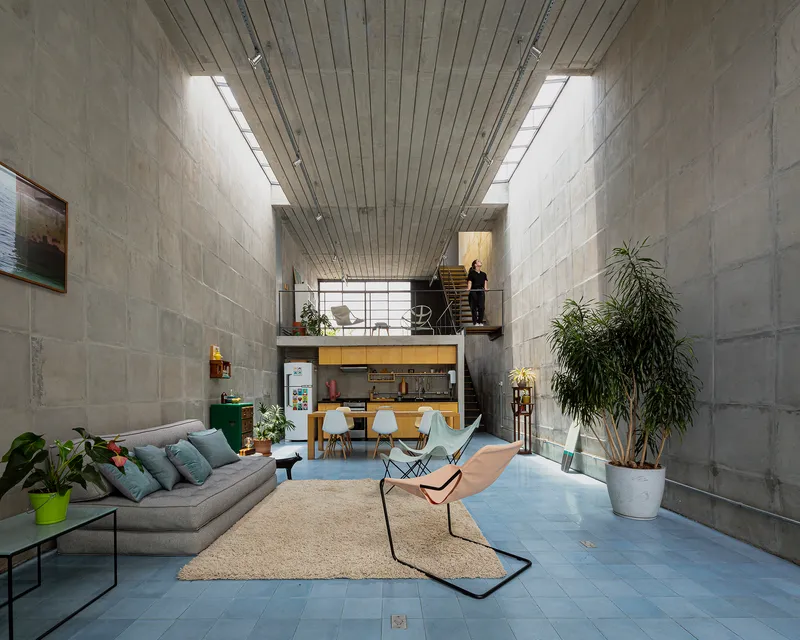
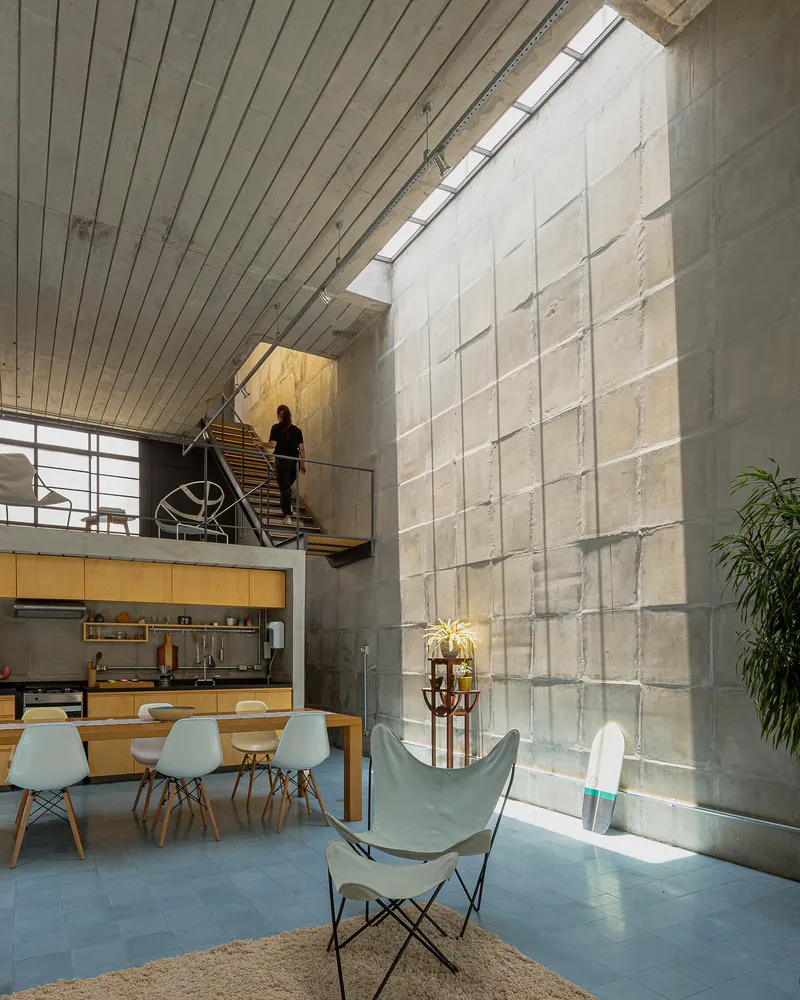
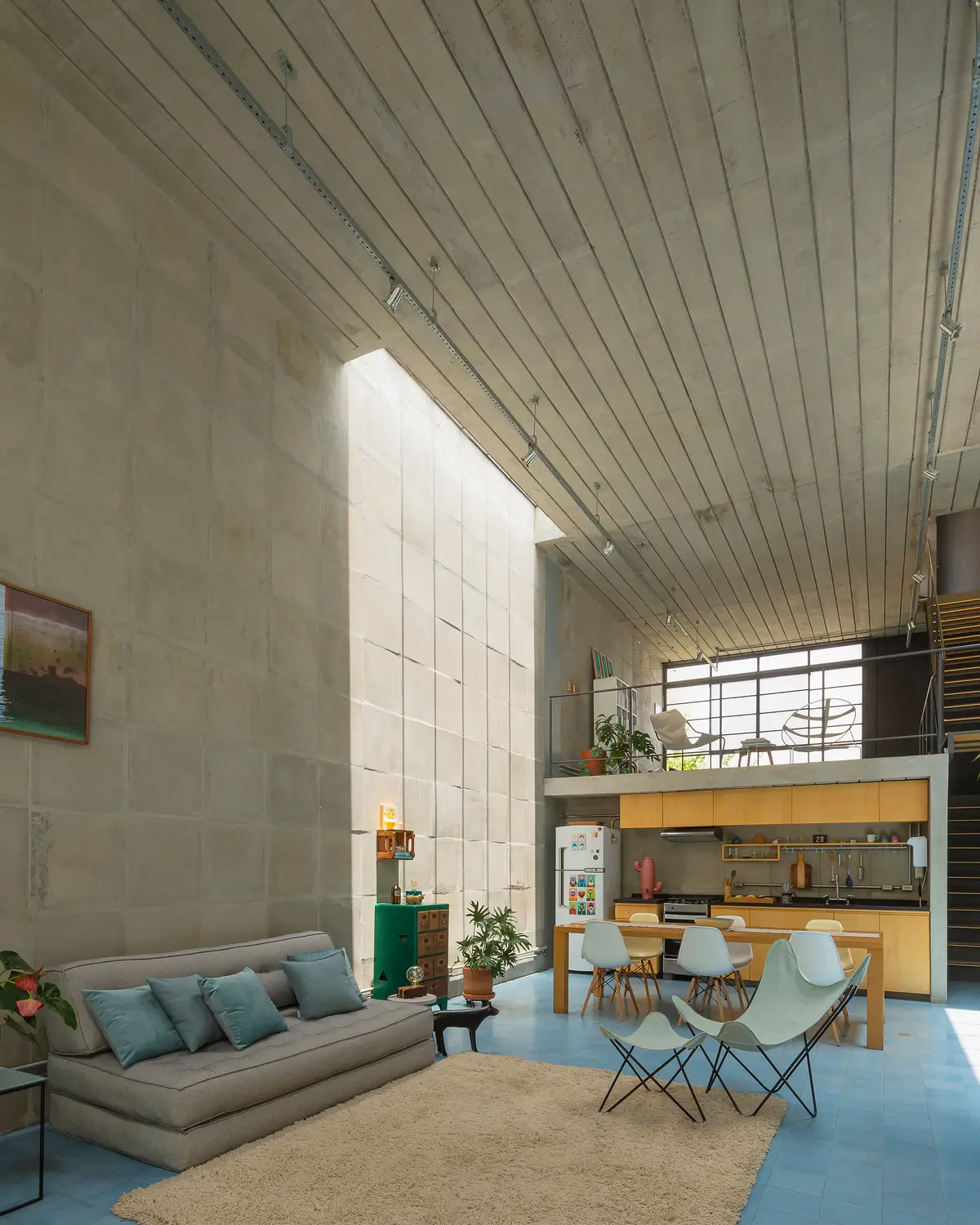
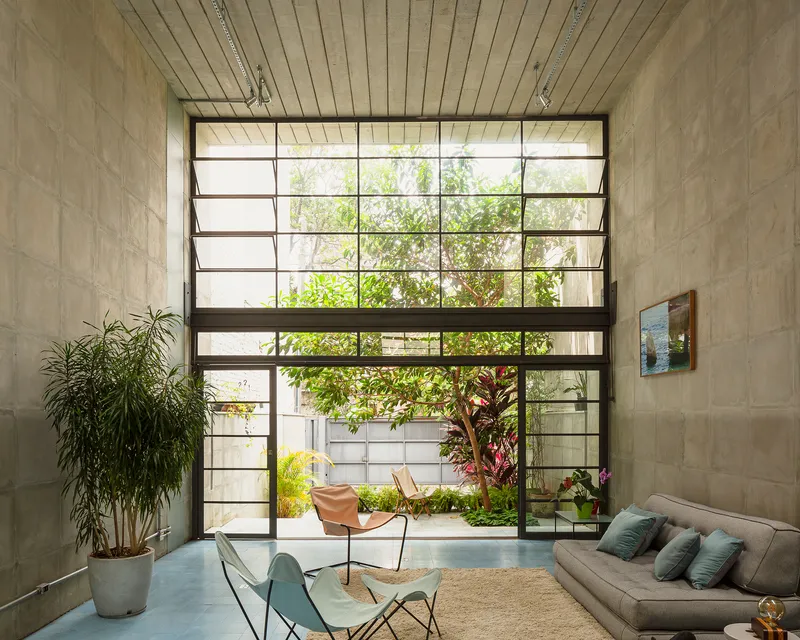
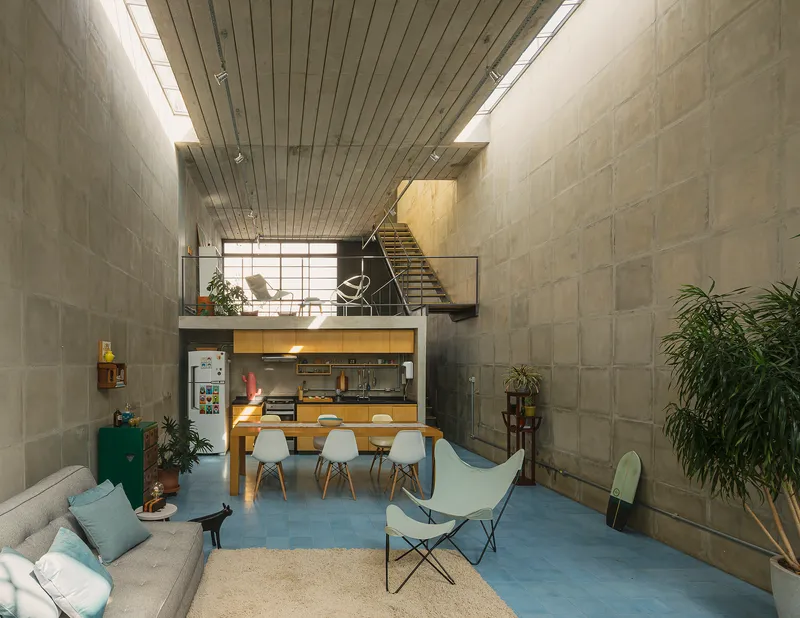
The double-height living volume is the central gambit of the house. By collapsing two floors into one open void, 23 SUL gives the narrowest part of the plan a sense of scale that a single-story ceiling could never achieve. Concrete block walls rise uninterrupted to the mezzanine level, and diagonal timber slats span above, lending warmth without lowering the perceived height. A steel mezzanine hovers at mid-level, turning the act of crossing between rooms into a moment of engagement with the full volume below.
Sunlight enters from clerestory glazing along the ceiling edge and from the courtyard-facing steel-framed wall, casting geometric and foliage shadows across the rough block surface. The effect changes through the day, giving the filmmaker exactly the kind of cinematic interior light shifts you would expect him to appreciate.
The Courtyard as Privacy Device
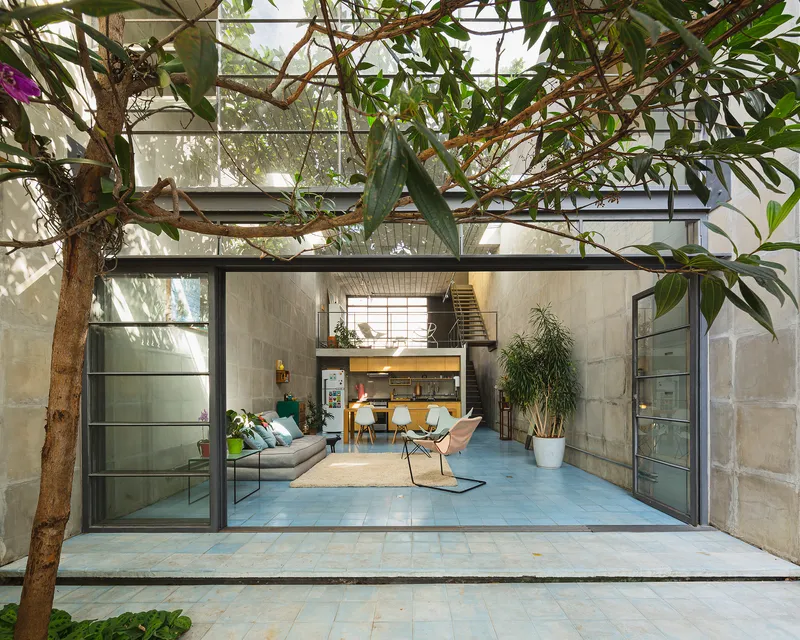
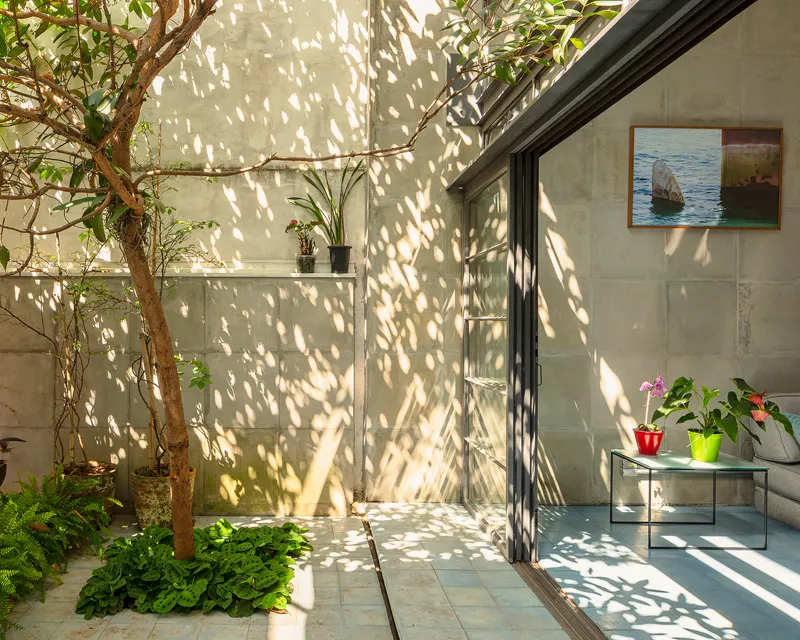
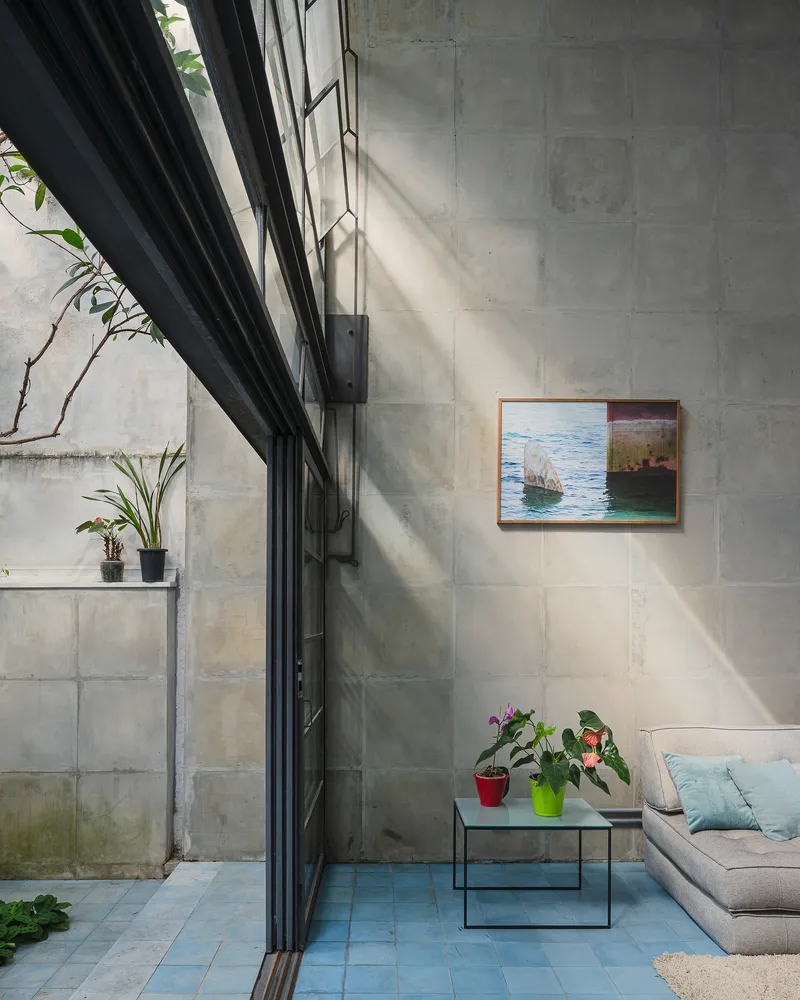
Rather than punching windows toward the street or neighboring walls, the house orients its primary glazing toward a planted courtyard wedged between the building and the lot boundary. Trees, ground cover, and potted plants create a green buffer that filters light and blocks sightlines from outside. Fully operable steel-framed glass doors collapse the boundary between inside and out, effectively doubling the usable living area on warm days.
The courtyard also functions as the house's lungs. Ventilation runs through the section from the courtyard openings up through the double-height void, pulling warm air upward and replacing it with cooler garden air. In a city where mechanical cooling is an energy burden, this passive strategy is as pragmatic as it is pleasant.
Raw Materials, Refined Details
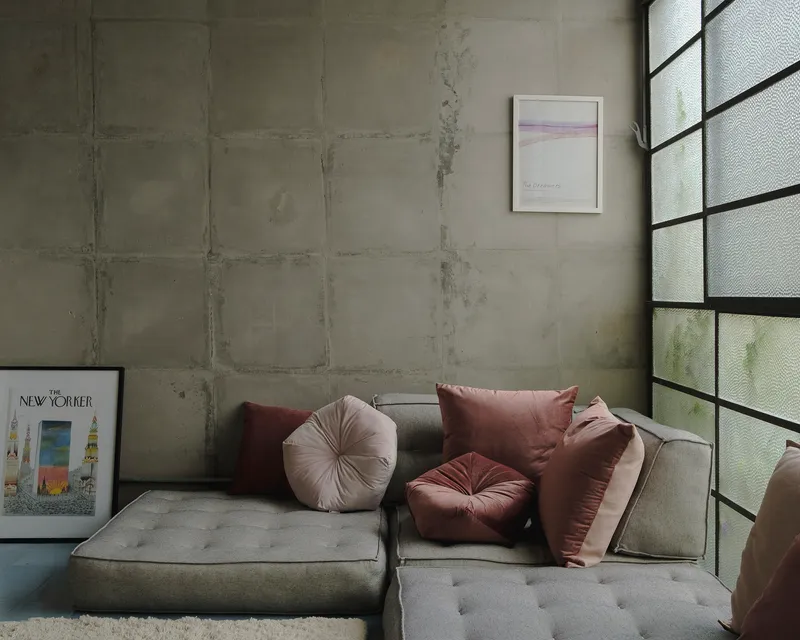
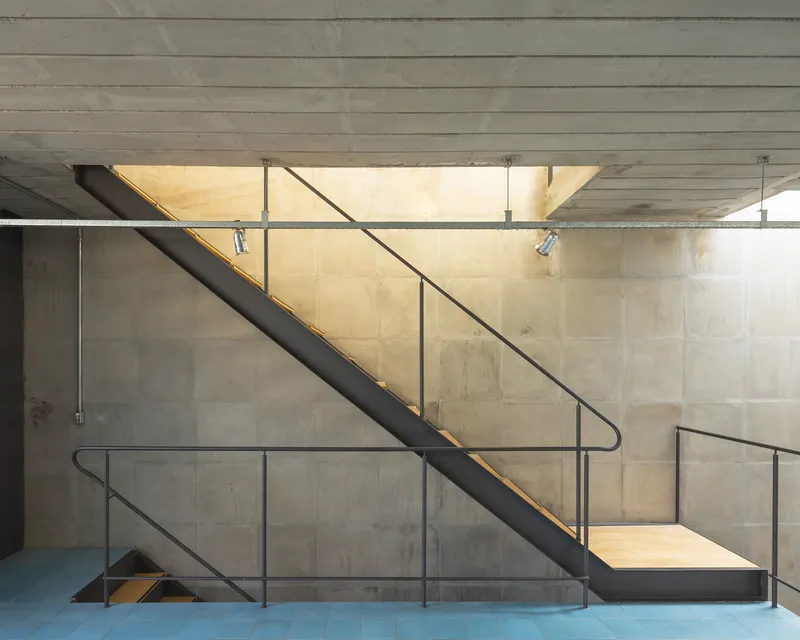
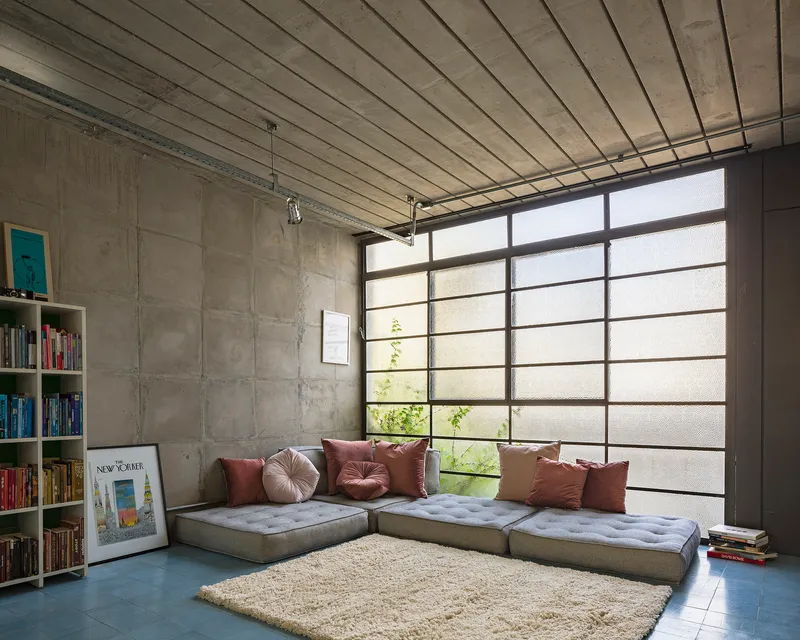
The material palette is deliberately limited: concrete block, board-formed concrete, black-painted steel, timber, and glass block. Each material pulls a distinct duty. Glass block panels let diffused light into the seating nook without exposing the interior. Board-formed concrete on specific walls provides a finer texture that contrasts with the rougher block. A brass LED strip lighting detail along the staircase handrail is perhaps the single moment of luxury, and it stands out precisely because everything else is so restrained.
Built-in shelving and seating are integrated into the concrete walls, reducing the need for freestanding furniture and keeping the narrow plan clear. The approach suggests a household that values openness over accumulation, which suits the filmmaker brief.
Steel and Timber Circulation
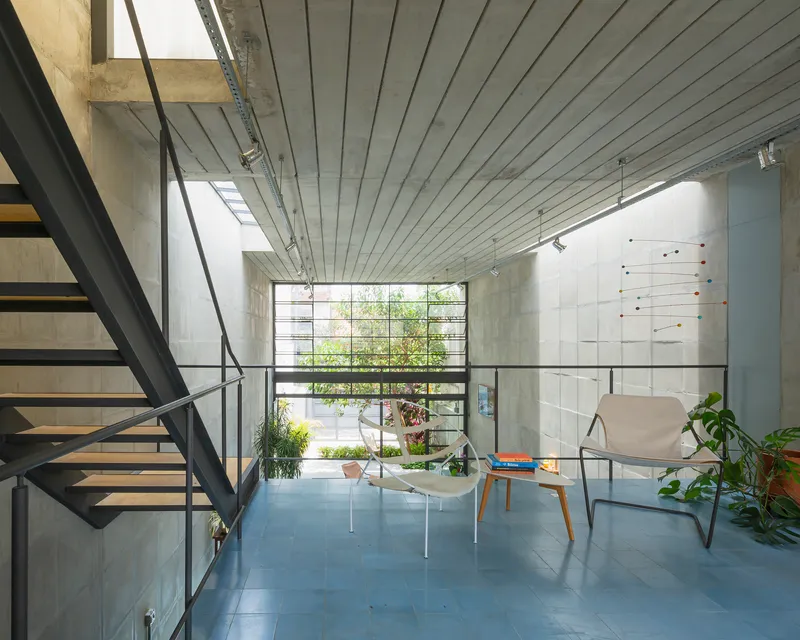
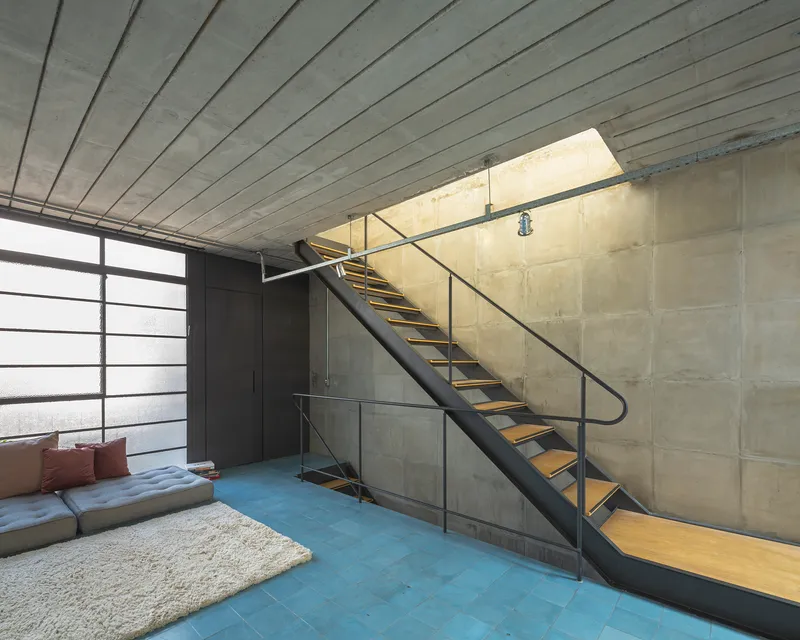
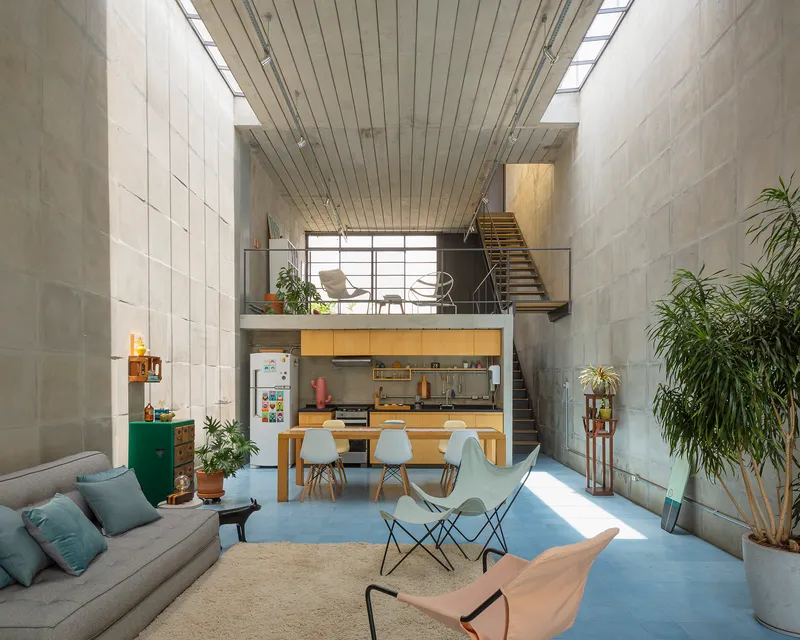
The staircase is the structural spine of the section. A steel stringer with cable railings rises beside the concrete block wall, connecting three levels with minimal visual weight. Wood treads soften the industrial character underfoot, and clerestory windows at the stair landing ensure the circulation zone never feels like a dark shaft. From the mezzanine, you can look down into the living room or across to the courtyard, turning every trip between floors into a spatial event.
Below the mezzanine, the kitchen tucks in beneath the slatted timber ceiling at a lower, more intimate height. The contrast between the compressed kitchen zone and the adjacent double-height void is one of the house's best spatial moves, making a modest area feel purposeful rather than cramped.
Light and Shadow as Finish
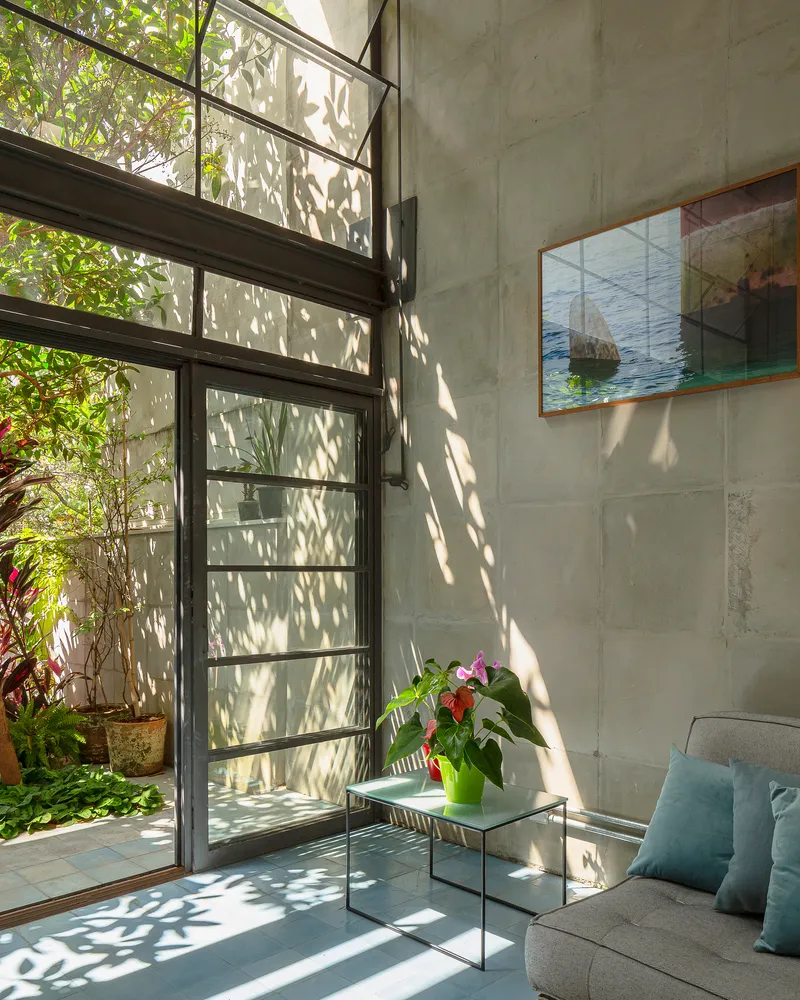
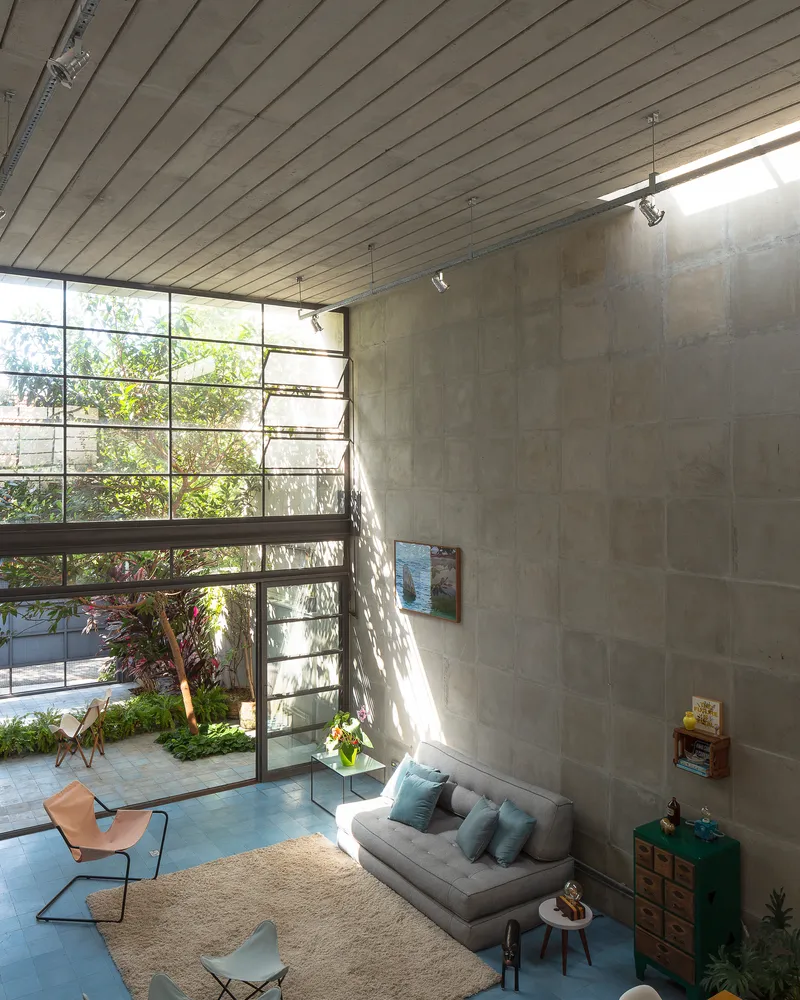
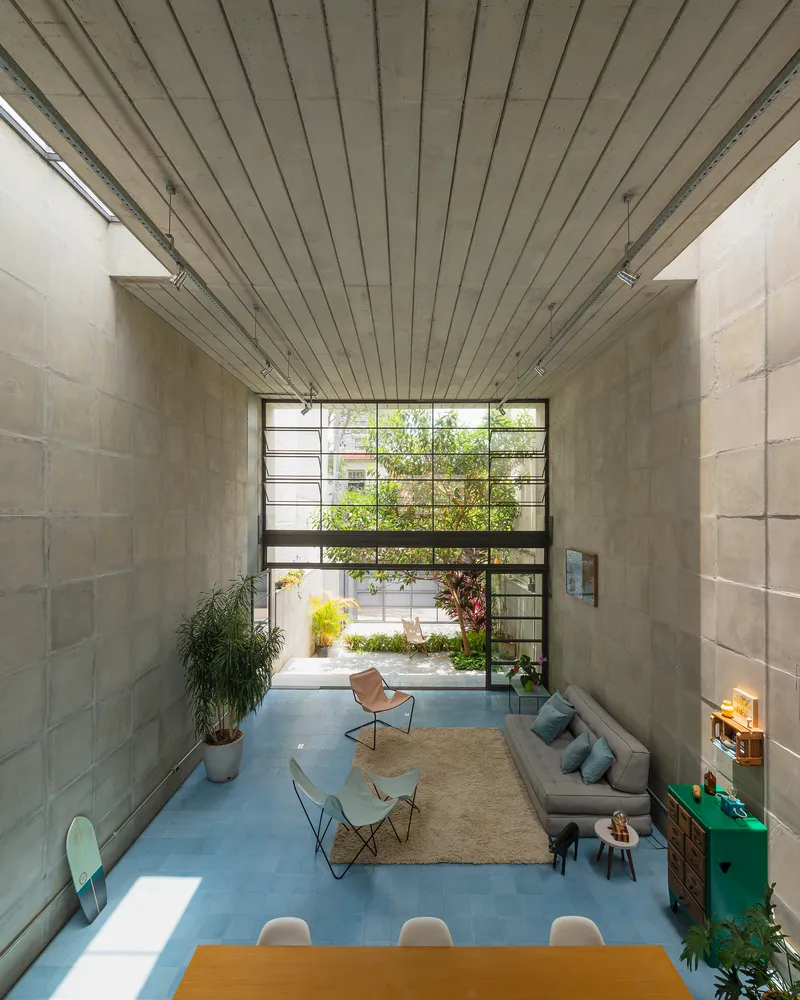
In a house where the budget excluded surface finishes beyond the raw structure, light does the work of decoration. Dappled shadows from the courtyard foliage project constantly shifting patterns onto the concrete walls. From the mezzanine, looking down, these shadows create a kind of natural projection, an appropriately cinematic quality for the client. The tall steel-framed window wall acts as a screen, framing the courtyard garden like a vertical landscape painting that changes with the seasons.
A Rooftop Retreat
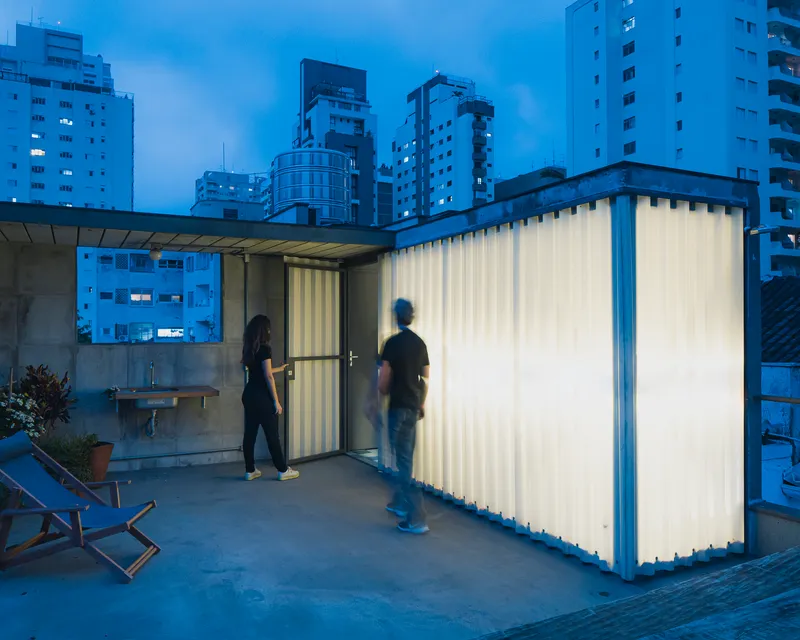
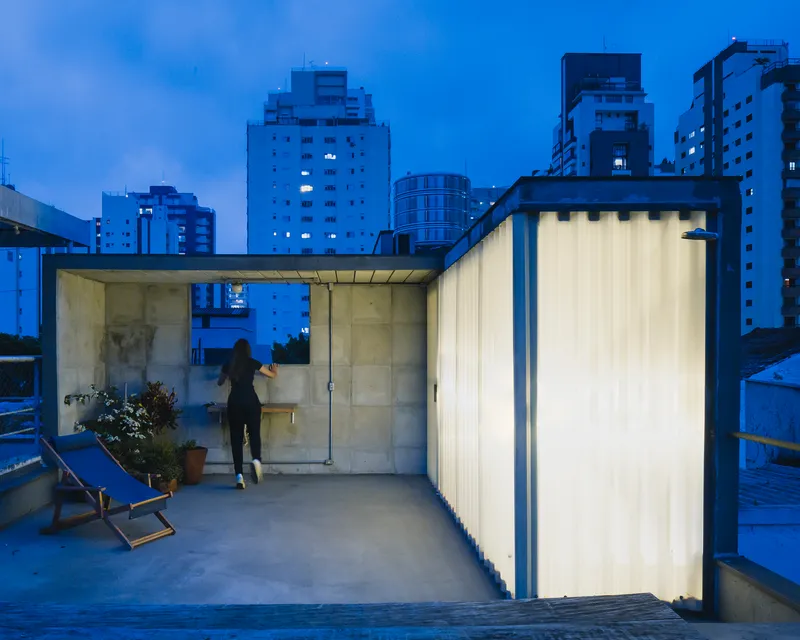
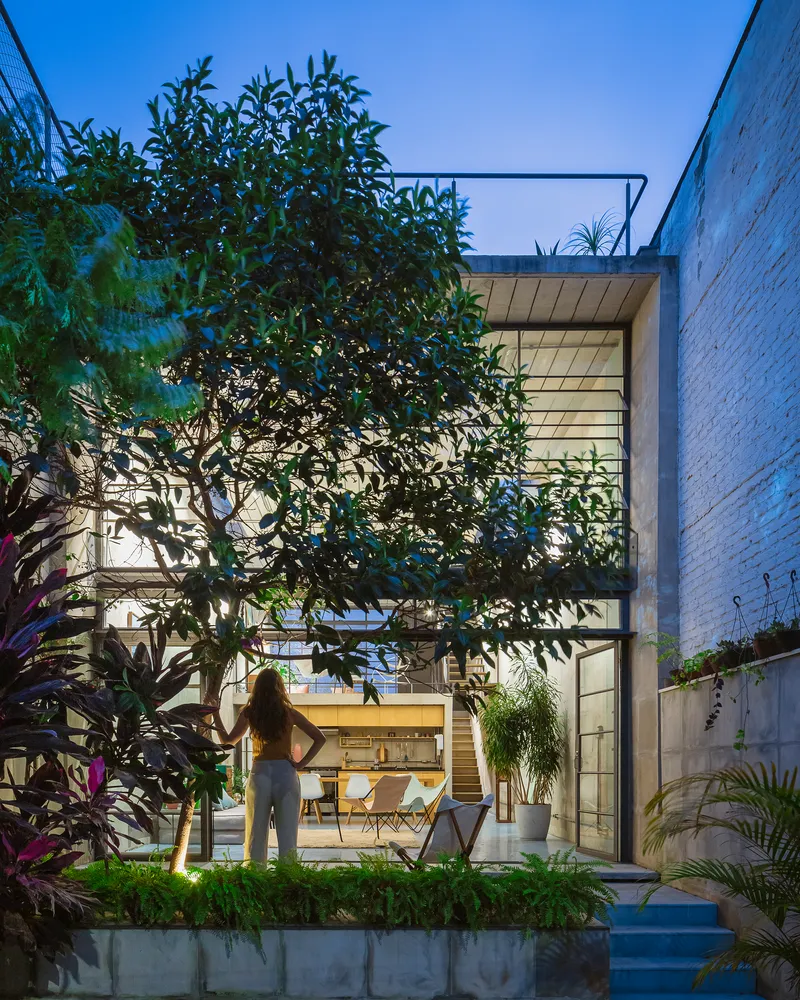
At the top of the section, a rooftop terrace enclosed by backlit translucent corrugated panels offers a third kind of outdoor space. Unlike the courtyard, which is intimate and green, the terrace is open to the city skyline. At dusk, the corrugated panels glow from within while the glass pavilion element frames views outward. It is a social space, a counterpoint to the private courtyard below, and it extends the usable area of the house without adding to the built footprint.
The Bedroom Level
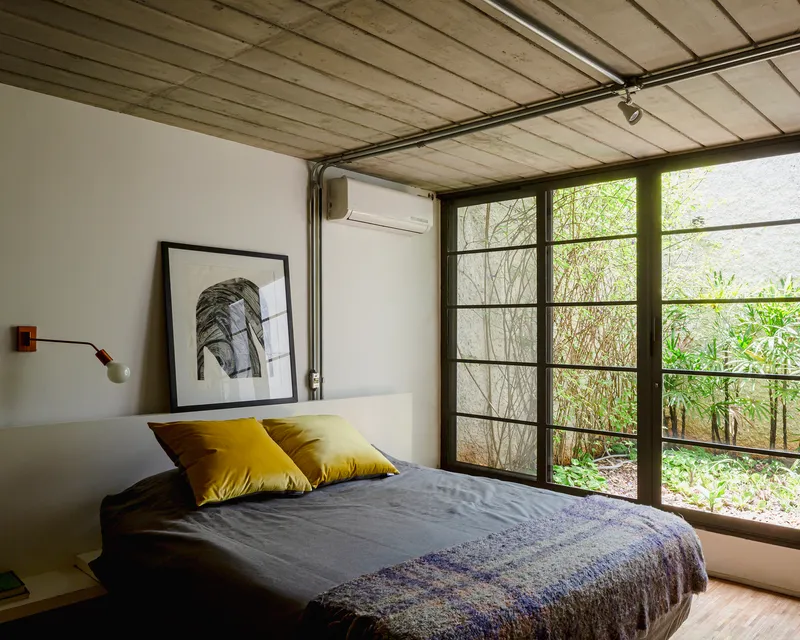
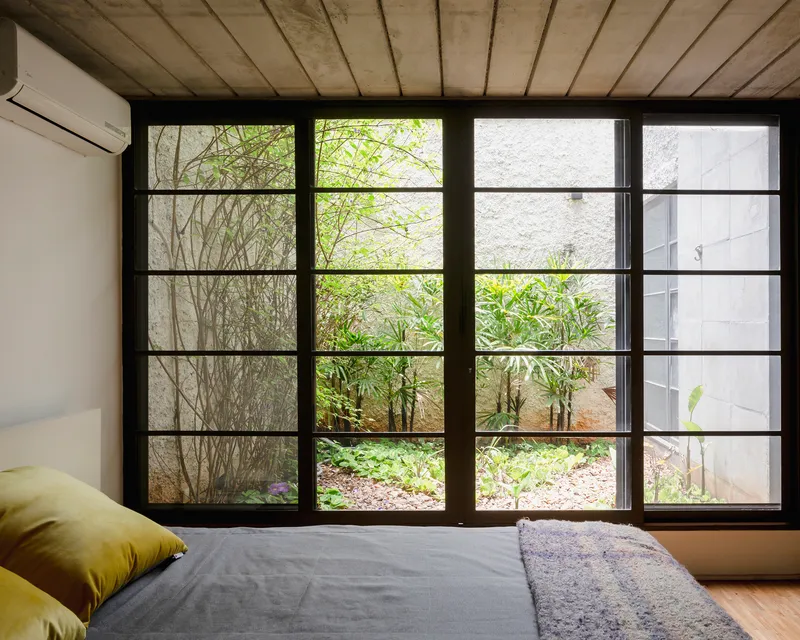
On the upper floor, the bedroom sits behind a gridded steel window wall that overlooks the planted garden. Bare branches and flowering plants provide a living screen that shifts density with the seasons, granting more privacy in summer and more light in winter. The decision to use an industrial steel grid rather than conventional residential fenestration keeps the language of the house consistent from ground to roof. Clerestory glazing continues at the ceiling edge, ensuring even the most enclosed room maintains a connection to daylight.
Plans and Drawings
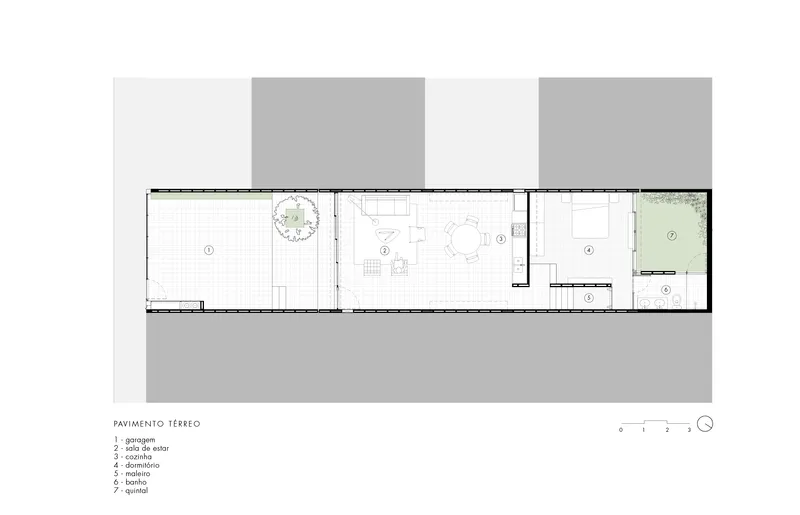
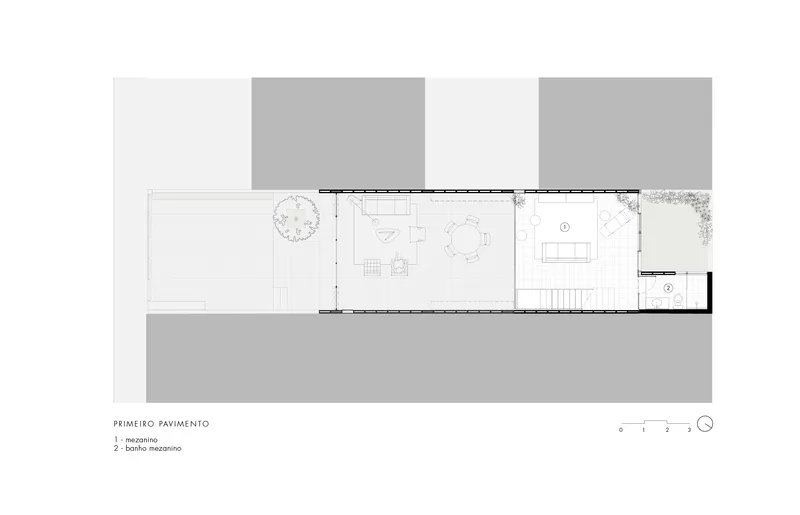
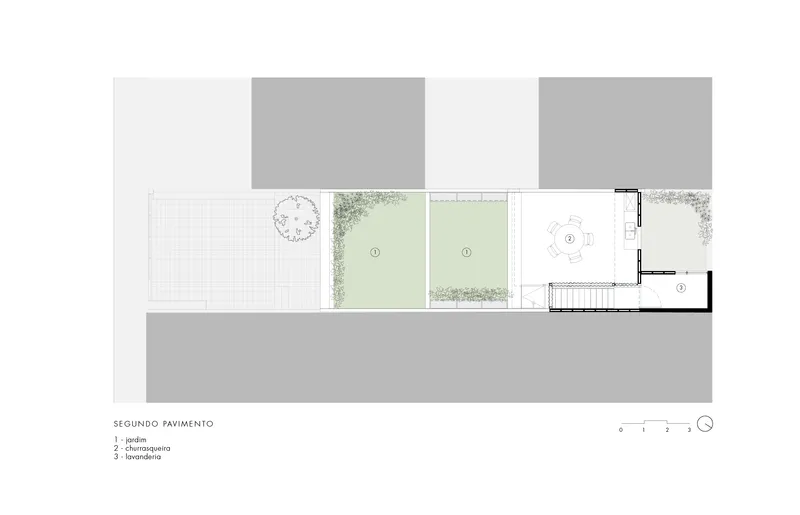
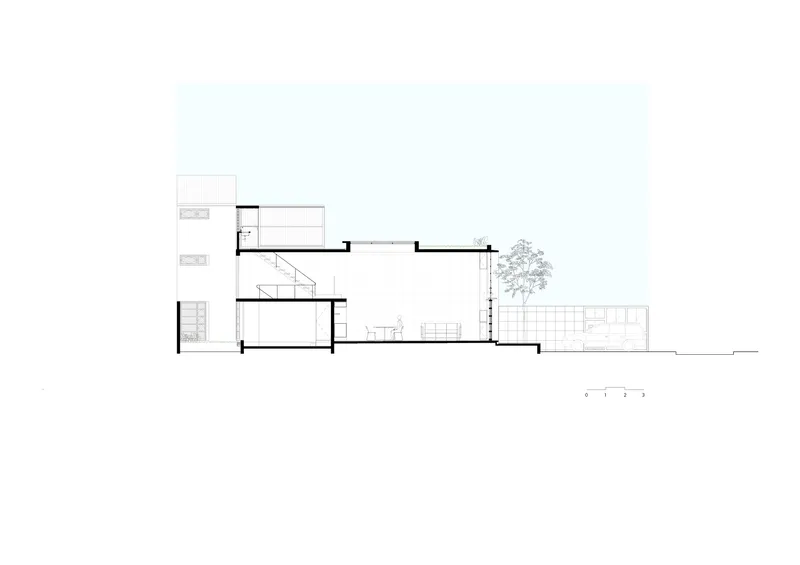
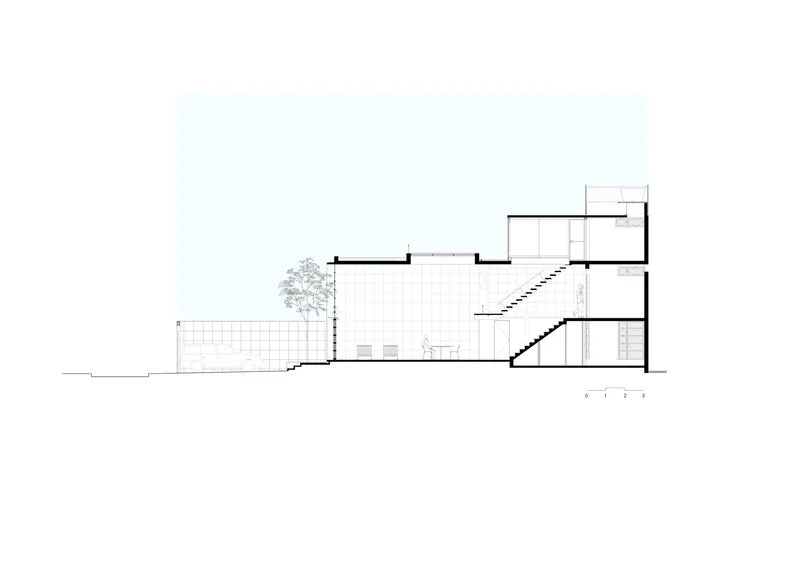
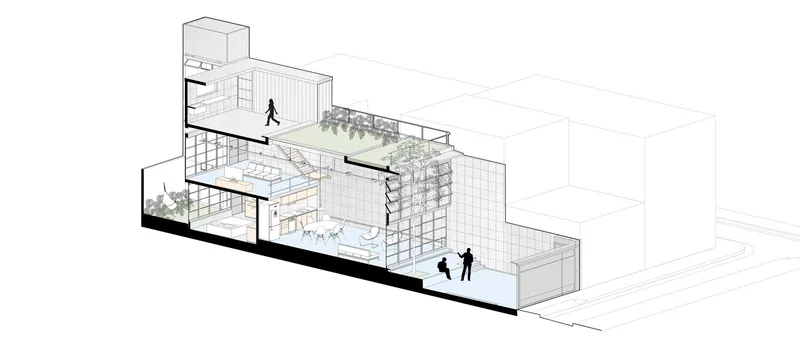
The floor plans reveal the strict linearity of the lot: rooms are arranged in sequence from street to rear, with the courtyard carved out at the center to distribute light and air to both sides of the plan. The section drawings are where the design logic becomes clearest. Stacked volumes, half-levels, and planted terraces interlock to squeeze maximum spatial variety from a narrow, deep footprint. The axonometric drawing shows how figures occupy different levels simultaneously, reinforcing the architects' intent to make a small house feel communal and connected.
Why This Project Matters
The Residence in Pinheiros is a reminder that budget constraints and material modesty do not have to produce modest architecture. By investing design intelligence in section, light, and spatial sequence rather than in expensive finishes, 23 SUL delivers a house that is richer experientially than many projects costing multiples of its budget. The double-height void, the courtyard, and the rooftop terrace are each distinct environments created within 118 square meters, proving that ambition and economy can coexist.
For architects working on tight urban lots across Latin America and beyond, this house offers a transferable lesson: treat the section as the primary design tool, use raw materials with discipline rather than apology, and let planting and light do the work of luxury. It is not a radical proposition, but it is executed here with enough clarity and conviction to warrant attention.
Residence in Pinheiros by 23 SUL (lead architects: Gabriel Manzi, Ivo Magaldi, Luis Pompeo, Luiz Florence, Moreno Zaidan Garcia, Tiago Oakley). São Paulo, Brazil. 118 m². Completed 2020. Photography by Pedro Kok.
About the Studio
Share Your Own Work on uni.xyz
If projects like this are the kind of work you want to make, uni.xyz is a place to publish your own, find collaborators, and enter design competitions.


Popular Articles
Popular articles from the community


Co-Life: Senior Housing Design That Reconnects Older Adults With the City
Co-Life reimagines senior housing design through healing gardens, shared streets, workshops, and a sustainable community across generations.

Little Red Riding Hood: Architectural Design as a Journey Through Fear, Light, and Storytelling
Little Red Riding Hood reimagines the fairy tale through architectural design shaped by fear, light, scale, memory, uncertainty, and choice.

ALGAL REALM: A Bio-Integrated Lunar Habitat Design for Life Beyond Earth
ALGAL REALM reimagines lunar habitat design with algae-powered life support, 3D-printed regolith, and vertical living for a lunar future.

Conexión: Biophilic Design Reimagines High-Rise Living in Hong Kong
Conexión reimagines high-rise living in Hong Kong through biophilic design, green facades, shared spaces, daylight, water and nature within.

Similar Reads
You might also enjoy these articles

Bao Huynh Watercolor Atelier: A Serene Art Retreat in Hội An
Bao Huynh Watercolor Atelier in Hội An blends multifunctional art spaces, sustainable design, local materials, and family-friendly living in a serene environment.

Atelier Macri Concept Store Interior Design by CASE-REAL
Atelier Macri store features a "ko" counter, walnut wood details, cork displays, blending retail, gallery, and seamless customer experiences.

Manuel Vargas Izquierdo Stadium and High-Performance Sports Center: Architectural Excellence in Jalpa de Méndez
The Manuel Vargas Izquierdo Stadium blends sustainable design, inclusive sports facilities, and cultural-inspired architecture, revitalizing Jalpa de Méndez’s public spaces.

KAKR Buluh Awar Hall: Revitalizing Community and Ecology Through Bamboo Architecture
Community built bamboo hall revitalizes Buluh Awar village, empowering youth, restoring ecology, celebrating vernacular craftsmanship through sustainable architecture and culture.


Comments (0)
Please login or sign up to add comments
No comments yet. Be the first to comment!