
23o5Studio Threads a Courtyard Garden Through Every Floor of a Ho Chi Minh City House
F10 House stacks planted terraces and white volumes to bring sunlight and greenery into a dense Vietnamese urban block.


Ho Chi Minh City keeps building outward, and its new residential quarters keep getting tighter. Row houses multiply across freshly platted blocks, each one locked between party walls with a narrow street frontage and almost no room to breathe. Most builders respond by sealing the envelope and turning on the air conditioning. 23o5Studio, led by architect Ngô Việt Khánh Duy, took the opposite position with F10 House: crack the section open, thread a garden vertically through the plan, and let every room negotiate its own relationship with light and air.
What makes this 122 square meter house worth studying is not the white minimalism, which is standard issue for the typology, but the discipline of the void. At every level, floor area is sacrificed for planted terraces and courtyards that stack upward, creating a continuous column of tropical vegetation from ground to roof. The result is a house that reads as a series of rooms interlocked with a garden rather than a garden tacked onto a house. That distinction matters in a city where green space is disappearing by the hectare.
A Facade That Breathes
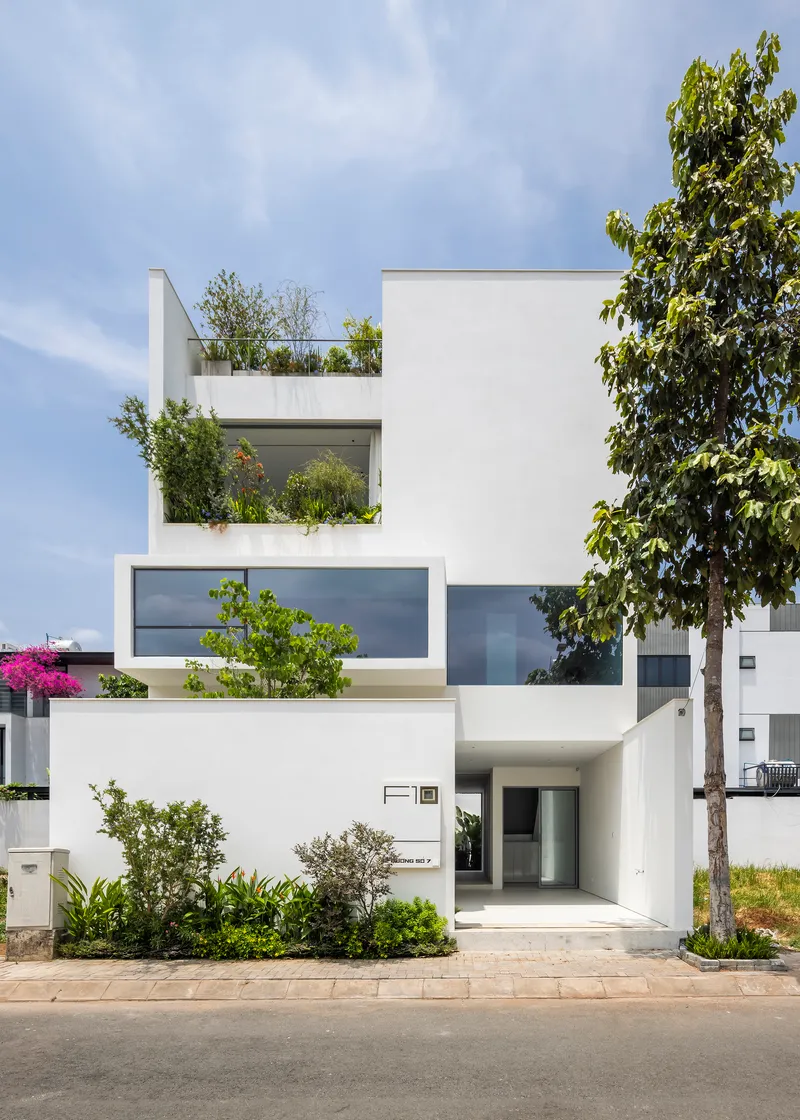
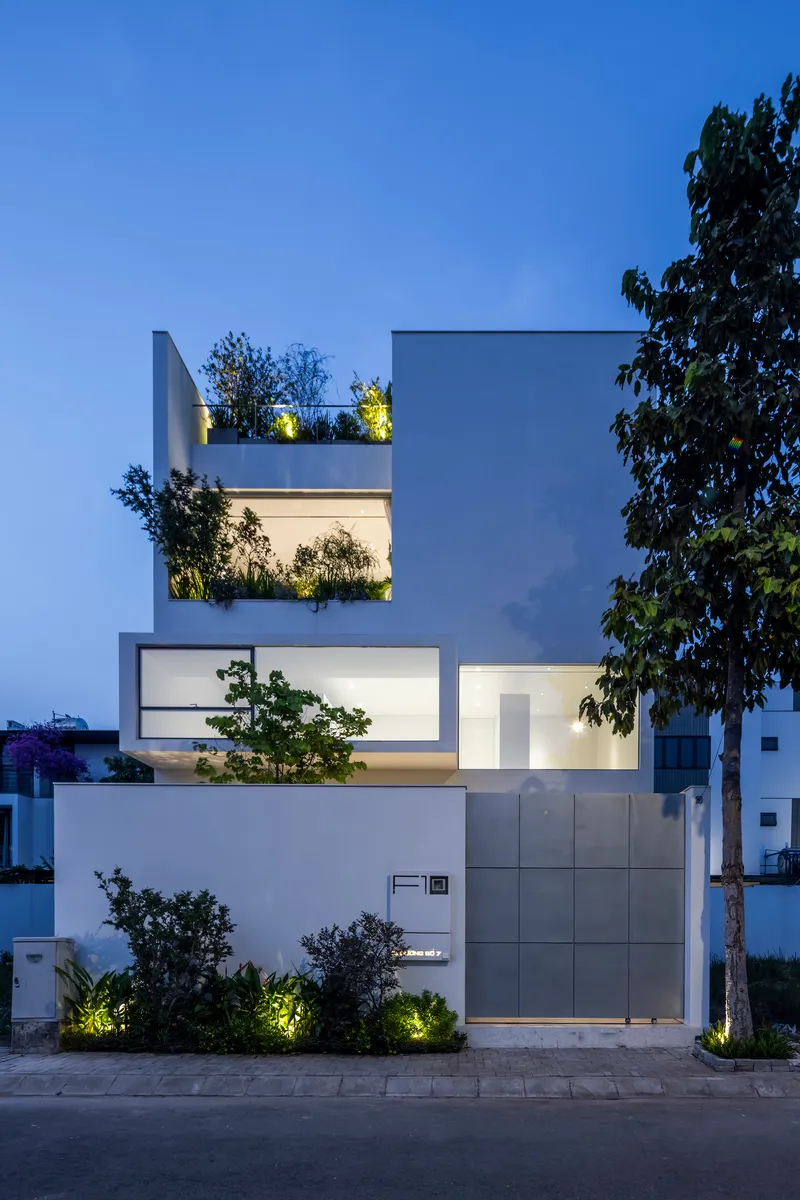
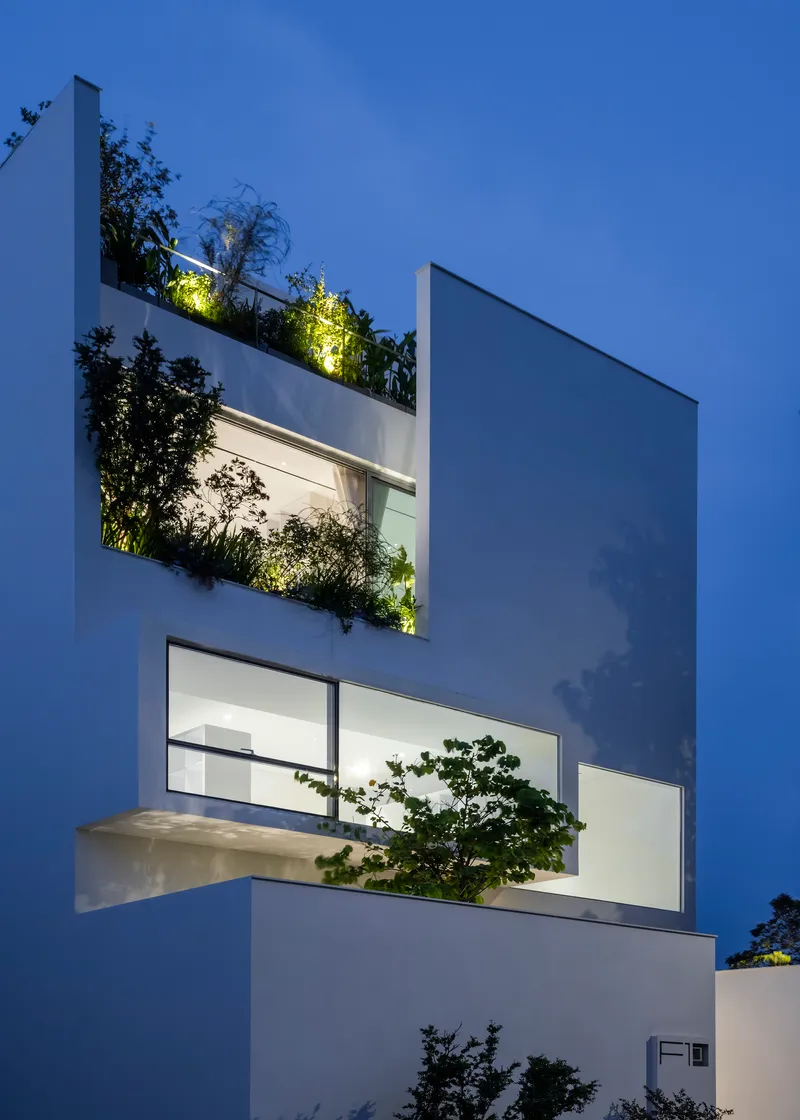
From the street, F10 House presents stacked white volumes that step back and cantilever forward in alternation. Each setback hosts a planted terrace visible through the gaps, so the facade becomes a layered section of architecture and vegetation. A mature street tree anchors the composition at ground level and softens the hard geometry above. At dusk, uplighting turns the greenery luminous against the white render, giving the house an almost theatrical presence on the block.
The stucco finish is deliberately plain, letting the planting do the visual work. There is no decorative screen, no perforated brick, no gratuitous material shift. The facade strategy is purely volumetric: pull a floor slab back, expose a garden, and let the resulting shadow tell you where one level ends and the next begins.
Ground Floor: Collapsing the Line Between Inside and Out
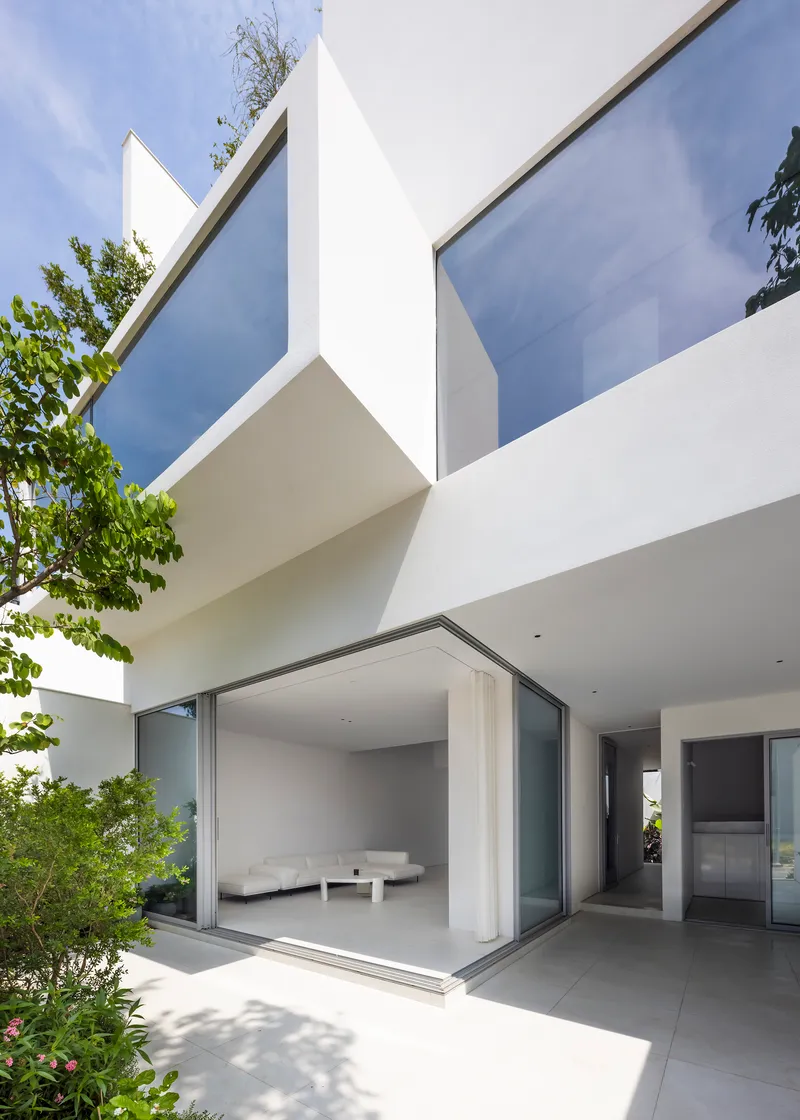
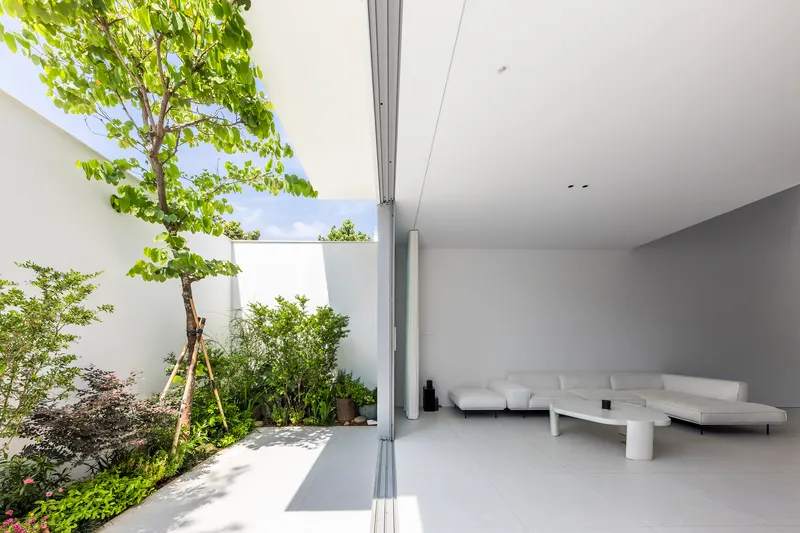
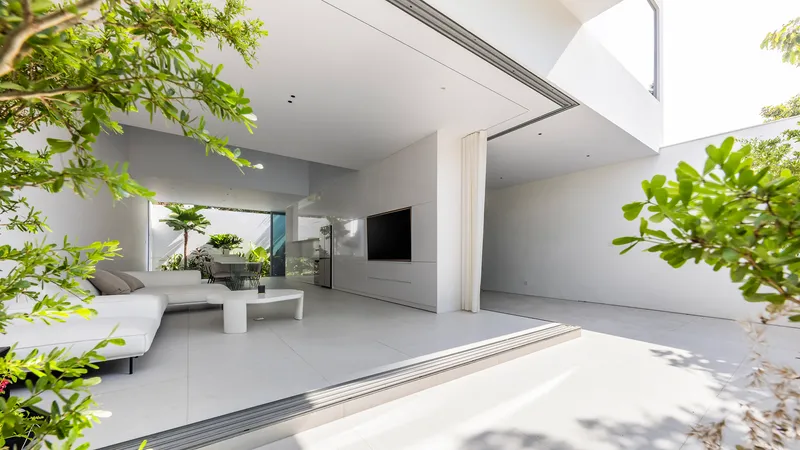
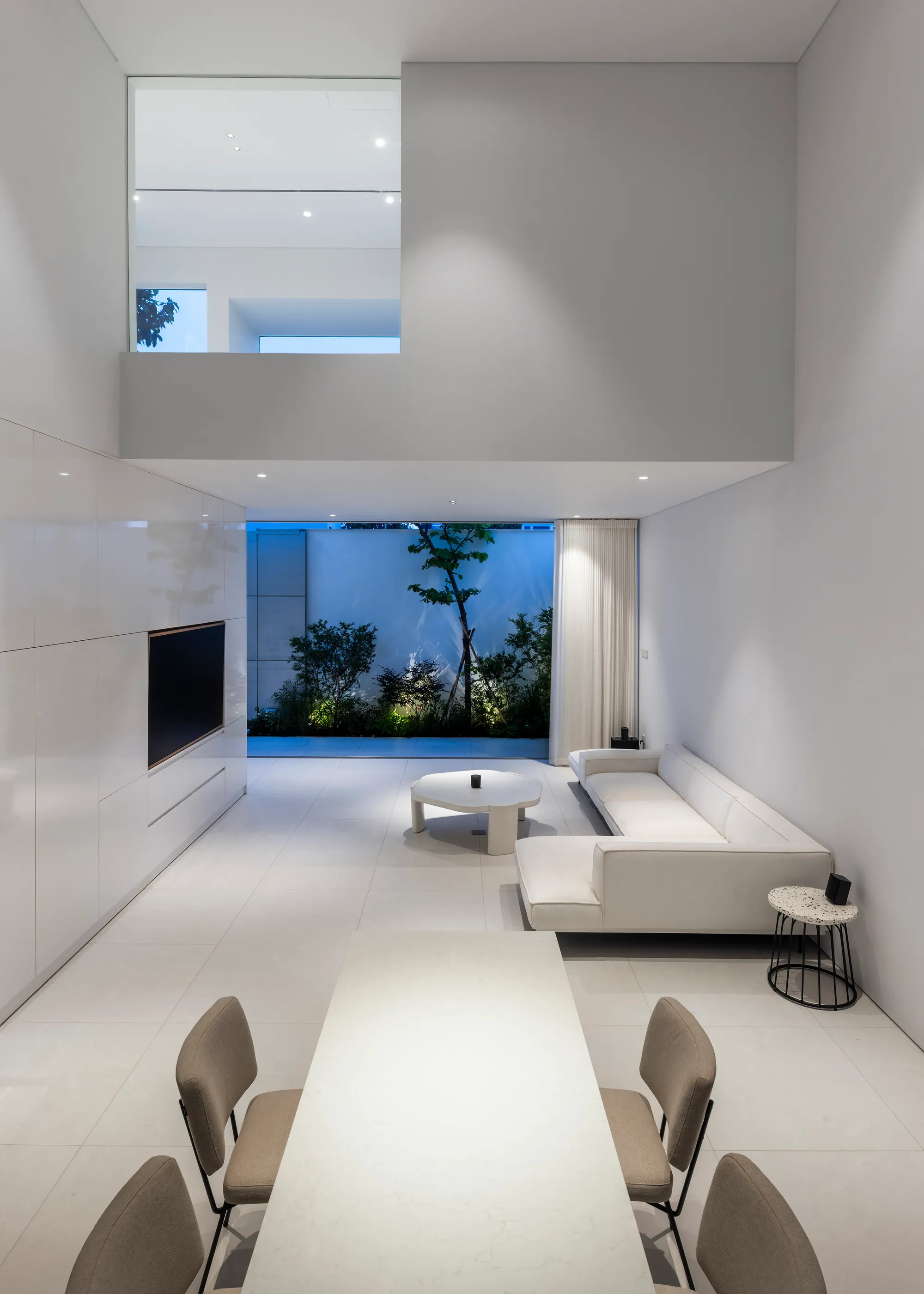
The ground level is where the courtyard idea is most legible. Sliding glass doors retract fully, merging the living space with a planted garden open to the sky. Tropical palms, ferns, and groundcover occupy the void, and dappled sunlight filters through the canopy onto white tile floors. When the doors are open, you are standing in a garden that happens to have a sofa nearby.
23o5Studio avoids the common trap of treating the courtyard as ornamental. Here it is structural to the plan: every adjacent room, the kitchen, the dining area, the living room, borrows light and ventilation from the void. Without it, the house would be a sealed corridor. With it, cross ventilation becomes possible even on the tightest urban plot.
Kitchen and Dining: Everyday Life Facing the Garden
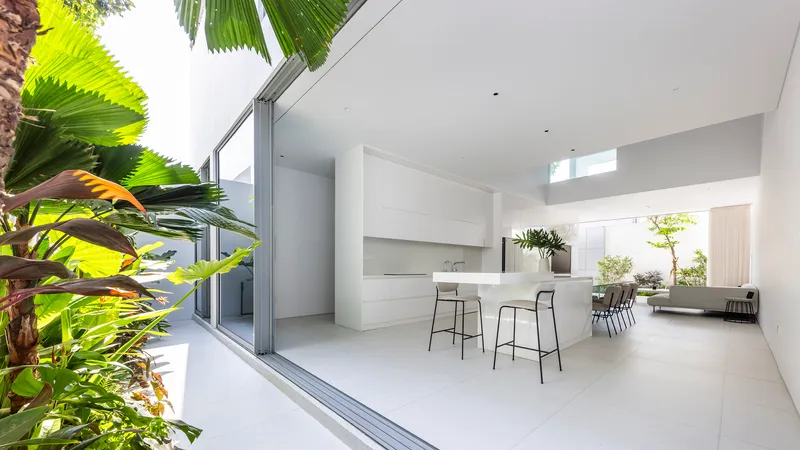

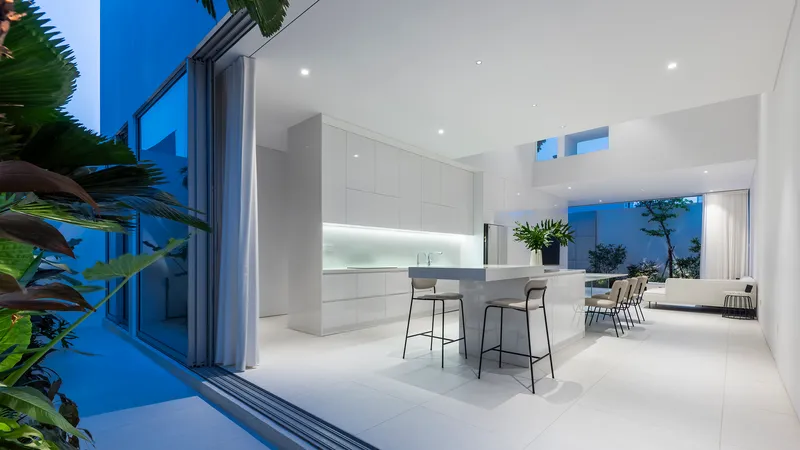
The kitchen sits at the heart of the ground floor plan, anchored by a white island with bar stools that faces the courtyard garden through a glass wall. White cabinetry and a clerestory window above keep the room bright without competing with the dominant green view. Palm fronds press against the glazing, making the boundary between cooking space and garden almost uncomfortably thin, which is exactly the point.
At dusk, the kitchen and dining area glow against the darkening foliage, inverting the daytime relationship. The tropical planting becomes a dark silhouette, the interior becomes the lantern, and the sliding doors remain open because the evening air is finally bearable. It is a house designed around the rhythms of a city where the temperature drops only after sunset.
The Double Height Void: Vertical Light
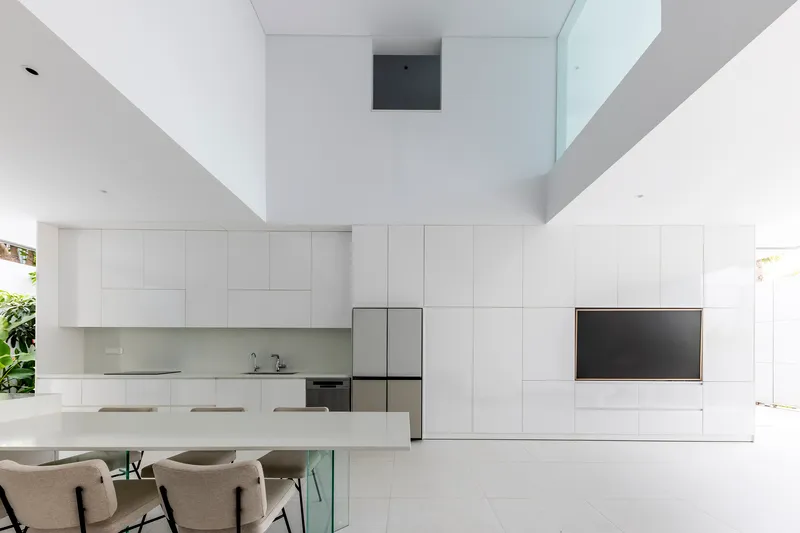
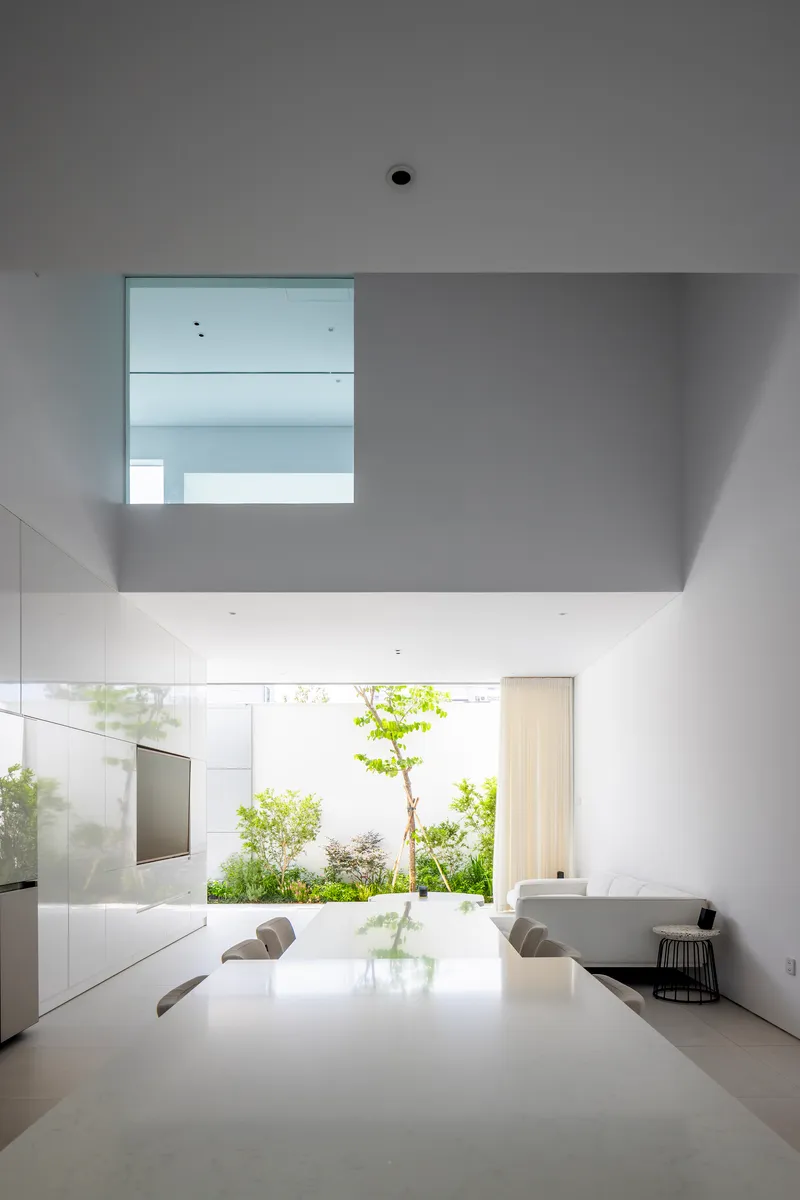
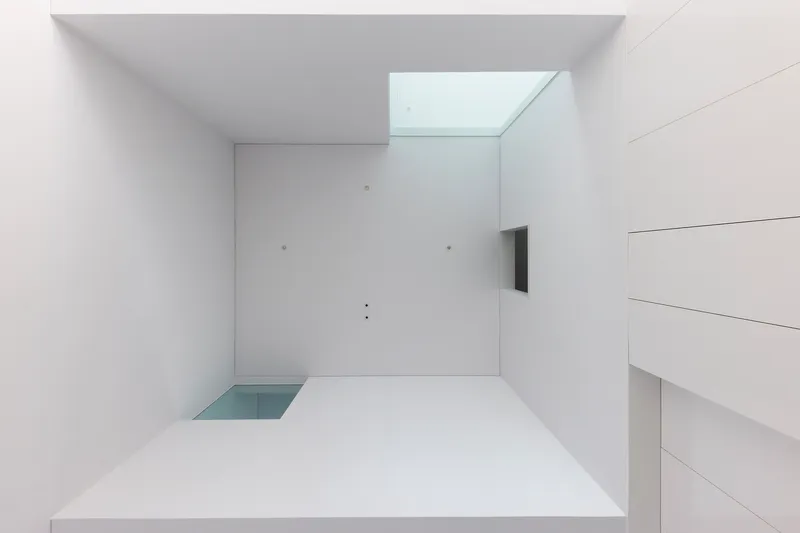
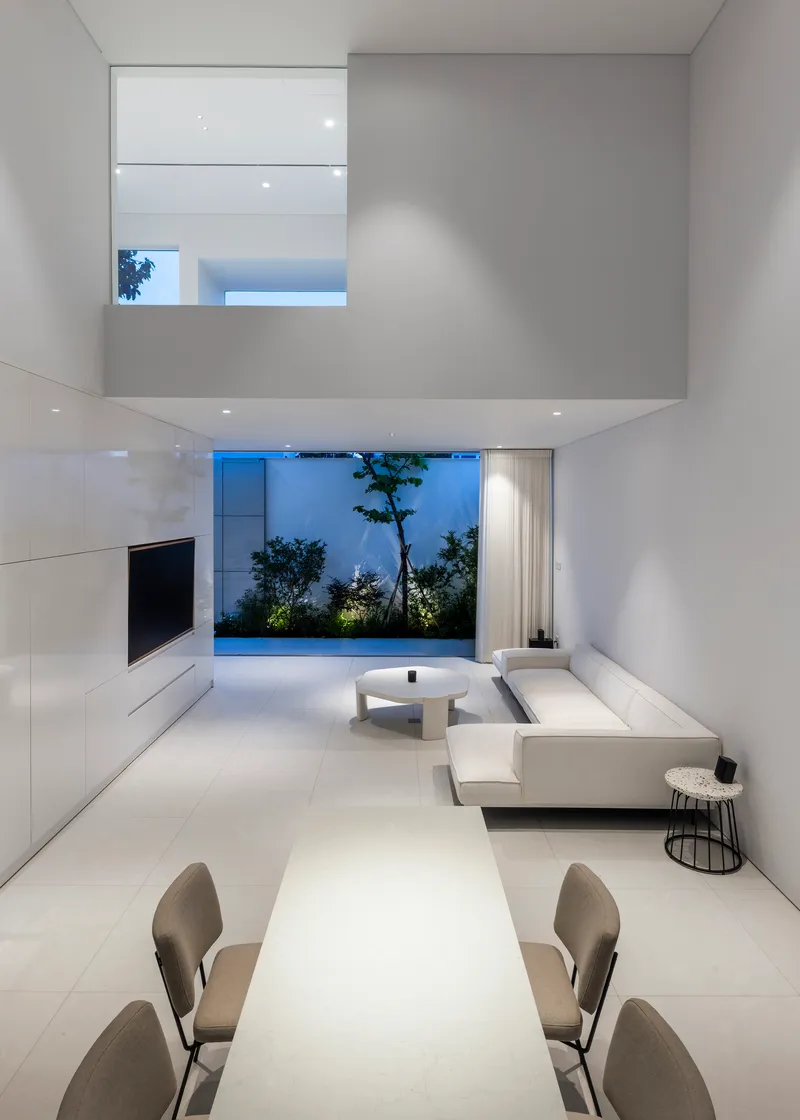
Above the dining table, the slab is cut away to form a double height void that pulls skylight deep into the center of the house. A mezzanine edge overlooks the space, and the eye travels upward past white walls to a recessed skylight panel at the ceiling. The effect is almost chapel-like in its restraint: pure white surfaces, a single shaft of light, and no ornament to distract from the spatial volume itself.
This is the move that prevents the house from feeling compressed despite its modest footprint. By borrowing height where it matters most, at the social core, the architects create a sense of openness that the plan alone could never deliver. It also stacks the garden view vertically: from the mezzanine above, you look down through the void, past the dining table, and out into the planted courtyard. Three layers of the house collapse into a single glance.
Upper Corridors and Bedrooms: White Volumes, Green Views
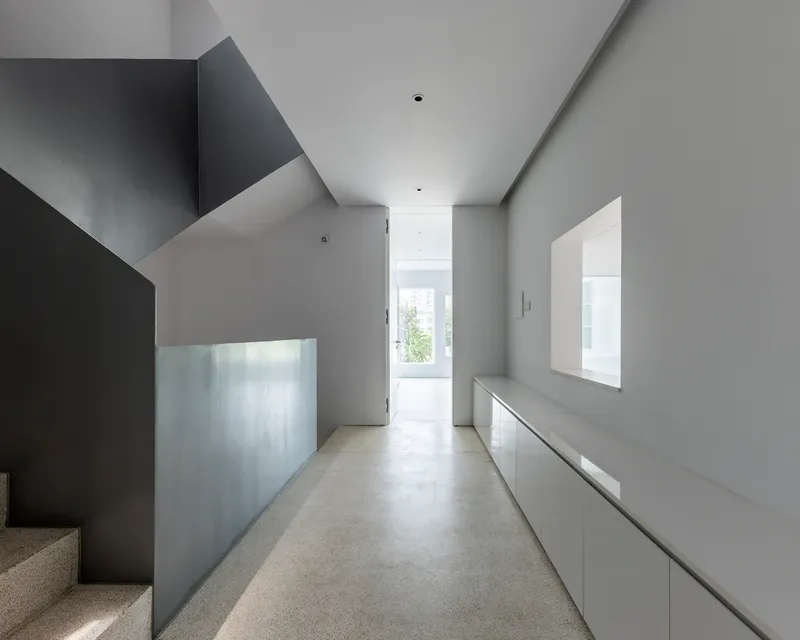
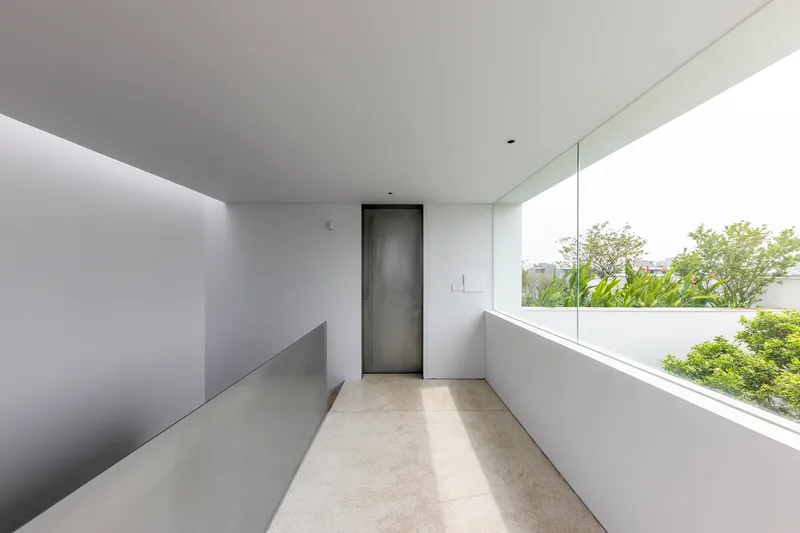
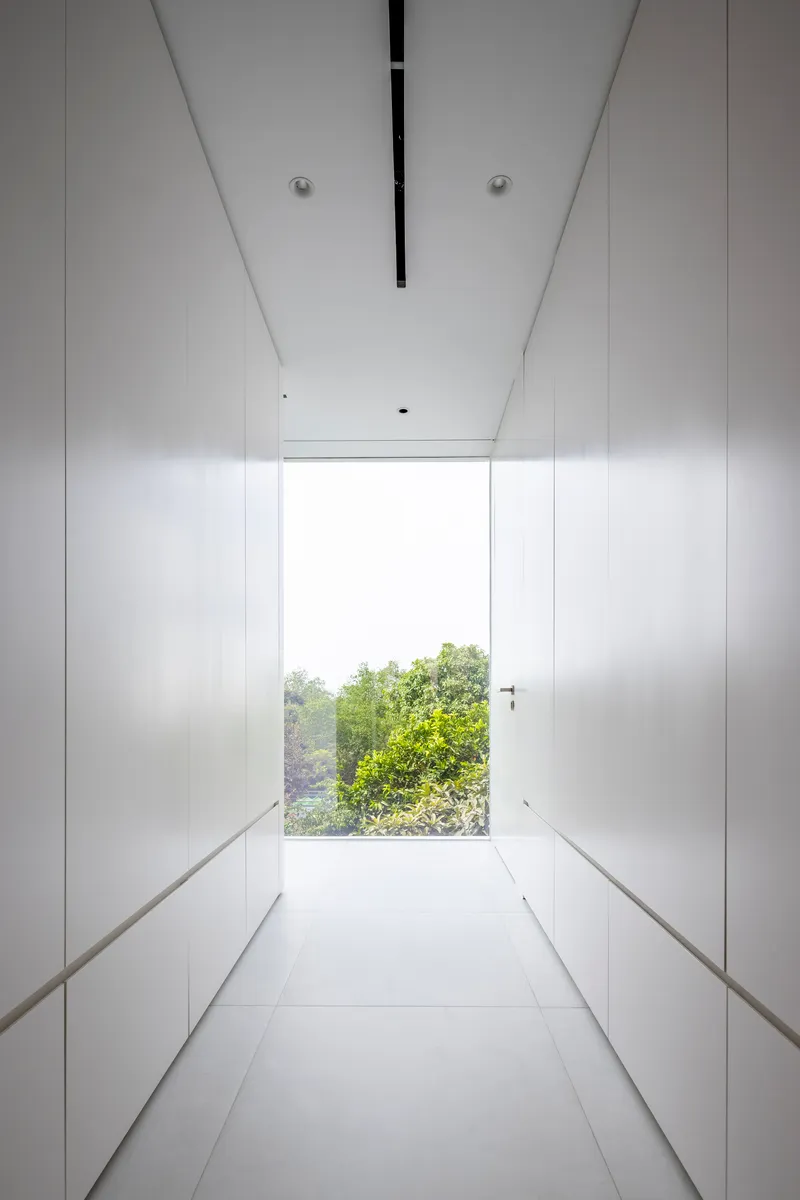
The upper levels are quieter in program and in palette. Terrazzo flooring replaces tile, angled ceiling planes compress and release the corridor sequence, and horizontal windows are carefully placed to frame the garden canopy rather than the neighboring apartment blocks. Full height storage cabinetry lines the corridors, turning circulation into usable wall area. There is no wasted surface.
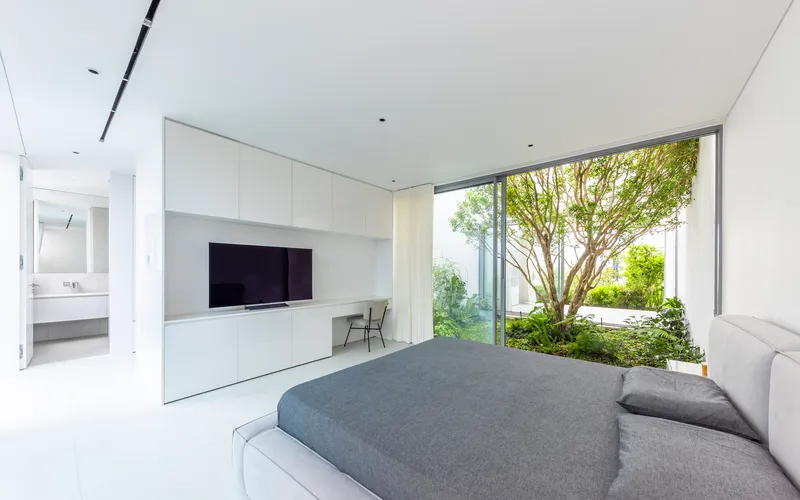
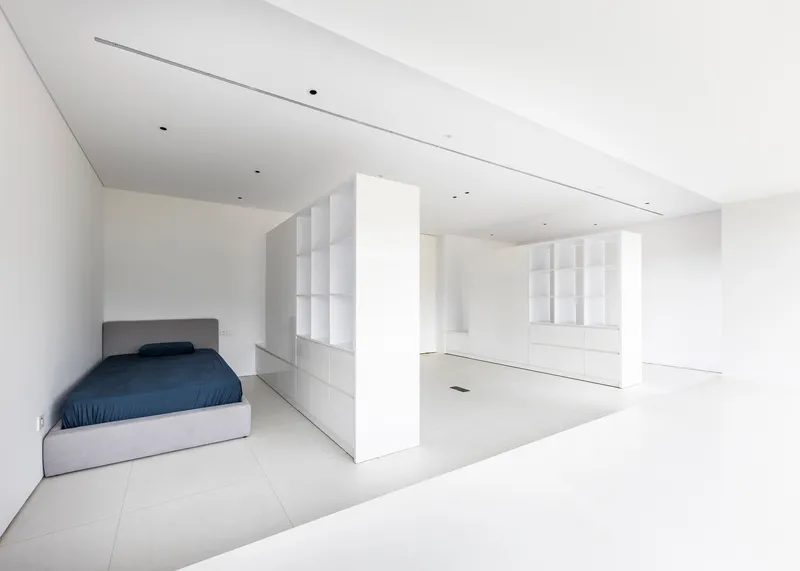

Bedrooms maintain the courtyard relationship through floor-to-ceiling glazing that opens directly onto planted terraces. One bedroom looks out at a mature multi-stemmed tree whose canopy fills the frame. Another uses a freestanding white partition to divide sleeping from storage without closing off the light path. At night, uplighted trees turn the bedroom views into something closer to a curated landscape painting than a typical urban window.
The Courtyard as Protagonist
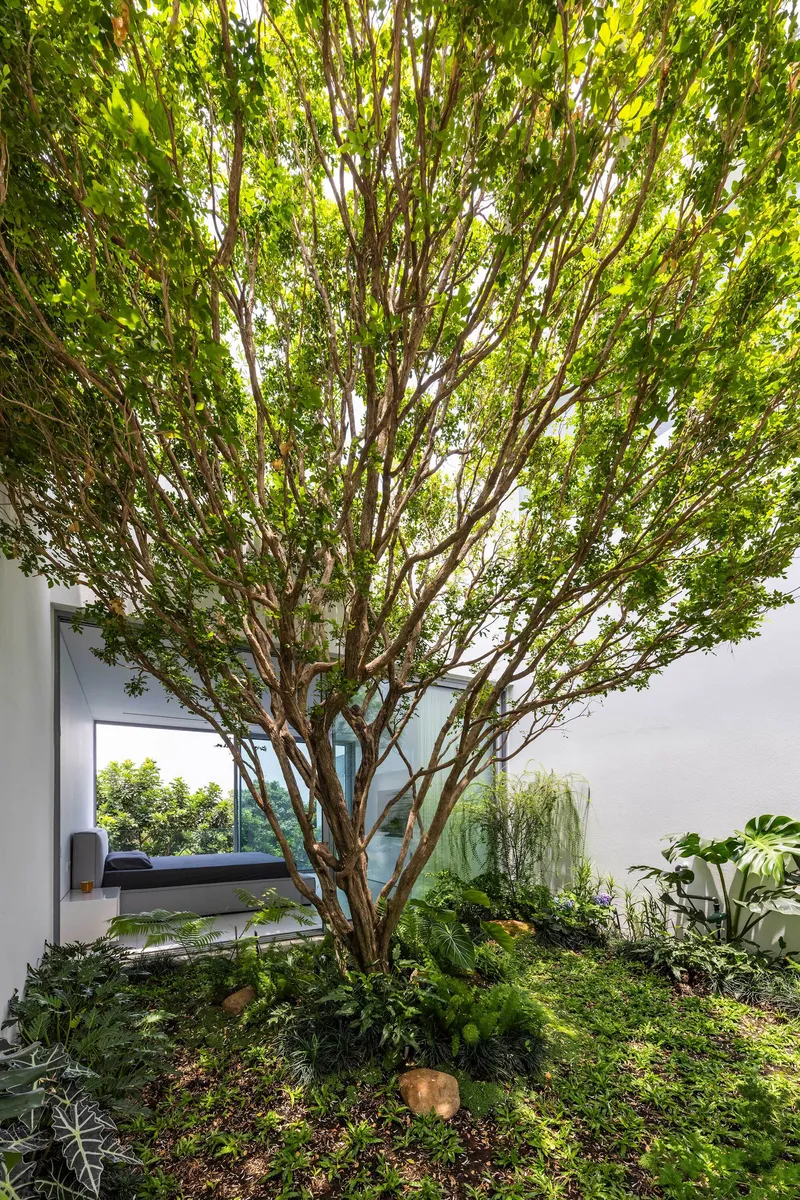
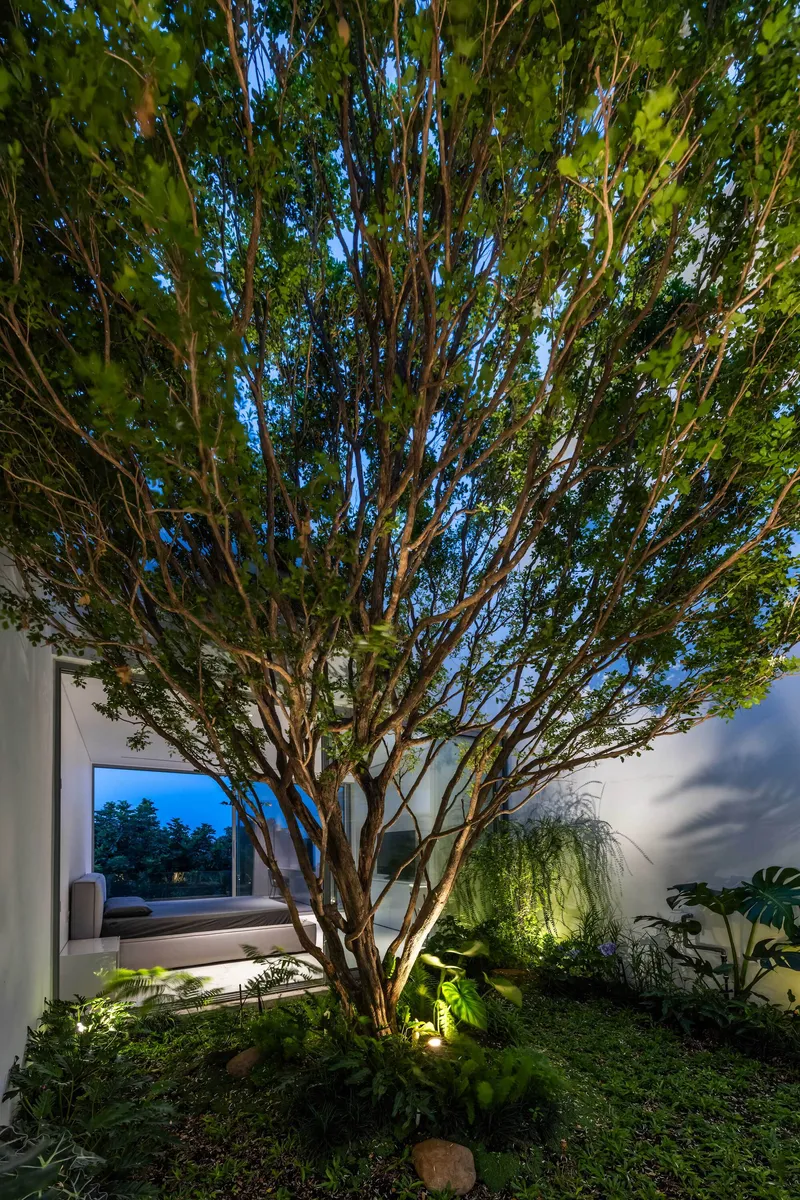
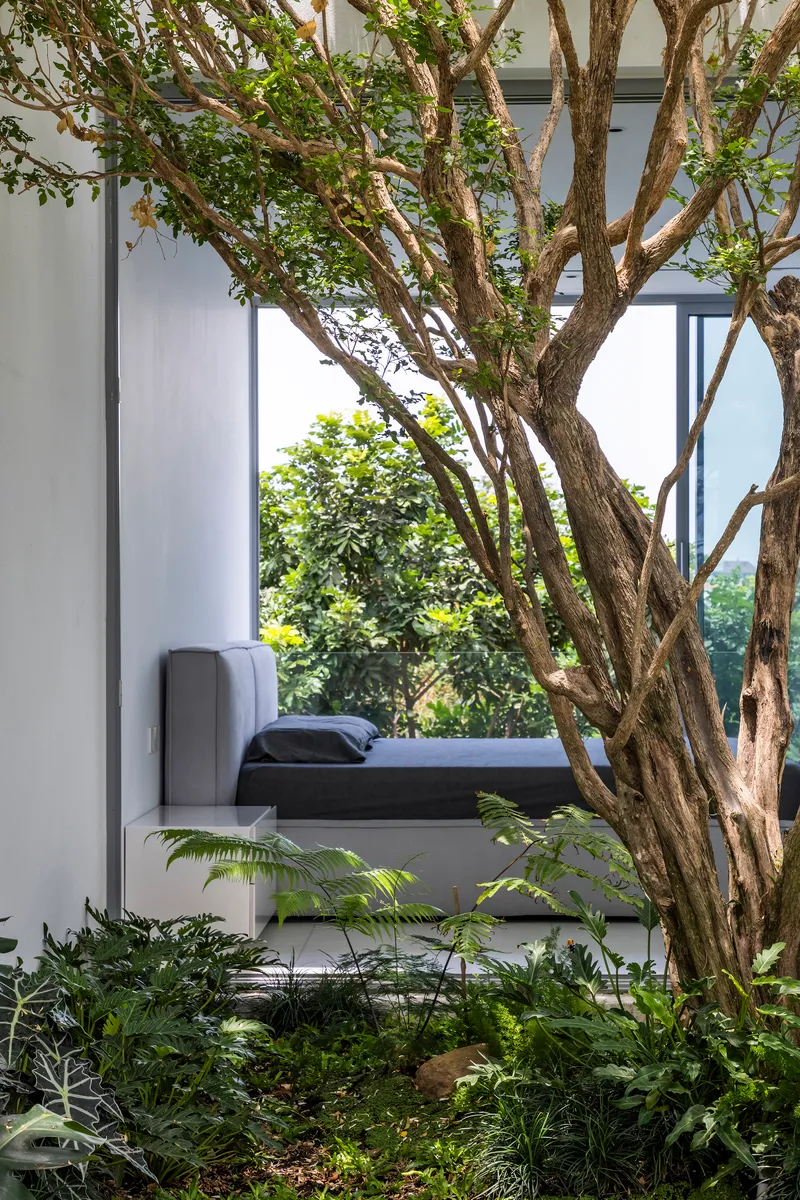
Strip away the furniture and the house is essentially a frame for its garden. The multi-stemmed tree at the center of the courtyard is the most important element in the composition: it anchors views from every floor, provides shade, and creates the shifting light patterns that animate the white interiors throughout the day. Ferns and groundcover fill the base, softening the hard edges where wall meets soil.
23o5Studio understands that in tropical climates, the courtyard is not a luxury. It is infrastructure. It drives the stack effect that pulls hot air upward, it introduces humidity that tempers the dry chill of air-conditioned rooms, and it provides the biophilic contact that dense cities systematically eliminate. F10 House makes the case that even on a tight plot, a serious garden is non-negotiable.
Night Readings
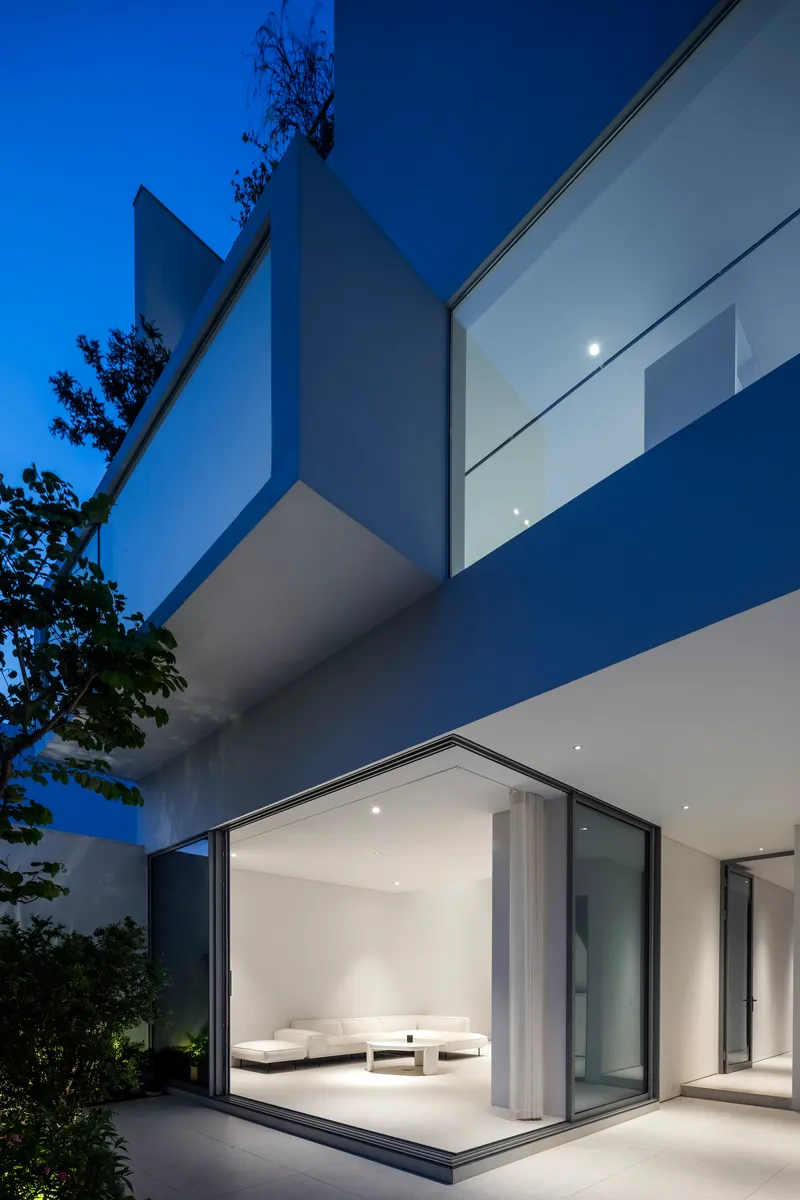
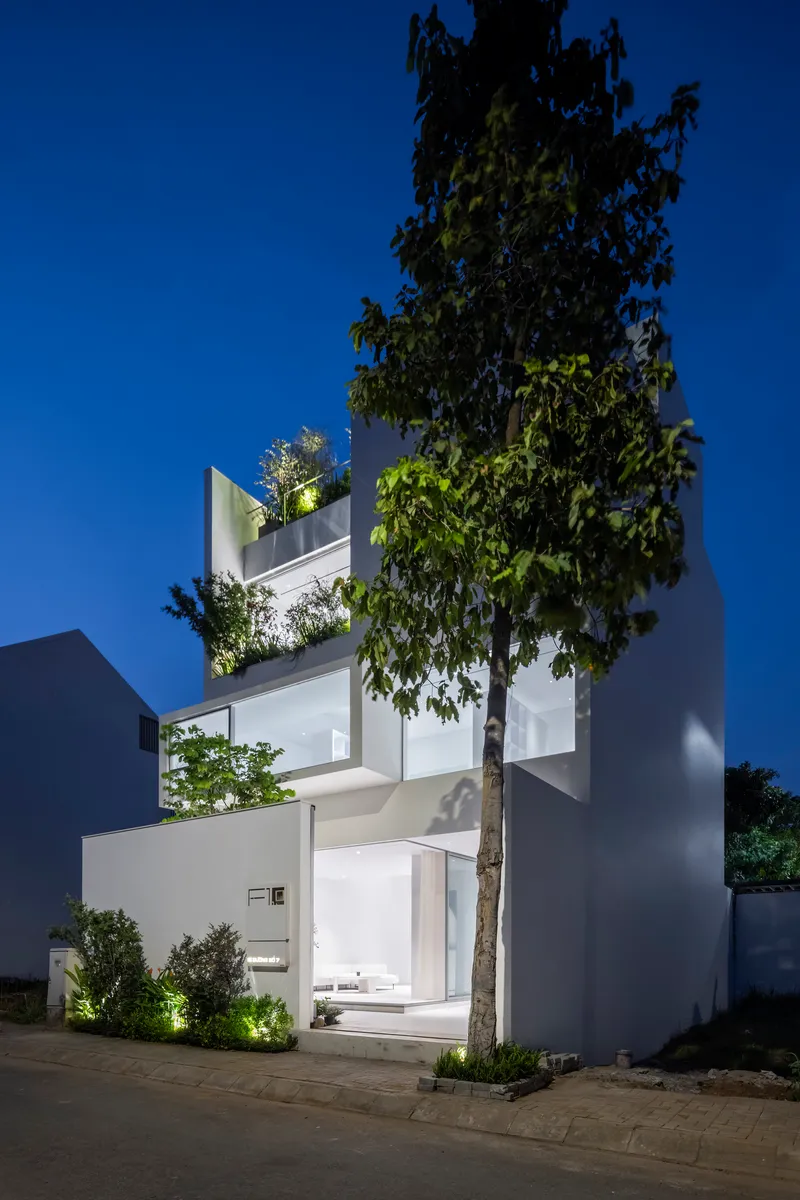
The house transforms at blue hour. The stacked volumes, which read as solid white masses during the day, dissolve into illuminated glass boxes framed by dark vegetation. The street tree that softened the facade in afternoon light now silhouettes against the glowing interior. Cantilevered floors hover above each other, their edges sharpened by contrast with the dark sky. It is a completely different building after sunset, and the architects clearly designed for both conditions.
Plans and Drawings
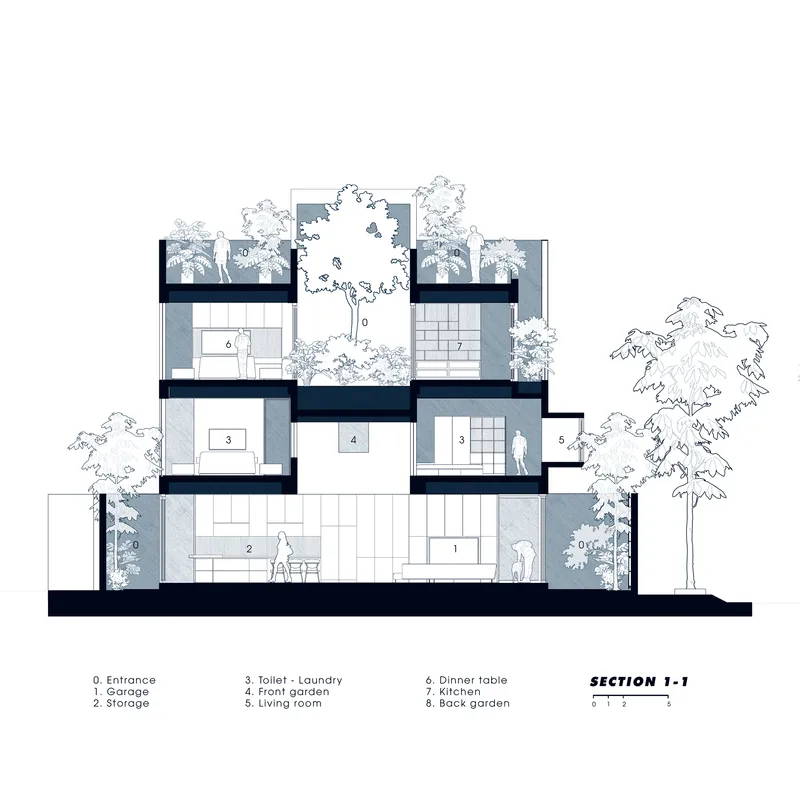
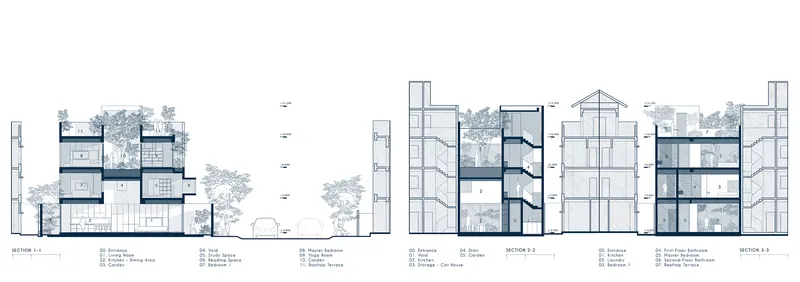
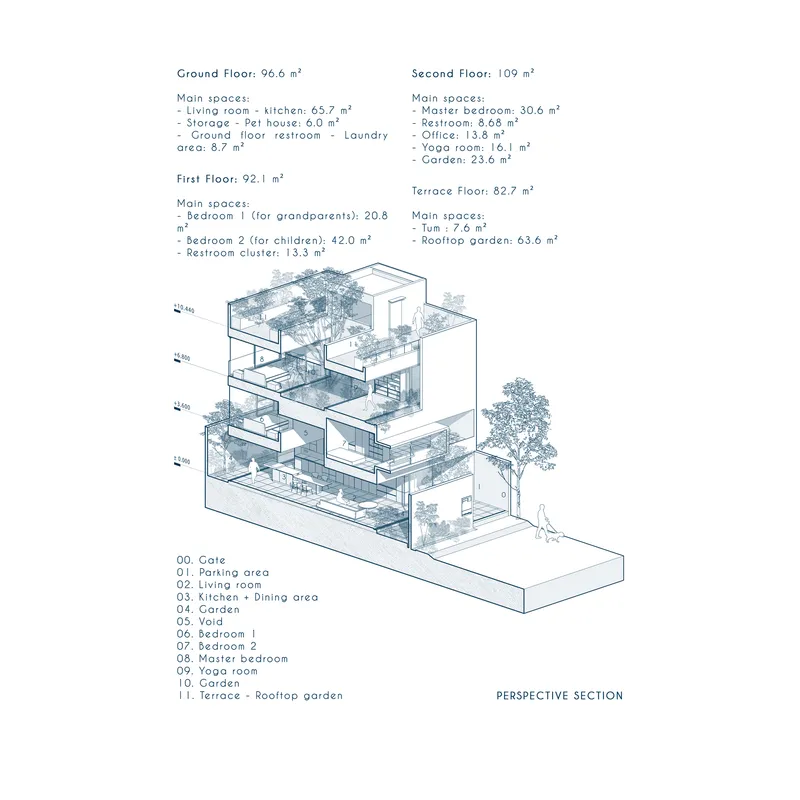
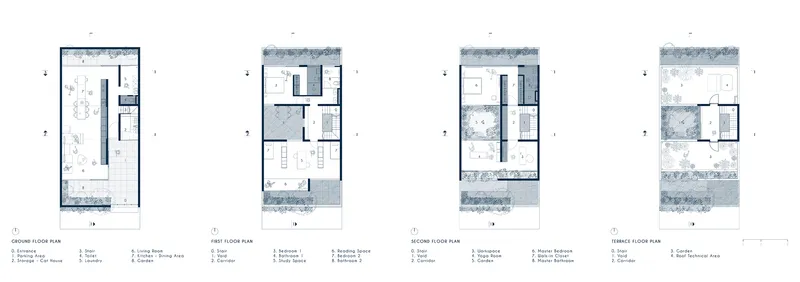

The section drawings are the most revealing documents. They show how the planted terraces are not simply balconies appended to a conventional stack but integral voids carved from the building mass at every level. Trees grow up through the section, their canopies reaching into the spaces two or three floors above where their roots sit. The floor plans trace the progression from ground level parking through social and private zones to a rooftop garden, with the courtyard void threaded consistently through every plate.
What the drawings confirm is the economy of the strategy. There is no structural gymnastics here, no complex steel transfers or cantilevered slabs beyond what a standard concrete frame can deliver. The architecture is in the subtraction: where floor area is removed, where walls are replaced with glass, and where soil replaces tile. The intelligence is organizational, not technical, and that makes the approach genuinely replicable across Ho Chi Minh City's expanding residential fabric.
Why This Project Matters
F10 House does not propose anything radical. Courtyard houses are ancient in Southeast Asia, and the idea of stacking gardens vertically has been explored by dozens of Vietnamese practices over the past decade. What 23o5Studio achieves here is precision of execution. Every floor plate sacrifices exactly enough area to make the garden work without making the rooms feel cramped. Every window is positioned to frame vegetation rather than a neighbor's wall. Every material decision, white render, white tile, terrazzo, white joinery, is in service of a single argument: let the garden be the color, the texture, and the focus.
In a city that is urbanizing at a pace that leaves little room for public green space, houses like F10 shift the burden of ecological amenity onto private architecture. That is an imperfect solution, but it is a real one. If the next thousand row houses in Ho Chi Minh City's new quarters borrowed even half of this strategy, the aggregate effect on microclimate, biodiversity, and daily quality of life would be substantial. The lesson is simple: stop building wall to wall, and start building around trees.
F10 House by 23o5Studio, lead architect Ngô Việt Khánh Duy. Ho Chi Minh City, Vietnam. Completed 2023. 122 m². Photography by Hiroyuki Oki.
About the Studio
Share Your Own Work on uni.xyz
If projects like this are the kind of work you want to make, uni.xyz is a place to publish your own, find collaborators, and enter design competitions.




Popular Articles
Popular articles from the community


The Musturak Paradise: Senior Living Architecture for a Connected Future in Temara, Morocco
The Musturak Paradise reimagines senior living architecture in Temara via private homes, social spaces, culture, community, and shared care.

Hill & Cross Opera: Sculptural Opera House Architecture Shaped by Tallinn’s Landscape and Identity
Hill & Cross Opera reimagines opera house architecture in Tallinn through its sculptural hill, civic plaza, glass wave and a luminous cross.

Riyadh For All: Intergenerational Urban Design for Active Aging in Rabat
Riyadh For All reimagines urban design in Rabat with intergenerational co-living, adaptive courtyards, and Moroccan cultural exchange today.
EW PARK: Sustainable Architecture Reimagines the Future of Urban Parking
EW PARK reimagines city parking as a modular wooden tower combining automation, solar energy, electric mobility, and adaptable urban design.


Similar Reads
You might also enjoy these articles

Bao Huynh Watercolor Atelier: A Serene Art Retreat in Hội An
Bao Huynh Watercolor Atelier in Hội An blends multifunctional art spaces, sustainable design, local materials, and family-friendly living in a serene environment.

Atelier Macri Concept Store Interior Design by CASE-REAL
Atelier Macri store features a "ko" counter, walnut wood details, cork displays, blending retail, gallery, and seamless customer experiences.

Manuel Vargas Izquierdo Stadium and High-Performance Sports Center: Architectural Excellence in Jalpa de Méndez
The Manuel Vargas Izquierdo Stadium blends sustainable design, inclusive sports facilities, and cultural-inspired architecture, revitalizing Jalpa de Méndez’s public spaces.

KAKR Buluh Awar Hall: Revitalizing Community and Ecology Through Bamboo Architecture
Community built bamboo hall revitalizes Buluh Awar village, empowering youth, restoring ecology, celebrating vernacular craftsmanship through sustainable architecture and culture.




Comments (0)
Please login or sign up to add comments
No comments yet. Be the first to comment!