

Some Thoughts Hides a Two-Storey Coffee Lab Behind a Quiet Shanghai Facade
On a leafy Xuhui District lane, 3½ Coffee compresses an entire coffee culture into 100 square metres of timber, terrazzo, and yellow light.


The French Concession streets of Shanghai reward restraint. Taiyuan Road, lined with plane trees and low-rise lane houses, punishes anything that shouts. Some Thoughts understood this when they designed 3½ Coffee, a two-storey specialty coffee shop that announces itself with nothing more than a small sign reading "3½" beside a timber-framed window. The name itself is borrowed from the scoring system in professional Italian coffee competitions, where 3 points signify "good" and the half point represents the ambition to push just beyond that mark. It is a fitting ethos for a project that refuses to settle for convention in either its program or its spatial strategy.
What makes the project worth studying is not any single gesture but the compression. Within roughly 100 square metres, Some Thoughts fits a vestibule that functions as an emotional threshold, a ground-floor bar with no tables, and an upper-level chef's kitchen for product development and industry events. Every surface works double duty: the terrazzo bench is seating and display, the L-shaped counter is service point and social catalyst, the stairwell is circulation and color statement. The result is a café that feels bigger than its footprint and more serious than its casual street presence suggests.
A Facade That Belongs to the Street
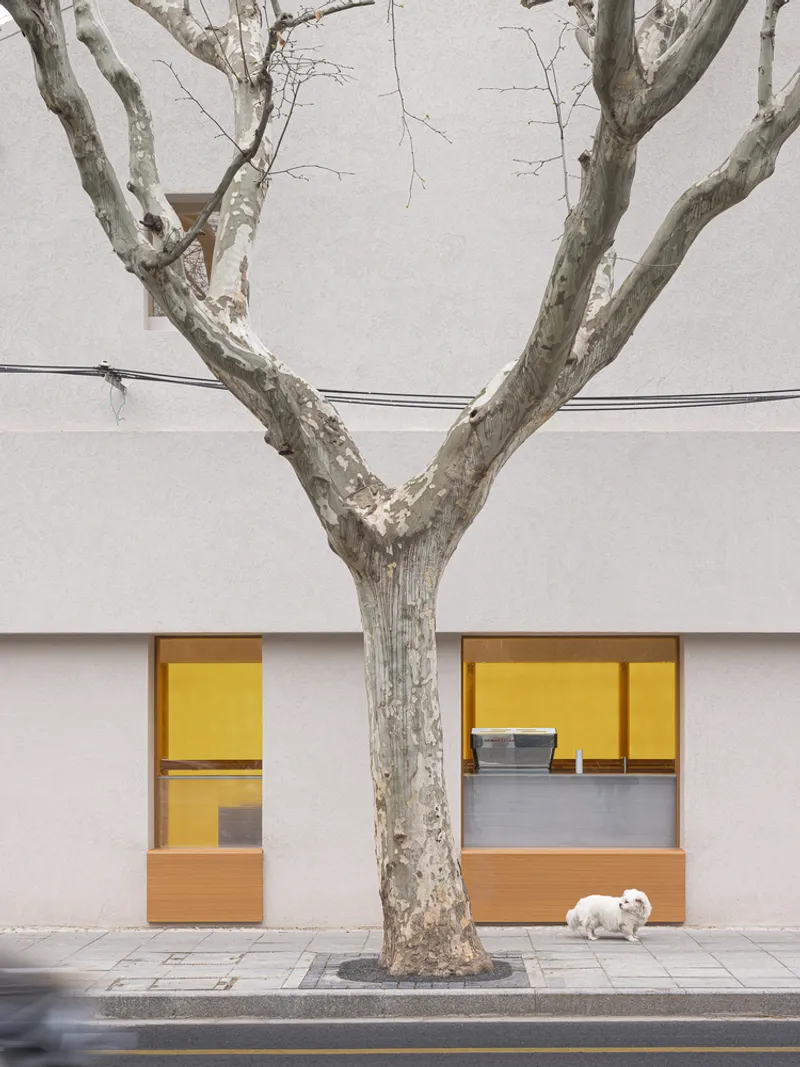
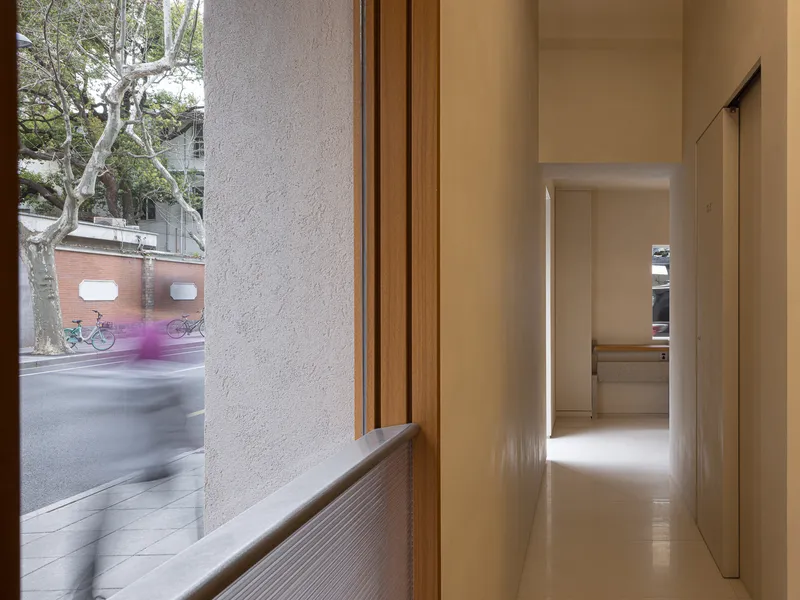
From the sidewalk, 3½ reads as a timber-framed shopfront that could have been here for decades. The window proportions echo the lane house vernacular of the Xuhui District, and the palette of natural wood against muted plaster deliberately refuses the glossy tile or blackened steel that so many Shanghai specialty coffee spots default to. A bare branching tree and a passing cyclist are enough to complete the composition. The architects have exercised a kind of disciplined self-effacement: the building does not compete with its context, it participates in it.
The timber bench set into the street-facing window is a small but telling detail. It frames the view outward, turning the city itself into the backdrop for the coffee experience. Patrons sitting here are half inside, half on the street, a deliberate blurring that keeps the café connected to its neighborhood rather than sealed off from it.
The Vestibule as Emotional Threshold
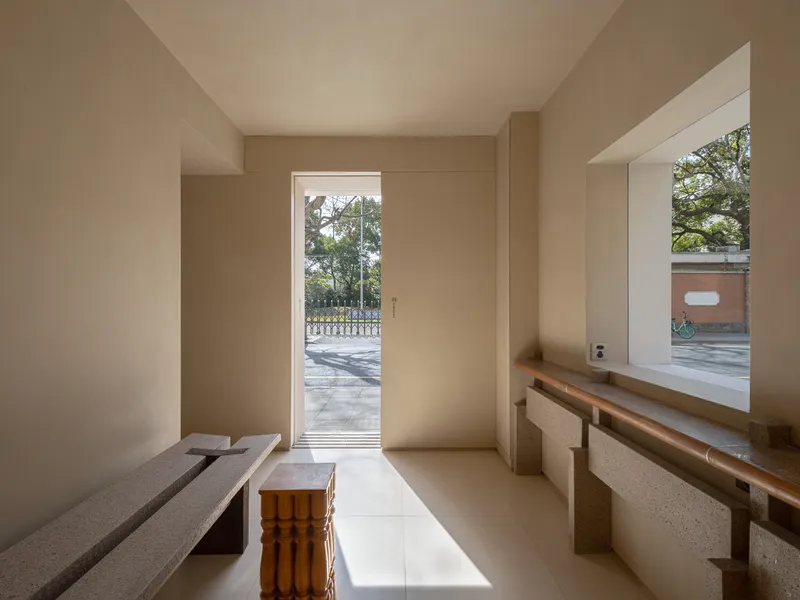
You enter through a narrow doorway into what Some Thoughts treats as a monastic-like vestibule. A terrazzo bench and a timber stool sit opposite a glazed door, and a slender sculptural piece made from upcycled wooden balusters found on the property occupies the center of the room. The move is deliberate: before you reach the coffee counter, you pause. The scale drops, the noise of the street recedes, and you shift gears from pedestrian to guest.
The balusters are worth noting because they reveal an attitude toward material. Rather than sourcing everything new, Some Thoughts salvaged existing elements from the building and recontextualized them as a sculptural focal point. It is a quiet statement about continuity, suggesting that the café's identity is layered onto the history of the building rather than erasing it.
Yellow as Spatial Punctuation
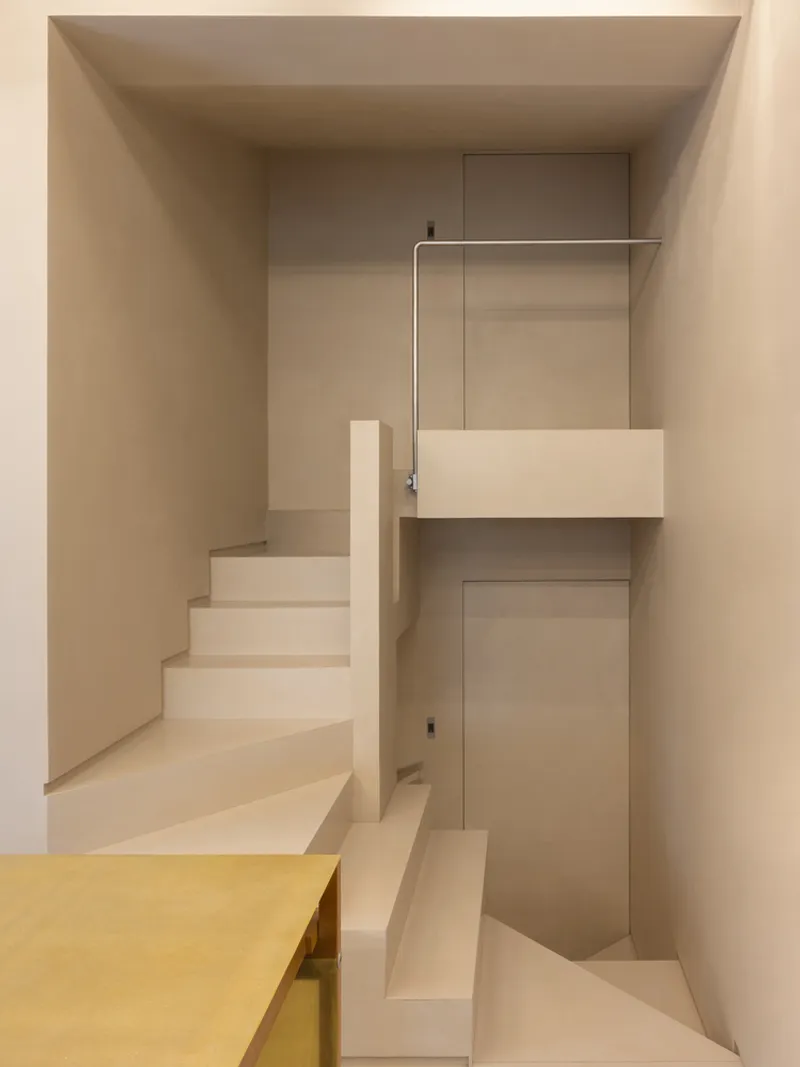
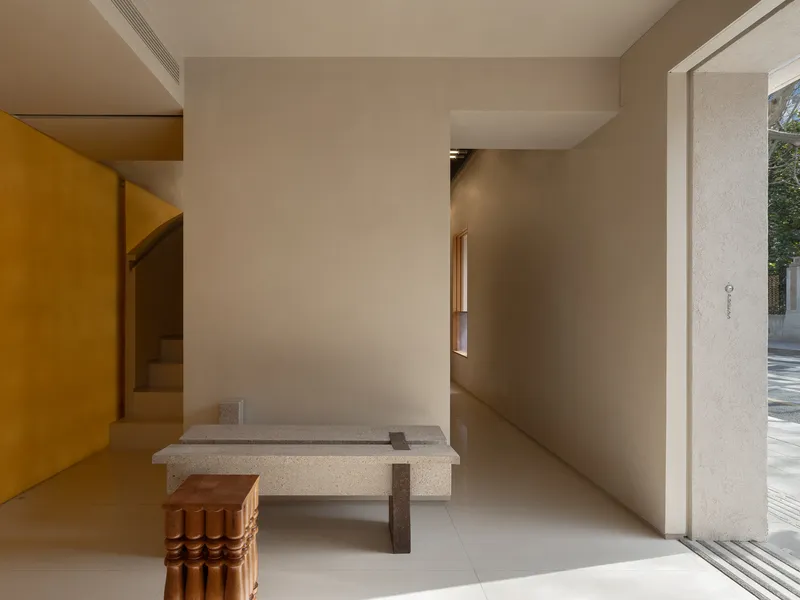
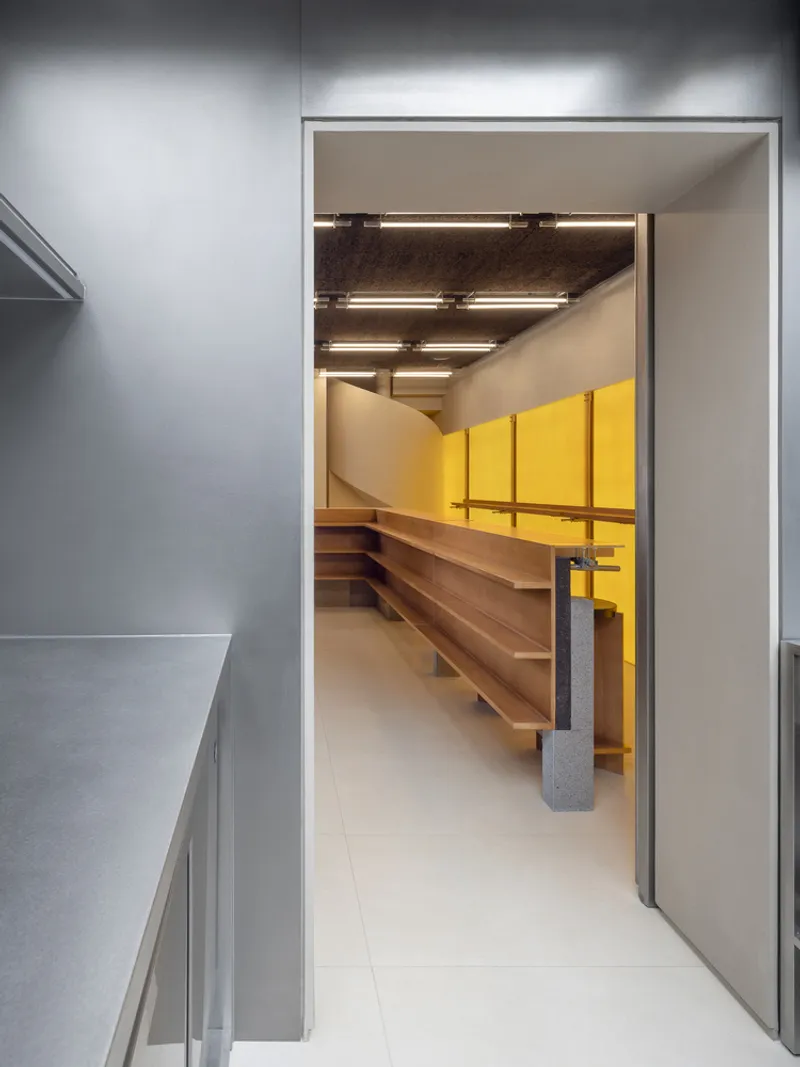
The stairwell is the loudest element in an otherwise muted interior, and it earns its volume. A saturated yellow partition wall separates ascending and descending runs, turning the vertical circulation into a moment of color that you glimpse from almost every point on the ground floor. Against the plaster walls and exposed concrete ceiling, the yellow operates like a marker: it signals movement, draws the eye upward, and hints at the second programme waiting above.
Some Thoughts uses color sparingly enough that this single intervention carries real weight. The yellow reads through doorways and corridors, appearing in fragments as you move through the plan. It gives the compact space a visual thread, pulling ground floor and upper floor into a legible whole without resorting to an open double-height volume that the footprint could not afford.
The Counter as Social Infrastructure
There are no tables at 3½. The entire ground-floor seating programme consists of a bar-height counter running parallel to the serving counter, with stools made from wood and carbonized cork. The L-shaped counter, built from wood, granite, and carbonized cork, maximizes the building's narrow footprint while forcing a particular kind of social behaviour. You sit facing the barista or side by side with other patrons. Conversation is not optional; it is architecturally encouraged.
Eliminating tables is a strong move for a café. It collapses the distance between preparation and consumption, turning every customer into a witness to the craft. The counter becomes the heart of the space in a way that a scattered table layout never could, and it reinforces the 3½ philosophy: coffee here is not a background commodity but a performance worth watching.
The Upstairs Kitchen as Hidden Programme
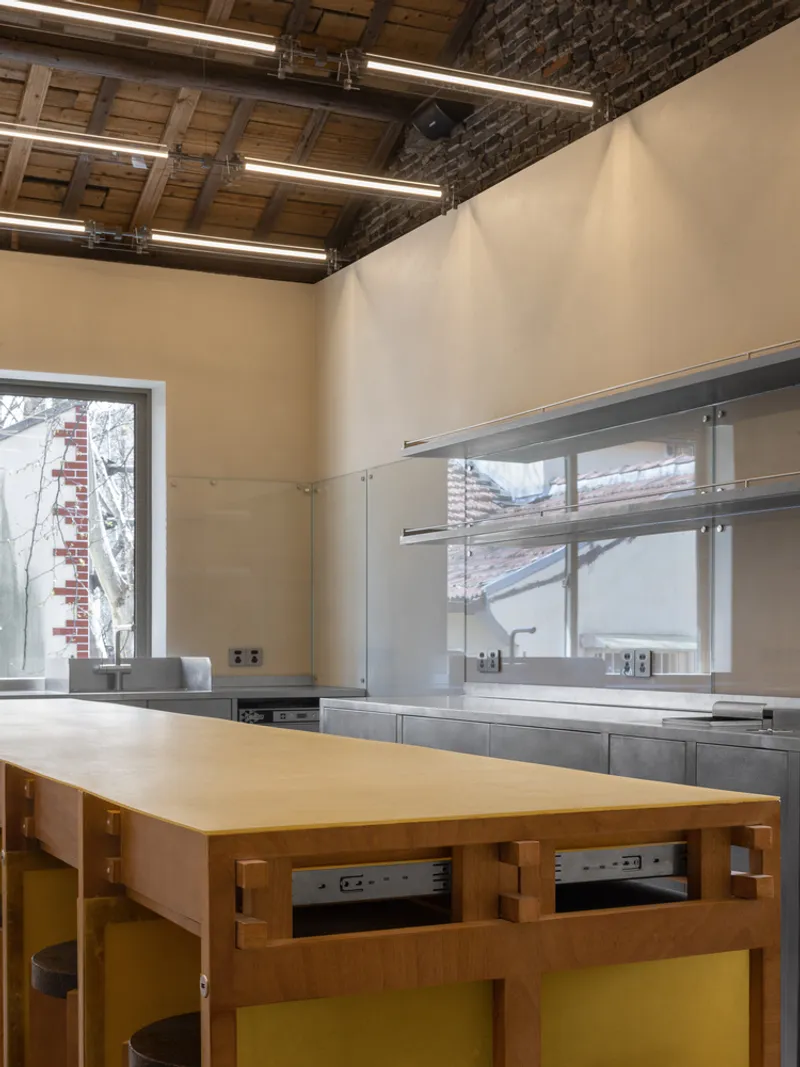
The upper floor reveals a different register entirely. An exposed brick ceiling and linear fluorescent fixtures give the chef's kitchen an industrial directness that contrasts with the warm minimalism below. A lengthy timber island anchors the room, serving as workspace for product development, a meeting table for industry gatherings, and an event surface for creative programming. Stainless-steel cabinetry lines the perimeter, and the mood shifts from hospitality to laboratory.
This dual identity is what separates 3½ from the hundreds of specialty coffee shops now competing for attention in Shanghai. The ground floor is public-facing and social; the upper floor is semi-private and productive. Some Thoughts has essentially stacked two programmes into one building, giving the brand a space that can evolve its offerings without outgrowing its physical container. The yellow acoustic panels that appear in glimpses through doorways tie the two levels together, a reminder that the same design intelligence governs both floors.
Why This Project Matters
Shanghai's specialty coffee scene has exploded in the past five years, and with it has come a familiar set of design tropes: raw concrete, blackened steel, neon signage, and Instagram-ready corner booths. 3½ rejects nearly all of them. Its materials are warm and specific. Its layout is opinionated, choosing the counter over the table. Its facade blends into the French Concession rather than disrupting it. These are not radical choices individually, but taken together they describe a coherent position: that a café can be architecturally serious without being architecturally loud.
Some Thoughts has also demonstrated something practical about working within extreme constraints. At 100 square metres across two floors, there is almost no margin for wasted space, and the architects waste none. Every element, from the vestibule sculpture to the yellow stairwell to the tableless ground floor, serves both a functional and an atmospheric purpose. The project is proof that compression, when handled with discipline, produces intensity rather than claustrophobia. That lesson extends well beyond coffee shops.
3½ Coffee by Some Thoughts. Located on Taiyuan Road, Xuhui District, Shanghai, China. 100 m². Completed in 2023. Photography by SFAP.
About the Studio
Share Your Own Work on uni.xyz
If projects like this are the kind of work you want to make, uni.xyz is a place to publish your own, find collaborators, and enter design competitions.


Popular Articles
Popular articles from the community


GROUP A Strips a 1969 Rotterdam Harbor Headquarters to Its Frame and Wraps It in Timber Louvers
In Rotterdam's M4H harbor district, Ferro Offices reuses a 1969 frame, adds one timber storey and reaches BREEAM-NL Outstanding.

U.GA Architects Wraps an Oval Rooftop Pool in Curved Board-Formed Concrete on Busan's Jeollidan-gil
In Busan's Jeonpo-dong, a 454 m² mixed-use block stacks a neighborhood facility, guest rooms and an oval rooftop pool inside spiraling concrete walls.

David Ortega Stacks a Two-Story Mexico City Penthouse Around a Steel Stair and a Pergola-Shaded Roof Terrace
In Colonia Roma, a 300 m² penthouse uses oak joinery, a planted steel stair and a slatted roof pergola to make a new-build apartment feel like a house.

longwave studio Reorganizes a 112 m² Tainan Apartment Around the Daily Routines of a Family and Two Cats
In Tainan, Taiwan, birch plywood, rust-red furniture and a freestanding plaster wall link arrival, storage, work and family life in one apartment.

Similar Reads
You might also enjoy these articles


Hodi-Mandai Geram
Project Function: Preservation and revitalization of the Intangible heritage and socio-spatial identity of the Hodi by Housing, Cultural Memory Center, Sacred Grove, landscape, local tourism economy


Olio Towers: A Mid-Rise for Performers That Fuses Housing, Rehearsal, and Stage
Located blocks from Houston's Theater District, this modular tower stacks living units around a central performance atrium.

Oasis: Modular Green Housing Carved into Dhaka's Urban Fabric
A shortlisted Plugin Housing entry reclaims unauthorized settlements in Dhaka with stepped concrete volumes, green roofs, and ventilation-driven design.

Black Hole: A Floating Megastructure for the Post-Physical Era
Emiliano Mazzarotto envisions a spherical, self-scaling arena where e-sports, digital hotels, and holographic stadiums replace traditional public space.

Explore Cafe and Restaurant Design Competitions
Discover active competitions in this discipline

Challenge to design luxury tourism on rails

Challenge to reimagine the Iron Throne

Photograph architecture without architects

VR headsets Storefront design competition
Comments (0)
Please login or sign up to add comments
No comments yet. Be the first to comment!