
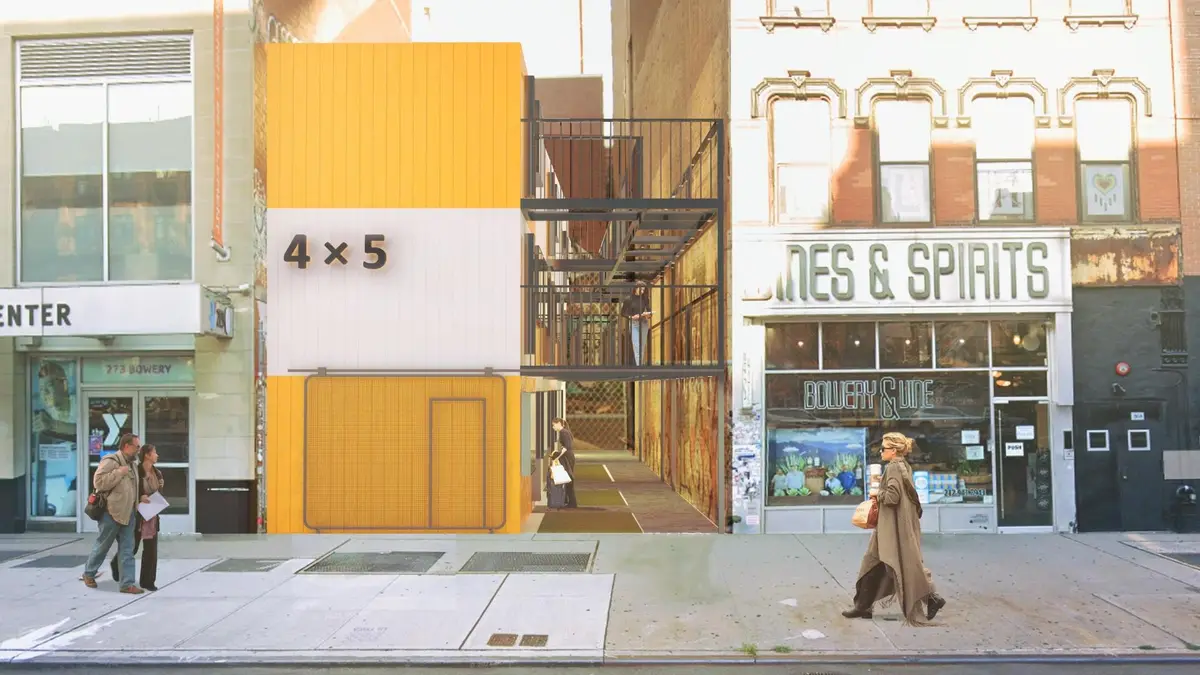
4 × 5
4m × 5m modular unit for compact living

The proposed site is in a narrow long rectangle shape that has a minimum width of 6.2 meters, and length of 27.55-meter, located in the central heart of New York City, surrounded by the three mid-rise buildings. The majority of its sunlight will be blocked by those neighboring buildings; therefore, the living units are placed on the west side near the entrance, and stacked along the north side of the property, leaving the service center placed on the back of the site. An exterior metal mesh hallway is placed on the opposite side of the property with 1.5m aways from the living units, in order to maximize sunlight reach into the housing and protect privacy.
This project requires the design of a living unit of temporary use that must be modular, and suitable for the small remaining vacant spaces around the city. The initial design idea came from shipping containers, which is a common and popular material that can be easily transformed into a living space and available in every country. Most importantly, its modularity in a variety of sizes and small width could fit into the small, oddly vacant of lands in the city effortlessly. The idea started with the shipping container and the detailed dimension is further developed because of the restrictions of the site and the project requirement. After investigating several left-behind spaces in the megacity, we decided to arrange our unit into 4 meters by 5 meters by 2.5 meters boxes.
The combination of stacking modular and additional walkway could easily fit into most abandoned spaces in the city through different arrangements. One of the examples we found is an unused open field in 277 Victoria St, Toronto,Canada. It is an triangular shaped land with around 200m2 of lot coverage, but only about ⅕ of the area on the south end is used for bicycle parking. By placing the 4x5 modular units on this site, this unoccupied downtown land can be transformed into a housing block to decrease the scarcity of housing. The roof area for any building is another possible location for emergency housing by stacking more of these modular units. The 4x5 modular unit can be also used as hiking cabins when placed in the forest, mountains, and hiking trails; its small-scale is beneficial for reducing environmental impact such as cutting down trees.
The unit is divided into two spaces by a sanitary section. One space includes an open kitchen and a living room, the other space contains a sleeping area and a study space. Due to the increasing demand for working remotely, the office/study area is taking most of the unit’s space. On the west side of the unit, a custom-designed storage shelf is placed, serving the main storage space for the whole unit. By minimizing the use of interior walls, living/dining/cooking spaces are integrated into one open space, which massively increases the utilization of the space. When the unit is occupied by more than one person, the living area and sleeping area can be separated into two rooms for multiple users to have their own individual space to work or study.
In terms of material choices, metal cladding is selected for the exterior finish due to its lightweight, high durability, and the possibility of prefabrication. It can also be processed with recycled shipping containers to reduce the building cost. Within a small living space, a light colored theme can help to form a visual expansion; therefore, light color plywood is chosen for all the indoor furniture for a simple aesthetic. As the south face is the only possible side to have an opening, the windows are designed to be in larger size; the windows are extruded outwards to extend the indoor space, presenting as a materiality contrast from the exterior view.
“Colors are fundamental elements of our visual perception and environmental experience; they are the substance of how we experience the environment”*. Orange and white color were chosen as the main color of the design, these two bright colors not only could bring a sense of vibrancy into the community, the white and orange could reflect as much sunlight as possible, thus brightening the space, helping the property to gain more natural light; even at night these two colors could brighten the space and giving people a warmer and safer feeling. With the use of reflective exterior metal cladding, more light can be reflected into the site and add depth to the space.

Popular Articles
Popular articles from the community


The Amber Palace Opera: A Geological Fiction Surfaces on Tallinn's Baltic Waterfront
Pierre Brillard reimagines a Baltic legend as a public landscape, opera house, and waterfront promenade rooted in Tallinn's coastal identity.

Cloaked Colonization: A Mobile Underwater Habitat That Moves Like a Fish
Micah Abaya's shortlisted EHC Pacific entry reimagines ocean settlement as a dispersed network of self-sustaining architectural organisms.
Extended Shell: Retrofitting Kolkata's Balconies as Living Urban Thresholds
A modular retrofit system recovers the social and environmental intelligence of Kolkata's historic verandas for contemporary Park Street residents.
Manzana Morphosis: Stretching Barcelona's Grid into a Living Landscape for 2050
A radical reworking of the Eixample manzana turns density into a tool for generous public space, vertical ecology, and environmental performance.

Similar Reads
You might also enjoy these articles

Shakur's House: Exposed Brick as an Interior Organiser in a 168 m² Mashhad Residence
Brick moves indoors in this Mashhad residence, where masonry walls, glass partitions and teal planes sequence a compact home without closing it off.

Day and Night Park: A Time-Based Urban Newsstand in Beijing
A temporary urban newsstand in Beijing blending travel, light, and reading through poetic colors, compact form, and community-focused design.

Modernist Patio Renovation in El Masnou, Barcelona by Oliver Segura Arquitectura + Cebrià Arquitectura
Modernist patio renovation blending tradition and innovation with a movable pool, leveled floors, and Catalan materials in El Masnou.

Alto Residencial Coop: Cooperative Housing Development in Santiago de Compostela by Carbajo Barrios Arquitectos
A linear cooperative housing complex blending white volumes and perforated metal façades, enhancing community living, natural light, privacy, and urban integration.

Explore Modular Housing Competitions
Discover active competitions in this discipline


Challenge to reimagine the Iron Throne

Photograph architecture without architects

Illustrate the lost glory of Angkor Wat - Render Challenge

Design challenge to reuse E-waste
Comments (0)
Please login or sign up to add comments
No comments yet. Be the first to comment!