
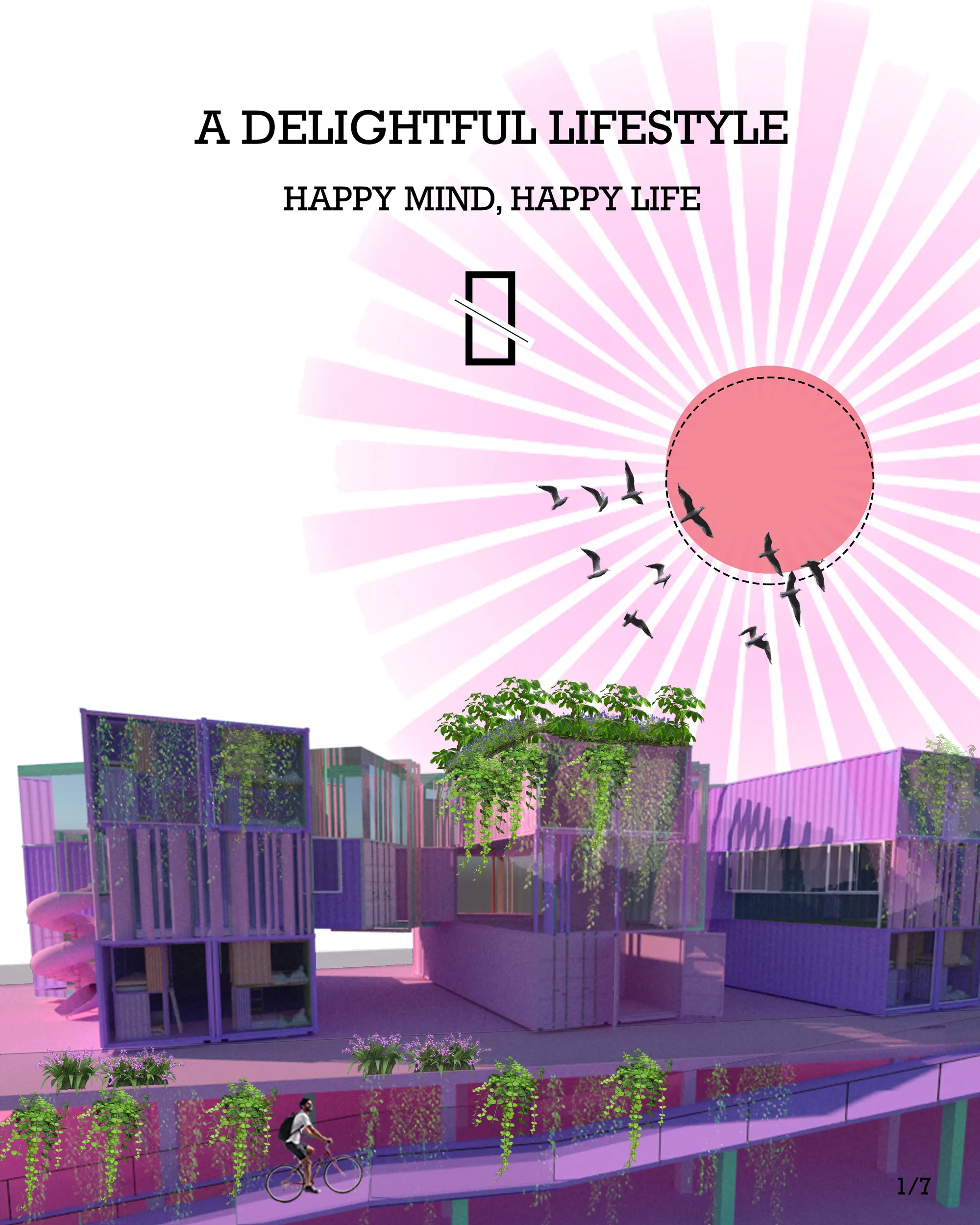
A DELIGTHTFUL LIFESTYLE
HAPPY MIND, HAPPY LIFE

A Delightful Lifestyle
Hadi, a medical student in Beirut, just like many others, suffered from trauma as well as severe anxiety and depression, having to witness the explosion, as well as hunger, and daily dying Covid patients in the hospital.
Scenario:
On the 5th of August 2020, a major explosion hit the port of Beirut, in the midst of a vast economic crisis, huge money inflation, and a worldwide pandemic.
This past year Lebanon has faced:
- Its worst social and economic crisis since the 1975 civil war.
- A sudden spike in suicidal rates, most of them among the youth.
- A sudden increase in poverty rate (from 8% to 55%) in the past 2 years
- Lack in mental health support and suicidal prevention.
Objective:
This problem calls for an urgent need to focus on the mental health and wellbeing of the youth. Hence this project aims to give Beirut students a fresh start and help them heal from their mental struggles as well as spread their happiness throughout the community. The dorm provides a playful environment for self-expression, imagination, social interaction, comfort, physical activity, and exploration, among likeminded peers.
Since happy vibes and smiles are contagious, this project not only helps the students, but also the society and the people these students meet every day. Hence, lowering suicidal rates and increasing productivity.
Also, this project creates a green space in the middle of an urban area that lacks greenery.
In order to decrease the rental cost, and hence provide affordable living in the heart of the city, the dorm is built on an elevated grid on a land originally serving as a parking spot.
In addition, solar panels as well as photovoltaic windows are installed in the dorm to provide the electricity needed.
How will the goal be reached?
Today’s modern lifestyle does not support our mental health:
- Living in urban spaces/ offices with minimal natural light.
- Isolation/not enough social interaction (lockdown, phones, social media, work from home…)
- Sitting for too long and not exercising enough
- Stress, always in a rush… a life between deadlines
Considering some aspects from Homo sapiens’ lifestyle and the way the human brain is wired, they were:
- Very active and highly social
- Living as a part of nature and following natural rhythms
- Engaged with all their senses
Hence the aspects considered in this project are:
- Activity and exercise (exercise is integrated in everyday routes… designing active and fun routes throughout the dorm)
- Social interaction, community and a sense of belonging (several spaces for communal activities)
- Control and autonomy (Providing a variety of environments/seating areas to give people choice over where they want to spend time and how they want to get there)
- Comfort and materials (Use of tactile materials to engage the senses and encourage mindfulness, as well as background calming music, sound insulation from the exterior and sound absorbing materials in the interior to minimize the amount of noise)
- Nature and biophilia (natural light, synchronizing with natural rhythms, greenery, natural elements)
- Encouraging mindfulness through the presence of all senses.
- Triggering the unconscious mind with happy quotes and words distributed throughout the dorm.
Location:
In the heart of Beirut, the dorm is built on a flat land originally used as a parking spot. This location is a walking distance from university campuses, museums, hospitals, bus station, pharmacy, supermarket, and the famous “Mar Mikhael” street full of pubs, restaurants, and nightlife.
Distribution of spaces:
The dorm is distributed into 3 connected buildings: the main central building (which holds the communal spaces), and the dormitory buildings, which are made up of 4 apartments, welcoming 16 students in total.
Each apartment (which guests 4 people) includes a kitchen, bathroom, storage, seating area, and 4 beds.
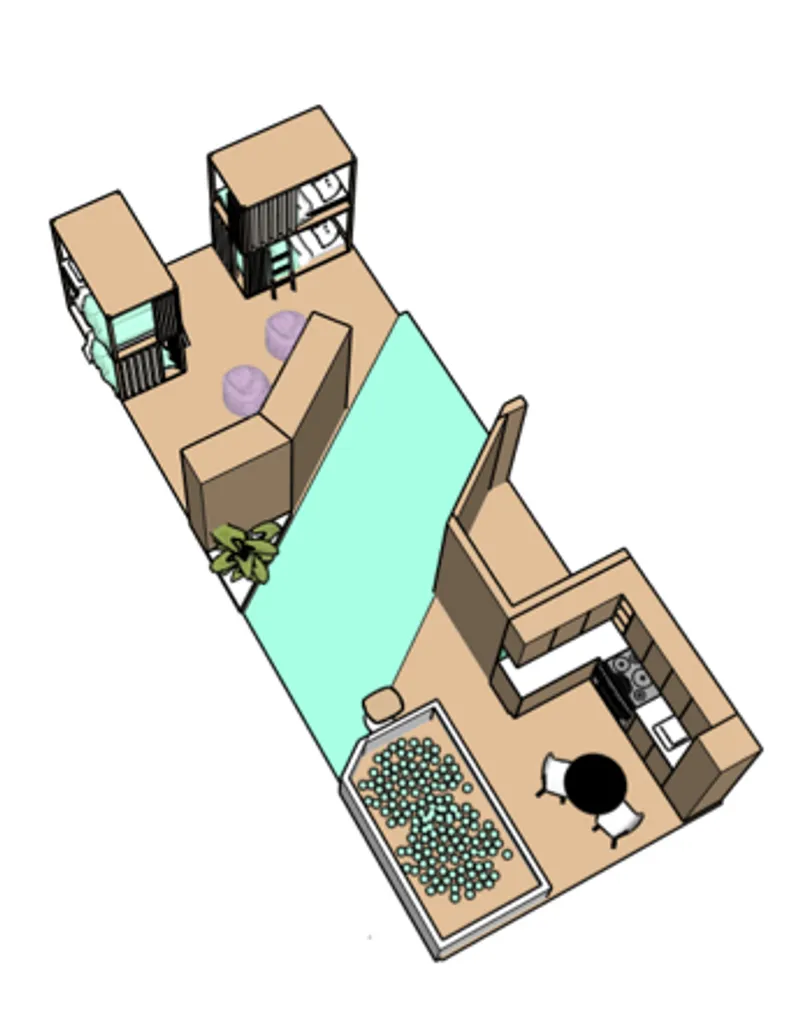
To gain the most out of the building, the negative spaces of the containers were closed with glass panels that can be opened during summer to gain a terrace, and closed during winter.
The project is elevated on a grid as to increase the use of the space and minimize the rental cost.
A passage/ ramp promenade invites the students to the dorm and encourages transportation by bike (bike parking spot is available in the dorm)
Further considerations in the future
-as many container units can be added to accommodate more people
-project can be used as hostel or housing for recent graduates as it gives them a chance to meet and live with likeminded people.
-due to decreased rental charges, this concept can be built and applied on different grounds to accommodate many of the 200000 people who lost their houses due to the Beirut explosion.
Sources:
Designing for happiness: How the built environment can support better mental health Ben Channon, Director, Ekkist February 2021
UK Department of Health
Mind Delos UN.org
Build Well to Live Well report 2018
UKGBC Healthy Homes Report 2016

Popular Articles
Popular articles from the community


Riyadh For All: Intergenerational Urban Design for Active Aging in Rabat
Riyadh For All reimagines urban design in Rabat with intergenerational co-living, adaptive courtyards, and Moroccan cultural exchange today.

Conexión: Biophilic Design Reimagines High-Rise Living in Hong Kong
Conexión reimagines high-rise living in Hong Kong through biophilic design, green facades, shared spaces, daylight, water and nature within.

Co-Life: Senior Housing Design That Reconnects Older Adults With the City
Co-Life reimagines senior housing design through healing gardens, shared streets, workshops, and a sustainable community across generations.

Lunar Spiral: Space Architecture Shaped by the Mathematics of the Universe
Lunar Spiral reimagines space architecture through Fibonacci geometry, lunar regolith, levitating habitats, and self-sustaining Moon living.

Similar Reads
You might also enjoy these articles

Day and Night Park: A Time-Based Urban Newsstand in Beijing
A temporary urban newsstand in Beijing blending travel, light, and reading through poetic colors, compact form, and community-focused design.

Modernist Patio Renovation in El Masnou, Barcelona by Oliver Segura Arquitectura + Cebrià Arquitectura
Modernist patio renovation blending tradition and innovation with a movable pool, leveled floors, and Catalan materials in El Masnou.

Alto Residencial Coop: Cooperative Housing Development in Santiago de Compostela by Carbajo Barrios Arquitectos
A linear cooperative housing complex blending white volumes and perforated metal façades, enhancing community living, natural light, privacy, and urban integration.

Vil Genis School by BPA ARCHITECTURE – Massy, France
Vil Genis School in Massy, France, features sustainable design, south-facing classrooms, community integration, accessible spaces, and modern educational architecture.

Explore Modern Architecture Competitions
Discover active competitions in this discipline




Challenge to reimagine the Iron Throne


Photograph architecture without architects


Illustrate the lost glory of Angkor Wat - Render Challenge


Design challenge to reuse E-waste
Comments (0)
Please login or sign up to add comments
No comments yet. Be the first to comment!