
TAO Carves a Hamlet out of Shenzhen's Densest Urban Village
A cluster of six buildings in Nantou Ancient Town becomes a new model for high-density renewal through concrete, courtyards, and community.


Nantou Ancient Town has existed since the fourth century. Its stone walls went up in the 1400s, and its streets have been rewriting themselves ever since, each generation of residents packing more volume into less space until the original lanes became dim corridors between opaque walls. TAO – Trace Architecture Office was asked to intervene in a 680-square-meter cluster of six buildings on East Street, right in the middle of this 70,000-square-meter historic district. The brief was simultaneously conservative and radical: preserve every property boundary, keep a Qing Dynasty structure at the center, and still transform a claustrophobic tangle into a porous, publicly accessible hamlet.
What makes the result genuinely interesting is that TAO did not clear the site and start over. Instead, the office laid a new reinforced concrete framework over and around what already existed, extending the original street pattern outward and upward. The concrete canopy acts less like a roof and more like a public ground plane lifted into the air, pulling light and air down into spaces that had neither. The effect is a small neighborhood that reads as both ancient and unfinished, a concrete scaffold waiting for life to fill it in.
The Concrete Canopy
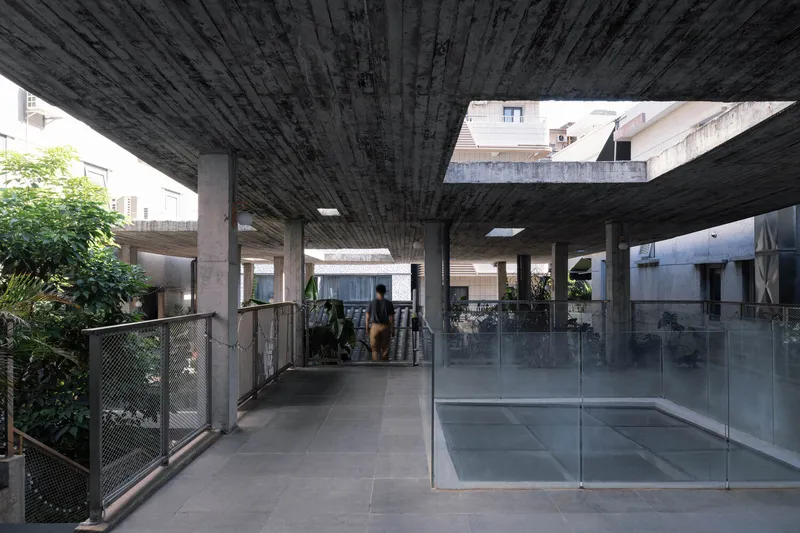
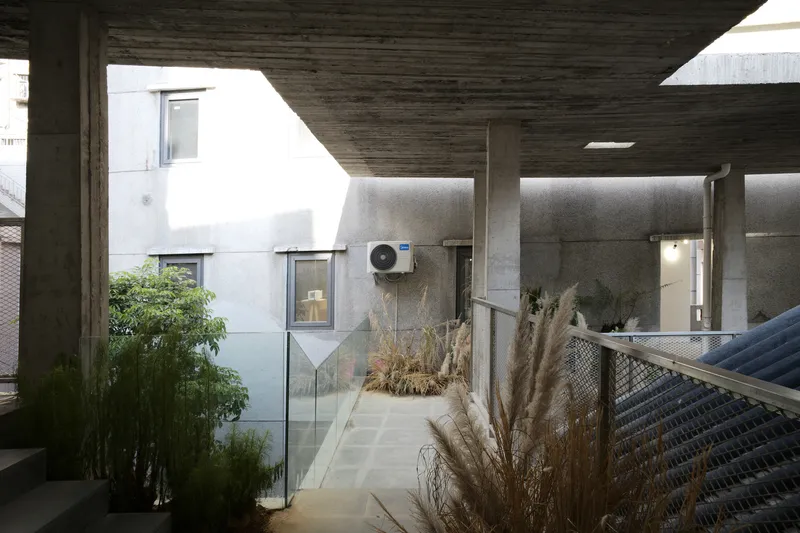
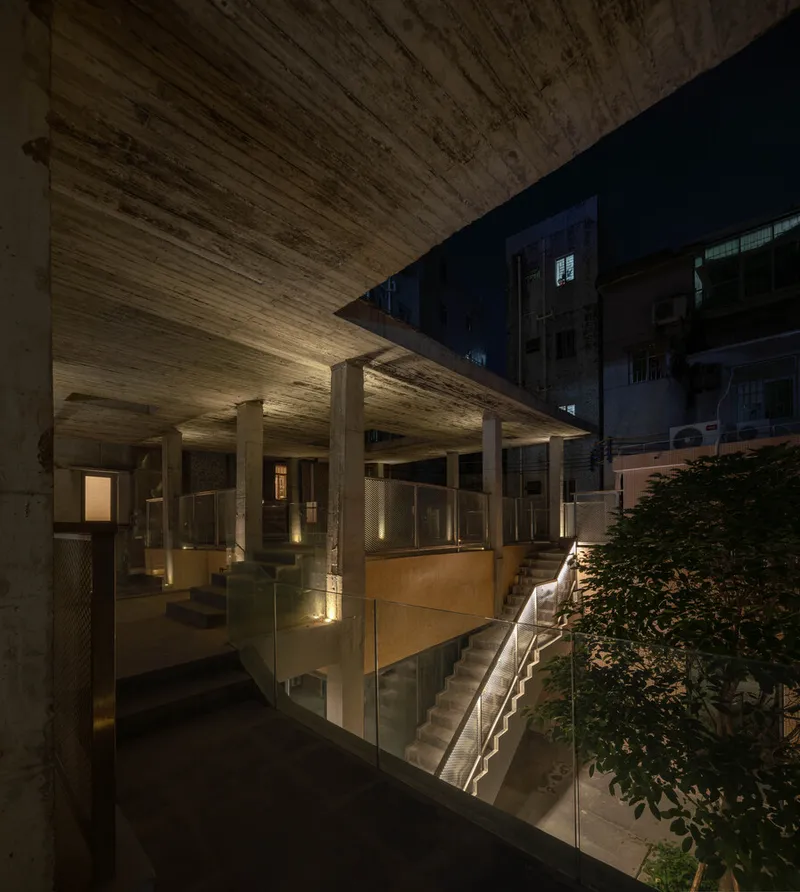
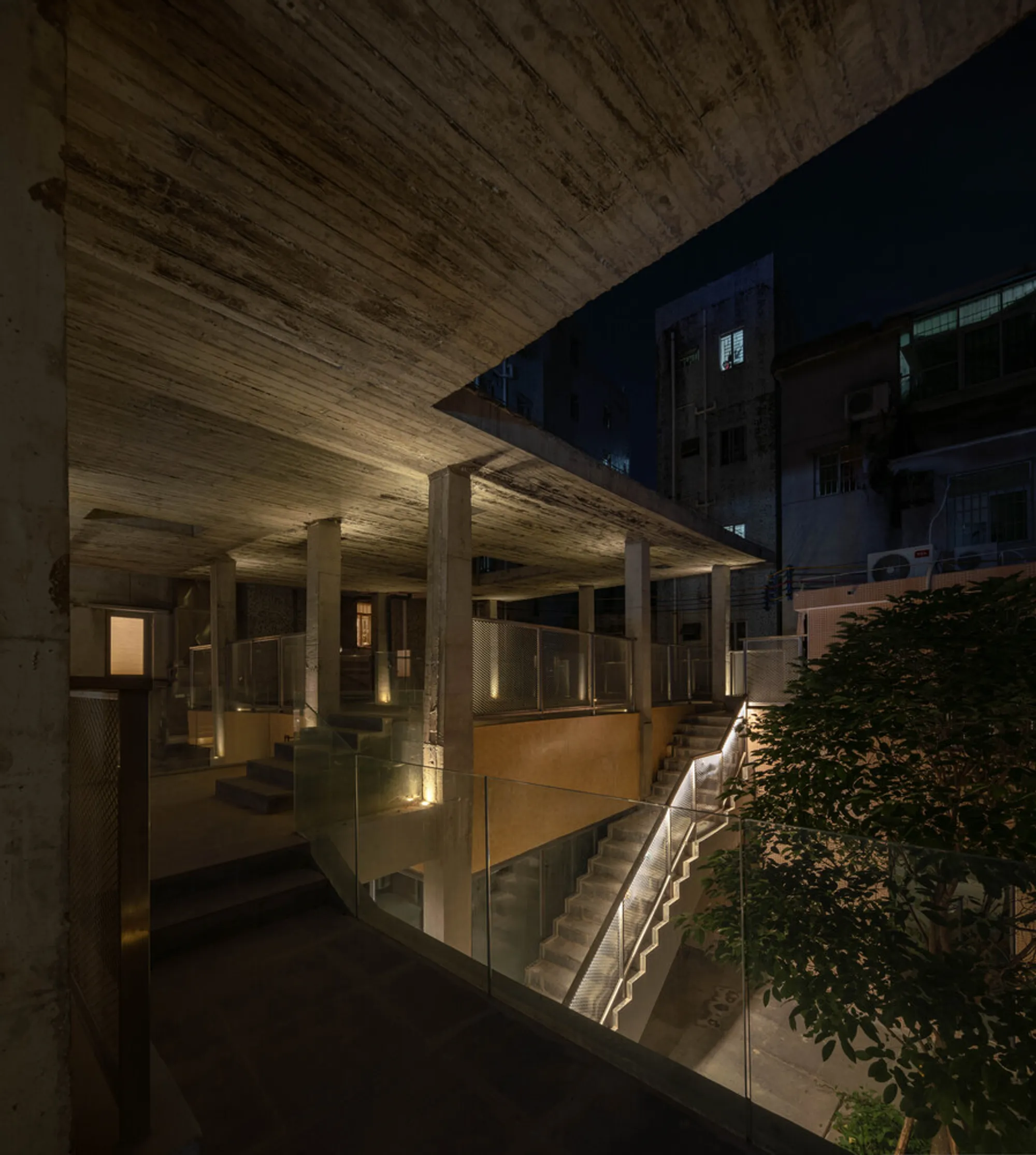
The defining architectural gesture here is the wood-cast in-situ concrete roof. Its board-formed soffit carries the grain of the timber formwork like a fossil record of its own construction, giving the surface a texture that rhymes with the older masonry below. At night, the canopy becomes a luminous overhang sheltering terraces and a central stair, its heaviness dissolved by the glow of the spaces beneath.
TAO uses a column-grid system that keeps the roof structurally independent of the older buildings, so the canopy floats above the cluster without crushing it. Planted beds of ornamental grasses sit at the edges, softening the concrete perimeter and creating the illusion that the roof is a garden someone forgot to finish. The glass railings let you read the full depth of the site from above, a rare luxury in a neighborhood where views have historically stopped at the next wall.
Ground Level: Alleys and Thresholds
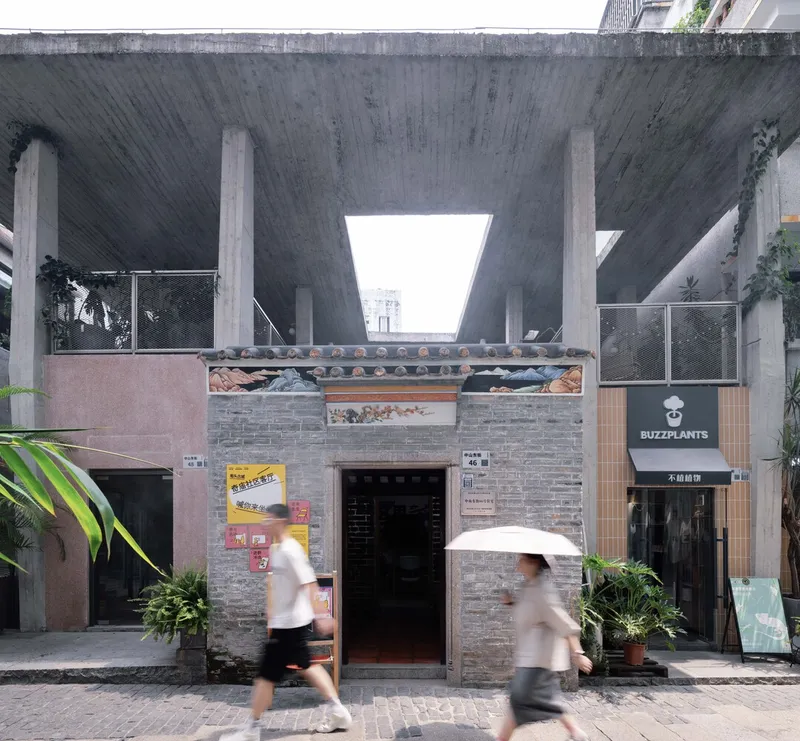
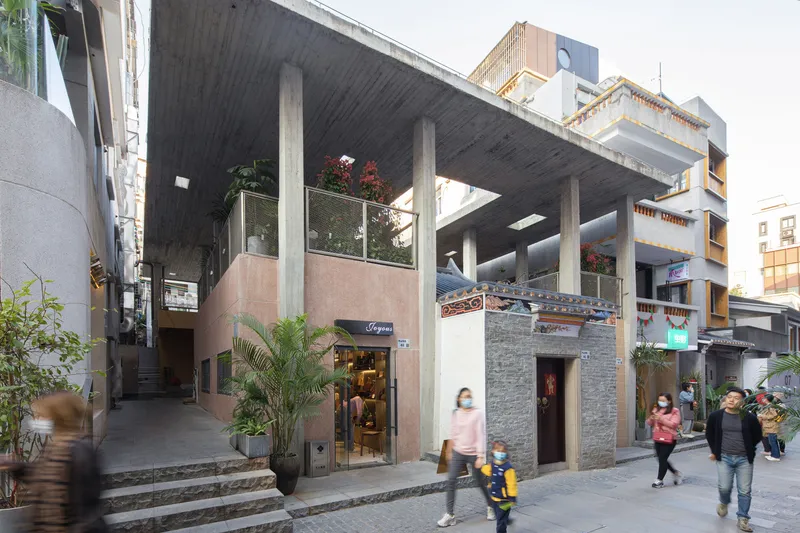
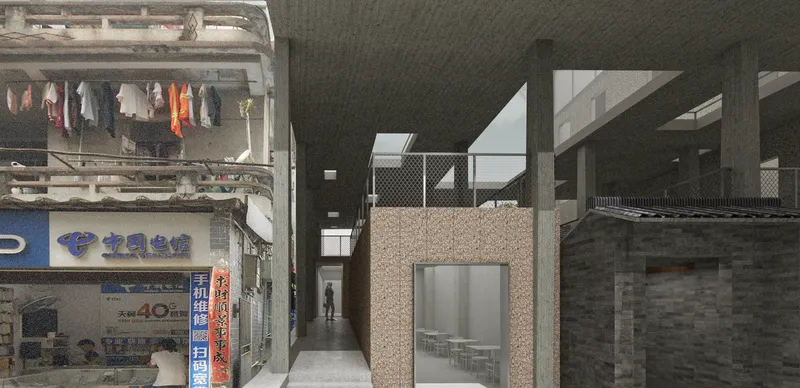
The ground floor preserves the logic of the urban village: commercial storefronts open onto narrow alleys, each unit maintaining its own sense of domain and privacy. Grey brick facades with decorative tile bands nod to the material language of the surrounding townscape, and the new concrete frame simply hovers overhead, asserting its presence without erasing what was there before. Pedestrians pass through without needing an invitation.
One of the narrowest passages threads between existing walls and a new terrazzo-clad volume, lit from above by skylights punched through the roof structure. This is the kind of space that a masterplan would never produce. It is a leftover, a gap between property lines, and TAO turns it into one of the most atmospheric moments in the project. The overhead light strips the alley of its former darkness and gives it the quality of a covered street.
The Central Courtyard and Qimiao
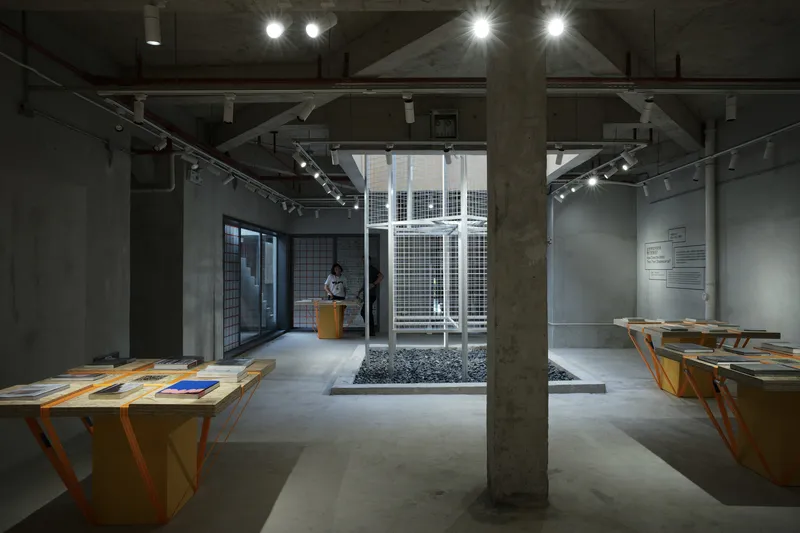
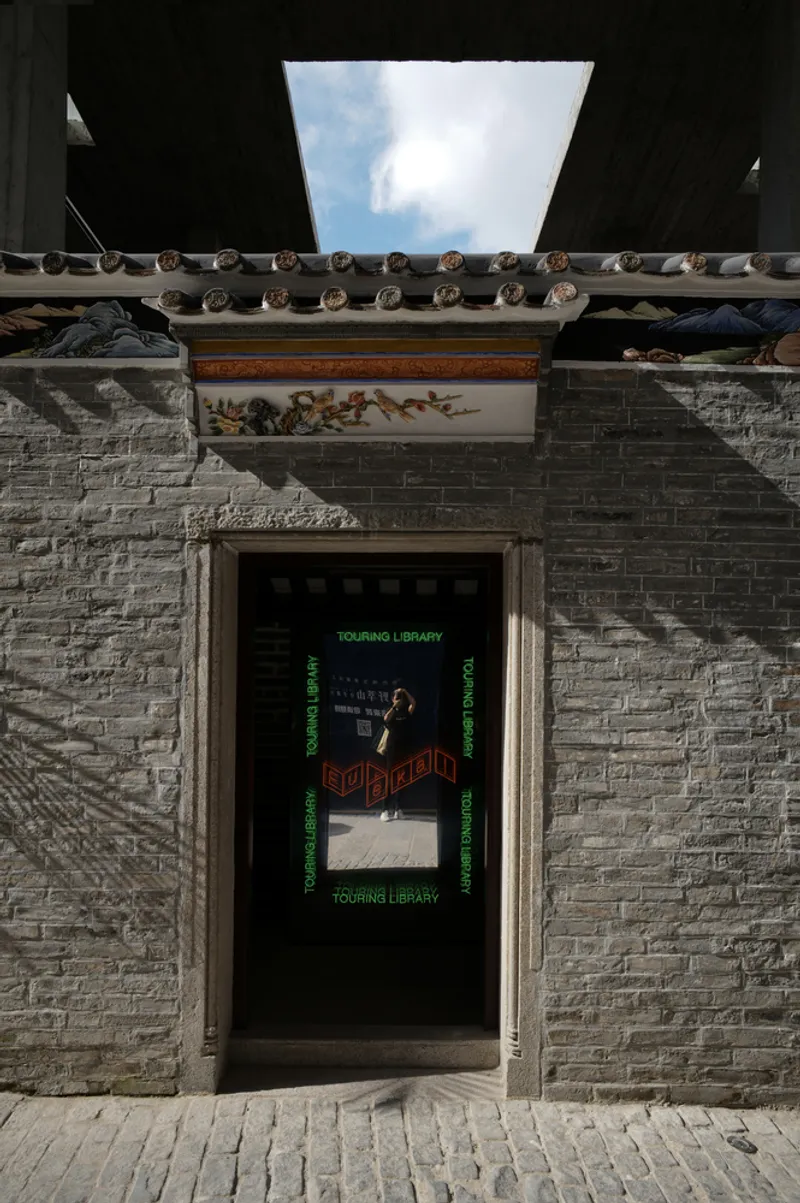
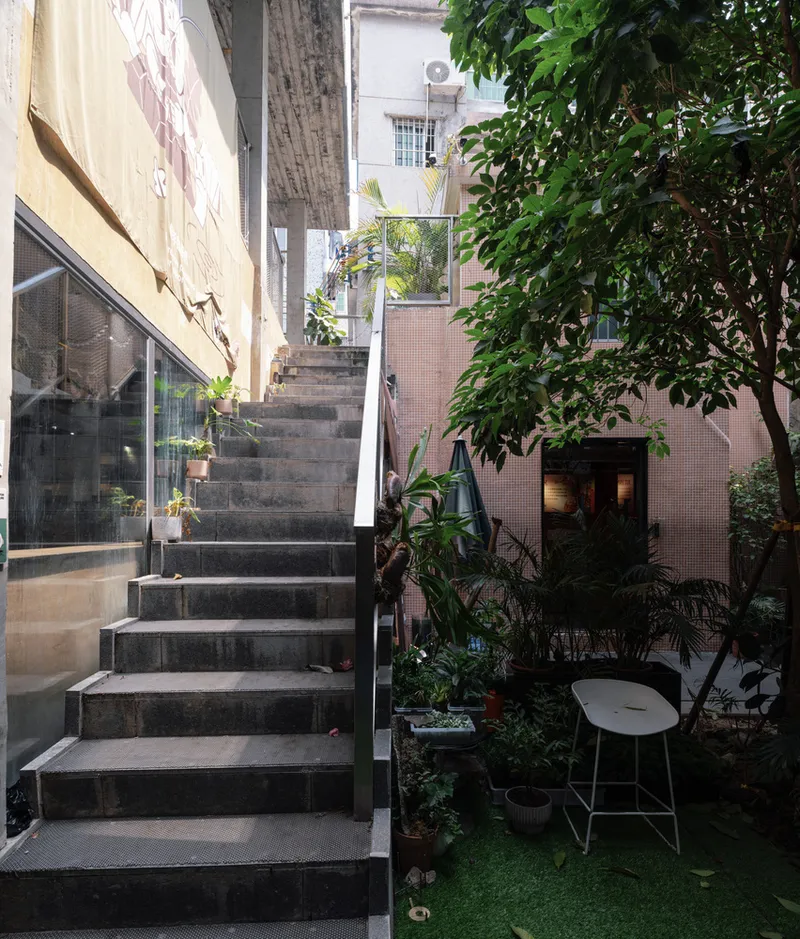
At the heart of the cluster sits the Qing Dynasty building, now repurposed as "Qimiao," a community living room that hosts exhibitions, cultural events, and social gatherings. TAO stripped the interior to its structural bones and installed track lighting and a floor of white gravel in the central courtyard, giving the space a gallery-like neutrality that lets the old walls speak for themselves. The exposed concrete columns of the new structure stand next to the historic masonry in frank juxtaposition, neither trying to imitate the other.
An exterior staircase climbs from this courtyard to the upper level, flanked by glass walls and a planted well containing a single tree. The stair is deliberately narrow and straight, a spatial compression that makes the release into the open terrace above feel earned. TAO understands that the pleasure of a public space is often proportional to the effort required to reach it.
Upper Level: Semi-Outdoor Shared Space
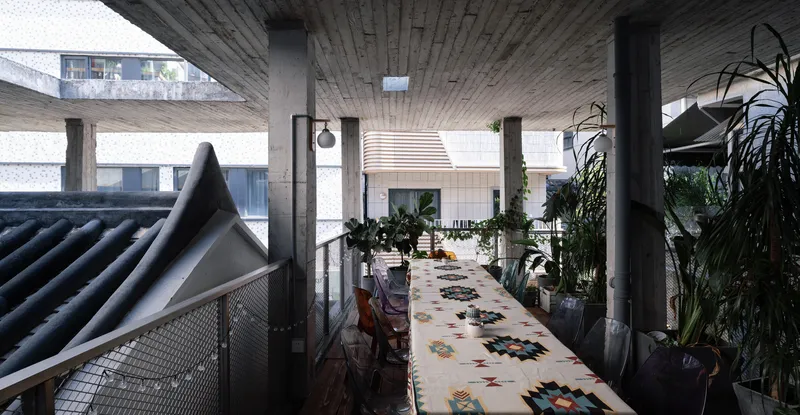
The upper floor functions as a versatile platform for public life: exhibitions, community events, parties, or simply rest. A covered corridor with a patterned runner rug and potted plants feels more like a domestic veranda than an institutional hallway. Rectangular openings in the board-formed ceiling let shafts of daylight fall through, creating a rhythm of bright patches along the floor that changes throughout the day.
The strategy of vertical growth within a site this compact is critical. Rather than expanding the footprint, which would have meant demolishing neighboring structures, TAO pushed the program upward, adding public space on top of commercial space. The result is a vertical section of community life stacked in under ten meters of height, a hamlet organized not by plan but by altitude.
Plans and Drawings
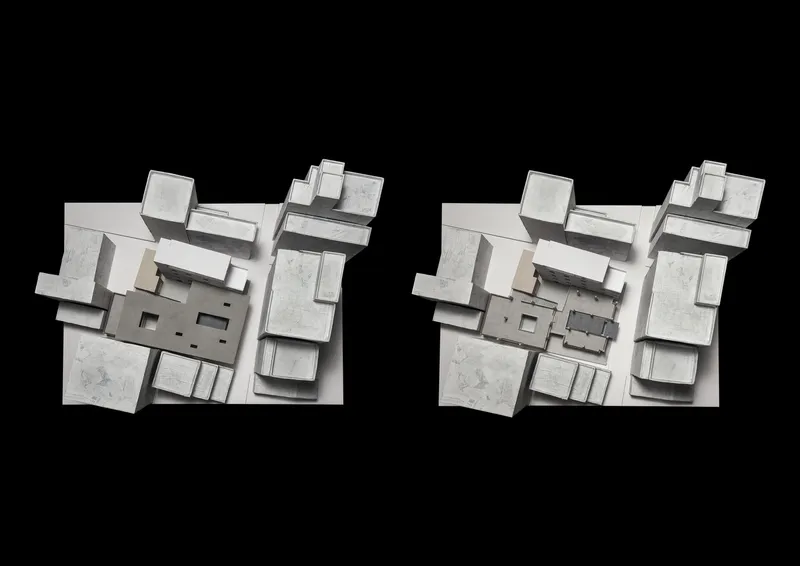
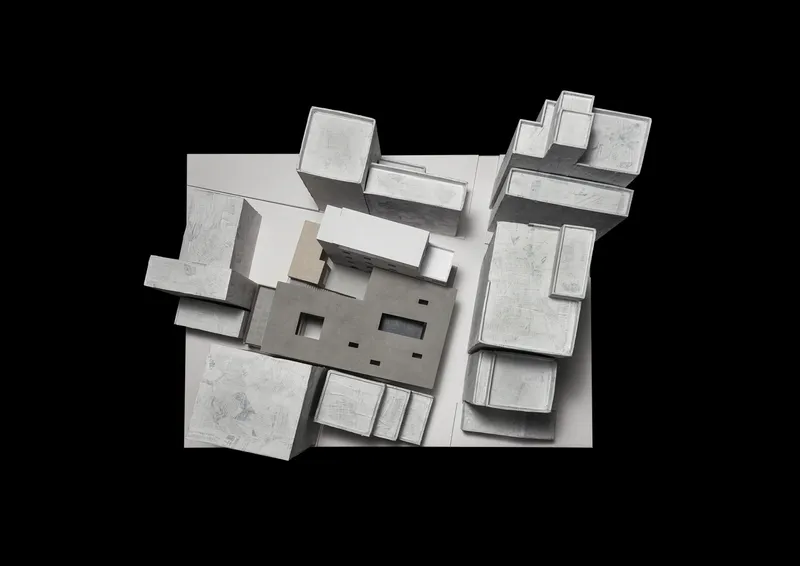
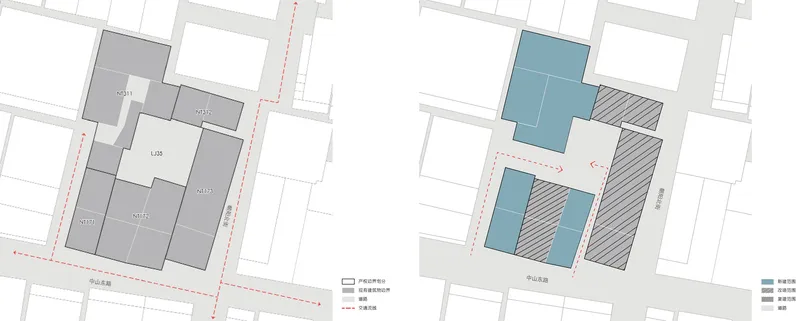
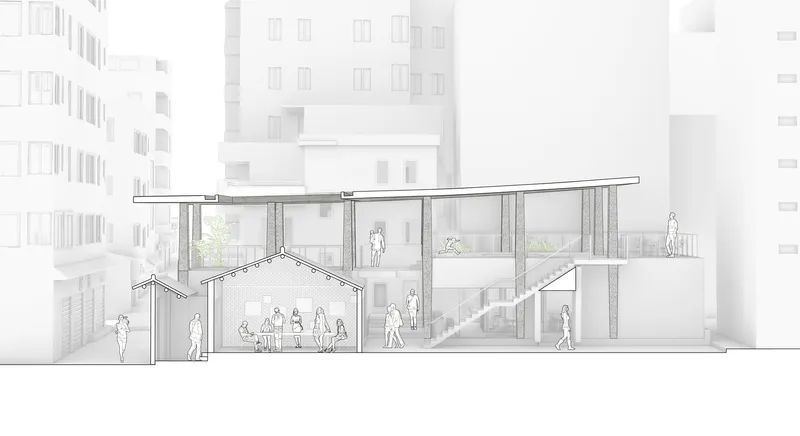
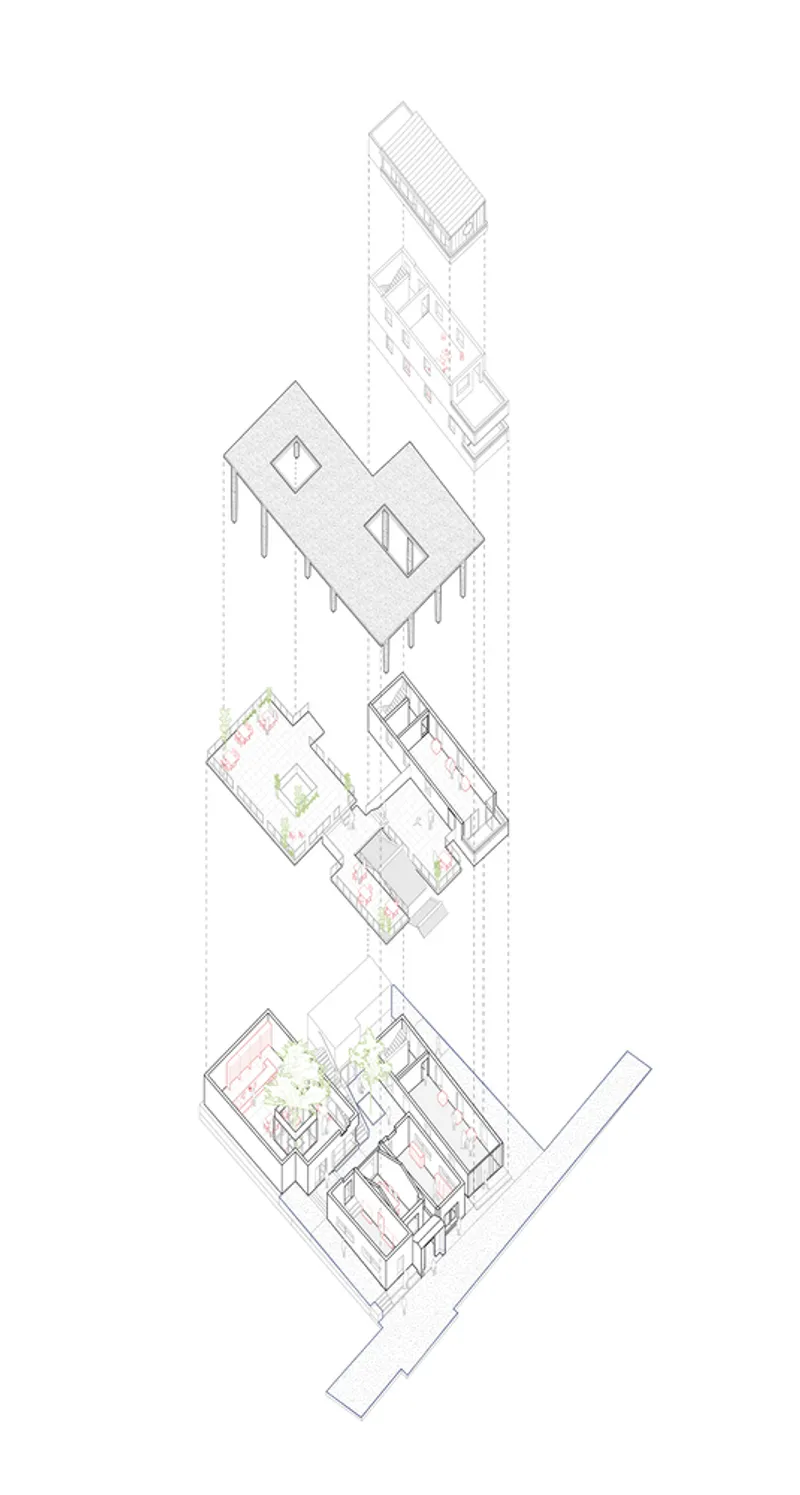
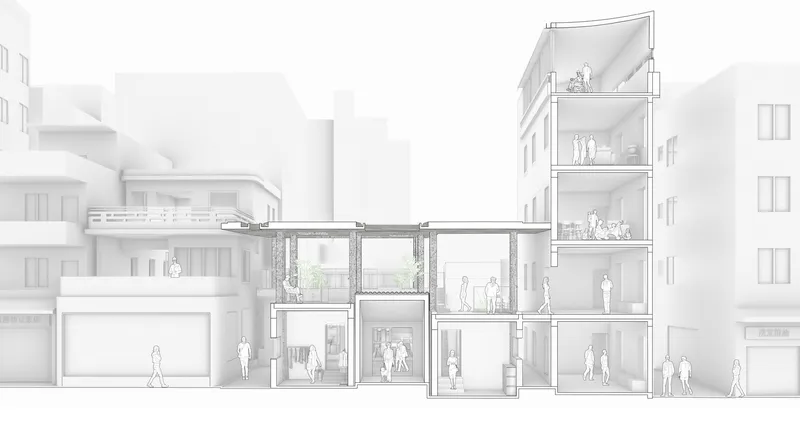
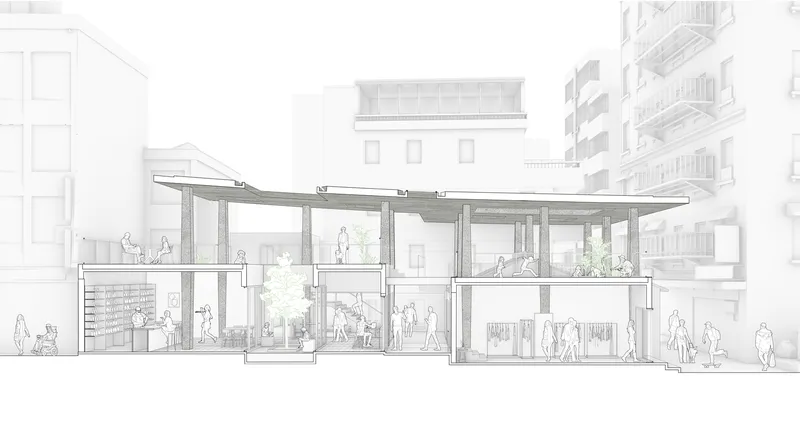
The site plan, rendered in blue against the existing urban block, reveals how surgically TAO inserted new footprints into the voids between property lines. The axonometric drawings show the cluster as a set of interlocking volumes organized around a central void, with the concrete roof binding them together like a tray holding loose objects. The exploded axonometric is particularly useful: it makes legible the way each floor level negotiates a different relationship between old walls and new structure.
The section drawings are where the project's ambition becomes clearest. Double-height spaces open beneath the thin cantilevered roof, and the staircase acts as a vertical spine connecting courtyard to terrace. You can see how the surrounding residential buildings press in from all sides, their irregular silhouettes forming a skyline that the new concrete roof deliberately refuses to compete with. It sits low, deferring to the existing fabric while quietly reorganizing everything beneath it.
Why This Project Matters
Urban renewal in Chinese cities has too often meant demolition followed by nostalgia, tearing down authentic neighborhoods and replacing them with sanitized replicas. TAO's project in Nantou takes the opposite approach. By treating property boundaries as design constraints rather than obstacles, and by layering new concrete structure over existing masonry, the office produced something that feels neither old nor new but genuinely layered, the way cities are supposed to be.
At 680 square meters, this is a small project with outsized implications. It demonstrates that high-density urban fabric can be made porous without being hollowed out, that public space can be created vertically when horizontal space is exhausted, and that a concrete roof can do the work of an entire masterplan if it is placed with care. If Shenzhen's other urban villages are lucky, this hamlet will become a prototype rather than an exception.
A Hamlet Within the Urban Village by TAO – Trace Architecture Office, Nantou Ancient Town, Shenzhen, China. 680 sqm. Completed 2022. Photography by Hao Chen and ZC Architectural Photography Studio.
About the Studio
Share Your Own Work on uni.xyz
If projects like this are the kind of work you want to make, uni.xyz is a place to publish your own, find collaborators, and enter design competitions.


Popular Articles
Popular articles from the community


Co-life: Sustainable Architecture for Age-Friendly Community Living
Co-life reimagines sustainable architecture for seniors through courtyards, rammed earth, shared gardens, and spaces designed for belonging.

Lunar Spiral: Space Architecture Shaped by the Mathematics of the Universe
Lunar Spiral reimagines space architecture through Fibonacci geometry, lunar regolith, levitating habitats, and self-sustaining Moon living.

Play: Fragments of Their World
Familiar architecture becomes modular playground design, creating safe spaces where displaced children can learn, connect, imagine and play.

Riyadh For All: Intergenerational Urban Design for Active Aging in Rabat
Riyadh For All reimagines urban design in Rabat with intergenerational co-living, adaptive courtyards, and Moroccan cultural exchange today.

Similar Reads
You might also enjoy these articles


Hodi-Mandai Geram
Project Function: Preservation and revitalization of the Intangible heritage and socio-spatial identity of the Hodi by Housing, Cultural Memory Center, Sacred Grove, landscape, local tourism economy


Olio Towers: A Mid-Rise for Performers That Fuses Housing, Rehearsal, and Stage
Located blocks from Houston's Theater District, this modular tower stacks living units around a central performance atrium.

Oasis: Modular Green Housing Carved into Dhaka's Urban Fabric
A shortlisted Plugin Housing entry reclaims unauthorized settlements in Dhaka with stepped concrete volumes, green roofs, and ventilation-driven design.

Black Hole: A Floating Megastructure for the Post-Physical Era
Emiliano Mazzarotto envisions a spherical, self-scaling arena where e-sports, digital hotels, and holographic stadiums replace traditional public space.

Explore Office Building Competitions
Discover active competitions in this discipline



Challenge to reimagine the Iron Throne


Photograph architecture without architects


Illustrate the lost glory of Angkor Wat - Render Challenge


Design challenge to reuse E-waste
Comments (0)
Please login or sign up to add comments
No comments yet. Be the first to comment!