
KAV Architects Wraps a House Around Two Walnut Trees in an Iranian Mountain Village
A 200-square-meter home in Aghdasieh, Alborz Province, treats two mature walnut trees as co-authors of its spatial logic.

Most architects would look at two mature walnut trees standing in the middle of a buildable plot and see a constraint. KAV Architects, led by Taraneh Iranpour and Shayan Seif, saw a design brief. Their 200-square-meter house in the village of Aghdasieh, set in the northern reaches of Iran's Alborz Province, does not simply avoid the trees. It extends toward them, wraps around them, and ultimately lifts residents up to the level of their branches. The result is a home whose plan is less a diagram of rooms than a negotiation between architecture and two living organisms.
What makes the project genuinely compelling is the way it translates a multigenerational family's needs into a clear material logic. Solid stone walls enclose private quarters; transparent glass and cement volumes open the communal spaces to the landscape. The walnut trees serve as the hinge between these two conditions, organizing the house along an axis that is biological rather than purely geometric. On a flat village site with few planning restrictions, this self-imposed discipline gives the building a rigor that many rural houses lack.
Stone and Glass: A Material Split That Means Something
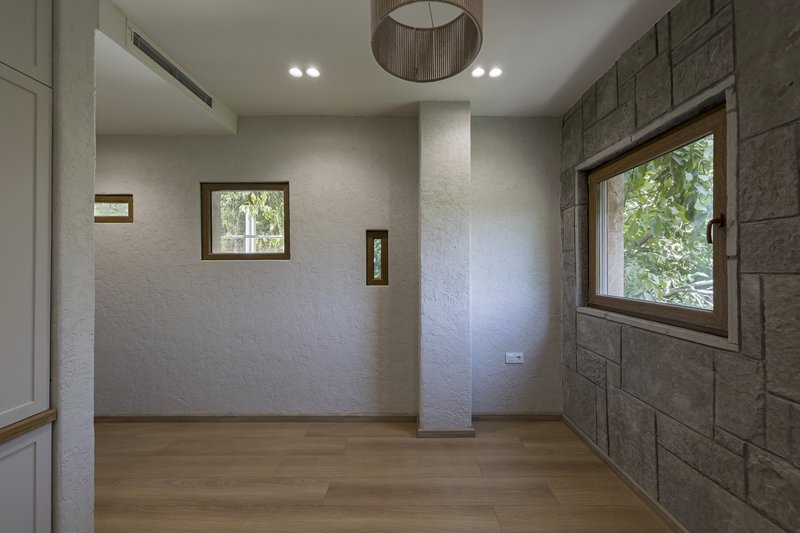
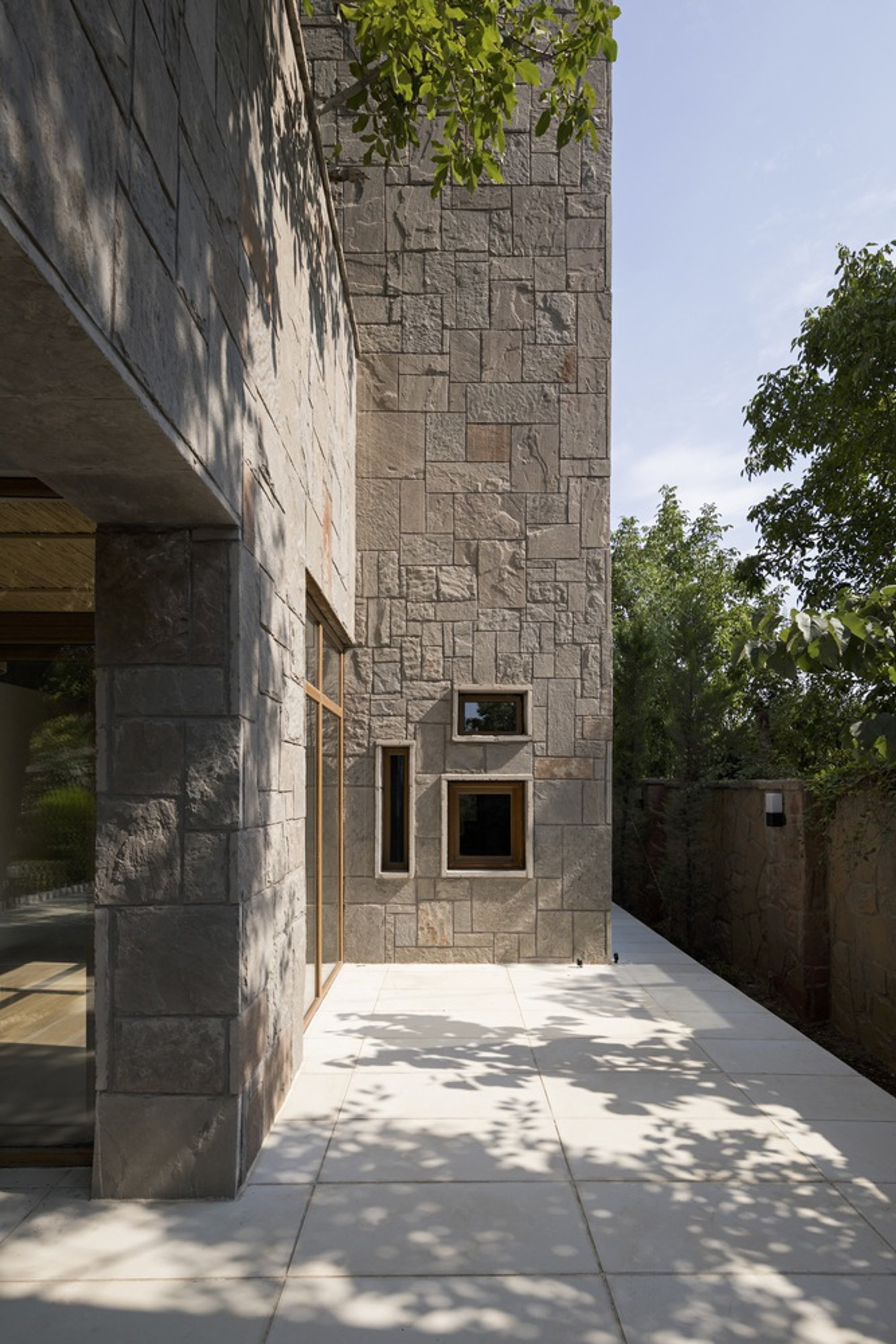
The house announces its organizational logic through two contrasting material palettes. Mountain stone, locally sourced, builds up the closed volumes that house private bedrooms and intimate spaces. These walls are thick, textured, and deliberately opaque, with small framed openings that offer controlled glimpses rather than panoramic views. The effect is protective without being oppressive: you feel sheltered, not sealed in.
The textured grey block walls visible in the interior reinforce this reading. Light enters through carefully positioned apertures, landing on timber floors and rough masonry in a way that changes throughout the day. Privacy here is not just a matter of curtains or screens; it is embedded in the construction itself. The daughter's bedroom, interestingly, breaks this rule by sitting on the north side yet remaining part of the more open system, a concession that hints at the generational tension the house is designed to mediate.
Transparent Living: Where the House Opens Up
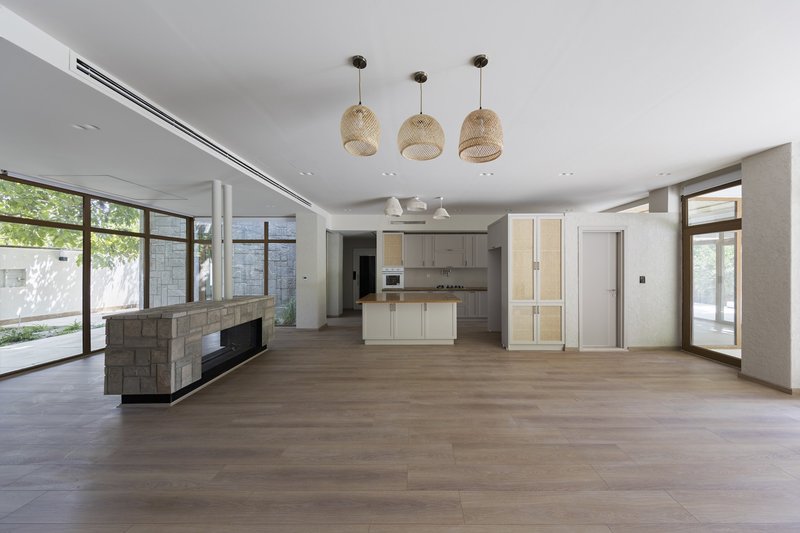
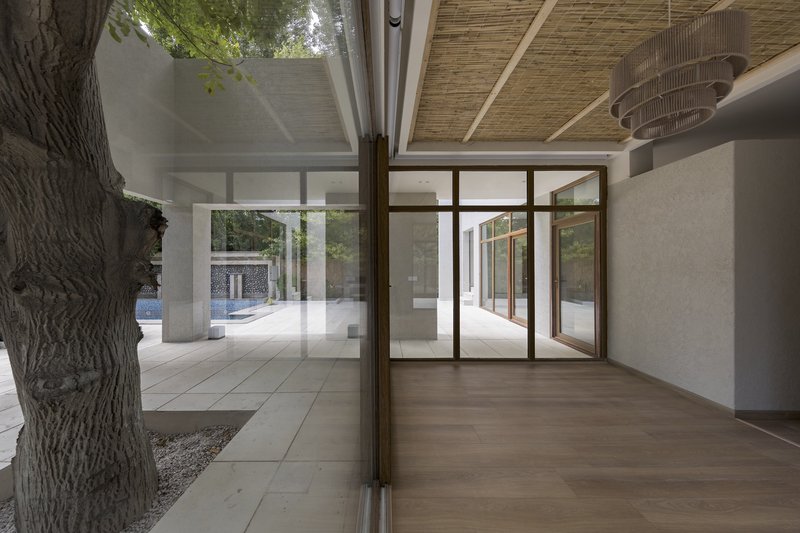
On the southern side, the house shifts register entirely. Floor-to-ceiling glazing dissolves the boundary between kitchen, living room, and courtyard. An open-plan layout with a generous kitchen island and wide-plank timber flooring reads as relaxed and contemporary, a deliberate counterpoint to the stone enclosures elsewhere. The glass walls frame the courtyard and the walnut trees so directly that the trunks become a kind of permanent art installation, their bark and canopy visible from every angle.
This transparency is not arbitrary. The south-facing orientation maximizes daylight in communal areas while the building's massing shields the north side from exposure. The result is a passive climate strategy that works with the site rather than relying on heavy mechanical systems. You gather where the light is; you retreat where the stone keeps things cool and quiet.
The Courtyard as Protagonist
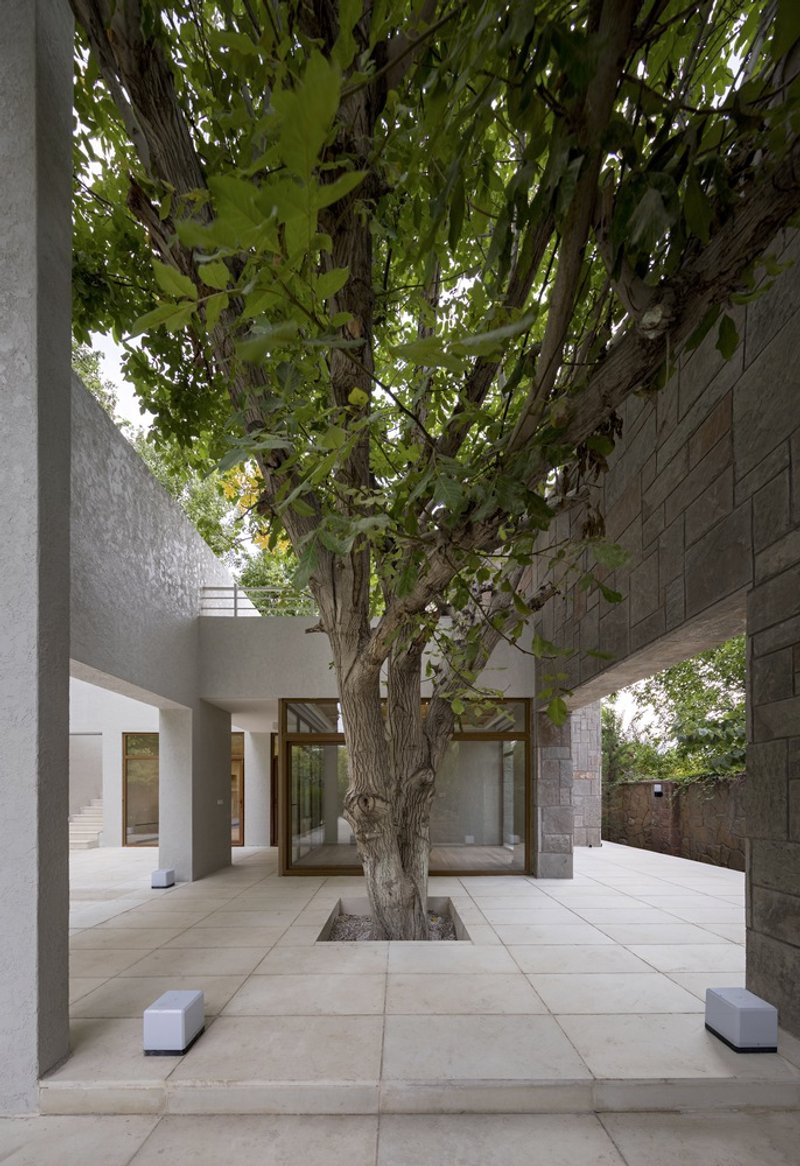
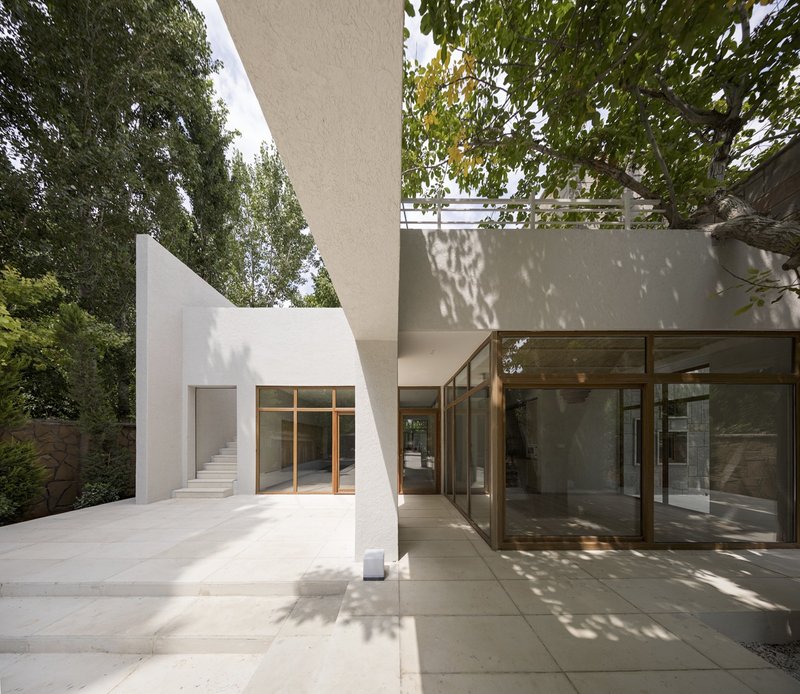
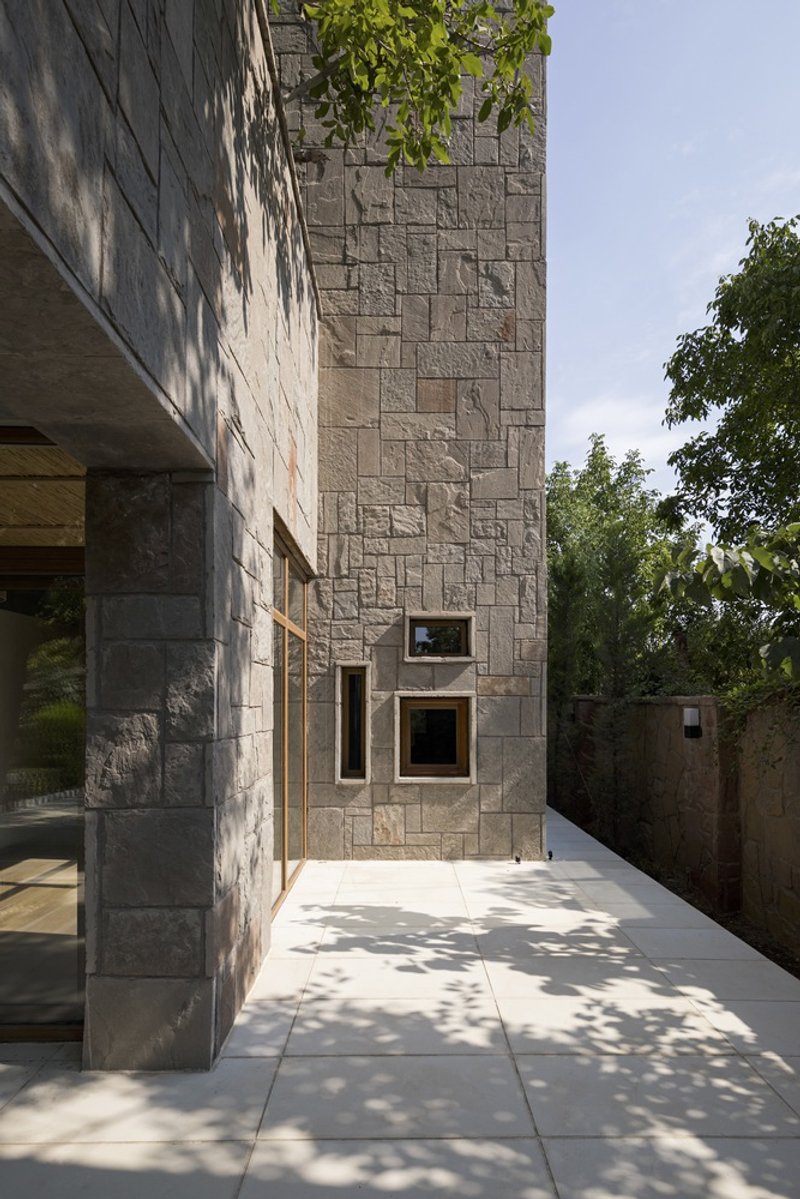
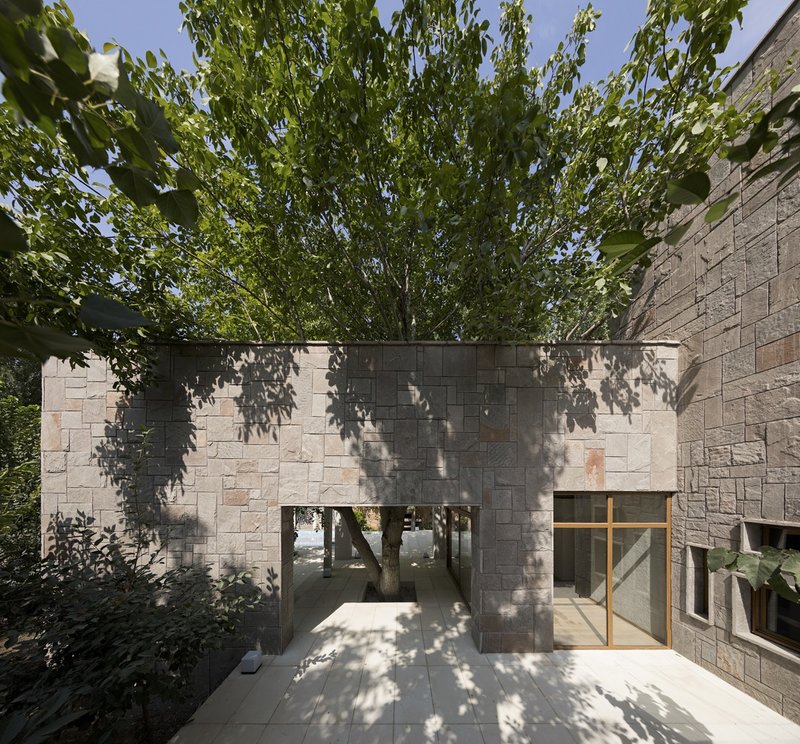
If the house has a single best idea, it is the courtyard. The paving is cut precisely to allow the walnut tree trunks to pass through, stone slabs fitting around bark like a tailor's seam. Dappled shadows from the canopy above animate the white surfaces throughout the day, making the courtyard feel alive even when empty. Variegated grey stone walls flank the space, grounding it materially while the tree overhead provides a shifting, organic ceiling.
An external staircase rises from the courtyard to a rooftop level that KAV Architects describe as an elevated courtyard connecting the two walnut trees. At this height, residents can touch branches, pick fruit, and sit among leaves. It is a genuinely unusual spatial experience: a domestic roof terrace that functions more like a treehouse. The staircase itself, rendered in white with clean geometric lines, acts as a visual connector between the grounded courtyard and the arboreal world above.
Thresholds and Entry
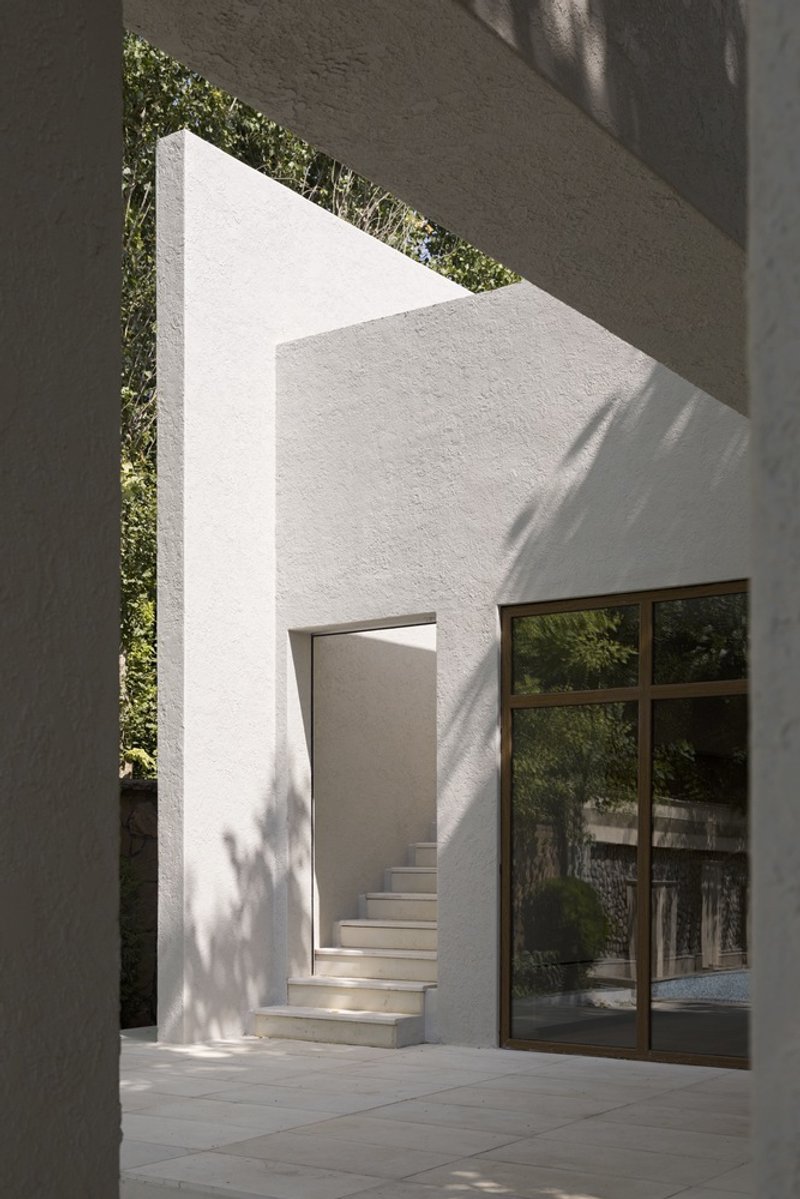
The approach to the house is orchestrated with care. A recessed white stucco alcove creates a deep threshold at the entrance, with a concrete stair and full-height glazed door casting sharp diagonal shadows that change with the sun's position. The recess compresses space before the interior opens up, a simple but effective bit of architectural choreography that makes the act of entering feel intentional.
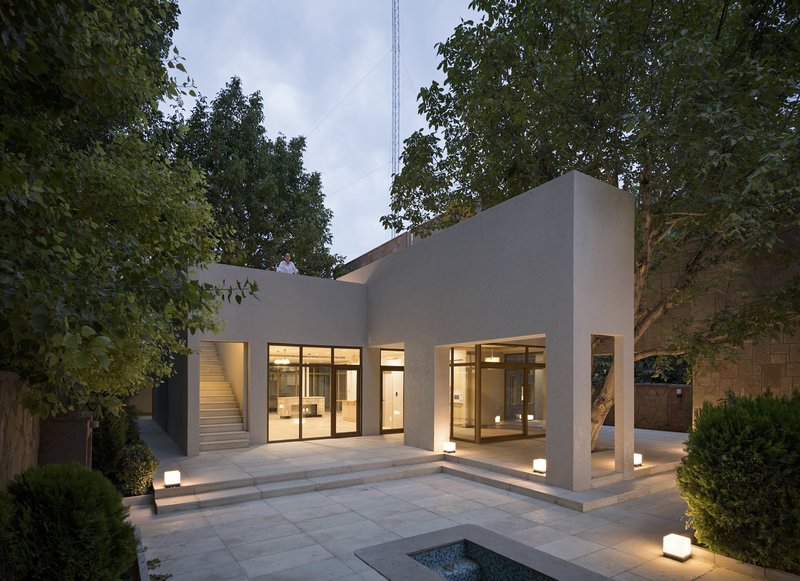
From the rear, the building reads as a series of white stucco volumes punctured by glazed openings, the terrace extending the interior living space outward at dusk. The southern walnut tree stands close enough that its canopy brushes the facade, and the building's arms appear to reach toward it. This is not metaphor for its own sake. The extensions create intermediate zones, covered outdoor areas that are neither fully inside nor fully outside, useful in a climate that swings between hot summers and cold mountain winters.
Why This Project Matters
A House Between Two Walnuts succeeds because it takes a specific site condition, two old trees on a flat village plot, and makes it the generator of every architectural decision. Too many residential projects treat landscape as a backdrop or an afterthought. Here, the walnut trees dictate the plan, the section, the material palette, and the experiential sequence from ground to rooftop. The house is proof that constraints, even biological ones, produce better architecture than a blank slate.
The multigenerational program adds another layer of specificity. By mapping the tension between traditional privacy and modern openness onto a literal material contrast, stone versus glass, KAV Architects avoid the vagueness that often accompanies talk of "designing for families." Each generation gets the spatial quality it needs, and the walnut trees, older than anyone in the household, hold the whole composition together. It is a small house with a big idea, executed with discipline and a clear sense of place.
A House Between Two Walnuts by KAV Architects (Taraneh Iranpour, Shayan Seif). Located in Aghdasieh village, Alborz Province, Iran. Built area: 200 square meters; site area: 1,350 square meters. Completed 2023. Photography by Mohammad Hassan Ettefagh.
About the Studio
Share Your Own Work on uni.xyz
If projects like this are the kind of work you want to make, uni.xyz is a place to publish your own, find collaborators, and enter design competitions.



Popular Articles
Popular articles from the community

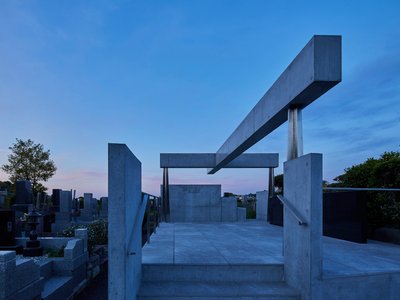
Takeshi Hosaka Architects Suspends a Concrete Cross Above a Yokohama Cemetery
A 28-square-meter burial renovation in Yokohama lifts the symbol of resurrection into the sky so mourners see it against heaven.
YOAP Architects Round a Corner in Yeongcheon with a Cylindrical Community Hub
A 197-square-meter brick and ribbed-clad tower turns a forgotten alley corner in South Korea into a public garden with a low threshold.
Rojkind Arquitectos and Think Parametric Build a Glueless Pavilion from 67 Interlocking Panels
A serpentine fiber-cement installation in Chapultepec Park celebrates a decade of architectural media in Mexico City.
3dor Concepts Wraps a Kerala Home in Mirrored Concrete Arcs Around a Courtyard Tree
In the Western Ghats foothills of Thamarassery, a 270 m² single-story house uses two curved volumes to frame nature as its center.

Similar Reads
You might also enjoy these articles

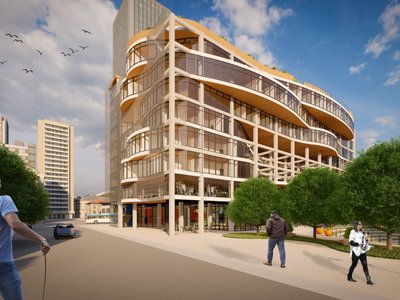
Olio Towers: A Mid-Rise for Performers That Fuses Housing, Rehearsal, and Stage
Located blocks from Houston's Theater District, this modular tower stacks living units around a central performance atrium.
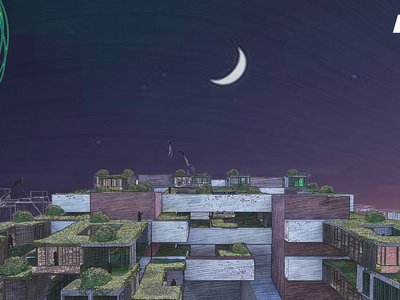
Oasis: Modular Green Housing Carved into Dhaka's Urban Fabric
A shortlisted Plugin Housing entry reclaims unauthorized settlements in Dhaka with stepped concrete volumes, green roofs, and ventilation-driven design.

Black Hole: A Floating Megastructure for the Post-Physical Era
Emiliano Mazzarotto envisions a spherical, self-scaling arena where e-sports, digital hotels, and holographic stadiums replace traditional public space.
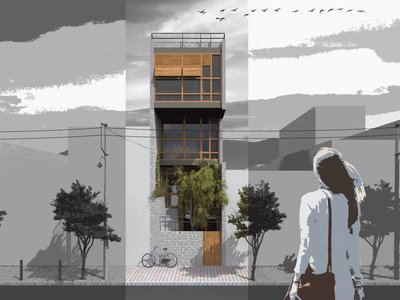
Compact & Sustainable Living in Piraeus: A Four-Level Family Home Built Around Light and Air
A narrow townhouse in one of Greece's densest port cities uses a central atrium and passive strategies to house three generations under one roof.


Explore Architecture Competitions
Discover active competitions in this discipline




The International Standard for Design Portfolios


The Global Benchmark for Architecture Dissertation Awards


The Global Benchmark for Graduation Excellence


Challenge to reimagine the Iron Throne
Comments (0)
Please login or sign up to add comments
No comments yet. Be the first to comment!