
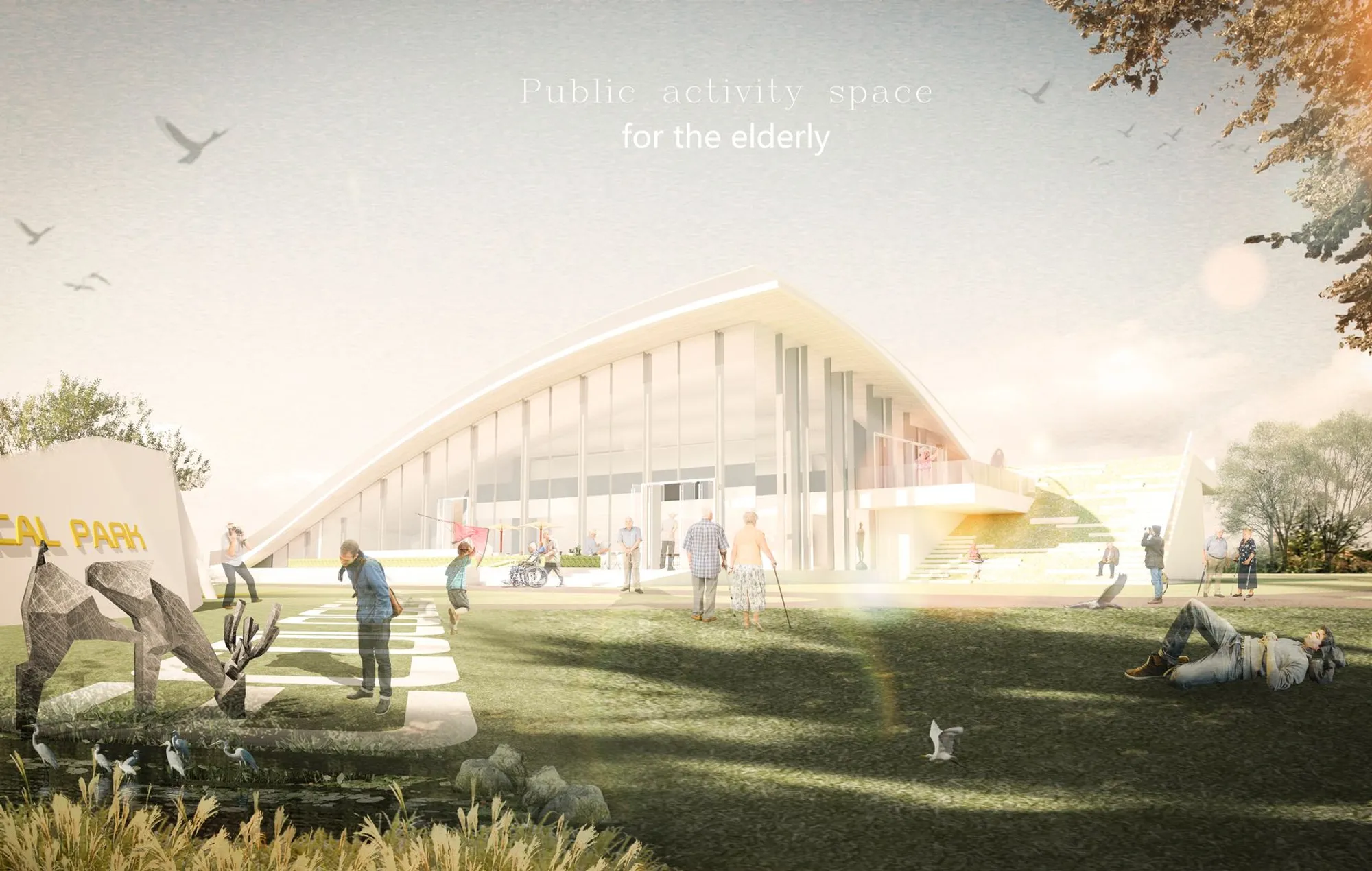
Huddle Shortlist: A Munich Park Carved into a Care Facility for Aging Residents
Ye Zhijie's subtractive terrain strategy buries an elderly care complex beneath a public green roof in a Munich urban park.


What if the building didn't sit on the park but became the park? In Munich, a proposal for elderly care housing takes that question literally, carving into the terrain of an urban green space to produce a structure whose roof is indistinguishable from the surrounding landscape. The result is a facility that older adults live within rather than retreat to, one that sustains public life on its surface while sheltering private life beneath it.
Designed by Ye Zhijie, this project was shortlisted in the Huddle competition on uni.xyz. Sited in a park surrounded by lush greenery and well-connected to Munich's urban fabric, the proposal draws on interviews with elderly residents to address real tensions: the desire for personal space versus the need for social engagement, the wish to garden and walk versus the physical limits of reduced mobility, and the openness to intergenerational contact versus the absence of structured opportunities for it. Ye's architecture responds to each of these tensions with spatial specificity.
Subtracting from the Ground to Build Community Below
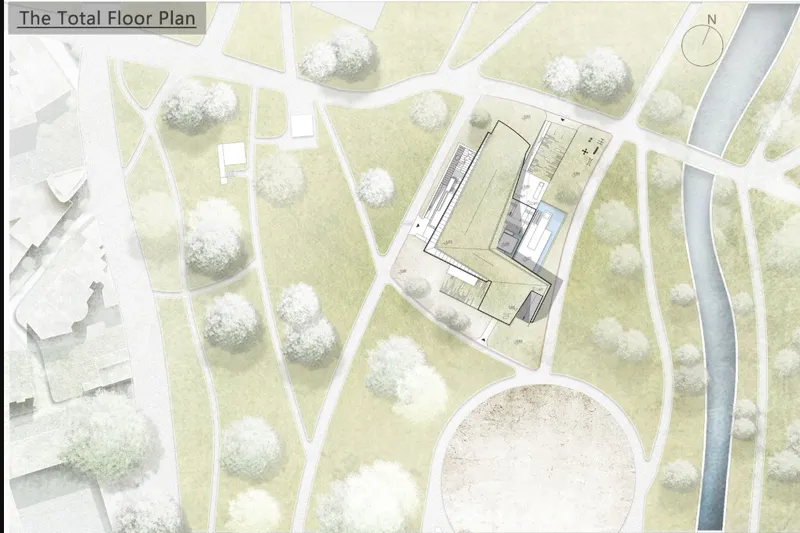
The axonometric site drawing reveals how the building is generated: a subtraction technique within the park's property lines removes material from the existing green terrain, producing an angular form that slots into the landscape rather than imposing upon it. The rectangular block sits nestled among pathways and mature trees, its edges defined by the logic of the park's circulation rather than by arbitrary property setbacks. It is a building shaped by what was already there.
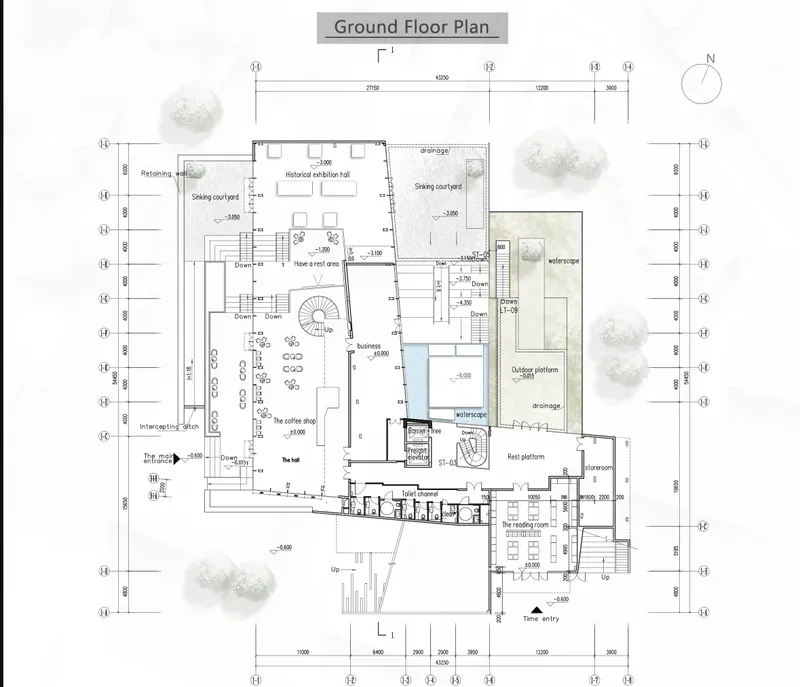
The ground floor plan shows how that carved volume is organized. Interior courtyards punctuate the layout, pulling daylight deep into the building while creating sheltered outdoor rooms. A pool, staircases, and planted zones are distributed across the plan to encourage movement without demanding it. Raised garden beds and scenic walking paths ensure that residents with limited mobility can still engage with the outdoors, while communal zones and more intimate spaces coexist in careful proportion, reflecting the interview finding that elderly individuals want both privacy and shared activity.
A Green Roof That Functions as Public Ground
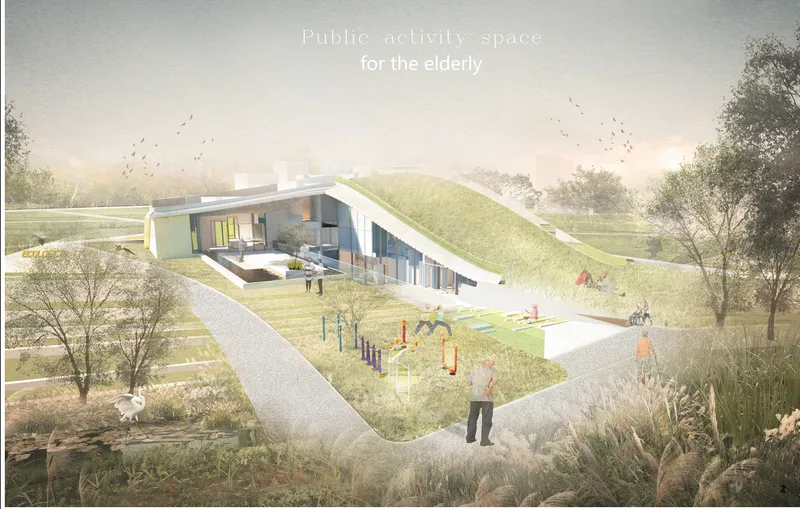
The aerial rendering makes the project's most ambitious move legible: the building's grass-covered sloping roof is not merely a sustainable gesture but a fully functioning public landscape. Playground equipment, walking paths, and seating areas populate the roof surface, attracting families and younger visitors to a space that sits directly above the elderly residents below. This vertical stacking of public and private life creates precisely the kind of structured intergenerational exchange that Ye's research identified as missing from conventional care environments.
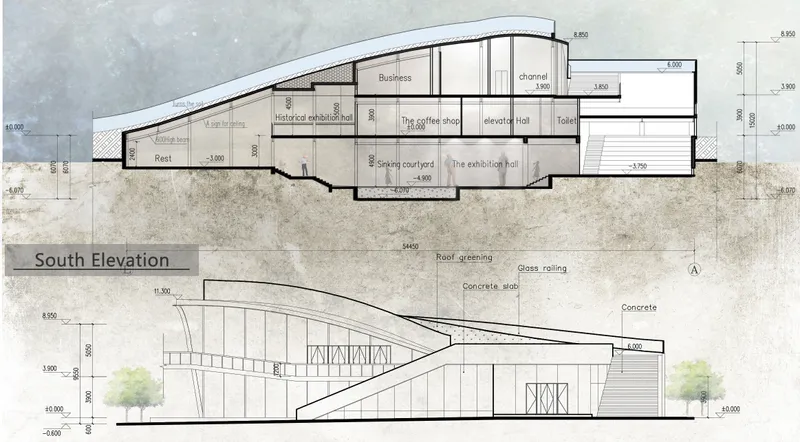
The section elevation clarifies the engineering of this relationship. A curved green roof rises gently above grade, creating generous ceiling heights for interior spaces including a sunken exhibition hall and a coffee shop designed as social anchors. The section shows how natural light enters from the courtyards and glazed facades while the earth-sheltered walls provide thermal mass, reducing energy demand. The form, Ye notes, was generated through iterative optimization, moving from the original grassland condition to the final angular block, shaped for function, flow, and ecological synergy.
Courtyard Life Between Planted Beds and Glass
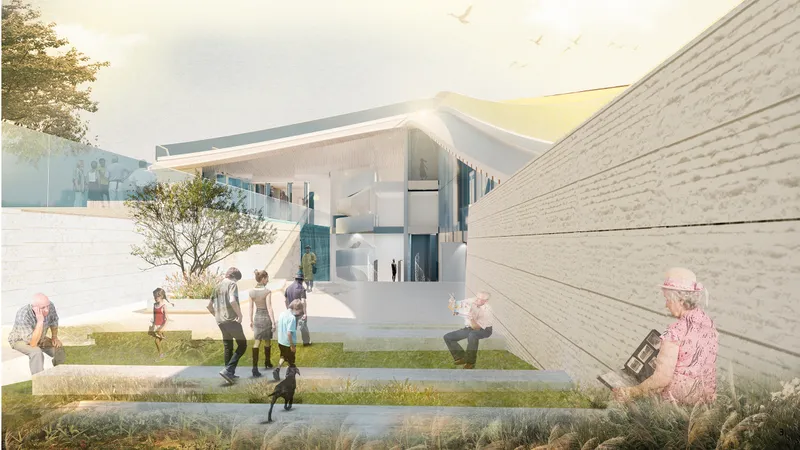
The courtyard view captures the experiential quality of daily life in Ye's proposal. A glazed facade brings transparency between interior and exterior, while the sloping white roof overhead frames the sky without overwhelming it. Elderly residents move along pathways between planted beds, the architecture offering rest zones and social nooks at intervals calibrated to reduced mobility. The planting is not decorative; it is programmatic, providing the gardening opportunities that residents specifically requested in the design research phase.
Outdoor platforms and tranquil viewing areas extend from the courtyard edges, creating a gradient from communal activity to solitary contemplation. The effect is a care environment that does not feel institutional. It reads as a garden with rooms, not a building with landscaping.
Why This Project Matters
Elderly care architecture too often defaults to either the clinical or the cozy, producing facilities that isolate their residents from the rhythms of public life. Ye Zhijie's Munich proposal refuses both modes. By burying the building within the park's terrain and activating its roof as public ground, the design makes older adults participants in the city rather than wards of it. The research-driven programme, grounded in actual interviews about mobility, privacy, and social desire, ensures that the architecture answers real needs rather than assumed ones.
The project demonstrates that sustainable architecture for aging populations is not a matter of adding ramps and green roofs to conventional typologies. It requires rethinking the relationship between the building and its context, between private dwelling and public space, and between the needs of a specific demographic and the life of the broader community. Ye's shortlisted entry for Huddle is a convincing argument that those rethinkings can produce architecture that is both ecologically responsible and genuinely dignified.
View the Full Project
About the Designers
Designer: Ye Zhijie
Enter a Design Competition on uni.xyz
uni.xyz runs architecture and design competitions year-round that reward proposals with spatial conviction and real site intelligence.
Project credits: Based on the study of public activity Spaces for the elderly by Ye Zhijie Huddle (uni.xyz).




Popular Articles
Popular articles from the community


Conexión: Biophilic Design Reimagines High-Rise Living in Hong Kong
Conexión reimagines high-rise living in Hong Kong through biophilic design, green facades, shared spaces, daylight, water and nature within.
AL-JANNAH: Sustainable Architecture and Permaculture for Afghan Widows
AL-JANNAH uses sustainable architecture and permaculture to create resilient oasis of housing, learning, work and renewal for Afghan widows.

Co-life: Sustainable Architecture for Age-Friendly Community Living
Co-life reimagines sustainable architecture for seniors through courtyards, rammed earth, shared gardens, and spaces designed for belonging.

The Earth Pod: 3D Printed Homes for Resilient Refugee Communities
The Earth Pod reimagines refugee housing through 3D printed homes made from clay, combining resilience, self-sufficiency, and rapid shelter.


Similar Reads
You might also enjoy these articles

Bao Huynh Watercolor Atelier: A Serene Art Retreat in Hội An
Bao Huynh Watercolor Atelier in Hội An blends multifunctional art spaces, sustainable design, local materials, and family-friendly living in a serene environment.

Atelier Macri Concept Store Interior Design by CASE-REAL
Atelier Macri store features a "ko" counter, walnut wood details, cork displays, blending retail, gallery, and seamless customer experiences.

Manuel Vargas Izquierdo Stadium and High-Performance Sports Center: Architectural Excellence in Jalpa de Méndez
The Manuel Vargas Izquierdo Stadium blends sustainable design, inclusive sports facilities, and cultural-inspired architecture, revitalizing Jalpa de Méndez’s public spaces.
KAKR Buluh Awar Hall: Revitalizing Community and Ecology Through Bamboo Architecture
Community built bamboo hall revitalizes Buluh Awar village, empowering youth, restoring ecology, celebrating vernacular craftsmanship through sustainable architecture and culture.



Comments (0)
Please login or sign up to add comments
No comments yet. Be the first to comment!