
A Threshold Turns a Bangalore Plot into a Vertical Stepwell Where Stairs Become Gardens
A split-level residence in northern Bengaluru reinterprets the ancient stepwell typology, weaving greenery through every staircase and void.

The stepwell is one of South Asia's most potent architectural inventions: a structure where infrastructure and public space merge through the simple act of descending. A Threshold, led by Avinash Ankalge, takes that logic and flips it skyward. On a 5,400 square foot corner plot in northern Bengaluru, adjacent to the veterinary college park and its agricultural fields, the Stepped Well House uses a cascading series of five-foot level differences to stitch together domestic life, vegetation, and borrowed landscape into a single continuous section.
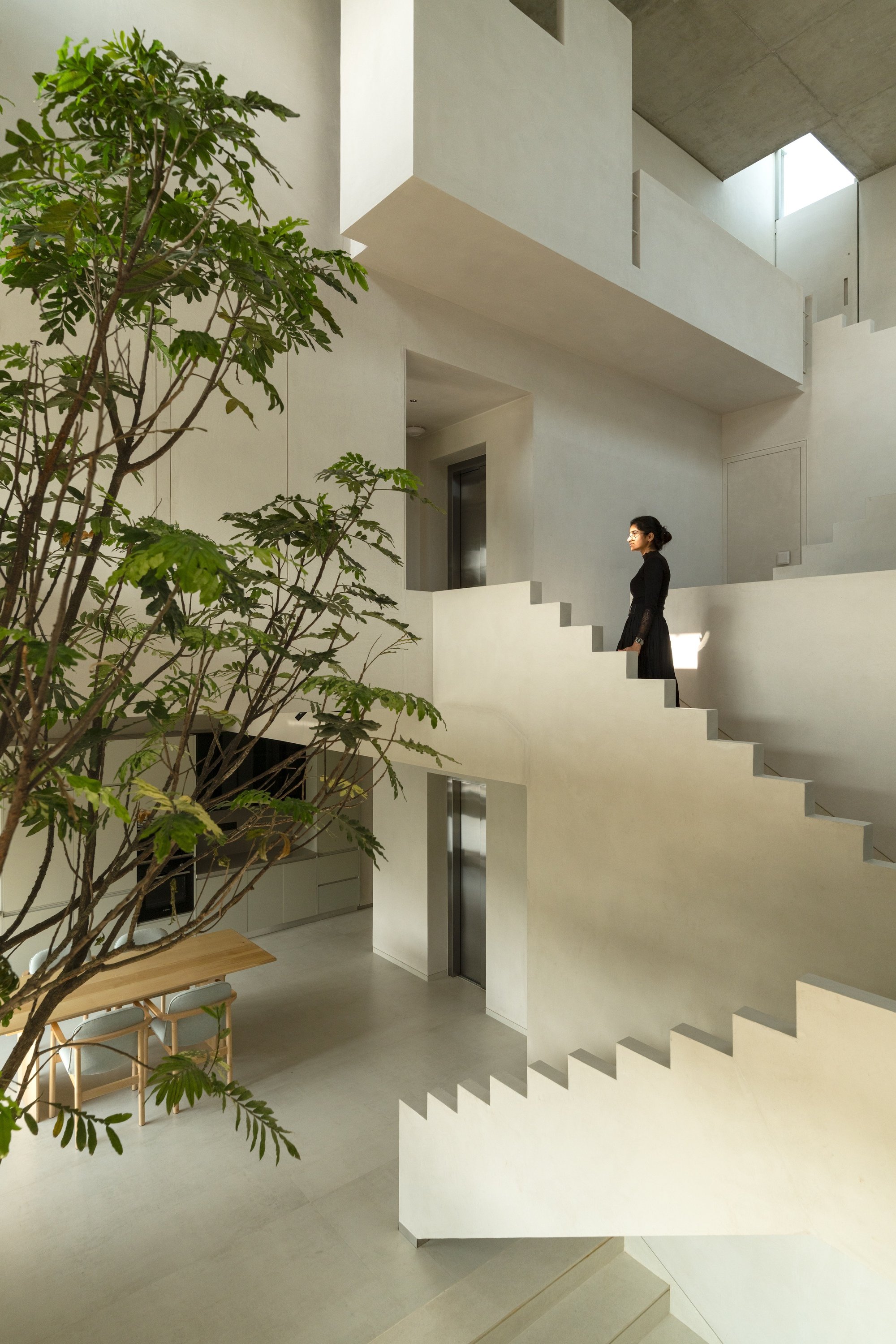
What makes this house genuinely interesting is its refusal to treat the staircase as mere circulation. In most compact urban houses, stairs are corridors you pass through as quickly as possible. Here, they are the primary spatial event: amphitheatres for sitting, frames for planted trees, sources of light, and mechanisms for visual connection between levels. The result is a house that feels substantially larger than its footprint, not because of any trick of proportion, but because every transitional zone is activated with program and greenery.
A Facade That Reads Like Strata
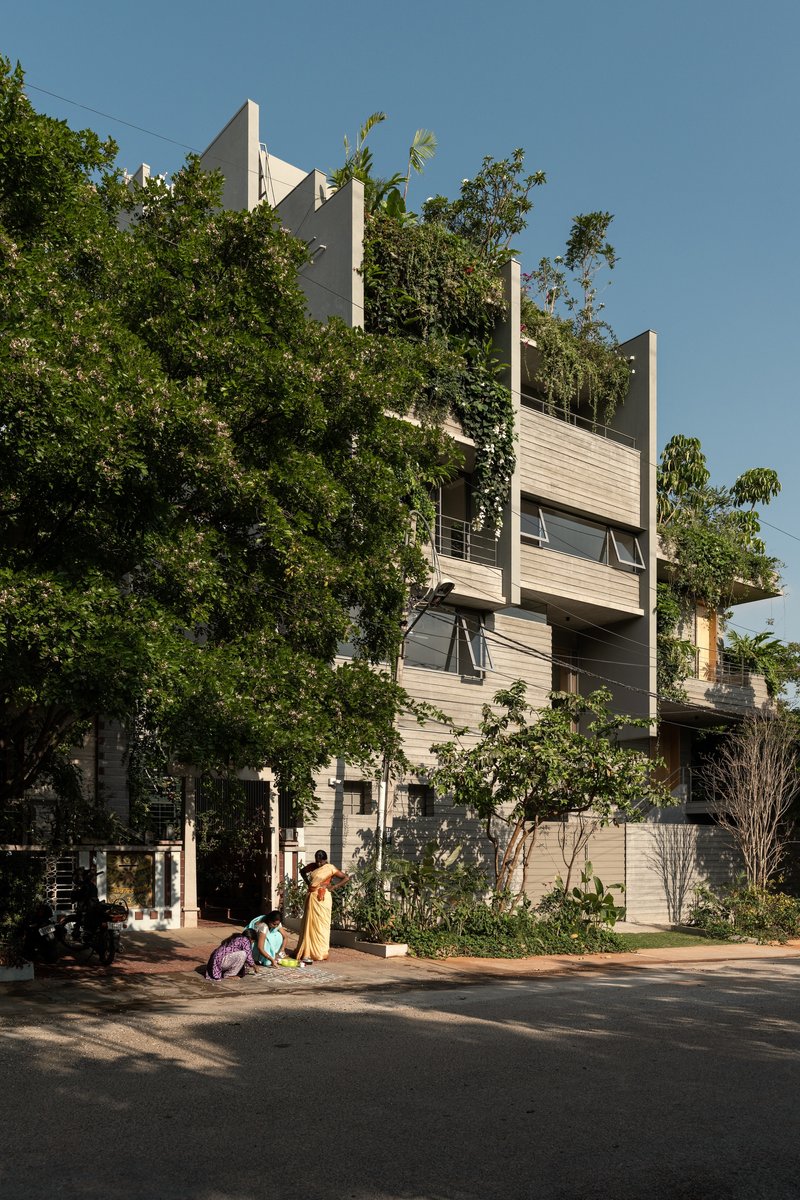
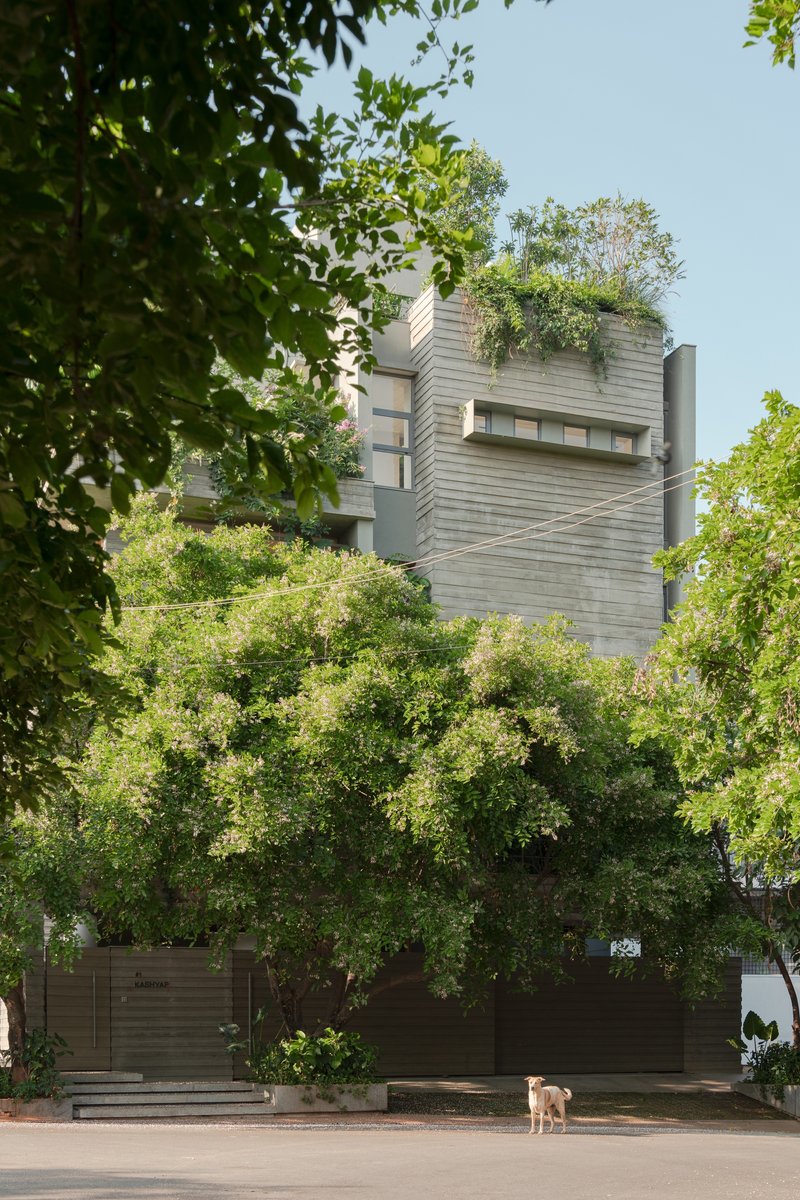
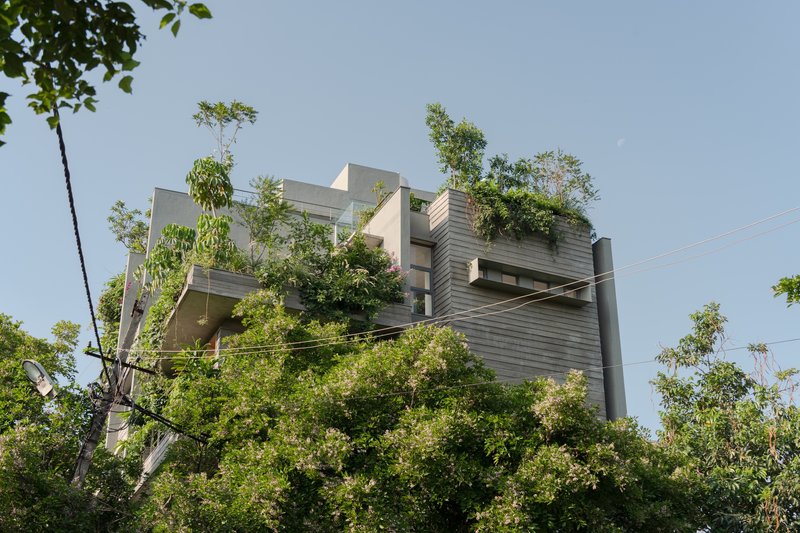
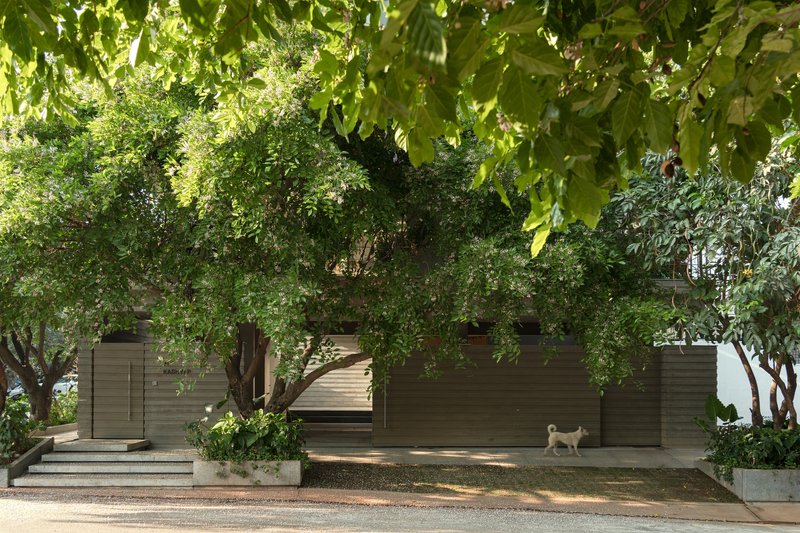
From the street, the house presents itself as a stack of horizontally ribbed concrete volumes rising through a canopy of mature Honge trees. The three-inch bands of exposed concrete, formed with shuttered planks, create a fine horizontal grain that visually compresses the building's actual height. It is a smart tactic for a dense urban neighborhood: the facade reads as geological rather than architectural, as though the house were a cut through layered earth rather than a four-storey object. At dusk, the louvred openings glow behind the foliage, and the boundary between building and tree canopy becomes genuinely ambiguous.
Three large Pongamia Pinnata trees buffer the north side from the road, and A Threshold wisely oriented the formal and informal living spaces toward these trees. The entry courtyard, set beneath dappled sunlight and flanked by planted beds, establishes the house's core proposition immediately: you will never be more than a few steps from vegetation.
The Central Void as Vertical Garden
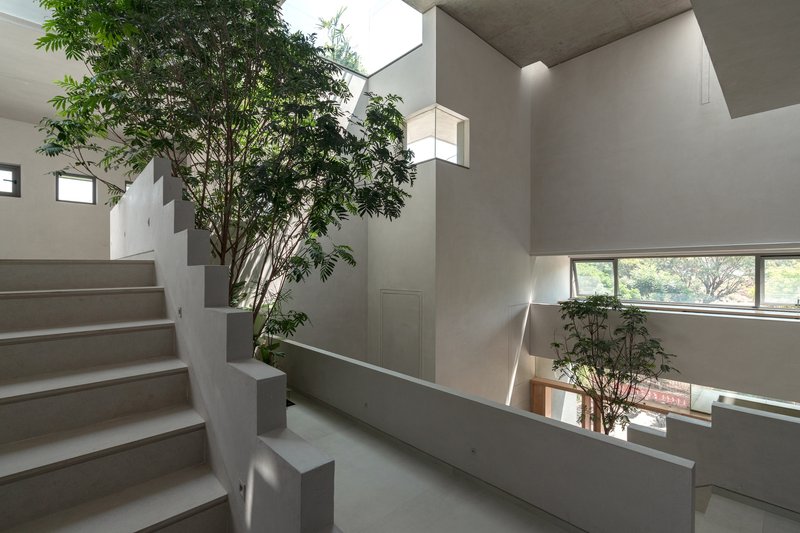
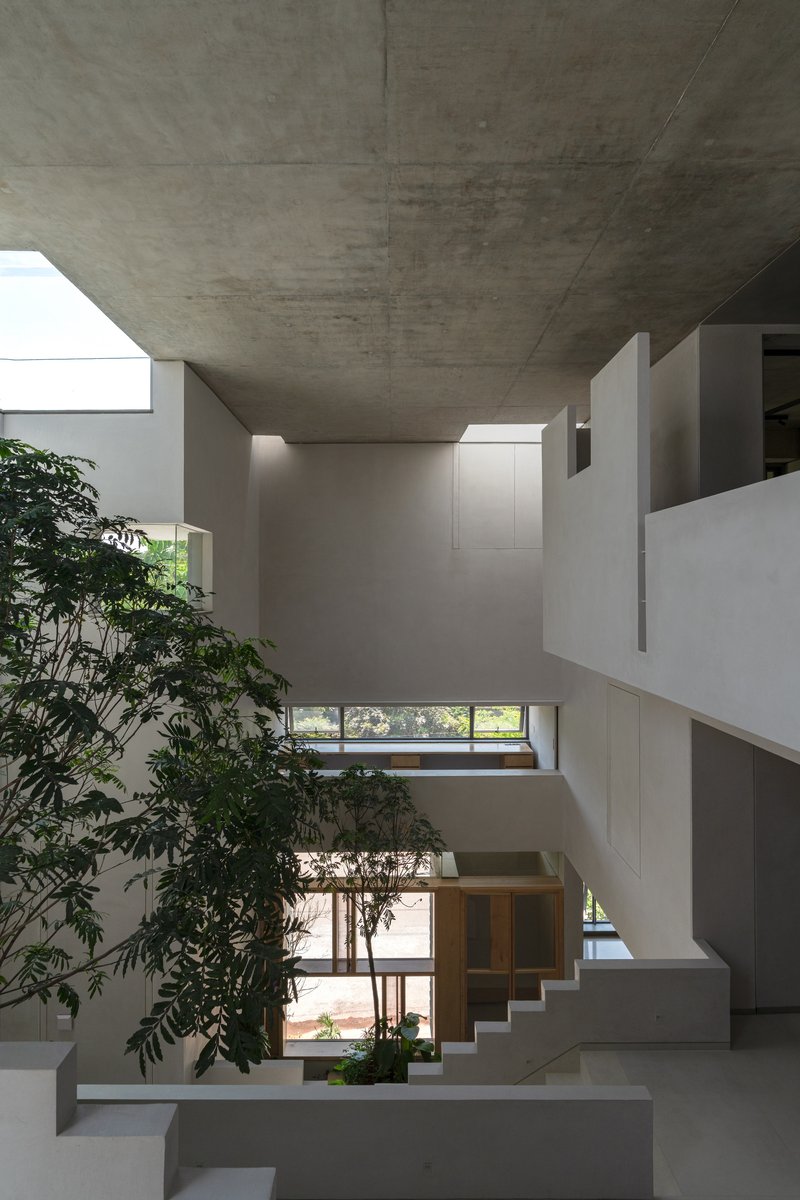
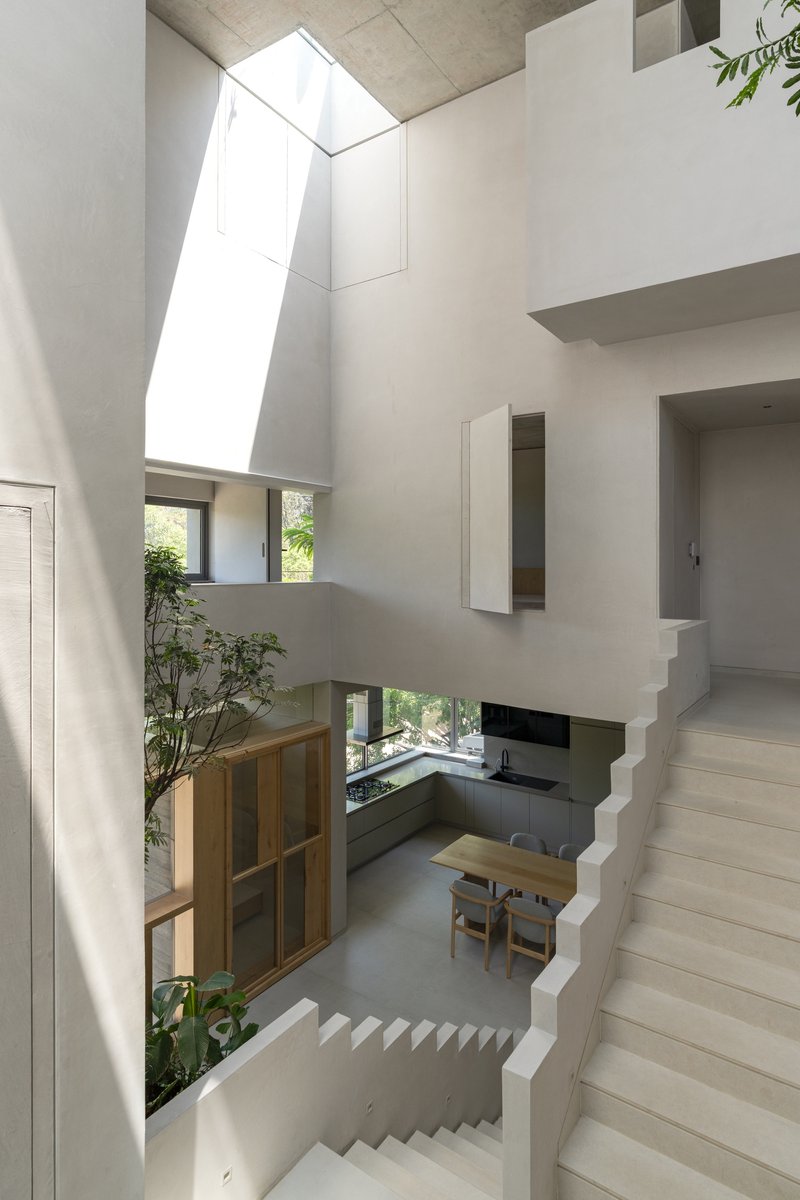
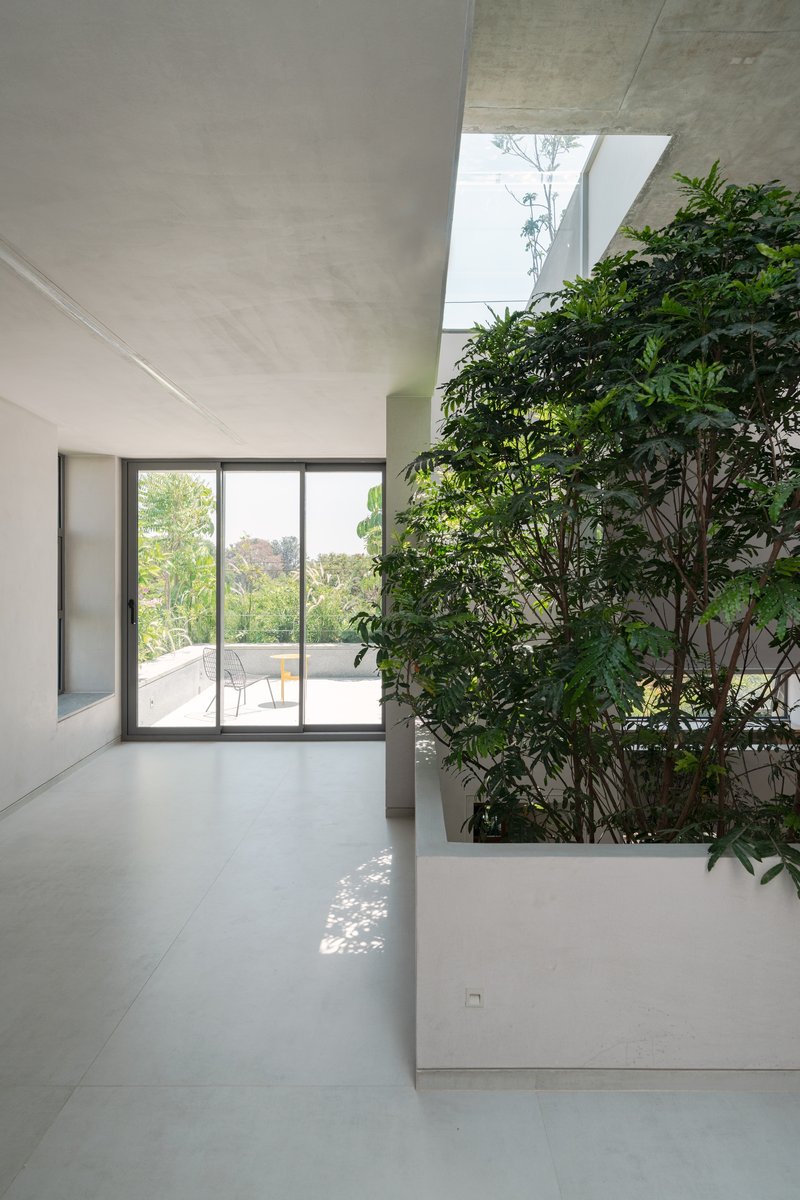
The heart of the house is a multi-storey atrium where a Phyllium tree grows from a planted bed at ground level, pushing upward through cascading terraces toward angular skylights. The tree is not decorative. It structures the entire section: staircases wrap around it, bedrooms look down onto its canopy, and its presence determines where daylight penetrates deepest. Board-formed concrete ceilings overhead give the void a raw, tactile quality that contrasts with the smooth white plaster of the stair walls.
Looking straight up through this void, you can read all five levels of the house at once. Cantilevered stairs, planted ledges, and clerestory windows stack into a composition that genuinely recalls the stepped geometry of a traditional vav or baoli, only oriented vertically rather than excavated downward. It is one of those rare residential moves where the metaphor is not applied to the surface but embedded in the spatial logic.
Stairs as Inhabited Space
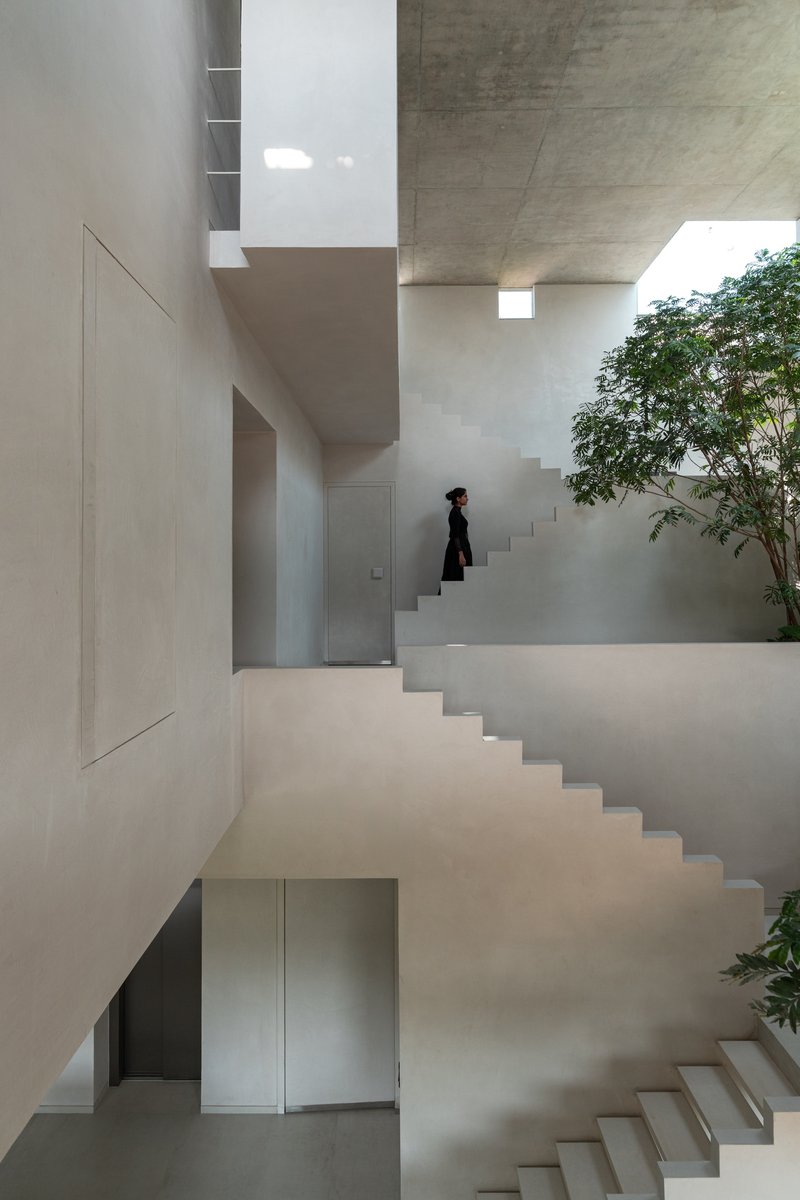
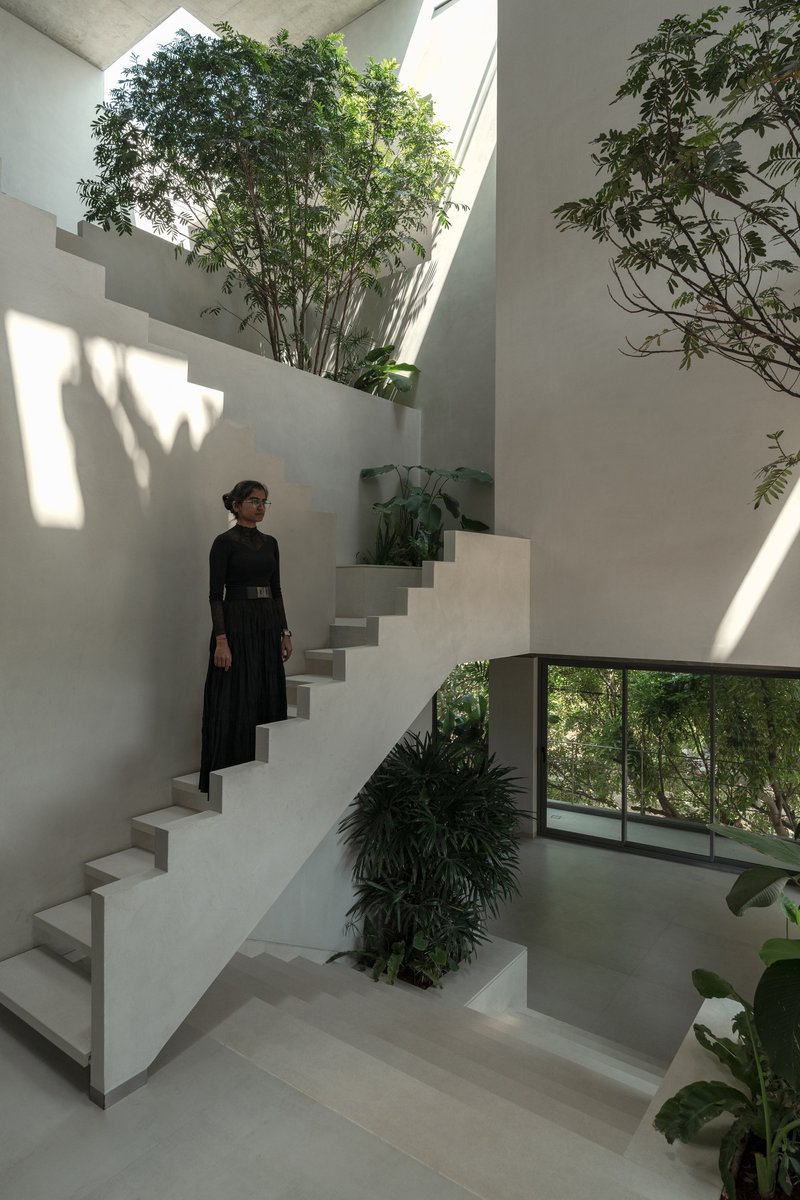
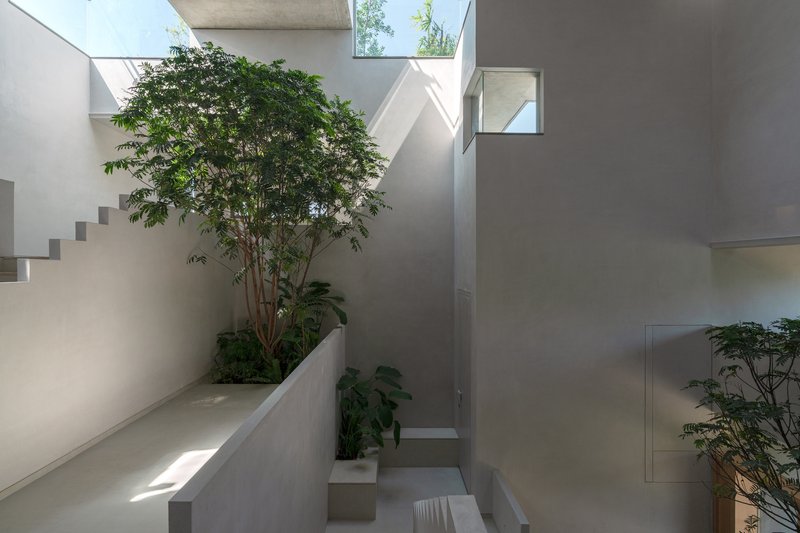
The stepped amphitheatre within the living areas doubles as a sit-out space with integrated greenery, and this idea of the stair as room recurs throughout the house. Figures photographed mid-ascent look comfortable, not hurried. The five-foot split levels mean that every half-flight arrives at a usable platform: a reading nook, a planter, a threshold between public and private zones. Light from overhead skylights casts angular shadows that shift through the day, turning the stairwell into a sundial of sorts.
Dappled sunlight filtering through the interior tree canopy creates conditions more commonly associated with a garden pergola than a staircase. The white plaster walls amplify this effect, bouncing indirect light into corners that would otherwise be dim. It is a house that rewards slow movement.
Living Rooms That Open to the Park
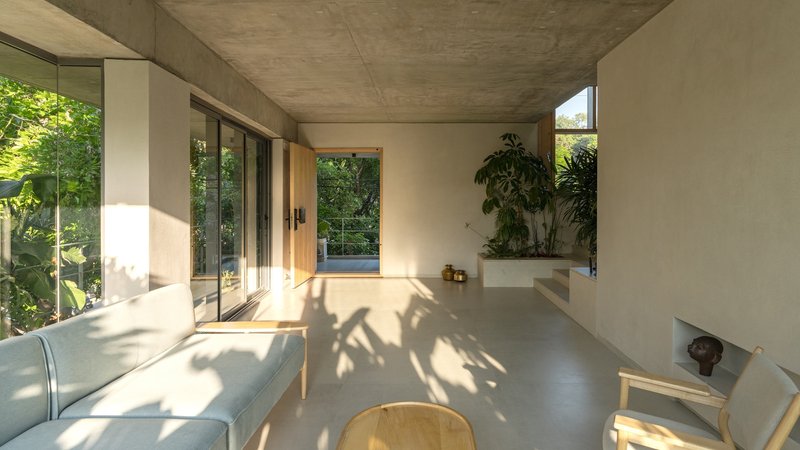
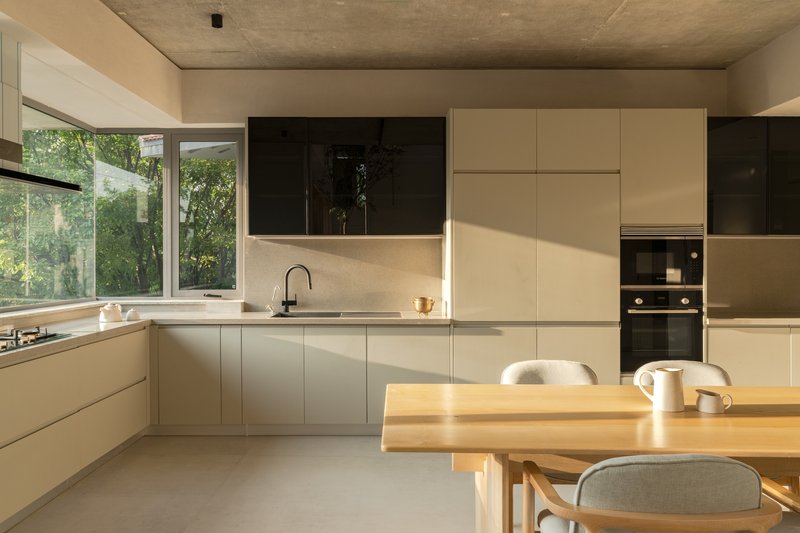
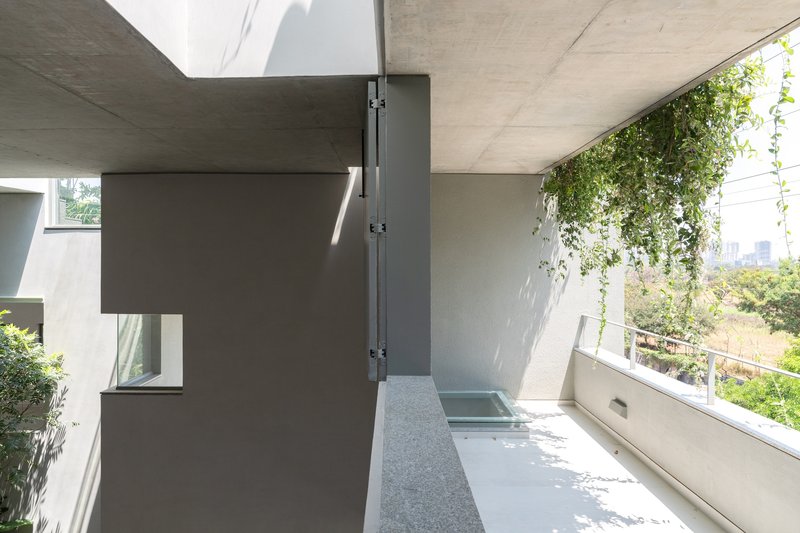
The east side of the plot opens to the veterinary college park and its agricultural fields, and A Threshold capitalizes on this borrowed landscape without hesitation. Living rooms, the kitchen, and bedroom balconies all face east and north, pulling the park's greenery into every social space. The living room itself, with its polished concrete floor, timber furniture, and concrete ceiling, has the restrained palette of a house that trusts its views to do the heavy lifting.
The kitchen and dining area receive afternoon sun through garden-facing windows, and a covered terrace with hanging vines and terrazzo flooring extends the living zone outward. Service areas are strategically banked against the southwest edge, creating a thermal and visual buffer from neighboring houses. The planning is precise: every room gets either park views or courtyard light, often both.
Bedrooms and the Intimacy of Tree Courts
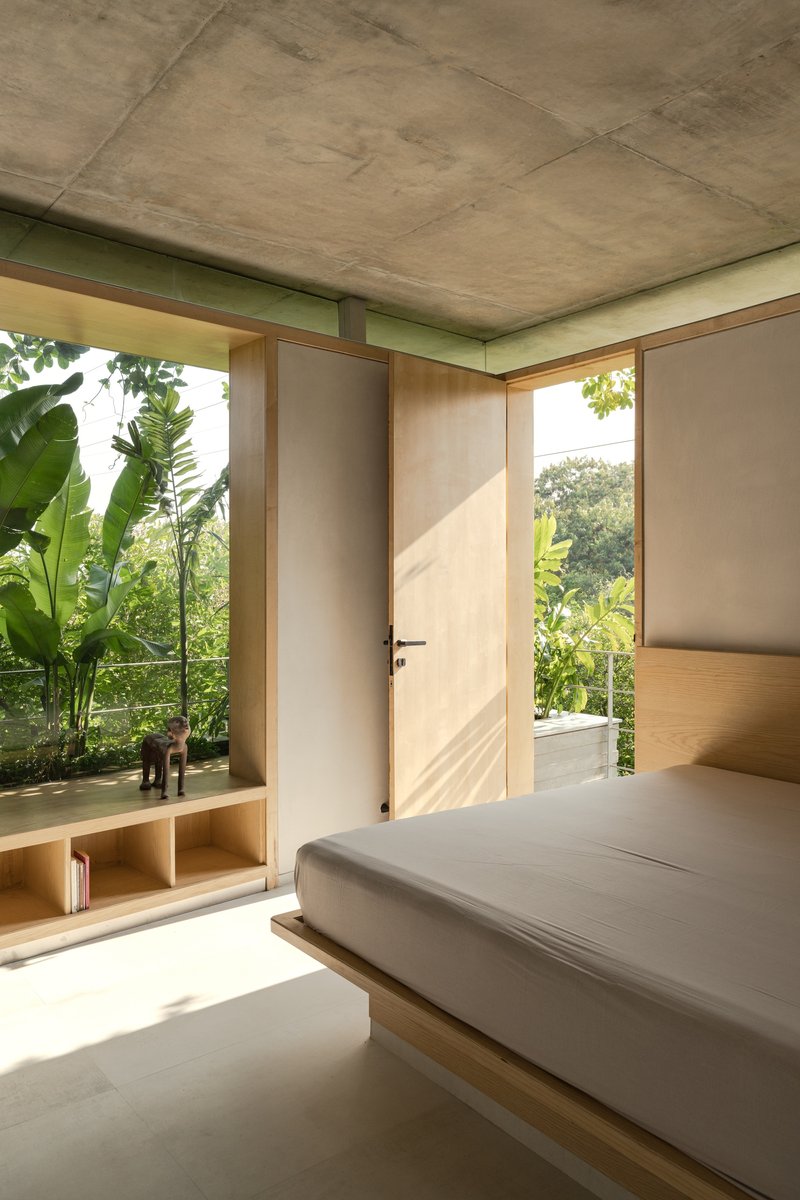
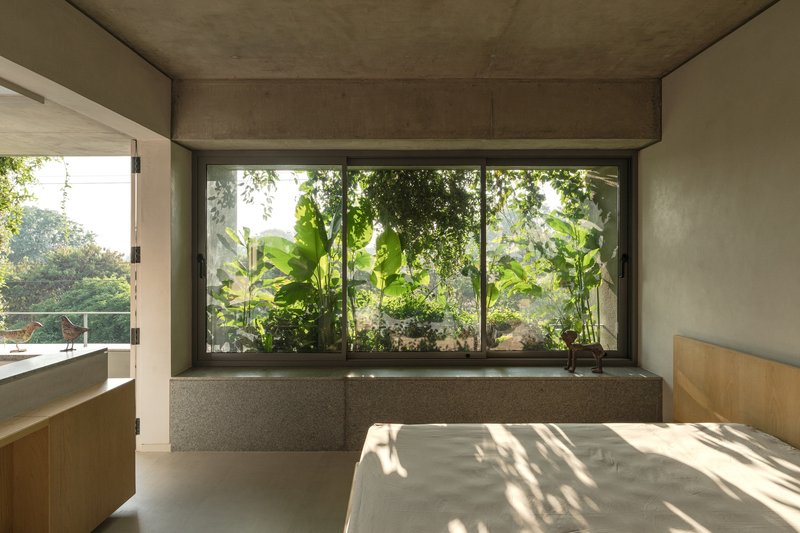
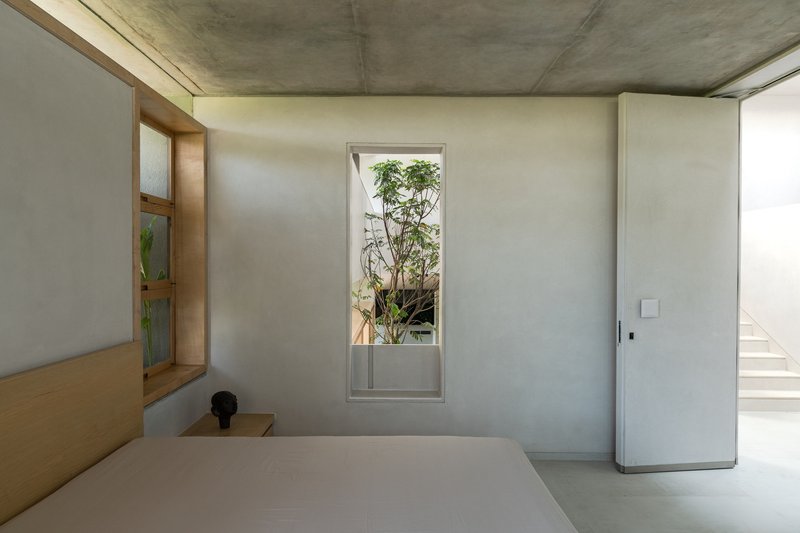
The daughter's and son's rooms occupy the east wing, overlooking the park through full-height glazing framed by tropical vegetation. The master bedroom retreats to the southwest corner for privacy, with its own balcony that surveys the rooftop plantings. Between the bedrooms, large tree courts with sit-out areas act as buffers, so that each room feels like it belongs to a separate pavilion rather than a shared floor plate.
Interiors are finished with exposed concrete ceilings, built-in timber bed platforms, and sliding timber screens that allow rooms to open or close to their adjacent courtyards. Pivoting windows frame specific plantings, banana leaves, succulents, the interior Phyllium tree, so that the view from each bed is curated rather than incidental. Terrazzo countertops and pale green wall accents in the bathrooms continue the material restraint, letting the concrete and timber do most of the work.
Light, Corridors, and Framed Green
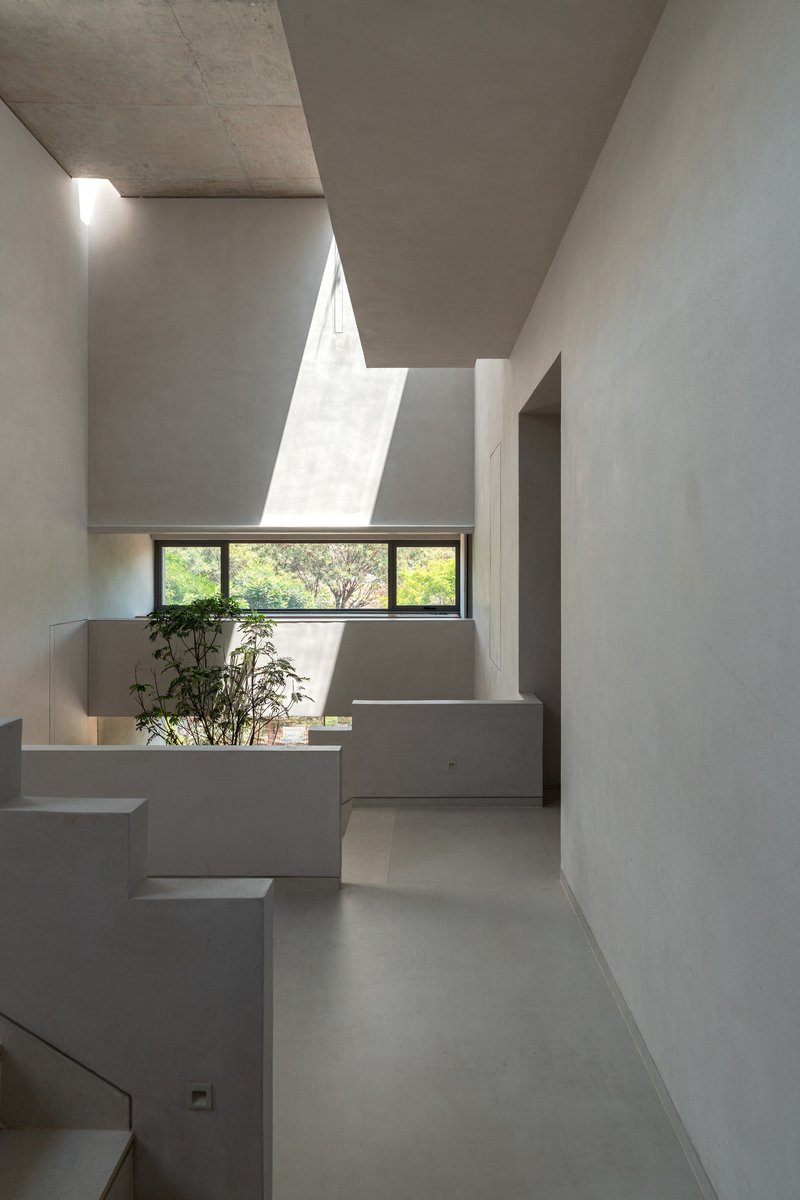
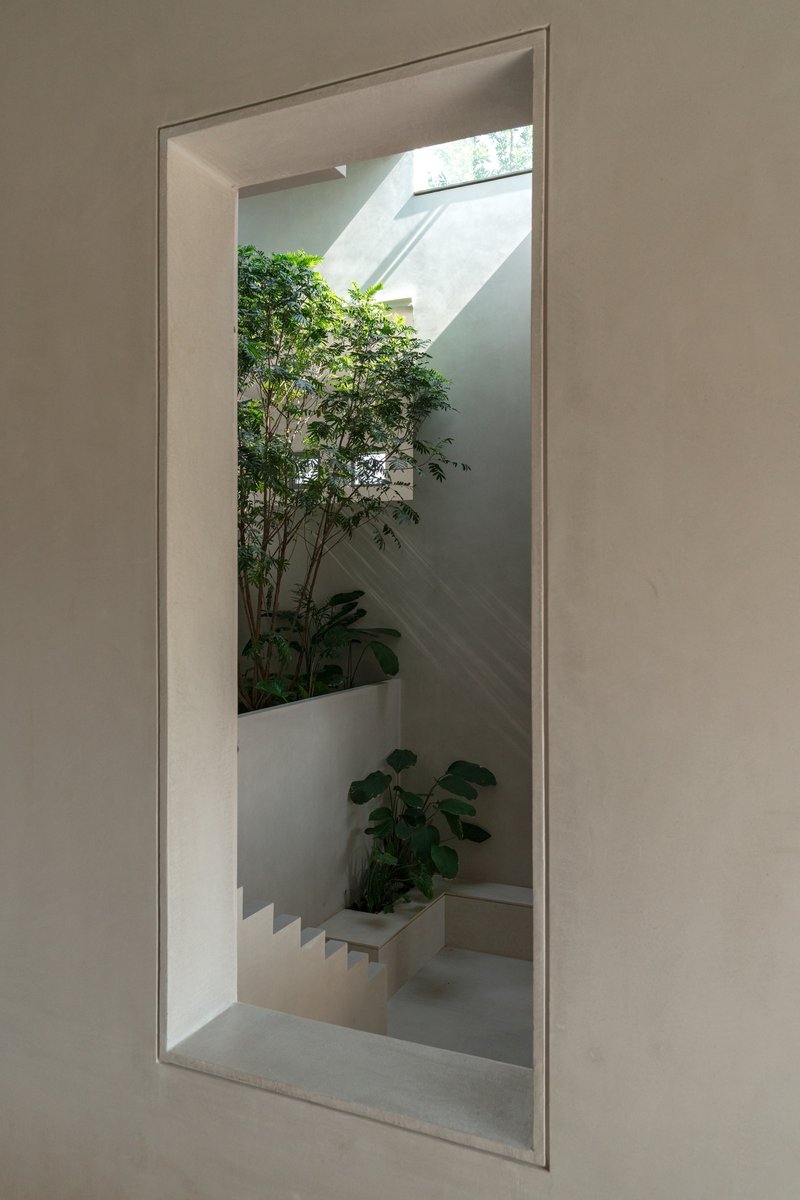
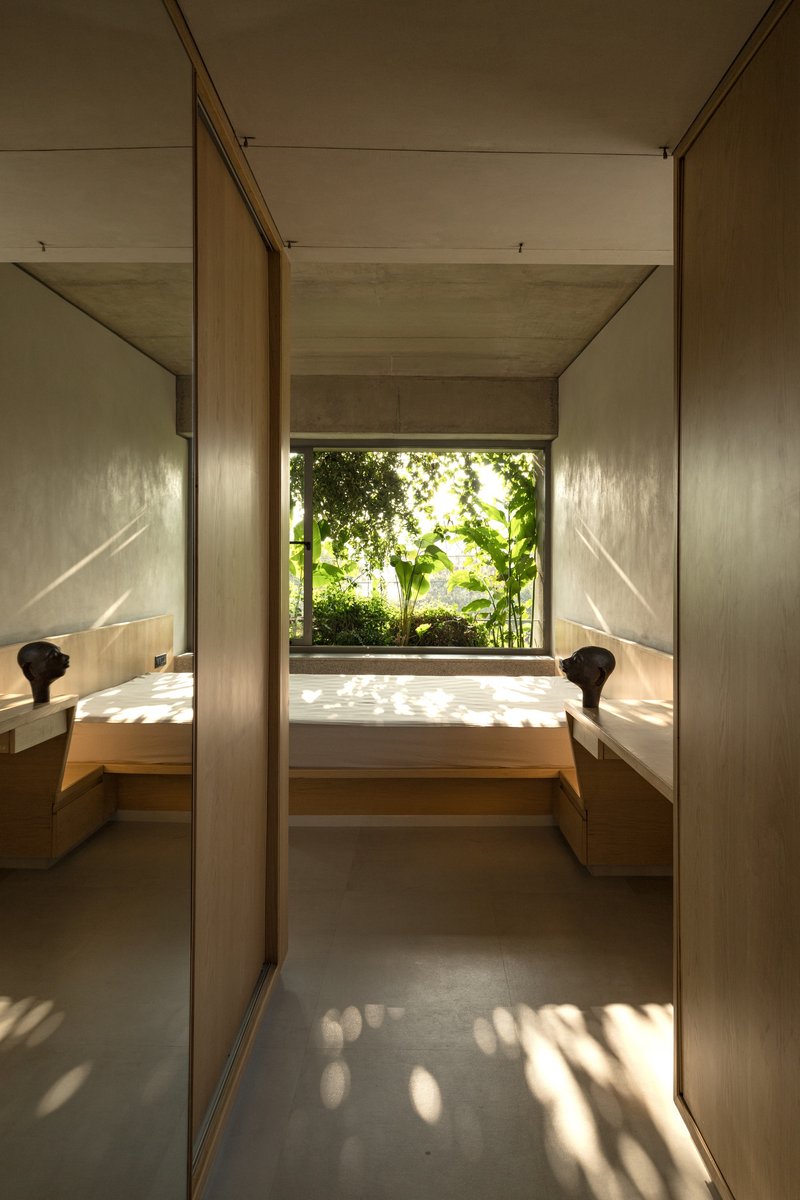
Even the secondary spaces receive careful attention. Narrow hallways with concrete ceilings channel horizontal windows that frame nothing but greenery, turning a corridor into a gallery of landscape vignettes. Timber-clad walls and built-in seating transform a pass-through into a pause point. A tall window beside the stairwell frames the internal courtyard so precisely that the planted trees and stepped concrete planters compose themselves like a vertical garden painting.
A study is positioned between the house and the park, occupying a threshold zone that is neither fully interior nor exterior. This is consistent with the broader design philosophy: every transitional space, whether corridor, landing, or study, becomes a room in its own right.
The Rooftop as Fifth Elevation
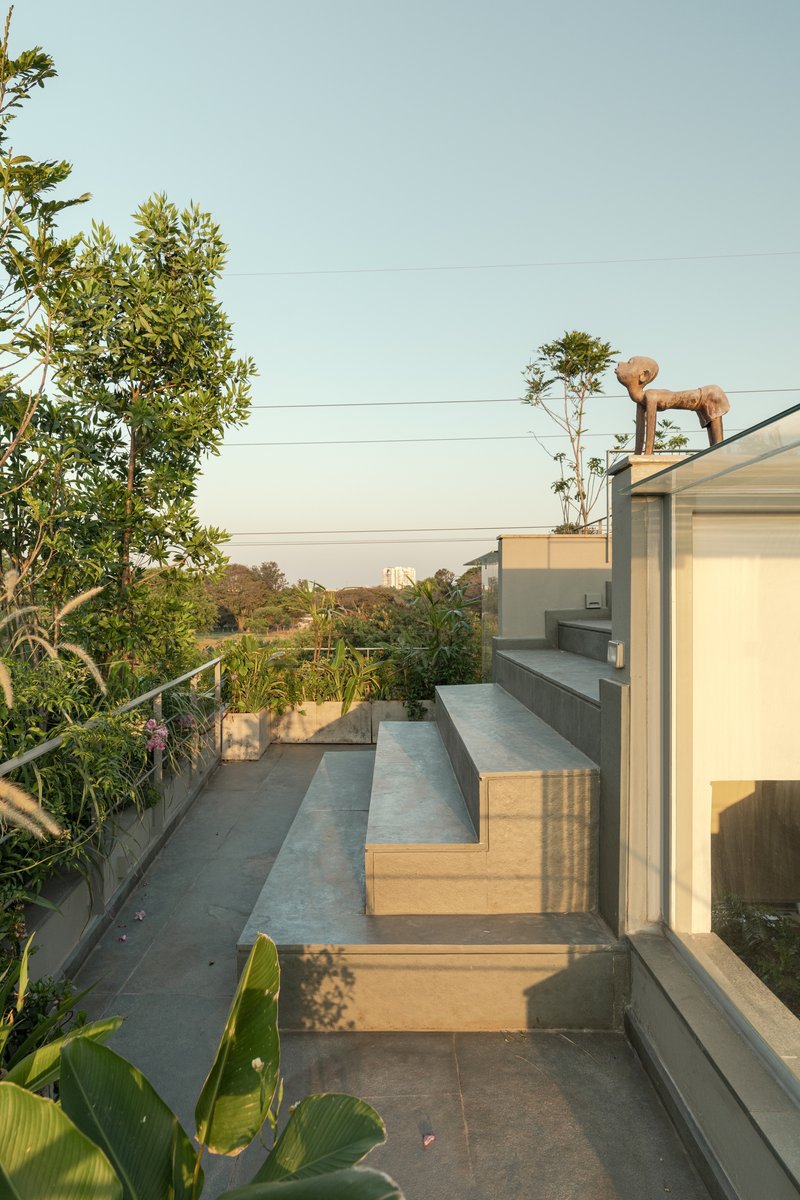
The rooftop terrace, with its timber and concrete benches overlooking planted beds at sunset, completes the vertical sequence. It is the final step of the inverted stepwell: having ascended through four levels of interlocking voids, courts, and planted landings, you arrive at an open sky. The cascading terraces below allow the interior tree to thrive, and from up here you can trace the section of the house in the staggered rooflines and planted ledges stepping down toward the street.
The entry courtyard at grade, with its mature trees casting shadows across the pavement, mirrors the rooftop condition. Both are open-air rooms anchored by vegetation. The house operates as a loop between these two poles, with the central stairwell as its vertical spine.
Plans and Drawings
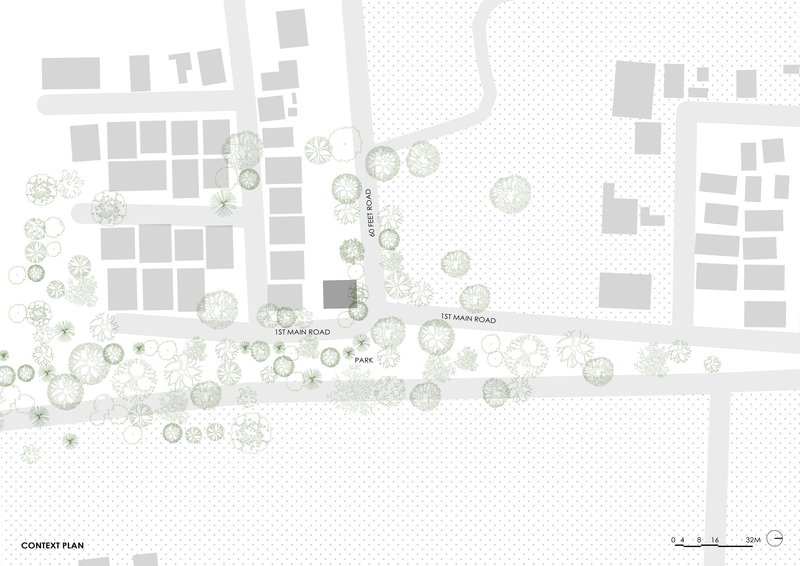
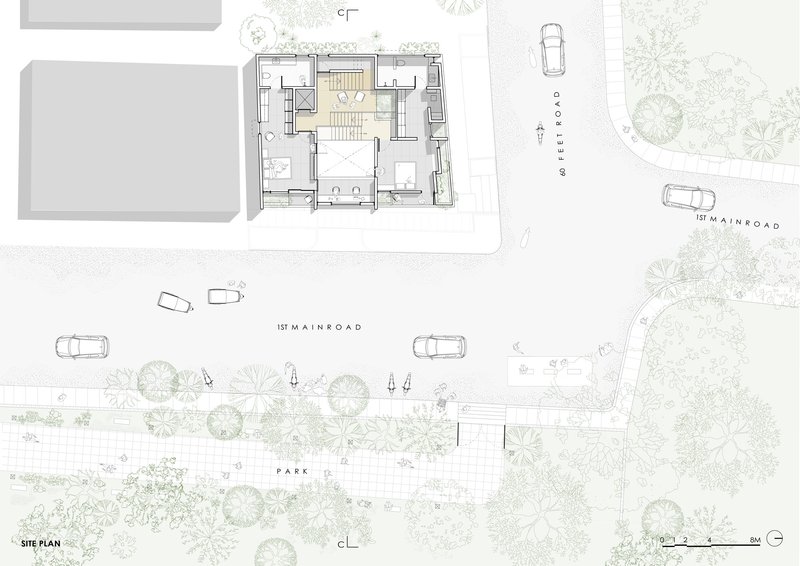
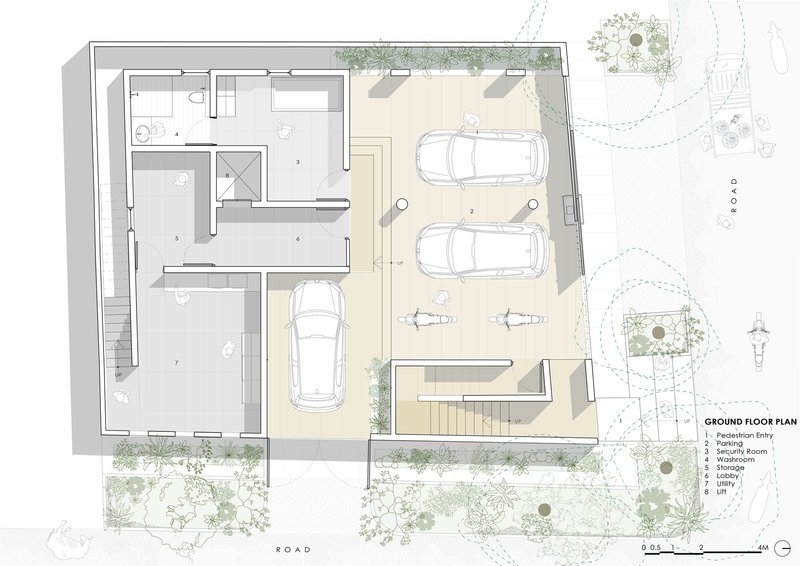
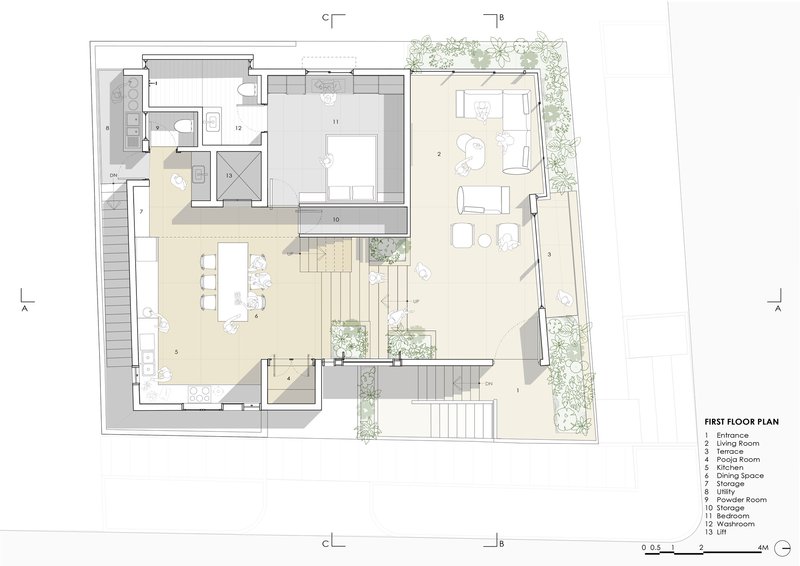
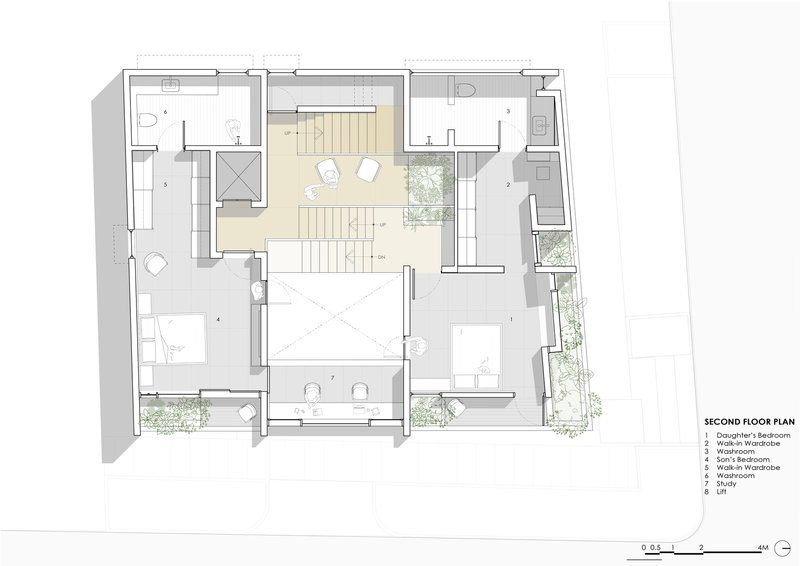
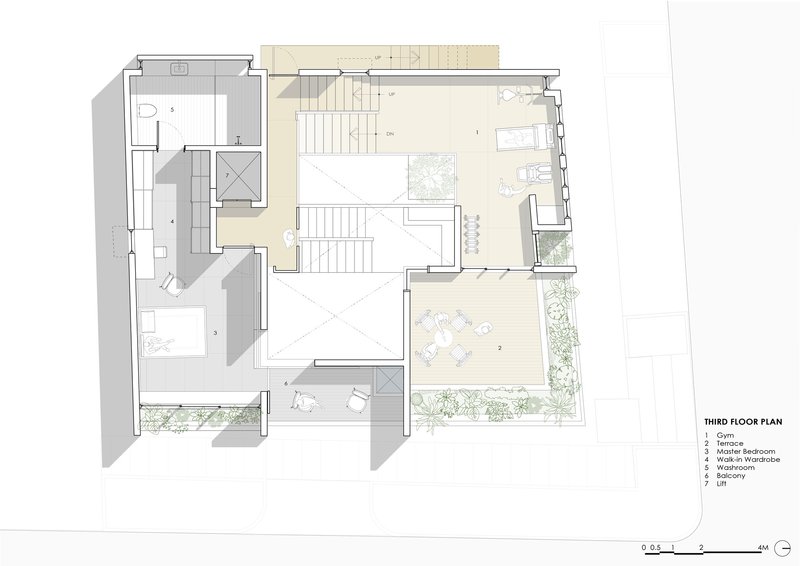
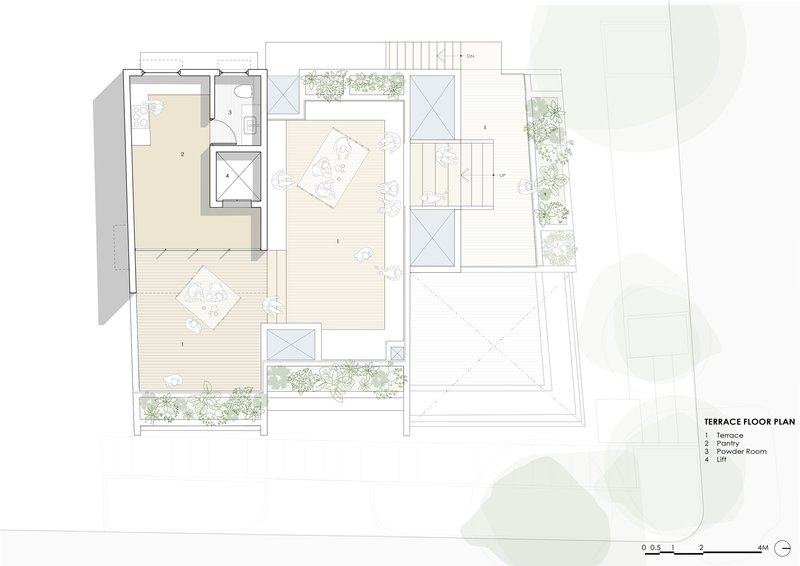
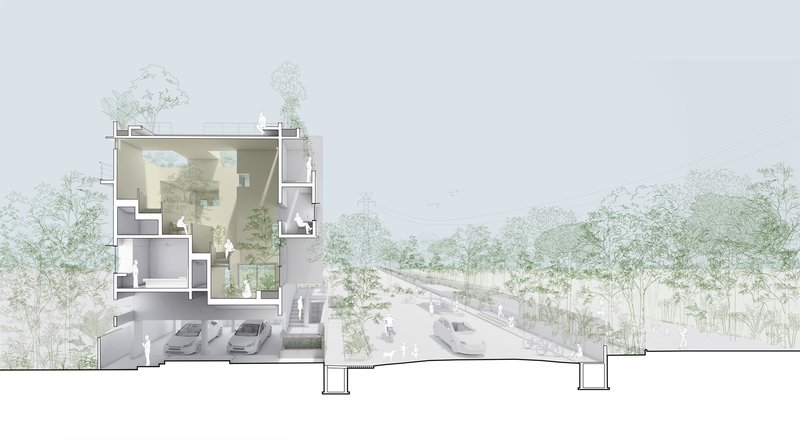
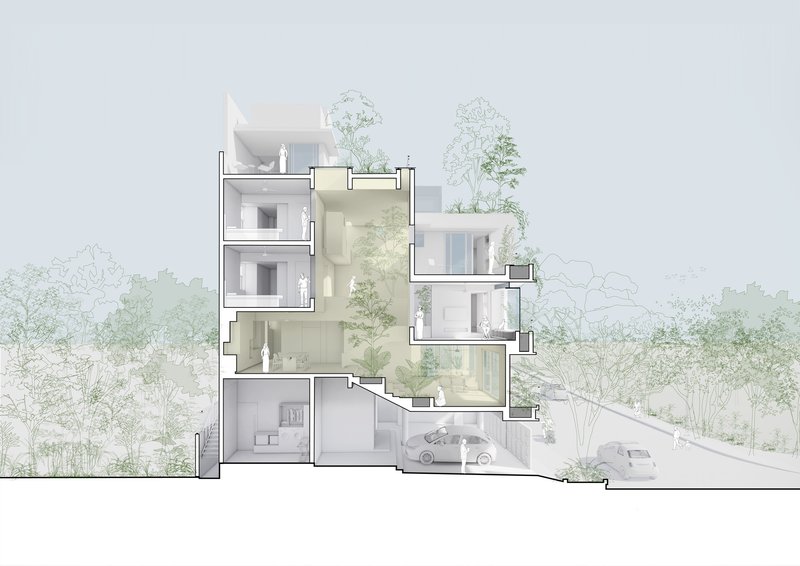
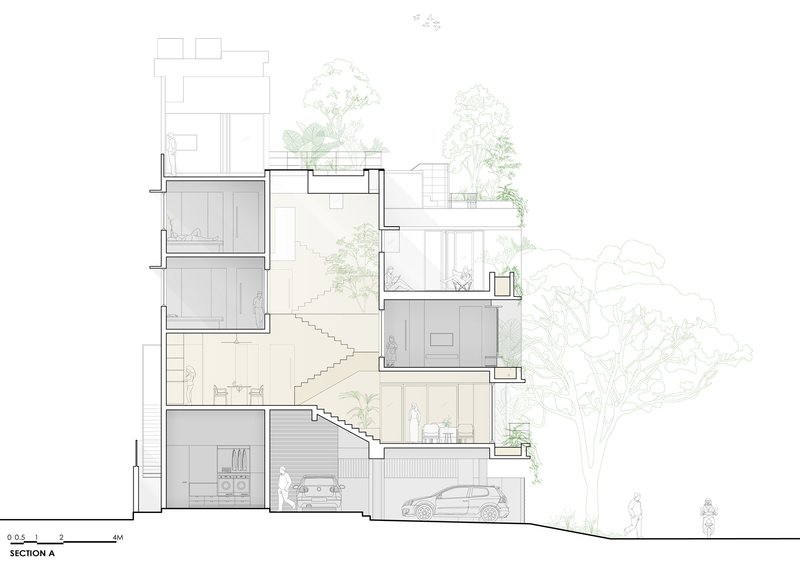
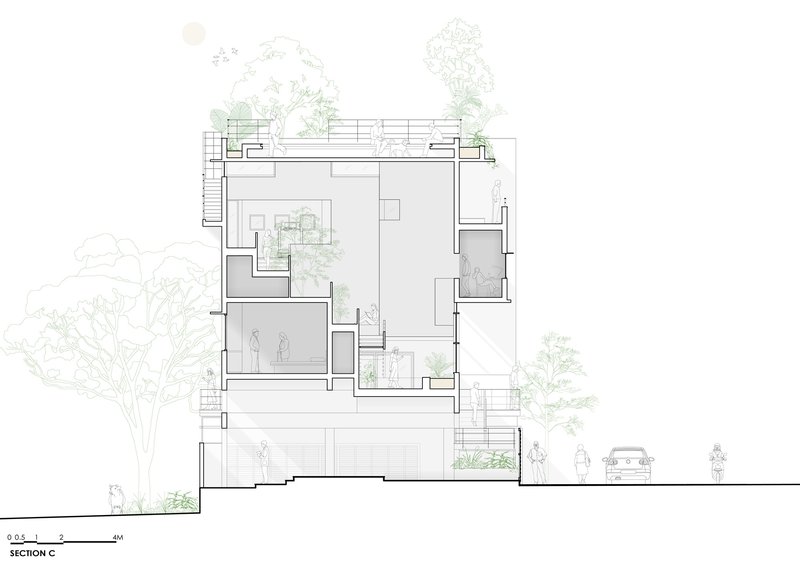
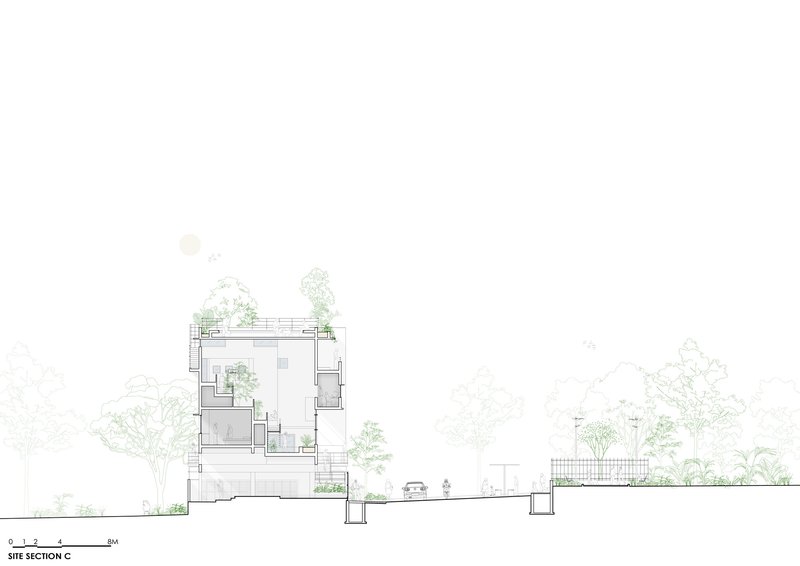
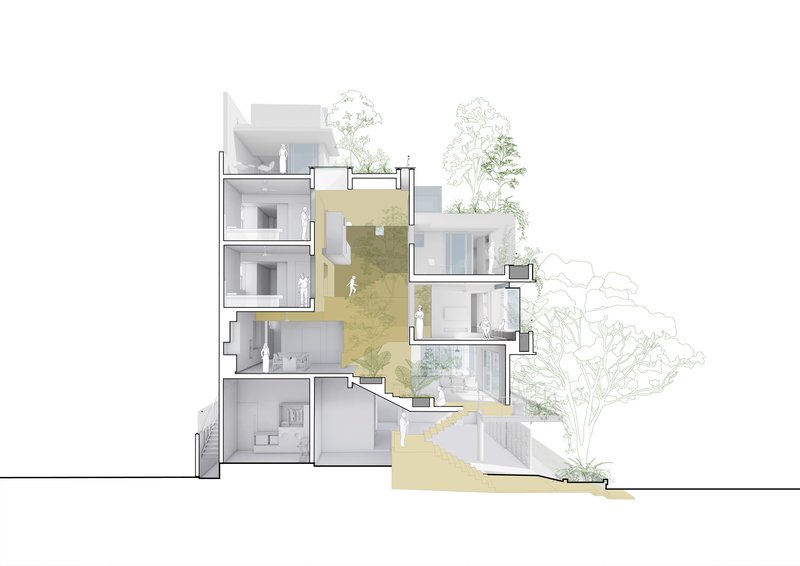
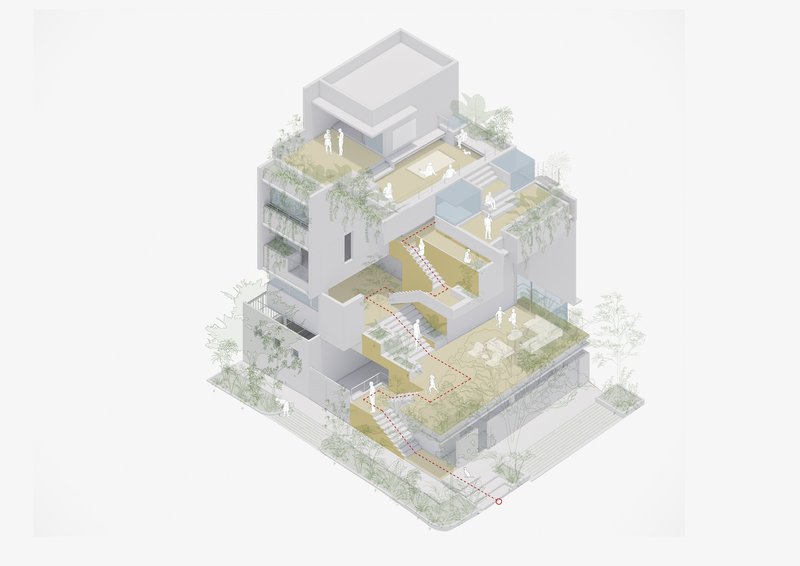
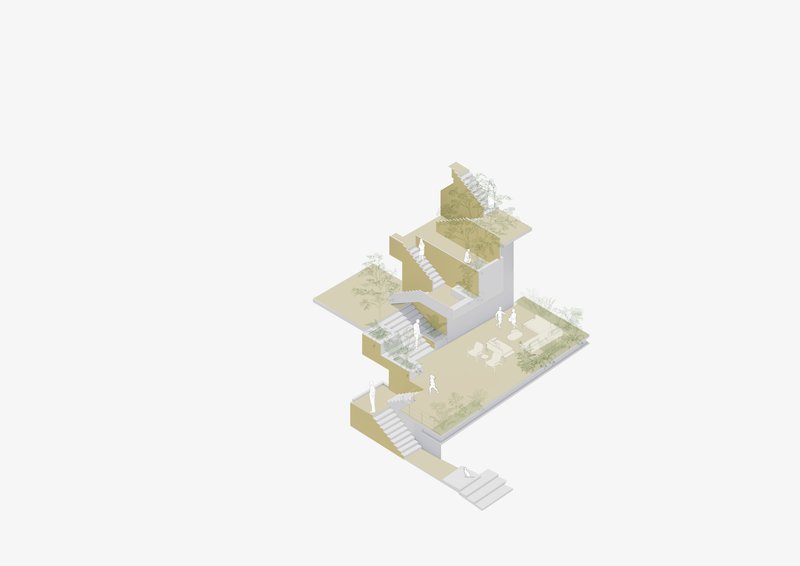
The drawings make the split-level logic legible in a way the photographs cannot. Each floor plan shows rooms arranged around the central stairwell void, with planted terraces eating into the floor plate at every level. The sections are the most revealing: they show how the five-foot level differences create a continuous cascade from east to west, with the interior tree rising through the center. The exploded axonometric illustrates the vertical circulation as a single connected organism rather than a stack of discrete floors. What reads as complexity in section is actually a simple rule applied consistently: every half-level shift creates an opportunity for planting, light, or a framed view.
Why This Project Matters
Bangalore's residential fabric is under enormous pressure. Plots are getting narrower, setbacks tighter, and the impulse to maximize built-up area on every square foot is relentless. The Stepped Well House offers a counter-argument: that density and generosity are not mutually exclusive, and that the most undervalued square footage in any house, the stairs, can become its most memorable spaces. By converting circulation into courtyard, landing into garden, and corridor into gallery, A Threshold extracts spatial richness from a modest urban plot without resorting to double-height spectacles or expensive structural gymnastics.
The stepwell metaphor is not cosmetic. It is a genuine organizational principle that determines the section, the planting strategy, the light distribution, and the relationship between inside and outside. That consistency between concept and execution is what separates this house from the many residential projects that invoke historical typologies only at the surface. The Stepped Well House suggests that the ancient logic of the stepwell, where architecture and landscape infrastructure are the same thing, still has lessons to offer the contemporary Indian city.
Stepped Well House by A Threshold (Avinash Ankalge, Harshith Nayak, Pooja Sawant), Bengaluru, India. Completed 2024. Photography by Syam Sreesyalam.
About the Studio
Share Your Own Work on uni.xyz
If projects like this are the kind of work you want to make, uni.xyz is a place to publish your own, find collaborators, and enter design competitions.




Popular Articles
Popular articles from the community

Francisco Cadau Converts a 1970s Corner House in Campana into Four Compact Dwellings
A light steel-and-timber upper volume lands on a brick base, turning a single Argentine home into a tectonic study in railroad vernacular.
BHA Studio Wraps a 2,000-Student Campus in Terracotta Screens and Double-Layered Roofs in Central Vietnam
iSchool Quang Tri in Đông Hà uses perforated brick lattices and rainwater harvesting to keep 17,000 square meters cool and green.
LIQE arquitectura Wraps a Vigo Old Town Housing Reform in Folding Pine Screens
Perched between castle walls and the historic center, a timber-clad renovation filters estuary light through autoclave-treated slats.
Studio Saxe Cantilevers a Seismic-Proof Jungle House Over the Costa Rican Canopy
Raintree House in Nosara perches on a forested hilltop, merging prefabricated steel structure with local craft and bioclimatic logic.


Similar Reads
You might also enjoy these articles

127af Flips a Tiny Bagnolet Rowhouse Upside Down with a Handcrafted Roof Extension
A 55-square-meter terraced house on the edge of Paris gains a luminous upper living floor through lightweight timber and steel.
1.61 Design Workshop Wraps a 600-Square-Meter Café in Vietnam in Sculptural Burgundy Drama
Reden Café & Bistro pairs a helical staircase, mosaic floors, and deep red interiors to rethink Vietnamese hospitality space.

The Unbound Brain: A School Shaped by Cognitive Architecture
Cylindrical learning pods radiate like neurons from a central cortex, turning the floor plan into a spatial model of human thought.
Revival Vernacular Architecture: Rammed Earth Settlements for the Sahara
A modular desert community in Mauritania that fuses passive cooling techniques with earthen construction and local craftsmanship.


Explore Educational Building Competitions
Discover active competitions in this discipline




The Global Benchmark for Architecture Dissertation Awards


Challenge to design public laboratory
Comments (0)
Please login or sign up to add comments
No comments yet. Be the first to comment!