
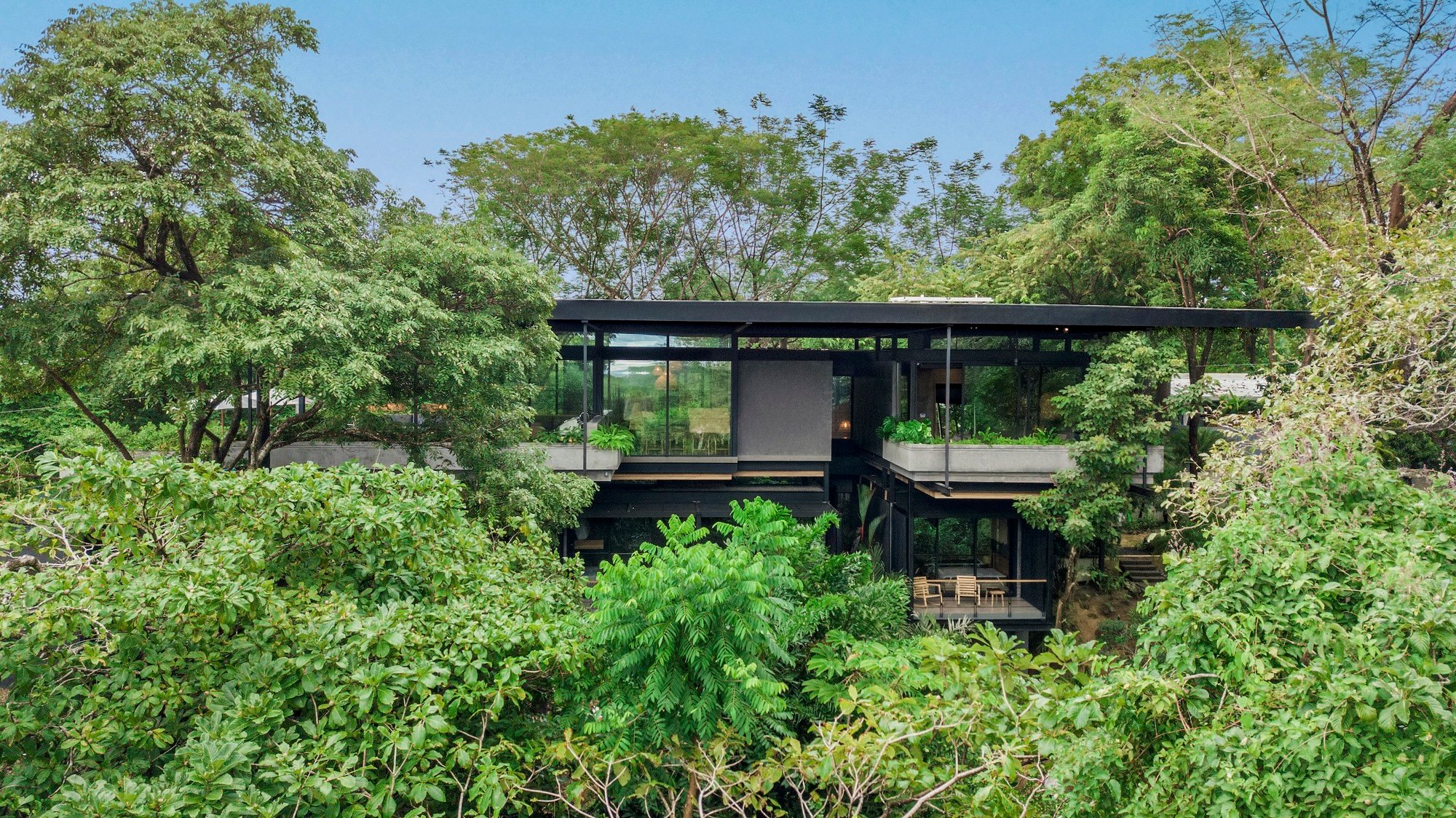
Studio Saxe Cantilevers a Seismic-Proof Jungle House Over the Costa Rican Canopy
Raintree House in Nosara perches on a forested hilltop, merging prefabricated steel structure with local craft and bioclimatic logic.

Nosara sits on the Nicoya Peninsula, a strip of Costa Rica where the Pacific meets a thick, humid wall of tropical forest. Building here means negotiating with the jungle on its own terms: heat, rain, seismic risk, and the sheer biological density of a landscape that will reclaim any structure that doesn't respect it. Studio Saxe, led by Benjamin G. Saxe, has spent years developing a design language that treats these conditions as assets rather than obstacles, and Raintree House is among the firmest expressions of that philosophy.
What makes this 750 m² residence worth studying is the clarity of its structural idea. A heavy concrete foundation, placed asymmetrically on the crest of a forested hill, anchors a system of prefabricated steel elements that cantilever outward over the slope. The house floats above the jungle, touching it lightly while borrowing industrial construction logic to resist the seismic forces that define the region. Every tree on the site was preserved, and the plan wraps around their trunks and root zones rather than clearing space. The result is a house that looks as though the forest grew around it, not the other way around.
Anchored to the Hill, Extended Over the Canopy
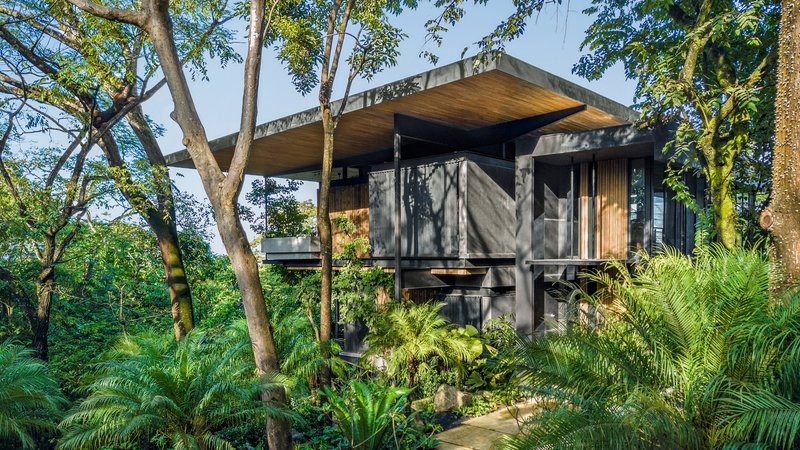
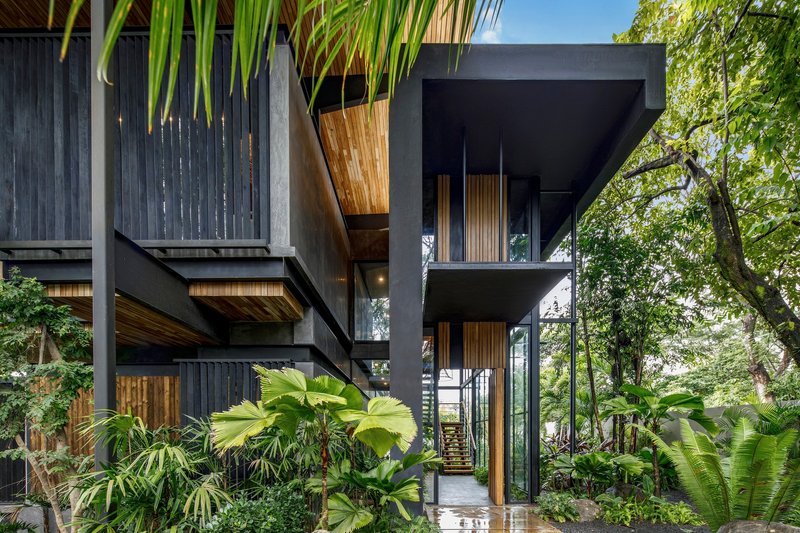
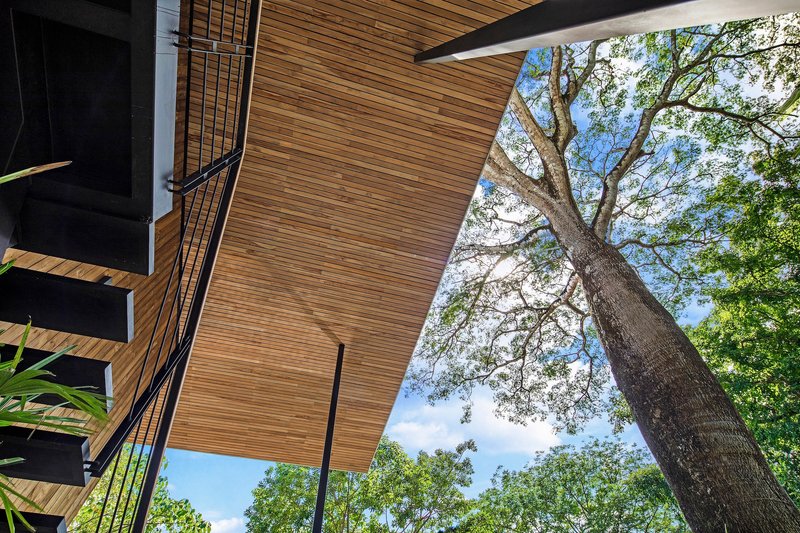
The structural move is legible from every angle. Black steel frames rise from the concrete base and project outward, creating cantilevered decks and living volumes that hover among the treetops. The Kebony wood cladding, a sustainably sourced timber used for both the exterior facades and second-floor siding, softens the industrial skeleton with a warm, textured surface. Timber soffits extend past leaning tree trunks, and the way the house negotiates around existing vegetation is not ornamental: it's the generative logic of the plan.
The seismic-proof design borrows from industrial construction methods, using prefabricated steel elements for speed, precision, and structural resilience. This is pragmatic architecture dressed in natural materials, not the other way around. The combination of ancient local techniques with modern fabrication, guided by builder Prodeyco and structural engineers Guidi Estructurales, produces a house that is both technically sophisticated and visually rooted.
A Roof as Umbrella
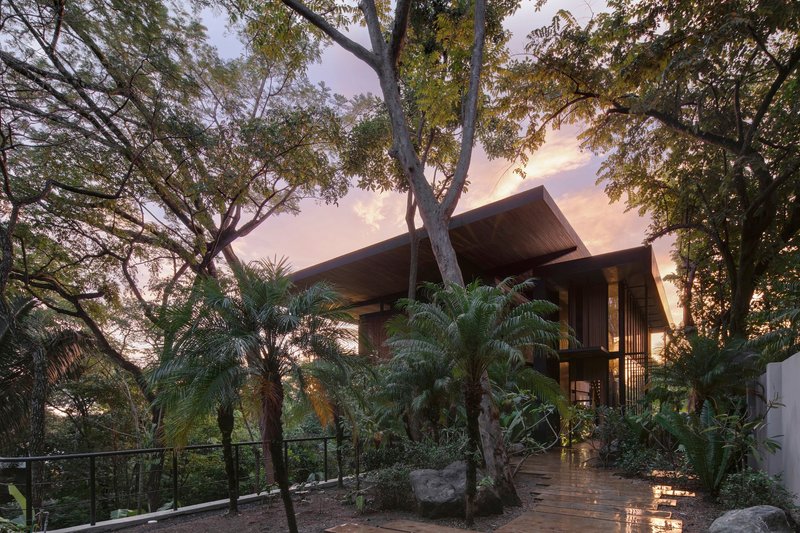
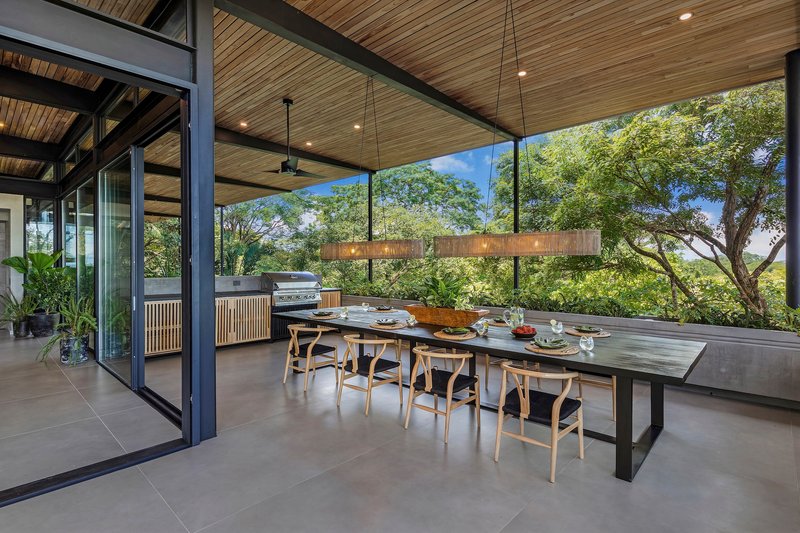
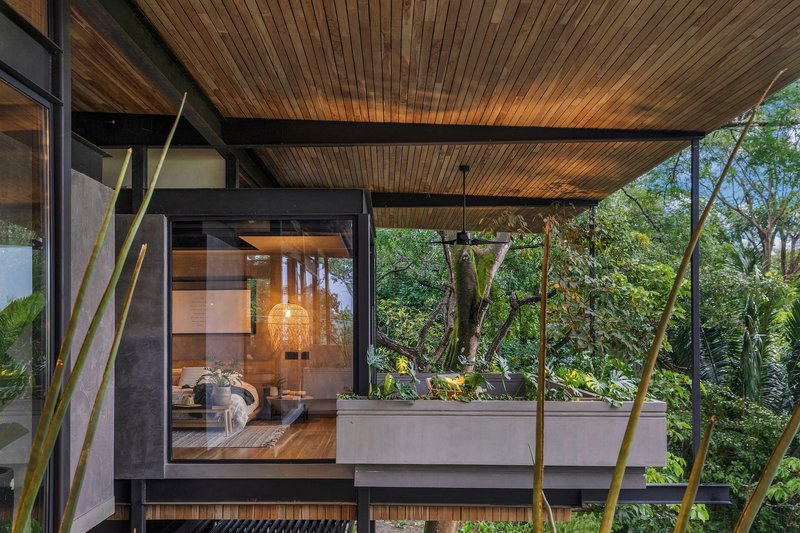
The most important architectural element in a tropical house is the roof, and Raintree House treats it accordingly. A dramatically extended overhang acts as an umbrella for the entire living space, shielding interiors from direct sun and driving rain while allowing cross-ventilation to flow uninterrupted through open walls and slatted screens. The deep soffit, lined in timber, creates a compression zone at the threshold before the eye is released to the canopy and ocean beyond.
Rainwater isn't shed and forgotten. The roof structure channels runoff into catchment areas for recycling into irrigation and household reuse. Combined with solar panels that generate part of the home's energy, the bioclimatic strategy here is not performative: it's systematic, working with the site's abundant rainfall and solar exposure rather than fighting them.
Living Among the Trees
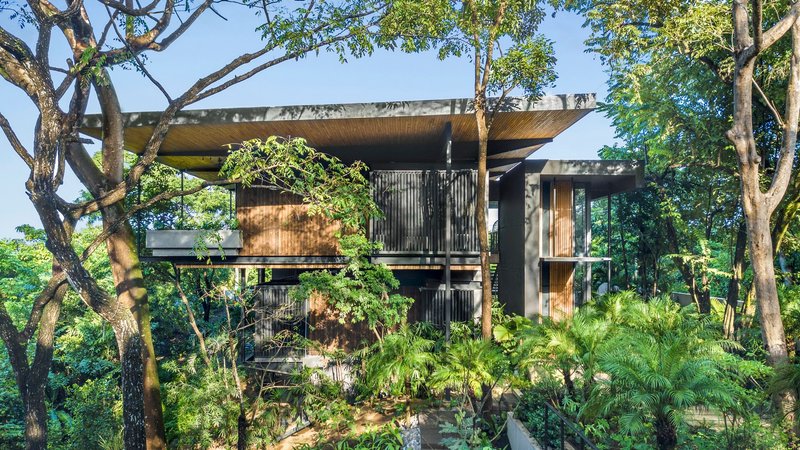
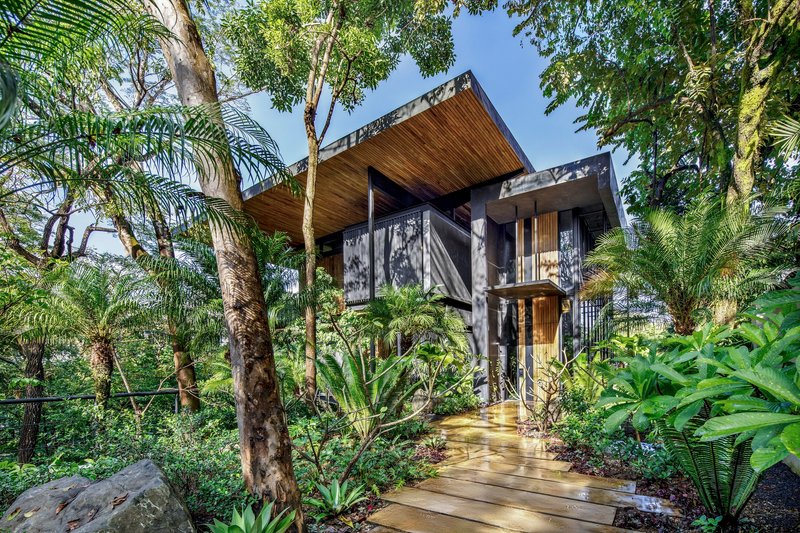
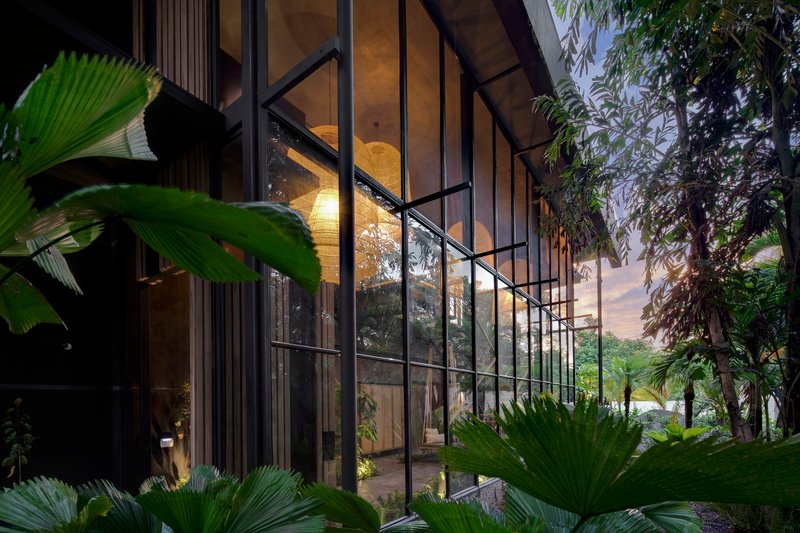
Approaching Raintree House along a timber boardwalk that threads through palms and dense tropical foliage, you understand immediately that the landscape is not decoration applied after the fact. GreenGo handled landscape design, and the result is a seamless gradient from wild jungle to cultivated planting to interior courtyard. Concrete planter boxes hold vegetation right up against the glass enclosure, collapsing the boundary between built and natural.
At dusk, the glass curtain walls glow from within, framed by palms, and the house reads as a lantern set into the hillside. The clients wanted a home that felt as though it had always been there, authentic to the landscape. That intention is visible in the refusal to clear trees, in the way roots and trunks become compositional elements rather than obstacles.
Interior Spaces: Craft and Openness
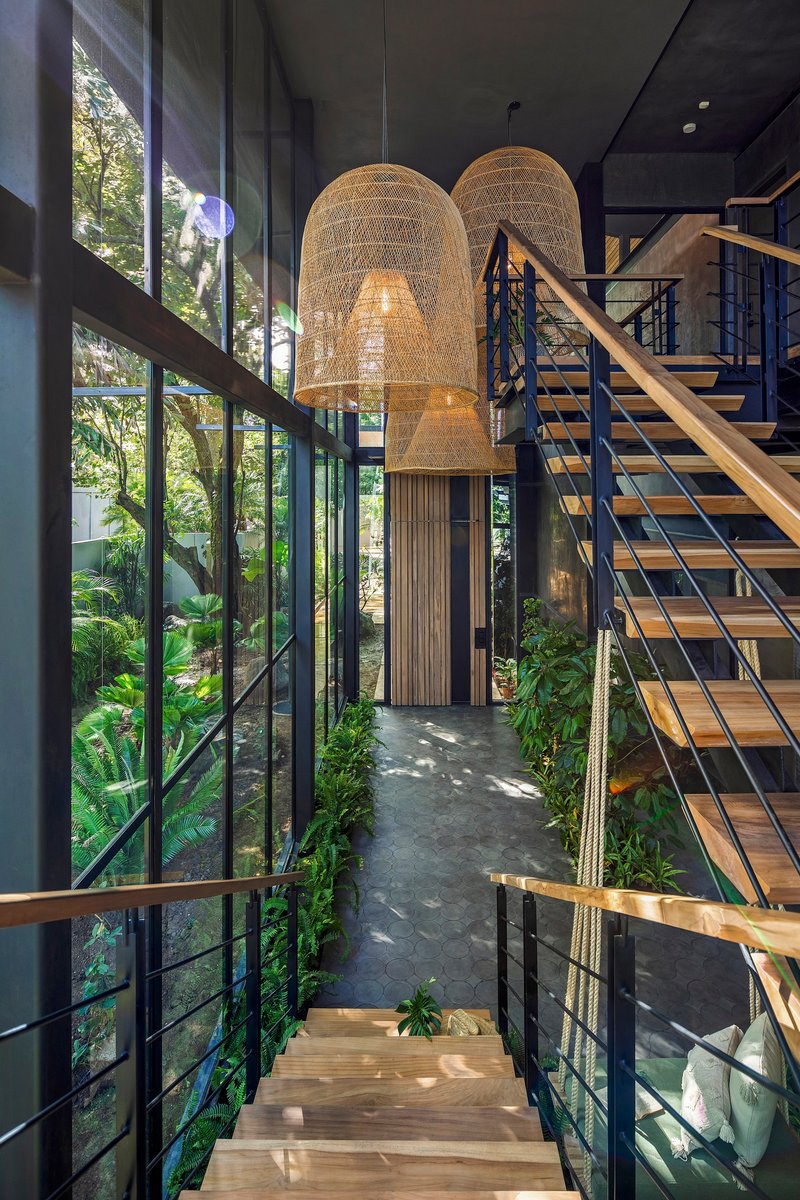
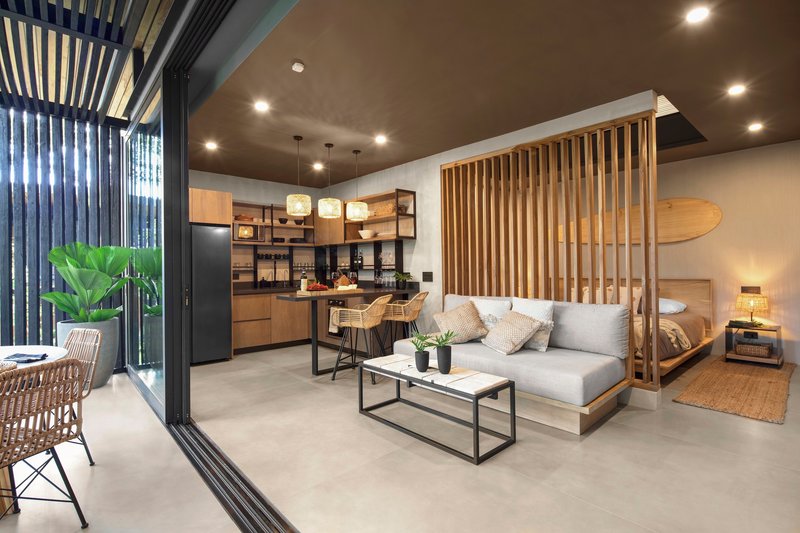
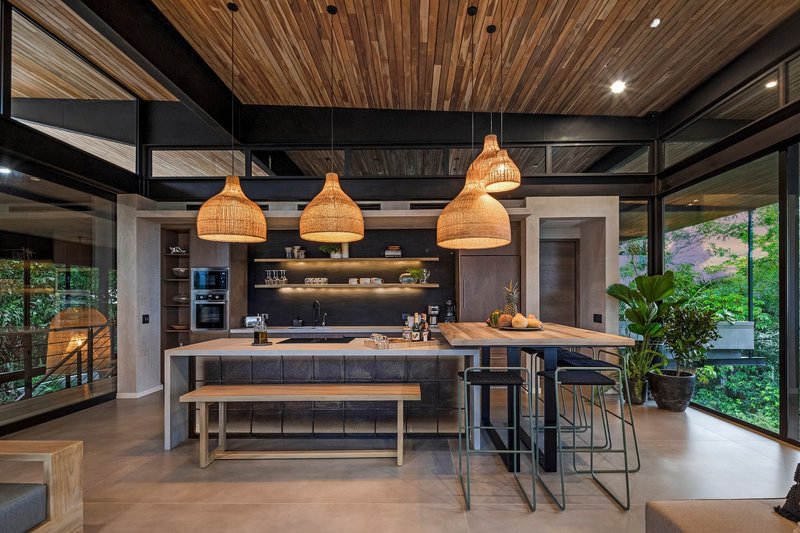
Interior design, handled by Saxe Interiors, draws from a palette of burnt wood, teak, hand-made hydraulic tiles, and woven lamps. The double-height entry hall with its metal staircase and woven pendant lights sets the tone: spaces are generous in volume, specific in material, and always oriented toward a view of the planted courtyard or the canopy beyond. A vertical timber screen divides the open-plan living area from the kitchen and bedroom zones, offering visual separation without blocking airflow.
The kitchen island, cast in concrete, anchors one end of the main pavilion beneath a slatted timber ceiling. Every surface is tactile. The material logic is consistent: rough where the house meets the ground, refined where it meets the body, transparent where it meets the landscape.
Private Rooms and the Swing Beneath the Stairs
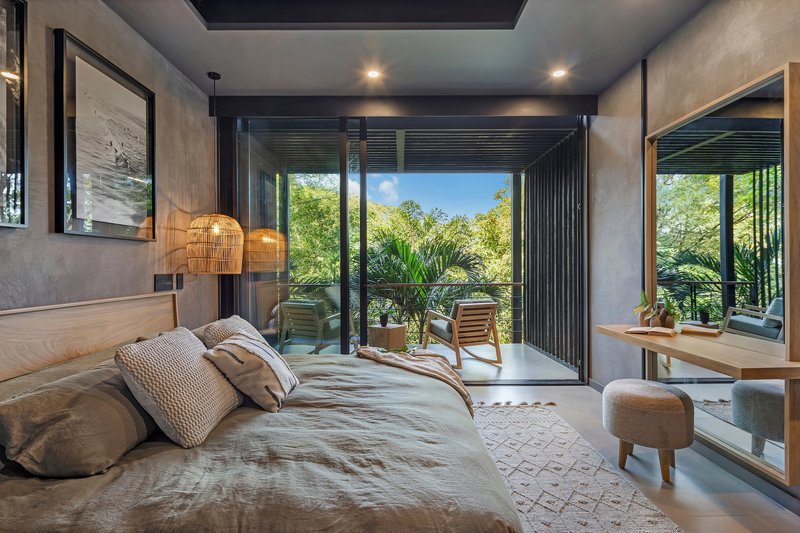
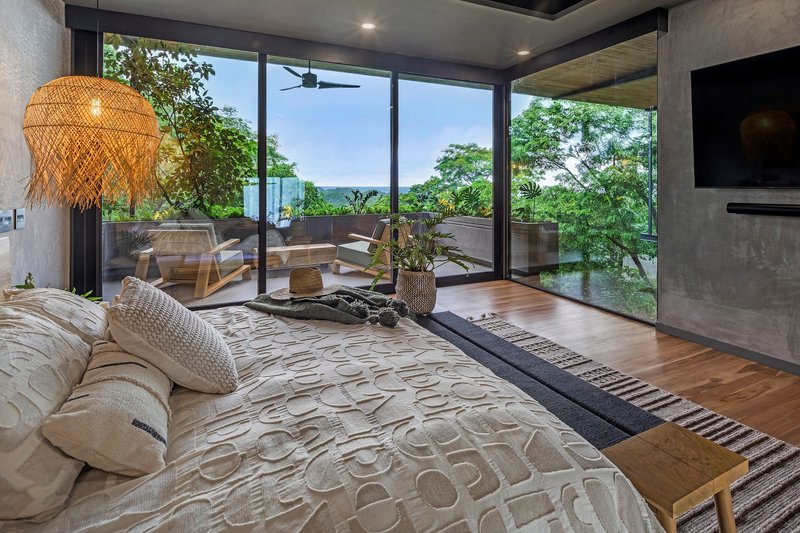
The spatial organization stacks social life on top and retreat below. Main living areas and the master bedroom occupy the second floor, where the canopy opens to ocean views. The ground floor holds three bedrooms, a small seating area, and a lounge, all tucked into the hillside with more intimate relationships to the surrounding ferns and undergrowth. Bedrooms open through floor-to-ceiling glazing onto private balconies framed by foliage, so the first thing you see on waking is not sky but green.
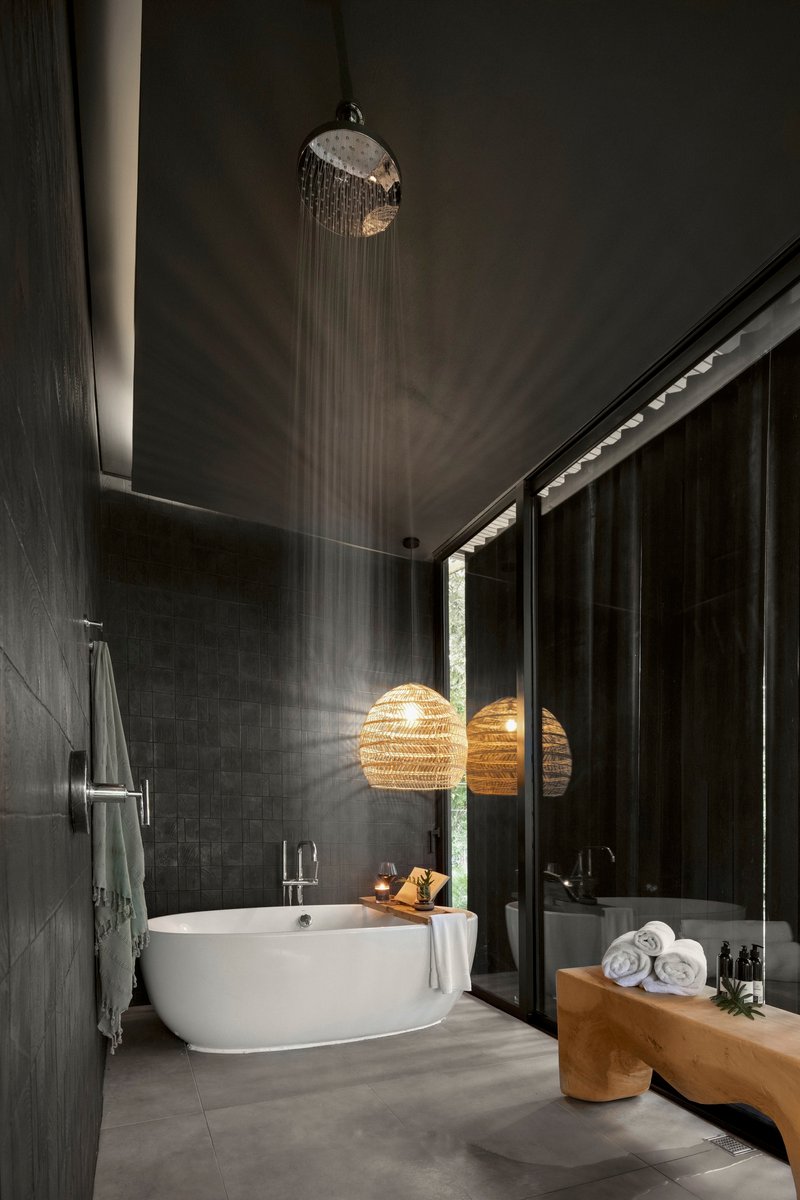
A dark-tiled bathroom with a freestanding tub beneath a rainfall showerhead and woven pendant light demonstrates the same attention to atmosphere found in the public rooms. And then there's the rope-suspended swing beneath an open-tread steel and timber staircase, a playful gesture that signals this is a house designed for living, not just looking at.
The Pool as Horizon Line
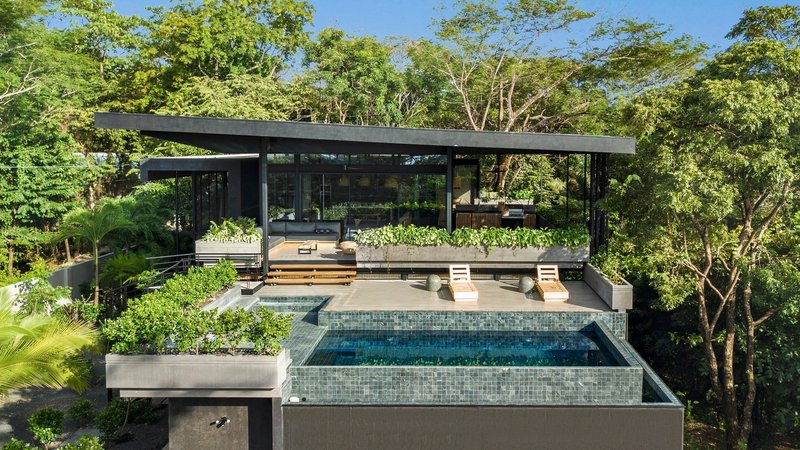
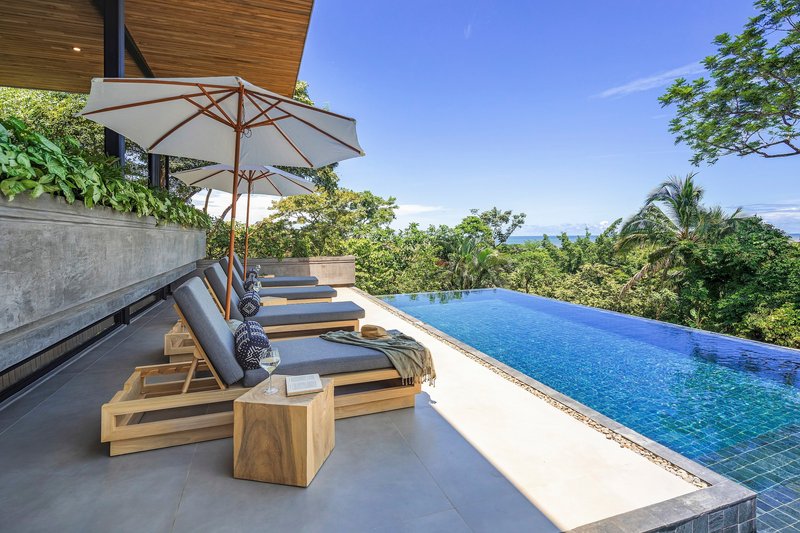
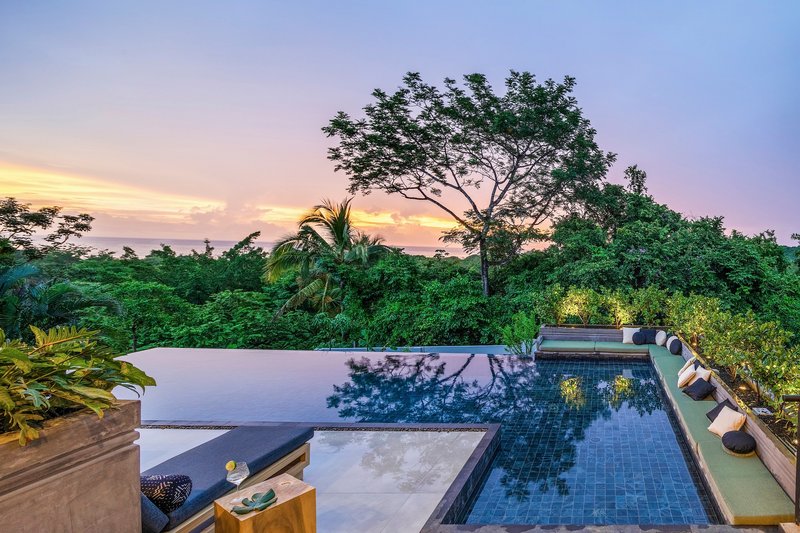
Designed by the Bio-Tile Group team and finished in Indonesian volcanic lava stone and Indian Silver Grey stone tile, the tiered infinity pool is positioned to dissolve the boundary between water, canopy, and ocean. At dusk, the pool deck with its dark tile mosaic becomes the social heart of the house, with lounge seating oriented toward the forested hills and the Pacific horizon beyond.
The decision to use volcanic stone for the pool finish is characteristically deliberate: the dark surface absorbs heat, blends visually with the surrounding foliage, and avoids the glare of a conventional light-tiled pool. It's a detail that reinforces the house's broader argument, that luxury in the tropics is not about contrast with nature but immersion in it.
Thresholds and Courtyards
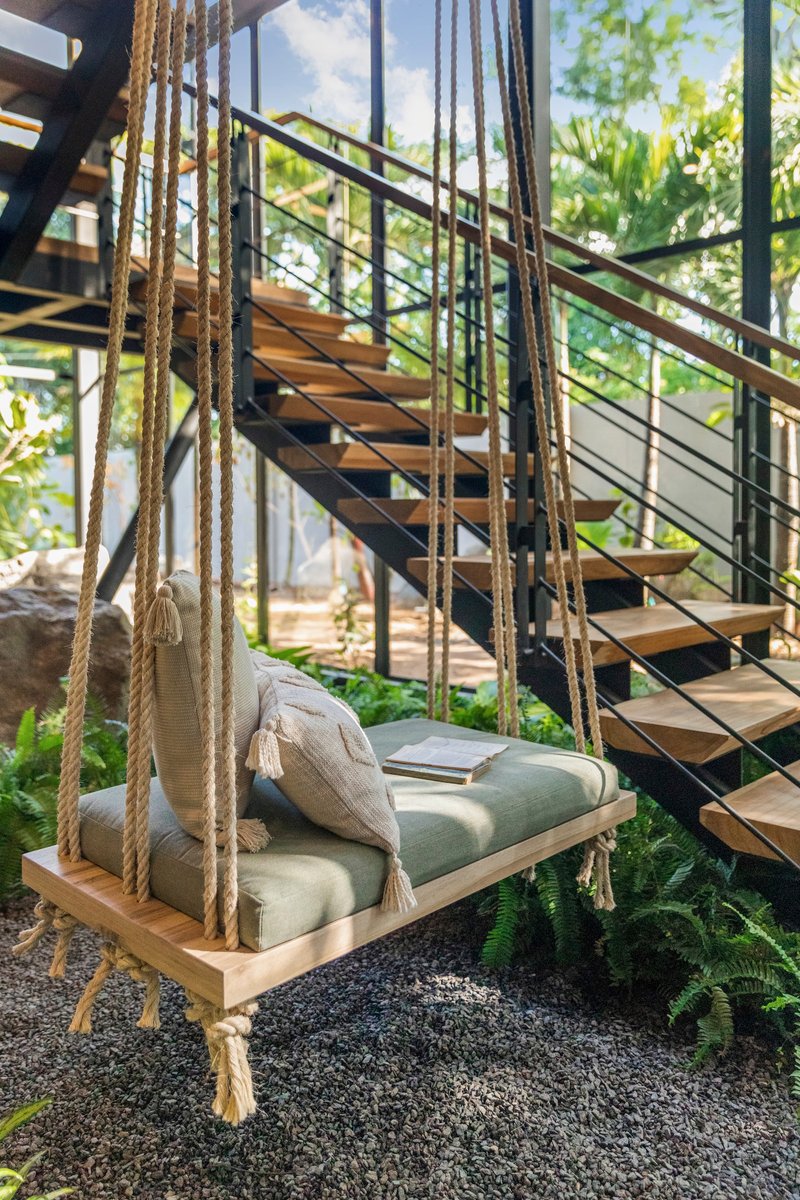
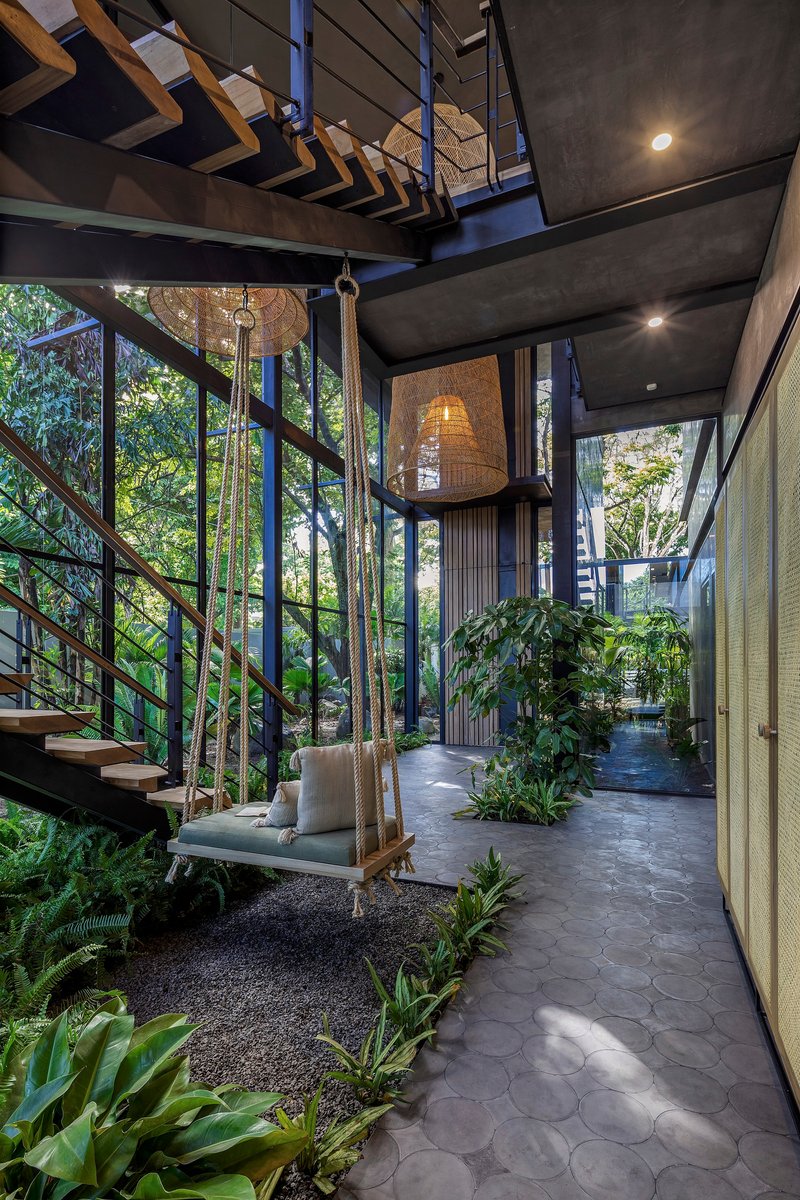
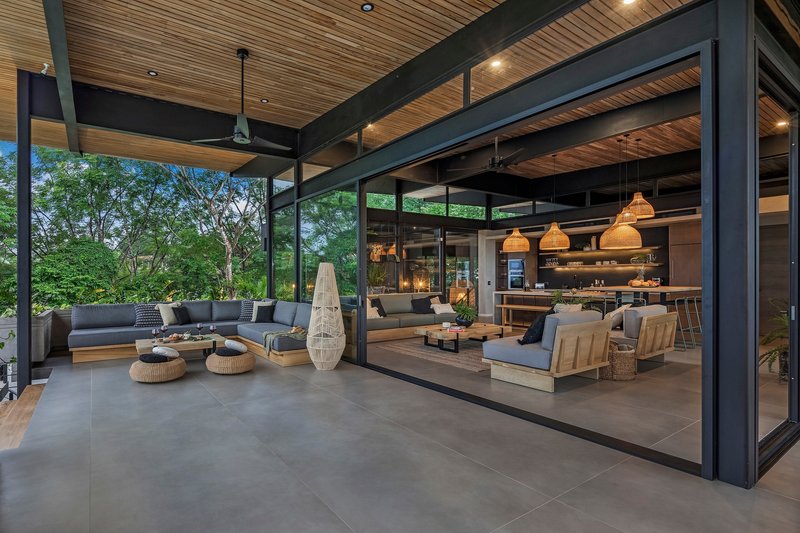
The semi-outdoor stairwell at the entrance, light wooden treads on a black metal frame, establishes the principle of threshold that governs the entire house. You are never fully inside. Courtyards with slate paving, hanging swing seats, and floor-to-ceiling glazing filter daylight through layers of vegetation. Covered terraces with steel frames open to both the living spaces and the garden, creating a spatial continuity where the distinction between room and terrace is largely irrelevant.
The house was designed to function as both the clients' home and a rental property, and this layering of semi-public and private zones makes sense in that context. Guests can occupy the common areas and pool without intruding on bedrooms; residents can retreat downhill without losing connection to the social spaces above.
Facade and Context
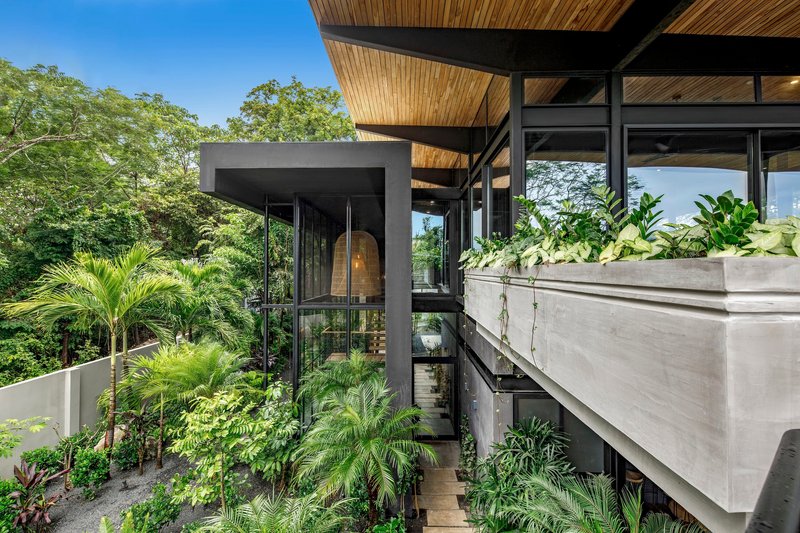
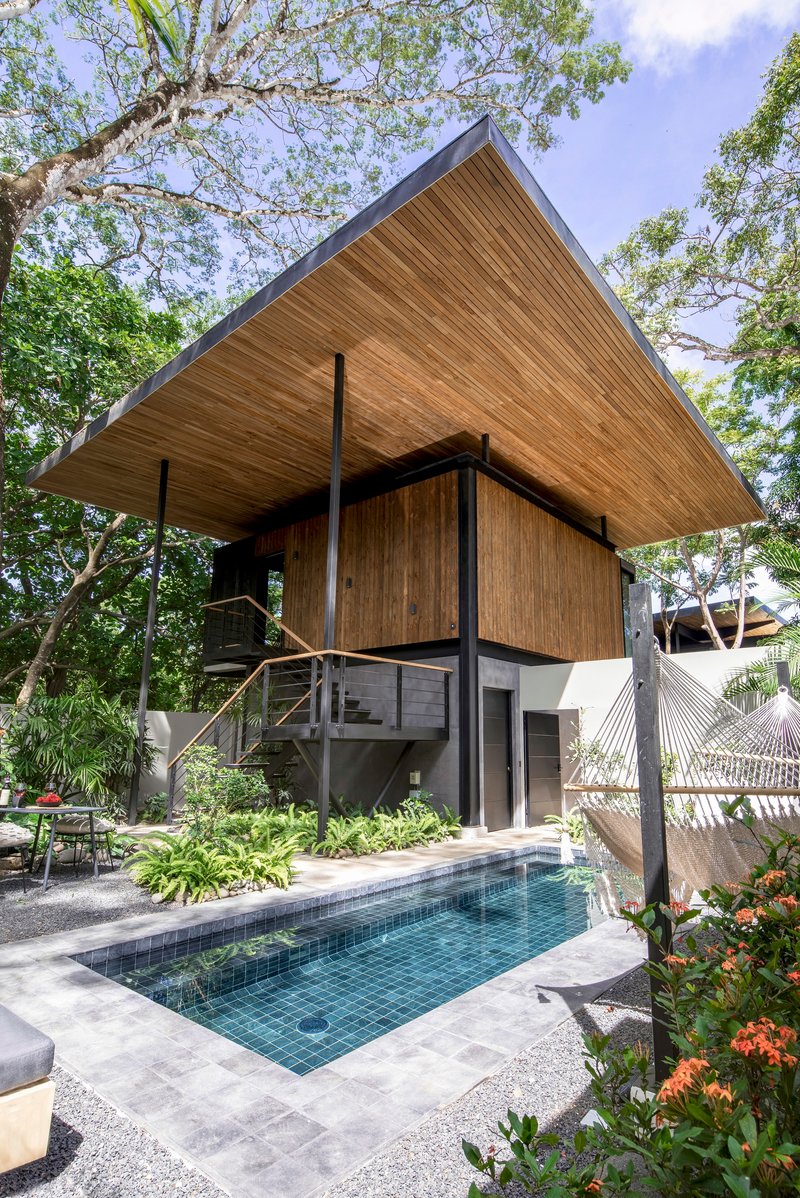
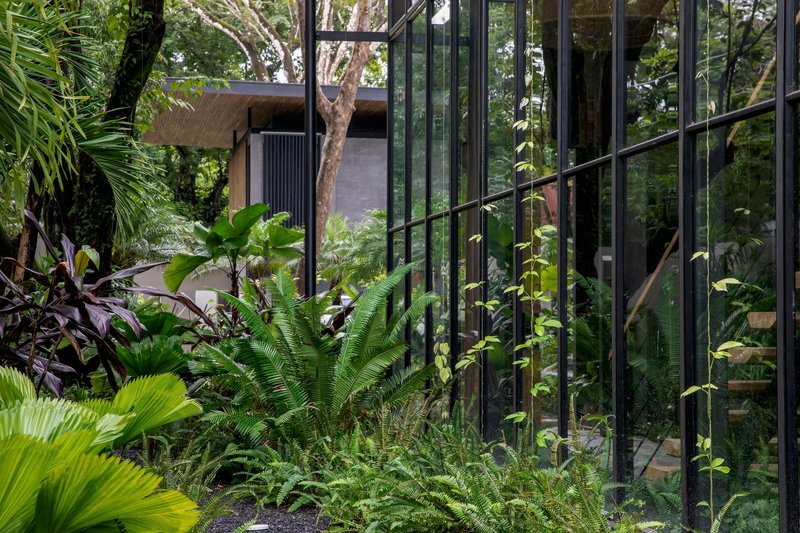
From the pool deck, the cantilevered timber-clad volume with its gabled soffit and steel columns reads as a clean, almost utilitarian object. But the building is not a single gesture. It's a cluster of volumes, stacked and offset, each responding to a different tree, a different view, a different breeze. Concrete planter boxes with vegetation sit beside timber-lined soffits, and glass enclosures are framed by ferns and tropical palms. The material palette, Kebony wood, black steel, concrete, is restrained enough to let the jungle do the decorating.
Plans and Drawings
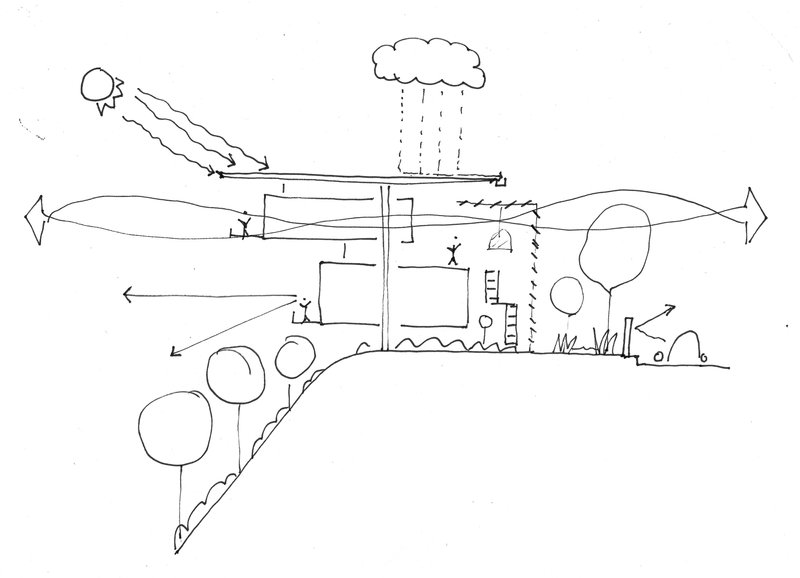
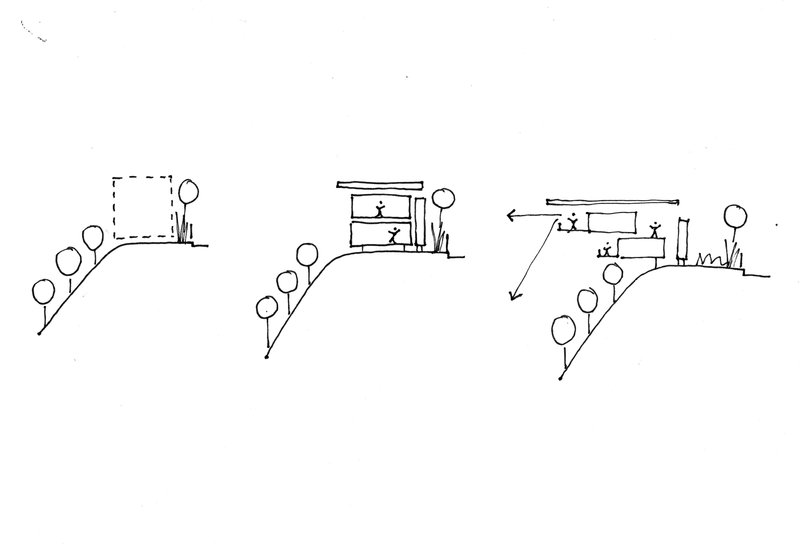
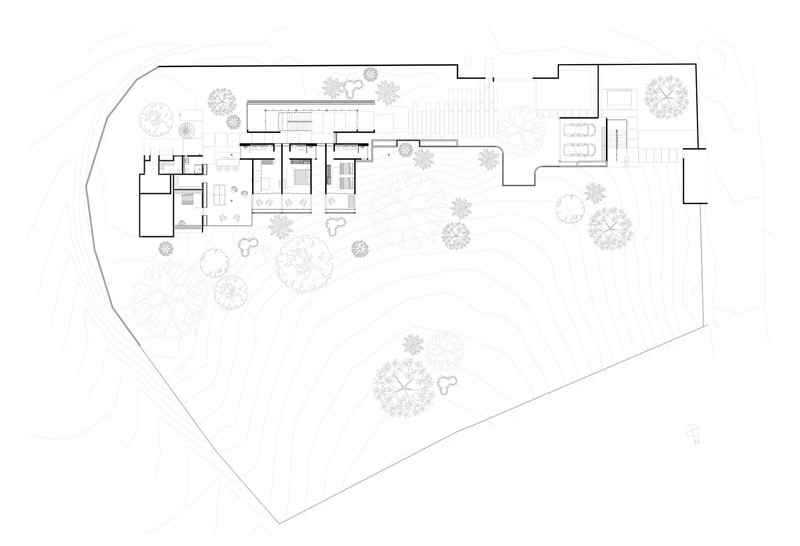
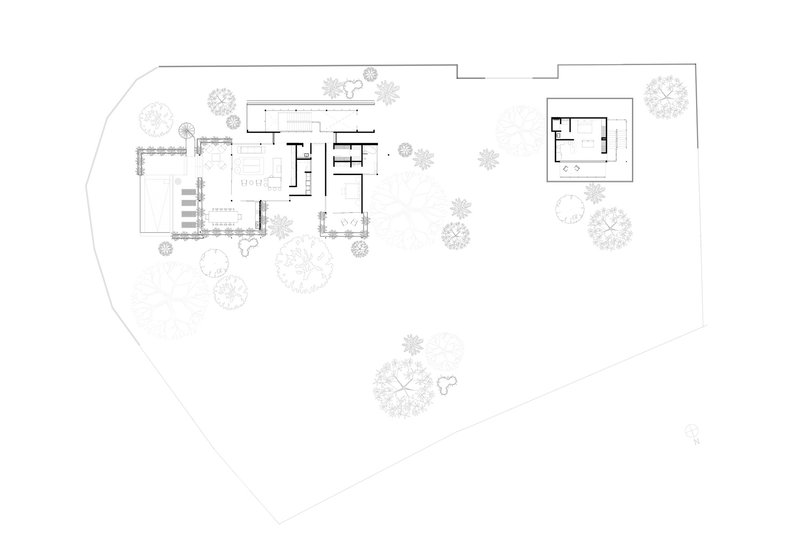
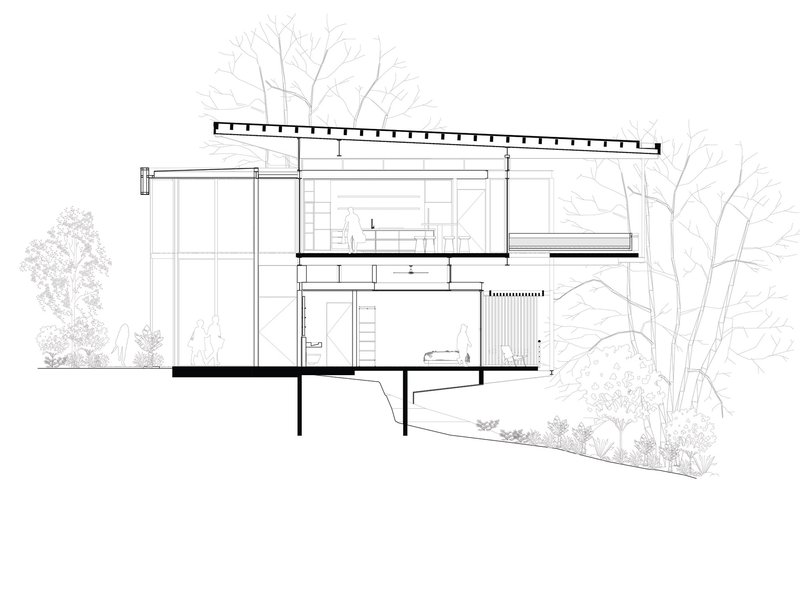
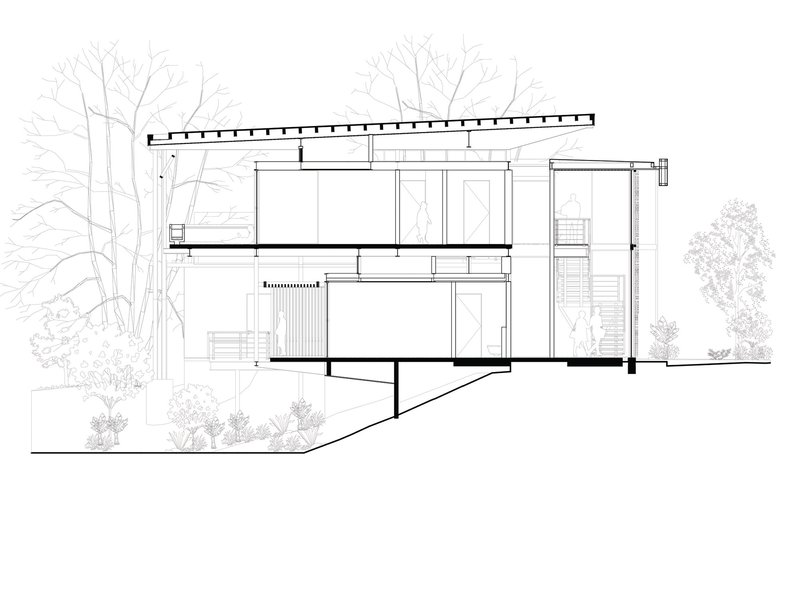
The section sketches reveal the bioclimatic logic most clearly: arrows indicating airflow paths show how the extended roof and open walls create a passive cooling engine, while rain collection diagrams trace the path of water from roof to catchment to reuse. The site plan shows the clustered pavilion arrangement on an irregular lot, with scattered tree canopies dictating the building footprint. Floor plans confirm the split between the main living pavilion and a detached guest structure, connected by landscape. The two section drawings, taken from opposite elevations, show the piloti foundation anchoring the house to the hillside while cantilevered volumes project outward and vertical circulation stitches the split levels together.
Why This Project Matters
Tropical residential architecture is flooded with projects that claim to blur the boundary between inside and outside. Most of them achieve this by simply removing walls and hoping for the best. Raintree House is more disciplined than that. The structural system, the roof strategy, the water management, the preservation of every tree on site: these are decisions that cost more in design time and coordination than clearing the lot and pouring a slab. The house earns its lightness through engineering, not aesthetics.
Studio Saxe has built a body of work in Costa Rica that treats the jungle not as a backdrop but as a collaborator with its own demands and rewards. Raintree House represents a mature version of that practice, where the seismic-proof steel frame, the bioclimatic roof, and the handmade hydraulic tiles are all part of the same argument. Building responsibly in a tropical forest doesn't require sacrificing ambition. It requires directing ambition toward the right problems.
Raintree House, designed by Studio Saxe (Design Director: Benjamin G. Saxe; Interior Design: Saxe Interiors), Nosara, Guanacaste, Costa Rica. 750 m². Completed 2022. Landscape Design: GreenGo. Structural Engineering: Guidi Estructurales. Electromechanical Engineering: Dynamo. Builder: Prodeyco. Photography by Kirsten Ellis Interior.
About the Studio
Share Your Own Work on uni.xyz
If projects like this are the kind of work you want to make, uni.xyz is a place to publish your own, find collaborators, and enter design competitions.




Popular Articles
Popular articles from the community

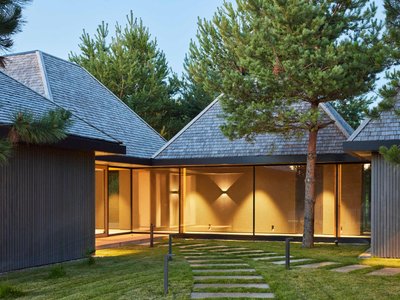
HEIMA Architects Scatters Four Oak-Shingled Pavilions Among the Pines of Northern Lithuania
A 150-square-meter guest house on a Lithuanian hilltop splits into four volumes to preserve every tree on the site.
a2o architecten Builds a Concrete and Brick Wunderkammer in the Belgian Countryside
House Be in Flanders treats dwelling as a Romantic act, threading rooms along a central axis that opens gradually toward a restored landscape.
BHA Studio Wraps a 2,000-Student Campus in Terracotta Screens and Double-Layered Roofs in Central Vietnam
iSchool Quang Tri in Đông Hà uses perforated brick lattices and rainwater harvesting to keep 17,000 square meters cool and green.
Apaloosa Builds a Forest-Edge Retreat from Compacted Earth and Pink Stucco in Chiapas
Villa Luciérnagas in San Cristóbal de las Casas pairs local earth block construction with rainwater systems and solar energy for Airbnb-ready living.

Similar Reads
You might also enjoy these articles

127af Flips a Tiny Bagnolet Rowhouse Upside Down with a Handcrafted Roof Extension
A 55-square-meter terraced house on the edge of Paris gains a luminous upper living floor through lightweight timber and steel.
1.61 Design Workshop Wraps a 600-Square-Meter Café in Vietnam in Sculptural Burgundy Drama
Reden Café & Bistro pairs a helical staircase, mosaic floors, and deep red interiors to rethink Vietnamese hospitality space.

The Unbound Brain: A School Shaped by Cognitive Architecture
Cylindrical learning pods radiate like neurons from a central cortex, turning the floor plan into a spatial model of human thought.
Revival Vernacular Architecture: Rammed Earth Settlements for the Sahara
A modular desert community in Mauritania that fuses passive cooling techniques with earthen construction and local craftsmanship.


Explore Landscape Design Competitions
Discover active competitions in this discipline




The Global Benchmark for Architecture Dissertation Awards


Challenge to design mud housing for contemporary communities
Comments (0)
Please login or sign up to add comments
No comments yet. Be the first to comment!